
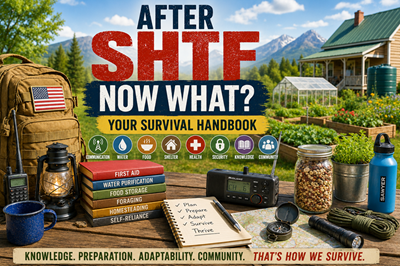
After SHTF – Your Survival Handbook
by Natural Born Prepper (2026-05-15)
TABLE OF CONTENTS
1.1 Why Information Becomes Critical During a Crisis
1.2 The Difference Between Panic and Preparedness
1.3 Why Access to Knowledge Matters
1.4 The Fragility of Modern Digital Dependence
1.5 Information as a Survival Resource
2.1 What Most People Search for First
2.2 Panic-Driven Information Needs
2.3 The Race for Reliable Information
2.4 Common Mistakes During Early Chaos
2.5 How Fast Information Systems Become Overloaded
3.1 Fear, Confusion, and Information Overload
3.2 Why People Freeze
3.3 Herd Behavior and Digital Dependence
3.4 The Psychology of Uncertainty
3.5 Rumors, Misinformation, and Panic
4.1 Communications
4.2 Water
4.3 Food
4.4 Medical
4.5 Security
4.6 Transportation
4.7 Power and Energy
4.8 Financial Access
4.9 Shelter and Survival
PART I — IMMEDIATE SAFETY & INFORMATION
5.1 Emergency Radio Broadcasts
5.2 NOAA Weather Radio
5.3 HAM Radio Operators
5.4 Police and Fire Scanner Traffic
5.5 Community Information Networks
5.6 Offline News Sources
5.7 Battery and Solar Radio Preparedness
6.1 Shortwave Radio Monitoring
6.2 Regional HAM Repeaters
6.3 CB Radio Truck Traffic
6.4 Emergency Broadcast Networks
6.5 Satellite Internet and Communications
6.6 Monitoring Supply Chain Disruptions
6.7 Recognizing Escalating Infrastructure Failure
7.1 Utility Outage Tracking
7.2 Crowd-Sourced Outage Reporting
7.3 Grid Failure Indicators
7.4 Infrastructure Observation Methods
7.5 Utility Radio Traffic
7.6 Printed Infrastructure Maps
7.7 Offline Preparedness Planning
8.1 Verifying Network Failures
8.2 Cell Data vs SMS Failures
8.3 Satellite Communication Systems
8.4 Mesh Networks
8.5 HAM Digital Communications
8.6 Offline Servers and Local Networks
8.7 Portable Offline Libraries
9.1 Emergency Broadcast Systems
9.2 Local Emergency Management Channels
9.3 HAM Emergency Nets
9.4 Siren Systems
9.5 Municipal Alert Networks
9.6 Why Smartphone Alerts Often Fail
10.1 Recognizing Government Emergency Measures
10.2 Curfews and Checkpoints
10.3 National Guard Deployments
10.4 Emergency Government Broadcasts
10.5 Verifying Rumors During Crisis
10.6 Maintaining Situational Awareness
11.1 Transportation Monitoring
11.2 CB Radio Traffic Reports
11.3 Police Scanner Information
11.4 State Transportation Channels
11.5 Mapping Alternate Routes
11.6 Rural and Backroad Planning
12.1 Why Officials Often Don’t Know
12.2 The False Hope of Restoration Timelines
12.3 Adapting to Long-Term Failure
12.4 Resource Tracking and Consumption Planning
12.5 Preparing for Cascading System Failures
13.1 Infrastructure Failure Patterns
13.2 Banking and Communication Disruptions
13.3 Government Announcements
13.4 Distinguishing Rumor from Reality
13.5 Information Verification During Chaos
14.1 Signs of Electromagnetic Pulse Events
14.2 Grid Failure Indicators
14.3 Vehicle and Electronics Failure
14.4 Shortwave and Emergency Monitoring
14.5 Community Observation Networks
15.1 Emergency Information Sources During Conflict
15.2 International Shortwave Broadcasts
15.3 Military Movement Indicators
15.4 Supply Chain Effects of War
15.5 Fuel, Food, and Banking Disruptions
16.1 ATM and Payment Failures
16.2 Banking System Disruptions
16.3 Cash-Only Economies
16.4 Emergency Cash Preparedness
16.5 Offline Financial Records
17.1 How Cellular Networks Actually Work
17.2 Tower Dependencies and Vulnerabilities
17.3 GMRS, CB, and HAM Alternatives
17.4 Satellite Communication Devices
17.5 Community Relay Systems
PART II — FAMILY & COMMUNICATION
18.1 Communication Plans Before Emergencies
18.2 Predetermined Meeting Locations
18.3 Scheduled Check-Ins
18.4 Radio Communication Planning
18.5 Physical Message Drop Systems
18.6 Family Preparedness Coordination
19.1 NOAA Frequencies
19.2 HAM Repeaters
19.3 GMRS and FRS Channels
19.4 CB Emergency Channels
19.5 Marine VHF Systems
19.6 Building Printed Frequency Guides
20.1 How Satellite Systems Work
20.2 Limitations During Large Crises
20.3 Garmin inReach
20.4 Starlink
20.5 Bivy Stick
20.6 HAM HF Communications
21.1 Briar
21.2 Meshtastic
21.3 Bridgefy
21.4 GoTenna
21.5 Local Wi-Fi Mesh Networks
21.6 Limitations of Offline Apps
PART III — FOOD & WATER
22.1 Refrigerator and Freezer Timelines
22.2 Food Safety Rules
22.3 Extending Cold Storage
22.4 Printed Food Safety Charts
22.5 USDA Emergency Guidelines
23.1 Boiling Water Safely
23.2 Filtration Systems
23.3 Chlorine and Iodine Treatment
23.4 UV Water Purification
23.5 Emergency Water Storage
23.6 Municipal Water Risks
24.1 Early Warning Signs
24.2 Empty Shelves and Panic Buying
24.3 Fuel and Transportation Disruptions
24.4 Trucker CB Intelligence
24.5 Monitoring Local Supply Systems
25.1 Smoking Meat
25.2 Salting and Curing
25.3 Pressure Canning
25.4 Dehydration
25.5 Cold Storage Methods
25.6 Food Preservation as a Skillset
PART IV — MEDICAL PREPAREDNESS
26.1 Prescription Dependency
26.2 Emergency Medication Reserves
26.3 Community Medical Networks
26.4 Herbal Alternatives
26.5 Insulin and Refrigeration Challenges
27.1 Responsible Antibiotic Preparedness
27.2 Legitimate Medical Kits
27.3 Physician Consultation
27.4 Printed Medical References
27.5 Medical Supply Checklists
28.1 Burns and Cuts
28.2 Trauma Response
28.3 Printed First Aid Guides
28.4 Red Cross Resources
28.5 Offline Medical Libraries
28.6 Why Knowledge Matters More Than Gear
PART V — TRANSPORTATION & FUEL
29.1 Fuel Infrastructure Dependencies
29.2 Generator-Powered Stations
29.3 Truck Stops and Rural Fuel Sources
29.4 CB Radio Fuel Intelligence
29.5 Fuel Storage Preparedness
30.1 Police Scanner Monitoring
30.2 HAM and CB Traffic
30.3 Physical Scouting
30.4 Alternate Route Planning
30.5 Rural Bypass Strategies
30.6 Movement During Civil Instability
PART VI — THE PREPPER MINDSET
31.1 Situational Assessment vs Panic
31.2 Infrastructure Monitoring
31.3 Supply Chain Awareness
31.4 Strategic Thinking During Crisis
31.5 Long-Term Adaptation
32.1 From Information to Survival
32.2 The Collapse of Convenience
32.3 Psychological Fatigue
32.4 Resource Management
32.5 Community Dependence
33.1 The Fragility of the Internet
33.2 Cloud Dependence Risks
33.3 Why Search Engines Cannot Be Trusted During Crisis
33.4 Information Bottlenecks
33.5 Decentralized Communication
34.1 Offline Libraries
34.2 Printed References
34.3 Portable Information Systems
34.4 Redundancy Planning
34.5 Knowledge Preservation
35.1 What Information to Store
35.2 Multiple Backup Methods
35.3 USB Drives and External Storage
35.4 Paper Backup Systems
35.5 Testing Offline Preparedness
36.1 Water Purification Guides
36.2 Medical References
36.3 Emergency Communications
36.4 Maps and Navigation
36.5 Food Preservation
36.6 Survival Checklists
36.7 Local Resource Information
PART VII — COMMUNITY & LONG-TERM RESILIENCE
37.1 Why Lone Wolf Survival Is Limited
37.2 Building Local Networks
37.3 Shared Skills and Resources
37.4 Community Security
37.5 Mutual Assistance Groups
38.1 Over-Reliance on the Internet
38.2 Waiting Too Long
38.3 Focusing Only on Gear
38.4 Ignoring Skills and Knowledge
38.5 Lack of Redundancy
39.1 Increasing Digital Dependence
39.2 AI and Cloud Vulnerabilities
39.3 Information Access as a Survival Issue
39.4 Preparedness Beyond Supplies
39.5 Building Long-Term Resilience
39.6 Using AI in Your Preparedness
40.1 Access = Control
40.2 Preparedness Is More Than Gear
40.3 Knowledge as a Survival Tool
40.4 Building Resilience Before It’s Needed
40.5 The Importance of Adaptability
© Prepping Communities. This content is for informational purposes only and not professional advice. Use at your own risk.
Terms | Privacy | Guidelines