
1. Foundations of Livestock Homesteading
1.1. Introduction to Livestock Homesteading
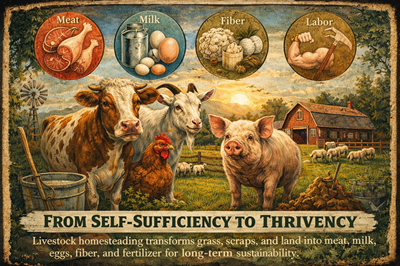 Livestock homesteading is one of the most powerful steps toward true self-sufficiency. While gardening provides plant-based calories, livestock fills the critical gaps—protein, fat, fertilizer, labor, and long-term sustainability. A homestead without livestock can survive. A homestead with livestock can thrive.
At its core, raising livestock is about converting resources you already have—grass, scraps, land—into usable outputs like meat, milk, eggs, fiber, and manure. This conversion process is what separates livestock from stored food. Stored food runs out. Livestock reproduces, regenerates, and continues producing.
For preppers, livestock represents renewable food security. In a long-term disruption, supply chains collapse, grocery stores empty, and stored food becomes finite. But a well-managed livestock system continues producing indefinitely, assuming you can maintain feed, water, and basic care.
However, livestock is not passive. It requires daily attention, planning, and a willingness to deal with reality—birth, death, illness, weather, and responsibility. This section lays the groundwork so you don’t walk into it blind.
1.2. Benefits of Raising Livestock
 The benefits go far beyond food production.
First, livestock provides nutrient-dense food that is difficult to replace through crops alone. Eggs, milk, and meat contain essential fats and proteins that are critical for long-term health, especially in physically demanding environments.
Second, livestock creates closed-loop systems. Manure fertilizes soil. Animals clear brush. Chickens reduce pests. Pigs turn waste into protein. Instead of relying on external inputs, your homestead begins to sustain itself.
Third, livestock offers barter value. In a grid-down or economic collapse scenario, eggs, milk, breeding stock, and meat become high-value trade goods. A laying hen is not just food—it’s a renewable asset.
Fourth, livestock contributes to security and resilience. Animals provide early warning systems (noise, movement detection), and some—like guardian dogs—actively protect your property.
Finally, livestock builds skill independence. You learn animal care, breeding, processing, and problem-solving. These are not theoretical skills—they are practical, real-world capabilities that hold value in any environment.
1.3. Matching Livestock to Your Goals
 Not all livestock serves the same purpose. One of the biggest mistakes beginners make is choosing animals based on popularity rather than purpose.
You need to define your goal first:
If your goal is quick protein, chickens and rabbits are ideal. They reproduce quickly, require minimal space, and provide fast returns.
If your goal is long-term sustainability, goats and sheep are strong options. They provide milk, meat, and fiber while thriving on marginal land.
If your goal is maximum calorie production, pigs and cattle become more attractive—but they require significantly more resources.
If your goal is low-maintenance systems, poultry again rises to the top.
Each animal comes with trade-offs:
- Chickens = easy, but vulnerable
- Goats = productive, but destructive
- Cattle = high output, but high cost
- Rabbits = efficient, but require consistent care
The right choice is not “best”—it’s what fits your land, time, and long-term plan.
1.4. Assessing Your Land and Resources
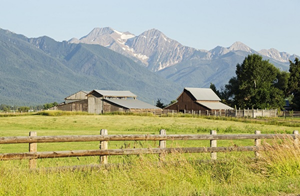 Before you bring in animals, your land needs to answer some hard questions.
How much usable space do you actually have? Not total acreage—usable acreage. Rocky land, steep slopes, or dense forest may limit what you can support.
What is your water situation? Livestock requires consistent water access. In a grid-down scenario, this becomes one of your biggest vulnerabilities. If your water system depends on electricity, you need a backup.
What kind of vegetation exists? Grass supports grazing animals. Brush supports goats. Poor soil may limit your options unless you’re prepared to improve it.
What is your climate? Harsh winters increase feed costs and shelter requirements. Hot climates require shade and water management.
What about predators? Coyotes, bears, wolves, raccoons, and even neighborhood dogs can destroy livestock quickly if you’re not prepared.
Your land doesn’t need to be perfect—but it needs to be understood.
1.5. Legal Considerations and Zoning
This is where many people get caught off guard.
Even rural areas often have regulations on:
- Number of animals
- Types of livestock allowed
- Slaughtering practices
- Waste management
- Noise and nuisance complaints
Urban and semi-rural homesteaders face even tighter restrictions.
Ignoring these rules can result in fines, forced removal of animals, or worse.
For preparedness planning, there’s also a second layer:
What happens when regulations stop being enforced?
Smart homesteaders plan for both:
- Operating legally today
- Operating independently tomorrow
1.6. Time, Cost, and Labor Reality
Livestock is not a hobby you can ignore for a few days.
Animals need:
- Daily feeding
- Water checks
- Health monitoring
- Shelter maintenance
There are no “days off.”
Costs also add up quickly:
- Initial setup (fencing, shelters, tools)
- Feed (especially in winter)
- Veterinary care
- Replacement animals
Many beginners underestimate both time and cost, which leads to burnout or failure.
From a prepper perspective, the goal is to:
- Reduce dependency on purchased inputs
- Build systems that are sustainable long-term
1.7. Homestead Planning and Layout Design
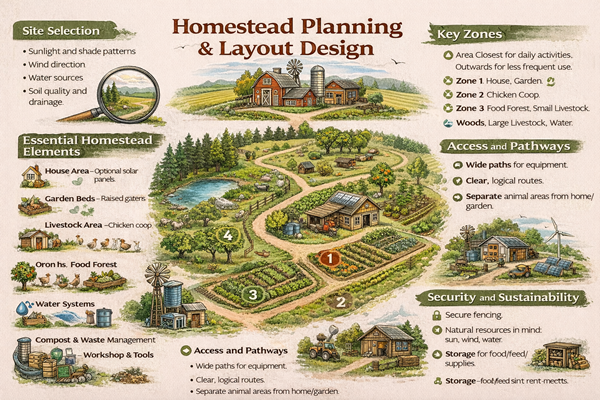 A well-designed homestead saves time, reduces stress, and increases survival odds.
Key principles:
Keep animals close enough for daily care
If feeding becomes inconvenient, it will eventually be neglected.
Separate species when needed
Different animals have different needs. Mixing them without planning creates problems.
Plan for manure flow
Waste should become fertilizer—not a problem.
Design for expansion
Start small, but leave room to grow.
Think defensively
Predator-proofing, visibility, and control matter.
Water access is central
Everything revolves around water.
A good layout isn’t just efficient—it’s resilient.
1.8 Summary
This foundation section is about one thing: thinking before acting.
Livestock is not just about animals—it’s about systems.
Systems that:
- Produce food
- Sustain themselves
- Survive disruption
If you get the foundation right, everything else becomes easier.
If you skip it, problems compound fast.
2. Getting Started with Livestock
2.1 Choosing the Right Species for Beginners
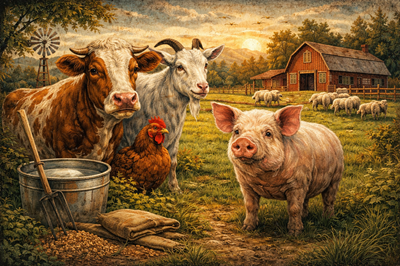 Starting with livestock is where most homesteaders either build momentum—or create problems that follow them for years. The choice of species is not just about preference; it’s about stacking the odds in your favor early.
For beginners, simplicity and resilience matter more than production volume. Animals that are forgiving, adaptable, and low-maintenance allow you to build confidence and systems before scaling up.
Chickens are often the best entry point. They require relatively little space, are easy to manage, and provide a steady supply of eggs. Their fast reproduction cycle and low feed requirements make them ideal for learning daily care routines.
Rabbits are another strong option. They are quiet, efficient converters of feed into meat, and can be raised in small spaces. However, they require consistency—missing feedings or neglecting sanitation can lead to rapid losses.
Goats are frequently chosen early but can be deceptive. While hardy and productive, they are known for testing fences, escaping enclosures, and requiring more attention than many expect. They are better suited for beginners who are ready for a learning curve.
Large livestock such as cattle or pigs should generally come later. They demand more infrastructure, more feed, and higher upfront investment. Mistakes with large animals are more expensive and harder to recover from.
The smartest approach is to start with species that:
- Tolerate beginner mistakes
- Require minimal infrastructure
- Produce quickly
- Fit your land and time availability
Your first animals are not your final system—they are your training ground.
2.2 Starting Small vs Scaling Up
There is a natural temptation to go big right away. More animals means more food, more production, more progress—at least in theory.
In practice, starting too large is one of the fastest ways to fail.
Small systems allow you to:
- Learn daily routines
- Identify weaknesses
- Adjust without major losses
For example, managing six chickens teaches you far more than reading about fifty. You learn feeding patterns, predator risks, egg production cycles, and health issues in a controlled environment.
Scaling up should happen only after your system becomes predictable. You should reach a point where daily care feels automatic, not overwhelming.
From a preparedness perspective, small systems are also easier to maintain during disruptions. If your feed supply is interrupted, a small flock is manageable. A large operation can become a liability overnight.
Think in phases:
- Phase 1: Learn
- Phase 2: Stabilize
- Phase 3: Expand
Growth should follow competence—not enthusiasm.
2.3 Sourcing Healthy Animals
Where you get your animals matters as much as what you choose.
Healthy livestock forms the foundation of everything that follows. Starting with weak or diseased animals creates ongoing problems that are difficult to fix later.
Local breeders are often the best source. Animals raised in your region are already adapted to your climate, local feed, and environmental conditions. They are more likely to thrive without constant intervention.
Auctions can offer lower prices, but they carry higher risk. Animals may be stressed, sick, or poorly handled. Without experience, it’s easy to bring home problems.
When selecting animals, look for:
- Bright eyes and alert behavior
- Clean coats or feathers
- Strong movement (no limping or weakness)
- Normal eating and drinking habits
Avoid animals that appear lethargic, underweight, or isolated from the group.
It’s also important to ask questions:
- What are they fed?
- What vaccinations have they received?
- How old are they?
- Have they had health issues?
For preppers, sourcing locally also builds connections. Knowing nearby farmers or breeders can become a critical resource in times of disruption.
2.4 Transporting Livestock Safely
Transport is often overlooked, but it’s one of the most stressful events in an animal’s life.
Stress weakens immune systems and can trigger illness, especially in young or newly purchased animals.
Proper transport starts with preparation. You need appropriate containers or trailers that provide:
- Ventilation
- Protection from weather
- Enough space to prevent crowding
Animals should be secured but not tightly packed. Overcrowding increases stress and risk of injury.
Travel time should be minimized whenever possible. Long trips require planning for water and rest.
Once animals arrive, they should not be immediately mixed with existing livestock. This leads directly into one of the most important practices: quarantine.
2.5 Initial Setup: Shelters, Fencing, and Water Systems
Before animals arrive, your system needs to be ready.
Shelter should provide protection from wind, rain, snow, and extreme heat. It doesn’t need to be complex—but it must be functional. Poor shelter leads to stress, illness, and reduced productivity.
Fencing is not just about keeping animals in—it’s about keeping predators out. Weak fencing is one of the most common failure points in new homesteads.
Different animals require different fencing strategies:
- Chickens need protection from above and below
- Goats test and climb
- Pigs root and push
- Cattle require strength and visibility
Water systems must be reliable. Animals cannot go without water for long, especially in hot conditions. In a preparedness context, you should always ask:
What happens if the power goes out?
Manual backup systems—gravity-fed water, stored reserves, or hand pumps—are essential.
Your setup doesn’t need to be perfect, but it must be dependable.
2.6 Basic Equipment and Tools
A well-equipped homestead reduces effort and increases efficiency.
At minimum, you will need:
- Feed containers
- Waterers
- Cleaning tools
- Basic medical supplies
- Handling equipment
Over time, you will add specialized tools depending on your animals:
- Milking equipment
- Egg collection systems
- Shearing tools
- Processing equipment
The goal is not to buy everything upfront, but to build a system that reduces friction in daily tasks.
From a prepper perspective, prioritize tools that:
- Don’t rely on electricity
- Are durable and repairable
- Serve multiple purposes
Simple tools outperform complex systems when conditions become uncertain.
2.7 Record Keeping and Tracking
This is one of the most overlooked areas—and one of the most important.
Without records, you are guessing. With records, you are improving.
Basic tracking should include:
- Birth dates
- Breeding history
- Health issues
- Feed consumption
- Production (eggs, milk, weight gain)
Over time, patterns emerge. You begin to see which animals perform well, which require more resources, and which should be removed from your system.
In a long-term survival scenario, memory is unreliable. Written records—especially physical ones—become critical.
Good record keeping turns livestock from a chore into a managed system.
2.8 Quarantine and Integration
Bringing new animals into your system without quarantine is a high-risk move.
Even healthy-looking animals can carry parasites or disease. Introducing them directly to your existing livestock can spread problems quickly.
A proper quarantine period is typically 2–4 weeks. During this time, animals are kept separate and monitored for:
- Signs of illness
- Eating and drinking behavior
- Parasite presence
Only after this period should integration begin.
Integration itself should be gradual. Animals establish hierarchies, and sudden mixing can lead to aggression or injury.
From a preparedness standpoint, quarantine is about protecting your entire system. One mistake here can wipe out months or years of work.
2.9 Summary
Getting started with livestock is not about buying animals—it’s about building systems that support them.
Every decision at this stage has long-term consequences:
- Choosing the wrong species creates ongoing challenges
- Scaling too fast leads to failure
- Poor sourcing introduces problems
- Weak infrastructure invites disaster
But when done correctly, this stage sets the foundation for everything that follows.
You move from theory to reality.
From planning to responsibility.
From dependence to production.
3. Housing and Infrastructure
3.1 Shelter Design for Different Species
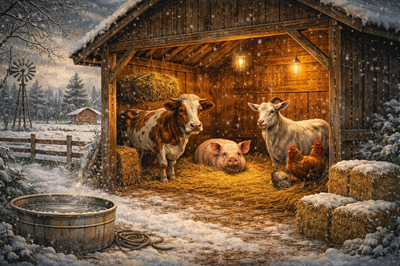 Shelter is one of the most underestimated components of livestock success. Many beginners assume animals are naturally resilient—and while that’s partially true, unmanaged exposure leads to stress, illness, reduced production, and eventually loss.
Good shelter is not about comfort—it’s about protection and consistency.
Different species have different tolerances. Chickens, for example, handle cold better than wet conditions. A dry, draft-free coop is far more important than a heated one. Goats, on the other hand, are extremely sensitive to moisture and require well-ventilated but dry environments. Cattle can tolerate harsh conditions but still need windbreaks and dry resting areas.
The key is understanding that animals don’t need luxury—they need:
- Dry conditions
- Protection from wind
- Shade in heat
- Adequate space
Overbuilding is common and unnecessary. A simple three-sided shelter, properly oriented away from prevailing winds, often performs better than a sealed structure with poor ventilation.
For preppers, shelter design should also consider repairability and independence. If a storm damages your structure, can you fix it with available materials? If not, it becomes a weak point in your system.
3.2 Ventilation, Drainage, and Sanitation
If shelter is about protection, ventilation and drainage are about survival.
Poor ventilation is one of the fastest ways to create disease conditions. Animals produce moisture through breathing, manure, and urine. Without airflow, this moisture builds up, creating a breeding ground for bacteria, mold, and respiratory illness.
Ventilation does not mean drafts. It means controlled airflow—typically higher openings that allow moisture to escape without exposing animals to direct wind.
Drainage is equally critical. Water accumulation leads to mud, and mud leads to:
- Foot infections
- Parasites
- Increased stress
Your shelter and surrounding area should always direct water away from where animals stand and rest. Slight elevation, gravel bases, or sloped ground can make a significant difference.
Sanitation ties everything together. Regular removal of waste, proper bedding management, and keeping feeding areas clean reduce disease pressure dramatically.
In a grid-down scenario, sanitation becomes even more important. Without access to veterinary care or medications, prevention becomes your primary defense.
3.3 Fencing Types and Predator Protection
Fencing is not optional—it is one of the most critical investments you will make.
But fencing is not just about containment. It is about control and protection.
Different animals challenge fencing in different ways:
- Chickens slip through gaps and attract aerial predators
- Goats climb, push, and test boundaries constantly
- Pigs root under fences
- Cattle lean and break weak structures
Choosing the wrong fence type leads to constant repairs and frustration.
Common fencing options include:
- Woven wire (versatile, strong)
- Electric fencing (effective deterrent, low material cost)
- Hardware cloth (essential for small animals and predator protection)
- Barbed wire (primarily for large livestock, less predator-resistant)
Predator protection requires thinking beyond the fence line. Predators attack from:
- Above (hawks, owls)
- Below (digging animals)
- Through (weak points or gaps)
A single vulnerability is all it takes.
From a preparedness standpoint, fencing should be:
- Durable
- Repairable
- Defensible
If your fence fails during a crisis, you don’t just lose animals—you lose food security.
3.4 Rotational Grazing Systems
One of the biggest mistakes in livestock management is leaving animals in the same area continuously.
Overgrazing destroys land. It leads to:
- Soil degradation
- Reduced forage growth
- Increased parasite loads
Rotational grazing solves this by moving animals between sections of land, allowing pastures to recover.
Even on small properties, simple rotation can dramatically improve:
- Grass quality
- Animal health
- Feed efficiency
The concept is straightforward:
- Divide your land into sections
- Move animals regularly
- Allow previously used areas to regrow
This mimics natural grazing patterns and reduces dependency on purchased feed.
For preppers, rotational grazing is critical. It transforms land into a renewable resource rather than something that depletes over time.
3.5 Water Supply and Storage Systems
Water is the single most critical resource for livestock. Without it, everything stops.
Animals require consistent, clean water daily. Even short disruptions can lead to dehydration, reduced production, or death.
Most modern systems rely on:
- Electric pumps
- Automatic waterers
- Municipal or well systems
The problem is obvious—these systems depend on infrastructure.
Prepared homesteaders plan for failure.
Backup options include:
- Gravity-fed systems
- Rainwater collection
- Stored water reserves
- Manual pumps
Water storage should not be an afterthought. You need enough capacity to sustain your animals through:
- Power outages
- Equipment failure
- Drought conditions
A simple rule: if your water system depends on electricity, you don’t have a complete system yet.
3.6 Winter vs Summer Housing Strategies
Seasonal changes create entirely different challenges.
In winter, the primary concerns are:
- Cold stress
- Wind exposure
- Frozen water
- Increased feed requirements
Animals burn more calories to stay warm, which increases feed consumption. Shelter must reduce wind and moisture, not trap heat.
In summer, the challenges shift:
- Heat stress
- Dehydration
- Reduced appetite
- Increased parasite activity
Shade becomes critical. Ventilation must increase. Water demand rises significantly.
The key is adaptability. Your infrastructure should not be static—it should respond to changing conditions.
From a preparedness perspective, seasonal planning ensures you are not caught off guard when conditions shift.
3.7 Off-Grid and Low-Tech Livestock Systems
Modern livestock systems often rely heavily on technology—electric fencing, automated feeders, water systems, climate control.
These systems work well—until they don’t.
Off-grid livestock systems prioritize:
- Simplicity
- Redundancy
- Manual operation
Examples include:
- Gravity-fed water systems
- Manual feeding routines
- Non-electric fencing backups
- Natural ventilation instead of powered systems
The goal is not to reject technology—but to avoid dependence on it.
In a long-term disruption, low-tech systems continue functioning while complex systems fail.
This is where livestock becomes either an asset or a liability. If your system requires constant external input, it will eventually break.
3.8 Waste Management and Manure Systems
Waste is not a problem—it’s a resource.
Properly managed manure becomes one of the most valuable outputs of your livestock system. It enriches soil, supports crop production, and closes the nutrient loop.
Poorly managed waste, however, creates:
- Odor issues
- Disease risks
- Pest infestations
Effective manure management includes:
- Regular collection
- Composting
- Strategic application to land
Composting transforms raw manure into stable, nutrient-rich material that improves soil structure and fertility.
From a preparedness standpoint, manure is critical for long-term food production. Without soil fertility, crop systems eventually fail.
3.9 Infrastructure for Expansion
Every system you build should anticipate growth.
Even if you start small, your infrastructure should allow for:
- Additional animals
- Expanded grazing areas
- Increased feed storage
- Additional shelter space
Retrofitting poorly planned systems is expensive and time-consuming.
Planning ahead doesn’t mean building everything at once—it means designing with expansion in mind.
For example:
- Position shelters where additional ones can be added
- Install fencing that can be extended
- Build water systems with extra capacity
A scalable system reduces future friction and allows your homestead to grow naturally.
3.10 Summary
Housing and infrastructure determine whether your livestock system is stable—or constantly under stress.
Animals can survive poor conditions for a time. But survival is not the goal.
Consistency is.
This section comes down to a few core principles:
- Keep animals dry
- Control airflow
- Protect from predators
- Manage land responsibly
- Build systems that don’t fail when conditions do
Infrastructure is not the most exciting part of livestock homesteading—but it is the part that determines whether everything else works.
4. Nutrition and Feeding
4.1 Understanding Animal Nutrition Basics
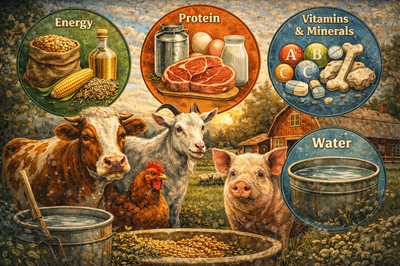 Feeding livestock is not just about keeping animals full—it’s about maintaining health, productivity, and long-term sustainability. Nutrition is the engine behind everything: growth, reproduction, immunity, and output.
At a basic level, all livestock require a balance of:
- Energy (carbohydrates and fats)
- Protein (muscle development, milk, eggs)
- Vitamins and minerals (immune function, bone strength)
- Water (often overlooked, but critical)
The challenge is that each species—and even each stage of life—has different requirements. A laying hen needs more calcium than a growing chick. A lactating goat needs significantly more nutrients than a dry one.
Beginners often make one of two mistakes:
- Overfeeding with expensive inputs
- Underfeeding due to poor planning
Both lead to problems. Overfeeding wastes resources and can cause health issues. Underfeeding reduces production and weakens animals, making them more susceptible to disease.
From a prepper perspective, nutrition is not just about optimization—it’s about resilience. Your feeding system must continue working even when supply chains fail.
4.2 Pasture Management and Grazing Techniques
Pasture is one of the most valuable assets on a homestead. Managed correctly, it can significantly reduce or even replace purchased feed.
Animals like cattle, sheep, and goats are designed to convert forage into usable nutrition. But pasture is not unlimited. Without management, it degrades quickly.
Effective grazing requires:
- Monitoring forage availability
- Preventing overgrazing
- Allowing recovery time
Rotational grazing, introduced earlier, becomes essential here. By moving animals regularly, you allow plants to regrow and maintain soil health.
Different animals interact with pasture differently:
- Cattle prefer grasses
- Sheep graze close to the ground
- Goats browse shrubs and woody plants
Using multiple species together can improve land use efficiency and reduce parasite loads.
From a preparedness standpoint, strong pasture management reduces reliance on external feed sources. It turns your land into a renewable system rather than a dependency.
4.3 Feed Types: Grain, Hay, Silage, and Supplements
Even with good pasture, supplemental feeding is often necessary—especially in winter or during periods of drought.
Hay is the most common stored feed. It provides fiber and energy, and its quality depends on how and when it was harvested. Poor-quality hay leads to poor animal performance.
Grain is used to boost energy and growth, particularly for meat animals or high-production livestock. However, it should be used carefully. Too much grain can cause digestive issues, especially in ruminants like cattle and goats.
Silage is fermented forage that retains more nutrients than dry hay. It requires more infrastructure but can be highly efficient.
Supplements fill nutritional gaps:
- Minerals (calcium, phosphorus, salt)
- Protein supplements
- Vitamins
Each feed type has advantages and trade-offs. The goal is not to rely heavily on one source, but to build a balanced system.
For preppers, diversification is key. If one feed source becomes unavailable, others must fill the gap.
4.4 Seasonal Feeding Adjustments
Feeding is not static—it changes with the seasons.
In spring and summer, pasture is abundant. Animals can meet most of their nutritional needs through grazing. Supplemental feeding is minimal.
In fall, pasture begins to decline. This is a transition period where stored feed becomes more important.
In winter, animals rely heavily on stored feed. Energy requirements increase as temperatures drop. Water access becomes more difficult due to freezing conditions.
Seasonal adjustments are not optional—they are necessary for maintaining health and productivity.
From a preparedness perspective, winter is the true test of your system. If you cannot sustain your animals through winter without external inputs, your system is not fully resilient.
4.5 Water Requirements by Species
Water is the most critical nutrient—and the most overlooked.
Animals can survive longer without food than without water. Even mild dehydration reduces feed intake, slows growth, and decreases production.
Water requirements vary:
- Chickens require small but consistent amounts
- Goats and sheep require moderate intake
- Cattle require large volumes daily
Factors that increase water needs include:
- Heat
- Lactation
- High-protein diets
Water must be:
- Clean
- Accessible
- Unfrozen in winter
In cold climates like much of Canada, preventing water from freezing becomes a major challenge. Heated waterers are common—but they rely on electricity.
Prepared homesteaders develop backup systems:
- Insulated containers
- Manual water delivery
- Alternative heat methods
Water is not just a daily need—it is a system that must be secured.
4.6 Growing and Storing Your Own Feed
One of the most important steps toward independence is producing your own feed.
Relying entirely on purchased feed creates a vulnerability. Supply disruptions, price increases, or transportation issues can quickly become critical problems.
Feed production can include:
- Growing hay or forage crops
- Planting grains
- Using garden surplus
- Harvesting natural forage
Storage is just as important as production. Feed must be protected from:
- Moisture
- Pests
- Mold
Improper storage leads to loss of nutrients or complete spoilage.
From a preparedness standpoint, feed production is a long-term strategy. It takes time to develop, but it reduces dependence and increases resilience.
4.7 Emergency Feed Planning and Stockpiling
Even well-managed systems can face unexpected challenges:
- Drought
- Crop failure
- Supply chain disruptions
- Severe weather
Emergency feed planning ensures you can continue feeding your animals when normal systems fail.
This includes:
- Maintaining a feed reserve
- Identifying alternative feed sources
- Reducing herd size if necessary
Alternative feeds might include:
- Tree leaves and branches (for goats)
- Kitchen scraps (for pigs and chickens)
- Stored grains
Stockpiling must be balanced. Too little leaves you vulnerable. Too much risks spoilage.
For preppers, this is where livestock becomes a strategic asset—or a liability. If you cannot feed your animals, they become a burden instead of a resource.
4.8 Feed Efficiency and Waste Reduction
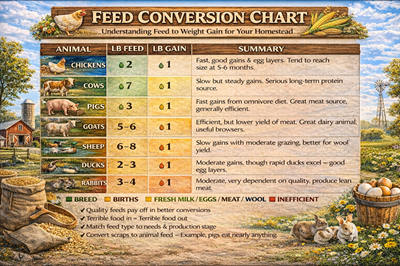
Efficiency is not just about saving money—it’s about maximizing output from limited resources.
Feed waste occurs in several ways:
- Spillage
- Overfeeding
- Poor storage
- Selective eating (animals picking preferred parts)
Reducing waste improves both cost efficiency and sustainability.
Simple improvements include:
- Proper feeder design
- Controlled feeding schedules
- Protecting feed from weather
From a preparedness perspective, efficiency extends your resources. It allows you to do more with less, which becomes critical in long-term disruptions.
4.9 Special Feeding Considerations (Breeding, Growth, Production)
Not all animals have the same nutritional needs at all times.
Breeding animals require increased nutrition before and during reproduction. Poor nutrition leads to weak offspring or failed pregnancies.
Young animals require higher protein for growth and development.
High-production animals—such as dairy goats or laying hens—require more energy and nutrients to sustain output.
Failing to adjust feeding based on these stages leads to:
- Reduced productivity
- Health issues
- Long-term inefficiency
Understanding these cycles allows you to allocate resources where they are most needed.
4.10 Natural Feeding and Foraging Systems
Beyond structured feeding, animals can supplement their diet through natural behaviors.
Chickens forage for insects and seeds. Goats browse shrubs and leaves. Pigs root for underground food sources.
Encouraging natural feeding behaviors:
- Reduces feed costs
- Improves animal health
- Diversifies nutrition
However, natural systems require management. Overuse can damage land, and some plants may be toxic.
From a preparedness standpoint, natural feeding systems provide flexibility. They allow animals to partially sustain themselves when external feed is limited.
4.11 Summary
Nutrition is the foundation of livestock productivity and survival.
This section comes down to a few core principles:
- Feed quality matters more than quantity
- Water is critical and must be secured
- Systems must adapt to seasons
- Independence requires feed production
- Efficiency extends survival
Livestock is not just about animals—it’s about managing inputs and outputs in a way that remains stable under pressure.
If feeding fails, everything fails.
5. Animal Health and Wellness
5.1 Daily Health Monitoring Practices
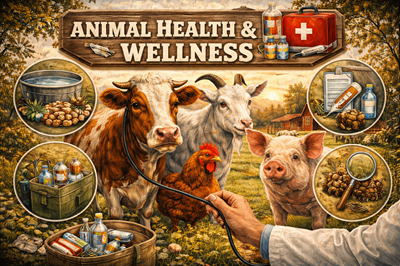 Healthy livestock systems are built on observation, not reaction. The earlier you detect a problem, the easier it is to manage—and in many cases, prevent entirely.
Daily health monitoring doesn’t require specialized tools. It requires consistency and attention. You should be watching your animals every day, even if only for a few minutes, and asking simple questions:
Are they eating normally?
Are they moving normally?
Are they interacting with the group?
Animals rarely show obvious signs of illness early. Instead, they show subtle changes:
- A chicken that stays in the corner
- A goat that doesn’t rush to feed
- A pig that seems less active
These small shifts are often the first warning signs.
Routine observation should include:
- Body condition (weight, muscle tone)
- Coat or feather quality
- Eyes (clear vs dull or discharge)
- Movement (limping, stiffness)
- Behavior (alert vs withdrawn)
For preppers, this habit becomes critical. Without immediate access to veterinary care, early detection is often the difference between recovery and loss.
5.2 Recognizing Signs of Illness
Animals instinctively hide weakness. In the wild, weakness attracts predators. That instinct remains, even in domesticated animals.
By the time obvious symptoms appear, the condition is often advanced.
Common warning signs include:
- Loss of appetite
- Lethargy or isolation
- Changes in posture
- Labored breathing
- Diarrhea or abnormal waste
- Sudden drop in production (eggs, milk)
Each species has its own patterns, but the principle is the same:
normal behavior is your baseline—anything outside of it matters.
It’s important to trust your instincts. If something feels off, it usually is.
From a preparedness standpoint, recognizing illness early reduces the need for external intervention. It allows you to isolate and treat before the problem spreads.
5.3 Common Diseases by Species
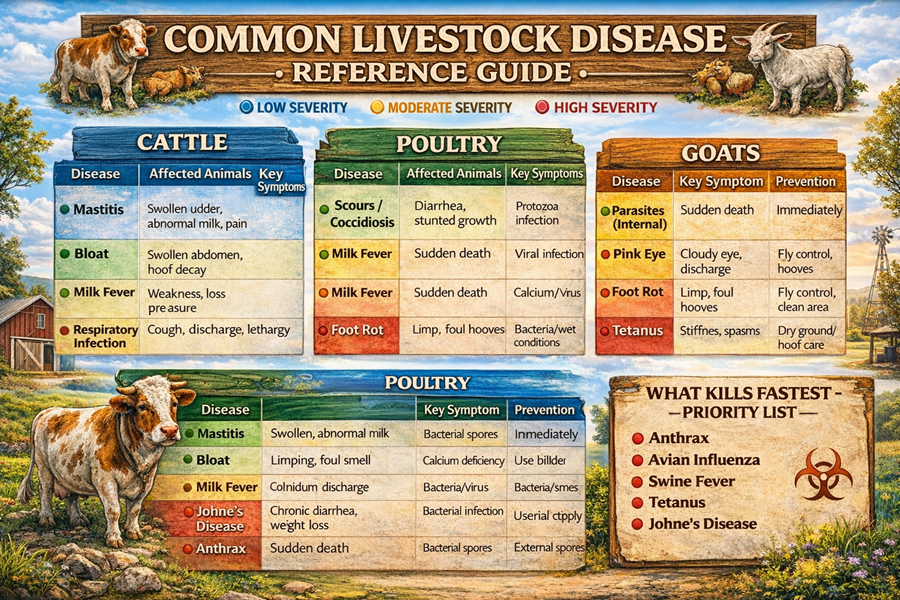 Every type of livestock comes with its own set of common health issues.
Chickens often face respiratory infections, parasites, and egg-laying complications.
Goats are highly susceptible to parasites, especially in wet or overgrazed environments.
Cattle can experience digestive disorders, infections, and hoof issues.
Pigs are prone to respiratory and digestive problems if conditions are poor.
The exact diseases vary by region, climate, and management practices.
What matters most is not memorizing every disease—but understanding:
- What risks exist in your area
- What symptoms to watch for
- How to respond quickly
Local knowledge becomes extremely valuable here. Farmers and veterinarians in your region often know which issues are most common.
For preppers, focusing on prevention and early detection is far more effective than trying to treat advanced disease without resources.
5.4 Parasite Control and Prevention
Parasites are one of the most persistent challenges in livestock management.
They come in many forms:
- Internal parasites (worms)
- External parasites (mites, lice, ticks)
Left unmanaged, parasites weaken animals, reduce production, and can lead to death.
The biggest mistake is relying solely on treatment instead of prevention.
Effective parasite control includes:
- Rotational grazing
- Avoiding overcrowding
- Maintaining clean living conditions
- Monitoring animals regularly
Chemical treatments (dewormers) can be effective, but overuse leads to resistance. Once resistance develops, treatment options become limited.
From a preparedness standpoint, parasite control must be sustainable without constant access to pharmaceuticals. This means relying more on management practices and less on chemical solutions.
5.5 Vaccination Schedules and Protocols
Vaccinations are a preventive tool designed to protect livestock from specific diseases.
In modern systems, vaccination schedules are often standard practice. However, availability may be limited in certain areas or during disruptions.
Deciding whether to vaccinate depends on:
- Local disease risks
- Type of livestock
- Your long-term preparedness plan
Some homesteaders rely heavily on vaccines, while others focus more on natural resistance and management practices.
There is no one-size-fits-all approach—but ignoring disease risks entirely is dangerous.
From a prepper perspective, the key question is:
What happens if vaccines are not available?
Building resilient systems—strong genetics, clean environments, and good nutrition—reduces reliance on external inputs.
5.6 Natural and Herbal Remedies
In situations where veterinary care or pharmaceuticals are limited, natural remedies can play a supporting role.
Herbal treatments have been used for generations to address:
- Minor infections
- Digestive issues
- Parasite management
- Wound care
Common examples include:
- Garlic (immune support, parasite control)
- Apple cider vinegar (digestive health)
- Herbal salves (wound treatment)
These remedies are not replacements for all medical care—but they can be effective for minor issues and as preventative support.
For preppers, natural remedies provide an additional layer of resilience. They are often locally available, renewable, and do not depend on supply chains.
However, they require knowledge and proper application. Misuse can be ineffective or even harmful.
5.7 First Aid for Livestock
Injuries are inevitable. Animals cut themselves, get caught in fencing, or develop infections.
Basic first aid skills allow you to respond quickly and prevent minor issues from becoming major problems.
A livestock first aid kit should include:
- Disinfectants
- Bandages and wraps
- Basic medications
- Tools for cleaning wounds
First aid is about stabilization:
- Clean the wound
- Prevent infection
- Monitor healing
More serious injuries may require professional care—but immediate action can make a significant difference.
From a preparedness standpoint, first aid knowledge is essential. In a grid-down scenario, you may be the only one available to treat your animals.
5.8 When to Call a Veterinarian
Even the most prepared homesteader cannot handle every situation alone.
Some conditions require professional expertise:
- Severe illness
- Complicated births
- Persistent infections
- Unknown symptoms
Knowing when to seek help is as important as knowing how to act.
However, access to veterinary care may be limited:
- Rural areas often have fewer veterinarians
- Emergency situations may delay response
- Long-term disruptions may eliminate access entirely
This is why building knowledge and experience matters. The more you understand, the less dependent you are.
From a prepper perspective, veterinarians are a resource—but not a guaranteed one.
5.9 Biosecurity and Disease Prevention
Biosecurity is about preventing disease from entering your system.
This includes:
- Limiting exposure to outside animals
- Controlling visitor access
- Cleaning equipment and footwear
- Quarantining new animals
Many outbreaks begin with a single point of entry.
Once disease enters your system, it spreads quickly—especially in confined or poorly managed environments.
Biosecurity may seem excessive in small homesteads, but it becomes critical as your operation grows.
For preppers, biosecurity is a defensive strategy. It protects your livestock from threats you cannot easily treat later.
5.10 Stress Management and Animal Welfare
Stress is one of the most overlooked factors in animal health.
Stressed animals are:
- More susceptible to disease
- Less productive
- More difficult to manage
Sources of stress include:
- Overcrowding
- Poor nutrition
- Extreme weather
- Frequent handling or movement
Reducing stress improves overall system performance.
Simple practices make a difference:
- Consistent routines
- Adequate space
- Proper shelter
- Gentle handling
From a preparedness standpoint, calm animals are easier to manage during emergencies. Stress amplifies problems—reducing it improves resilience.
5.11 Culling and Hard Decisions
Not every animal should remain in your system.
Culling—the removal of animals—is one of the hardest but most necessary parts of livestock management.
Reasons for culling include:
- Chronic illness
- Poor production
- Aggressive behavior
- Genetic weaknesses
Keeping weak animals drains resources and weakens your overall system.
This is where homesteading becomes real. Decisions are not emotional—they are practical.
From a prepper perspective, culling is about maintaining strength and efficiency. In limited-resource situations, every input must produce value.
5.12 Summary
Animal health is not built in emergencies—it is built daily.
This section comes down to core principles:
- Observe constantly
- Act early
- Prevent more than you treat
- Build systems that reduce disease risk
- Be prepared to make hard decisions
Healthy animals are productive animals.
Productive animals are sustainable assets.
If health fails, the entire system begins to collapse.
6. Breeding and Reproduction
6.1 Basics of Animal Reproduction
 Breeding is where livestock transitions from a resource you maintain into a system that sustains itself. Without reproduction, livestock is finite. With reproduction, it becomes renewable.
At its core, animal reproduction follows simple biological cycles—yet managing it effectively requires attention, timing, and planning.
Most livestock reproduce through natural mating, though some operations use artificial insemination. For homesteaders, natural breeding is usually the most practical and resilient approach.
Understanding reproduction begins with recognizing that:
- Each species has its own breeding cycle
- Fertility is influenced by nutrition, health, and environment
- Timing directly affects success rates
Animals do not breed efficiently under poor conditions. Stress, inadequate nutrition, and illness reduce fertility and increase complications.
From a preparedness perspective, reproduction is one of the most important long-term skills. It ensures that your livestock system does not depend on outside sources for replacement animals.
6.2 Selecting Breeding Stock
The quality of your livestock system is determined by the quality of your breeding animals.
Selecting breeding stock is not about choosing the biggest or most visually appealing animals—it’s about choosing those that consistently perform well.
Key traits to look for include:
- Strong health and resistance to disease
- Good temperament
- Consistent production (milk, eggs, growth rate)
- Structural soundness (no deformities or weaknesses)
Animals that require constant intervention should not be used for breeding. Passing on weak genetics creates long-term problems that compound over generations.
It’s also important to avoid selecting animals based solely on short-term gains. For example, a high-producing animal that requires excessive feed or care may not be ideal for a resilient system.
From a prepper standpoint, breeding stock should prioritize:
- Hardiness
- Efficiency
- Adaptability to local conditions
These traits matter more than maximum output.
6.3 Breeding Cycles and Timing
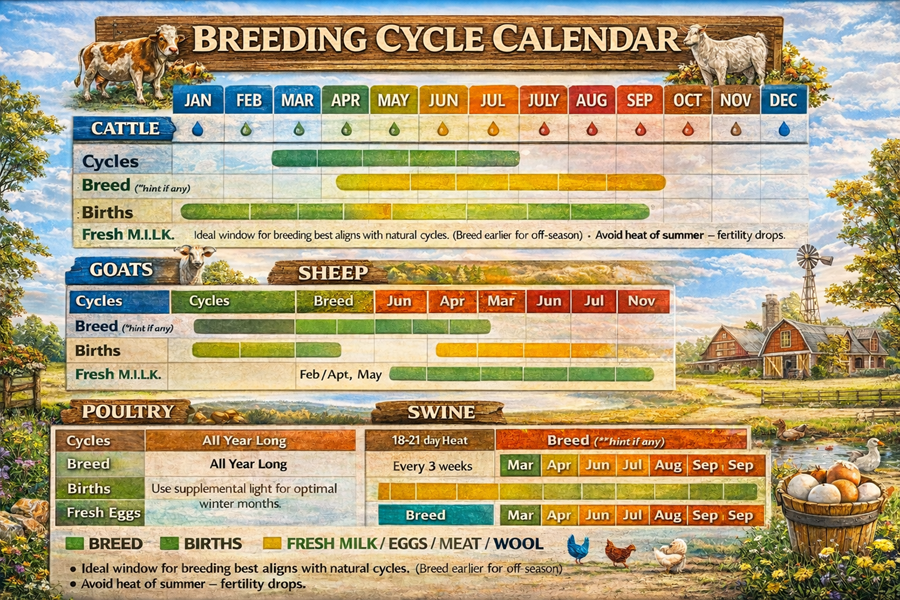
Every species has a natural breeding rhythm. Understanding these cycles allows you to plan effectively and improve success rates.
Some animals breed seasonally, while others can reproduce year-round. Factors influencing breeding cycles include:
- Daylight length
- Temperature
- Nutrition
Recognizing signs of heat (estrus) is critical. These may include:
- Increased activity or restlessness
- Vocalization
- Physical changes
- Seeking or accepting a mate
Missing these signs can result in delayed breeding and reduced productivity.
Timing also affects when offspring are born. Planning births for favorable seasons improves survival rates and reduces stress on both the mother and newborn.
From a preparedness perspective, controlled breeding ensures that your system produces when you need it—not randomly.
6.4 Pregnancy Care and Monitoring
Once breeding is successful, the focus shifts to supporting the animal through pregnancy.
Pregnancy increases nutritional demands. Animals require:
- Higher-quality feed
- Consistent water
- Reduced stress
Poor nutrition during pregnancy leads to weak offspring, complications during birth, and long-term health issues.
Monitoring is essential, but it should not be intrusive. Watch for:
- Changes in body condition
- Behavioral shifts
- Signs of distress
Handling should be minimized, especially in later stages.
For preppers, pregnancy management is about balancing support and independence. The goal is to provide what’s needed without creating dependency on external inputs.
6.5 Birthing (Kidding, Calving, Lambing, Farrowing)
Birth is one of the most critical—and risky—moments in livestock management.
Most births occur without intervention. However, when problems arise, they can escalate quickly.
Signs that birth is approaching include:
- Restlessness
- Nesting behavior
- Isolation from the group
- Physical changes (swelling, discharge)
During birth, the priority is observation. Intervene only when necessary.
Common issues include:
- Prolonged labor
- Improper positioning of the offspring
- Weak contractions
Intervention requires knowledge and confidence. Incorrect handling can cause more harm than good.
From a preparedness standpoint, understanding the basics of birthing is essential. In a situation without veterinary access, you may need to act.
6.6 Neonatal Care for Newborn Animals
The first hours of a newborn’s life are critical.
Healthy newborns should:
- Stand within a short period
- Begin nursing quickly
- Show alert behavior
Colostrum—the first milk produced by the mother—is essential. It provides antibodies that protect the newborn from disease.
Failure to nurse early can lead to:
- Weakness
- Increased susceptibility to illness
- Higher mortality rates
Environmental conditions also matter. Newborns are vulnerable to:
- Cold
- Wet conditions
- Predators
Providing a dry, sheltered space improves survival.
From a prepper perspective, neonatal care ensures that your breeding efforts result in viable, healthy animals—not losses.
6.7 Managing Breeding Programs
Breeding should not be left entirely to chance.
A structured breeding program allows you to:
- Control population size
- Improve genetics over time
- Align production with your needs
This includes tracking:
- Breeding dates
- Expected birth dates
- Performance of offspring
Over time, patterns emerge. You identify which pairings produce strong animals and which do not.
Uncontrolled breeding leads to:
- Overpopulation
- Resource strain
- Reduced overall quality
For preppers, controlled breeding ensures sustainability. It allows you to maintain balance between resources and production.
6.8 Avoiding Inbreeding and Genetic Issues
In small livestock systems, inbreeding becomes a real risk.
Breeding closely related animals over multiple generations leads to:
- Reduced fertility
- Increased health problems
- Weak offspring
Managing genetics requires planning.
Options include:
- Rotating breeding animals
- Introducing new genetics periodically
- Maintaining separate breeding lines
Introducing new animals must be balanced with biosecurity concerns. Quarantine and careful selection are essential.
From a preparedness standpoint, maintaining genetic diversity ensures long-term viability. A closed system without genetic management will degrade over time.
6.9 Weaning and Transitioning Young Animals
Weaning is the process of transitioning young animals from milk to solid food.
Timing varies by species, but the principle is consistent:
- Gradual transition reduces stress
- Early weaning can lead to health issues
- Late weaning may strain the mother
During this stage, animals require:
- High-quality feed
- Clean water
- Protection from stress
Weaning is also a point where animals can be:
- Integrated into the herd
- Selected for breeding
- Prepared for processing
From a prepper perspective, successful weaning ensures that your system continues producing independent, self-sustaining animals.
6.10 Ethical Considerations and Responsibility
Breeding livestock is not just a technical process—it carries responsibility.
Every animal brought into existence requires:
- Care
- Resources
- A purpose within your system
Uncontrolled breeding leads to:
- Overpopulation
- Resource shortages
- Animal suffering
Ethical management means making decisions that balance:
- Animal welfare
- Resource availability
- Long-term sustainability
This includes making difficult choices, such as culling animals that cannot be supported or do not contribute to the system.
From a preparedness perspective, ethics and practicality align. Responsible breeding creates stronger, more sustainable systems.
6.11 Summary
Breeding transforms livestock from a static resource into a renewable system.
This section comes down to key principles:
- Choose strong, resilient breeding stock
- Understand and manage breeding cycles
- Support animals through pregnancy and birth
- Ensure newborn survival
- Control population and genetics
Reproduction is where long-term resilience is built.
If done correctly, your system becomes:
- Self-sustaining
- Adaptable
- Independent of external supply
If done poorly, it becomes unstable and resource-intensive.
7. Species-Specific Guides
7.1 Poultry: The Foundation Livestock
 Poultry is often the entry point into livestock—and for good reason. It offers one of the highest returns for the lowest input. Chickens, ducks, and other birds provide protein quickly, reproduce efficiently, and require relatively little space.
From a preparedness standpoint, poultry is one of the most resilient systems you can build. Even small flocks can produce a steady food supply while also contributing to pest control and waste reduction.
7.1.1 Chickens (Egg Layers vs Meat Birds)
Chickens are the most versatile livestock species available to homesteaders.
Egg-laying breeds are designed for continuous production. A well-managed hen can produce hundreds of eggs per year, making them a reliable and renewable protein source. These birds are generally hardy and easier to maintain over the long term.
Meat birds, on the other hand, are bred for rapid growth. They convert feed into body mass quickly but are less sustainable long-term. Many meat breeds require more careful management due to health issues associated with fast growth.
Dual-purpose breeds offer a balance. They provide both eggs and meat, though not at the same efficiency as specialized breeds.
Chickens require:
- Secure housing (predator protection is critical)
- Consistent feed and water
- Basic health monitoring
From a prepper perspective, chickens are ideal because they:
- Reproduce easily
- Eat a wide range of food sources
- Integrate well into other systems
7.1.2 Ducks and Geese
Ducks and geese are often overlooked but offer unique advantages.
Ducks are excellent egg producers and tend to be more resistant to certain diseases than chickens. They thrive in wet environments and can forage effectively for insects and plants.
Geese are more specialized. They are strong grazers, capable of converting grass into usable nutrition. They also serve as natural alarm systems due to their territorial behavior.
However, both require access to water—not necessarily ponds, but enough to maintain hygiene and natural behavior.
From a preparedness standpoint:
- Ducks offer reliable egg production in diverse conditions
- Geese provide grazing efficiency and security benefits
7.1.3 Turkeys
Turkeys are primarily raised for meat production. They grow larger than chickens and provide significant yields, especially for seasonal harvests.
However, turkeys require more care:
- They are more sensitive as young birds
- They require more space
- They consume more feed
Turkeys are not typically used for continuous production systems. Instead, they are best suited for planned meat production cycles.
For preppers, turkeys are a high-output, periodic resource rather than a daily production animal.
7.1.4 Quail and Other Small Birds
Quail are a compact, efficient livestock option for small spaces.
They mature quickly, produce eggs rapidly, and require minimal space compared to chickens. This makes them ideal for:
- Urban homesteaders
- Backup protein systems
- Redundant livestock setups
However, quail are more fragile and less adaptable to harsh outdoor conditions.
From a preparedness standpoint, quail serve as:
- A low-space, high-turnover protein source
- A backup system if larger livestock is not viable
7.2 Small Livestock: Efficient and Scalable
Small livestock bridges the gap between poultry and large animals. They require more care than birds but offer greater production and versatility.
7.2.1 Rabbits
Rabbits are one of the most efficient meat-producing animals available.
They convert feed into protein quickly, reproduce rapidly, and require minimal space. Their quiet nature also makes them suitable for urban or discreet homesteading.
Rabbits require:
- Clean, dry housing
- Consistent feeding schedules
- Careful temperature management
They are particularly sensitive to heat and poor sanitation.
From a prepper perspective, rabbits are one of the best options for:
- Rapid protein production
- Low-resource systems
- Redundant food supply
7.2.2 Goats (Dairy vs Meat)
Goats are one of the most versatile livestock animals.
Dairy goats provide milk, which can be processed into cheese, butter, and other products. Meat goats offer a renewable protein source.
Goats are highly adaptable and can thrive on land that is unsuitable for other livestock. They browse rather than graze, consuming shrubs and woody plants.
However, goats are also known for:
- Escaping enclosures
- Testing fencing
- Requiring consistent management
From a preparedness standpoint, goats offer:
- High adaptability
- Multi-purpose production
- Independence from high-quality pasture
But they require strong infrastructure and attention.
7.2.3 Sheep (Wool vs Meat)
Sheep are similar to goats but differ in behavior and management.
They are primarily grazers and are well-suited for pasture-based systems. Sheep provide:
- Meat
- Wool
- Secondary products like milk (in some breeds)
They are generally easier to manage than goats but more vulnerable to predators.
From a prepper perspective, sheep offer:
- Efficient pasture utilization
- Renewable fiber production
- Moderate maintenance requirements
7.3 Large Livestock: High Output, High Commitment
Large livestock provides significant returns—but also requires significant investment.
7.3.1 Cattle (Beef vs Dairy)
Cattle are one of the most resource-intensive livestock options.
Beef cattle provide large quantities of meat but require substantial land, feed, and infrastructure.
Dairy cattle provide milk, which can be processed into multiple products, but require consistent care and milking routines.
Cattle systems demand:
- Strong fencing
- Reliable water supply
- Large grazing areas
From a prepper perspective, cattle are:
- High-output assets
- Long-term investments
- Less flexible in small-scale or emergency situations
They are best suited for established homesteads with sufficient resources.
7.3.2 Pigs
Pigs are highly efficient converters of feed into meat.
They grow quickly, consume a wide variety of food, and produce large quantities of meat in a relatively short time.
However, pigs require:
- Strong fencing (they root and push)
- Careful feeding management
- Proper sanitation
Pigs can also process food waste, making them valuable in closed-loop systems.
From a prepper perspective, pigs are:
- High-efficiency meat producers
- Valuable for waste reduction
- Resource-intensive if not managed properly
7.3.3 Horses (Work and Transport)
Horses are not primarily raised for food in most homesteading systems. Instead, they provide:
- Transportation
- Labor (plowing, hauling)
- Mobility in grid-down scenarios
Horses require:
- Significant space
- Consistent feeding
- Ongoing care
From a preparedness standpoint, horses offer:
- Independence from fuel-based transport
- Increased mobility and capability
However, they are high-maintenance and require skill to manage effectively.
7.4 Alternative Livestock: Specialized Systems
7.4.1 Bees (Honey Production)
Beekeeping provides:
- Honey
- Wax
- Pollination for crops
Bees require relatively little space but do require knowledge and seasonal management.
From a prepper perspective, bees contribute to:
- Food production
- Crop yields
- Trade goods
They are a valuable addition to a diversified homestead.
7.4.2 Fish (Aquaculture Systems)
Aquaculture allows for controlled fish production.
Systems can range from ponds to tanks, depending on space and resources.
Fish provide:
- High-quality protein
- Efficient feed conversion
However, aquaculture systems depend heavily on:
- Water quality
- Oxygen levels
- System stability
From a preparedness standpoint, fish systems can be highly productive—but require careful management.
7.4.3 Alpacas and Llamas
These animals are primarily used for:
- Fiber production
- Livestock guarding (especially llamas)
They require less intensive management than some large livestock and can integrate well into grazing systems.
From a prepper perspective:
- Alpacas provide renewable fiber
- Llamas can enhance security
7.5 Choosing the Right Combination of Livestock
No single species provides everything.
The most resilient homesteads use a combination of livestock to:
- Diversify food sources
- Balance land use
- Reduce risk
For example:
- Chickens + goats = eggs + milk
- Rabbits + garden = protein + crop integration
- Cattle + poultry = grazing + pest control
Diversity reduces dependency on any one system.
From a preparedness standpoint, redundancy is critical. If one system fails, others continue producing.
7.6 Summary
Livestock selection is not about choosing the “best” animal—it’s about building the right system.
This section comes down to key principles:
- Start with manageable species
- Match animals to your land and goals
- Combine species for resilience
- Understand trade-offs between output and effort
Each species brings strengths and weaknesses.
The goal is not perfection—it’s balance.
8. Daily Care and Management
8.1 Daily, Weekly, and Seasonal Chores
 Livestock systems don’t fail because of one big mistake—they fail because of small things not done consistently.
Daily care is the backbone of everything. It’s not complicated, but it must be reliable. Every day, animals depend on you for:
- Food
- Water
- Safety
- Observation
Skipping even a single day can create problems quickly, especially in extreme weather.
Daily routines should include:
- Feeding and checking intake
- Refilling and inspecting water sources
- Quick visual health checks
- Ensuring fencing and enclosures are intact
Weekly tasks go deeper:
- Cleaning shelters
- Checking feed stores
- Inspecting infrastructure
- Monitoring animal condition more closely
Seasonal tasks prepare your system for changing conditions:
- Stockpiling feed before winter
- Reinforcing shelters before storms
- Adjusting grazing areas
Consistency reduces stress—for both you and the animals. Over time, these routines become automatic, which is exactly what you want in a preparedness scenario.
When things go wrong, it’s usually because routine broke down.
8.2 Handling and Restraining Animals Safely
Handling livestock is where many injuries—both human and animal—occur.
Animals don’t respond well to chaos. Sudden movements, loud noises, or aggressive handling create fear, and fear leads to unpredictable behavior.
The goal is control through calm, not force.
Each species responds differently:
- Chickens can be handled directly but require gentleness
- Goats respond well to routine and familiarity
- Cattle require space awareness and careful positioning
- Pigs can be stubborn and require patience
Restraint should always be:
- Controlled
- Minimal
- Purpose-driven
Improper restraint can cause injury or stress that affects health and productivity.
From a prepper perspective, safe handling is critical. In an emergency, you may need to move, treat, or secure animals quickly. If your animals are not accustomed to handling, this becomes much more difficult.
Training animals to tolerate human interaction is part of daily management—not an afterthought.
8.3 Cleaning and Waste Management
Cleanliness is one of the simplest ways to prevent disease.
Manure buildup leads to:
- Increased parasite loads
- Bacterial growth
- Poor air quality
Regular cleaning reduces these risks significantly.
The goal is not sterility—it’s balance. Animals can tolerate natural conditions, but excessive waste creates unhealthy environments.
Effective cleaning routines include:
- Removing soiled bedding
- Refreshing living areas
- Keeping feeding zones clean
Waste should not be discarded—it should be managed. Composting turns manure into a valuable resource for crops.
From a preparedness standpoint, waste management supports long-term sustainability. It keeps your animals healthy while improving your soil.
8.4 Milking Techniques and Equipment
For those raising dairy animals, milking becomes part of daily life.
Milking requires consistency. Animals adapt to routine, and disruptions can reduce production or cause discomfort.
Proper milking includes:
- Clean conditions
- Gentle handling
- Consistent timing
Equipment can range from simple manual systems to more advanced setups, but simplicity is often more reliable.
Cleanliness is critical. Poor hygiene during milking can lead to infections, which reduce production and harm the animal.
From a prepper perspective, manual milking skills are essential. Automated systems are convenient—but they rely on power and maintenance.
Milk is one of the most valuable outputs on a homestead, but only if it can be produced safely and consistently.
8.5 Egg Collection and Storage
Egg production is one of the most consistent outputs in a livestock system.
Collecting eggs regularly prevents:
- Breakage
- Contamination
- Egg-eating behavior
Eggs should be handled carefully and stored in a clean environment.
Storage methods vary depending on conditions:
- Refrigeration (modern systems)
- Cool, dry storage (traditional methods)
- Preservation techniques for long-term use
From a preparedness standpoint, eggs are highly valuable:
- Nutrient-dense
- Easily stored short-term
- Useful for barter
Consistent collection ensures maximum yield and reduces waste.
8.6 Shearing and Fiber Processing
For those raising sheep or fiber animals, shearing is a critical task.
Shearing removes excess wool, which:
- Prevents overheating
- Improves hygiene
- Allows for fiber use
Timing is important. Shearing too early exposes animals to cold. Too late increases stress.
Processing fiber adds another layer:
- Cleaning
- Carding
- Spinning
From a preparedness perspective, fiber production provides:
- Clothing material
- Insulation
- Trade goods
However, it requires skill and time. It is not a passive system.
8.7 Managing Herd Dynamics
Animals live within social structures. Understanding these dynamics helps prevent conflict and stress.
Most livestock establish hierarchies:
- Dominant animals control access to resources
- Subordinate animals may be pushed aside
Problems arise when:
- New animals are introduced
- Space is limited
- Resources are insufficient
Managing herd dynamics includes:
- Providing enough space
- Ensuring multiple feeding points
- Introducing animals gradually
Ignoring these dynamics leads to injuries, stress, and reduced productivity.
From a prepper perspective, stable groups are easier to manage, especially during disruptions.
8.8 Routine Health Checks During Daily Care
Daily care is also your first line of defense for health monitoring.
This is not a separate task—it’s integrated into everything you do.
While feeding or cleaning, you should be observing:
- Movement
- Behavior
- Physical condition
The goal is to catch problems early.
A slight limp today can become a serious issue tomorrow. A small change in behavior may signal illness.
This constant awareness reduces the need for reactive care.
For preppers, this habit is critical. It replaces reliance on external diagnostics with personal observation.
8.10 Feed and Water Management in Daily Operations
Feeding and watering are not just tasks—they are systems.
Consistency matters:
- Animals expect regular feeding times
- Irregular schedules create stress
Feed should be:
- Measured appropriately
- Protected from waste
- Adjusted based on needs
Water systems must be checked daily:
- Cleanliness
- Functionality
- Availability
Small issues—like a blocked waterer—can quickly escalate into serious problems.
From a preparedness standpoint, daily checks ensure that failures are caught early before they become critical.
8.11 Time Management and Efficiency
Daily livestock care can become overwhelming without structure.
Efficiency is not about rushing—it’s about reducing unnecessary effort.
This includes:
- Grouping tasks logically
- Minimizing movement between areas
- Using tools effectively
A well-designed routine saves time and energy.
For preppers, efficiency is even more important. In a crisis, time and energy are limited resources. Systems that require excessive effort are harder to maintain.
8.12 Adapting Daily Care in Emergencies
Normal routines may not always be possible.
Emergencies—weather events, power outages, supply disruptions—require adaptation.
This might include:
- Manual feeding when automation fails
- Alternative water sources
- Reduced herd size to match available resources
Flexibility is key.
Animals still need care, even when conditions are difficult. Your system must be able to operate under less-than-ideal circumstances.
From a preparedness perspective, this is where planning pays off. Systems designed with redundancy continue functioning when others fail.
8.13 Summary
Daily care is where theory becomes reality.
This section comes down to a few core principles:
- Consistency is more important than complexity
- Observation prevents problems
- Cleanliness supports health
- Efficiency reduces strain
- Flexibility ensures survival under pressure
Livestock management is not about occasional effort—it’s about steady, reliable action every day.
If daily care is strong, the system holds.
If it breaks down, everything else follows.
9. Processing and Production
9.1 Meat Processing (DIY vs Professional)
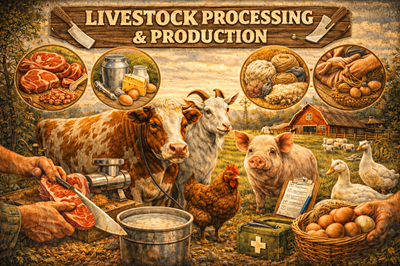 Processing livestock for meat is one of the most important—and often most avoided—skills in homesteading. It marks the transition from raising animals to actually utilizing them as a food source.
There are two primary approaches: professional processing and do-it-yourself (DIY).
Professional processing offers convenience, regulated conditions, and efficiency. However, it comes with limitations:
- Scheduling delays
- Cost
- Dependence on external systems
In a disruption scenario, professional services may not be available at all.
DIY processing requires skill, preparation, and mental readiness. It involves:
- Humane dispatch
- Proper bleeding
- Skinning or scalding
- Butchering into usable cuts
The process must be done correctly to ensure:
- Food safety
- Meat quality
- Minimal waste
The first time is always the hardest. After that, it becomes a skill like any other—one that improves with experience.
From a prepper perspective, DIY processing is essential. If you cannot process your own livestock, you are still dependent on outside systems.
9.2 Humane Handling and Ethical Slaughter
Processing animals carries ethical responsibility.
Humane handling minimizes stress and ensures the animal is treated with respect. Stress before slaughter affects both the animal and the quality of the meat.
Key principles include:
- Keeping animals calm
- Avoiding prolonged fear or discomfort
- Using proper techniques for quick dispatch
Improper handling leads to:
- Suffering
- Lower-quality meat (due to stress hormones)
- Increased difficulty during processing
Ethical slaughter is not just about morality—it is about doing the job correctly.
From a preparedness standpoint, this is a skill that must be approached with seriousness. It requires both technical knowledge and mental discipline.
9.3 Butchering Basics and Meat Breakdown
Once an animal is processed, the next step is breaking it down into usable portions.
Butchering involves separating the carcass into:
- Primary cuts
- Secondary cuts
- Trim and byproducts
Each species has its own structure, but the principles remain the same:
- Work cleanly
- Use sharp tools
- Follow natural muscle lines
Efficiency improves over time. Early attempts may be slower and less precise, but skill develops with repetition.
Proper butchering maximizes yield and ensures that nothing is wasted.
From a prepper perspective, this is about resource utilization. Every part of the animal has value—meat, fat, bones, and organs.
9.4 Meat Preservation Methods
Fresh meat is only useful if it can be preserved.
Without preservation, meat spoils quickly—especially in warm conditions.
Common preservation methods include:
- Refrigeration (modern systems)
- Freezing
- Drying (jerky)
- Smoking
- Curing and salting
Each method has advantages and limitations.
Freezing is convenient but depends on electricity. Drying and curing are more resilient but require skill and proper conditions.
Smoking adds both preservation and flavor but requires time and fuel.
From a preparedness standpoint, relying solely on refrigeration is a vulnerability. Traditional preservation methods provide independence from power systems.
9.5 Milk Processing (Butter, Cheese, Yogurt)
Milk is one of the most versatile products on a homestead—but it is also highly perishable.
Processing milk extends its usability and creates a range of valuable products:
- Butter (fat extraction)
- Cheese (protein preservation)
- Yogurt (fermentation)
Each process requires:
- Clean handling
- Basic equipment
- Knowledge of timing and conditions
Milk spoilage occurs quickly without proper handling. Cleanliness is critical at every stage.
Processing also reduces waste. Surplus milk can be transformed into products with longer shelf lives.
From a prepper perspective, dairy processing is a force multiplier. It turns a perishable resource into multiple stable products.
9.6 Egg Handling and Preservation
Eggs are one of the easiest animal products to manage—but they still require proper handling.
Fresh eggs can be stored short-term without refrigeration if kept clean and unwashed (to preserve their natural protective coating).
Long-term preservation methods include:
- Water glassing (lime solution storage)
- Dehydration
- Pickling
Each method extends shelf life and allows eggs to be stored beyond peak production periods.
Egg handling should focus on:
- Clean collection
- Proper storage conditions
- Minimizing breakage
From a preparedness standpoint, eggs are one of the most reliable food sources. Preserving surplus ensures availability during low-production periods.
9.7 Wool and Fiber Processing
Fiber-producing animals add another layer of productivity to a homestead.
Wool and fiber can be used for:
- Clothing
- Insulation
- Trade goods
Processing fiber involves multiple steps:
- Shearing
- Cleaning (removing dirt and oils)
- Carding (aligning fibers)
- Spinning
This process is labor-intensive but creates valuable materials.
From a prepper perspective, fiber production supports long-term self-sufficiency. Clothing and insulation are often overlooked but become critical in extended disruptions.
9.8 Rendering Fats and Byproducts
Fat is one of the most valuable—and underutilized—parts of an animal.
Rendering converts raw fat into usable forms:
- Lard (from pigs)
- Tallow (from cattle)
Rendered fat can be used for:
- Cooking
- Soap making
- Candle production
Other byproducts include:
- Bones (broth, tools)
- Organs (nutrient-dense food)
- Hides (leather)
Nothing should go to waste.
From a preparedness standpoint, byproducts increase efficiency and resilience. They turn a single resource into multiple outputs.
9.9 Food Safety and Storage
Processing food is only valuable if it remains safe to eat.
Food safety begins during processing:
- Clean tools and surfaces
- Proper handling
- Avoiding contamination
Storage must prevent:
- Spoilage
- Bacterial growth
- Pest access
Temperature control is critical for many products, but not all.
Traditional storage methods—drying, curing, root cellaring—provide alternatives when refrigeration is not available.
From a prepper perspective, food safety is non-negotiable. Illness from contaminated food can be as dangerous as food shortages.
9.10 Scaling Production for Sustainability
Production must match your system’s capacity.
Overproduction leads to waste. Underproduction limits self-sufficiency.
Scaling involves balancing:
- Number of animals
- Available feed
- Processing capacity
- Storage capability
It’s not just about producing more—it’s about producing what you can manage effectively.
From a preparedness standpoint, sustainable production ensures long-term stability. Systems that overextend eventually collapse.
9.11 Processing Under Limited Resources
In a disruption scenario, processing becomes more challenging.
You may lack:
- Electricity
- Refrigeration
- Access to tools or supplies
This requires adapting methods:
- Processing during cooler temperatures
- Using manual tools
- Relying on traditional preservation techniques
Planning ahead makes this easier:
- Having the right tools
- Practicing skills in advance
- Understanding alternative methods
From a prepper perspective, processing under limited conditions is the true test of your system.
9.12 Summary
Processing and production turn livestock into usable resources.
This section comes down to key principles:
- Learn to process independently
- Preserve food using multiple methods
- Use the entire animal
- Maintain food safety
- Match production to capacity
Livestock without processing is potential.
Processing turns it into survival.
10. Predator and Security Management
10.1 Understanding the Threat Landscape
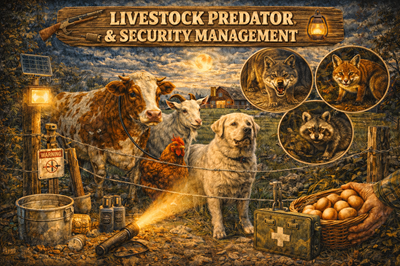 Livestock losses rarely come from one dramatic event—they come from predictable threats that were not properly accounted for.
Predators are part of every environment. Whether rural, suburban, or even urban, something is always looking for an easy meal. The key is not eliminating predators—it’s removing opportunity.
Predators are opportunistic. They don’t attack the strongest animal—they go after the weakest point in your system:
- Poor fencing
- Unsecured shelters
- Animals left exposed at night
- Inconsistent routines
Understanding this mindset changes how you approach security. You are not trying to fight predators—you are trying to make your livestock not worth the effort.
From a preparedness perspective, this same principle applies to human threats as well. Weak systems attract attention.
10.2 Identifying Common Predators
Predator threats vary by region, but most fall into predictable categories.
Small predators include:
- Raccoons
- Foxes
- Weasels
- Birds of prey
These animals are persistent and often target poultry. They exploit small gaps and can cause significant damage quickly.
Medium predators include:
- Coyotes
- Dogs (often one of the biggest threats)
These animals are capable of killing multiple animals in a single event.
Large predators include:
- Wolves
- Bears
- Mountain lions
These are less common but far more destructive when they appear.
Each predator type uses different methods:
- Digging under fences
- Climbing or jumping over barriers
- Attacking from above
- Exploiting weak points
Knowing what you are dealing with allows you to build defenses that actually work.
From a prepper standpoint, local knowledge is critical. Talk to nearby farmers, observe tracks, and understand seasonal predator behavior.
10.3 Physical Barriers and Fencing Strategies
Fencing is your first line of defense—and often your most important.
But not all fences are equal. A fence that keeps animals in does not necessarily keep predators out.
Effective fencing must address:
- Height (to prevent jumping)
- Strength (to resist pressure)
- Depth (to prevent digging)
- Material (to stop small predators)
For example:
- Poultry fencing must use small mesh (hardware cloth) to prevent entry
- Electric fencing can deter larger predators
- Buried fencing or aprons can stop digging
Weak points are what predators exploit:
- Corners
- Gates
- Areas near structures
From a preparedness perspective, fencing should be:
- Redundant
- Repairable
- Inspectable
A single failure point can lead to total loss.
10.4 Livestock Guardian Animals
Guardian animals add a dynamic layer of protection that static systems cannot provide.
Common guardian animals include:
- Livestock guardian dogs (LGDs)
- Donkeys
- Llamas
Guardian dogs are the most effective in many situations. They live with the livestock and actively deter predators through presence, noise, and, if necessary, confrontation.
Donkeys and llamas can also provide protection, particularly against smaller predators.
However, guardian animals require:
- Training
- Proper integration
- Ongoing care
They are not a “set and forget” solution.
From a prepper perspective, guardian animals provide:
- 24/7 presence
- Early warning
- Active deterrence
They are one of the few defenses that continue working without electricity or infrastructure.
10.5 Night Protection and Lockdown Systems
Most predator attacks occur at night.
Darkness reduces visibility and increases predator confidence. This makes nighttime protection one of the most critical elements of livestock security.
Effective night systems include:
- Securing animals in enclosed shelters
- Reinforcing doors and latches
- Eliminating gaps and weak points
For poultry, a secure coop at night is essential. Many losses occur because animals are left exposed after dark.
Lighting can act as a deterrent, but it should not be relied upon as the primary defense.
From a preparedness standpoint, night routines must be consistent. Forgetting to secure animals even once can result in loss.
10.6 Surveillance and Early Warning Systems
Detection is just as important as defense.
Knowing that something is approaching your livestock allows you to respond before damage occurs.
Modern systems include:
- Cameras
- Motion sensors
- Alarm systems
However, these depend on power and infrastructure.
Low-tech alternatives include:
- Guardian animals
- Strategic placement of livestock
- Natural sightlines
- Audible indicators (noise from animals)
Even simple awareness—such as recognizing unusual animal behavior—can serve as an early warning system.
From a prepper perspective, surveillance should not rely entirely on technology. Systems must function even when power is unavailable.
10.7 Human Threats and Theft Prevention
Predators are not always animals.
In times of scarcity or instability, livestock becomes a valuable target for theft.
Human threats differ from animal predators:
- They are intelligent
- They adapt quickly
- They may target your entire system
Preventing theft involves:
- Limiting visibility of livestock from roads or public areas
- Securing access points (gates, locks)
- Maintaining awareness of surroundings
Community relationships also play a role. Neighbors who know each other are more likely to notice suspicious activity.
From a preparedness standpoint, security is layered:
- Physical barriers
- Awareness
- Community
No single measure is enough.
10.8 Reducing Attractants and Risk Factors
Predators are drawn to opportunity.
Certain conditions increase risk:
- Leaving feed exposed
- Improper disposal of carcasses
- Weak or sick animals
- Unsecured waste
Reducing these attractants lowers the likelihood of attacks.
Simple practices include:
- Storing feed securely
- Removing waste promptly
- Maintaining strong, healthy livestock
From a prepper perspective, prevention is more effective than reaction. Eliminating attractants reduces the need for active defense.
10.9 Emergency Response to Predator Attacks
Even well-designed systems can fail.
When an attack occurs, the response must be immediate and deliberate.
Key steps include:
- Securing remaining animals
- Identifying how the predator entered
- Repairing vulnerabilities immediately
Understanding the type of predator involved helps determine next steps. Different predators leave different signs.
Repeated attacks are common if the vulnerability is not fixed. Once a predator identifies an easy food source, it will return.
From a preparedness standpoint, response speed matters. Delayed action leads to repeated losses.
10.10 Building a Layered Security System
Effective livestock protection is not based on a single solution—it is built in layers.
A strong system includes:
- Physical barriers (fencing, shelters)
- Active deterrents (guardian animals)
- Detection systems (surveillance, awareness)
- Good management practices (reducing attractants)
Each layer compensates for the weaknesses of the others.
If one layer fails, the others remain.
From a prepper perspective, this mirrors broader survival strategy:
- Redundancy
- Depth
- Adaptability
Single-point systems fail. Layered systems endure.
10.11 Summary
Predator and security management is about control—not elimination.
This section comes down to core principles:
- Understand the threats in your environment
- Build strong physical defenses
- Add active deterrents
- Maintain constant awareness
- Respond quickly to failures
Livestock security is not a one-time setup—it is an ongoing process.
If your system is weak, it will be tested.
If it is strong, it will be avoided.
11. Seasonal and Climate Considerations
11.1 Understanding Seasonal Impact on Livestock
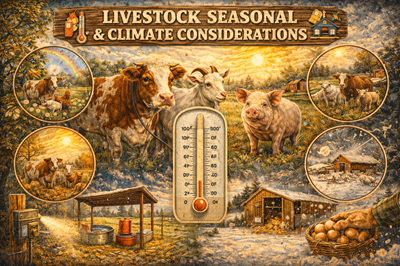 Livestock systems do not operate in a stable environment. They are constantly influenced by seasonal changes—temperature, daylight, precipitation, and resource availability all shift throughout the year.
Each season introduces new pressures:
- Winter stresses animals through cold and limited feed
- Summer stresses animals through heat and water demand
- Transitional seasons (spring/fall) create instability and disease risk
The mistake many homesteaders make is treating their system as static. In reality, livestock management must be dynamic.
Animals are resilient, but only within limits. When seasonal stress exceeds those limits, productivity drops, health declines, and losses occur.
From a preparedness standpoint, your system must be designed not just for average conditions—but for the worst conditions each season can bring.
11.2 Winter Livestock Care
Winter is the most demanding season for most homesteads, especially in colder regions like much of Canada.
The primary challenges include:
- Cold stress
- Frozen water
- Reduced forage
- Increased feed requirements
Animals burn more energy to maintain body temperature. This means they need more calories, not less. Underfeeding in winter leads quickly to weight loss and weakened immunity.
Shelter becomes critical—not for warmth, but for protection from wind and moisture. A dry, wind-protected animal handles cold far better than a wet, exposed one.
Water is often the biggest challenge. Frozen water sources can quickly become life-threatening. Systems must be in place to:
- Prevent freezing
- Provide consistent access
Simple solutions often outperform complex ones:
- Insulated containers
- Regular manual checks
- Backup water systems
From a prepper perspective, winter is a stress test. If your system can survive winter without external support, it is strong.
11.3 Summer Heat Management
While winter gets most of the attention, heat can be just as dangerous.
High temperatures lead to:
- Heat stress
- Reduced appetite
- Dehydration
- Lower production
Unlike cold, animals have limited ways to cool themselves. Shade and water become the primary defenses.
Effective heat management includes:
- Providing consistent shade (natural or built)
- Increasing airflow
- Ensuring constant access to clean water
Water demand rises significantly in heat. Systems that work in cooler months may fail under summer conditions.
From a preparedness standpoint, heat waves are becoming more common and intense. Planning for extreme heat is no longer optional.
11.4 Spring and Fall Transition Periods
Spring and fall are often underestimated—but they are periods of instability.
Spring introduces:
- Rapid pasture growth
- Wet conditions
- Increased parasite activity
Fall brings:
- Declining forage
- Temperature fluctuations
- Preparation for winter
These transitions create stress because conditions change quickly.
In spring, lush pasture can lead to digestive issues if animals are not introduced gradually. Wet ground increases the risk of hoof problems and parasites.
In fall, failing to prepare for winter leads to shortages later.
From a prepper perspective, these seasons are about preparation and adjustment. They are the windows where you either set yourself up for success—or create problems for the next season.
11.5 Drought Planning and Water Scarcity
Water scarcity is one of the most serious threats to livestock systems.
Drought reduces:
- Pasture availability
- Water sources
- Feed production
Without planning, drought forces difficult decisions—often reducing herd size.
Preparation includes:
- Storing water in advance
- Identifying alternative water sources
- Managing pasture to reduce stress
Feed planning is also critical. Drought reduces forage, which increases reliance on stored feed.
From a preparedness standpoint, drought is not a rare event—it is a recurring risk. Systems must be built to withstand periods of scarcity.
11.6 Storm and Extreme Weather Preparedness
Storms—whether snowstorms, windstorms, or heavy rain—can cause sudden and severe disruptions.
Risks include:
- Structural damage
- Flooding
- Power outages
- Animal exposure
Preparation involves:
- Reinforcing shelters
- Securing loose materials
- Ensuring drainage systems are functional
Animals should have access to safe shelter before storms arrive—not during.
After a storm, immediate checks are critical:
- Structural integrity
- Animal condition
- Water and feed availability
From a prepper perspective, storms test both infrastructure and response readiness. The ability to recover quickly is just as important as the ability to withstand the event.
11.7 Shelter-in-Place vs Evacuation Planning
In extreme scenarios, you may need to decide whether to shelter livestock in place or move them.
Shelter-in-place is the most common approach. It requires:
- Strong infrastructure
- Sufficient feed and water reserves
- Protection from environmental threats
Evacuation is far more complex. Moving livestock requires:
- Transportation
- Temporary housing
- Safe routes
For most homesteads, large-scale evacuation is not practical.
Planning should focus on:
- Making your location as resilient as possible
- Having limited relocation options for high-value animals
From a preparedness standpoint, the best strategy is usually to build systems that don’t require evacuation.
11.8 Seasonal Feed Storage and Management
Feed availability changes with the seasons, making storage essential.
Winter requires:
- Stockpiled hay or feed
- Protection from moisture and pests
Summer may allow for reduced feeding—but this depends on pasture conditions.
Storage systems must:
- Keep feed dry
- Prevent spoilage
- Protect from rodents
Improper storage leads to loss—not just of quantity, but of nutritional value.
From a prepper perspective, feed storage is as important as food storage for humans. Without it, livestock systems collapse quickly.
11.9 Adapting to Changing Climate Patterns
Climate patterns are becoming less predictable. Traditional seasonal expectations may no longer apply.
This introduces new challenges:
- Unexpected weather extremes
- Shifting growing seasons
- Increased variability
Rigid systems struggle under these conditions. Flexible systems adapt.
Adaptation includes:
- Diversifying livestock species
- Building flexible infrastructure
- Monitoring conditions closely
From a preparedness standpoint, adaptability is more valuable than optimization. Systems that can adjust survive longer.
11.10 Seasonal Health Risks and Disease Patterns
Health risks change with the seasons.
Winter risks include:
- Respiratory issues
- Nutritional deficiencies
Summer risks include:
- Parasites
- Heat stress
Spring and fall introduce:
- Rapid changes in conditions
- Increased disease transmission
Understanding these patterns allows you to anticipate problems rather than react to them.
Preventative measures—adjusting feed, improving sanitation, monitoring closely—reduce seasonal health issues.
From a prepper perspective, prevention reduces reliance on treatment, which may not always be available.
11.12 Summary
Seasonal and climate considerations are not external factors—they are core parts of livestock management.
This section comes down to key principles:
- Systems must adapt to changing conditions
- Preparation happens before the season changes
- Water and feed are the most critical resources
- Infrastructure must withstand extremes
- Flexibility is more valuable than perfection
Livestock systems are tested by seasons.
Strong systems adapt. Weak systems fail.
12. Off-Grid and Emergency Livestock Management
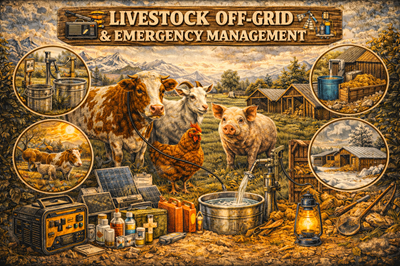 Off-grid and emergency livestock management is about maintaining animal health and production when normal systems—power, supply chains, and outside support—are unavailable. It focuses on building resilient, low-dependency systems for water, feed, shelter, and medical care, using what is available on the land. This means planning for backup water sources, storing or producing feed locally, and relying on practical skills rather than equipment. In an emergency, priorities shift from maximizing production to preserving herd health, preventing losses, and maintaining a sustainable cycle that can continue without outside inputs.
12.1 Operating Without Electricity
Most modern livestock systems quietly depend on electricity:
- Water pumps
- Heated waterers
- Electric fencing
- Lighting
- Automated feeders
When the power goes out, these systems don’t degrade—they stop.
Operating off-grid means designing systems that continue functioning without power, not just temporarily—but indefinitely.
The first step is identifying every point of electrical dependency. Then you either:
- Replace it with a manual system
- Build a backup
- Eliminate the need entirely
For example:
- Replace electric waterers with gravity-fed systems
- Use manual feeding routines instead of automation
- Add non-electric fencing backups
From a preparedness perspective, electricity should be a convenience—not a requirement.
If your system cannot function without power, it is not resilient.
12.2 Manual Watering and Feeding Systems
Water and feed are the two daily requirements that cannot fail.
Manual systems are simple, reliable, and independent:
- Buckets
- Gravity-fed tanks
- Hand pumps
These systems require more effort—but they work under any conditions.
Manual feeding systems involve:
- Pre-measured feed
- Controlled distribution
- Reduced reliance on automated feeders
The key is predictability. Animals must receive consistent care even when conditions are difficult.
From a prepper standpoint, manual systems are not a downgrade—they are a safeguard. They ensure that your livestock continues to function when modern systems fail.
12.3 Backup Plans for Feed and Medicine
Disruptions rarely affect just one area. Feed shortages often coincide with limited access to veterinary care and supplies.
A resilient system requires backup plans for both.
Feed backups include:
- Stored reserves
- Alternative feed sources
- Reduced herd strategies
Medicine backups include:
- Basic first aid supplies
- Knowledge of natural remedies
- Preventative care practices
The goal is not to stockpile everything—it’s to reduce dependency.
From a preparedness perspective, this is where planning meets reality. When supply chains fail, you rely on what you have and what you know.
12.4 Communication and Coordination in Emergencies
Livestock management does not happen in isolation.
In emergency situations, coordination becomes critical:
- With family members
- With neighbors
- With local communities
Clear communication ensures that:
- Animals are cared for consistently
- Resources are shared effectively
- Problems are addressed quickly
Low-tech communication methods—like radio or simple signaling systems—become valuable when modern systems fail.
From a prepper standpoint, livestock management is part of a larger system. Coordination strengthens resilience.
12.5 Long-Term Sustainability Without Supply Chains
Short-term disruptions are one thing. Long-term disruptions require a different mindset.
Without supply chains, you cannot rely on:
- Purchased feed
- Replacement animals
- Veterinary supplies
Your system must produce what it needs.
This includes:
- Growing feed
- Managing breeding cycles
- Maintaining health through prevention
Sustainability is not about maintaining current output—it’s about maintaining function over time.
From a preparedness perspective, long-term thinking separates temporary survival from true resilience.
12.6 Reducing System Complexity
Complex systems fail more easily.
Automation, specialization, and high-input systems may increase efficiency—but they also increase vulnerability.
Simplifying your system involves:
- Reducing dependencies
- Standardizing routines
- Eliminating unnecessary components
Simple systems are:
- Easier to maintain
- Easier to repair
- More adaptable
From a prepper standpoint, simplicity is a strength. It allows your system to continue functioning under stress.
12.7 Resource Prioritization During Crisis
In a crisis, resources become limited.
You may need to prioritize:
- Which animals to feed
- Which systems to maintain
- How to allocate water
This requires difficult decisions.
Not all animals will be equally valuable in every situation. High-maintenance animals may become liabilities if resources are scarce.
Prioritization ensures that:
- Core systems survive
- Resources are used effectively
From a preparedness perspective, this is about maintaining function—not preserving everything.
12.8 Emergency Shelter and Relocation Strategies
While most planning focuses on sheltering in place, emergencies may force temporary relocation or rapid adjustments.
This includes:
- Moving animals to safer areas
- Creating temporary shelters
- Protecting animals from immediate threats
Emergency shelters do not need to be perfect—they need to be functional.
Materials on hand—tarps, fencing panels, natural barriers—can be used to create temporary protection.
From a prepper standpoint, flexibility is key. Systems that can adapt quickly are more likely to survive unexpected events.
12.9 Maintaining Morale and Routine Under Stress
Livestock care is physically demanding under normal conditions. In emergencies, it becomes even more challenging.
Maintaining routine provides stability:
- For animals
- For people
Animals respond to consistency. Even in difficult conditions, maintaining feeding and care routines reduces stress and prevents additional problems.
For people, routine creates structure and reduces decision fatigue.
From a preparedness perspective, morale is often overlooked—but it is critical. Systems fail not just from lack of resources, but from exhaustion and disorganization.
12.10 Learning to Operate With Less
Emergency conditions often mean doing more with less:
- Less feed
- Less water
- Fewer tools
Efficiency becomes critical.
This may involve:
- Reducing waste
- Using alternative resources
- Adjusting expectations
The goal is not to maintain ideal conditions—it is to maintain survival conditions.
From a prepper standpoint, adaptability is more valuable than abundance.
12.11 Building Redundancy Into Every System
Redundancy is the foundation of resilience.
Every critical system should have:
- A primary method
- A backup method
For example:
- Water: pump + gravity system
- Feed: stored + forage
- Shelter: permanent + temporary options
Redundancy prevents single points of failure.
From a preparedness perspective, systems without redundancy are fragile. Systems with redundancy endure.
12.12 Summary
Off-grid and emergency livestock management is about one thing: continuity under failure.
This section comes down to key principles:
- Eliminate dependency on electricity where possible
- Build manual and backup systems
- Plan for resource shortages
- Simplify operations
- Prioritize and adapt under pressure
Livestock systems are only as strong as their weakest dependency.
Remove the dependencies—and the system becomes resilient.
13. Economics and Sustainability
 Livestock economics and sustainability focus on balancing inputs and outputs to create a system that is both productive and resilient over the long term. It involves managing costs like feed, infrastructure, and labor while maximizing returns through meat, milk, eggs, fiber, and secondary benefits such as manure and breeding stock. True sustainability goes beyond profit—it includes maintaining soil health, reducing dependency on external inputs, and ensuring animals can continue to reproduce and thrive year after year. A well-managed livestock system doesn’t just generate food; it creates a cycle where resources are reused, waste is minimized, and the homestead becomes increasingly self-reliant over time.
13.1 Understanding the True Cost of Livestock
One of the biggest misconceptions in homesteading is that livestock automatically saves money.
In reality, livestock can either:
- Reduce costs and increase independence
or - Become a constant financial drain
The difference comes down to management.
The true cost of livestock includes more than just feed. It includes:
- Infrastructure (fencing, shelters)
- Equipment
- Time and labor
- Veterinary care
- Losses (illness, predators, mistakes)
Many beginners focus only on feed costs and overlook everything else.
A chicken that produces eggs is valuable—but if it requires expensive feed, constant care, and infrastructure, the net benefit may be minimal.
From a prepper perspective, the goal is not to make livestock “cheap”—it’s to make it efficient and sustainable.
13.2 Cost Analysis and Budgeting
A functional livestock system requires planning at both startup and ongoing levels.
Startup costs often include:
- Animals
- Fencing
- Shelter materials
- Equipment
Ongoing costs include:
- Feed
- Maintenance
- Replacement animals
- Medical supplies
Budgeting helps you understand:
- What your system actually requires
- Where inefficiencies exist
- How to adjust over time
Without tracking costs, it’s easy to overspend without realizing it.
From a preparedness standpoint, budgeting is not about profit—it’s about ensuring that your system can continue operating under limited resources.
13.3 Income Opportunities (Eggs, Meat, Breeding Stock)
Livestock can generate income, but only if managed intentionally.
Common income streams include:
- Selling eggs
- Selling meat
- Selling breeding stock
- Selling secondary products (milk, fiber, honey)
However, income requires:
- Consistent production
- Quality products
- Reliable demand
Small-scale operations often struggle to compete with commercial producers on price. Instead, they succeed by focusing on:
- Local markets
- Quality over quantity
- Direct relationships
From a prepper perspective, income is not just about money—it’s about exchange value.
Livestock products can be traded for:
- Tools
- Services
- Other food
This becomes especially important in disrupted economies.
13.4 Bartering with Livestock Products
Bartering is one of the most overlooked benefits of livestock.
In a stable economy, bartering is optional. In a disrupted economy, it becomes essential.
Livestock products are highly tradable because they are:
- Useful
- Consumable
- Renewable
Examples include:
- Eggs for vegetables
- Meat for labor
- Milk for tools
Bartering requires relationships. It works best within communities where trust already exists.
From a prepper standpoint, livestock provides leverage. It gives you something valuable to offer, even when currency loses value.
13.5 Reducing Input Costs
The most sustainable systems are not those that produce the most—but those that require the least input.
Reducing input costs involves:
- Producing your own feed
- Using natural grazing systems
- Recycling waste into resources
- Minimizing external dependencies
For example:
- Chickens can reduce feed costs by foraging
- Pigs can consume food waste
- Manure can replace purchased fertilizer
Every input you eliminate increases resilience.
From a prepper perspective, reducing inputs is critical. Systems that depend heavily on external resources are fragile.
13.6 Scaling for Profit vs Self-Sufficiency
There is a fundamental difference between scaling for profit and scaling for self-sufficiency.
Profit-focused systems aim to:
- Maximize output
- Optimize efficiency
- Compete in markets
Self-sufficiency systems aim to:
- Meet internal needs
- Reduce dependency
- Maintain stability
Trying to do both at the same time often creates conflict.
For example:
- High-output systems may require high inputs
- Low-input systems may produce less but be more stable
From a prepper perspective, self-sufficiency should take priority. Profit is a bonus—not the primary goal.
13.7 Ethical and Sustainable Practices
Sustainability is not just environmental—it is operational.
A sustainable livestock system:
- Maintains animal health
- Preserves land quality
- Operates within resource limits
Unsustainable practices lead to:
- Soil degradation
- Increased disease
- Long-term system failure
Ethical practices include:
- Proper animal care
- Responsible breeding
- Avoiding unnecessary waste
From a preparedness standpoint, sustainability ensures that your system continues functioning over time—not just in the short term.
13.8 Resource Cycling and Closed-Loop Systems
The most efficient homesteads operate as closed-loop systems.
This means outputs from one part of the system become inputs for another.
Examples include:
- Manure fertilizing crops
- Crop waste feeding animals
- Animals improving soil through grazing
Closed-loop systems reduce waste and increase efficiency.
They also reduce reliance on external inputs.
From a prepper perspective, closed-loop systems are ideal. They create self-sustaining cycles that continue even when outside resources are limited.
13.9 Managing Losses and Risk
Losses are inevitable.
Animals will get sick, predators will attack, and mistakes will happen.
The goal is not to eliminate losses—it is to minimize and manage them.
This includes:
- Building strong systems
- Maintaining awareness
- Learning from failures
Risk management also involves diversification. Relying on a single type of livestock increases vulnerability.
From a prepper perspective, resilience comes from accepting risk and building systems that absorb it.
13.10 Long-Term Sustainability Planning
Sustainability is not measured in weeks or months—it is measured in years.
Long-term planning includes:
- Maintaining breeding stock
- Preserving soil health
- Managing resources carefully
It also involves adapting to changing conditions:
- Climate
- Resource availability
- External pressures
A sustainable system evolves. It is not fixed.
From a prepper perspective, long-term planning ensures that your livestock system remains viable through extended disruptions.
13.11 Community Economics and Cooperation
No homestead exists in isolation.
Working with others creates opportunities for:
- Resource sharing
- Knowledge exchange
- Mutual support
Community systems may include:
- Shared breeding programs
- Cooperative feed production
- Barter networks
From a preparedness standpoint, community increases resilience. It spreads risk and expands available resources.
13.12 Summary
Economics and sustainability determine whether your livestock system is viable over time.
This section comes down to key principles:
- Understand true costs
- Reduce dependency on external inputs
- Use livestock for both production and exchange
- Build closed-loop systems
- Plan for long-term sustainability
Livestock is not just about raising animals—it’s about managing resources.
Efficient systems endure.
Inefficient systems fail.
14. Advanced Homesteading Strategies
14.1 Moving Beyond Basic Livestock Systems
 Most homesteaders begin with simple, isolated systems—chickens in a coop, goats in a pasture, feed brought in from outside. These systems work, but they are often inefficient and dependent.
Advanced homesteading is about integration.
Instead of treating each part of the homestead separately, you begin connecting systems so they support each other. Waste becomes input. Animals serve multiple roles. Land is used more efficiently.
The shift is from:
- Linear systems (input → output → waste)
to - Cyclical systems (input → output → reuse → regeneration)
This is where homesteading moves from basic self-sufficiency toward long-term sustainability.
From a prepper perspective, integrated systems are stronger because they reduce dependency and increase redundancy.
14.2 Integrated Farming Systems (Livestock + Crops)
One of the most powerful strategies is combining livestock with crop production.
Instead of separating animals and plants, they are managed together in a way that benefits both.
Examples include:
- Chickens following grazing animals to eat insects and spread manure
- Livestock fertilizing fields naturally
- Crop residues feeding animals
This integration reduces:
- Feed costs
- Fertilizer needs
- Waste
It also improves soil health and productivity.
However, integration requires planning. Poorly managed systems can lead to overgrazing or crop damage.
From a prepper perspective, integrated systems create resilience. If one part of the system struggles, others compensate.
14.3 Permaculture and Regenerative Grazing
Permaculture focuses on designing systems that mimic natural ecosystems.
In livestock management, this often takes the form of regenerative grazing.
Instead of allowing animals to graze continuously, they are moved in patterns that:
- Allow plants to recover
- Improve soil structure
- Increase biodiversity
Over time, this approach can actually improve land quality rather than degrade it.
Healthy soil retains more water, supports more plant growth, and reduces the need for external inputs.
From a preparedness standpoint, regenerative systems turn land into a long-term asset rather than a resource that is slowly depleted.
14.4 Multi-Species Grazing Benefits
Different animals use land differently.
Cattle graze grasses.
Sheep graze lower vegetation.
Goats browse shrubs.
Combining species allows more complete use of available forage.
It also reduces parasite loads. Many parasites are species-specific, so rotating different animals through the same area disrupts their lifecycle.
Multi-species systems increase efficiency while improving land health.
From a prepper perspective, diversification reduces risk. If one species struggles, others continue producing.
14.5 Soil Improvement Through Livestock
Livestock is not just about food—it is a tool for land management.
Properly managed animals can:
- Improve soil fertility
- Increase organic matter
- Enhance water retention
Manure adds nutrients. Grazing stimulates plant growth. Hoof action can help incorporate organic material into the soil.
However, mismanagement has the opposite effect:
- Overgrazing damages soil
- Compaction reduces productivity
The difference comes down to control and timing.
From a preparedness standpoint, soil is one of your most valuable assets. Livestock can either build it—or destroy it.
14.6 Automation vs Manual Systems
As systems grow, there is a natural push toward automation.
Automation can improve efficiency by:
- Reducing labor
- Standardizing processes
- Increasing output
Examples include:
- Automatic feeders
- Timed water systems
- Electric fencing
However, automation introduces dependency:
- Power requirements
- Maintenance needs
- Potential points of failure
Manual systems require more effort but offer:
- Reliability
- Independence
- Simplicity
From a prepper perspective, the goal is balance.
Use automation where it adds value—but ensure that manual backups exist. Systems should not collapse when automation fails.
14.7 Advanced Breeding Strategies
Basic breeding ensures continuity. Advanced breeding improves quality.
Over time, you can select for traits that matter most to your system:
- Disease resistance
- Feed efficiency
- Climate adaptability
This requires:
- Record keeping
- Observation
- Selective culling
Advanced breeding is a long-term process. Results are not immediate, but they compound over generations.
From a prepper perspective, strong genetics reduce the need for external inputs and increase resilience.
14.8 Resource Optimization and Efficiency
Advanced systems focus on maximizing output from available resources.
This includes:
- Using land more effectively
- Reducing waste
- Improving feed conversion
Efficiency is not about pushing animals harder—it’s about reducing unnecessary inputs.
Examples include:
- Matching livestock to available forage
- Using seasonal cycles effectively
- Minimizing losses
From a preparedness standpoint, efficiency extends resources. It allows systems to operate longer under limited conditions.
14.9 Building Redundant Production Systems
Redundancy is not just about backup—it’s about ensuring continuity.
In advanced systems, redundancy exists across multiple levels:
- Multiple livestock species
- Multiple feed sources
- Multiple water systems
This prevents single points of failure.
For example:
- If chickens fail, rabbits still produce
- If pasture fails, stored feed is available
From a prepper perspective, redundancy is one of the most important principles in system design.
14.10 Long-Term Land Stewardship
Advanced homesteading is not just about production—it’s about stewardship.
This includes:
- Maintaining soil health
- Protecting water sources
- Preserving biodiversity
Short-term gains often come at the expense of long-term sustainability.
Stewardship requires thinking beyond immediate needs and considering the future of the land.
From a prepper perspective, land is not just a resource—it is a foundation for survival.
14.11 Adapting Systems Over Time
No system remains perfect.
Conditions change:
- Climate shifts
- Resources fluctuate
- Goals evolve
Advanced homesteaders continuously adapt:
- Adjusting livestock numbers
- Changing grazing patterns
- Introducing new species
Rigid systems break under pressure. Flexible systems adapt.
From a preparedness standpoint, adaptability is one of the most valuable traits a system can have.
14.12 Summary
Advanced homesteading is about moving from isolated systems to integrated, efficient, and resilient systems.
This section comes down to key principles:
- Integrate livestock with crops and land
- Use natural systems to improve efficiency
- Diversify species and production
- Balance automation with independence
- Continuously adapt and improve
Basic systems survive.
Advanced systems thrive.
15. Troubleshooting and Problem Solving
 Livestock troubleshooting and problem solving is the process of identifying issues early, understanding their root cause, and taking practical steps to correct them before they escalate. Problems in a livestock system rarely happen in isolation—they are often tied to feed, water, shelter, stress, or management practices. Effective troubleshooting requires observation, pattern recognition, and a willingness to adjust systems rather than just treat symptoms. Whether it’s reduced feed intake, unusual behavior, or declining production, the goal is to quickly narrow down the cause and implement simple, effective solutions that restore stability and prevent the issue from recurring.
15.1 Why Livestock Systems Fail
Livestock systems rarely collapse all at once. They degrade gradually through small, repeated problems that go unaddressed.
Common causes of failure include:
- Poor planning
- Inconsistent routines
- Weak infrastructure
- Lack of observation
Most failures are not caused by unpredictable events—they are caused by predictable issues that were ignored.
A fence that isn’t repaired.
A water system that isn’t checked.
A health issue that isn’t addressed early.
These small failures accumulate.
Understanding this changes your mindset. You stop reacting to problems and start preventing them.
From a prepper perspective, failure is not just loss—it is vulnerability. A failing system attracts further problems.
15.2 Identifying Problems Early
Early detection is the most powerful tool in troubleshooting.
Most issues start small:
- A slight drop in egg production
- A small change in behavior
- Minor damage to infrastructure
If caught early, these problems are easy to fix.
If ignored, they escalate.
The key is establishing a baseline. You need to know what “normal” looks like for:
- Animal behavior
- Production levels
- Feed and water usage
Anything outside of that baseline is a signal.
From a preparedness standpoint, early detection reduces resource use. Fixing small problems requires less time, less effort, and fewer materials.
15.3 Feed Shortages and Solutions
Feed shortages are one of the most common and serious problems in livestock systems.
They can be caused by:
- Poor planning
- Drought
- Supply disruptions
- Unexpected herd growth
When feed becomes limited, immediate action is required.
Short-term solutions include:
- Rationing feed carefully
- Using alternative sources (forage, scraps, natural browse)
- Reducing waste
Long-term solutions involve:
- Increasing feed production
- Improving storage
- Adjusting herd size
This is where difficult decisions may be necessary. Keeping too many animals without sufficient feed leads to larger losses later.
From a prepper perspective, feed shortages test your system’s resilience. Systems that rely heavily on purchased feed are the most vulnerable.
15.4 Water System Failures
Water system failures escalate faster than almost any other issue.
Animals can survive short-term feed disruptions—but water is immediate.
Failures can include:
- Frozen lines
- Broken containers
- Pump failure
- Contamination
The response must be immediate:
- Provide alternative water sources
- Repair the system quickly
- Monitor animals for signs of dehydration
Backup systems are critical. Without them, a single failure can lead to rapid loss.
From a preparedness standpoint, water redundancy is non-negotiable.
15.5 Disease Outbreak Management
Disease outbreaks can spread quickly through livestock, especially in confined or poorly managed systems.
When illness appears in multiple animals, immediate action is required:
- Isolate affected animals
- Identify symptoms
- Improve sanitation
Waiting or hoping the problem resolves itself often leads to wider spread.
Managing outbreaks involves:
- Reducing contact between animals
- Maintaining clean conditions
- Supporting affected animals
In some cases, culling may be necessary to protect the rest of the system.
From a prepper perspective, disease control is about containment. Once an outbreak spreads, options become limited.
15.6 Predator Breaches and Security Failures
Predator attacks are often the result of a system weakness—not just predator behavior.
When a breach occurs, the priority is identifying how it happened:
- Was the fence damaged?
- Was a gate left open?
- Was there a structural weakness?
Fixing the immediate damage is only part of the solution. You must also prevent recurrence.
Predators that succeed once will return.
Improving defenses may involve:
- Reinforcing fencing
- Adding deterrents
- Adjusting routines
From a prepper perspective, every breach is a lesson. Systems must evolve based on real threats.
15.7 Aggressive Animal Behavior
Aggression in livestock can create safety risks and disrupt the system.
Causes include:
- Overcrowding
- Competition for resources
- Poor handling
- Genetic traits
Aggressive animals may:
- Injure other animals
- Damage infrastructure
- Pose risks to people
Managing aggression involves:
- Providing adequate space
- Ensuring sufficient feed and water access
- Removing problem animals if necessary
From a preparedness standpoint, safety is critical. Unpredictable animals become liabilities in stressful situations.
15.8 Infrastructure Failures
Infrastructure failures often occur at the worst possible times:
- Fences break during storms
- Shelters fail under snow load
- Gates weaken over time
These failures expose animals to:
- Predators
- Weather
- Escape risks
Regular inspection is the best prevention.
When failures occur:
- Prioritize containment and safety
- Make temporary repairs if needed
- Plan permanent fixes
From a prepper perspective, infrastructure must be maintained proactively. Waiting for failure increases risk.
15.9 Reproductive Issues and Low Productivity
Reproduction problems can reduce the long-term sustainability of your system.
Common issues include:
- Failed breeding cycles
- Weak offspring
- Low fertility
These problems often trace back to:
- Poor nutrition
- Stress
- Genetic weaknesses
Addressing them involves:
- Improving feeding practices
- Reducing stress
- Selecting better breeding stock
From a preparedness standpoint, reproduction is critical. Without it, livestock systems decline over time.
15.10 Environmental and Weather-Related Problems
Extreme weather can disrupt even well-managed systems.
Examples include:
- Flooding damaging shelters
- Heat waves reducing production
- Cold snaps stressing animals
Response requires:
- Immediate protection of animals
- Adjustment of feeding and watering
- Repairing damage quickly
Planning ahead reduces the impact:
- Reinforced shelters
- Drainage systems
- Seasonal preparation
From a prepper perspective, weather is unpredictable—but its effects can be managed.
15.11 Human Error and System Breakdown
Many problems come down to human error.
Examples include:
- Forgetting to secure animals
- Misjudging feed needs
- Delaying repairs
These errors are often caused by:
- Fatigue
- Lack of routine
- Poor planning
Reducing human error involves:
- Creating consistent routines
- Using checklists
- Simplifying systems
From a preparedness standpoint, systems should be designed to reduce reliance on perfect performance. People make mistakes—systems must account for that.
15.12 Learning From Failure
Failure is not the end—it is part of the process.
Every problem provides information:
- What went wrong
- Why it happened
- How to prevent it
Successful homesteaders are not those who avoid failure—but those who learn from it.
This requires:
- Honest assessment
- Willingness to change
- Continuous improvement
From a prepper perspective, failure is feedback. Systems that evolve become stronger over time.
15.13 Summary
Troubleshooting is about understanding and responding to problems before they become failures.
This section comes down to key principles:
- Detect problems early
- Respond quickly
- Fix root causes, not just symptoms
- Build systems that reduce risk
- Learn and adapt continuously
Livestock systems are not perfect—they are managed.
Strong systems recover.
Weak systems collapse.
16. Building a Livestock-Based Community
 Building a livestock-based community is about more than raising animals—it’s about creating a network of people who share resources, skills, and responsibility. No single homestead can efficiently produce everything, but a connected group can specialize, trade, and support each other through challenges like feed shortages, disease, or equipment failure. By working together, communities can share breeding stock, rotate grazing land, pool labor during critical periods, and build stronger local food systems. In the long term, a livestock-based community increases resilience, reduces individual risk, and creates a sustainable system that can adapt and thrive even under pressure.
16.1 Why Community Matters in Livestock Systems
No matter how well-built your homestead is, it has limits.
You have limited time.
Limited resources.
Limited knowledge.
A community expands all three.
Livestock systems are demanding. Animals require daily care, and unexpected problems can arise at any time. Operating completely alone increases risk—if you’re unavailable, the system suffers.
A community provides:
- Redundancy in labor
- Shared knowledge
- Access to additional resources
Historically, livestock was rarely managed in isolation. Farming communities relied on each other for breeding, labor, and support.
From a prepper perspective, community is not just helpful—it is a force multiplier. It turns individual systems into a network.
16.2 Working With Neighboring Farms
Your closest and most valuable resource is often nearby.
Neighboring farms and homesteads can provide:
- Practical advice based on local conditions
- Equipment sharing
- Emergency assistance
Building relationships before you need them is critical.
This means:
- Communicating regularly
- Offering help when possible
- Sharing knowledge and resources
These relationships create informal support systems.
For example:
- Someone can check your animals if you’re unavailable
- Equipment can be borrowed instead of purchased
- Problems can be solved collaboratively
From a preparedness standpoint, local connections are far more reliable than distant resources.
16.3 Shared Resources and Equipment
Not every homestead needs to own every tool.
Some equipment is expensive, rarely used, or difficult to maintain individually.
Examples include:
- Processing equipment
- Large tools (tractors, trailers)
- Specialized livestock handling equipment
Sharing resources reduces cost and increases access.
However, shared systems require:
- Clear agreements
- Trust
- Responsibility
Without structure, shared resources can lead to conflict.
From a prepper perspective, resource sharing increases efficiency and reduces redundancy—but only when managed properly.
16.4 Breeding Networks and Genetic Diversity
One of the biggest challenges in small livestock systems is maintaining genetic diversity.
In isolated systems, inbreeding becomes a risk over time.
Breeding networks solve this problem by:
- Exchanging breeding stock
- Coordinating breeding programs
- Sharing knowledge about genetics
This improves:
- Animal health
- Productivity
- Long-term sustainability
Breeding networks also reduce dependency on outside sources.
From a prepper perspective, maintaining strong genetics is critical. Weak genetics reduce resilience and increase resource demands.
16.5 Local Markets and Cooperative Systems
Livestock production often exceeds personal needs at times.
Surplus creates opportunity.
Local markets allow you to:
- Sell excess products
- Build relationships with buyers
- Generate income or trade value
Cooperative systems take this further by:
- Pooling production
- Sharing processing resources
- Coordinating distribution
Small-scale producers can compete more effectively when working together.
From a prepper perspective, local markets strengthen the community and create alternative economic systems that do not rely on large-scale infrastructure.
16.6 Knowledge Sharing and Skill Building
Knowledge is one of the most valuable resources in any livestock system.
No single person knows everything. Problems arise that require experience and insight.
Communities allow for:
- Sharing practical knowledge
- Learning from others’ mistakes
- Developing new skills
This can happen informally or through structured efforts such as:
- Workshops
- Group projects
- Skill exchanges
From a prepper perspective, knowledge sharing increases resilience. It ensures that critical skills are not limited to one person.
16.7 Mutual Aid and Emergency Support
In times of crisis, community becomes essential.
Mutual aid involves:
- Helping each other during emergencies
- Sharing resources when needed
- Supporting recovery after setbacks
Examples include:
- Assisting with livestock care during illness
- Sharing feed during shortages
- Helping repair infrastructure after storms
Mutual aid is not charity—it is cooperation.
It works best when relationships are established before emergencies occur.
From a prepper perspective, mutual aid increases survival chances. It creates a network that can respond to challenges collectively.
16.8 Building Trust and Cooperation
Community systems depend on trust.
Without trust, cooperation breaks down.
Trust is built through:
- Consistent behavior
- Reliability
- Fairness
It cannot be forced or rushed.
Clear communication is also essential. Misunderstandings lead to conflict, which weakens the system.
From a prepper perspective, trust is a critical resource. It determines whether a community functions effectively under pressure.
16.9 Organizing Community Livestock Systems
As communities grow, informal systems may need structure.
This can include:
- Coordinated breeding schedules
- Shared grazing plans
- Resource management agreements
Organization does not mean complexity—it means clarity.
Everyone should understand:
- Roles and responsibilities
- Expectations
- Limits
Well-organized systems reduce confusion and improve efficiency.
From a prepper perspective, organization ensures that community systems function under stress, not just under normal conditions.
16.10 Balancing Independence and Cooperation
One of the key challenges in community systems is maintaining balance.
Too much independence leads to isolation.
Too much dependence leads to vulnerability.
Each homestead should remain capable of operating independently while benefiting from cooperation.
This balance ensures:
- Flexibility
- Stability
- Resilience
From a prepper perspective, the goal is not to rely entirely on others—but to strengthen your system through connection.
16.11 Community Security and Collective Defense
Livestock communities face shared threats:
- Predators
- Theft
- Resource shortages
Coordinated defense improves security.
This may include:
- Shared surveillance
- Communication systems
- Coordinated response plans
Community awareness increases detection and reduces risk.
From a prepper perspective, collective defense is stronger than individual efforts. It creates a wider perimeter and faster response capability.
16.12 Long-Term Community Resilience
A strong community is more than a collection of individuals—it is a system.
Resilience comes from:
- Diversity of skills
- Redundancy of resources
- Strong relationships
Over time, communities that cooperate effectively become:
- More efficient
- More adaptable
- More stable
From a preparedness perspective, long-term survival is rarely individual—it is collective.
16.13 Summary
Building a livestock-based community transforms isolated systems into networks of strength.
This section comes down to key principles:
- Build relationships before you need them
- Share resources and knowledge
- Maintain genetic diversity
- Support each other in emergencies
- Balance independence with cooperation
Individual systems survive.
Communities endure.
17. Tools, Checklists, and Resources
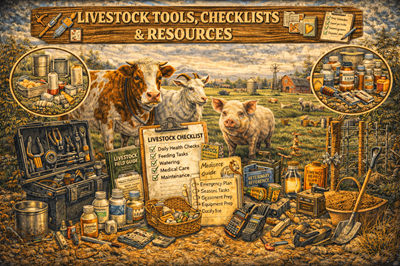 Livestock tools, checklists, and resources form the operational backbone of a successful homestead, turning daily tasks into consistent, repeatable systems. Having the right tools—feeders, water systems, fencing supplies, medical kits, and basic handling equipment—reduces effort, improves safety, and prevents small issues from becoming major problems. Checklists help ensure nothing is missed, from daily health checks to seasonal preparations and emergency readiness. Combined with reliable reference materials and local knowledge, these resources allow homesteaders to stay organized, respond quickly to challenges, and maintain a stable, efficient livestock system over time.
17.1 Why Systems and Checklists Matter
Livestock management is not complicated—but it is constant.
The biggest risk is not lack of knowledge. It’s inconsistency.
Even experienced homesteaders forget things:
- A gate left open
- Water not checked
- Feed running low
Small oversights create large problems.
Checklists solve this.
They turn:
- Memory → system
- Habit → consistency
- Complexity → simplicity
In high-stress situations—fatigue, bad weather, emergencies—checklists become even more valuable. They reduce decision-making and ensure critical tasks are not missed.
From a prepper perspective, checklists are force multipliers. They allow systems to function even when you’re tired, distracted, or under pressure.
17.2 Essential Equipment Checklists
Having the right tools matters—but having the right tools ready and organized matters more.
A basic livestock equipment checklist should cover:
Feeding and Watering
- Feed containers (sealed, pest-proof)
- Water buckets or troughs
- Backup manual watering systems
Handling and Care
- Basic restraint tools
- Cleaning equipment
- First aid supplies
Infrastructure Maintenance
- Repair tools (wire, fasteners, basic tools)
- Spare fencing materials
- Shelter repair supplies
This is not about having everything—it’s about having what you actually use, accessible and functional.
From a preparedness standpoint, tools should be:
- Durable
- Multi-purpose
- Usable without power
If a tool breaks or depends on electricity, you need a backup.
17.3 Daily Care Checklists by Species
Daily routines should be simple enough to follow without thinking.
A basic daily checklist might include:
- Check feed levels
- Check water availability
- Observe animal behavior
- Inspect fencing and shelter
Species-specific adjustments matter.
For example:
- Chickens require egg collection
- Dairy animals require milking
- Grazing animals require pasture checks
The goal is not complexity—it’s consistency.
From a prepper perspective, daily checklists ensure that essential tasks are completed even under stress.
17.4 Weekly and Monthly Maintenance Checklists
Daily care keeps animals alive. Weekly and monthly tasks keep the system functional.
Weekly tasks might include:
- Cleaning shelters
- Inspecting feed storage
- Checking for signs of wear in infrastructure
Monthly tasks may include:
- Reviewing feed supply levels
- Inspecting fencing thoroughly
- Evaluating animal condition
These tasks prevent small issues from becoming larger problems.
From a preparedness standpoint, maintenance is prevention. Systems that are regularly checked are less likely to fail unexpectedly.
17.5 Emergency Preparedness Checklists
Emergencies require immediate action. There is no time to think through every step.
Emergency checklists should be simple and direct:
- Secure animals
- Check water and feed
- Assess damage
- Implement backup systems
These checklists should be:
- Written down
- Easily accessible
- Practiced in advance
Different scenarios require different checklists:
- Power outage
- Severe weather
- Predator attack
- Feed shortage
From a prepper perspective, preparation is not complete until it is written and rehearsed.
17.6 Printable Record Sheets
Record keeping is critical—but only if it’s usable.
Digital systems are convenient, but they rely on power and devices. Physical records provide reliability.
Basic record sheets should track:
- Breeding dates
- Births
- Health issues
- Feed usage
- Production levels
Over time, these records reveal patterns:
- Which animals perform well
- Where inefficiencies exist
- When problems tend to occur
From a prepper standpoint, records are data. Data allows you to make informed decisions even when conditions change.
17.7 Recommended Books and Training Resources
No system is built in isolation. Learning from others accelerates progress.
Books provide:
- Proven methods
- Detailed explanations
- Long-term reference material
Hands-on training provides:
- Practical experience
- Skill development
- Confidence
The key is selecting resources that match your goals:
- Small-scale homesteading
- Off-grid systems
- Low-input livestock management
From a prepper perspective, knowledge is one of the few resources that increases with use.
17.8 Online Tools and Apps (With Limitations)
Modern tools can improve efficiency:
- Feed calculators
- Record-keeping apps
- Weather tracking
However, they come with limitations:
- Dependence on devices
- Need for internet access
- Risk of data loss
These tools are useful—but they should not be relied upon exclusively.
From a prepper perspective, digital tools are enhancements—not foundations. Always maintain offline alternatives.
17.9 Building Your Own Livestock Handbook
The most effective system is one you build yourself.
A personalized livestock handbook should include:
- Your routines
- Your checklists
- Your observations
- Your lessons learned
This becomes your reference:
- What works on your land
- What fails in your conditions
- How your system evolves
No external guide can fully replace local experience.
From a prepper perspective, your handbook is one of your most valuable assets. It captures knowledge that cannot be easily replaced.
17.10 Creating Redundant Information Systems
Information is often overlooked in preparedness planning.
If knowledge exists only in your head—or in one place—it is vulnerable.
Redundancy includes:
- Multiple copies of records
- Physical backups of critical information
- Shared knowledge within a community
If something happens to you, others should be able to maintain the system.
From a prepper perspective, redundancy applies to information just as much as it does to physical systems.
17.11 Training Others and Passing Knowledge
A system that depends on one person is fragile.
Training others ensures continuity.
This includes:
- Family members
- Trusted community members
Training should cover:
- Daily routines
- Emergency procedures
- Basic troubleshooting
The goal is not perfection—it’s competence.
From a prepper perspective, shared knowledge increases resilience. It ensures that the system continues even if one person is unavailable.
17.12 Summary
Tools, checklists, and resources turn livestock management into a repeatable system.
This section comes down to key principles:
- Write things down
- Standardize routines
- Maintain tools and equipment
- Use both digital and physical systems
- Share knowledge and train others
Systems that exist only in memory fail.
Systems that are written, practiced, and shared endure.
18. Final Thoughts
 Livestock homesteading is often imagined as a peaceful, self-sufficient lifestyle—but the reality is more demanding, unpredictable, and hands-on than most expect. Animals rely on you every single day, regardless of weather, fatigue, or other priorities. There are no days off when it comes to feeding, watering, and monitoring health. What starts as a simple idea quickly becomes a system that requires consistency, discipline, and a willingness to adapt when things don’t go as planned.
One of the biggest realities is that livestock amplifies both your strengths and your weaknesses as a homesteader. Good systems—clean water, proper nutrition, secure shelter, and regular observation—lead to healthy, productive animals. Poor systems, even small oversights, can lead to stress, illness, or loss. Livestock does not tolerate neglect or inconsistency for long, and problems tend to compound if they are not addressed early.
There is also a learning curve that cannot be avoided. Every species behaves differently, every season introduces new challenges, and every animal has its own quirks. Mistakes will happen—whether it’s choosing the wrong breed, underestimating feed needs, or dealing with unexpected health issues. These experiences are part of the process, but they come with real consequences, which is why starting small and building gradually is critical.
At the same time, the rewards are substantial. Livestock provides food, fertility for the land, and a level of independence that stored supplies alone cannot match. Over time, as systems improve and knowledge builds, what once felt overwhelming becomes routine. The reality of livestock homesteading is not about perfection—it’s about developing resilient systems, learning continuously, and building a lifestyle that can sustain itself through both good conditions and difficult ones.
18.1 The Reality of Livestock Homesteading
Livestock homesteading is often idealized—but the reality is more demanding.
It is not passive.
It is not convenient.
It does not pause when life gets busy.
Animals require daily care, regardless of weather, energy levels, or outside circumstances.
There will be:
- Early mornings
- Late nights
- Losses and setbacks
- Difficult decisions
But there will also be:
- Independence
- Production you can rely on
- Skills that matter in any environment
The difference between success and failure is not knowledge—it is commitment.
From a prepper perspective, livestock is not just a resource. It is a responsibility that must be accepted fully.
18.2 Building a Sustainable Homestead System
Sustainability is not about maximizing output—it is about maintaining function over time.
A sustainable livestock system:
- Produces consistently
- Uses resources efficiently
- Adapts to changing conditions
It avoids extremes:
- Overproduction that strains resources
- Underproduction that limits self-sufficiency
Balance is the goal.
This balance comes from:
- Matching livestock to land
- Managing feed and water carefully
- Maintaining animal health
- Integrating systems
From a preparedness standpoint, sustainability is what allows a system to survive beyond short-term disruptions.
18.3 Livestock as a Long-Term Asset
Livestock is not just food—it is a system that produces food.
This distinction matters.
Stored food decreases over time.
Livestock, when managed properly, increases or maintains production.
This makes livestock one of the few assets that:
- Regenerates
- Reproduces
- Adapts
It also creates secondary benefits:
- Fertility for soil
- Materials (fiber, fat, hides)
- Trade opportunities
From a prepper perspective, livestock transforms survival from a finite plan into a renewable system.
18.4 The Importance of Adaptability
No plan survives unchanged.
Conditions shift:
- Weather patterns change
- Resources fluctuate
- Unexpected problems arise
Rigid systems break under pressure.
Adaptable systems adjust.
Adaptability comes from:
- Experience
- Observation
- Willingness to change
This may mean:
- Reducing herd size during shortages
- Switching feed strategies
- Adjusting infrastructure
From a preparedness standpoint, adaptability is one of the most valuable traits you can build into your system.
18.5 The Role of Discipline and Routine
Livestock systems are maintained through routine.
Discipline ensures that:
- Animals are fed consistently
- Water systems are checked
- Problems are caught early
Routine reduces:
- Mistakes
- Stress
- Decision fatigue
It creates stability in an otherwise unpredictable environment.
From a prepper perspective, discipline is what keeps systems functioning when conditions are difficult.
Motivation changes.
Discipline remains.
18.6 Learning as an Ongoing Process
No matter how much experience you gain, there will always be more to learn.
Each season brings new challenges.
Each animal behaves differently.
Each system evolves over time.
Learning comes from:
- Observation
- Experience
- Mistakes
Mistakes are not failures—they are feedback.
The key is to:
- Recognize them
- Understand them
- Adjust accordingly
From a prepper perspective, continuous learning ensures that your system improves rather than stagnates.
18.7 Balancing Independence and Community
True resilience comes from balance.
Complete independence is difficult and limiting.
Complete dependence is fragile.
The goal is:
- Strong individual systems
- Supported by cooperative networks
This allows for:
- Flexibility
- Redundancy
- Shared knowledge
From a preparedness standpoint, balance creates strength.
You are capable on your own—but stronger together.
18.8 Preparing for Uncertainty
Livestock systems exist in an unpredictable world.
There will always be unknowns:
- Weather events
- Resource shortages
- External disruptions
Preparation is not about predicting every scenario—it is about building systems that can handle uncertainty.
This includes:
- Redundancy
- Flexibility
- Strong fundamentals
From a prepper perspective, the goal is not certainty—it is readiness.
18.9 The Mindset of a Livestock Homesteader
Beyond systems and tools, success comes down to mindset.
A livestock homesteader must be:
- Observant
- Patient
- Consistent
- Willing to act
There is no shortcut.
This mindset develops over time through:
- Daily routines
- Problem-solving
- Experience
From a prepper perspective, mindset is the foundation. Without it, even the best systems fail.
18.10 Final Perspective: Building Something That Lasts
Livestock homesteading is not just about meeting immediate needs.
It is about building something that continues:
- Beyond short-term disruptions
- Beyond individual effort
- Beyond a single season
A well-designed system:
- Produces consistently
- Adapts to change
- Supports both people and land
It becomes more than a collection of animals—it becomes a living system.
From a preparedness standpoint, this is the goal:
Not just to survive—but to create systems that endure.
18.11 Final Summary
This entire handbook comes down to a few core principles:
- Build systems, not just setups
- Focus on consistency over complexity
- Reduce dependency on external inputs
- Observe and adapt continuously
- Integrate livestock into a broader system
- Prepare for failure before it happens
Livestock homesteading is not easy—but it is one of the most powerful ways to build true resilience.
When done correctly, it provides:
- Food
- Independence
- Stability
And most importantly—continuity.
19. Feed Conversion Charts
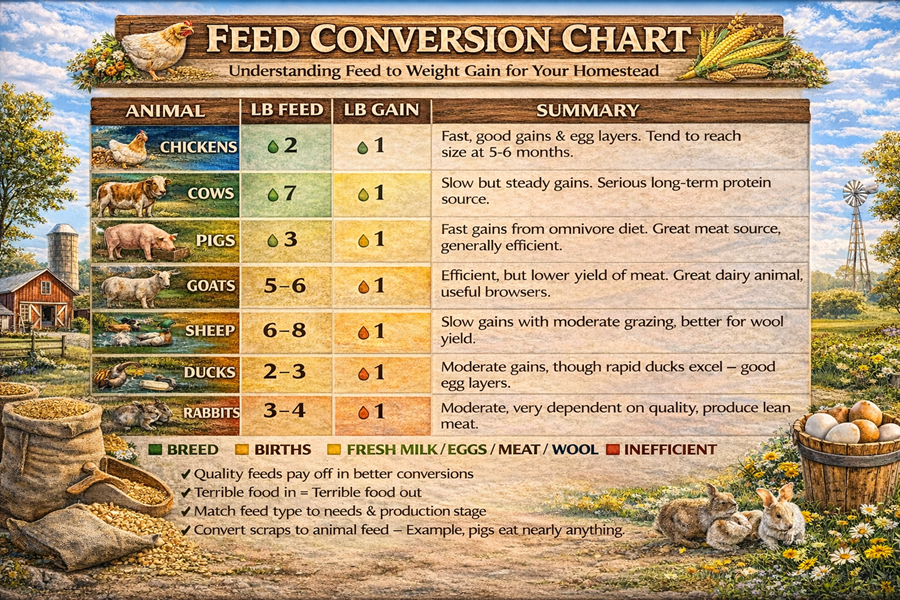
20. Breeding Cycle Calendars
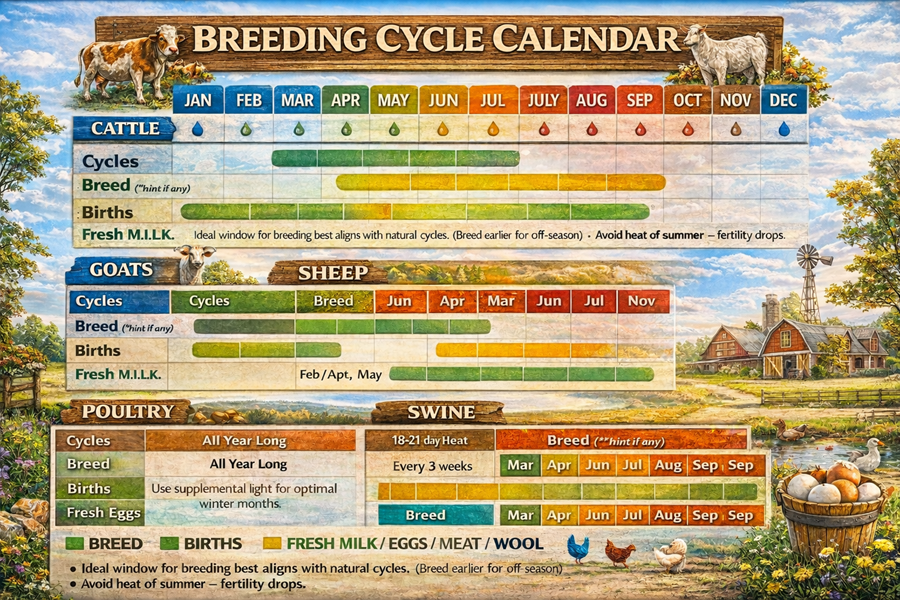
21. Common Disease Reference Guide
| Common Livestock Disease Reference Guide | |||||||||||||||||||||||||||||||||||||||||||||||||||||||||||||||||||||||||||||||||||||||||||||||||||||||||||||||||||||||||||||||
|
|||||||||||||||||||||||||||||||||||||||||||||||||||||||||||||||||||||||||||||||||||||||||||||||||||||||||||||||||||||||||||||||
22. Morse Code & Emergency Signaling for Farms
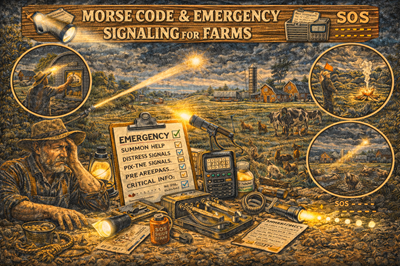 Morse code and emergency signaling provide a simple, reliable communication backup for farms when modern systems fail or distance becomes a barrier. By using basic signals—light, sound, or tapping—farmers can communicate across fields, between buildings, or during emergencies without relying on power or cellular networks. Its strength lies in its flexibility and minimal resource requirements, allowing it to function in nearly any situation, from nighttime signaling with flashlights to daytime visual cues. When combined with pre-agreed signals and regular practice, Morse code becomes an effective tool for coordination, safety, and rapid response in both everyday operations and critical situations.
22.1 Why Morse Code Still Matters on a Homestead
Modern communication systems are convenient but fragile, especially during outages or emergencies. This section explains why Morse code remains a valuable backup, giving homesteads a simple, reliable way to communicate when everything else fails.
Modern communication systems are fragile.
Cell towers fail.
Power goes out.
Internet access disappears.
When that happens, most people lose the ability to communicate beyond shouting distance.
Morse code solves that problem.
It is:
- Simple
- Low-tech
- Extremely flexible
- Independent of infrastructure
On a farm or homestead, Morse code becomes a backup communication layer that can function when everything else fails.
It allows you to:
- Signal for help
- Communicate across distance
- Coordinate movement
- Share critical information
From a preparedness standpoint, Morse code is not outdated—it is redundancy.
22.2 Core Principles of Morse Code
This section introduces the basic structure of Morse code, including dots, dashes, and the timing that gives them meaning. It emphasizes that Morse is best understood as a rhythm-based system rather than just a series of symbols.
Morse code is based on timing and rhythm, not just symbols.
- Dot (·) = short signal
- Dash (–) = long signal (3x longer than a dot)
Spacing is critical:
- Between parts of a letter = short pause
- Between letters = medium pause
- Between words = longer pause
This timing creates recognizable patterns that can be:
- Heard
- Seen
- Felt
Experienced users don’t think in dots and dashes—they recognize patterns instinctively.
22.3 Essential Morse Code Reference
Distress Signal (Most Important)
SOS
- · · – – – · · ·
This is the universal distress signal.
Use it for:
- Injury
- Fire
- Immediate danger
- Life-threatening situations
Basic Letters (High Priority for Learning)
A · –
B – · · ·
C – · – ·
E ·
H · · · ·
I · ·
O – – –
R · – ·
S · · ·
T –
These letters allow you to form many basic words quickly.
22.4 Practical Farm Signaling Methods
Morse code is not tied to any single tool. It can be used with whatever you have available. This section shows how Morse code can be transmitted using tools already available on a homestead, such as flashlights, whistles, or tapping. It demonstrates how adaptable the system is across different environments and conditions.
Light Signals
- Flashlight
- Headlamp
- Lantern
Use:
- Short flash = dot
- Long flash = dash
Best for:
- Night signaling
- Long-distance communication
Sound Signals
- Whistle
- Horn
- Metal tapping (pipes, tools, structures)
Use:
- Short sound = dot
- Long sound = dash
Best for:
- Fog
- Dense terrain
- Short to medium distances
Physical Signals
- Tapping on walls or pipes
- Knocking on structures
Best for:
- Trapped or confined situations
- Indoor communication
Visual Signals (Daytime)
- Mirror flashes
- Flag movement
- Arm signals
Best for:
- Open fields
- Long-distance daytime communication
22.5 Farm Emergency Use Cases
Morse code becomes valuable in real scenarios—not theory. Real-world examples are provided to illustrate how Morse code can be used during injuries, equipment breakdowns, or predator threats. The focus is on turning a simple skill into a practical communication tool during critical moments.
Scenario 1: Injury in Remote Area
A worker is injured in a distant pasture.
They can:
- Use a flashlight or whistle
- Signal SOS
- Alert others without needing a phone
Scenario 2: Equipment Failure
Tractor breaks down far from the house.
Instead of walking long distances:
- Signal a basic message like “HELP”
- Coordinate pickup or assistance
Scenario 3: Predator Threat
Someone spots a predator near livestock.
They can signal:
- Short warning messages
- Alert others quickly without shouting
Scenario 4: Grid-Down Communication
No phones, no power.
Morse code allows:
- Communication between buildings
- Coordination across property
- Silent signaling when needed
22.6 Simple Farm Signal Codes (Recommended)
Instead of spelling out full messages, this section encourages creating short, pre-agreed signals for common situations. This approach speeds up communication and makes the system more efficient in high-pressure scenarios:
- SOS = Emergency
- ·· (I) = “OK / Safe”
- – (T) = “Come here”
- ··· (S) = “Need assistance”
You can expand this into your own system:
- Short codes for common farm situations
- Signals everyone understands
This speeds up communication significantly.
22.7 Training and Practice
Morse code is only effective if it is practiced regularly and understood by everyone involved. This section outlines simple ways to build familiarity and emphasizes the importance of shared knowledge across the homestead.
Start simple:
- Learn SOS first
- Practice with flashlight or tapping
- Build recognition of patterns
Short daily practice is enough:
- 5–10 minutes
- Repetition over time
Train others on the homestead:
- Family members
- Workers
- Trusted neighbors
From a preparedness standpoint, shared knowledge is critical.
22.8 Advantages Over Modern Systems
Morse code works when modern systems fail. This section explains why Morse code remains useful despite modern technology, highlighting its independence from power and infrastructure. It reinforces its role as a resilient communication method in uncertain conditions.
It:
- Requires no electricity (can be manual)
- Works with basic tools
- Functions across multiple mediums
- Is difficult to completely disable
Even weak signals can be understood if the rhythm is clear.
22.9 Limitations to Understand
Morse code is powerful—but not perfect. While effective, Morse code has limitations such as slower transmission speed and the need for training. This section provides a balanced view to ensure it is used appropriately as a backup rather than a primary system.
Limitations include:
- Requires training
- Slower than modern communication
- Limited detail unless practiced
It should not replace modern systems—it should back them up.
22.10 Building a Redundant Communication System
Morse code is most effective when combined with other communication methods like radios or phones. This section shows how to integrate it into a layered system that maintains communication even when primary tools fail. A strong homestead communication system includes layers:
- Primary: Phones / radios
- Secondary: Two-way radios
- Backup: Morse code signaling
Each layer compensates for the others.
If everything else fails, Morse code remains.
22.11 Summary
Morse code is not about nostalgia—it’s about resilience.
On a farm or homestead:
- Distance matters
- Communication matters
- Failure happens
Having a simple, reliable backup system can make the difference between:
- Delay and response
- Isolation and coordination
- Risk and control
Simple systems endure.
23. Glossary of Livestock Terms
A
Abattoir – A facility where animals are slaughtered for food.
Adaptability – An animal’s ability to thrive in different environments.
Ad lib feeding – Allowing animals to eat as much as they want.
Aeration (soil/manure) – Introducing air to improve decomposition or soil quality.
Aggression (livestock) – Hostile behavior that can affect safety and herd dynamics.
AI (Artificial Insemination) – Breeding method using collected semen.
Alfalfa – High-protein forage crop used for hay.
Ammonia buildup – Harmful gas from manure in poorly ventilated areas.
Anemia – Condition often caused by parasites, leading to weakness.
Anthelmintic – Medication used to treat internal parasites.
B
Barrow – Castrated male pig.
Batch processing – Processing multiple animals at once.
Bedding – Material used for animal comfort and sanitation (straw, shavings).
Biosecurity – Practices that prevent disease introduction.
Birth weight – Weight of newborn livestock, key health indicator.
Blacksmithing (farm use) – Metalwork for tools, fencing, repairs.
Body condition score (BCS) – Assessment of fat and health level.
Boar – Intact male pig.
Browse – Leaves, shrubs, and woody plants eaten by animals like goats.
Broiler – Chicken raised for meat production.
C
Calf – Young cow or bull.
Calving – Process of a cow giving birth.
Castration – Removal of male reproductive organs.
Chaff – Plant material left after harvesting grain.
Chick starter – Feed designed for young chickens.
Colostrum – First milk rich in antibodies.
Compost – Decomposed organic matter used as fertilizer.
Confinement system – Livestock raised in enclosed areas.
Creep feeding – Feeding young animals separately from adults.
Cull – Remove an animal from the herd due to poor performance.
D
Dairy herd – Livestock raised for milk production.
Dehorning – Removing horns for safety.
Dehydration – Lack of sufficient water intake.
Docking – Removing part of the tail (common in sheep).
Doe – Female goat or rabbit.
Drenching – Administering liquid medicine orally.
Dry lot – Enclosed feeding area without pasture.
Dry period – Time when dairy animals are not producing milk.
Dual-purpose breed – Used for both meat and production (e.g., eggs/milk).
Dung – Animal waste used as fertilizer.
E
Ear tagging – Identification method using tags.
Estrus (heat) – Period when female is fertile.
Electrolytes – Minerals that maintain hydration balance.
Embryo transfer – Moving embryos between animals.
Energy feed – High-calorie feed like grains.
Enrichment – Stimulating environment for animal well-being.
Evaporation cooling – Heat reduction method using water.
Excretion – Waste elimination process.
Extensive farming – Low-input, large-area livestock systems.
Ewe – Female sheep.
F
Farmer’s carryover – Animals kept longer than planned.
Farrowing – Pig giving birth.
Feed conversion ratio (FCR) – Efficiency of turning feed into body mass.
Feedlot – Area where animals are fattened before slaughter.
Fencing (woven wire) – Common livestock containment system.
Fiber animals – Livestock raised for wool or fleece.
Forage – Plant material eaten by grazing animals.
Free-range – Animals allowed to roam freely.
Freshening – Beginning of milk production after birth.
Frostbite – Tissue damage caused by extreme cold.
G
Gelding – Castrated male horse.
Genetics – Inherited traits affecting livestock performance.
Gestation – Pregnancy period.
Grazing pressure – Impact animals have on pasture.
Grain ration – Controlled grain feeding.
Green manure – Crops grown to improve soil fertility.
Guard animal – Animal used to protect livestock.
Gut health – Digestive system condition.
Gilt – Young female pig.
Grass-fed – Animals fed primarily on pasture.
H
Hay – Dried forage used as feed.
Heat stress – Condition caused by excessive heat.
Heifer – Young female cow.
Herd immunity – Resistance to disease within a group.
Hoof trimming – Maintenance of hooves.
Homesteading – Self-sufficient farming lifestyle.
Hutch – Small enclosure for rabbits or poultry.
Hydration – Adequate water intake.
Handling chute – System for controlling livestock movement.
Herbivore – Animal that eats plants.
I
Immunity – Ability to resist disease.
Incubation – Artificial hatching of eggs.
Inbreeding – Breeding closely related animals.
Infrastructure – Physical systems supporting livestock.
Intensive farming – High-input livestock systems.
Isolation pen – Area for sick animals.
Iron supplementation – Used for piglets.
Irrigation – Watering land for pasture growth.
Inspection (health) – Routine animal check.
Input costs – Expenses required to maintain livestock.
J
Jersey cattle – Dairy breed known for rich milk.
Judging livestock – Evaluating animal quality.
Joint swelling – Sign of infection or injury.
Jerky – Dried meat for preservation.
Jowl – Pig cheek meat.
K
Kid – Young goat.
Kidding – Goat giving birth.
Knot tying (fencing) – Essential livestock skill.
Kelp supplement – Mineral supplement from seaweed.
Keel bone – Bone used to assess poultry condition.
L
Lactation – Milk production period.
Lamb – Young sheep.
Lambing – Sheep giving birth.
Layer – Egg-producing chicken.
Leg bands – Identification for poultry.
Livestock rotation – Moving animals between areas.
Litter (pigs) – Group of piglets.
Loafing area – Rest space for livestock.
Lye – Used in soap-making from animal fat.
Lung infection – Respiratory disease in animals.
M
Manure – Animal waste used as fertilizer.
Mastitis – Infection in milk-producing glands.
Meat yield – Usable meat from an animal.
Mineral block – Supplement for livestock nutrition.
Molting – Shedding feathers in poultry.
Mortality rate – Death rate within a herd.
Multi-species grazing – Using different animals together.
Muzzle – Device to control feeding.
Milk letdown – Release of milk during milking.
Management system – Overall livestock care strategy.
N
Natural breeding – Mating without intervention.
Nesting box – Area for chickens to lay eggs.
Nutrient density – Amount of nutrients in feed.
Nitrate toxicity – Poisoning from certain plants.
Neonate – Newborn animal.
Netting (electric) – Portable fencing system.
No-till farming – Soil conservation method.
Nursing – Feeding young with milk.
Navel care – Cleaning newborn umbilical area.
Non-ruminant – Animal with simple stomach (e.g., pigs).
O
Off-grid – Independent of utilities.
Oestrus – Another term for heat cycle.
Organic farming – Chemical-free livestock management.
Overgrazing – Excessive pasture use.
Oxen – Trained cattle for work.
Outbuilding – Structure for livestock housing.
Overwintering – Keeping animals through winter.
Observation – Monitoring animal behavior.
Open range – Unfenced grazing land.
Output efficiency – Production relative to input.
P
Pasture – Grazing land.
Parasite load – Level of infestation.
Piglet – Young pig.
Processing – Slaughter and preparation of meat.
Protein feed – High-protein diet component.
Pullet – Young female chicken.
Predator pressure – Risk from predators.
Quarantine – Isolating animals to prevent disease.
Ration – Daily feed allocation.
Ruminant – Animal with multi-chambered stomach.
Q–Z
Quarantine pen – Isolation area for new/sick animals
Ranching – Large-scale livestock management
Rendering – Processing fat into usable form
Resilience – Ability to withstand stress
Roost – Perch for poultry
Rotational grazing – Moving animals between pastures
Runoff – Water flow affecting land
Scours – Diarrhea in livestock
Selective breeding – Choosing traits over generations
Silage – Fermented feed
Stockpile – Stored feed/resources
Tallow – Rendered beef fat
Tethering – Restricting movement with rope
Vaccination – Disease prevention method
Weaning – Transition from milk to solid food
Yield – Production output
Zoning laws – Regulations affecting livestock
© Prepping Communities. This content is for informational purposes only and not professional advice. Use at your own risk.
Terms | Privacy | Guidelines