
1 Why Morse Code Still Matters
Morse code is one of the simplest yet most powerful communication systems ever created. At its core, it transforms language into patterns of short and long signals—dots and dashes—that can travel through sound, light, or motion. What makes it remarkable isn’t just its history, but its resilience. Long after telegraphs disappeared and digital networks took over, Morse code continues to function in environments where modern systems fail.
In a world increasingly dependent on fragile infrastructure—cell towers, satellites, power grids—Morse code stands apart as something fundamentally different. It doesn’t require a network. It doesn’t need software updates or batteries beyond the simplest tools. It can be improvised, adapted, and used under conditions where nearly every other communication method breaks down.
For preppers, survivalists, and anyone thinking about redundancy, Morse code isn’t just a curiosity—it’s a fallback language that can still save lives.
2 From Experiment to Global Standard
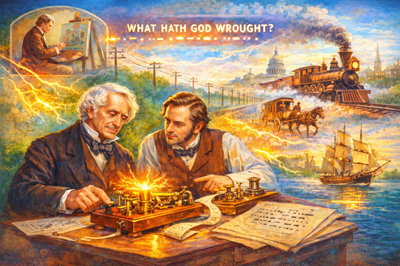 Morse code was born during a period of rapid technological experimentation in the early 19th century. Samuel Morse, originally a painter, became fascinated with the idea of transmitting information over long distances using electricity. Working alongside Alfred Vail, he helped transform a theoretical concept into a functioning system.
The telegraph was the hardware—but Morse code was the language that made it useful. Instead of sending full written characters, the system encoded letters into combinations of electrical pulses. This dramatically simplified transmission and allowed messages to travel across wires at unprecedented speeds.
The first successful long-distance message sent in 1844—“What hath God wrought?”—marked a turning point. Communication was no longer bound by physical travel. Information could now move faster than people, goods, or even trains. This fundamentally reshaped commerce, journalism, military strategy, and human connection.
What began as a technical experiment quickly evolved into a global communication standard.
3 Evolution Into International Morse Code
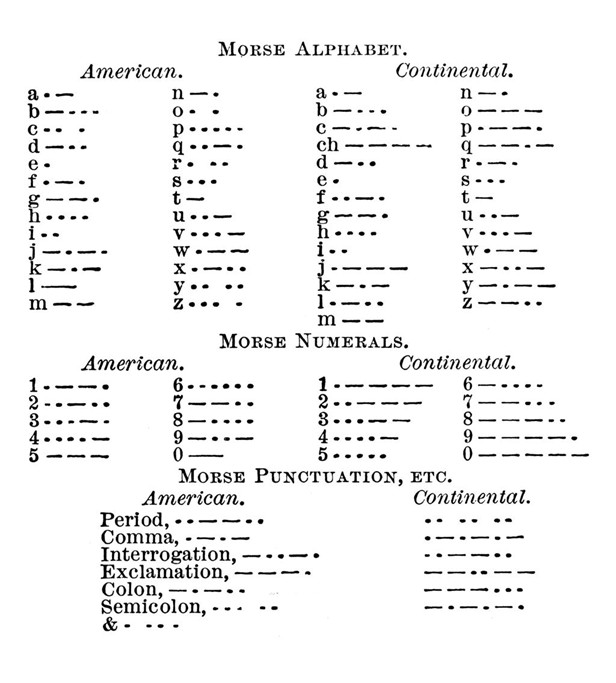 Early Morse code, now known as American Morse, contained irregular timing and spacing that made it difficult to standardize internationally. As communication expanded across continents and oceans, the need for a simpler, more consistent system became clear.
This led to the creation of International Morse Code in 1865. The revised system eliminated inconsistencies and established a universal structure that could be used regardless of language or region. This standardization was critical—it allowed operators from different countries to communicate without needing to share a spoken language.
Over time, International Morse Code became the dominant system used in maritime navigation, aviation, military operations, and global communication networks. Even today, it remains the version taught and used worldwide.
4 How Morse Code Works: Timing and Rhythm
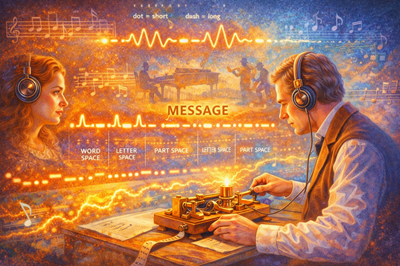 At first glance, Morse code looks like a simple sequence of dots and dashes. In reality, it is a carefully timed system where rhythm carries meaning just as much as the symbols themselves.
A dot represents a short signal, while a dash represents a signal three times longer. The spacing between elements is equally important. A brief pause separates parts of a letter, a slightly longer pause separates letters, and a longer pause separates words. This timing creates a recognizable cadence that experienced operators can interpret almost instinctively.
Unlike written language, Morse code is often learned as a sound pattern rather than a visual one. Skilled users don’t think in dots and dashes—they hear entire letters or words as rhythms. This is similar to how musicians recognize chords or how fluent speakers process spoken language without consciously parsing each syllable.
This rhythmic nature is one of Morse code’s greatest strengths. Even when signals are weak, distorted, or partially lost, the timing often remains recognizable enough to reconstruct the message.
5 The Alphabet and Structure
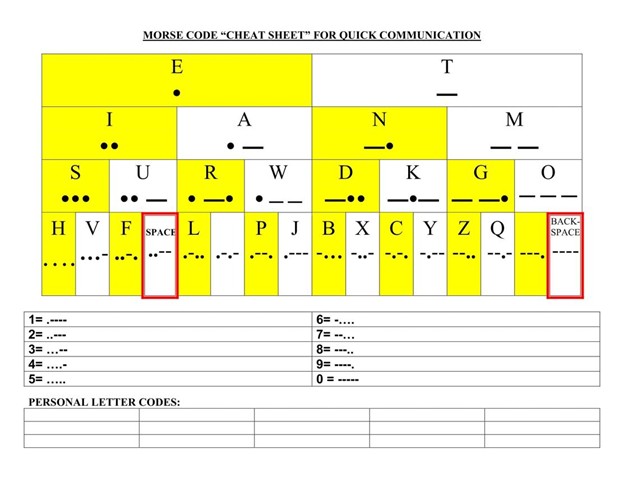
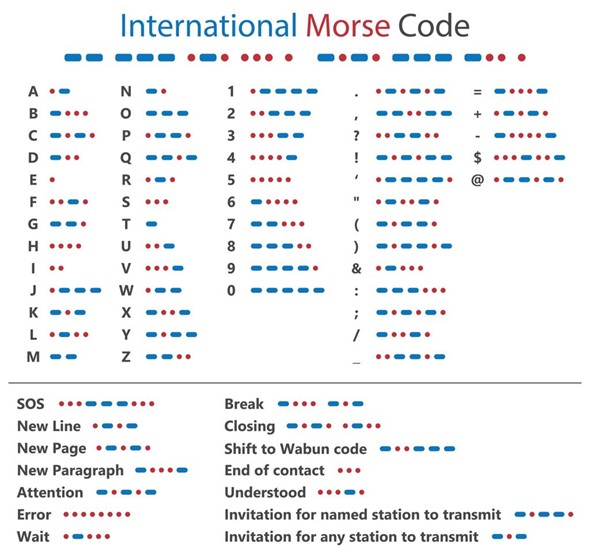
Morse code assigns a unique combination of dots and dashes to each letter, number, and common punctuation mark. The system is not random—frequently used letters such as “E” and “T” are given the simplest codes (a single dot and a single dash), while less common letters have longer sequences.
This efficiency was intentional. It reduced transmission time and minimized errors, especially when sending messages over long distances or through noisy channels.
Numbers and punctuation follow similar patterns, allowing Morse code to represent complete written communication. Over time, operators also developed abbreviations and shorthand signals—known as prosigns—to speed up exchanges and convey common phrases quickly.
6 SOS: The Universal Distress Signal
One of the most widely recognized elements of Morse code is the distress signal:
·· ––– ···
This sequence, known as SOS, was chosen not because of its meaning as letters, but because of its simplicity and unmistakable pattern. Three short signals, three long signals, and three short signals create a rhythm that is easy to recognize even under poor conditions.
SOS became the international standard for distress calls in the early 20th century and was used in numerous maritime emergencies, including the sinking of the Titanic. Its continued recognition today makes it one of the most important signals anyone can learn.
7 Methods of Transmission: From Wire to Wilderness
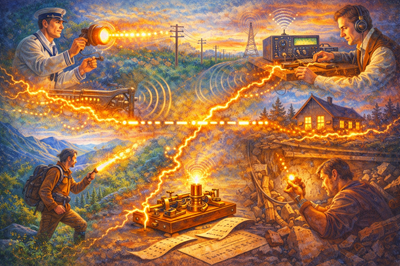 One of the defining strengths of Morse code is its adaptability. It is not tied to any single technology or medium. Instead, it can be transmitted using whatever resources are available.
Historically, Morse code traveled through telegraph wires as electrical pulses. As technology evolved, it found new forms—radio transmissions, signal lamps, and even mechanical devices. In modern times, it can still be sent using simple tools like flashlights, whistles, or tapping sounds.
In survival situations, this flexibility becomes invaluable. A stranded hiker can signal rescuers with a flashlight. Someone trapped under debris can tap messages through pipes or walls. A prepper community can establish low-tech signaling systems that function independently of the grid.
The method may change, but the language remains the same.
8 Where Morse Code Is Still Used Today
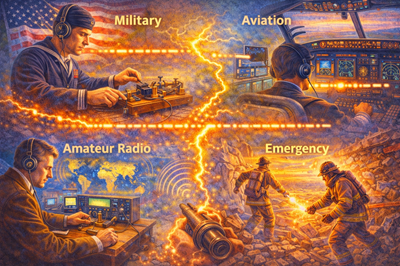 Despite being over a century old, Morse code has not disappeared. Instead, it has found specialized roles where reliability and simplicity are unmatched.
In aviation, Morse code is still used to identify navigation beacons, allowing pilots to confirm their location even if visual systems fail. In the military, it remains part of training for certain communication scenarios where stealth or redundancy is required.
Perhaps its most active community today is within amateur radio. Ham radio operators around the world continue to use Morse code because it can transmit over long distances with minimal power and bandwidth. In weak signal conditions where voice communication fails, Morse code often succeeds.
Additionally, Morse code has been adapted for accessibility. Individuals with severe physical limitations have used it as a communication method through eye blinks or small movements, demonstrating its versatility beyond traditional uses.
9 Learning Morse Code: A Different Way of Thinking
 Learning Morse code is not about memorizing symbols—it’s about developing a new way of perceiving patterns. Beginners often start by associating dots and dashes visually, but this approach quickly becomes limiting.
The most effective method is to learn Morse code as sound. By listening to the rhythm of each letter and practicing regularly, learners begin to recognize patterns instinctively. Over time, entire words can be understood without consciously decoding each character.
This process requires patience, but it also builds a unique cognitive skill. Morse code trains the brain to interpret timing, rhythm, and pattern recognition in a way that few other systems do.
10 Morse Code in Survival and Preparedness
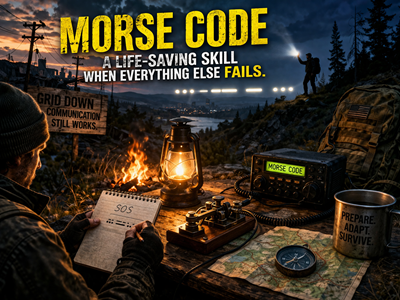 For those focused on preparedness, Morse code offers a level of redundancy that is difficult to match. It operates outside the dependencies of modern systems, making it immune to many of the failures that affect digital communication.
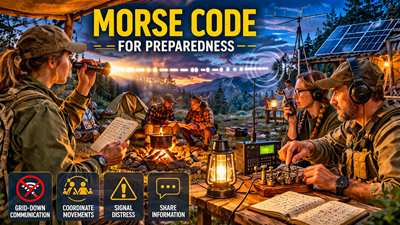
In a grid-down scenario, the ability to send and receive Morse code could provide a critical link between individuals or groups. It can be used to signal distress, coordinate movement, or share information without relying on infrastructure.
More importantly, it encourages a mindset of adaptability. Learning Morse code isn’t just about acquiring a skill—it’s about preparing for communication in uncertain conditions.
11 The Legacy and Future of Morse Code
 Morse code represents a bridge between the earliest days of electronic communication and the modern digital world. It laid the foundation for encoding information, influencing everything from binary systems to data transmission protocols.
Although its mainstream use has declined, its relevance has not disappeared. Instead, it has become a specialized tool—valued by those who understand its strengths and limitations.
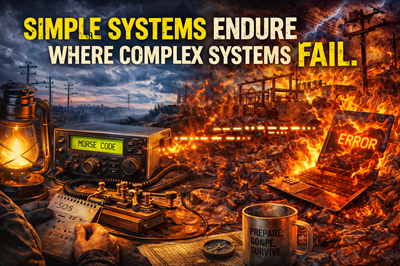
In many ways, Morse code embodies a principle that is central to preparedness: simple systems often endure where complex systems fail.
12 In Summary
 Morse code is more than a historical artifact. It is a living system that continues to prove its value in situations where reliability matters most. Its simplicity, adaptability, and independence from infrastructure make it one of the most enduring communication methods ever created.
In a world that increasingly depends on complex, interconnected systems, Morse code offers something rare—a way to communicate that cannot easily be taken away.
And that alone makes it worth learning.
© Prepping Communities. This content is for informational purposes only and not professional advice. Use at your own risk.
Terms | Privacy | Guidelines