
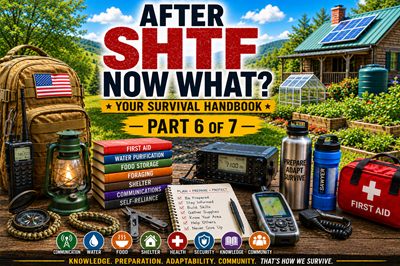
After SHTF – Your Survival Handbook
by Natural Born Prepper (2026-05-15)
TABLE OF CONTENTS |
|
PART VI — THE PREPPER MINDSET (Chapters 31-36) |
|
31. Why Preppers Search Differently
One of the biggest differences between prepared individuals and the general public during emergencies is not necessarily the amount of gear they own.
It is how they think.
During uncertain situations, most people instinctively search for reassurance. They want confirmation that systems will return to normal quickly and that someone else is fully in control of the situation.
Prepared individuals often approach emergencies differently.
Rather than focusing only on immediate fear or emotional reaction, they frequently begin asking practical questions involving:
- infrastructure
- supply chains
- transportation
- communication
- timelines
- regional impact
- resource availability
- long-term consequences
This difference in mindset becomes extremely important during crises because information gathering directly affects decision-making.
Historically, communities that survived difficult periods most effectively were often the ones capable of adapting calmly and realistically to changing conditions. Wars, disasters, famines, economic collapses, severe weather, and infrastructure failures repeatedly demonstrated that panic and denial often worsen emergencies more than the initial event itself.
Modern civilization became highly dependent on convenience, automation, and centralized systems functioning continuously in the background. Most people rarely think about how interconnected these systems are until something begins to fail.
Prepared individuals frequently spend time studying these systems before emergencies occur.
One important preparedness lesson is that awareness reduces panic.
People who already understand:
- food distribution
- fuel systems
- communication networks
- power infrastructure
- transportation systems
- medical supply chains
often respond more calmly because uncertainty becomes easier to interpret.
Preparedness increasingly means developing realistic awareness rather than living in constant fear.
Another important reality is that preparedness is not simply about expecting collapse.
Prepared individuals frequently focus on resilience, adaptability, and practical planning because disruptions of all kinds happen regularly throughout history.
Storms, blackouts, transportation failures, shortages, cyber incidents, inflation, wildfires, floods, and communication outages all demonstrate how quickly ordinary life may change when infrastructure becomes unstable.
Preparedness ultimately improves resilience by helping individuals think strategically rather than react emotionally during uncertainty.
This is another reason offline preparedness matters so much.
A system like Prepper Offline may help preserve preparedness knowledge independently from internet access during communication disruption or infrastructure instability. Individuals may still retain access to emergency planning guides, survival references, offline maps, infrastructure information, and practical resilience knowledge stored locally across offline devices.
Likewise, preparedness communities may become increasingly valuable during uncertain times.
A platform like Prepping Communities may help preparedness-minded individuals connect with local groups discussing infrastructure awareness, emergency planning, communication systems, homesteading, local resilience, and mutual assistance before emergencies occur.
Preparedness ultimately means strengthening awareness, adaptability, and long-term resilience before systems become unstable.
31.1 Situational Assessment vs Panic
One of the most important preparedness skills is the ability to assess situations calmly rather than reacting emotionally.
Prepared individuals frequently recognize that panic often causes poor decisions involving:
- unnecessary travel
- dangerous behavior
- wasteful purchasing
- misinformation
- conflict
- resource mismanagement
Historically, crises repeatedly demonstrated that fear spreads quickly when people lack reliable information or practical planning.
Modern populations became accustomed to instant communication and immediate convenience, making sudden uncertainty psychologically difficult for many people.
Prepared individuals often focus heavily on slowing down mentally during emergencies and asking practical questions such as:
- What is actually happening?
- How widespread is the disruption?
- What systems are affected?
- What resources are available?
- What problems may develop next?
One important preparedness lesson is that calm observation often provides more value than immediate reaction.
Preparedness increasingly means developing emotional discipline alongside physical preparation.
31.2 Infrastructure Monitoring
Prepared individuals frequently think differently because they pay attention to infrastructure rather than only surface-level events.
Modern civilization depends on interconnected systems involving:
- electricity
- transportation
- fuel
- communication
- water
- food distribution
- healthcare
- financial systems
Most people rarely notice these systems during ordinary life because they operate quietly in the background.
Emergencies reveal how important they really are.
Historically, communities surviving difficult periods often developed strong awareness of:
- transportation routes
- weather patterns
- food systems
- local resources
- communication networks
- regional vulnerabilities
because survival depended heavily on understanding changing conditions.
One important preparedness lesson is that infrastructure failures rarely happen completely without warning.
Prepared individuals frequently monitor patterns involving:
- shortages
- delays
- outages
- transportation issues
- fuel availability
- communication instability
because early awareness improves decision-making and adaptability.
Preparedness increasingly means understanding systems rather than reacting only to headlines.
31.3 Supply Chain Awareness
Modern supply chains are among the most complex systems supporting daily life.
Prepared individuals frequently recognize that grocery stores, pharmacies, fuel stations, hospitals, and retail systems depend heavily on continuous transportation and logistics infrastructure functioning smoothly.
Most people rarely think about this complexity because shelves appear constantly stocked during ordinary conditions.
Emergencies reveal how quickly supply systems may become unstable.
Historically, communities relied far more heavily on local production, preservation, farming, and regional trade because long-distance supply systems were slower and less centralized.
Modern civilization dramatically improved efficiency, but also increased dependency on global logistics systems.
One important preparedness lesson is that shortages often begin gradually before becoming obvious to the public.
Prepared individuals frequently pay attention to:
- delivery delays
- rising prices
- inventory inconsistency
- transportation disruption
- fuel shortages
- changing consumer behavior
because these patterns may reveal deeper infrastructure stress.
Preparedness ultimately strengthens resilience through awareness and gradual adaptation rather than panic-driven reaction.
31.4 Strategic Thinking During Crisis
Prepared individuals frequently focus on long-term consequences rather than only immediate problems during emergencies.
Modern populations often become highly reactive during crises because uncertainty creates emotional stress and pressure for immediate answers.
Historically, communities surviving difficult periods often succeeded because they thought strategically about:
- resource conservation
- transportation
- communication
- security
- food management
- long-term sustainability
rather than assuming conditions would quickly return to normal.
One important preparedness lesson is that strategic thinking improves flexibility.
Prepared individuals frequently ask:
- What if this lasts longer than expected?
- What systems may fail next?
- What resources become most important over time?
- How can waste be reduced?
- What local options exist?
Preparedness increasingly means planning beyond the first few hours or days of a crisis.
Another important reality is that strategic thinking often reduces fear because preparation creates options.
People who already considered transportation alternatives, communication plans, food storage, medical preparedness, and local coordination frequently adapt more calmly during instability.
Preparedness ultimately strengthens resilience through planning and realistic awareness rather than emotional reaction.
31.5 Long-Term Adaptation
One of the most important preparedness concepts is adaptation.
Prepared individuals frequently recognize that emergencies are rarely static. Conditions evolve continuously over time.
Power outages may become fuel shortages.
Fuel shortages may affect food distribution.
Transportation problems may affect medical access.
Communication outages may increase confusion and panic.
Historically, communities surviving long periods of instability adapted gradually by changing habits, conserving resources, strengthening local relationships, and improving self-reliance.
Modern civilization became highly optimized around convenience and efficiency, but emergencies often reward flexibility and adaptability instead.
One important preparedness lesson is that resilience is not built overnight during a crisis.
Prepared individuals frequently spend time developing:
- practical skills
- local awareness
- communication capability
- food resilience
- medical preparedness
- transportation flexibility
- community relationships
before emergencies occur.
Preparedness increasingly means creating systems that remain useful even during instability rather than depending entirely on fragile convenience infrastructure.
This is one reason systems like Prepper Offline may become extremely valuable during prolonged outages or infrastructure disruption. By storing preparedness knowledge locally across offline devices, individuals may continue accessing emergency planning guides, survival references, offline maps, infrastructure information, and practical resilience knowledge even if internet systems become unavailable.
Likewise, Prepping Communities may help preparedness-minded individuals build local preparedness groups, resilience communities, emergency planning networks, homesteading discussions, and mutual assistance systems before emergencies occur.
Preparedness ultimately means strengthening awareness, adaptability, practical knowledge, and long-term resilience before modern infrastructure becomes unstable.
32. The Shift After 72 Hours
One of the most important preparedness realities is that emergencies change dramatically as time passes.
During the first few hours of a crisis, most people focus heavily on gathering information. They search for updates, check their phones repeatedly, watch the news, contact family members, monitor social media, and wait for reassurance that systems will return to normal quickly.
The first stage of most emergencies is dominated by uncertainty.
People want answers.
They ask what happened, how widespread the disruption is, how long it may last, whether help is coming, and whether systems will recover soon.
Prepared individuals frequently recognize that the psychological atmosphere begins changing significantly after roughly the first seventy-two hours.
As outages continue, shortages begin appearing, communication systems remain unstable, and normal routines fail to return, many people slowly begin realizing the situation may last longer than initially expected.
Historically, this transition period has been extremely important during disasters, wars, blackouts, hurricanes, floods, economic crises, and infrastructure failures.
The first few days often involve confusion and hope for rapid restoration.
After that, reality begins settling in.
Modern civilization became deeply dependent on convenience infrastructure functioning continuously in the background. Most people rarely think about fuel distribution, food transportation, refrigeration, communication systems, banking networks, water systems, or medical supply chains until those systems stop functioning normally.
Prepared individuals frequently spend time thinking about these systems before emergencies occur.
One important preparedness lesson is that prolonged emergencies create different challenges than short-term disruptions.
The longer instability continues, the more important become adaptability, emotional resilience, resource management, community relationships, practical skills, and long-term planning.
Preparedness increasingly means understanding that survival is not only physical.
It is psychological, social, and logistical as well.
Another important reality is that prolonged uncertainty exhausts people mentally.
Fear, isolation, lack of information, disrupted routines, poor sleep, financial stress, shortages, and social tension may gradually wear people down over time.
Prepared individuals frequently focus on maintaining structure, routines, planning, communication, and practical purpose during emergencies because psychological resilience becomes critically important during long-term instability.
Preparedness ultimately improves resilience by helping people adapt gradually rather than collapse emotionally under prolonged stress.
This is another reason offline preparedness matters so much.
A system like Prepper Offline may help preserve preparedness knowledge independently from internet access during prolonged outages or infrastructure instability. Individuals may still retain access to emergency planning guides, survival references, offline maps, food and medical information, communication resources, and practical resilience knowledge stored locally across offline devices.
Likewise, preparedness communities may become increasingly valuable during long-term emergencies.
A platform like Prepping Communities may help preparedness-minded individuals connect with local groups discussing emergency coordination, homesteading, communication systems, medical preparedness, food resilience, and mutual assistance before emergencies occur.
Preparedness ultimately means strengthening awareness, adaptability, emotional resilience, and local capability before modern systems become unstable.
32.1 From Information to Survival
During the early stages of most emergencies, people focus primarily on information.
They constantly monitor news reports, alerts, social media, communication systems, official statements, and online discussions because they believe understanding the situation will restore a sense of control.
Prepared individuals frequently recognize that after several days, priorities begin shifting away from information gathering and toward practical survival concerns.
Historically, communities experiencing prolonged disasters or instability often moved gradually from observation into adaptation.
As outages continued, people became more focused on food, water, fuel, sanitation, communication, medical care, and transportation because survival needs became more immediate than constant updates.
One important preparedness lesson is that information remains important, but practical capability becomes increasingly critical as emergencies continue.
Prepared individuals frequently focus on balancing situational awareness with resource conservation and long-term planning.
Preparedness increasingly means understanding when to shift from observation into sustainable action.
32.2 The Collapse of Convenience
Modern civilization is built heavily around convenience.
Most people expect instant communication, unlimited electricity, immediate transportation, stocked grocery shelves, digital payments, climate control, internet access, and rapid delivery systems to function continuously without interruption.
Emergencies reveal how dependent society became on these systems.
Prepared individuals frequently recognize that one of the hardest adjustments during prolonged instability is psychological rather than physical.
People struggle with the sudden loss of convenience.
Historically, communities lived with far greater self-reliance and far fewer automated systems. Daily life required more direct involvement in food production, water management, preservation, heating, transportation, and communication.
Modern infrastructure removed much of that burden, but also increased dependency.
One important preparedness lesson is that adaptation becomes easier when expectations are realistic.
Prepared individuals frequently focus on flexibility and problem-solving because emotional frustration over lost convenience may impair judgment during emergencies.
Preparedness ultimately improves resilience by helping people adapt mentally as systems become less reliable.
32.3 Psychological Fatigue
One of the most underestimated aspects of prolonged emergencies is psychological exhaustion.
Prepared individuals frequently recognize that fear, uncertainty, disrupted sleep, isolation, shortages, poor communication, financial stress, and constant instability may gradually wear people down emotionally over time.
Historically, populations surviving wars, disasters, evacuations, and long-term hardship often faced enormous psychological strain even when immediate physical survival needs were met.
Modern populations are particularly vulnerable to uncertainty because society became highly structured around routine, predictability, and continuous connectivity.
Emergencies disrupt all of those systems simultaneously.
One important preparedness lesson is that emotional resilience matters enormously during long-term instability.
Prepared individuals frequently focus on maintaining routines, communication, structure, purpose, planning, and cooperation because stability helps reduce panic and emotional collapse.
Preparedness increasingly means strengthening mental adaptability alongside physical preparedness.
32.4 Resource Management
One of the most important differences between short-term emergencies and prolonged crises is the growing importance of resource management.
During the first stages of an emergency, many people consume supplies rapidly because they assume restoration will happen quickly.
Prepared individuals frequently recognize that long-term uncertainty requires a completely different mindset.
Historically, communities surviving difficult conditions focused heavily on rationing, conservation, repair, preservation, maintenance, reuse, and careful planning because resources could not easily be replaced.
Modern consumer culture encourages constant consumption and convenience, but emergencies reward efficiency and adaptability instead.
One important preparedness lesson is that waste becomes increasingly dangerous during prolonged instability.
Prepared individuals frequently focus on tracking supplies, reducing unnecessary consumption, preserving fuel, managing food carefully, protecting tools, and conserving medical resources because sustainability becomes more important over time.
Preparedness ultimately strengthens resilience through planning and discipline rather than emotional reaction.
32.5 Community Dependence
One of the biggest realizations many people experience during prolonged emergencies is that survival rarely remains purely individual for very long.
Prepared individuals frequently recognize that communities become increasingly important as crises continue.
Historically, resilient communities survived hardship more effectively because people shared skills, labor, information, transportation, food production, security, caregiving, and communication.
Modern society became highly individualized, but emergencies repeatedly demonstrate how dependent people remain on cooperation and local relationships.
One important preparedness lesson is that isolation often becomes harder over time during prolonged instability.
Prepared individuals frequently focus on building local relationships and mutual assistance before emergencies occur because trust and coordination become extremely valuable during difficult conditions.
Preparedness increasingly means strengthening community resilience alongside personal preparedness.
This is one reason systems like Prepper Offline may become extremely valuable during prolonged outages or infrastructure disruption. By storing preparedness knowledge locally across offline devices, individuals may continue accessing emergency planning guides, survival references, offline maps, medical information, food preparedness resources, and practical resilience knowledge even if internet systems become unavailable.
Likewise, Prepping Communities may help preparedness-minded individuals build local preparedness groups, resilience communities, emergency coordination networks, homesteading discussions, and mutual assistance systems before emergencies occur.
Preparedness ultimately means strengthening awareness, adaptability, emotional resilience, and community capability before modern infrastructure becomes unstable.
33. Communication Failures and Information Collapse
Modern civilization became deeply dependent on communication systems functioning continuously in the background. Internet access, cellular networks, cloud services, search engines, social media platforms, mapping systems, banking networks, emergency alerts, streaming services, and digital communication tools all became woven into nearly every aspect of daily life.
Most people rarely think about how dependent they became on these systems until they stop functioning normally.
Emergencies reveal how fragile modern communication infrastructure may actually be.
Prepared individuals frequently recognize that communication failures create far more than inconvenience. When communication systems weaken, people may lose access to emergency information, navigation, financial systems, coordination, transportation updates, medical guidance, family communication, and situational awareness.
Historically, communities relied on far more decentralized communication systems involving radios, printed materials, local coordination, physical message systems, and regional communication networks.
Modern digital systems dramatically improved speed and convenience, but also centralized enormous amounts of information into relatively fragile infrastructure.
One important preparedness lesson is that information itself becomes a survival resource during emergencies.
People who understand what is happening, how systems are changing, and what risks are developing often make far better decisions than those operating in confusion or panic.
Prepared individuals frequently focus heavily on communication resilience because access to reliable information directly affects transportation decisions, food management, medical response, security awareness, evacuation planning, and family coordination.
Another important reality is that modern communication systems are highly interconnected.
Internet access depends on electrical infrastructure, fiber networks, data centers, cloud providers, satellites, communication routing systems, cellular towers, and cybersecurity infrastructure.
Failures within one part of the system may create cascading disruption very quickly.
Preparedness increasingly means understanding communication vulnerability before emergencies occur.
One important preparedness lesson is that centralized systems often become overloaded during crises precisely when people need them most.
Prepared individuals frequently recognize that communication resilience requires redundancy, decentralization, and practical alternatives rather than dependence on one platform or technology.
Preparedness ultimately improves resilience by reducing dependence on fragile infrastructure during unstable conditions.
This is another reason offline preparedness matters so much.
A system like Prepper Offline may help preserve preparedness knowledge independently from internet access during communication disruption or infrastructure instability. Individuals may still retain access to emergency planning guides, offline maps, medical references, survival information, and practical resilience knowledge stored locally across offline devices.
Likewise, preparedness communities may become increasingly valuable during communication instability or information disruption.
A platform like Prepping Communities may help preparedness-minded individuals connect with local groups discussing communication systems, emergency planning, decentralized coordination, local resilience, and mutual assistance before emergencies occur.
Preparedness ultimately means strengthening awareness, adaptability, and communication resilience before modern infrastructure becomes unstable.
33.1 The Fragility of the Internet
Most people think of the internet as something permanent and nearly indestructible because it became such a normal part of everyday life.
Prepared individuals frequently recognize that the internet is actually an enormous collection of interconnected infrastructure systems that depend heavily on electricity, fiber optic networks, undersea cables, satellites, data centers, routing systems, cellular infrastructure, and cloud providers.
Historically, communication systems were often more localized and decentralized. Modern internet infrastructure dramatically improved global communication, but also concentrated enormous amounts of dependency into digital systems.
One important preparedness lesson is that internet access may fail for many different reasons involving power outages, severe weather, cyber incidents, overloaded infrastructure, damaged cables, communication failures, or regional instability.
Prepared individuals frequently focus on maintaining communication and information alternatives because internet access itself should never be assumed permanent during emergencies.
Preparedness increasingly means planning for reduced connectivity rather than total dependence on continuous online access.
33.2 Cloud Dependence Risks
Modern society quietly shifted enormous amounts of critical information into cloud-based systems.
Most people no longer store information locally.
Instead, communication, photos, financial records, documents, maps, contacts, media, and even emergency resources often exist primarily through internet-dependent platforms.
Prepared individuals frequently recognize that this creates major vulnerability during infrastructure disruption.
Historically, people maintained physical books, printed references, paper maps, local records, and independently stored information because access did not depend on distant servers remaining continuously available.
Modern cloud systems improved convenience dramatically, but also centralized information into infrastructure most people neither control nor fully understand.
One important preparedness lesson is that access matters just as much as ownership.
Information stored online may become difficult or impossible to reach during internet outages, communication failures, account problems, power outages, or infrastructure instability.
Prepared individuals frequently focus on maintaining local copies of critical information because preparedness increasingly means preserving access independently from cloud systems.
This is one reason offline systems like Prepper Offline may become extremely valuable during prolonged outages or communication failures.
33.3 Why Search Engines Cannot Be Trusted During Crisis
Modern populations became highly dependent on search engines for nearly all information gathering.
During ordinary life, people instinctively search online for answers involving emergencies, medical questions, transportation, news, food safety, weather, communication, and survival information.
Prepared individuals frequently recognize that search engines may become unreliable during crises for several reasons.
Historically, information systems have always struggled during periods of confusion because rumors, incomplete reports, propaganda, fear, and rapidly changing conditions often spread faster than verified information.
Modern digital systems accelerated this problem dramatically.
One important preparedness lesson is that search engines prioritize algorithms, popularity, engagement, and indexing systems — not necessarily accuracy, context, or reliability during rapidly developing emergencies.
Prepared individuals frequently recognize that outdated information, conflicting reports, misinformation, censorship, overload, manipulated content, and algorithmic filtering may all affect online information during crises.
Preparedness increasingly means developing critical thinking and independent verification skills rather than blindly trusting digital information systems during emergencies.
33.4 Information Bottlenecks
One of the biggest problems during emergencies is that information often becomes centralized into a small number of channels.
Prepared individuals frequently recognize that when millions of people attempt to access updates simultaneously, communication systems may become overloaded very quickly.
Historically, bottlenecks occurred whenever transportation routes narrowed, communication systems centralized, governments controlled messaging, or infrastructure became damaged.
Modern internet systems created the appearance of unlimited communication, but much of the infrastructure remains surprisingly centralized.
One important preparedness lesson is that bottlenecks may affect both technology and human behavior.
People tend to gather around a small number of news sources, social media platforms, official statements, viral rumors, and trending narratives during uncertainty.
Prepared individuals frequently focus on maintaining multiple independent information pathways because diversified communication improves resilience.
Preparedness ultimately strengthens adaptability by reducing dependence on any single source of information during crises.
33.5 Decentralized Communication
Historically, resilient communities often relied on decentralized communication systems because no single infrastructure network could fully support every situation.
People used local coordination, radios, physical message systems, regional networks, face-to-face communication, and printed references to maintain awareness and cooperation.
Modern civilization centralized enormous amounts of communication into smartphones, cloud systems, social media platforms, and internet-dependent infrastructure.
Prepared individuals frequently recognize that decentralization improves resilience because it reduces dependency on fragile centralized systems.
One important preparedness lesson is that communication redundancy matters enormously during emergencies.
Prepared individuals frequently focus on HAM radio, CB communication, GMRS systems, offline messaging, local coordination, printed materials, and community awareness because layered communication systems improve adaptability during instability.
Preparedness increasingly means rebuilding local communication resilience before emergencies occur.
This is one reason systems like Prepper Offline may become extremely valuable during prolonged communication outages or infrastructure disruption. By storing preparedness knowledge locally across offline devices, individuals may continue accessing emergency planning guides, offline maps, survival references, medical resources, and practical resilience knowledge even if internet systems become unavailable.
Likewise, Prepping Communities may help preparedness-minded individuals build local preparedness groups, communication networks, emergency coordination systems, resilience communities, and mutual assistance networks before emergencies occur.
Preparedness ultimately means strengthening awareness, communication flexibility, decentralization, and long-term resilience before modern infrastructure becomes unstable.
34. The Importance of Offline Knowledge
Modern civilization became deeply dependent on instant digital access to information. Most people no longer memorize large amounts of practical knowledge because answers appear instantly through search engines, video platforms, cloud systems, mobile applications, and online communities.
During ordinary life, this convenience feels permanent.
Emergencies reveal how fragile that assumption may become.
Prepared individuals frequently recognize that knowledge is only useful if it remains accessible during infrastructure disruption.
When internet systems fail, power outages occur, communication networks become overloaded, or cloud services become unavailable, enormous amounts of information may suddenly become difficult or impossible to access.
People often assume they “have” information simply because they can normally reach it online.
Prepared individuals frequently think differently.
They recognize that access matters just as much as ownership.
Historically, communities preserved practical knowledge through:
- books
- manuals
- printed references
- oral traditions
- field guides
- local education
- personal libraries
because information needed to remain available independently from distant infrastructure.
Modern society centralized enormous amounts of knowledge into internet-dependent systems. Medical information, maps, repair guides, food preservation instructions, communication knowledge, survival skills, and emergency procedures increasingly exist inside cloud-based platforms most people neither control nor store locally.
One important preparedness lesson is that infrastructure failures may create information failures very quickly.
Without access to reliable information, people may struggle with:
- medical emergencies
- food safety
- water purification
- navigation
- communication planning
- repair work
- transportation
- resource management
Prepared individuals frequently focus heavily on preserving critical knowledge locally because practical information directly affects survival and decision-making during emergencies.
Another important reality is that stress and uncertainty impair memory.
Even experienced individuals may forget procedures or details during high-pressure situations.
Preparedness increasingly means preserving organized, accessible knowledge before emergencies occur rather than assuming memory alone will remain reliable during crisis conditions.
One important preparedness lesson is that offline knowledge systems improve both resilience and confidence.
People who retain access to practical information during communication outages or infrastructure disruption often remain calmer and more adaptable because they still have guidance available when systems become unstable.
Preparedness ultimately strengthens resilience by preserving access to critical knowledge independently from fragile infrastructure.
This is another reason offline preparedness matters so much.
A system like Prepper Offline was built specifically around this concept. By storing preparedness knowledge locally across offline devices, individuals may continue accessing emergency planning guides, survival references, offline maps, medical information, communication resources, homesteading knowledge, and practical resilience information even if internet systems become unavailable.
Likewise, preparedness communities may become increasingly valuable during periods of instability or communication disruption.
A platform like Prepping Communities may help preparedness-minded individuals connect with local groups discussing emergency planning, homesteading, communication systems, medical preparedness, local resilience, and mutual assistance before emergencies occur.
Preparedness ultimately means strengthening awareness, adaptability, and long-term knowledge resilience before modern infrastructure becomes unstable.
34.1 Offline Libraries
One of the most valuable preparedness concepts is the creation of offline libraries containing practical survival and preparedness information.
Prepared individuals frequently recognize that digital information remains extremely powerful as long as it can still be accessed locally without depending on internet connectivity.
Historically, libraries represented some of the most important centers of resilience within civilizations because preserved knowledge allowed communities to maintain:
- education
- medicine
- engineering
- agriculture
- communication
- practical survival skills
during periods of instability and change.
Modern internet systems dramatically increased access to information, but also centralized much of that knowledge into cloud-dependent infrastructure.
Prepared individuals frequently focus on preserving critical information locally because internet access itself may become unreliable during emergencies.
One important preparedness lesson is that organized information improves adaptability.
Offline libraries may help individuals retain access to:
- medical guides
- food preservation references
- repair manuals
- communication information
- navigation resources
- emergency planning materials
even during prolonged outages.
Preparedness increasingly means preserving both supplies and knowledge before crises occur.
34.2 Printed References
Despite modern digital technology, printed references remain one of the most resilient forms of information storage ever developed.
Prepared individuals frequently recognize that books, manuals, maps, and printed guides require:
- no electricity
- no internet
- no batteries
- no cloud systems
- no servers
Historically, printed knowledge preserved civilizations through wars, disasters, economic collapse, and technological disruption because physical references remained accessible independently from fragile infrastructure systems.
Modern populations often underestimate the value of printed information because digital convenience became so dominant.
Emergencies reveal how valuable physical references may still become.
One important preparedness lesson is that redundancy matters enormously.
Prepared individuals frequently maintain printed references involving:
- first aid
- water purification
- food preservation
- communication systems
- maps
- repair guides
- survival skills
because physical information systems remain reliable under conditions where digital systems may fail.
Preparedness ultimately improves resilience by preserving practical knowledge in multiple forms.
34.3 Portable Information Systems
One important advantage of modern preparedness technology is that enormous amounts of practical knowledge may now be stored in highly portable formats.
Prepared individuals frequently recognize that portable offline systems allow critical information to travel with them during:
- evacuations
- transportation disruption
- power outages
- communication failures
- long-term emergencies
Historically, survival knowledge often depended on memory or physical books that could be difficult to transport in large quantities.
Modern digital storage dramatically improved portability while still allowing local offline access when systems are designed properly.
One important preparedness lesson is that portability improves flexibility during uncertain conditions.
Prepared individuals frequently focus on maintaining information systems that may be stored across:
- USB drives
- laptops
- tablets
- external drives
- backup devices
because redundancy and mobility improve resilience during emergencies.
Preparedness increasingly means balancing modern technology with independence from continuous internet connectivity.
This is one reason systems like Prepper Offline may become extremely valuable during prolonged outages or infrastructure instability.
34.4 Redundancy Planning
One of the core principles of preparedness is redundancy.
Prepared individuals frequently recognize that systems fail, equipment breaks, batteries die, storage devices become damaged, and infrastructure may become unreliable during emergencies.
Historically, resilient communities survived instability partly because they avoided dependence on any single point of failure.
Modern civilization optimized heavily for efficiency and convenience, but emergencies repeatedly demonstrate the importance of backups and layered systems.
One important preparedness lesson is that redundancy reduces vulnerability.
Prepared individuals frequently apply redundancy to:
- communication systems
- food storage
- medical supplies
- transportation
- power systems
- water treatment
- information storage
because single-system dependence creates major risk during instability.
Preparedness increasingly means building multiple pathways for survival and adaptation rather than relying entirely on one technology or infrastructure system.
34.5 Knowledge Preservation
One of the most important preparedness concepts is that knowledge itself may become one of the most valuable survival resources during long-term instability.
Prepared individuals frequently recognize that tools, supplies, and equipment become far more useful when combined with practical understanding.
Historically, civilizations survived difficult periods because knowledge was preserved and passed between generations. Agriculture, medicine, engineering, communication, navigation, and survival skills all depended heavily on preserving practical information.
Modern civilization outsourced enormous amounts of knowledge into internet-dependent systems and specialized institutions.
Emergencies reveal how vulnerable this dependency may become.
One important preparedness lesson is that preserving knowledge improves long-term resilience far beyond short-term emergency survival.
Prepared individuals frequently focus on maintaining access to:
- practical skills
- repair knowledge
- medical references
- communication methods
- food production information
- sanitation guidance
- survival planning
because adaptability depends heavily on access to usable knowledge.
Preparedness increasingly means preserving both capability and information before infrastructure becomes unstable.
This is one reason systems like Prepper Offline may become extremely valuable during communication outages or infrastructure disruption. By storing preparedness knowledge locally across offline devices, individuals may continue accessing emergency planning guides, survival references, offline maps, medical information, food preparedness resources, repair manuals, and practical resilience knowledge even if internet systems become unavailable.
Likewise, Prepping Communities may help preparedness-minded individuals build local preparedness groups, homesteading communities, emergency planning networks, communication systems, and mutual assistance structures before emergencies occur.
Preparedness ultimately means strengthening knowledge resilience, adaptability, local capability, and long-term independence before modern systems become unstable.
35. Building a Personal Information Resilience Plan
One of the most overlooked preparedness realities is that modern people became highly dependent on instant digital access to information without thinking much about long-term accessibility.
Most individuals assume their information will always remain available through smartphones, cloud systems, search engines, online accounts, streaming platforms, and internet-connected devices.
Emergencies reveal how fragile that assumption may become.
Prepared individuals frequently recognize that information resilience is just as important as food, water, fuel, medical supplies, or transportation planning.
Without access to reliable information, people may struggle with:
- medical emergencies
- communication failures
- navigation
- repair work
- food preservation
- sanitation
- emergency planning
- decision-making
Historically, communities preserved practical knowledge locally because survival depended heavily on maintaining access to information independently from distant infrastructure systems.
Books, manuals, maps, field guides, handwritten records, local training, and oral knowledge all played important roles in helping communities adapt during disasters, wars, economic hardship, and long periods of instability.
Modern civilization centralized enormous amounts of information into cloud-based systems that depend on:
- internet connectivity
- electrical infrastructure
- servers
- data centers
- communication networks
- corporate platforms
Prepared individuals frequently recognize that these systems may become unavailable during emergencies precisely when information becomes most important.
One important preparedness lesson is that information resilience requires intentional planning.
Prepared individuals often ask practical questions such as:
- What information would still matter if internet access disappeared?
- What resources should remain available offline?
- How many backups exist?
- Would those backups survive power outages or device failure?
- Could information still be accessed during evacuation or transportation disruption?
Preparedness increasingly means thinking about access and redundancy rather than assuming digital systems will always function normally.
Another important reality is that information itself may become a stabilizing force during emergencies.
People who retain access to practical knowledge often remain calmer and more adaptable because they still have guidance available when communication systems fail or confusion spreads.
Preparedness ultimately improves resilience by reducing dependence on fragile digital infrastructure.
This is another reason offline preparedness matters so much.
A system like Prepper Offline was built specifically around this concept. By storing preparedness knowledge locally across offline devices, individuals may continue accessing emergency planning guides, survival references, medical information, offline maps, communication resources, food preparedness systems, and practical resilience knowledge even if internet systems become unavailable.
Likewise, preparedness communities may become increasingly valuable during communication disruption or infrastructure instability.
A platform like Prepping Communities may help preparedness-minded individuals connect with local groups discussing emergency planning, communication systems, homesteading, medical preparedness, local resilience, and mutual assistance before emergencies occur.
Preparedness ultimately means strengthening awareness, adaptability, and long-term knowledge resilience before modern infrastructure becomes unstable.
35.1 What Information to Store
One of the first steps in building an information resilience plan is identifying which knowledge would remain important during prolonged emergencies or infrastructure disruption.
Prepared individuals frequently recognize that many forms of information become far more valuable when internet access disappears.
Historically, households often maintained physical references involving medicine, food preservation, navigation, repair work, farming, communication systems, and practical survival skills because access to outside assistance was not guaranteed.
Modern populations became highly dependent on online search systems for nearly all practical knowledge.
Emergencies reveal how vulnerable this dependency may become.
One important preparedness lesson is that survival information should be organized before crises occur rather than searched for during emergencies.
Prepared individuals frequently focus on preserving access to:
- medical references
- first aid information
- water purification guidance
- food preservation methods
- offline maps
- communication procedures
- repair manuals
- emergency contact information
because practical knowledge directly affects adaptability during instability.
Preparedness increasingly means identifying what information truly matters before systems become unreliable.
35.2 Multiple Backup Methods
One of the core principles of preparedness is redundancy.
Prepared individuals frequently recognize that relying on only one storage method creates unnecessary vulnerability.
Historically, resilient communities survived instability partly because important knowledge and resources existed in multiple forms and locations.
Modern digital systems improved convenience dramatically, but emergencies repeatedly demonstrate that devices fail, batteries die, hardware becomes damaged, and cloud systems may become inaccessible.
One important preparedness lesson is that backups matter just as much as original storage.
Prepared individuals frequently maintain layered information systems involving:
- offline digital copies
- printed references
- portable storage
- duplicate backups
- physically separated storage locations
because redundancy improves resilience during uncertain conditions.
Preparedness increasingly means reducing single points of failure across all critical systems.
35.3 USB Drives and External Storage
Modern digital storage allows enormous amounts of practical knowledge to be preserved in highly portable formats.
Prepared individuals frequently recognize that USB drives, external hard drives, and offline storage systems may provide valuable resilience during communication outages or infrastructure disruption.
Historically, transporting large libraries of survival knowledge would have been extremely difficult.
Modern storage technology dramatically improved portability while still allowing local offline access when systems are designed properly.
One important preparedness lesson is that portability increases flexibility during emergencies.
Prepared individuals frequently focus on storing offline information across multiple devices because transportation disruption, evacuation, equipment damage, or hardware failure may affect access unexpectedly.
Preparedness increasingly means balancing modern technology with independence from continuous internet connectivity.
This is one reason systems like Prepper Offline may become extremely valuable during prolonged outages or communication failures. By storing preparedness information locally, users may continue accessing survival references, medical information, offline maps, emergency planning guides, and practical resilience knowledge directly from portable devices without relying on internet infrastructure.
35.4 Paper Backup Systems
Despite modern technology, paper remains one of the most reliable information storage systems ever developed.
Prepared individuals frequently recognize that printed materials require:
- no electricity
- no internet
- no batteries
- no operating systems
- no cloud infrastructure
Historically, books, manuals, printed maps, handwritten notes, and physical records preserved knowledge through wars, disasters, economic collapse, and technological disruption.
Modern populations often underestimate the value of printed references because digital systems became so dominant during ordinary life.
Emergencies reveal how useful physical information may still become.
One important preparedness lesson is that paper systems provide valuable resilience during prolonged outages or equipment failure.
Prepared individuals frequently maintain printed copies of:
- emergency contacts
- maps
- first aid guides
- communication frequencies
- food preservation information
- medical records
- evacuation plans
because physical references remain accessible even when digital systems fail completely.
Preparedness increasingly means preserving critical knowledge in multiple formats rather than depending entirely on electronic devices.
35.5 Testing Offline Preparedness
One of the most important preparedness principles is testing systems before emergencies occur.
Prepared individuals frequently recognize that plans often appear functional until real-world conditions expose weaknesses.
Historically, resilient communities survived difficult conditions partly because practical systems were used, practiced, and refined over time rather than simply stored away and forgotten.
Modern populations often purchase preparedness equipment or download information without fully testing whether those systems actually function independently from internet infrastructure.
One important preparedness lesson is that preparedness requires verification, not assumptions.
Prepared individuals frequently test:
- offline devices
- stored information
- backup power systems
- communication methods
- transportation plans
- emergency procedures
because small failures discovered early are far easier to correct before real emergencies occur.
Preparedness increasingly means practicing adaptability rather than simply accumulating supplies.
This is one reason systems like Prepper Offline may become extremely valuable during prolonged outages or communication disruption. By allowing individuals to test offline access to preparedness information before emergencies occur, users may build confidence that critical knowledge remains available independently from internet systems.
Likewise, Prepping Communities may help preparedness-minded individuals connect with local groups discussing emergency planning, communication systems, offline preparedness, local resilience, and mutual assistance before emergencies occur.
Preparedness ultimately means strengthening awareness, redundancy, practical capability, and long-term knowledge resilience before modern infrastructure becomes unstable.
36. Preparedness Information Everyone Should Save Offline
One of the most important preparedness lessons is that critical information becomes far more valuable when systems stop functioning normally.
During ordinary life, most people rely heavily on smartphones, search engines, cloud storage, streaming platforms, and internet access for nearly everything. Information feels unlimited because answers are usually only seconds away.
Emergencies reveal how fragile that convenience may become.
Prepared individuals frequently recognize that practical knowledge is only useful if it remains accessible during power outages, communication failures, internet disruption, transportation problems, or infrastructure instability.
Modern populations became deeply dependent on cloud-based systems for information storage, but emergencies may suddenly interrupt access to maps, medical guidance, communication procedures, emergency contacts, repair information, food preservation methods, and survival references.
Historically, communities maintained physical books, local records, field manuals, printed maps, and practical reference systems because survival depended heavily on preserving access to knowledge independently from distant infrastructure.
Modern technology dramatically improved portability and storage capacity, but preparedness still depends on the same core principle:
critical information should remain accessible even when normal systems fail.
Prepared individuals frequently focus on preserving practical information involving water, medical care, food, transportation, communication, navigation, emergency planning, and local resources because these categories directly affect survival and adaptability during crises.
Another important reality is that stress and uncertainty impair memory.
Even experienced individuals may forget procedures or details during emergencies.
Preparedness increasingly means creating organized systems that reduce confusion and preserve practical guidance under difficult conditions.
One important preparedness lesson is that offline knowledge improves both confidence and resilience.
People who maintain reliable access to practical information often adapt more calmly during instability because they retain the ability to make informed decisions even when internet systems become unreliable.
Preparedness ultimately strengthens long-term resilience by preserving access to usable knowledge independently from fragile infrastructure systems.
This is another reason offline preparedness matters so much.
A system like Prepper Offline was built specifically around this concept. By storing preparedness knowledge locally across offline devices, individuals may continue accessing emergency planning guides, medical references, communication information, survival checklists, food preparedness systems, offline maps, and practical resilience knowledge even if internet systems become unavailable.
Likewise, preparedness communities may become increasingly valuable during emergencies or infrastructure instability.
A platform like Prepping Communities may help preparedness-minded individuals connect with local groups discussing emergency planning, communication systems, homesteading, medical preparedness, local resilience, and mutual assistance before emergencies occur.
Preparedness ultimately means strengthening awareness, adaptability, and long-term information resilience before modern infrastructure becomes unstable.
36.1 Water Purification Guides
Water quickly becomes one of the most critical concerns during prolonged emergencies.
Prepared individuals frequently recognize that safe drinking water may become difficult to access during power outages, infrastructure failures, natural disasters, contamination events, or transportation disruption.
Historically, unsafe water caused enormous numbers of illnesses and deaths because communities lacked reliable purification systems and sanitation knowledge.
Modern infrastructure dramatically improved water safety, but emergencies may still disrupt treatment facilities, pumping systems, or distribution networks.
One important preparedness lesson is that water purification knowledge remains critically important even when equipment is available.
Prepared individuals frequently preserve offline information involving boiling procedures, filtration systems, chemical treatment, emergency storage, contamination risks, and sanitation methods because practical guidance may become essential during infrastructure instability.
Preparedness increasingly means preserving both tools and knowledge before emergencies occur.
36.2 Medical References
Medical information may become extremely valuable during communication outages or healthcare disruption.
Prepared individuals frequently recognize that access to hospitals, pharmacies, internet systems, or emergency responders may become delayed during prolonged emergencies.
Historically, households often maintained practical medical guides because professional care was not always immediately available.
Modern populations became highly dependent on online searches and centralized healthcare systems, but emergencies reveal how vulnerable this dependency may become.
One important preparedness lesson is that organized medical knowledge improves decision-making and reduces panic during emergencies.
Prepared individuals frequently preserve offline medical references involving first aid, wound care, dehydration, sanitation, infection prevention, medications, and emergency procedures because calm access to reliable information improves resilience during uncertainty.
Preparedness increasingly means preserving medical knowledge independently from internet systems.
36.3 Emergency Communications
Communication failures may quickly create confusion, isolation, and poor decision-making during emergencies.
Prepared individuals frequently recognize that emergency communication information should remain accessible even if cellular networks fail, internet systems collapse, power outages continue, or communication infrastructure becomes overloaded.
Historically, communities relied heavily on radios, printed frequency lists, local coordination systems, and decentralized communication methods because modern smartphone infrastructure did not yet exist.
Modern digital systems improved convenience dramatically, but emergencies repeatedly demonstrate the importance of communication redundancy.
One important preparedness lesson is that communication planning matters before emergencies begin.
Prepared individuals frequently preserve offline information involving radio frequencies, emergency channels, HAM communication, CB systems, GMRS systems, contact plans, and local communication procedures because communication resilience directly affects coordination and situational awareness during crises.
Preparedness increasingly means reducing dependence on any single communication system.
36.4 Maps and Navigation
Modern populations became highly dependent on internet-connected mapping systems and GPS applications for navigation.
During ordinary life, most people rarely think about how dependent they became on continuous connectivity for transportation and situational awareness.
Emergencies reveal how vulnerable that dependency may become.
Prepared individuals frequently recognize that navigation information remains critically important during evacuations, road closures, communication failures, severe weather, or transportation disruption.
Historically, physical maps, terrain knowledge, landmarks, and route familiarity played major roles in survival and travel.
Modern digital systems improved convenience dramatically, but preparedness still requires independent navigation capability.
One important preparedness lesson is that navigation systems should remain accessible even when internet systems fail.
Prepared individuals frequently preserve offline maps, regional route information, topographic maps, evacuation routes, fuel locations, and local infrastructure information because transportation flexibility improves resilience during emergencies.
Preparedness increasingly means understanding local geography rather than depending entirely on automated systems.
36.5 Food Preservation
Food shortages and refrigeration failures may quickly become serious problems during prolonged emergencies.
Prepared individuals frequently recognize that food preservation knowledge may become extremely valuable when supply chains weaken or electrical systems fail.
Historically, communities survived difficult periods through canning, drying, smoking, curing, root cellars, fermentation, and cold storage methods because refrigeration did not yet exist.
Modern populations became heavily dependent on industrial food systems and refrigeration infrastructure, but emergencies reveal how quickly those systems may become unstable.
One important preparedness lesson is that preserving food extends both resilience and flexibility during uncertain conditions.
Prepared individuals frequently preserve offline information involving food safety, dehydration, canning, preservation methods, storage planning, and spoilage prevention because practical food knowledge improves long-term adaptability during crises.
Preparedness increasingly means rebuilding practical capability before infrastructure disruption occurs.
36.6 Survival Checklists
One of the most useful preparedness tools during emergencies is organization.
Prepared individuals frequently recognize that stress, fatigue, fear, and confusion may impair judgment during crises.
Historically, structured systems and routines helped communities maintain stability during difficult conditions because people could follow established procedures even under pressure.
Modern emergencies often create overwhelming amounts of information and competing priorities.
One important preparedness lesson is that checklists reduce confusion and improve consistency.
Prepared individuals frequently preserve offline checklists involving evacuation planning, medical supplies, food storage, communication systems, water preparation, transportation, and emergency procedures because organized planning improves decision-making during unstable conditions.
Preparedness increasingly means simplifying complex situations before emergencies occur.
36.7 Local Resource Information
One of the most overlooked preparedness concepts is the importance of local knowledge.
Prepared individuals frequently recognize that local awareness often matters far more than national headlines during real emergencies.
Historically, communities survived instability more effectively because people understood local geography, water sources, transportation routes, farming areas, fuel locations, weather patterns, nearby skills, and community resources.
Modern populations became highly dependent on centralized systems and digital platforms, reducing local awareness in many areas.
Emergencies reveal how valuable regional knowledge may become.
One important preparedness lesson is that resilience often depends heavily on local capability and local relationships.
Prepared individuals frequently preserve offline information involving nearby resources, local maps, emergency contacts, medical facilities, fuel locations, supply points, communication networks, and trusted community members because practical local awareness improves adaptability during crises.
This is one reason systems like Prepper Offline may become extremely valuable during prolonged outages or infrastructure disruption. By storing preparedness knowledge locally across offline devices, individuals may continue accessing emergency planning guides, survival references, offline maps, medical resources, communication information, and practical resilience knowledge even if internet systems become unavailable.
Likewise, Prepping Communities may help preparedness-minded individuals build local preparedness groups, emergency coordination systems, homesteading communities, communication networks, and mutual assistance structures before emergencies occur.
Preparedness ultimately means strengthening local awareness, practical knowledge, adaptability, and long-term resilience before modern infrastructure becomes unstable.
© Prepping Communities. This content is for informational purposes only and not professional advice. Use at your own risk.
Terms | Privacy | Guidelines