

Could Your Household Manage 14 Days Without Running Water or Working Toilets?
Prepping Communities | Emergency Preparedness Checklists
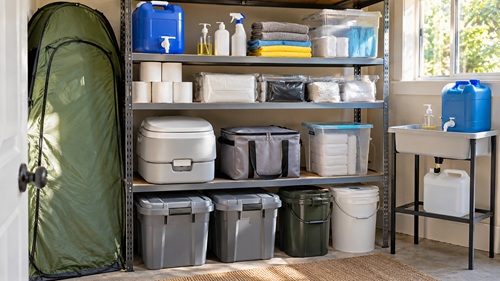
Most households rarely think about sanitation until something stops working. Toilets flush, sinks provide running water, wastewater disappears through drains, and household garbage is collected regularly. These services make everyday hygiene relatively simple, but they also create dependencies that can become serious problems when essential infrastructure is disrupted.
A prolonged power outage, water supply interruption, sewer failure, flood, or natural disaster can affect several of these services at the same time. A household may have enough drinking water and food for two weeks but discover that its toilets cannot be used, wastewater cannot drain safely, or there is no practical way to wash hands after handling waste. What initially appears to be a manageable interruption can quickly become a serious sanitation problem when the household lacks suitable alternatives.
Consider a family of four experiencing a regional infrastructure failure. Their drinking water supplies are adequate, and they have enough stored food to remain at home. However, their wastewater system is no longer functioning, and they have no alternative sanitation equipment. During the first day, the family must determine how to manage normal toilet use without sending additional waste into the damaged drainage system. By the third day, they may also be dealing with accumulated garbage, limited handwashing water, and uncertainty about where collected waste can be stored. If the disruption continues, their ability to maintain safe sanitation may become a more immediate concern than their food supplies.
Some households keep extra toilet paper, disinfectants, garbage bags, and personal hygiene supplies. Others may own a portable camping toilet, a bucket-based sanitation system, or equipment that allows an existing household toilet to be used temporarily without flushing. These resources can be useful, but their presence does not necessarily mean the household can manage human waste safely throughout an extended disruption. A temporary toilet solves the immediate problem of where waste is collected, but it does not automatically provide a safe method of storing or disposing of that waste.
An Emergency Sanitation and Hygiene Inventory helps households examine their existing sanitation equipment, understand their dependence on water and wastewater infrastructure, calculate essential supply requirements, and identify whether they have safe alternatives when normal facilities become unavailable. The assessment also considers how sanitation needs change as supplies are consumed, waste accumulates, and normal services remain unavailable.
The accompanying downloadable color checklist helps readers record sanitation equipment, personal hygiene supplies, cleaning products, waste containment capacity, handwashing arrangements, and maintenance requirements. It also supports practical equipment testing, sanitation calculations, and a Day 1, Day 7, and Day 14 assessment to identify when essential capabilities could become inadequate.
The objective isn’t simply to accumulate cleaning products or emergency toilet supplies. It’s to establish whether the household can maintain safe hygiene, contain waste, prevent contamination, and continue managing essential sanitation needs when normal services are disrupted.
Why an Emergency Sanitation Inventory Matters
Sanitation is closely connected to drinking water, food preparation, personal health, and household safety. When normal sanitation services fail, these activities become more difficult to manage without creating additional contamination risks. A household may have several cases of bottled water but no dedicated supply for handwashing. It may own a portable toilet but lack suitable waste containment materials. Cleaning products may be available, but household members may not know which products are appropriate for contaminated surfaces or how to use them safely.
These weaknesses are not always obvious during ordinary equipment inspections because sanitation involves a continuing process rather than a single item. Waste must be collected and contained, hands and surfaces must be cleaned, supplies must be replenished, and contaminated materials must be managed until safe disposal becomes available. Each activity depends on equipment, consumables, and supporting resources that may become unavailable at different times.
The consequences of inadequate sanitation can extend beyond unpleasant conditions. Human waste can contain disease-causing microorganisms, while contaminated hands, surfaces, water, and food can create opportunities for illness to spread. Poorly managed garbage may attract insects and rodents, and unsuitable waste storage can expose household members to additional hazards. These risks become particularly important during prolonged emergencies when healthcare services, cleaning supplies, and safe water may also be limited.
Sanitation failures can affect people beyond the immediate household. A blocked municipal sewer may cause wastewater to back up into neighbouring properties, while improper waste disposal can contaminate soil or water sources used by others. Standing water and accumulated garbage may create conditions that allow pests to spread throughout a neighbourhood. A household may maintain clean living areas and still experience problems caused by shared infrastructure or contamination originating elsewhere.
An inventory helps identify the equipment and supplies needed to maintain sanitation activities while revealing where those arrangements depend on running water, electricity, drainage, wastewater treatment, municipal collection services, or outside assistance. The purpose is to determine whether essential sanitation activities can continue safely, not merely whether the household has enough toilet paper or cleaning products.
Begin With Your Household’s Sanitation Requirements
Before counting supplies, consider who will depend on the household’s sanitation arrangements and what assistance or equipment they may require. A household of two healthy adults may have different needs from a family with young children, an older adult requiring assistance, or someone who uses medical equipment or personal care supplies. Infants, people with limited mobility, and household members managing incontinence or other personal care requirements may need additional hygiene materials, accessible equipment, and more frequent waste handling.
The number of people is important, but the type of sanitation activity also matters. Toileting, handwashing, food preparation, personal cleaning, laundry, and household surface cleaning each create different demands for water, equipment, and consumable supplies. Some activities can be reduced temporarily, while others must continue regardless of the disruption. Handwashing after using the toilet and before handling food remains important even when water is limited, and human waste must still be contained safely when normal flushing is unavailable.
Household circumstances can also change during an emergency. Additional relatives may need temporary shelter, a caregiver may remain in the home, or someone may become ill and require more frequent sanitation assistance. For example, a family of four may calculate its sanitation requirements based on normal household use, only to have two relatives arrive after an evacuation. The additional people increase demand for toilet facilities, handwashing water, hygiene products, and waste storage capacity. Supplies that originally appeared sufficient for 14 days may no longer last that long.
A useful assessment should therefore consider both ordinary household requirements and reasonable changes that could occur during an emergency. The inventory should identify who depends on the sanitation plan, which activities must continue, and what resources are required to support them. This provides a more dependable starting point than estimating sanitation needs from household size alone.
Understand Your Toilet and Wastewater Dependencies
A working toilet does not necessarily mean the household’s wastewater system is functioning safely. Toilets depend on a combination of water supply, drainage, and wastewater infrastructure, and a failure in any of these components may prevent normal use. Understanding these dependencies is important because the loss of running water does not always require the same response as a damaged sewer or failed septic system.
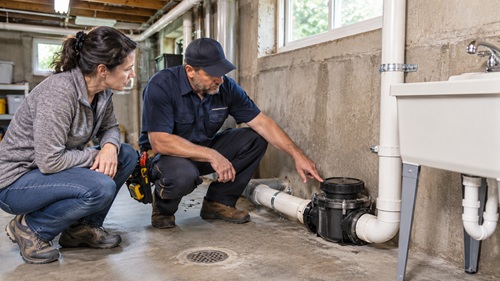
In homes connected to municipal sewer systems, wastewater generally travels through underground pipes to collection and treatment facilities. During flooding, sewer damage, or certain infrastructure failures, wastewater may not drain normally. Continuing to flush toilets when a sewer system is blocked or backing up can create contamination inside the home or contribute to problems elsewhere in the system. In some circumstances, wastewater from other properties may also enter a home through lower plumbing fixtures even when its occupants are not using their toilets.
Households with septic systems have different dependencies. Many conventional gravity-fed septic systems can operate without electricity, provided the system is otherwise functioning and adequate water is available. However, systems that use electrically powered pumps, alarms, or treatment components may become unusable during a power outage. A household with a private well may face an additional limitation if the well pump stops supplying water, even though the wastewater system itself remains functional.
A power outage alone does not necessarily mean normal toilet use must stop. If running water is unavailable but a gravity-fed wastewater system remains operational, manually flushing with an appropriate quantity of water may be possible. The household must first understand the toilet’s requirements and confirm that the receiving sewer or septic system remains capable of handling wastewater. Water should not be poured into a toilet simply because it appears to drain normally when the condition of the wider wastewater system is uncertain.
When Should Normal Toilet Use Stop?
Sewage backing up through drains, wastewater emerging from plumbing fixtures, a known septic system failure, or official instructions restricting wastewater use are reasons to stop using affected fixtures and seek appropriate guidance. Unusual gurgling, repeated drainage problems, or wastewater rising in lower fixtures may also indicate a developing blockage or backup. These warning signs deserve particular attention during flooding or widespread infrastructure disruptions, when normal wastewater services may be operating under unusual conditions.
The household should identify its wastewater system, any electrical dependencies, and the circumstances under which normal toilet use would need to stop. Where operating requirements are uncertain, advice from the relevant utility, septic professional, or local authority may be necessary. Understanding these conditions before an emergency can prevent unnecessary use of temporary sanitation equipment while reducing the risk of continuing to discharge waste into an unsafe system.
Protecting Your Home From Sewer Backups
A sewer backup can occur even when a household is not actively using its own toilets. In some municipal sewer failures, wastewater from elsewhere in the collection system can enter buildings through lower plumbing fixtures, floor drains, showers, or toilets. Homes with basements or plumbing fixtures below the surrounding sewer level may face particular vulnerabilities, although the actual risk depends on the property’s plumbing configuration, elevation, drainage conditions, and local infrastructure.
A backwater valve is a plumbing device designed to reduce the risk of wastewater flowing backward into a building through a protected drainage connection. These devices can provide important protection, but their effectiveness depends on appropriate design, installation, inspection, and maintenance. Not every home has a backwater valve, and homeowners may not know whether one is installed. Some systems protect only particular fixtures or drainage branches rather than every possible route through which wastewater could enter.
During the household inspection, locate any existing backwater valve, confirm that its access point remains unobstructed, and arrange for inspection or servicing according to the manufacturer’s instructions and local plumbing requirements. If the property does not have suitable protection, a qualified plumber can help identify vulnerable plumbing connections and determine whether additional measures are appropriate. This assessment is particularly valuable for households with finished basements, lower-level bathrooms, or emergency supplies stored near floor drains.
Some emergency preparedness discussions recommend improvised drain plugs, rags, or other materials to block wastewater from entering a building. These arrangements may fail under pressure, damage plumbing, or interfere with necessary repairs. Pouring concrete into sewer lines or inserting unsuitable objects into drains can create particularly serious problems. A more dependable approach is to identify sewer-backup vulnerabilities before an emergency and use properly designed protective equipment appropriate for the property’s plumbing system.
If sewage begins entering occupied areas, household members should avoid contact with contaminated water, keep children and animals away, and obtain appropriate professional or public-health guidance. Extensive contamination may require temporary relocation until affected areas can be made safe. The inventory should identify the property’s wastewater vulnerabilities, existing protective equipment, maintenance requirements, and circumstances that would make continued occupancy unsafe.
Emergency Toilet Equipment and Alternative Arrangements
When normal toilets cannot be used safely, a household needs an alternative that allows human waste to be collected without contaminating living areas. Portable camping toilets, purpose-built emergency sanitation systems, and suitable bucket-based arrangements may provide temporary options. Choosing between them requires considering available space, accessibility needs, waste collection capacity, and the practical requirements for servicing the equipment.
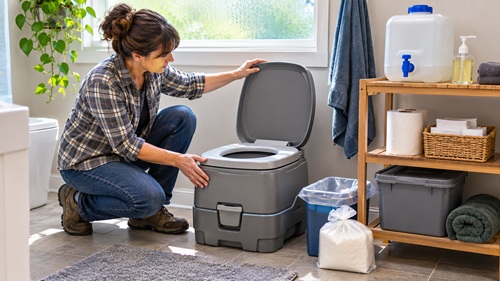
A portable toilet with a sealed holding tank may offer controlled containment but will eventually require emptying or servicing. A bucket-based system may be less expensive and easier to store, although stability, seating comfort, and safe waste handling become particularly important. Some emergency sanitation systems use absorbent or gelling materials to reduce free liquid and make collected waste easier to contain. These materials must be compatible with the intended equipment and used according to manufacturer instructions. They do not make untreated human waste harmless or eliminate the need for appropriate disposal.
The location of an emergency toilet also matters. It should provide reasonable privacy, accessibility, stability, and ventilation while remaining separated from food preparation and drinking water storage areas. Households with young children, older adults, or people with limited mobility should consider whether the equipment can be used safely without assistance. A lightweight portable toilet that works well for one household member may be unstable or difficult for another.
The inventory should identify the selected toilet system, its operating requirements, expected capacity, and any limitations that could prevent safe use. An existing household toilet may also provide a practical alternative when normal flushing is unavailable.
Using an Existing Toilet as an Emergency Dry Toilet
One practical option that households may overlook is using an existing toilet as a temporary dry waste collection station when normal flushing is unavailable or unsafe. A household toilet already provides a familiar seat, stable support, and a location designed for personal privacy. For some people, particularly older adults or household members with mobility limitations, this may be more comfortable and accessible than using a portable bucket toilet.
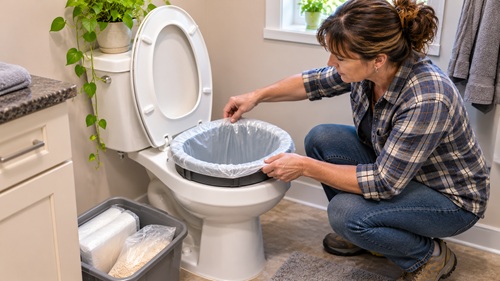
A compatible, purpose-designed waste collection liner or insert may allow waste to be collected above the toilet bowl without relying on normal flushing. The arrangement must prevent waste from entering the unusable plumbing system and remain secure during use and removal. Ordinary household garbage bags should not automatically be considered suitable because some may tear or leak under the weight and moisture associated with human waste.
The condition of the existing plumbing system also matters. Removing water from a toilet trap can allow sewer gases to enter the building, while improvised attempts to block the drain may fail or create additional hazards. A temporary collection arrangement should not require household members to dismantle plumbing or interfere with protective drainage components.
Before an emergency, households can examine whether their toilet is compatible with a suitable collection system and whether the equipment can be installed and removed without contamination. Any practical test should use clean materials and simulated waste rather than actual human waste.
Using an existing toilet may improve comfort and accessibility, but it does not increase the household’s waste storage or disposal capacity. Collected waste must still be managed according to the sanitation system’s safe operating requirements.
Assemble a Dedicated Emergency Toilet Supply Kit
Once an emergency toilet arrangement has been selected, the supplies required to operate it should be organized so they can be accessed quickly. A household may own suitable equipment but keep essential accessories in several different locations. During a disruption, discovering that necessary consumables are missing can make an otherwise functional sanitation arrangement unusable.
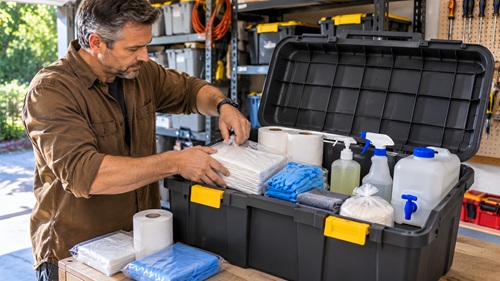
A dedicated emergency toilet kit can reduce this problem by keeping waste collection liners, toilet paper, appropriate absorbent materials, disposable gloves, cleaning supplies, and necessary accessories together in one storage container. Its contents should reflect the selected sanitation system, including any manufacturer-required treatments or replacement components.
Where appropriate, the kit may also include a portable handwashing arrangement, soap, and suitable containers for collecting used water. Clean supplies should remain protected from contact with waste-handling equipment.
The kit should be stored in a location protected from moisture, pests, and unsuitable temperatures. Household members should know where it is kept and how the equipment is assembled.
During the inventory, verify that the kit contains everything required for its intended use. A complete emergency toilet kit should support the collection process from initial setup through safe servicing, rather than simply providing a place to sit.
Calculate Emergency Toilet Use Requirements
An emergency toilet inventory becomes more useful when households estimate how frequently their alternative sanitation equipment may be needed. The number of toilet uses varies with age, health, hydration, diet, and individual circumstances. A planning estimate can help establish potential demand, but it should not be treated as a fixed biological requirement.
For illustration, consider a family of four planning for an average of five toilet uses per person per day. Multiplying four people by five daily uses and fourteen days produces 280 estimated toilet uses over a 14-day disruption. This does not mean the household necessarily needs 280 waste bags or individual containers. Some approved systems accommodate multiple uses before servicing, while others require more frequent liner changes or separate handling of liquid and solid waste.
The number of toilet uses provides an estimate of how frequently equipment may require attention, but it does not directly establish waste volume. Liquid and solid waste quantities vary, so storage calculations should also consider container capacity, expected waste volume, and the manufacturer’s servicing requirements.
The important consideration is whether the available equipment can safely manage the expected volume and type of waste. A portable toilet’s holding capacity, the number of suitable liners, the quantity of absorbent material, and the availability of secure waste storage all influence how long the system can remain usable.
Calculate Liner and Servicing Requirements
Once the estimated number of toilet uses is established, the household can compare that demand with the verified capacity of its sanitation equipment. If a particular approved system can safely accommodate five uses before its liner must be replaced, dividing 280 estimated uses by five produces 56 liner changes over 14 days.
This calculation is illustrative, not a recommendation that every liner should accommodate five uses. Actual capacity depends on equipment design, waste volume, liquid content, manufacturer instructions, and safe handling requirements. Some systems require servicing based on waste volume or weight rather than the number of uses, while others may require more frequent changes when liquid waste is collected together with solid waste.
A system that separates urine from solid waste may have different servicing requirements for each container, so the household should calculate both capacities rather than assuming one liner-change estimate covers all waste.
The inventory should compare estimated demand with actual equipment capacity, available consumables, temporary storage arrangements, and servicing requirements. This helps identify the point at which the sanitation system could become inadequate.
Separating Urine and Solid Waste
Some emergency sanitation systems are designed to separate urine from solid waste. This can reduce the volume and weight of collected solid waste, make handling easier, and help certain containment systems operate more effectively. Separating liquids may also reduce the amount of absorbent material required by some dry toilet systems, although the benefits depend on the equipment design and whether household members can use the arrangement correctly.
Urine should not automatically be treated as sterile or harmless. It can contain microorganisms or become contaminated during collection, particularly when equipment is shared or waste streams are not completely separated. Collected urine still requires appropriate containment and disposal. Although urine has been used as a nutrient source in some agricultural systems, applying untreated urine directly to gardens, trees, or surrounding soil should not be assumed safe or legally permitted. Environmental conditions, proximity to drinking water sources, storage practices, treatment requirements, and local regulations all affect whether any form of land application is appropriate.
For households using urine-diverting sanitation equipment, the inventory should identify how liquid waste is collected, whether containers are suitable and secure, how frequently they require servicing, and what approved disposal arrangements are available. Urine separation is an option worth understanding, particularly for longer disruptions, but it does not eliminate the need for safe waste management.
Safe Human Waste Containment, Storage, and Disposal
Human waste requires careful handling because it can contain bacteria, viruses, and parasites capable of causing illness. An emergency toilet is only one part of the sanitation arrangement. Safe containment, temporary storage, cleaning, and eventual disposal must also be considered. These activities should be evaluated separately because a household may have enough equipment to collect waste without having sufficient capacity to store it or an approved method of disposing of it.
Containment begins with equipment designed or appropriately configured to hold waste without leakage, splashing, or unnecessary contact. Suitable liners, sealed containers, and compatible waste-treatment materials may help, but their effectiveness depends on the system and how it is used.
Temporary storage becomes necessary when filled containers cannot be emptied immediately. Storage arrangements should protect against leakage, accidental opening, weather exposure, pests, and access by children or animals. Waste should remain separated from food, drinking water, and clean household supplies. Disposable gloves may provide additional protection during waste handling, but they do not replace handwashing. Gloves should be removed carefully, and hands should be cleaned afterward using appropriate hygiene procedures.
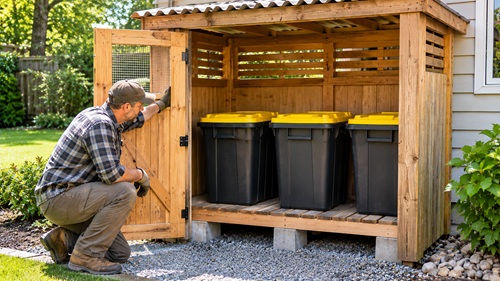
Consider a household with enough emergency toilet liners for 14 days but only two secure waste storage containers. If those containers reach their safe capacity after four days and normal waste collection remains unavailable, the household has a sanitation problem despite having plenty of unused liners.
The household should record the verified usable capacity of each waste container, estimate the volume of waste requiring storage, and calculate when that capacity could be reached. This provides a more dependable assessment than simply counting available containers. Waste volume will vary according to household size, the type of sanitation system, and whether liquid and solid waste are collected separately.
Disposal introduces another set of requirements. Local public-health and waste-management authorities may provide instructions for emergency waste collection, approved disposal locations, or temporary sanitation arrangements. These requirements can vary with the type of waste, the sanitation system, and the nature of the emergency. A household should not assume that collected human waste can be placed in ordinary garbage, emptied into storm drains, buried on residential property, or discharged onto the ground. These methods may be prohibited or create serious contamination risks.
This illustrates why sanitation preparedness cannot be measured by counting toilet supplies alone. The sanitation system can remain usable only while collection, containment, storage, and eventual disposal arrangements can all be managed safely. The inventory should establish the capacity and limitations of each stage, including how frequently containers require servicing, where collected waste can be stored, and whether approved disposal arrangements remain available. Identifying the first stage likely to become inadequate provides a more dependable basis for emergency planning.
When normal waste collection and wastewater services remain unavailable, households may eventually reach the limits of their temporary sanitation arrangements. Understanding those limits is essential because some alternative disposal methods introduce serious health and environmental risks. The next consideration is what options may exist when conventional waste management is no longer available and how to determine whether those options are appropriate.
Last-Resort Sanitation Options During Prolonged Emergencies
Emergency sanitation planning becomes more complicated when normal waste collection, wastewater treatment, and professional assistance remain unavailable for an extended period. A household may have sufficient emergency toilet supplies for several days but eventually face the problem of where collected waste can be safely stored or disposed of. These circumstances deserve consideration because simply advising households to follow normal disposal procedures may not provide a workable solution when those services have stopped functioning. However, methods that appear practical in the short term can create serious contamination problems if they are used without understanding local environmental conditions.
The appropriate response depends on the type of waste, available sanitation equipment, property conditions, and whether the disruption is expected to last days, weeks, or longer. Local public-health requirements and environmental restrictions must also be considered before selecting any alternative treatment or disposal method.
Burial of Human Waste
Burial has historically been used to manage human waste where conventional sanitation systems are unavailable. In some remote or emergency settings, properly designed and authorized sanitation facilities may still use controlled burial or pit-based arrangements. However, burial is not suitable for every property. Soil conditions, groundwater levels, flooding, nearby wells, surface water, drainage patterns, and population density all affect whether underground disposal can be considered.
A household located on a small residential lot, near a private well, or in an area with a high water table may have no suitable location for burying human waste. Improper disposal can contaminate groundwater or create exposure risks for neighbouring properties. An additional concern is that human waste may remain infectious after burial. Soil does not automatically eliminate every pathogen, and environmental conditions influence how contaminants move or persist underground.
Biodegradable bags also require careful consideration. A bag described as biodegradable does not necessarily break down quickly under burial conditions, nor does its decomposition make the contents safe. Before including burial in an emergency sanitation plan, households should determine whether an approved arrangement is available and whether their property conditions would permit its safe use. Where burial is unsuitable, a different containment or disposal arrangement will be necessary.
Burning Human Waste
Burning waste may appear to offer a way to reduce accumulated material when collection services are unavailable. However, ordinary outdoor fires, household wood stoves, and improvised burn containers are not reliable methods for safely treating human waste. Incomplete combustion can leave contaminated material behind, while smoke, airborne particles, odours, and fire hazards can create additional risks. Burning waste that contains plastic liners, chemical treatments, or other materials may also release harmful emissions.
Specialized incinerating toilet systems exist, but they are engineered for controlled operation and have specific fuel, electrical, ventilation, and maintenance requirements. They should not be confused with burning collected waste in an ordinary fire. An incinerating toilet may also introduce dependencies that are easily overlooked. A household may have the equipment installed but be unable to operate it when electricity or fuel becomes unavailable. Its capacity, operating cycle, ventilation requirements, and maintenance needs must therefore be considered as part of the emergency inventory.
For household preparedness, burning human waste should not be treated as a routine disposal method. Any specialized system must be suitable for its intended use and operated according to manufacturer instructions and applicable regulations.
Composting Human Waste
Human waste composting is another subject that deserves careful explanation, particularly for experienced preppers interested in long-term self-sufficiency. Properly engineered sanitation systems can use controlled biological processes to treat human waste. However, these systems differ considerably from ordinary household garden composting.
Human feces may contain pathogens that survive inadequate treatment. Temperature, moisture, oxygen, processing time, and system design all influence whether treatment is effective. Material that looks or smells like finished compost is not necessarily free of harmful microorganisms. Adding untreated human waste to an ordinary garden compost pile is therefore not a safe substitute for a properly designed sanitation system.
Commercial composting toilets vary considerably in their operation. Some primarily collect or dehydrate waste and require additional treatment or approved disposal elsewhere. Others incorporate more extensive processing. The term composting toilet does not, by itself, guarantee that material removed from the system is safe for unrestricted use.

Households interested in these systems should investigate equipment specifically designed for that purpose, including operating requirements, waste-handling procedures, maintenance needs, and appropriate treatment or disposal arrangements. For an experienced prepper considering a long-term off-grid sanitation arrangement, the important question is not simply whether a composting toilet can be purchased or constructed. It is whether the entire treatment and disposal process can be maintained safely under the household’s actual conditions.
Separating and Managing Urine
During a prolonged emergency, households using urine-diverting sanitation equipment may eventually face limitations involving liquid waste storage and disposal. Although separating urine from solid waste can reduce the volume and weight of collected solid waste, the liquid must still be contained and managed safely.
A system that reduces solid waste storage requirements may become unusable if its urine containers require frequent emptying and no suitable disposal arrangement remains available. This limitation may become particularly important when municipal wastewater services are disrupted or when environmental conditions prevent alternative disposal methods.
The inventory should establish the usable capacity of liquid waste containers, how frequently they require servicing, and whether approved disposal arrangements remain available. Households should also consider how changing temperatures, available storage space, and the duration of the disruption could affect continued operation.
The objective is to determine whether urine separation provides a sustainable sanitation capability under the household’s actual circumstances, rather than simply reducing the amount of solid waste requiring containment.
Improvised Sewer and Drain Protection
During a prolonged sewer failure, wastewater may continue to accumulate within damaged or overloaded drainage systems. Even households that have stopped using their own plumbing fixtures may remain vulnerable to sewage entering through lower drains, toilets, or other connections.
The earlier section on protecting homes from sewer backups explains the importance of properly installed backwater valves and suitable plumbing protection. During an extended disruption, the additional concern is whether those protective arrangements remain effective and whether changing conditions create new risks.
Households should monitor for warning signs such as wastewater emerging from drains, unusual drainage behaviour, or official reports of sewer system failures. Improvised attempts to block plumbing connections may create additional hazards, particularly when materials are unsuitable for the pressures involved.
If sewage begins entering occupied areas, household members should avoid contact with contaminated water and seek appropriate professional or public-health guidance. Where contamination cannot be controlled safely, temporary relocation may become necessary.
The inventory should identify the household’s existing sewer protection, its limitations, and the conditions that would require an alternative sanitation arrangement or relocation.
Pest Control When Normal Services Are Unavailable
During a prolonged sanitation disruption, accumulating household garbage and stored waste may increase the risk of insect and rodent activity. Conditions that are manageable during the first few days may become more difficult as waste containers fill and normal collection services remain unavailable.
The household should pay particular attention to the condition of temporary waste storage areas. Containers that initially provide suitable protection may develop damaged closures, leaks, or other weaknesses as they are repeatedly handled. Changes in temperature, rainfall, and surrounding environmental conditions may also increase pest activity.
The dedicated section on Preventing Pests and Contamination During Sanitation Disruptions explains how to recognize pest activity, inspect potential entry points, and use appropriate prevention and control measures.
For longer emergencies, the additional preparedness requirement is determining whether those measures can continue working as waste accumulates. A household may have suitable containers for several days but lack enough protected storage space for two weeks.
The inventory should establish how waste storage areas will be inspected, what signs would indicate deteriorating conditions, and what corrective actions are available if pest prevention becomes inadequate.
Planning for Conditions Beyond 14 Days
A 14-day sanitation inventory provides a useful starting point, but some disruptions may last longer. Waste containers may fill, disposable supplies may be exhausted, and available storage areas may become unsuitable as temperatures or environmental conditions change. Households should therefore consider what happens when their initial sanitation arrangements reach their limits. This includes identifying the maximum safe capacity of waste containers, whether additional storage is available, how essential hygiene water will be replenished, and what alternatives exist if approved disposal services remain unavailable.
The assessment should also identify circumstances in which remaining at home may no longer be safe. Sewage entering living areas, uncontrollable waste accumulation, contamination of drinking water, or the inability to maintain essential hygiene may require outside assistance or relocation. The objective is not to assume that every household can independently manage human waste indefinitely. It is to understand the limitations of available sanitation arrangements and recognize when conditions require a different response.
Long-term sanitation preparedness means planning for the entire waste-management process, from collection and containment to safe treatment or disposal. A temporary toilet solves only the first part of that problem.
Emergency Handwashing Without Running Water
Handwashing becomes especially important when households are using alternative toilets or handling waste. It is also one of the first hygiene activities affected when running water becomes unavailable. A household may have adequate drinking water but lack a practical arrangement for dispensing water safely during handwashing. Pouring water from a large container can be awkward, wasteful, and difficult for children or people with limited mobility.
A dedicated handwashing station can help manage this problem. Depending on the household’s circumstances, it may use a clean water container with a controlled dispensing tap, liquid soap, and a suitable method for collecting used water. The station should be positioned where handwashing is needed, particularly near emergency toilet facilities and food preparation areas, while keeping clean water protected from contamination.
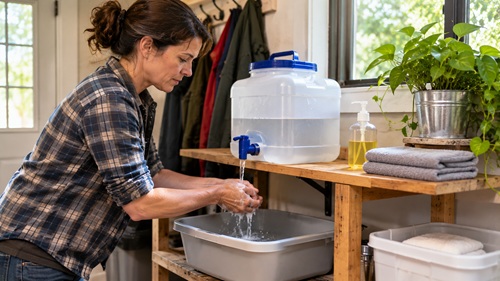
Soap and clean running water are preferred for removing many types of contamination. Alcohol-based hand sanitizer containing at least 60% alcohol can reduce many germs when soap and water are unavailable, but it is less effective when hands are visibly dirty or greasy. It is also less effective against certain pathogens, including norovirus, and should not replace proper handwashing after handling human waste whenever soap and clean water are available.
Effective handwashing involves wetting the hands with clean water, applying soap, and thoroughly lathering all surfaces. Hands should be scrubbed with soap for at least 20 seconds, including between the fingers, around the thumbs, and beneath the fingernails, before rinsing with clean water. A controlled-flow dispenser can help reduce unnecessary water use while still allowing household members to wash effectively.
Calculate Emergency Handwashing Water Requirements
A household may have calculated its drinking water requirements without considering how much additional water will be needed for essential hygiene. A practical assessment begins by estimating how many handwashing events are likely to occur each day and how much water the selected handwashing arrangement uses.
For illustration, consider a household of four using a controlled-flow handwashing station that consumes approximately 0.5 litres per wash. If each person performs five handwashing events daily, multiplying four people by five washes and half a litre produces 10 litres of handwashing water per day. Over a 14-day disruption, that represents 140 litres of water for handwashing alone.
This estimate is intended to demonstrate how quickly hygiene water requirements can accumulate. It should not be treated as a recommended minimum or maximum, and households should determine their actual requirements through safe, practical testing. The five-wash assumption is used only to demonstrate the calculation. Actual handwashing frequency should reflect household activities and hygiene requirements, particularly after toilet use, before food preparation, and after handling potentially contaminated materials.
The example demonstrates why sanitation water should be calculated separately from drinking water. A household may have enough stored water for consumption while lacking sufficient water to maintain essential hygiene. The inventory should identify the handwashing equipment available, the quantity of suitable water required, and whether the household can replenish that supply during an extended disruption.
Used handwashing water also requires appropriate management. A household that uses ten litres of water daily for handwashing may generate a similar quantity of wastewater requiring collection or safe drainage. The purpose of the calculation is to evaluate the complete handwashing arrangement rather than simply determine how much clean water is available.
Personal Hygiene Supplies and Household Requirements
Personal hygiene involves more than toilet paper and hand soap. During an extended emergency, households may need additional supplies for bathing, dental care, menstrual hygiene, infant care, incontinence management, and other personal requirements. The appropriate inventory depends on the people living in the household. Some supplies may be used daily, while others are needed only by particular household members or under specific circumstances.
Toilet paper, tissues, soap, toothbrushes, toothpaste, menstrual products, diapers, wipes, and suitable waste containers may all deserve consideration. Households supporting people with medical or accessibility requirements may need specialized hygiene products or equipment. These supplies should be evaluated according to actual consumption rather than arbitrary quantities. A household that normally uses a particular number of diapers, incontinence products, or other consumables each day can estimate how many would be required for a 14-day interruption.

For example, if a household uses six diapers daily, a 14-day reserve would require approximately 84 diapers before allowing for additional needs or unexpected delays. The same approach can be applied to other regularly consumed hygiene products. Where usage varies, a reasonable additional reserve may help accommodate changing circumstances.
Portable Bidets and Low-Water Personal Cleaning
Portable bidet bottles and other controlled-flow washing devices may provide a useful alternative when normal bathing facilities or toilet hygiene arrangements are unavailable. These devices can help people maintain personal cleanliness while using relatively small quantities of water. Some may be particularly helpful for household members who find dry toilet paper uncomfortable or who require additional personal hygiene assistance.
However, the equipment must be used in a way that prevents contamination of clean water supplies. Water should be suitable for the intended personal hygiene task, and the device should be cleaned and stored according to manufacturer instructions. Used water must also be managed appropriately. A portable washing device may reduce dependence on disposable wipes or toilet paper, but it does not eliminate the need for wastewater collection or disposal.
The inventory should establish whether suitable personal washing equipment is available, whether household members know how to use it, and whether adequate clean water and wastewater arrangements can support its operation.
Reusable Hygiene Supplies
Reusable hygiene products may reduce dependence on disposable supplies during extended emergencies. Washable cloths, reusable menstrual products, cloth diapers, and other purpose-designed items can provide alternatives when normal purchasing or waste collection services are disrupted. However, reusable supplies introduce additional requirements. They must be cleaned, rinsed, dried, and stored hygienically between uses. Some products have specific manufacturer instructions for cleaning or disinfection that must be followed.
A household without dependable water, suitable cleaning equipment, or safe drying conditions may find reusable supplies difficult to maintain. Reuse should not be treated as a safe alternative unless the household can complete the required cleaning process. For example, a household may have enough reusable cloth diapers for several days but discover that it lacks the water, detergent, drying space, or wastewater capacity needed to clean them safely. The inventory should therefore evaluate the complete cleaning process rather than simply count reusable items.
Reusable menstrual products may offer similar benefits, although their suitability depends on individual preferences, access to appropriate cleaning facilities, and the ability to maintain hygiene. The inventory should identify which reusable products are available and what supporting resources are required to keep them safe for continued use.
A reusable item is only a dependable emergency resource when the household can maintain it properly.
Cleaning and Disinfection During an Emergency
Cleaning and disinfection serve different purposes, and understanding the distinction is important when sanitation conditions become difficult. Cleaning removes dirt, organic material, and many microorganisms from surfaces, usually through the use of water, detergent, and physical action. Disinfection uses an appropriate product or process to reduce or inactivate specified microorganisms on suitable surfaces.
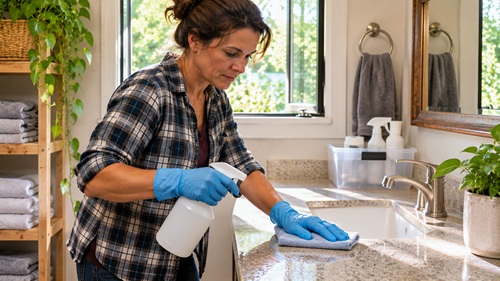
During an emergency, households may need to clean toilet equipment, handwashing areas, food preparation surfaces, and other locations exposed to contamination. The appropriate method depends on the surface, type of contamination, and product instructions. Disinfectants should be used according to their labels, including dilution requirements where applicable, contact times, ventilation, and personal protective equipment. A product that is effective on one surface or against certain microorganisms may not be appropriate for every sanitation task.
When disinfection is required, surfaces should generally be cleaned first to remove dirt and organic material that may interfere with the disinfectant’s effectiveness. The disinfectant should then be applied according to its instructions, including the required contact time. Simply spraying a contaminated surface and immediately wiping it dry may not provide the intended level of disinfection. Some products combine cleaning and disinfection, but their effectiveness still depends on following the manufacturer’s directions.
Household chemicals should never be mixed unless the manufacturer explicitly permits it. In particular, mixing bleach with ammonia, acids, or certain other cleaning products can release dangerous gases. Some cleaning tasks may also require access to clean water, disposable cloths, brushes, protective gloves, and suitable waste containers. These supporting supplies should be included in the inventory rather than counting disinfectant bottles alone.
Households should also consider whether cleaning products remain usable after extended storage. Certain disinfectants lose effectiveness over time, particularly when stored under unsuitable conditions or diluted in advance. Where sewage contamination or extensive flooding has occurred, ordinary household cleaning equipment may be insufficient. Professional remediation or specific public-health guidance may be necessary before affected areas can be used safely.
Consider a household using a portable emergency toilet during a prolonged water outage. The family has disinfectant available but discovers that its cleaning supplies require water for dilution, rinsing, or washing reusable cloths. Without a dedicated cleaning-water reserve and a safe method of managing contaminated wastewater, the household may be unable to maintain the toilet area hygienically despite having sufficient disinfectant. The inventory should therefore assess the entire cleaning process rather than simply count bottles of cleaning products.
The objective is to maintain hygienic conditions without introducing additional chemical exposure, contamination, or injury risks. A dependable cleaning arrangement should account for the products being used, the surfaces requiring attention, the water needed for cleaning, and how contaminated materials will be handled afterward.
Managing Greywater and Used Household Water
Water used for handwashing, bathing, laundry, or other household activities becomes wastewater after use. During normal conditions, this water is carried away through drainage systems, but a sewer or septic failure may prevent safe disposal. Greywater is often used to describe wastewater from certain household activities that does not include toilet waste. However, it can still contain microorganisms, cleaning chemicals, oils, and other contaminants. It should not be assumed safe simply because it does not contain human toilet waste.
Every litre of water used for washing creates wastewater that must go somewhere. When household drains cannot be used, the ability to collect and manage that wastewater may become just as important as having enough clean water available. For example, the family of four in the earlier handwashing calculation may use approximately 140 litres of water over 14 days. If normal drainage is unavailable, much of that water could require separate collection and appropriate disposal. The household would need to consider not only how to supply clean water but also how to manage the resulting wastewater without contaminating living areas.
This relationship becomes especially important when households introduce manual laundry, portable washing equipment, or additional personal hygiene arrangements. Each activity may increase wastewater volume even when water is used carefully. A household may have sufficient drinking water and enough additional water for washing but discover that it lacks the containers or approved disposal arrangements needed to manage the wastewater produced.
A practical assessment should begin by identifying which household drains remain usable. A loss of running water does not necessarily mean wastewater drainage has failed, but a damaged sewer, overloaded septic system, or official restriction may make normal drainage unsafe. When the condition of the system is uncertain, households should seek guidance from the appropriate utility or qualified professional rather than assuming that sinks and drains can continue receiving wastewater.
If drainage is unavailable, suitable containers may be needed to collect used water temporarily. These containers should be durable, leak-resistant, and clearly distinguishable from drinking water storage. Containers previously used for contaminated wastewater should not be repurposed for drinking water without an appropriate cleaning and sanitizing process, and containers exposed to hazardous chemicals may be unsuitable for that purpose altogether.
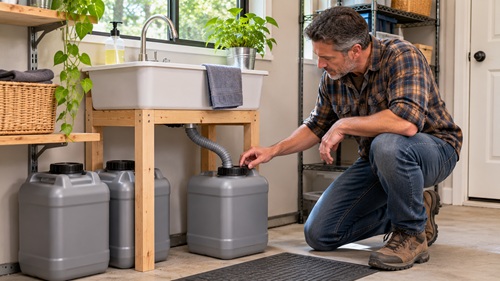
The location of wastewater storage also requires consideration. Containers should be protected against accidental tipping, leakage, freezing, excessive heat, and access by children or animals. They should not be placed where a spill could contaminate food, drinking water, or essential household equipment. Where possible, storage arrangements should also allow containers to be inspected and serviced without unnecessary handling or exposure.
Households should avoid assuming that greywater can be poured onto lawns, into gardens, or down storm drains. These disposal methods may be prohibited or create environmental problems, particularly when wastewater contains detergents, disinfectants, bodily fluids, or other contaminants. Disposal should follow applicable local public-health and environmental requirements.
Calculate Temporary Greywater Storage Requirements
The quantity of wastewater produced can be estimated from the water used for essential washing activities. This provides a starting point for assessing whether temporary storage arrangements are adequate. Consider a household using ten litres of water daily for handwashing and another eight litres for essential personal cleaning. If most of that water must be collected because normal drainage is unavailable, the household could generate approximately 18 litres of wastewater per day.
Over seven days, this would represent approximately 126 litres of wastewater, while a 14-day disruption could produce approximately 252 litres requiring management. These figures are illustrative rather than recommended water allowances. Actual wastewater volumes depend on household activities, water conservation practices, and the amount of water retained in clothing, cleaning materials, or other items.
The calculation demonstrates an important limitation. Even when clean water is available, the household may not have sufficient space or suitable containers to store all the resulting wastewater. Storage calculations should therefore be based on verified container capacity and realistic servicing or disposal arrangements.
For example, suppose the household has three suitable wastewater containers, each with a usable capacity of 20 litres. Together, they provide 60 litres of temporary storage. Dividing that capacity by the estimated daily wastewater production of 18 litres gives approximately 3.3 days of storage capacity if no wastewater can be safely disposed of.
This calculation assumes all three containers are available, their combined usable capacity is 60 litres, and wastewater production remains constant. In practice, households should allow for changing water use, safe handling limits, and unexpected increases in wastewater production rather than plan to use every litre of available storage.
Under the stated assumptions, the household’s wastewater storage could reach capacity during the fourth day. Containers should never be filled beyond their safe operating limits, and sufficient capacity should remain available to prevent spills during handling. The calculation should therefore use verified usable capacity rather than assuming every container can be filled completely.
The household may have enough clean water for 14 days but only enough wastewater storage for approximately three days. Unless suitable disposal or additional containment arrangements are available, wastewater management could become the first limitation affecting the household’s ability to maintain hygiene.
Reducing unnecessary water use can help limit wastewater accumulation, but essential handwashing, food hygiene, and personal care should not be compromised simply to conserve storage capacity. The inventory should identify how much wastewater the household could generate, how much can be safely collected, and what approved disposal arrangements are available. If wastewater storage becomes inadequate before clean water supplies are exhausted, that limitation may determine how long the household can safely remain without normal sanitation services.
Household Garbage and Solid Waste Management
A prolonged disruption may interrupt normal garbage collection even when other household services remain operational. Food packaging, spoiled food, disposable hygiene products, cleaning materials, and ordinary household waste continue accumulating regardless of whether collection trucks are operating. Garbage management becomes more difficult when waste cannot be removed regularly because organic materials can produce unpleasant odours and attract insects or rodents, while improperly stored contaminated materials may expose household members to microorganisms or other hazards.
A useful inventory should examine the types of waste the household produces and whether appropriate storage arrangements are available. Ordinary dry household garbage may require different handling from food waste, used diapers, contaminated cleaning materials, or waste associated with an emergency toilet. Waste containers should be durable, appropriately sized, and suitable for the materials being stored. Lids and closures can help prevent accidental contact and reduce access by insects and animals. Outdoor storage arrangements should also account for weather exposure and wildlife, particularly in areas where bears or other animals may be attracted to food waste.
Separating Household Waste
Separating waste into appropriate categories can make temporary storage more manageable. Clean recyclable materials, ordinary dry garbage, food waste, and contaminated hygiene materials may have different storage and disposal requirements. However, separation should not create additional contamination risks. Materials exposed to human waste, sewage, or other hazardous substances should not be treated as ordinary clean recyclables.
Food scraps may be suitable for an established household composting system where local requirements permit it, but composting does not automatically solve every waste-management problem. Poorly maintained compost can attract pests, and untreated human waste should not be added to ordinary garden compost. Households that normally rely on municipal organics collection should consider what happens when that service becomes unavailable. An existing composting arrangement may provide an alternative for suitable food and garden waste, but only when it can be maintained without creating odours, pest problems, or contamination.
Reducing unnecessary packaging and using washable household items where appropriate may help limit garbage production. However, reusable alternatives can increase water and cleaning requirements. The decision should consider the complete sanitation process rather than simply reduce the number of garbage bags used.
Calculate Garbage Storage Capacity
Households can estimate their ordinary waste production by observing how many bags or containers they fill during a typical week. This provides a more realistic starting point than assuming every household produces the same quantity of garbage. For example, a family that normally fills two garbage bags each week might estimate four bags over 14 days under similar conditions.
However, emergency conditions may increase waste production. Disposable dishes, personal hygiene wipes, food packaging, additional cleaning materials, and temporary sanitation supplies can all increase the amount of waste requiring storage. Suppose that same household produces three bags of garbage each week during an emergency instead of its normal two. Over 14 days, the household would generate approximately six bags rather than four.
If its existing secure garbage containers can accommodate only four filled bags, the household would need additional suitable storage capacity or another approved waste-management arrangement. The important consideration is not simply whether enough unused garbage bags are available. The household must determine whether the filled bags can be stored securely without creating leakage, odours, pest problems, or contamination.
Bag counts are only a rough planning measure because bags differ in size and fullness. Where practical, the inventory should compare estimated waste volume with the usable capacity of the household’s actual storage containers. The assessment should identify how much waste can be safely stored, where it will be kept, and what arrangements apply if normal collection services remain unavailable beyond the expected disruption.
Laundry and Clothing Hygiene During Extended Disruptions
Laundry is another household activity that may become difficult when electricity, running water, or wastewater services are unavailable. Washing machines depend on several systems operating together, and even manual washing requires clean water, detergent, suitable equipment, and a way to manage the resulting wastewater.
Not all clothing needs to be washed at the same frequency during an emergency. However, underwear, socks, towels, clothing contaminated with bodily fluids, and certain caregiving materials may require more frequent attention. The inventory should identify whether the household has sufficient clean clothing and bedding to reduce immediate laundry demands. Additional supplies may be particularly important for infants, people requiring personal care, or anyone whose clothing becomes contaminated during essential activities.
A household that normally washes clothing every few days may be able to delay some laundry by maintaining additional clean clothing. However, this approach has limits, especially when sanitation conditions increase the likelihood of contamination.
Manual Laundry Equipment and Washing Arrangements
Manual laundry equipment may provide an alternative when washing machines are unavailable. Suitable wash basins, buckets, purpose-designed manual washing devices, and other non-electric equipment can help households clean essential clothing. The effectiveness of these arrangements depends on the type of clothing, available water, suitable detergent, and the ability to rinse items adequately. Heavily contaminated materials may require separate handling and additional precautions.
For example, a household may own a manual washing device but discover that it requires more water than expected. Another may have enough water for washing but lack a practical way to rinse clothing or collect the used water. The equipment should therefore be tested before an emergency using ordinary laundry. This allows household members to determine how much water is consumed, how long the process takes, and whether the equipment is suitable for the clothing and bedding they expect to wash.
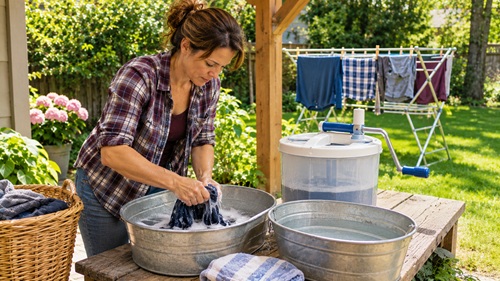
Detergent selection also matters. Products should be appropriate for the fabrics and washing method, and enough clean water must remain available for adequate rinsing. Excess detergent can increase rinsing requirements and create unnecessary wastewater.
Wringing and Drying Clothing Without Electricity
Washing clothing is only part of the process. Wet clothing must also be dried under conditions that prevent unnecessary contamination and moisture accumulation. A clothesline, drying rack, suitable clothespins, and a sheltered drying area may provide practical alternatives when an electric dryer is unavailable. Manual wringing equipment may help remove excess water, although it must be appropriate for the fabrics being handled.
Drying conditions vary considerably with temperature, humidity, airflow, and weather. Clothing that dries quickly outdoors during warm weather may remain damp for extended periods during cold or humid conditions. Indoor drying can also introduce problems. Large quantities of wet clothing may increase indoor humidity and contribute to condensation or mould growth, particularly when ventilation and heating are limited.
The inventory should identify where essential clothing could be washed and dried, what equipment would be required, and whether the household can manage the associated water and wastewater demands. Reusable hygiene products and contaminated laundry may require more stringent handling than ordinary clothing. Manufacturer instructions and relevant public-health guidance should be followed when cleaning items exposed to bodily fluids or infectious materials.
A dependable laundry arrangement must support the entire process, from collecting soiled clothing through washing, rinsing, drying, and safe storage.
Additional Sanitation Needs for Infants, Older Adults, and People Requiring Care
Some household members may require sanitation arrangements that differ considerably from those used by healthy, independent adults. Infants, young children, older adults, and people with disabilities or ongoing care requirements may depend on specialized supplies, accessible equipment, or assistance from another person. These needs become particularly important when normal bathing facilities, toilets, laundry equipment, and waste collection services are unavailable.
An infant may require frequent diaper changes, suitable cleaning materials, clean clothing, and safe disposal or laundering arrangements. A person managing incontinence may need absorbent products, protective bedding, skin care supplies, and additional waste storage capacity. Household members with limited mobility may be unable to use a portable bucket toilet safely, while others may require support when transferring to a toilet, washing, or changing clothing.
The assessment should therefore consider whether emergency sanitation equipment is accessible to everyone who may need it. A stable toilet seat, appropriate support equipment, adequate lighting, and a safe location may be as important as the quantity of supplies available. Personal care also requires attention to privacy, dignity, and comfort. Emergency arrangements should allow people to maintain as much independence as reasonably possible while receiving necessary assistance.
Calculate Specialized Hygiene Supply Requirements
Regularly used personal care supplies can be assessed using the same consumption-based approach applied to other household consumables. If someone uses four incontinence products daily, a 14-day disruption would require approximately 56 products before allowing for changes in usage or additional needs.
However, the inventory should also consider the supplies required to use those products safely. Protective gloves, cleaning materials, skin care products, suitable waste bags, clean clothing, and bedding may all be necessary. Reusable alternatives may reduce disposable supply requirements but can increase laundry and wastewater demands. A household should not assume that reusable products provide a dependable backup unless the required cleaning arrangements can be maintained.
Caregiving responsibilities should also be considered. If the person normally providing assistance becomes unavailable, another household member may need to understand how to operate the equipment and maintain appropriate hygiene. The inventory should identify specialized sanitation needs, the supplies required, who can provide assistance, and which limitations could place a household member at increased risk during an extended disruption.
Preventing Pests and Contamination During Sanitation Disruptions
Pest prevention becomes increasingly important when normal garbage collection, wastewater management, or cleaning services are disrupted. Food waste, standing water, poorly secured containers, and contaminated materials can create conditions that attract insects, rodents, and other pests. Flies may move between waste and food preparation areas, while rodents can contaminate stored supplies through droppings, urine, and contact with packaging. Standing water may also provide breeding opportunities for mosquitoes, depending on local conditions.
The most dependable approach begins with preventing pests from accessing food, water, and suitable shelter. Households should examine whether waste containers close securely, food storage areas remain protected, and spills can be cleaned promptly. Damaged screens, openings around pipes, and gaps in exterior structures may provide entry points for insects or rodents.
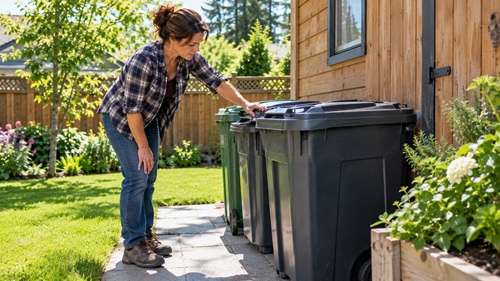
Stored drinking water should remain covered, and unnecessary standing water should be eliminated where safe to do so. Waste storage areas should be inspected regularly for leakage, damaged containers, pest activity, and other signs that conditions are deteriorating.
Pest-Control Equipment and Safety
Some households keep traps or other pest-control equipment as part of their preparedness supplies. These resources may be useful, but their suitability depends on the type of pest, location, and risks to household members, pets, and wildlife.
The earlier discussion of last-resort sanitation explains why homemade pest-control mixtures and powdered treatments should not automatically be considered safe or effective. The more important preparedness activity is identifying conditions that allow pests to enter, feed, or reproduce around the household.
During the household inspection, look for evidence of pest activity such as droppings, gnaw marks, damaged food packaging, insects around waste containers, or signs that stored materials have been disturbed. These observations may indicate that existing storage and exclusion measures are inadequate and require corrective action.
A practical inspection should also examine waste storage areas, food containers, doors, screens, vents, and other potential entry points. Where appropriate, suitable exclusion materials and properly selected pest-control equipment can help reduce the risk of infestation.
The inventory should establish whether the household has the equipment and knowledge needed to recognize and address developing pest problems. Any treatment products should be appropriate for the intended application and used according to their safety instructions.
The objective is not to eliminate every insect or microorganism from the household environment. It is to prevent pests from spreading contamination and creating additional health risks during an already difficult situation.
Neighbourhood Sanitation and Shared Infrastructure Risks
Household sanitation does not operate entirely within individual property boundaries. Municipal sewer systems, drainage networks, groundwater, surface water, garbage collection, and pest populations connect neighbouring properties in ways that may become more apparent during an emergency.
A household may maintain clean living areas and secure waste storage while still being affected by a sewage backup elsewhere in the neighbourhood. Contaminated floodwater may cross property boundaries, and improperly stored garbage on nearby properties may attract pests throughout the surrounding area.
These shared conditions are particularly important during prolonged disruptions because problems may become more difficult to manage as municipal services and professional assistance remain unavailable. For example, a household with a functioning emergency toilet may still face contamination if sewage enters its basement through a damaged municipal sewer connection. Another may have secure waste storage but experience increased rodent activity because garbage has accumulated throughout the neighbourhood.
Understanding these dependencies helps households recognize that sanitation preparedness requires awareness of conditions beyond their own supplies. Where appropriate, neighbours may be able to exchange information about service interruptions, official sanitation instructions, available collection arrangements, or emerging hazards. Community coordination can also help identify people who may need assistance obtaining hygiene supplies or accessing safe sanitation facilities.
However, households should avoid handling other people’s human waste, entering sewage-contaminated areas, or undertaking hazardous cleanup without appropriate training and protective measures. The inventory should identify relevant shared infrastructure, available sources of official information, and trusted contacts who may help communicate sanitation-related problems.
Community preparedness cannot replace functioning public sanitation infrastructure, but cooperation and early identification of problems may help reduce preventable exposure while services are being restored.
Test Your Emergency Sanitation Arrangements Before an Emergency
An emergency sanitation inventory becomes considerably more useful when the household tests whether its equipment and procedures can actually be used. A portable toilet may appear complete while stored in a cupboard but prove unstable when assembled. A handwashing station may dispense water successfully but produce more wastewater than the household can collect. A waste storage container may be suitable for temporary containment but too heavy to move safely when filled.
These limitations are easier to address before an emergency than during a prolonged disruption. Begin with a controlled exercise using clean equipment and simulated materials. The purpose is to evaluate the arrangement without creating actual contamination or interfering with essential plumbing services.
Test Emergency Toilet Setup and Accessibility
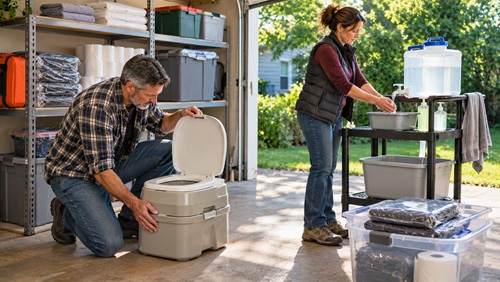
Assemble the selected emergency toilet according to its instructions. Confirm that it is stable, appropriately positioned, and accessible to the people who may need it. If the household intends to use a compatible collection insert with an existing toilet, test the fit using clean materials. Verify that the arrangement remains secure and can be removed without spilling its simulated contents.
Do not deliberately disable plumbing, remove trap water, or introduce actual human waste as part of the exercise. Consider whether children, older adults, or household members requiring assistance could use the arrangement safely. The exercise may reveal a need for better lighting, additional support equipment, or a more accessible location.
The test should also consider privacy, ventilation, and whether the toilet can be reached safely during a nighttime power outage. A sanitation arrangement that works during daylight may become difficult to use when normal lighting is unavailable. Record any problems with stability, accessibility, equipment compatibility, or setup so they can be corrected before an emergency.
The objective is to confirm that the household can establish a usable emergency toilet without improvising essential components during an actual disruption.
Test Waste Containment and Handling
Once the emergency toilet has been assembled, examine how collected waste would be contained and transferred to temporary storage. Using clean equipment and simulated contents, verify that collection liners or containers can be secured and handled without tearing, leaking, or requiring unsafe lifting. Where appropriate, a measured quantity of clean water may be used to evaluate the handling characteristics of equipment designed to contain liquids, provided this is compatible with the manufacturer’s instructions.
The household should also confirm that filled containers can be moved safely to the intended storage location. A container that appears easy to handle when empty may become difficult to lift, carry, or secure when approaching its permitted capacity. Storage arrangements should protect against accidental opening, leakage, temperature extremes, pests, and access by children or animals while remaining separated from drinking water, food, and clean household supplies.
The exercise should not involve filling containers beyond their safe operating limits or deliberately testing whether a liner will rupture. Manufacturer specifications and appropriate handling procedures should guide the assessment. Record the capacity of the collection equipment, how frequently servicing would be required, and whether the household has enough suitable storage containers to manage the estimated waste volume.
A successful containment test should demonstrate that waste can be collected, secured, and transferred without unnecessary exposure. It does not establish that the household has an approved method of disposing of the waste afterward, which must be evaluated separately.
Test the Emergency Handwashing Station
Set up the household’s emergency handwashing equipment and confirm that it can dispense clean water effectively without requiring normal plumbing. The station should provide access to soap, a controlled flow of water, and a suitable arrangement for collecting used water if normal drainage is unavailable. Clean water containers should remain protected against contamination during dispensing and refilling.
Have household members complete a normal handwashing activity and measure the approximate quantity of water consumed. The test should allow effective washing rather than attempting to minimize water use at the expense of hygiene. For example, a household may estimate that its handwashing station uses half a litre of water per wash but discover during testing that some household members require more water to wash and rinse their hands effectively.
These findings should be used to refine the household’s daily and 14-day hygiene water calculations. The exercise should also examine whether the station is accessible to children, older adults, and people requiring assistance. A dispenser that is difficult to operate may lead to unnecessary water consumption or inadequate handwashing.
Finally, confirm that wastewater can be collected without overflowing or contaminating nearby surfaces. A handwashing station is only dependable when both clean water delivery and wastewater management can be maintained.
Test Personal Hygiene and Laundry Alternatives
Where practical, test portable washing devices, low-water personal hygiene equipment, and manual laundry arrangements using ordinary clean or lightly soiled materials. Determine whether the equipment is comfortable to use, how much water it requires, and whether clothing can be rinsed and dried adequately.
A household may discover that its manual washing equipment works well but requires more water than expected. Another may have sufficient washing supplies but lack suitable drying space during cold or wet weather. The exercise should consider the complete laundry process, including washing, rinsing, removing excess water, drying, and storing clean clothing.
Reusable hygiene products should be assessed according to their specific cleaning and storage requirements. Do not conduct exercises that involve unsafe handling of bodily waste or contaminated materials. Record the amount of water consumed, the time required, and any equipment or environmental limitations that could affect continued use.
The objective is to determine whether the household can maintain essential personal hygiene without depending entirely on disposable products or electrically powered appliances.
Conduct a Simulated Household Sanitation Failure
Individual equipment tests are useful, but they do not necessarily demonstrate whether the household’s sanitation arrangements can function together. A more realistic exercise involves simulating several service interruptions at the same time.
Consider a family of four preparing for a hypothetical regional infrastructure failure. During the exercise, the household assumes that running water is unavailable, toilets cannot be flushed, wastewater drains cannot be used, and normal garbage collection has stopped. The family must determine how it would establish an emergency toilet, provide water for handwashing, contain collected waste, manage used water, and store household garbage without creating contamination risks.
The exercise should use clean equipment, simulated waste, and normal household conditions. There is no need to shut off essential services, disable plumbing, handle actual human waste, or create hazardous conditions. Begin by identifying where the emergency toilet would be established and which supplies would be required. Confirm that the equipment can be assembled and used safely by the household members who depend on it.
Next, establish the handwashing station and determine how clean water would be supplied. Measure the water used during a representative handwashing activity and identify where the resulting wastewater would be collected. Examine how collected toilet waste would be secured and moved to temporary storage, then determine whether the available containers can accommodate the estimated volume without exceeding their safe capacity.
The exercise should also consider household garbage. Identify where ordinary waste, food waste, and contaminated hygiene materials would be stored if collection services remained unavailable. Once these arrangements have been examined, extend the scenario to seven and fourteen days.
For example, the household may calculate that its emergency toilet supplies could support 14 days of use, but its secure waste storage containers would reach capacity after four days. Its handwashing water might last ten days, while its wastewater storage could become inadequate after three days. These findings reveal that the household does not yet have a dependable 14-day sanitation arrangement, even though several individual pieces of equipment function correctly.
A successful exercise should demonstrate that the household can establish its emergency toilet, maintain effective handwashing, contain simulated waste without leakage, and identify how long its available supplies and storage capacity could support those activities. Any capability that cannot be demonstrated or reasonably verified should be recorded as an unresolved preparedness limitation.
The exercise should identify the earliest point at which an essential sanitation activity could no longer continue safely. That limitation becomes a priority for corrective action. The purpose is not to demonstrate that the household can survive every possible infrastructure failure, but to discover weaknesses while there is still time to address them.
Record the Results and Corrective Actions
A practical sanitation exercise should produce information that can improve household preparedness. Record which equipment was tested, whether it operated as intended, what resources were consumed, and which limitations were discovered. Identify problems that could prevent the household from maintaining safe sanitation during an extended disruption.
For example, a family may discover that its emergency toilet is suitable for everyone but that the planned handwashing station requires more water than expected. Another household may have sufficient water and hygiene supplies but lack enough secure wastewater storage. These findings should distinguish between equipment that is available, arrangements that have been successfully tested, and capabilities that remain uncertain.
Corrective actions may involve replacing incompatible liners, obtaining additional suitable containers, improving equipment accessibility, identifying approved waste disposal arrangements, or establishing a more practical handwashing station. Each significant deficiency should be assigned a priority based on its potential consequences. Problems that could lead to sewage exposure, unsafe waste accumulation, contamination of drinking water, or loss of essential hygiene should receive particular attention.
Each corrective action should identify the problem, its potential consequences, the improvement required, the person responsible, and a target completion date. Once an improvement is completed, the affected sanitation arrangement should be tested again to confirm that the original problem has been resolved.
The value of a sanitation exercise is not simply confirming that equipment works. It is discovering whether the household can maintain the entire sanitation process safely when normal services are unavailable.
The results of this exercise should become the starting point for the household’s Day 1, Day 7, and Day 14 sanitation assessment, replacing assumptions with measured consumption, verified equipment capacity, and documented limitations wherever possible.
Assess Your Sanitation Capability on Day 1, Day 7, and Day 14
A sanitation inventory becomes more valuable when it considers how household conditions may change throughout an extended disruption. Equipment that provides a practical solution during the first day may become inadequate as waste accumulates, hygiene water is consumed, cleaning supplies are depleted, and temporary storage containers reach their safe capacity.
The assessment should examine several connected capabilities: providing usable toilet facilities, containing human waste, maintaining handwashing and personal hygiene, managing wastewater, controlling household garbage, and preventing contamination of living areas. These capabilities should be evaluated separately because they may become inadequate at different times.
A household may retain sufficient toilet paper and emergency toilet liners while running out of secure waste storage. Another may have enough clean water for drinking but insufficient water for handwashing and essential cleaning. The purpose of the Day 1, Day 7, and Day 14 assessment is to identify which essential sanitation capability is likely to become inadequate first and what consequences would follow.
Day 1 — Establish Safe Sanitation Arrangements
During the first day of a disruption, the household should determine which normal sanitation services remain available. Running water may be unavailable while the wastewater system continues functioning. Alternatively, the household may have water available but be unable to use its drains because of sewer damage, flooding, or a septic system failure. These circumstances require different responses, so the household should not automatically assume that every plumbing fixture has become unusable.
If normal toilet use is unsafe, the household should establish its planned emergency toilet arrangement and confirm that the required collection materials are available. A suitable handwashing station should also be established, particularly when household members begin using alternative toilet facilities. Waste containers, cleaning supplies, and personal hygiene materials should be located and organized before significant waste accumulation occurs.
During this initial period, the household should confirm that everyone understands the sanitation arrangements and can use them safely. The Day 1 assessment should identify immediate equipment shortages, accessibility problems, unsafe storage conditions, and any essential sanitation activity that cannot be maintained.
Day 7 — Evaluate Consumption and Storage Capacity
By the seventh day, sanitation conditions may differ considerably from those experienced during the initial disruption. Emergency toilet liners, absorbent materials, toilet paper, soap, and personal hygiene products may have been consumed. Waste storage containers may be approaching capacity, and household garbage may be accumulating because normal collection services remain unavailable.
Handwashing and personal cleaning will also have consumed water and generated wastewater. If normal drainage remains unavailable, the household may face increasing pressure on its temporary wastewater storage arrangements.
Consider a family of four that estimated its sanitation requirements before the emergency. After seven days, it discovers that toilet supplies are being consumed at the expected rate, but wastewater production is higher than anticipated because additional water is needed for cleaning and personal care. The household may still have adequate clean water available, yet its wastewater storage arrangements could become inadequate before the end of the planned disruption.
The Day 7 assessment should compare actual consumption with the original estimates. Where practical, households should update their calculations using the quantities of supplies remaining and the amount of waste already collected. Equipment condition should also be reviewed because containers may have developed leaks, temporary washing arrangements may require cleaning, and stored supplies may have become damaged or contaminated.
The objective is to identify whether the sanitation plan remains dependable for the following week or whether corrective action is required before essential capabilities are lost.
Day 14 — Determine Whether Sanitation Can Continue Safely
By the fourteenth day, the household may have exhausted a substantial portion of its disposable supplies and reached the limits of some temporary storage arrangements. At this stage, the assessment should examine whether the household can continue maintaining safe sanitation if normal services are not restored.
A family may still have sufficient toilet paper, soap, and cleaning supplies but no remaining secure capacity for collected human waste. Another may have a functioning emergency toilet but insufficient clean water for essential handwashing. Some households may have established reusable hygiene arrangements that reduce disposable supply consumption, but these alternatives may depend on water, detergent, drying space, and wastewater disposal capacity that are also becoming limited.
The Day 14 assessment should identify which sanitation activities remain functional, which are approaching their limits, and which can no longer be maintained safely. It should also consider whether the household has access to approved waste collection, additional water supplies, alternative sanitation facilities, or other assistance.
If essential sanitation can no longer be maintained safely, the household should seek an appropriate alternative before conditions deteriorate further. Having enough food and drinking water does not necessarily make remaining at home safe when waste containment, hygiene, or wastewater management has failed.
If sewage is entering occupied areas, drinking water has become contaminated, or collected waste cannot be contained safely, remaining at home may no longer be appropriate. The household should follow relevant public-health instructions and seek safer arrangements rather than continue using an unsafe sanitation system.
The decision to seek alternative sanitation facilities or relocate should be based on the actual condition of the household’s sanitation arrangements, not simply on how many days have passed since the disruption began. Sanitation conditions may require outside assistance or relocation much earlier than Day 14.
Identify the First Sanitation Capability Likely to Fail
The most useful result of the 14-day assessment is often the identification of the first essential sanitation capability that becomes inadequate.
Consider a household with enough emergency toilet consumables for 14 days, enough handwashing water for ten days, secure human waste storage for four days, and temporary greywater storage for three days. Although several resources could last more than a week, the household’s sanitation arrangement may become inadequate during the fourth day because wastewater storage is expected to reach capacity after approximately three days.
This limitation should receive attention before the household purchases additional toilet paper or other supplies that are already sufficient. The same principle applies to personal hygiene, cleaning, garbage management, and specialized caregiving requirements.
The inventory should identify each essential sanitation activity, its estimated duration, the resources it depends on, and the consequences if those resources become unavailable. Where possible, the household should establish alternative arrangements that address the earliest limitation without creating new contamination or safety risks.
A household’s sanitation preparedness is determined by how long it can maintain essential hygiene and waste management safely, not by how long its largest supply of consumables will last.
Download Your Free Emergency Sanitation and Hygiene Inventory Checklist
The Emergency Sanitation and Hygiene Inventory Checklist is designed to help households examine their sanitation equipment, calculate essential supply requirements, evaluate waste containment capacity, and identify whether practical alternatives are available when normal sanitation services become unavailable.
The accompanying printable color PDF provides organized worksheets for household sanitation requirements, toilet and wastewater dependencies, emergency toilet equipment, personal hygiene supplies, cleaning products, and waste-management resources. A dedicated emergency toilet assessment helps readers record the type of sanitation system available, its operating requirements, compatible consumables, storage location, and maintenance needs.
The toilet-use calculation worksheet allows households to estimate expected use over 14 days and compare that demand with verified liner capacity, servicing requirements, and secure waste storage arrangements. Separate worksheets support handwashing water calculations and temporary greywater storage assessments, helping readers identify situations where sufficient clean water is available but wastewater collection or disposal becomes the limiting factor.
The checklist also includes assessments for household garbage storage, manual laundry equipment, reusable hygiene supplies, specialized personal care requirements, pest prevention, and sewer-backup vulnerabilities. A dedicated Last-Resort Sanitation and Waste Disposal Assessment provides space to document the limitations of temporary storage, available approved disposal arrangements, relevant environmental concerns, and conditions that may make continued household occupancy unsafe.
The practical sanitation exercise worksheet helps households record equipment tests, observed water consumption, waste containment limitations, and problems discovered during a simulated infrastructure failure. A Day 1, Day 7, and Day 14 assessment helps readers identify which essential sanitation capability could become inadequate first, while a corrective-action worksheet provides space to document shortages, equipment problems, required improvements, responsible household members, and target completion dates.
The completed checklist should be kept with household emergency preparedness records and reviewed whenever sanitation equipment, household circumstances, or local service arrangements change.
Download your free printable Emergency Sanitation and Hygiene Inventory Checklist:
Preparedness Action Plan
Begin by identifying the sanitation activities your household must maintain during an emergency. Consider toilet use, handwashing, personal hygiene, cleaning, wastewater management, garbage storage, and any specialized needs involving infants, older adults, or people requiring assistance. Examine the household’s normal water and wastewater systems to determine whether toilets depend on municipal sewer infrastructure, a septic system, an electrically powered pump, or another arrangement that could be affected by an outage. Identify circumstances that would make normal toilet use unsafe and establish how the household would recognize those conditions.
Inspect the emergency toilet equipment already available. Confirm that it can be assembled safely, that suitable collection materials are present, and that everyone who may need the equipment can use it appropriately. Where an existing household toilet may be adapted for temporary dry collection, verify that a compatible arrangement is available without interfering with essential plumbing protections. Calculate the household’s estimated toilet use over 14 days and compare the result with the verified capacity of its sanitation equipment, considering liner changes, absorbent materials, servicing requirements, and secure waste storage capacity.
Evaluate waste containment and disposal separately. Determine where filled containers would be stored, how they would be protected against leakage and pests, and what approved disposal arrangements are available if normal services remain unavailable. Establish a practical emergency handwashing arrangement and measure its water consumption, then use the results to estimate daily and 14-day hygiene water requirements. Include the wastewater generated by washing activities when assessing temporary storage capacity.
Review personal hygiene supplies, cleaning products, laundry equipment, and specialized caregiving requirements. Identify regularly consumed products that could become inadequate and consider whether reusable alternatives can be maintained safely with the water, cleaning equipment, and drying arrangements available. Examine household garbage storage and pest prevention to confirm that waste containers are suitable, storage locations are protected, and accumulated garbage can be managed without contaminating food, drinking water, or occupied living areas.
Conduct a controlled sanitation exercise using clean equipment and simulated materials. Test the emergency toilet, handwashing station, waste containment arrangements, and any manual hygiene or laundry equipment the household expects to use. Extend the exercise into a simulated 14-day disruption, comparing the expected duration of each essential sanitation capability and identifying the first limitation likely to prevent safe continued operation.
Record significant deficiencies and prioritize corrective actions according to their consequences. Each corrective action should identify the problem, its potential consequences, the improvement required, the person responsible, and a target completion date. Once the improvement has been completed, test the affected sanitation arrangement again to confirm that the original problem has been resolved.
For example, if testing reveals that wastewater storage would reach capacity after three days, the corrective action should identify how the household will safely manage the remaining eleven days rather than simply record that additional containers are needed. The solution might involve an approved wastewater disposal arrangement, additional suitable storage capacity, or another practical method that can be maintained safely. The household should then recalculate its storage duration and verify that the revised arrangement addresses the original limitation without creating new risks.
Problems involving sewage exposure, unsafe waste storage, contaminated water, or the inability to maintain essential hygiene should receive particular attention. If an essential sanitation capability cannot be restored or maintained safely, the household should identify when outside assistance or relocation would become necessary rather than waiting for conditions to deteriorate.
Review the inventory at least every six months, after significant household changes, when sanitation equipment is replaced, and whenever local wastewater or waste-management arrangements change. The objective is to establish a sanitation plan that can be carried out with the equipment, supplies, knowledge, and resources actually available to the household.
Key Takeaways
Emergency sanitation preparedness involves more than storing toilet paper, garbage bags, and cleaning products. A household must understand how its water and wastewater systems operate, when normal toilet use may become unsafe, and what alternatives are available when those systems fail. A power outage does not necessarily make every toilet unusable, but sewer damage, wastewater backups, or a failed septic system can create conditions where continuing to flush may introduce serious contamination risks.
An emergency toilet provides a place to collect waste, but it does not automatically provide a complete sanitation solution. Safe containment, temporary storage, treatment where appropriate, and eventual disposal are separate requirements. The household’s ability to maintain sanitation depends on whether these activities can continue together, not simply on how many toilet liners or other consumables are available.
Water availability creates another important dependency. Drinking water, handwashing water, and water used for cleaning or laundry serve different purposes, while much of the water used for hygiene becomes wastewater that must be managed. A household may have adequate clean water but insufficient wastewater storage, making sanitation unsafe before its water supplies are exhausted.
Alternative sanitation arrangements also have limitations. Portable toilets, dry collection systems, urine-diverting equipment, composting toilets, and specialized incinerating systems may be appropriate in different circumstances, but each depends on suitable operating conditions, maintenance, and safe waste management. Burial, burning, or other last-resort disposal methods should never be assumed safe simply because normal collection services are unavailable.
Personal hygiene and sanitation requirements vary between households. Infants, older adults, people with disabilities, and household members requiring assistance may need specialized supplies, accessible equipment, and additional support. Reusable hygiene products can reduce dependence on disposable supplies, but only when the necessary cleaning, drying, and wastewater arrangements remain available.
Sanitation risks may also extend beyond the household. Sewer backups, contaminated floodwater, accumulated neighbourhood garbage, and pest activity can affect otherwise well-prepared properties. Recognizing these shared infrastructure and environmental dependencies helps households understand when individual preparedness measures may be insufficient.
The most important lesson from the practical exercises and Day 1, Day 7, and Day 14 assessments is that preparedness should be measured by demonstrated capability rather than equipment ownership. Testing reveals how sanitation arrangements perform, calculations identify how long resources may last, and corrective actions address the limitations most likely to cause problems.
A household does not need to wait until Day 14 to recognize that its sanitation arrangements are failing. If essential hygiene, waste containment, or wastewater management can no longer be maintained safely, appropriate assistance or alternative arrangements should be sought before conditions become hazardous.
A dependable sanitation plan is one that household members understand, can put into operation, and have tested against realistic disruptions. Its value comes from maintaining safe conditions while recognizing the limits of what the household can manage independently.
Explore More Emergency Preparedness Checklists
Sanitation preparedness is closely connected to several other household emergency capabilities. Maintaining hygiene requires access to suitable water, while food preparation, medical care, backup power, and communication arrangements may all be affected by the same infrastructure disruption. The following related preparedness guides can help households examine those connections and strengthen their overall readiness.
The Emergency Drinking Water Inventory helps households assess stored water supplies, alternative water sources, treatment equipment, and the amount of water required during an extended emergency. It provides a useful companion to this sanitation guide because drinking water and hygiene water must be considered together, particularly when normal water supplies become unavailable.
The Emergency Food Storage Inventory examines whether stored food supplies can support a household throughout a prolonged disruption. Food preparation also creates sanitation requirements involving handwashing, cleaning, food waste, and safe handling when normal utilities are unavailable.
The Home First-Aid Kit Inventory helps households evaluate medical supplies, equipment condition, and their ability to manage common injuries when professional assistance may be delayed. Clean water, hand hygiene, and suitable waste handling remain important considerations when providing first aid during an emergency.
The Emergency Power Equipment Inventory examines the electrical equipment and backup power arrangements needed to maintain essential household functions. Some wastewater pumps, private well systems, and specialized sanitation equipment depend on electricity, making backup power an important consideration for certain households.
The Emergency Communication Equipment Inventory helps households determine whether they can maintain contact with family members and receive emergency information when cellular networks or internet services become unavailable. Reliable communication can be particularly important when seeking official wastewater advisories, locating alternative sanitation facilities, or obtaining assistance during infrastructure failures.
These related guides and their free printable checklists help households develop a more complete understanding of their emergency preparedness. Each examines a different essential capability, but their greatest value comes from recognizing how those capabilities depend on one another.
Preparedness is not simply having enough supplies to get through an emergency. It is understanding what your household depends on, knowing how to maintain essential functions when those dependencies fail, and having a practical plan for what to do when your available resources reach their limits.
© Prepping Communities. This content is for informational purposes only and not professional advice. Use at your own risk.
Terms | Privacy | Guidelines