
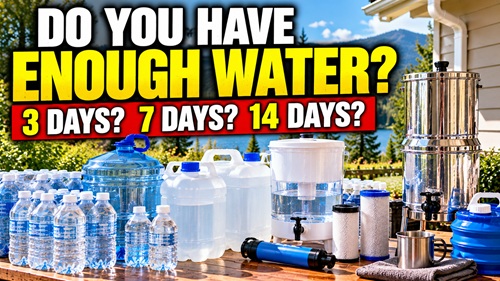
Do You Have Enough Safe Water When You Need It?
Prepping Communities | Emergency Preparedness Checklists
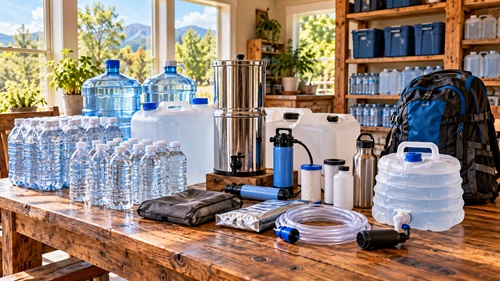
Most households use water throughout the day without giving much thought to how much they consume. Drinking, cooking, washing dishes, cleaning, personal hygiene, and flushing toilets all depend on a reliable supply. Turn on a tap, and the water is simply there. That convenience can disappear quickly during an emergency, sometimes without enough warning to fill a single container.
A major storm might damage municipal infrastructure, an earthquake could break water mains, or a prolonged power outage might disable the electric pump supplying a private well. Flooding and industrial accidents can contaminate normally dependable water sources. Even when water continues flowing, an official advisory may mean it is no longer safe to drink without appropriate treatment.
Many households keep bottled water in storage, perhaps alongside a portable filter or purification tablets. Those supplies are useful, but their presence doesn’t establish how long the household could function without normal water service. Several large containers may look reassuring until their combined capacity is compared with the amount of water everyone actually needs.
An Emergency Drinking Water Inventory helps households calculate their requirements, inspect stored water, identify shortages, and evaluate whether alternative water sources and treatment equipment can be relied upon. It distinguishes water that is already safe and accessible from water that may be available but requires treatment, and from potential sources that have not been verified.
The accompanying downloadable color checklist provides space to record water quantities, container condition, storage locations, treatment equipment, replacement dates, and household-specific requirements. It includes calculations for 3, 7, 14, and 30 days, estimated days of coverage, water safety assessments, and a practical method for identifying when essential supplies could become inadequate.
The purpose isn’t simply to accumulate water containers. It’s to understand how much safe water your household has available, what it needs, and how long that supply could support everyone if normal services stopped working.
Why a Drinking Water Inventory Matters
A household may own several water containers without knowing their combined capacity. Some might be full, others partially empty, and a few may have been stored so long that nobody remembers when they were last inspected. An empty 20-litre container provides storage capacity, but it contributes nothing to the household’s immediately available drinking water.
The same distinction applies to filtration equipment. A portable water filter may be useful when an appropriate source is available, but the filter itself doesn’t create water. It may be unable to remove certain contaminants or incapable of treating enough water to meet household demand. A private well may contain abundant water but remain inaccessible if its electric pump stops working.
An inventory helps establish the difference between supplies that are ready to use and resources that depend on additional equipment, treatment, or operating conditions. It also identifies damaged containers, unsuitable storage locations, and supplies that may be difficult to access during an emergency.
This becomes increasingly important as a disruption continues. Water that appears sufficient for several days may be consumed faster than expected when cooking, medical needs, hot weather, or additional household members increase demand. Establishing actual quantities before an emergency makes it easier to recognize and correct these weaknesses.
Begin With Your Household’s Actual Water Requirements
Before counting stored water, establish how many people and animals your inventory must support. A household with two adults has different requirements from one with several children, an infant, older relatives, or someone with medical needs that increase water consumption. Pets also require safe drinking water, and their needs vary with species, size, diet, activity, and temperature.
Consider what everyone normally uses water for and which activities would remain essential during an emergency. Drinking and food preparation are immediate priorities, but handwashing, personal hygiene, and certain medical activities may also require water of an appropriate quality. An infant using powdered formula, for example, may have specific water safety and preparation requirements that should be confirmed with an appropriate healthcare professional.
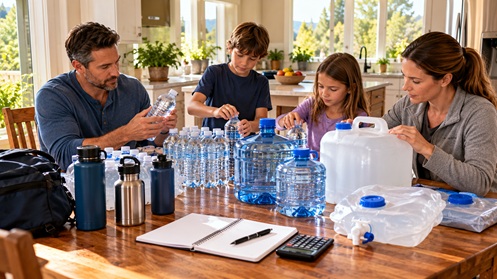
Climate and physical activity matter as well. Someone performing strenuous work in hot conditions may require substantially more drinking water than a person resting indoors in a temperate climate. Illness can also increase requirements, particularly when fever, vomiting, or diarrhea causes additional fluid loss.
Rather than applying one quantity to every household member without adjustment, use a common starting allowance and record additional requirements separately. This keeps the calculations manageable while accounting for differences that matter.
Calculating Water Requirements for 3, 7, 14, and 30 Days
A commonly recommended emergency planning allowance is approximately one US gallon, or 3.8 litres, per person per day for drinking and basic sanitation.
This allowance should be treated as a minimum starting point for emergency planning, not as a complete estimate of every household water requirement. Cooking, medical needs, pets, hot weather, and more extensive sanitation may require additional quantities.
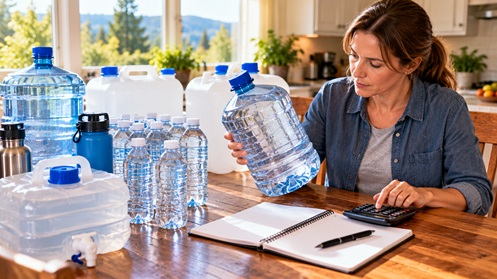
For planning purposes, multiply the number of people by the daily allowance and the number of days being considered. A family of four using 3.8 litres per person would have a starting daily requirement of 15.2 litres.
| Emergency duration |
Starting requirement for four people |
|---|---|
| 3 days | 45.6 litres |
| 7 days | 106.4 litres |
| 14 days | 212.8 litres |
| 30 days | 456 litres |
These quantities reveal a practical storage challenge. A two-week reserve for four people weighs approximately 213 kilograms before the containers are included, while a 30-day reserve exceeds 450 kilograms. Storage space, structural load limits, accessibility, and the ability to handle heavy containers all become important considerations.
The inventory should compare the required quantity with the amount of safe water actually available. If a household has 80 litres of verified drinking water against a 14-day starting requirement of 212.8 litres, the shortage is 132.8 litres. Recording that shortage provides a clear target for improvement rather than relying on the impression that several full containers represent an adequate supply.
Calculate How Many Days Your Stored Water Will Last
Knowing the total quantity stored is useful, but estimating how long it could last provides a more meaningful measure of preparedness. Divide the usable stored drinking water by the household’s estimated daily requirement to calculate approximate days of coverage.
Usable stored drinking water ÷ estimated daily household water requirement = estimated days of coverage
For a family of four with 80 litres of safe drinking water and a starting daily requirement of 15.2 litres, the calculation is 80 ÷ 15.2, or approximately 5.3 days.
This means the household has slightly more than five days of coverage at the assumed consumption rate. It does not guarantee that everyone will have sufficient water for that period. Additional cooking, medical, pet, or sanitation needs may shorten the duration, particularly if those requirements weren’t included in the daily estimate.
A useful inventory should therefore calculate both an expected daily requirement and a higher-demand scenario. If daily consumption increases from 15.2 litres to 20 litres, the same 80-litre reserve lasts four days instead of 5.3. That difference could become significant during hot weather, illness, or an extended disruption.
Record both estimates on the downloadable checklist. The lower coverage figure helps reveal how quickly supplies could become inadequate if circumstances change.
Distinguish Safe Water From Water That Is Merely Available
One of the most important parts of a drinking water inventory is distinguishing between water that exists and water that can safely be consumed.
A household might have hundreds of litres of rainwater in outdoor tanks, access to a nearby stream, or water remaining in a private well. These resources may be valuable, but they should not automatically be counted as safe drinking water.
For inventory purposes, distinguish between verified safe drinking water that is already accessible, water that may become suitable after an appropriate treatment process, and potential sources whose availability or safety has not been established.
A full rainwater tank might be useful for certain permitted non-drinking activities, but it may not provide safe drinking water without additional assessment and treatment. A natural water source could become contaminated during flooding or inaccessible because of road closures or hazardous conditions.
Only water that is already safe, accessible, and appropriate for drinking should be included in the immediately usable reserve. Other sources should be recorded separately, along with their limitations and the steps required before they could be used.
Inspecting Stored Drinking Water
Water inventory should begin with the actual containers rather than a shopping list. Examine commercially bottled water, filled household storage containers, and any other water intended for drinking. Record the capacity of each container and how much water it currently holds. A 20-litre container that is only half full contributes approximately 10 litres, not 20.
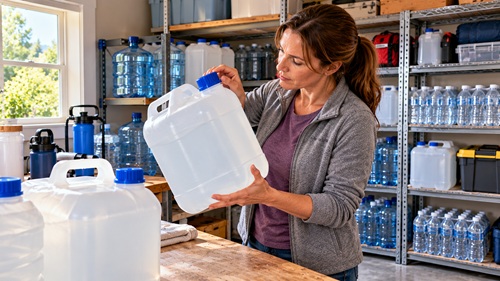
Check for leaks, cracks, damaged closures, contamination, and other conditions that could affect water safety. Food-safe containers intended for drinking water are preferable to improvised containers of uncertain history. Never use containers that previously held fuels, pesticides, toxic chemicals, or other hazardous substances for drinking water storage.
Commercially bottled water should be stored according to manufacturer instructions, with packaging condition and applicable date information considered during inspections. Water filled into reusable containers requires appropriate cleaning, sanitizing, filling, sealing, and maintenance procedures consistent with public-health guidance.
Avoid assuming that water remains safe indefinitely simply because its container is sealed. Storage history, container condition, contamination risks, and the method used to fill it all matter. If the safety of stored water cannot be established, record it as requiring assessment rather than automatically counting it toward the dependable reserve.
Choosing Suitable Water Storage Locations
A household might have enough storage capacity on paper but keep most of its containers in an inaccessible basement, an outbuilding exposed to freezing temperatures, or a location that becomes difficult to reach during an evacuation. Water storage needs to account for these practical limitations as well as water safety.
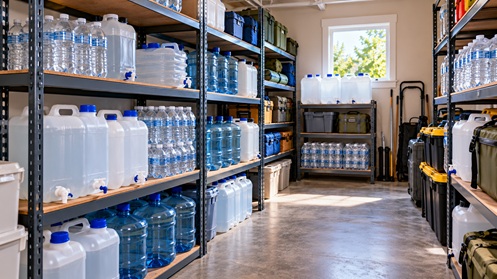
Consider the weight of full containers when choosing shelves and storage areas. A 20-litre container holds approximately 20 kilograms of water, and several containers can place substantial loads on ordinary shelving. Larger quantities should be stored where the structure can safely support their combined weight.
Protect containers from damage, excessive heat, freezing conditions, and possible chemical contamination. Follow manufacturer storage recommendations and keep drinking-water containers away from fuels, pesticides, cleaning products, and other hazardous substances.
Frequently needed water should remain accessible without moving heavy equipment or searching through crowded storage areas. Smaller containers may be easier for children, older adults, or people with mobility limitations to handle. The inventory should record not only where water is stored but also whether household members can safely reach and use it during an emergency.
Drinking Water and Water for Other Household Needs
Not every household activity requires water of the same quality, but the distinction must be handled carefully. Drinking, food preparation, infant feeding, oral hygiene, and many medical activities require water that meets applicable safety standards. Certain cleaning or toilet-flushing activities may have different requirements, depending on the emergency and local public-health guidance.
Stored rainwater, for example, might be suitable for some non-drinking purposes under appropriate conditions, but it should not automatically be considered safe for drinking, cooking, or washing food. Water intended for non-drinking use should be clearly identified and stored separately to prevent accidental consumption or contamination of potable supplies.
During an extended disruption, households may use drinking water for every activity simply because it is the most accessible resource. That can exhaust the reserve much faster than expected. A practical inventory identifies which activities require potable water and which may have safe alternatives, while ensuring that drinking-water containers and food preparation areas remain protected from contamination.
Water Filtration, Purification, and Treatment Equipment
Portable filters, purification equipment, and chemical disinfectants can strengthen emergency preparedness, but their limitations need to be understood. Different treatment methods address different hazards. Some filters can remove certain microorganisms and particles but may not remove viruses, dissolved chemicals, heavy metals, or other contaminants. Boiling can inactivate many disease-causing microorganisms, but it does not reliably make chemically contaminated water safe.
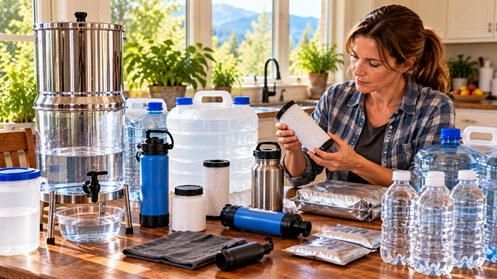
A household should evaluate treatment equipment according to the contaminants it is designed to address, its rated capacity, maintenance requirements, and the type of water source it may be used with. Check whether replacement filter elements are available, whether equipment has been maintained, and whether treatment requires electricity, batteries, fuel, or other supplies.
Water purification tablets and chemical disinfectants also have storage, dosing, contact-time, and effectiveness limitations. Follow product instructions and official public-health guidance rather than assuming that one method works for every situation.
Understanding Emergency Water Advisories
Water safety advisories deserve particular attention because they do not all mean the same thing. A boil-water advisory generally indicates that boiling water according to official instructions can address specified microbial hazards. A do-not-drink advisory may indicate contamination that boiling cannot correct, while a do-not-use advisory can impose broader restrictions, potentially including washing or other contact with the water.
The exact meaning and required precautions depend on the issuing authority and the contamination involved. A household should follow the specific instructions provided by its local water supplier or public-health authority rather than assuming that boiling, filtering, or adding disinfectant will make any water safe.
This is especially important after industrial incidents, fuel spills, chemical contamination, and certain flooding events. Some contaminants cannot be reliably removed by ordinary household treatment methods, and attempting to treat unsuitable water may create a false sense of security.
During your inventory, record where official advisories can be obtained, how the household would receive updates if internet service were unavailable, and which alternative drinking-water supplies could be used if the normal source became restricted.
A treatment system that has never been tested or cannot address the relevant hazards should be recorded as an unverified capability, not a guaranteed supply.
Alternative Water Sources and Their Limitations
Households with access to private wells, rainwater collection systems, springs, or nearby natural water sources may have additional options during an emergency. Those options can be valuable, but they should be evaluated separately from stored drinking water.
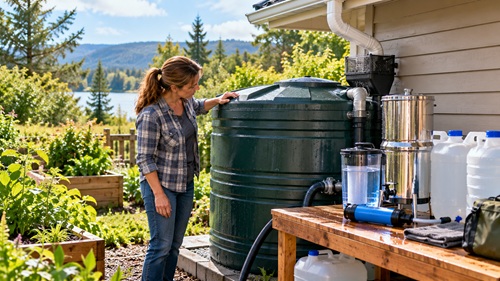
A private well may contain water while its electric pump remains unusable during a power outage. A rainwater collection system depends on rainfall, suitable collection surfaces, storage capacity, and water quality. Rivers, lakes, and streams may become contaminated or inaccessible after flooding, industrial incidents, or other disasters.
Availability also changes with seasons and local conditions. A source that is dependable during a wet season may be inadequate during drought or freezing weather. Consider whether each source can be reached safely, whether access is permitted, how much water could realistically be collected, and whether appropriate treatment is available.
Record alternative sources as confirmed, conditional, or unverified according to the evidence available. Do not count their potential output as though it were already stored in a container.
Emergency Water for Cooking and Food Preparation
Water planning is closely connected to emergency food storage. A household might have enough bottled water for drinking but overlook the amount required to prepare rice, pasta, dried beans, freeze-dried meals, and other stored foods.
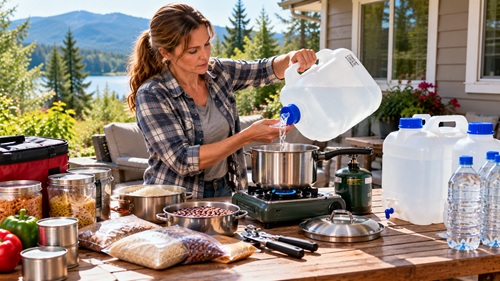
These requirements can become significant over a two-week disruption, particularly when much of the emergency food reserve consists of dry staples. Review your emergency meal plan and identify foods that require additional water. Estimate the quantities needed using package instructions and realistic meal portions.
Some cooking methods may also require water for cleaning equipment and utensils. Where safe and practical, ready-to-eat foods can reduce dependence on cooking water and fuel. Include food preparation water in your inventory calculations rather than assuming it will come from the drinking reserve without affecting its duration.
Water Requirements for Hygiene, Sanitation, and Medical Needs
Water disruptions affect more than drinking and cooking. Handwashing, cleaning, personal hygiene, and safe waste management can become difficult when normal water service is unavailable. Households caring for infants, older adults, or people with medical needs may require additional clean water and hygiene supplies.
Some activities can be managed with suitable alternatives, such as hand sanitizer when hands are not visibly soiled and its use is appropriate. Other tasks require water of a particular quality and cannot safely be replaced with untreated water.
If toilets cannot be flushed or wastewater systems are damaged, the household may need an alternative sanitation plan developed according to local public-health requirements. Medical equipment and prescribed care routines may also depend on specific water quality standards, which should be confirmed with healthcare professionals.
The inventory should reveal whether sufficient water is available for essential activities without assuming that every normal household routine can continue unchanged.
Maintaining and Rotating Emergency Water Supplies
Water storage should be inspected regularly rather than forgotten until an emergency occurs. Check containers for damage, leaks, compromised seals, and unsuitable storage conditions. Review commercially bottled products according to manufacturer guidance and maintain household-filled containers using appropriate public-health recommendations.
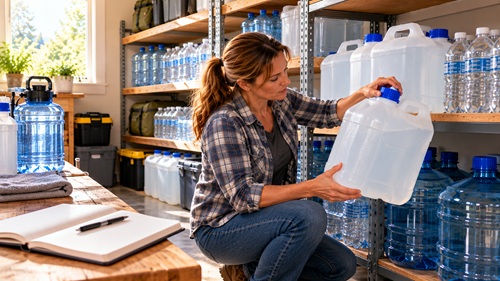
Record when containers were filled, inspected, cleaned, or replaced, as applicable. Water treatment equipment should also be checked for maintenance requirements, replacement components, and operating limitations.
A complete inventory review at least every six months is a practical starting point, with additional inspections after major temperature changes, flooding, storage damage, or use of emergency supplies. Regular maintenance helps ensure that the quantity recorded in the inventory still represents water the household can depend on.
Assess Your Water Supply on Day 1, Day 7, and Day 14
A useful water inventory should reveal how the household’s available supply would change throughout an extended disruption. The assessment should begin with the calculated days of coverage and then consider conditions that could increase daily demand or make stored supplies unusable.
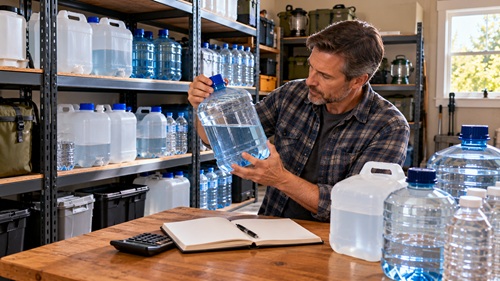
On Day 1, stored drinking water may be readily available, containers are full, and alternative sources have not yet been needed. The main task is determining whether everyone can access sufficient safe water without relying on the usual taps or well pump.
By Day 7, a household with limited storage may have consumed much of its reserve. Cooking, hygiene, illness, hot weather, or unexpected household needs could increase daily consumption. If replenishment depends on filtration equipment, a private well, or another source, its limitations may now become important.
On Day 14, the assessment should consider what water remains and whether the household could continue safely if normal services were still unavailable. Would there be enough drinking water for another day? Could essential medical and food preparation needs still be met? Would the household have needed to obtain a verified alternative supply or relocate earlier?
Download Your Free Emergency Drinking Water Inventory Checklist
The revised Emergency Drinking Water Inventory Checklist provides a practical way to calculate household requirements, inspect existing supplies, evaluate alternative water sources, and identify shortages before normal water services become unavailable. It is designed for households preparing for short interruptions as well as extended disruptions lasting several weeks.
The professionally formatted, color-coded PDF includes water calculations for 3, 7, 14, and 30 days, drinking-water storage records, container inspections, filtration and purification equipment, alternative water sources, cooking and sanitation requirements, and portable evacuation water supplies. Each inventory section provides space to record quantities required, quantities available, shortages, container condition, inspection dates, and storage locations.
A dedicated Water Coverage and Safety Assessment helps households calculate how many days their stored drinking water could last under normal conditions and how that duration might change if consumption increases. The checklist distinguishes verified safe drinking water from potentially treatable water and unverified sources, preventing households from counting resources that may not be immediately available or safe to consume.
The assessment also addresses the differences between boil-water, do-not-drink, and do-not-use advisories. These distinctions are important because treatment methods that address microbial contamination may not be appropriate when chemical contamination or other hazards are present. The checklist encourages households to examine their treatment capabilities and identify where official water safety information can be obtained.
The Day 1, Day 7, and Day 14 assessment helps readers determine when essential water requirements could become inadequate. Record both the expected first shortage day under normal consumption and the earlier shortage day that could occur under higher demand. Comparing these estimates provides a more realistic understanding of how quickly stored water might be depleted during hot weather, illness, or other demanding circumstances.
The checklist also includes corrective-action and maintenance sections for documenting shortages, equipment inspections, replacement priorities, and future review dates. Once completed, it becomes a useful reference for maintaining household water supplies rather than a form that is filled out once and forgotten.
Print the checklist and complete it while examining your actual water storage. Check container capacities, inspect their condition, verify treatment equipment where appropriate, and record anything requiring attention. Keep the completed inventory with your emergency supplies so it can be updated as water is used, replaced, or reorganized.
Download your free printable inventory checklist:
The 11-page color checklist is formatted for US Letter paper (8.5 × 11 inches) and includes water requirement calculations, storage and treatment inventories, water safety assessments, supply duration estimates, and corrective-action worksheets.
Preparedness Action Plan
Begin by examining the water your household already has available. Check commercially bottled water, filled storage containers, larger water tanks, and any other supplies intended for drinking. Use the downloadable checklist to record the actual quantity in each container rather than relying on its maximum capacity. Include everyone in the household, along with pets and anyone requiring additional water for medical, dietary, or personal care.
Calculate your starting requirements for the emergency period you’re preparing for. The commonly used allowance of approximately 3.8 litres per person per day provides a useful starting point, but it should not be treated as a complete estimate of every household water requirement. Additional water for cooking, medical needs, pets, hot weather, and sanitation may be necessary. Compare the calculated requirement with the quantity of safe drinking water currently stored, taking care not to count the same supply twice.
Next, calculate how many days your stored water could last at the estimated daily consumption rate. Repeat the calculation using a higher daily requirement to account for conditions that could increase demand. This comparison helps identify whether the household’s reserve would remain adequate during a more demanding emergency.
Inspect water containers and storage locations for damage, leaks, compromised seals, contamination risks, and unsuitable conditions. Check whether supplies can be safely accessed and handled by the people who may need them. A large quantity of water is less useful if it is stored somewhere inaccessible or in containers that cannot be safely moved or opened.
Examine filtration equipment, purification supplies, and alternative water sources separately from stored drinking water. Record whether these resources are maintained, accessible, and appropriate for the hazards they may encounter. Identify how your household would obtain official water safety information and what alternative supplies would be available if normal water sources became unsafe.
If your budget is limited, concentrate first on establishing a dependable supply of safe drinking water for immediate household needs. Additional storage capacity, specialized treatment systems, and convenience equipment can be considered as resources permit. Increasing the reserve gradually may be more manageable than purchasing large quantities of equipment at once, and some improvements may involve reorganizing or properly maintaining containers already owned.
Once the inventory is complete, work through the Day 1, Day 7, and Day 14 assessment. Estimate how much water would remain as the disruption continues, considering both normal consumption and higher-demand conditions. Identify the earliest day an essential water requirement could become inadequate and determine whether additional storage, a verified alternative source, or a contingency plan is necessary.
Record the three most important improvements in the corrective-action section of the checklist. Establish realistic completion dates and verify that each correction has addressed the original shortage. Review the inventory at least every six months, after using stored water, or whenever household circumstances change.
Key Takeaways
An emergency drinking water inventory should establish how much safe water a household can actually use, not simply how many containers or treatment devices it owns. Stored drinking water, empty storage capacity, potentially treatable water, and unverified sources serve different purposes and should be evaluated separately.
Calculating household requirements and estimated days of coverage helps reveal shortages that may not be obvious when examining storage containers. Comparing normal consumption with higher-demand conditions provides a more realistic understanding of when supplies could become inadequate.
Water treatment equipment and alternative sources can strengthen preparedness, but their usefulness depends on the type of contamination, equipment condition, and actual operating circumstances. Understanding emergency water advisories helps households recognize when ordinary treatment methods may be unsuitable and when an alternative safe supply is necessary.
Regular inspections and the Day 1, Day 7, and Day 14 assessment help identify deteriorating supplies, equipment limitations, and the earliest expected water shortage. These findings provide a practical basis for prioritizing improvements and maintaining the reserve over time.
The value of an emergency water reserve isn’t measured by how many containers are stored. It’s measured by how reliably the household can obtain and use enough safe water when normal services are unavailable.
Explore More Emergency Preparedness Checklists
Having enough safe drinking water is an essential part of emergency preparedness, but water storage is only one of the resources a household may need during an extended disruption. Food, medical supplies, emergency power, sanitation, and communication equipment all contribute to maintaining household safety and independence.
Prepping Communities offers additional free emergency preparedness checklists to help you evaluate your existing supplies, identify shortages, and maintain the resources your household depends on.
Explore these related checklists:
- 72-Hour Emergency Kit Inventory — Assess the essential supplies needed during the first three days of an emergency.
- Two-Week Emergency Supplies Inventory — Determine whether your household has sufficient resources to manage a 14-day disruption.
- Emergency Food Storage Inventory — Evaluate stored food, calculate meal requirements, inspect storage conditions, and determine how long your food supply could last.
Each resource includes practical preparedness guidance and a downloadable color inventory checklist to help you assess and improve your household’s readiness.
Explore the Prepping Communities Emergency Preparedness Checklist series for more free resources designed to help you prepare for unexpected disruptions.
© Prepping Communities. This content is for informational purposes only and not professional advice. Use at your own risk.
Terms | Privacy | Guidelines