
Choosing, Storing, and Using Nutrient-Dense Survival Foods
When building an emergency food supply, it’s easy to concentrate on the basics. Rice, beans, pasta, canned vegetables, and other shelf-stable foods usually come first, and for good reason. They’re affordable, familiar, and can provide the foundation for meals during an extended disruption. But having enough food to fill a pantry isn’t quite the same as having a balanced emergency food supply.
One area that sometimes gets overlooked is dietary fat. The body needs fat for energy, normal cellular function, and the absorption of certain vitamins. During an emergency, when meals may be less varied and physical demands can increase, having dependable sources of dietary fat becomes particularly useful.
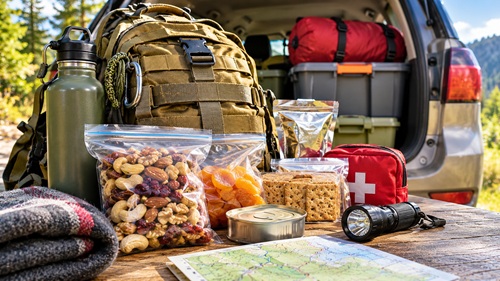
Nuts can help fill that need. They’re compact, calorie-dense, and ready to eat without cooking, electricity, or additional water. A small package can be carried in an emergency backpack, kept with evacuation supplies, or eaten during a power outage when preparing a proper meal isn’t practical.
There is a catch, though. Nuts aren’t foods that can be sealed in a container and forgotten for decades. Their natural oils gradually deteriorate, particularly when exposed to heat, oxygen, and light. They require more attention than many traditional dry storage staples.
That doesn’t make them a poor preparedness choice. It simply means understanding how to select, store, and rotate them is just as important as knowing their nutritional value.
Why Nuts Are Useful During an Emergency
Under normal circumstances, the weight of food rarely enters into everyday meal planning. Groceries are carried home, meals are prepared, and most people have access to a kitchen whenever they need one. Emergencies can change that quickly.
Someone evacuating on foot may have to carry several days of supplies. A person clearing storm damage could spend hours performing physical work without access to regular meals. During a prolonged power outage, cooking fuel and clean water may need to be conserved.
In these situations, food that provides substantial energy without requiring much preparation becomes especially valuable.
Fat contains approximately nine calories per gram, compared with four calories per gram from either carbohydrates or protein. Because nuts contain relatively high amounts of fat, they provide a considerable amount of energy in a small package.
A 100-gram portion of mixed nuts, for example, can provide approximately 550 to 650 calories, depending on the varieties included. That’s a useful amount of energy from something small enough to fit into a backpack pocket.
Compare that with many fresh fruits or vegetables, which contain substantial amounts of water and generally provide fewer calories for the same weight. Fresh produce remains important for balanced nutrition, but it isn’t always practical when someone needs to carry food over long distances.
Nuts also have the advantage of being ready to eat. There’s no need to boil water, operate a stove, or use cooking fuel. During an emergency, that convenience can be just as important as their nutritional content.
Still, nuts should never be considered a complete emergency diet. They provide valuable fats, some protein, fiber, and minerals, but they cannot supply every nutrient the body requires. They work best as part of a broader food supply that includes carbohydrates, other protein sources, and appropriate fruits and vegetables.
Choosing the Right Nuts for Your Emergency Food Supply
Not every variety of nut offers the same nutritional benefits. Some are particularly rich in calories, others provide more protein, and certain varieties contain useful concentrations of specific vitamins and minerals.
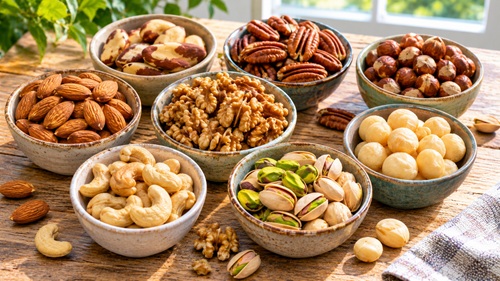
Almonds are among the most practical choices for everyday preparedness. A typical one-ounce serving, approximately 28 grams, provides around 164 calories, six grams of protein, and 14 grams of fat. Almonds also contain vitamin E, magnesium, calcium, and dietary fiber. They’re easy to portion, widely available in many regions, and versatile enough to use in ordinary meals. They can be eaten directly, added to oatmeal, or combined with dried fruit for a simple emergency snack.
Walnuts provide approximately 185 calories per ounce and contain alpha-linolenic acid, a plant-based omega-3 fatty acid. This makes them a useful addition to a varied diet, although their relatively high polyunsaturated fat content also makes them sensitive to oxidation. Shelled walnuts can develop rancid flavors when stored under unfavorable conditions, so they benefit from cool storage and regular rotation.
Pecans are particularly useful when calorie density is the priority. They provide approximately 196 calories per ounce, along with manganese, copper, and other minerals. Their high fat content makes them an efficient source of energy, especially when food weight and storage space are limited. They also fit easily into everyday meals, which makes rotating stored supplies relatively simple.
Hazelnuts provide approximately 178 calories per ounce and contain vitamin E, manganese, copper, and fiber. Their compact size makes them convenient for emergency food portions, and they can be eaten whole or crushed into other foods. In suitable growing regions, hazelnut shrubs may also contribute to longer-term household food production.
Pistachios provide approximately 159 calories and nearly six grams of protein per ounce of edible kernels. They also contain potassium, vitamin B6, and dietary fiber. For emergency backpacks, shelled pistachios are generally more practical because their shells add weight and occupy space without contributing nutrition.
Cashews offer approximately 157 calories per ounce, along with protein, copper, and magnesium. Their relatively soft texture may also make them easier to eat for people who have difficulty chewing harder nuts. Macadamia nuts, meanwhile, provide approximately 204 calories per ounce, making them one of the more calorie-dense options. However, their higher cost in many regions can make them less practical for large emergency food inventories.
Brazil nuts are worth mentioning for a different reason. They’re exceptionally rich in selenium, an essential trace mineral involved in thyroid function and normal antioxidant processes. However, selenium concentrations vary considerably, and eating too many Brazil nuts regularly can result in excessive intake. Some individual nuts contain enough selenium that several could approach or exceed the adult daily upper intake level of 400 micrograms established under U.S. guidance. Brazil nuts are therefore better treated as an occasional addition rather than a primary emergency snack.
There’s no need to purchase every variety available. A combination of affordable, familiar nuts will generally provide more practical value than an expensive collection of specialty products that rarely get eaten.
Local availability matters too. Almonds and walnuts may be inexpensive in one region but costly in another. In some countries, locally produced peanuts, seeds, or other nutrient-dense foods may provide a more affordable alternative. Although peanuts are technically legumes, they offer many of the same practical advantages as tree nuts for emergency food planning.
The best choice is one that fits the household’s nutritional needs, budget, food preferences, and ability to maintain a fresh supply.
How Much Should You Store?
Knowing that nuts provide concentrated energy is helpful, but preparedness planning becomes more meaningful when actual quantities are considered.
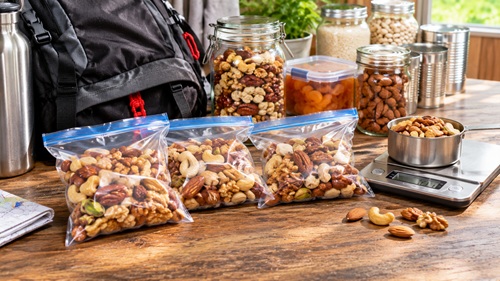
Imagine someone preparing a 72-hour emergency backpack. Space is limited, and every additional item adds weight. They need food that can be eaten without cooking and that provides enough energy to supplement other emergency rations.
If they pack three 100-gram portions of mixed nuts, they’ll be carrying approximately 300 grams of food containing roughly 1,650 to 1,950 calories. Spread across three days, that provides approximately 550 to 650 calories per day.
That’s a useful contribution from less than a third of a kilogram of food, excluding packaging. However, it isn’t enough to meet most adults’ total daily energy requirements. Additional foods would still be necessary, particularly if the person expects to walk long distances or perform demanding physical work.
The same principle applies to household storage.
Consider two adults preparing for a two-week disruption. If each person were allocated a 50-gram portion of mixed nuts per day, the household would need approximately 1.4 kilograms for the entire period.
At an average of 600 calories per 100 grams, that supply would provide approximately 8,400 calories over two weeks, or about 300 calories per person per day.
Those calories could make a useful contribution to the household’s emergency diet, particularly when combined with rice, beans, canned foods, and other staples.
These examples are planning illustrations rather than fixed dietary recommendations. Energy requirements vary according to age, body size, activity level, health, and environmental conditions. Some people also need to avoid nuts because of allergies or other dietary restrictions.
The important lesson is to calculate what stored food actually provides. Having several large bags of nuts in a pantry doesn’t automatically mean the household has enough food for an extended emergency.
Understanding Shelf Life and Proper Storage
One of the biggest mistakes in emergency food planning is assuming that all dry foods can be stored in the same way.
White rice and many dried legumes contain relatively little fat. When properly dried and stored under suitable conditions, they can remain usable for extended periods because there is less oil available to oxidize.
Nuts are different. Their high fat content is what makes them calorie-dense, but those same oils gradually react with oxygen. Heat and light accelerate the process, eventually causing changes in flavor, aroma, and overall quality.
This explains why a package of walnuts left in a warm cupboard may develop an unpleasant smell even though the package remains sealed. It also explains why nuts stored in a freezer generally retain their quality longer than the same nuts stored in a hot garage.
Packaging helps, but it has limitations.
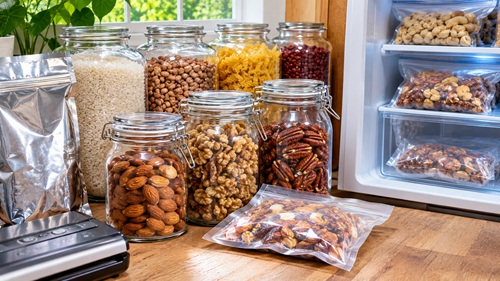
Vacuum sealing reduces oxygen exposure and may slow deterioration. Properly sealed packaging with effective barriers against moisture, oxygen, and light can also help protect stored food. However, neither vacuum sealing nor Mylar packaging turns nuts into a food suitable for decades of unattended storage.
Oxygen absorbers are sometimes promoted as a universal solution for long-term food preservation, but their suitability depends on the food’s moisture content, packaging, and storage conditions. For nuts, following established storage guidance and using refrigeration or freezing where practical is generally more dependable than relying on unverified preservation methods.
Whole nuts usually retain their quality better than chopped or ground nuts because less surface area is exposed to oxygen. Nuts protected by intact shells may also keep longer than shelled varieties under comparable conditions, although this varies by species and storage environment.
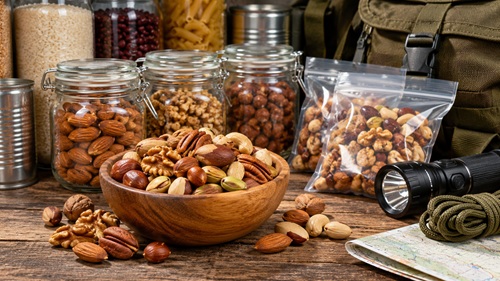
For ordinary pantry storage, commercially sealed packages are often convenient. Once opened, nuts should be transferred to suitable airtight containers if they won’t be consumed promptly.
Refrigeration can extend storage life, while freezing is often an effective option for larger quantities. Dividing nuts into smaller airtight portions allows households to remove only what they need without repeatedly exposing the entire supply to temperature changes and moisture.
Of course, freezing introduces another consideration. During an extended power outage, freezer temperatures may gradually rise if backup electricity isn’t available. Nuts don’t automatically become unsafe simply because they thaw, but their remaining quality will depend on the conditions they experience afterward.
For this reason, households preparing for prolonged electricity disruptions should maintain some appropriately packaged pantry supplies rather than relying entirely on frozen food.
Recognizing When Stored Nuts Have Deteriorated
Best-before dates can help with food rotation, but they shouldn’t be confused with guarantees of safety.
For many shelf-stable products, a best-before date primarily indicates the period during which the manufacturer expects the food to retain its intended quality under recommended storage conditions. It doesn’t necessarily mean the product becomes unsafe the following day.
However, stored nuts should still be inspected before use.
Nuts that have become rancid may develop a bitter, stale, sharp, or paint-like odor. Their flavor may also change noticeably. When this happens, replacing them is the sensible choice.
Visible mold, insect contamination, unusual discoloration, or damaged packaging are additional reasons to discard the product.
Mold contamination is particularly important because certain molds can produce mycotoxins, including aflatoxins. These substances can present serious health risks and aren’t reliably eliminated through ordinary cooking. Moldy nuts should never be taste-tested to determine whether they’re still usable.
Rancidity and microbial contamination are different problems, but neither belongs in a dependable emergency food supply.
A package that looks acceptable from the outside isn’t necessarily in good condition internally. This is why inspection and rotation matter just as much as the original packaging method.
Special Considerations for Vehicles and Bug-Out Bags
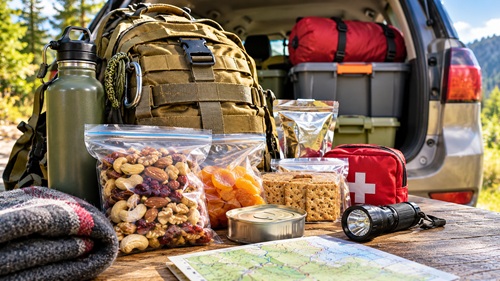
Nuts are convenient for emergency backpacks and vehicle kits, but these storage locations present challenges that don’t necessarily exist in a household pantry.
Vehicles are particularly problematic because interior temperatures can rise substantially during warm weather. Food stored in a glove compartment, trunk, or cargo area may experience repeated heating and cooling cycles that accelerate deterioration.
Consider someone who places a bag of mixed nuts in a vehicle emergency kit in early spring and forgets about it until winter. That package may have spent months exposed to high temperatures, even though it was never opened.
The solution isn’t necessarily to avoid carrying nuts. It’s to recognize that vehicle food requires more frequent inspection and replacement.
Small, commercially sealed portions are generally easier to manage than large containers. They can be replaced individually, distributed among passengers, and eaten without preparation. In particularly hot climates, other commercially packaged emergency foods with manufacturer-supported temperature tolerances may be more dependable for longer vehicle storage.
Bug-out bags present a slightly different challenge. Weight and space are limited, and food must compete with water, shelter, clothing, first aid supplies, and other essentials.
Nuts perform well because they provide substantial calories without requiring cooking equipment or fuel. A small pouch can be eaten during a rest stop or while traveling through an area where preparing a meal isn’t practical.
However, relying entirely on nuts would create nutritional limitations. The body also requires carbohydrates, adequate protein, vitamins, minerals, and water. During strenuous activity, carbohydrates are particularly useful because they provide readily available energy for working muscles.
Combining nuts with dried fruit creates a more varied snack. The nuts contribute fats and some protein, while the fruit provides carbohydrates. Other portable foods, such as suitable crackers, shelf-stable protein products, and commercially prepared emergency rations, can help fill additional nutritional gaps.
Water remains essential. Nuts are dry foods, and their calorie density doesn’t reduce the body’s need for adequate hydration.
Food allergies must also be considered. For anyone with a serious nut allergy, nuts may be entirely unsuitable. Shared emergency supplies should be clearly identified, and alternatives should be available for people who cannot safely consume them.
Making Emergency Trail Mix From Everyday Ingredients
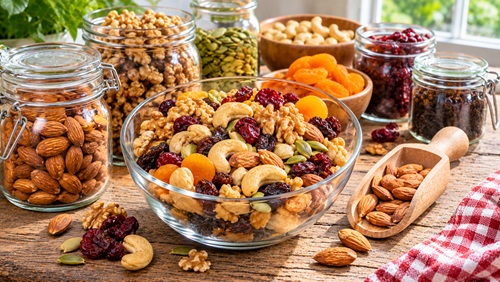
One of the simplest ways to incorporate nuts into preparedness planning is to prepare trail mix using foods the household already enjoys.
A combination of almonds, walnuts, pumpkin seeds, and dried fruit provides a useful mixture of fats, protein, fiber, and carbohydrates. Other nuts or seeds can be substituted depending on availability, cost, and personal preference.
There’s no need to make the mixture complicated. In fact, familiar ingredients are often a better choice than expensive specialty products purchased solely for emergencies.
Someone who regularly eats almonds and raisins may be better served by maintaining a rotating supply of those ingredients than by purchasing an unfamiliar mixture that sits untouched in storage.
Homemade trail mix should be prepared using clean, dry ingredients and suitable food-safe packaging. Because different ingredients have different storage lives, the finished mixture should be managed according to its least stable component.
Chocolate can add variety, but it may melt during warm-weather storage. For vehicle kits or outdoor travel in hot climates, simpler combinations are often more practical.
Trail mix is best treated as a regularly rotated food rather than something intended for years of unattended storage.
Growing Nuts for Long-Term Food Independence
Emergency food storage addresses immediate needs, but households interested in greater self-sufficiency may also want to consider producing some of their own food.
Nut-producing trees and shrubs can contribute to that goal where suitable growing conditions exist.
Walnuts, hazelnuts, pecans, chestnuts, and other species can provide useful harvests, but their suitability depends heavily on climate, soil, rainfall, pollination requirements, pest pressure, and available space.
Some hazelnut varieties can begin producing relatively early under favorable conditions, while walnut and pecan trees may require several years before delivering substantial harvests.
Regional differences are important. Pecans generally need sufficiently long, warm growing seasons, while certain hazelnut and walnut varieties can tolerate colder conditions. In other parts of the world, locally adapted nut and seed crops may be more practical than the varieties commonly sold in international grocery markets.
Growing nuts also introduces preservation challenges. Harvested nuts must be properly dried, protected from insects and rodents, and stored under conditions that reduce spoilage.
A productive tree doesn’t automatically provide a dependable year-round food supply. Harvests can vary, pests can damage crops, and poor storage can result in substantial losses.
For households interested in long-term food independence, nut production is best considered alongside vegetables, fruits, staple crops, and other locally appropriate food sources.
Building a Reliable Emergency Food Rotation
The most dependable emergency food inventory isn’t necessarily the largest one. It’s the one that remains usable and can be maintained without excessive cost or waste.
Nuts fit particularly well into a rotating pantry system because they can be incorporated into ordinary meals.
Almonds can be added to breakfast cereals, walnuts can be used in baking, pecans can be included in snacks, and mixed nuts can be portioned for lunches or outdoor activities.
When new packages are purchased, older stock can be moved into everyday use. This keeps the emergency supply replenished while reducing the chance that food will deteriorate unnoticed.
Recording purchase dates and manufacturer best-before dates makes rotation easier, particularly when several varieties are stored.
It’s also worth reviewing the nutritional balance of the entire emergency food supply. A household may have sufficient carbohydrates from rice and pasta but relatively few convenient sources of fats and protein. Nuts can help address part of that imbalance.
On the other hand, a household already storing substantial quantities of peanut butter, canned fish, cooking oils, and other fat-containing foods may have less need for additional nuts.
The goal is to understand what each stored food contributes rather than collecting supplies simply because they appear on preparedness lists.
Preparedness Action Plan
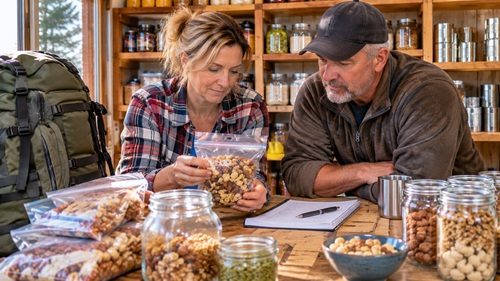
Begin by reviewing your existing emergency food inventory and identifying which foods provide fats, protein, and ready-to-eat calories. Consider how much cooking would be required to use those supplies during a power outage or evacuation. If most of your food depends on boiling water or operating a stove, adding some ready-to-eat options may improve your preparedness.
Next, examine any nuts already in storage. Check their packaging, purchase dates, and storage conditions. Pay particular attention to food kept in vehicles, garages, sheds, or other locations exposed to high temperatures. Replace products showing signs of deterioration, and move usable older supplies into regular household consumption before their quality declines.
Choose a few varieties that suit your budget, dietary needs, and food preferences. There is no need to purchase every type of nut. A manageable selection of familiar products is often easier to rotate and maintain.
Calculate the approximate calories your selected nuts provide. As a simple planning example, 500 grams of mixed nuts averaging 600 calories per 100 grams would provide approximately 3,000 calories. That calculation helps establish how much energy the food contributes, but it shouldn’t be confused with the number of complete meals available.
For evacuation backpacks, consider whether smaller portions would be more practical than carrying one large package. For household storage, determine how nuts complement existing foods rather than treating them as a replacement for balanced meals.
If you maintain a vehicle emergency kit, establish a separate inspection schedule because temperature exposure can shorten food quality. Replace heat-exposed supplies as necessary, even when the packaging remains intact.
Finally, make food rotation part of normal household routines. Using stored nuts in everyday meals and replacing them regularly is one of the simplest ways to keep emergency supplies fresh without creating unnecessary waste.
Households interested in longer-term food independence can also investigate whether locally adapted nut trees or shrubs would be practical additions to their property. The time required for establishment, harvest, and preservation should be considered before relying on future production.
Key Takeaways
Nuts offer several advantages for emergency preparedness. They provide concentrated calories, useful fats, protein, and essential nutrients in a compact form that requires no cooking. These characteristics make them particularly valuable for emergency backpacks, vehicle kits, and situations where normal food preparation is disrupted.
Different varieties offer different nutritional strengths. Almonds and pistachios provide relatively useful amounts of protein, walnuts contribute plant-based omega-3 fatty acids, and pecans and macadamias offer particularly high calorie density. Choosing a variety of affordable, familiar nuts can help improve dietary diversity.
Their greatest limitation is storage life. The same natural oils that make nuts calorie-dense also make them vulnerable to oxidation. Heat, oxygen, moisture, and light can reduce their quality, and no packaging method makes them suitable for indefinite storage.
Proper storage, regular inspection, and food rotation are therefore essential. Refrigeration and freezing can help extend quality, but households preparing for extended power outages should also consider the limitations of electricity-dependent storage.
Nuts should complement a broader emergency food supply rather than replace staple foods, adequate protein sources, fruits, vegetables, or drinking water. Their value comes from filling specific nutritional and practical needs within a balanced preparedness plan.
Ultimately, preparedness isn’t measured simply by how much food has been stored. It depends on whether that food remains safe, nutritious, accessible, and appropriate for the circumstances in which it may be needed.
A modest supply of well-chosen, properly stored, and regularly rotated nuts can make a meaningful contribution to that goal.
Nutrition and Food Storage References
The nutritional figures used in this lesson are approximate values based on standard food composition data. Actual values may differ according to variety, processing, and serving size. The following resources provide additional information on nutrition, food preservation, and safe nutrient intake.
USDA FoodData Central: https://fdc.nal.usda.gov/
National Center for Home Food Preservation: https://nchfp.uga.edu/
NIH Office of Dietary Supplements — Selenium: https://ods.od.nih.gov/factsheets/Selenium-HealthProfessional/
© Prepping Communities. This content is for informational purposes only and not professional advice. Use at your own risk.
Terms | Privacy | Guidelines