
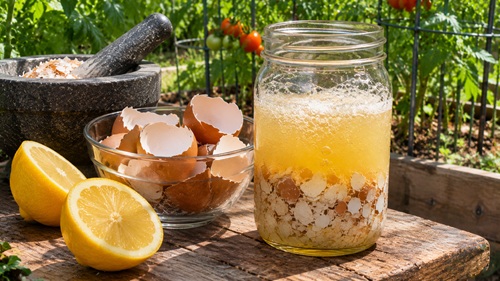
Turning Kitchen Scraps into a Gardening Resource
If you grow your own vegetables, chances are you’ve heard that eggshells are good for the garden. Some gardeners crush them and sprinkle them around tomato plants, while others add them to compost or bury them directly in the soil. But there’s another method that combines eggshells with something most kitchens already have: fresh lemon juice.
At first glance, it seems almost too simple. Take something you would normally throw away, combine it with lemon juice, and create a homemade calcium supplement for your plants. The idea has become popular among gardeners looking for inexpensive alternatives to store-bought fertilizers.
There is some interesting science behind the method. Eggshells contain calcium carbonate, and the citric acid in lemon juice can react with that mineral to form calcium compounds that behave differently in water and soil. However, whether the resulting mixture actually benefits your plants depends on several factors, including soil conditions, how much calcium is already available, and whether your plants need additional calcium in the first place.
For anyone interested in growing more of their own food, this is a useful technique to understand. It offers an opportunity to reuse kitchen waste, learn a little about soil chemistry, and become more familiar with the nutrients that support a productive vegetable garden. The important thing is knowing what the mixture can do, what it cannot do, and when it might be worth experimenting with.
Why Calcium Is Important for Healthy Plants
Most gardeners are familiar with nitrogen, phosphorus, and potassium, the three nutrients commonly displayed on fertilizer packaging. Calcium receives less attention, but it is just as essential to normal plant development. It helps plants build and maintain strong cell walls and is particularly important in actively growing tissues, including new leaves, developing roots, and young fruit.
One of the challenges with calcium is that plants cannot easily move it from older tissues into new growth. Much of the calcium absorbed through the roots travels with water moving through the plant. This means healthy roots and consistent moisture are especially important for delivering calcium to developing tissues.
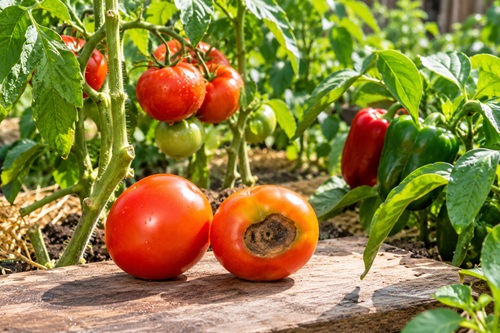
Tomatoes and peppers provide a familiar example. Gardeners sometimes discover dark, sunken patches developing on the blossom ends of otherwise healthy-looking fruit. This condition, known as blossom-end rot, is associated with insufficient calcium reaching the developing fruit. It’s tempting to assume the soil needs more calcium, but that isn’t always the problem. A tomato plant can be growing in soil with adequate calcium and still develop blossom-end rot if watering is inconsistent or its roots are struggling.
Imagine a tomato plant growing through a particularly hot week. The soil becomes very dry, and the plant struggles to take up enough water. A heavy watering follows, but the developing fruit may already have experienced a disruption in calcium delivery. Adding more calcium to the soil won’t necessarily prevent that from happening again. This is why understanding how plants absorb nutrients is often more valuable than simply adding another fertilizer.
What Happens When You Mix Eggshells and Lemon Juice?
Eggshells are made primarily of calcium carbonate, a mineral also found in limestone. Although calcium carbonate contains plenty of calcium, it does not dissolve readily in ordinary water. This explains why large pieces of eggshell can remain in garden soil or compost for months, sometimes much longer. They may eventually contribute calcium as conditions allow them to react and break down, but they are not an immediate source of dissolved calcium.
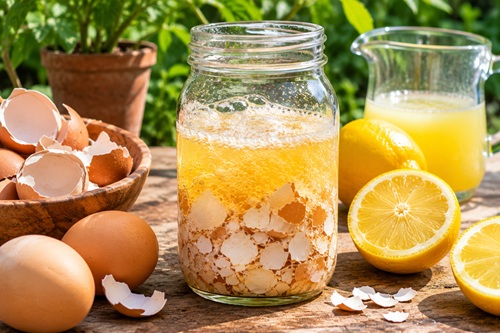
Lemon juice changes the situation because it contains citric acid. When that acid comes into contact with calcium carbonate, a chemical reaction begins. Carbon dioxide gas is released, and calcium compounds, including calcium citrate, may form. If you’ve ever poured vinegar over baking soda, you’ll recognize the bubbling. The reaction with eggshells is different chemically, but the visible fizzing is also caused by carbon dioxide being released.
What makes this interesting for gardeners is that the reaction can convert some of the calcium carbonate into other chemical forms. Some calcium may enter the liquid, although calcium citrate itself has limited solubility, and not all of the calcium necessarily remains dissolved. The amount depends on how much lemon juice is used, how finely the shells are crushed, the acidity of the mixture, and whether enough acid is present to react with the available calcium carbonate.
There is one important distinction here. The reaction does not create additional calcium. It changes the chemical form of calcium that was already present in the eggshells. The finished liquid is also not a standardized fertilizer. Without testing, there is no reliable way to know how much dissolved calcium it contains or how plants will respond to it.
Still, watching this reaction provides a practical introduction to the relationship between minerals, acidity, and nutrient availability. Understanding that relationship can help gardeners make better decisions about soil amendments and avoid adding materials that may not be necessary.
How to Make a Homemade Eggshell and Lemon Calcium Supplement
This is a simple kitchen-scale experiment that can be prepared using ingredients and equipment already found in many households. The quantities are deliberately small because the purpose is to learn how the reaction works before considering whether the resulting mixture has a useful place in the garden.
For a small batch, gather the shells from approximately four to six eggs and enough freshly squeezed lemon juice to cover the crushed shells. You’ll also need a clean glass jar or bowl, something suitable for crushing the shells, and a fine-mesh strainer or coffee filter. A mortar and pestle works well for crushing, although a rolling pin or another suitable kitchen tool can also be used.
The number of eggshells is not a precise fertilizer measurement. Eggshells vary in size and thickness, and lemons vary in acidity. These differences affect the final mixture, which is why this preparation should be considered an experiment rather than a recipe that produces a predictable fertilizer concentration.
Begin by rinsing the eggshells to remove any remaining egg contents. Allow them to dry completely, and avoid using shells contaminated with spoiled egg. Wash your hands and utensils after handling raw eggshells. Once dry, crush the shells into small pieces or a coarse powder. The finer they are crushed, the more surface area is exposed to the lemon juice, allowing the acid to reach more of the calcium carbonate.
Place the crushed shells into a clean glass container, leaving enough empty space for bubbling. Slowly add fresh lemon juice until the shells are covered. You may notice bubbles forming almost immediately as carbon dioxide is released during the reaction. This is normal, but the container should never be sealed tightly while bubbling continues because pressure could build inside.
Loosely cover the container with a breathable barrier to keep dust and insects out while allowing gas to escape. Allow the mixture to react for approximately 24 to 48 hours, stirring occasionally with a clean utensil. Bubbling may gradually slow as the available acid is consumed, although this observation period does not guarantee that all the calcium carbonate has reacted.
When the reaction has largely settled, strain the mixture through a fine-mesh strainer or coffee filter. Some eggshell material may remain at the bottom, particularly if there wasn’t enough acid to react with all of it. The strained liquid may contain dissolved calcium compounds, residual acid, and other substances from the shells.
Because this is an unstandardized homemade preparation, its exact calcium concentration and acidity remain unknown unless measured. It is best prepared in small quantities and used promptly for educational experimentation rather than stored for extended periods.
How Should You Use the Mixture in Your Garden?
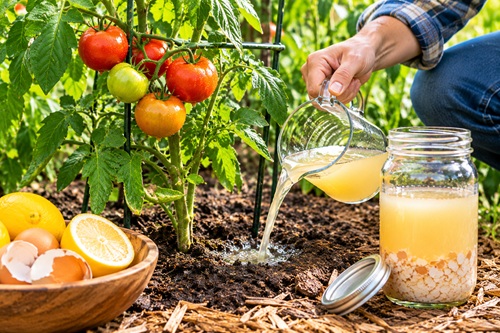
This is where it’s worth being cautious. Many online gardening videos recommend a particular dilution ratio and suggest pouring the mixture around tomatoes, peppers, or other vegetables every few weeks. The problem is that homemade batches are not chemically identical. One gardener may use several large lemons and finely powdered shells, while another uses a small amount of juice and much larger shell fragments. Their finished liquids may contain very different amounts of dissolved calcium and residual acid.
There is no scientifically established universal dilution ratio for this homemade eggshell-and-lemon preparation. Giving every gardener the same application instructions would suggest a level of reliability that the method has not demonstrated.
Before considering a soil application, check whether your garden actually needs additional calcium. A soil test is the most useful starting point, particularly if you have experienced repeated problems with blossom-end rot or poor plant growth. If your soil already contains sufficient calcium, adding more may accomplish very little. In some situations, unnecessary amendments can interfere with the balance of other nutrients or change soil conditions.
For anyone interested in experimenting, begin with a small number of nonessential plants rather than applying the mixture throughout the garden. The acidity of any diluted solution should be checked, and strongly acidic liquids should never be applied directly to roots or foliage. However, even a near-neutral pH does not guarantee that a mixture is suitable for plants. A pH reading cannot establish how much calcium is present or determine a safe application rate.
For this reason, the most reliable use of this homemade preparation is as a small educational experiment. Gardeners seeking to correct a confirmed calcium deficiency should use an appropriate, tested soil amendment according to established horticultural recommendations.
Will Eggshell and Lemon Fertilizer Prevent Blossom-End Rot?
Blossom-end rot is one of the most common reasons gardeners look for homemade calcium solutions. It can be discouraging to watch tomatoes develop beautifully, only to discover dark, leathery patches forming on the bottoms of the fruit. Because the condition involves calcium delivery to developing fruit, it seems reasonable to assume that adding calcium will solve the problem. Unfortunately, gardening isn’t always that straightforward.
In many vegetable gardens, the soil already contains enough calcium. The real difficulty is getting that calcium into the plant and transporting it to developing fruit at the right time. Water plays a major role in this process. When soil repeatedly dries out and becomes saturated again, calcium uptake and movement can become disrupted. Root damage, excessive nitrogen fertilization, and high concentrations of soluble salts can also contribute.
This is particularly important for gardeners growing tomatoes in containers or raised beds. These growing environments can dry out more quickly than surrounding garden soil, especially during hot weather. A container that seems adequately moist in the morning may become surprisingly dry by late afternoon, particularly when a large tomato plant is producing fruit.
Consistent watering is therefore one of the most effective ways to reduce the risk of blossom-end rot. Mulching around plants helps conserve moisture and moderate soil temperature, while avoiding excessive fertilizer applications can reduce unnecessary stress. Maintaining healthy roots is equally important because damaged or restricted root systems may struggle to absorb the water and nutrients plants need.
If a soil test confirms that calcium is genuinely deficient, an appropriate soil amendment may be beneficial. The type and amount should be selected according to the soil’s existing pH and nutrient levels. Agricultural lime, for example, can supply calcium while raising soil pH, making it unsuitable for some soils that are already alkaline. Gypsum can supply calcium without substantially raising pH, although it is not necessary or beneficial in every garden.
A homemade eggshell-and-lemon solution has not been reliably demonstrated to prevent blossom-end rot. It should not replace consistent watering or correction of confirmed soil problems. Once blossom-end rot has damaged a developing tomato, the affected tissue will not recover, although improving growing conditions may help later fruit develop normally.
Why Eggshells Are Not a Complete Plant Fertilizer
Eggshells contain a useful mineral, but plants need much more than calcium to grow successfully. Nitrogen supports leafy growth and the production of chlorophyll. Phosphorus is involved in energy transfer and other essential processes, while potassium helps regulate water movement and numerous plant functions. Plants also require magnesium, sulfur, and several micronutrients.
Eggshells do not provide these nutrients in the balanced quantities needed to maintain a productive vegetable garden. Adding lemon juice does not change that. The chemical reaction may alter the form of some of the calcium, but it does not create the other nutrients plants require.
This is an important lesson for anyone interested in homemade fertilizers. A material can contain a beneficial nutrient without being suitable as a complete plant food. The same principle applies to many other popular gardening remedies. Banana peels contain potassium, coffee grounds contain organic matter and nutrients, and wood ash contains minerals, but none should automatically be applied without considering the needs of the soil.
A productive garden depends on balance. Too much of one amendment can sometimes create new problems rather than solve existing ones. For households trying to become more self-sufficient, learning to recognize these differences helps make better use of limited gardening resources and reduces the temptation to apply unnecessary treatments.
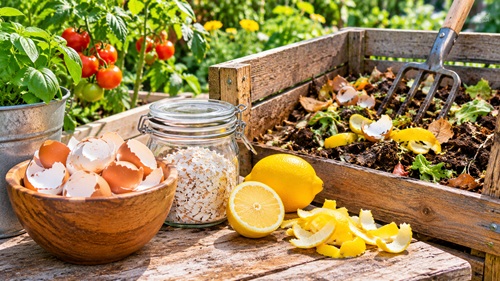
Other Ways to Use Eggshells and Lemon Scraps
Making a liquid calcium preparation is not the only way to keep eggshells and lemon scraps out of the garbage. One of the simplest alternatives is composting. Clean, crushed eggshells can be mixed into an established compost system, where they become part of the finished material. Their calcium carbonate may remain present for some time, but the shells can still contribute to the mineral content of the compost.
Grinding the shells into smaller particles increases the surface area exposed to moisture and soil processes. Large pieces tend to remain visible much longer, which is why gardeners sometimes find recognizable eggshell fragments when turning older compost. This doesn’t necessarily mean the composting process has failed. It simply reflects how slowly some mineral materials break down.
Lemon peels can also be composted in moderate amounts. Cutting them into smaller pieces and mixing them with leaves, grass clippings, vegetable scraps, and other compost ingredients encourages more even decomposition. A well-managed compost pile benefits from a mixture of carbon-rich and nitrogen-rich materials, adequate moisture, and sufficient oxygen. These conditions allow microorganisms to break down organic matter efficiently.
For gardeners with limited space, a small enclosed composting system can help manage kitchen scraps without requiring a large backyard. Even households growing vegetables in containers can benefit from learning how to produce and use finished compost safely.
There is also value in keeping a small supply of clean, dry, crushed eggshells for future soil amendment experiments. Unlike a wet homemade infusion, properly dried shells are easier to store, although they should still be kept clean and protected from moisture. The broader lesson is that kitchen waste can become a resource when its properties and limitations are understood.
Building Soil Fertility Without Relying Entirely on Store-Bought Fertilizers
For gardeners interested in preparedness, the real value of this subject goes beyond eggshells and lemons. A productive garden depends on healthy soil, and maintaining that soil becomes especially important when commercial fertilizers, compost, or other gardening supplies are expensive or difficult to obtain.
Households that understand composting, mulching, crop rotation, and soil management are better positioned to maintain food production using locally available materials. These practices help build a more resilient growing environment and reduce unnecessary dependence on purchased gardening products.
Compost is particularly valuable because it contributes organic matter, supports soil structure, and helps improve the soil’s ability to retain moisture. Depending on the ingredients and maturity of the compost, it can also contribute nutrients, although its nutrient content is variable. Over time, regular additions of suitable organic matter can help improve soil conditions and support beneficial soil organisms.
Mulching offers another practical advantage. A layer of suitable organic mulch can reduce evaporation, moderate soil temperature, suppress weeds, and gradually contribute organic material as it decomposes. These benefits become especially important during periods of hot, dry weather when plants may struggle to maintain consistent moisture uptake.
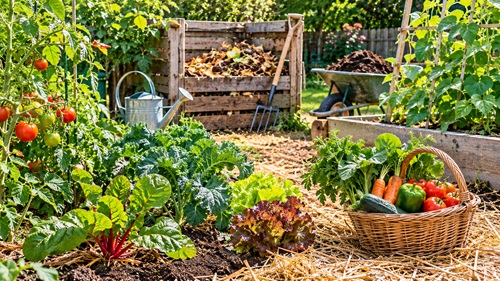
These practices work together. Soil with good structure and adequate organic matter can often retain moisture more consistently, supporting healthier roots and more dependable nutrient uptake. That consistency is especially important for crops such as tomatoes and peppers, where irregular moisture can contribute to blossom-end rot.
Crop rotation and the use of cover crops can also support long-term soil management. Leguminous cover crops may contribute nitrogen when properly managed, while other cover crops help protect exposed soil and reduce erosion. Maintaining living roots in the soil during suitable parts of the growing season can also support soil structure and biological activity.
None of these methods eliminates the need to understand soil nutrient levels. Harvesting vegetables removes nutrients from the growing system, and those nutrients eventually need to be replenished. In a self-sufficient garden, the goal is to manage those inputs carefully, recycle suitable organic materials, and avoid unnecessary losses.
A gardener who understands soil fertility is much better prepared than one who depends on a collection of homemade fertilizer recipes without knowing when or why to use them.
Testing Homemade Gardening Methods Before Depending on Them
One of the best ways to improve gardening knowledge is to test ideas on a small scale before making them part of the regular growing routine. A homemade eggshell-and-lemon preparation provides an opportunity to practice this approach while learning about the limitations of unstandardized gardening treatments.
Rather than applying an unfamiliar mixture to every tomato plant, gardeners can begin by examining the condition of their soil and identifying whether additional calcium is needed. If a controlled gardening experiment is appropriate, it should involve a small number of nonessential plants of the same variety, similar size, and comparable growing conditions.
Watering, sunlight exposure, and other growing conditions should remain as consistent as possible. Some plants should remain untreated so that differences can be observed. However, because the homemade solution has no established safe application rate, plant trials should not be mistaken for proof that the mixture is suitable for routine use.
Even when a plant appears healthier after receiving a treatment, the improvement may have resulted from changes in temperature, watering, sunlight, or other growing conditions. A small backyard experiment cannot establish the exact calcium concentration of the mixture or prove that any improvement resulted from additional calcium.
A gardening notebook can be surprisingly valuable over several growing seasons. Recording planting dates, soil amendments, watering practices, weather conditions, and harvest results makes it easier to recognize patterns that might otherwise be forgotten.
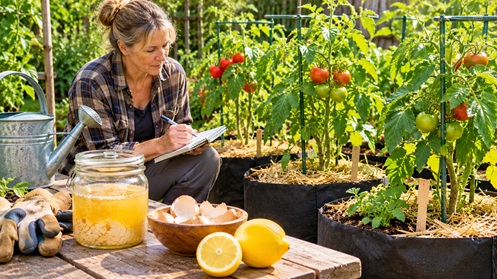
For example, a gardener may discover that blossom-end rot occurs mainly during periods of extreme heat or when container-grown tomatoes are watered inconsistently. That information is often more useful than knowing which homemade supplement was applied.
The ability to observe, evaluate, and adjust gardening practices is one of the most important skills a self-sufficient household can develop. It encourages decisions based on actual growing conditions rather than assumptions or popular gardening trends.
Important Safety and Storage Considerations
Although eggshells and lemons are familiar kitchen ingredients, that does not mean every preparation made from them is automatically safe for plants. Lemon juice is acidic, and concentrated acidic solutions can damage sensitive roots or foliage. The acidity of a homemade mixture can vary considerably depending on the ingredients and how completely the reaction proceeds.
Never assume that a mixture is safe simply because the bubbling has stopped. The absence of visible gas production does not establish a safe pH or a particular calcium concentration. Even when a mixture has been diluted, its suitability for plants cannot be determined from acidity alone.
The reaction also releases carbon dioxide, so the container must remain vented while bubbling continues. A tightly sealed jar can develop pressure and should not be used for this process. A loosely fitted, breathable covering is sufficient to keep debris out while allowing gas to escape.
Because the preparation is homemade and unstandardized, its storage stability is unknown. Prepare small batches, avoid prolonged storage, and discard mixtures that develop mold, unusual odors, or other signs of contamination. Clearly identify the container and keep it separate from food and beverages. Equipment used during preparation should be cleaned thoroughly afterward.
Most importantly, avoid treating the solution as a universal remedy for plant problems. Yellowing leaves, slow growth, damaged fruit, and poor harvests can result from many different causes, including water stress, pests, disease, unsuitable temperatures, and nutrient imbalances. Understanding the problem before applying a treatment is always the better approach.
Preparedness Action Plan
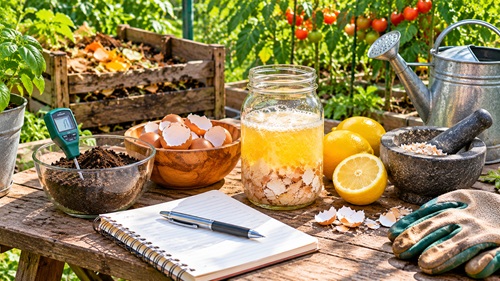
The next time you prepare eggs for breakfast, save a few shells instead of throwing them away. Rinse them, allow them to dry, and crush them into small pieces. If you have a lemon available, use a small portion of the shells to observe how calcium carbonate reacts with citric acid. Watch the bubbling, notice how the shell material changes, and become familiar with the process.
Before considering whether to use the resulting liquid in your garden, take a closer look at your soil and plants. Think about whether you’ve experienced blossom-end rot, inconsistent growth, or other problems that might be related to nutrient availability. Review your watering habits, particularly if you grow tomatoes or peppers in containers that dry out quickly.
If you haven’t tested your garden soil recently, consider arranging a soil test before the next growing season. Knowing the soil’s pH and nutrient levels can help determine whether calcium or other amendments are actually needed. This is a more dependable approach than applying homemade mixtures simply because a gardening video recommends them.
Use the eggshell experiment as an opportunity to improve your gardening records. Write down the ingredients, preparation date, and observations. If you want to investigate its effects on plants, first establish whether additional calcium is needed and seek reliable guidance on appropriate application rates. Without knowing the mixture’s composition, there is no scientifically supported dosage to recommend.
At the same time, look for other ways to recycle suitable kitchen and garden waste. Establish or improve a composting system, save leaves for mulch, and consider how organic materials from around the household might contribute to long-term soil health.
The most important preparedness goal is not producing a jar of homemade fertilizer. It is developing the knowledge and practical skills needed to maintain productive soil and healthy food crops when gardening supplies become more difficult to obtain.
Download Your Free Garden Preparedness Planning Tool
Understanding your soil and keeping track of what works in your garden can make a real difference from one growing season to the next. To help you put these lessons into practice, we’ve created a free, printable Eggshell & Lemon Garden Preparedness Planning Tool. It includes space to record soil test results, document homemade gardening experiments, track watering and plant growth, and review what worked throughout the growing season. Download a copy, keep it with your gardening supplies, and use it to build a more reliable and productive garden.
Key Takeaways
Eggshells are primarily calcium carbonate, and lemon juice contains citric acid that can react with this mineral. The reaction releases carbon dioxide and can produce calcium compounds, including calcium citrate. However, the amount of calcium remaining dissolved in a homemade preparation is uncertain, and the mixture should not be considered a standardized fertilizer.
Calcium is essential for healthy plant development, but adding more calcium does not automatically improve growth. Blossom-end rot in tomatoes and peppers often develops because calcium is not reaching the fruit consistently, even when sufficient calcium is present in the soil. Proper watering, healthy roots, and balanced soil conditions are therefore critical.
Kitchen scraps such as eggshells and lemon peels can be useful gardening resources, particularly when incorporated into a well-managed composting system. Their value comes from understanding how they behave in soil rather than assuming they provide an immediate fertilizer benefit.
For households working toward greater self-sufficiency, the most dependable approach is to combine resourcefulness with sound gardening practices. Composting, mulching, soil testing, consistent watering, and careful observation will contribute far more to long-term food production than relying on any single homemade gardening remedy.
Disclaimer: This preparation is described as an educational gardening experiment rather than a proven fertilizer treatment. Its calcium concentration, acidity, effectiveness, safe application rate, and storage life have not been established. Gardeners should use soil testing and established horticultural recommendations when correcting suspected nutrient deficiencies.
© Prepping Communities. This content is for informational purposes only and not professional advice. Use at your own risk.
Terms | Privacy | Guidelines