
Will Your Household Be Ready on Day 14?
Prepping Communities | Emergency Preparedness Checklists
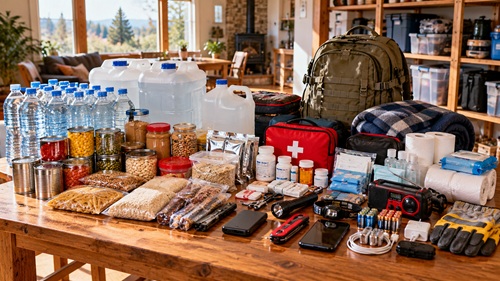
Most households have emergency supplies tucked away somewhere. There may be canned food in the pantry, bottled water in a cupboard, flashlights in a drawer, and a few extra necessities stored in the garage. Those supplies can be reassuring, but how long would they actually last if electricity, running water, transportation, and access to stores were interrupted?
Imagine a major storm damages electrical infrastructure throughout your region. Grocery stores close, fuel deliveries are delayed, and local water service becomes unreliable. Roads may be blocked, emergency crews are overwhelmed, and nobody knows when normal services will return.
During the first few days, your household might manage reasonably well. By the end of the first week, however, fresh food may be gone, rechargeable equipment needs power, medications could be running low, and sanitation is becoming increasingly difficult.
A Two-Week Emergency Supplies Inventory helps households determine whether their existing resources could support everyone for 14 days. It provides a practical way to calculate requirements, identify shortages, inspect equipment, and recognize dependencies that could become serious problems during an extended disruption.
The accompanying downloadable color-coded checklist allows readers to record what they already own, compare quantities against household requirements, and develop a manageable plan for correcting deficiencies. The process begins with understanding what’s available rather than purchasing everything on a generic emergency supply list.
Why Preparing for Two Weeks Is Different
A 72-hour emergency kit provides an important starting point, particularly for evacuations and shorter disruptions. Extending those preparations to 14 days involves more than increasing the quantities of food and water.
Some requirements grow directly with time. Drinking water, food, medications, and personal hygiene products are consumed daily, so a longer emergency requires larger reserves. Other problems develop because equipment and household systems cannot operate indefinitely without outside support.
Consider a family that stores several rechargeable flashlights, a portable radio, and two power banks. During a three-day outage, that equipment may be sufficient. After ten days without electricity, however, the family could be struggling to recharge devices unless it has another dependable power source.
Food presents similar challenges. A pantry containing rice, pasta, dried beans, and canned goods may look well stocked, but much of that food requires cooking. Without a safe alternative to an electric stove, the number of usable meals may be much smaller than expected.
Then there are the everyday problems that gradually accumulate. Garbage needs somewhere to go. Toilets may stop working. Laundry becomes difficult. Refrigerated food can no longer be relied upon, and household members may begin using more stored water for cleaning and sanitation than originally planned.
Preparing for two weeks also requires understanding the difference between stored supplies and the ability to replenish or sustain essential resources.
Stored drinking water provides a known quantity that can be used immediately. A dependable water source and an appropriate treatment method may allow a household to obtain additional safe water, but only if that source remains accessible and the treatment method is suitable for the contamination present.
The same distinction applies to electricity. Spare batteries and charged power banks provide a limited reserve. A properly sized solar charging system or another suitable backup power arrangement may extend that reserve, provided it can operate under the conditions of the emergency.
Owning equipment, however, doesn’t necessarily mean having a dependable capability. A water filter that has never been tested, a generator without sufficient fuel, or a solar charger that cannot meet essential electrical demands should not automatically be counted as reliable backup resources.
When completing your inventory, record stored quantities separately from equipment or systems intended to replenish them. This prevents a possible future resource from being mistaken for something already available.
Fourteen days is a planning target, not a guarantee that services will return after two weeks. Depending on the emergency, remaining at home may become unsafe, and evacuation could be necessary long before supplies run out. A dependable emergency reserve should therefore be supported by a household emergency plan.
Start With Your Household’s Actual Needs
Before examining your stored supplies, consider the people who will depend on them.
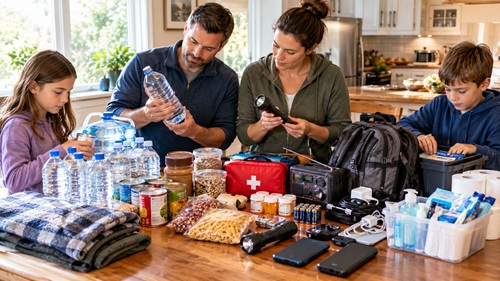
A household of two adults has different requirements from a family with young children, an older relative, or someone who relies on medical equipment. Pets need their own food, drinking water, medications, and arrangements for sanitation or evacuation.
Think about what your household normally uses over two weeks. How many meals are prepared? Which medications are taken every day? How much water is consumed? What hygiene products are regularly replaced? Are there medical devices, mobility aids, or other essential items that require electricity?
These details can be easy to overlook when purchasing emergency supplies.
For example, a household might have plenty of canned food but no suitable meals for a family member with food allergies. Someone using electrically powered medical equipment may have adequate consumable supplies but no reliable backup power. An infant may require formula, diapers, clean feeding equipment, and additional water that wasn’t included in the original calculations.
For supplies consumed regularly, a simple calculation provides a useful starting point:
Average daily consumption × 14 days = planned two-week quantity
If your household uses one roll of toilet paper every two days, approximately seven rolls would cover that normal rate of use for 14 days. A household using six diapers per day would need 84 diapers over the same period. Additional supplies may be appropriate when consumption varies or unexpected needs arise.
Not every item should be calculated this way. First-aid supplies, emergency lighting, and communication equipment should be evaluated according to their intended purpose, condition, and ability to function throughout the disruption.
Once you’ve calculated the amount required, compare it against the supplies that are actually usable.
Required quantity − usable quantity available = inventory shortage
For example, if a household requires approximately 213 litres of drinking water and has 80 litres safely stored, the shortage is approximately 133 litres.
Only count supplies that are accessible, in suitable condition, and appropriate for their intended purpose. Damaged containers, spoiled food, medications that are no longer safe or suitable to use, and equipment that doesn’t work should not be included in the usable inventory.
This distinction matters because a household can appear well supplied on paper while having significantly fewer dependable resources than expected.
Record household-specific requirements before deciding whether your emergency storage is adequate. The inventory should reflect the people who actually live in your household, not an imaginary average family.
Water: Calculating a Two-Week Supply
Water is often the most difficult part of preparing for a longer emergency because the required quantities become substantial.
A commonly recommended starting allowance is one US gallon, approximately 3.8 litres, per person per day for drinking and basic sanitation. Over 14 days, that works out to approximately 53.2 litres per person.
For a family of four, the calculation is:
4 people × 3.8 litres × 14 days = 212.8 litres
That’s approximately 213 kilograms of water before accounting for the containers.
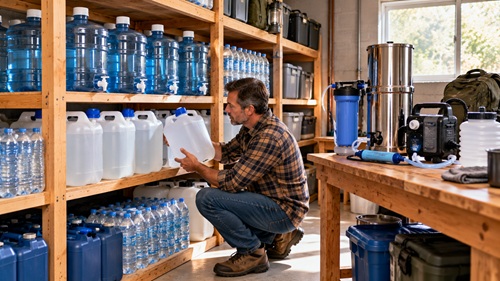
This is a starting planning allowance rather than a universal requirement. Hot weather, illness, physical activity, medical needs, and pets can increase water consumption. Cooking and more extensive sanitation needs may require additional water.
The quantity also creates practical storage considerations. Water containers should be food-safe, protected from contamination, and stored where their weight can be supported safely. Large quantities of water may be better distributed across suitable storage locations rather than placed on a single ordinary shelf.
A household with ten 4-litre water containers has 40 litres available. That may seem like a considerable amount until it is compared with the approximately 213 litres needed for four people over 14 days. The difference is about 173 litres.
Water filtration and treatment equipment can provide additional options, but they are not automatic replacements for stored drinking water. Some contaminants cannot be removed by ordinary portable filters or boiling. Households relying on wells should also consider whether water can be accessed if an electric pump stops working.
A rainwater collection system, nearby natural water source, or private well may provide additional options, but each has limitations. Availability can change with weather, contamination, equipment failure, and local conditions. Water collected from an uncertain source should not be considered safe for drinking until it has been assessed and treated appropriately.
When completing the checklist, record your total potable water, the household’s starting requirement, and any additional water needed for cooking, pets, or special circumstances. If storing the full amount immediately isn’t practical, document the shortage and develop a gradual storage plan rather than assuming an unverified water source will be available.
Food: Plan Meals Rather Than Count Packages
A full pantry doesn’t necessarily mean a household has enough usable food for two weeks.

Rice, dried beans, pasta, canned vegetables, and other shelf-stable foods can provide a valuable reserve. But their usefulness depends on preparation requirements, available water, cooking equipment, and the dietary needs of the people eating them.
A family of four eating three meals per day would need to account for 168 individual meal servings over 14 days, plus snacks and any additional nutritional requirements.
That doesn’t mean purchasing 168 separate food products. A large package may contain several servings, while a small can may provide only one. The important thing is to calculate what the household can realistically eat.
Try planning a two-week menu using only the food currently available in your emergency storage. Consider breakfast, lunch, dinner, snacks, and beverages. Check whether the meals provide adequate nutrition and reasonable variety, rather than relying on one inexpensive staple for every meal.
Pay attention to how food will be prepared. Dried beans and rice require water and cooking, while canned meals, nut butter, crackers, canned fish, dried fruit, and other ready-to-eat foods can reduce dependence on electricity or cooking fuel.
A manual can opener and suitable serving utensils are easy to overlook. So is the additional water needed to prepare dehydrated foods.
If you intend to cook during a power outage, the equipment must be suitable for the location where it will be used. Never operate charcoal grills, outdoor camping stoves, or other outdoor fuel-burning appliances inside a home, garage, or enclosed space because of the risk of carbon monoxide poisoning.
Food rotation is particularly important when maintaining a larger reserve. Store products under suitable conditions, inspect packaging, and use older stock before newer purchases where appropriate. A household that regularly eats and replaces its stored food may find it easier to maintain a dependable supply without unnecessary waste.
Households that grow or preserve some of their own food may have additional resources, but those should be evaluated realistically. A garden may produce little during winter, preserved foods still have storage requirements, and livestock depend on feed, water, and ongoing care. Food production can strengthen long-term preparedness without replacing the need for a dependable emergency reserve.
Medical Supplies, Prescriptions, and Access to Healthcare
Medical preparedness becomes more complicated when routine services may be unavailable for two weeks.
A basic first-aid kit can help manage minor injuries, but it does not address ongoing medical requirements. Prescription medications, diabetic testing supplies, hearing-aid batteries, mobility equipment, and other personal necessities may be difficult to replace during a widespread disruption.
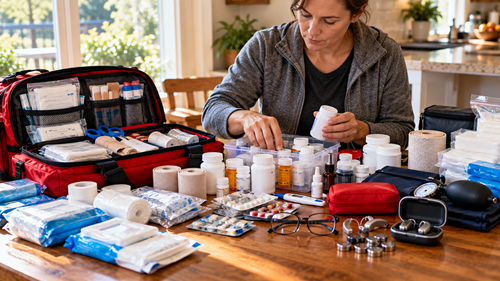
Some medications cannot be refilled early, and others require specific storage conditions. Discuss emergency medication reserves with a pharmacist or healthcare provider rather than changing prescribed doses to build a supply.
For medications requiring refrigeration, consider what would happen during a prolonged outage. Households relying on electrically powered medical equipment may need backup electricity, alternative care arrangements, and a plan for relocating before equipment or power reserves become inadequate.
Access to healthcare may also be disrupted. Roads could become impassable, ambulance response times may increase, and clinics or pharmacies may operate with reduced services. A household member who normally receives regular treatment or monitoring may need arrangements that go beyond maintaining additional supplies.
Discuss these possibilities in advance with the relevant healthcare professional. Know which symptoms or equipment failures require urgent assistance, how to contact emergency services, and what alternatives may be available if the usual care provider cannot be reached. Do not delay necessary medical care simply because an emergency is underway.
Personal hygiene supplies also deserve attention. Diapers, menstrual products, incontinence supplies, soap, hand sanitizer, and other everyday necessities are consumed regularly. Their quantities can be estimated using normal daily consumption, with an additional allowance where appropriate.
Medical requirements that cannot safely be supported at home should be documented separately. An inventory can identify the dependency, but a medical contingency plan is needed to address it.
Lighting, Communication, and Emergency Power
A flashlight that works on the first night of a power outage may not be much help if its batteries are depleted several days later.
For a two-week emergency, lighting and communication equipment need to be considered alongside their power requirements.
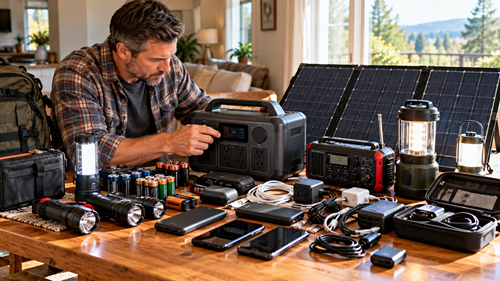
Inspect flashlights, headlamps, battery-powered lanterns, emergency radios, charging cables, and portable power banks. Check whether rechargeable devices hold a charge and whether spare batteries match the equipment in your household.
A battery-powered or hand-crank radio can help maintain access to emergency information when internet service is unavailable. Test reception before an emergency rather than assuming the radio will receive useful local broadcasts.
Power banks are helpful, but their capacity is limited. A unit capable of charging a phone several times may be adequate for a short outage without being sufficient for 14 days of regular use.
Households with larger backup power systems should estimate daily electricity consumption, usable battery capacity, and realistic recharging opportunities. Essential medical equipment and other critical electrical needs deserve particular attention.
For example, a portable power station might have enough stored energy to charge several small devices, but that doesn’t mean it can operate a refrigerator or medical appliance continuously. The equipment’s actual power consumption, startup requirements, usable battery capacity, and charging losses all affect how long it can operate.
Solar panels, generators, and other charging systems may extend available power, but each depends on suitable operating conditions. Solar charging varies with sunlight, while fuel-powered generators require fuel, maintenance, and safe outdoor placement well away from doors, windows, and vents.
Keep the amount of energy already stored separate from the amount you expect to generate or replenish. A backup system that has never been tested under a realistic load should not be treated as a guaranteed source of power.
Communication planning also involves knowing whom to contact and where to meet if household members become separated. Keep essential phone numbers written on paper and maintain secure, accessible copies of important documents.
A modest amount of emergency cash in smaller denominations may be useful if electronic payment systems are unavailable. The appropriate amount will depend on household circumstances and likely expenses.
Sanitation, Clothing, and Safe Living Conditions
A prolonged interruption to running water or wastewater services can create sanitation problems even when a household has sufficient food and drinking water.
Toilet paper, soap, hygiene wipes, hand sanitizer, waste bags, and cleaning products are straightforward to inventory. Managing human waste safely requires more planning.
If toilets cannot be flushed or wastewater systems are damaged, households may need temporary sanitation arrangements. Waste must be handled according to local public-health guidance to reduce contamination and disease risks.
Consider how much sanitation material your household normally uses and whether those products remain practical without running water.
Clothing and bedding also become important when heating or cooling systems fail. Weather-appropriate clothing, blankets, sleeping insulation, sturdy footwear, and rain protection can help manage changing conditions.
However, additional clothing cannot always compensate for dangerous indoor temperatures. A household preparing for two weeks without utilities should identify when remaining at home would become unsafe and where family members could relocate.
Pet owners should account for food, drinking water, medications, waste management, and transportation. These requirements can become substantial over 14 days, especially in households with several animals.
Organizing Home Storage and Evacuation Supplies
A two-week emergency reserve is generally intended for household storage rather than being carried in a backpack.
The water calculation alone demonstrates why. A basic two-week supply for four people weighs more than 200 kilograms before containers are included.
Home emergency supplies can be stored in suitable cupboards, shelving units, and storage containers. They should remain protected from moisture, pests, extreme temperatures, and other conditions that could damage their contents.
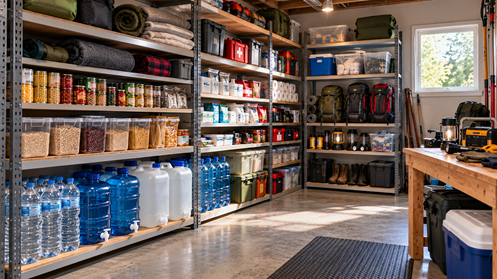
Keep supplies organized so household members can find them without searching through multiple storage areas. Frequently needed items should be accessible, and heavier containers should be stored where they can be handled safely.
Portable evacuation bags serve a different purpose. They should contain essential medications, identification, communication equipment, clothing, suitable food, and a manageable amount of drinking water.
An evacuation plan must also account for transportation, destination arrangements, and access to additional supplies after leaving home.
Record storage locations on your checklist. If supplies are distributed between the house, garage, vehicle, and evacuation bags, knowing exactly where everything is kept can prevent confusion when time is limited.
The Day 1, Day 7, and Day 14 Preparedness Assessment
A household can appear well prepared at the beginning of an emergency while having serious weaknesses that only become apparent later. Examining three points during a hypothetical two-week disruption can help identify those problems.
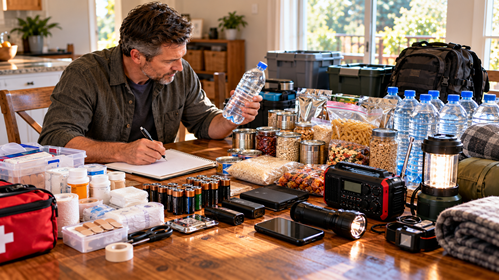
On Day 1, most households are still relying on familiar resources. Phones may be charged, fresh food is available, and stored supplies haven’t been used extensively. Consider what would happen if electricity, running water, and access to stores suddenly became unavailable. Could everyone eat, drink, receive emergency information, and remain safe?
By Day 7, the situation may have changed considerably. Refrigerated food may no longer be usable, rechargeable devices could be depleted, and sanitation supplies may be disappearing faster than expected. If cooking requires fuel, how much remains? Are medications and medical equipment still adequately supported? Could the household continue functioning without assuming that outside assistance will arrive tomorrow?
On Day 14, the assessment becomes more revealing. The household may be relying entirely on shelf-stable food, stored water, remaining medications, and whatever backup systems are still operational. Calculate what would remain at this point. Would there be enough drinking water for another day if services were still unavailable? Could everyone remain safe, or would relocation have been necessary earlier?
As you work through the scenario, identify the first day an essential resource would become unavailable, rather than only checking whether your supplies last until Day 14.
For example, a household may have enough food for two weeks but run out of safe drinking water on Day 6. Another household might have adequate food and water but lose the electricity required for essential medical equipment on Day 3.
These failures matter more than the total number of supplies stored. A household cannot be considered adequately prepared for 14 days if an essential need becomes unsupported much earlier.
Record the first expected point of failure for drinking water, usable food, essential medications, sanitation, emergency power, and safe indoor conditions. If an essential resource would become unavailable, identify whether additional supplies, a dependable alternative, or an earlier evacuation plan is needed.
This exercise doesn’t require deliberately disconnecting utilities or creating unsafe conditions. Use the inventory to work through the scenario on paper, accounting for normal daily consumption and the limitations of your equipment.
The important question isn’t simply whether the household can make it to Day 14. It’s whether essential needs can be met safely throughout the disruption, including when supplies are running low.
Record the weaknesses you discover. They provide a practical starting point for deciding what to improve.
Download Your Free Two-Week Emergency Supplies Inventory Checklist
The downloadable Two-Week Emergency Supplies Inventory Checklist helps households compare what they have stored against what they may need during a 14-day disruption. Rather than relying on assumptions about how much food, water, or emergency equipment is available, the workbook provides a practical way to examine existing supplies, calculate shortages, and identify improvements.
The expanded, color-coded PDF covers drinking water, food, first aid, medications, emergency power, communication equipment, sanitation, clothing, shelter, important documents, and household-specific requirements. Each inventory category includes dedicated spaces for recording quantities needed, quantities available, shortages, equipment condition, replacement dates, and storage locations.
The workbook also includes calculations for determining basic household water and food requirements. These help readers establish realistic starting quantities based on the number of people they are preparing for, rather than following a generic supply list that may not reflect their circumstances.
One of the most useful features is the Day 1, Day 7, and Day 14 Preparedness Assessment. This section encourages households to consider how their resources will change during an extended emergency. Supplies that are adequate at the beginning of a disruption may become insufficient after several days without electricity, running water, or access to stores.
A separate First Essential Resource Failure Assessment helps identify the earliest day an essential resource could become unavailable. For example, a household might have enough food for 14 days but run out of safe drinking water on Day 6. Recording that weakness makes it easier to determine which improvements deserve attention first.
The workbook also includes corrective-action worksheets, inspection records, and additional writing space for special household requirements. These sections allow readers to prioritize missing supplies, record replacement dates, and track improvements over time.
To get the most value from the checklist, complete it while physically examining your emergency supplies. Count actual quantities, inspect packaging, test equipment where appropriate, and record anything that needs attention. Don’t include damaged, inaccessible, or unusable supplies when calculating what your household can depend on.
Once completed, the inventory becomes a useful reference for future inspections. Keep a copy with your emergency supplies and review it at least every six months, after using stored resources, or whenever household circumstances change.
Download your free printable inventory workbook:
The printable workbook includes 11 pages of color-coded inventory tables, household calculations, preparedness assessments, and corrective-action worksheets.
Preparedness Action Plan
Set aside time this week to examine your household’s emergency supplies. Begin with what you already own rather than purchasing additional equipment. Gather your stored food, water, first-aid supplies, medications, lighting, communication equipment, and other emergency resources, then use the downloadable checklist to record their actual condition and quantities.
Calculate your household’s basic 14-day requirements, including drinking water, meals, and regularly consumed necessities. Remember to include children, older adults, pets, and anyone with medical or dietary requirements. Compare those figures against the supplies that are currently available and usable.
Pay particular attention to resources that depend on other equipment or services. A pantry full of dried food may be less useful without sufficient cooking water or a safe cooking method. A rechargeable radio may stop working after several days without electricity. A private well may become inaccessible if its electric pump loses power.
Record stored supplies separately from systems intended to replenish them. Water filtration equipment, solar charging systems, generators, and other backup resources can improve preparedness, but only when their limitations are understood and they have been tested under realistic conditions.
Once the inventory is complete, identify the shortages that could affect household safety most quickly. Safe drinking water, essential medications, usable food, protection from dangerous temperatures, and basic sanitation should receive priority over convenience items. Reliable lighting and access to emergency information are also important considerations.
There’s no need to purchase everything at once. If your budget is limited, begin with the most serious deficiencies and address them gradually. Adding extra shelf-stable foods during regular shopping trips, increasing stored water, rotating existing supplies, and replacing damaged equipment can make preparedness more manageable.
Some improvements may not require spending money at all. Reorganizing storage containers, charging equipment, testing flashlights, updating emergency contacts, and ensuring everyone knows where supplies are kept can improve readiness immediately.
After completing the inventory, work through the Day 1, Day 7, and Day 14 assessment. Consider how your household’s circumstances would change as resources are consumed and normal services remain unavailable.
Identify the first day an essential resource would become inadequate. If drinking water runs out on Day 6, for example, that shortage deserves attention before less important supplies that would remain available throughout the emergency. If essential medical equipment would lose power on Day 3, a dependable backup arrangement or earlier relocation plan may be necessary.
Record the three most important improvements in the corrective-action section of the workbook. Establish realistic completion dates and identify how each improvement will be tested or verified.
If your household cannot safely meet an essential need for the full two weeks, develop a contingency plan rather than assuming that remaining at home will always be possible. An emergency reserve should provide greater flexibility, not create a false sense of security.
Review the completed inventory at least every six months and whenever household circumstances change. Over time, these regular inspections will help keep your supplies dependable without requiring you to rebuild your emergency preparations from scratch.
Key Takeaways
Preparing for a two-week emergency involves more than accumulating additional food, water, and equipment. A household needs to understand how those resources will support everyday activities when electricity, transportation, shopping, healthcare access, and other normal services are interrupted.
An inventory provides a practical way to identify shortages, damaged equipment, outdated supplies, and dependencies that might otherwise go unnoticed. It also helps households distinguish between supplies they already have and resources they may only be able to obtain under favorable conditions.
Stored resources provide a known reserve, while tested replenishment capabilities may help extend that reserve. Both are valuable, but neither should be assumed sufficient without considering the conditions in which they will be needed.
The Day 1, Day 7, and Day 14 assessment helps reveal weaknesses that may not become apparent during the first few days of an emergency. Identifying the earliest point at which an essential resource becomes inadequate gives households a clearer understanding of where improvements are most urgently needed.
A dependable two-week emergency reserve doesn’t have to be assembled all at once. Careful inventory management, regular inspections, practical household calculations, and gradual improvements can make preparedness more affordable and easier to maintain.
A full storage room may look reassuring, but the completed inventory is what helps determine whether those supplies could actually support your household for 14 days.
The most important thing isn’t how much emergency equipment you own. It’s knowing how long your household can safely depend on the resources you have.
© Prepping Communities. This content is for informational purposes only and not professional advice. Use at your own risk.
Terms | Privacy | Guidelines