
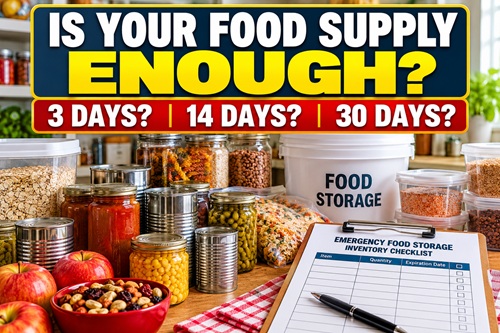
Do You Really Have Enough Food When You Need It?
Prepping Communities | Emergency Preparedness Checklists
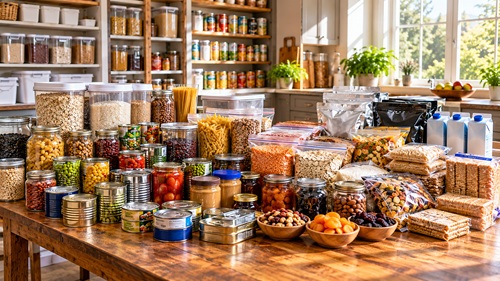
A pantry can look well stocked without containing enough food to support a household during an emergency. Shelves may be filled with canned vegetables, rice, pasta, dried beans, and other staples, yet nobody has calculated how many meals those supplies could provide or whether they could be prepared without normal household services. Having food in storage is reassuring, but knowing how long that food will last, whether it provides adequate nutrition, and what is required to prepare it is far more useful.
Food storage tends to develop gradually. Extra cans are purchased during grocery shopping, bulk foods are placed in storage containers, and emergency meals are tucked away for future use. Some products are consumed without being replaced, while others remain untouched for years. Over time, the household accumulates what appears to be a substantial reserve, but the actual quantity of usable food may be considerably smaller than expected.
Imagine a prolonged power outage or transportation disruption prevents your household from shopping. You open the pantry expecting to find plenty of food, only to discover that much of it requires cooking, several packages have deteriorated, and the available meals won’t last nearly as long as you thought. The problem isn’t necessarily that you failed to store food. It’s that nobody established how those supplies would function together during an emergency.
An Emergency Food Storage Inventory helps households determine what food is actually available, how much usable nutrition it provides, and whether it can support everyone for the intended emergency period. The accompanying downloadable color-coded checklist provides a practical way to record food quantities, serving sizes, dietary energy, packaging condition, storage locations, and preparation requirements. It also helps identify shortages, estimate how long the reserve could last, establish rotation schedules, and determine which essential food resource might become unavailable first.
The objective isn’t to fill every available shelf with emergency food. It’s to maintain a reserve of safe, familiar, nutritionally suitable foods that your household can depend on when ordinary shopping and meal preparation are interrupted.
Why an Emergency Food Inventory Matters
Emergency food supplies often accumulate without a deliberate plan. A few extra cans are purchased, a bag of rice is added to the pantry, and bulk purchases gradually fill available storage space. Eventually, the household has what appears to be a substantial reserve, but the quantity of food on the shelves doesn’t necessarily reflect how many complete meals it can provide.
Twenty cans of vegetables may contribute useful nutritional variety without supplying enough energy or protein for complete meals. Several large bags of dried beans may contain considerable food energy but require water, preparation time, and cooking fuel that the household hasn’t stored. A collection of emergency meal packages may look impressive until someone checks the serving sizes and discovers that each package provides fewer meals than expected.
An inventory reveals these differences by connecting stored quantities with actual household requirements. It also identifies food that has deteriorated, products that are no longer suitable for household members, and supplies that may be difficult to access or prepare. Rather than assuming everything in storage is usable, the household can establish which foods are dependable and which require attention.
There is a financial benefit as well. Without an inventory, households may repeatedly purchase foods they already have while overlooking important shortages. Knowing what’s available makes it easier to direct limited money toward the supplies that would improve preparedness most. Familiar products that are properly stored, regularly used, and replaced can provide a practical foundation without requiring expensive specialty foods or elaborate storage systems.
Begin With the People You Need to Feed
Before counting cans or weighing bags of rice, establish who will depend on your emergency food supply. A household of two adults has different requirements from a family with young children, older relatives, or someone following a medically necessary diet. Food allergies, intolerances, swallowing difficulties, and other dietary restrictions can determine which products are suitable, while pets require their own food and should be included in the inventory separately from human meal calculations.
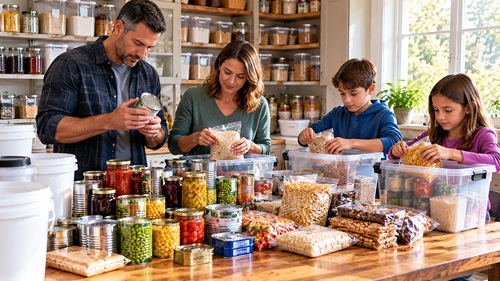
Consider what everyone normally eats and what might change during an emergency. Some household members may require specialized nutritional products, infant formula, or foods that can be prepared without assistance. Others may have limited ability to chew, swallow, or prepare particular foods. These requirements should be identified before deciding whether the household has enough food.
A family might have several weeks of wheat-based products but no suitable alternatives for someone who cannot consume gluten. Another might store large quantities of dried beans and rice without considering whether an older household member can comfortably prepare or eat them. Even when the total amount of food appears adequate, individual dietary needs can create shortages that aren’t obvious until the inventory is examined more carefully.
Record these requirements at the beginning of the checklist and use them when evaluating stored products. Food should only be counted toward a person’s emergency reserve when it is appropriate for that person’s needs.
Calculate Meals, Dietary Energy, and Food Supply Duration
Counting meals is a useful starting point, but it doesn’t establish whether a household has enough food. An emergency food inventory should examine three related measurements: the number of meals that can be assembled, the total dietary energy available, and whether those meals are nutritionally suitable for household members. Each measurement provides different information, and relying on only one can produce a misleading estimate of preparedness.
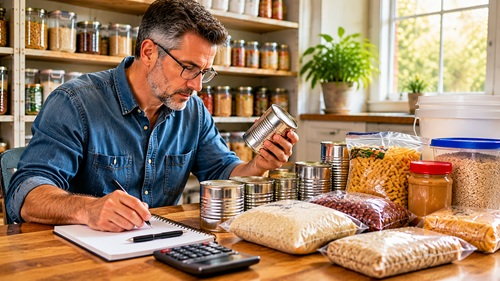
Begin by deciding how long you want your emergency food reserve to last. A 72-hour supply provides a foundation, while two weeks, 30 days, or longer may be appropriate depending on local hazards and household circumstances. For basic meal planning, multiply the number of people by the number of meals normally eaten each day and the number of days you want to cover.
For example, a household of four preparing for 14 days, assuming three meals per person each day, would need to plan for 4 people × 3 meals × 14 days = 168 individual meals. This doesn’t mean purchasing 168 separate packages. A large container may provide several portions, while a small can may provide only one. It also doesn’t mean that every manufacturer’s serving represents a complete meal. A serving of canned vegetables and a serving of nut butter may contribute very different amounts of energy and nutrition.
To estimate the dietary energy available in packaged foods, use the nutritional information provided by the manufacturer. Multiply the number of servings per package by the calories per serving and then by the number of packages stored. Four packages containing eight servings each, at 250 calories per serving, provide approximately 8,000 calories in total.
Once the total usable dietary energy has been estimated, divide it by the household’s combined daily energy requirement to calculate an approximate duration. A household with 84,000 usable food calories and an estimated daily requirement of 7,000 calories has approximately 12 days of dietary energy coverage. That calculation is useful, but it doesn’t guarantee 12 days of complete, nutritionally suitable meals.
Individual energy requirements vary with age, body size, activity, health, and other circumstances. A single calorie target should not be applied automatically to everyone. Food labels in some regions also use kilojoules, so calculations should use consistent energy units. Where medically necessary diets or specialized nutritional requirements are involved, appropriate professional guidance should inform the planning figures.
A pantry may contain enough calories on paper while providing limited protein, insufficient dietary variety, or foods that some household members cannot safely eat. The most useful inventory compares estimated energy coverage with actual meal coverage and nutritional suitability. When those measurements suggest different durations, investigate the difference rather than relying on whichever figure looks most reassuring.
Count Food That Can Actually Be Used
A common inventory mistake is counting everything in storage as though it contributes equally to the household’s emergency reserve. Consider a pantry containing ten cans of soup, five bags of rice, several jars of nut butter, and a collection of snack foods. Without examining package sizes and serving information, it’s difficult to know how many meals those products represent or whether they provide a reasonable nutritional balance.
Start with the actual products. Record the quantity, package size, usable servings, estimated dietary energy, packaging condition, and preparation requirements. Then compare the amount available against what your household needs. The basic shortage calculation is straightforward: required usable quantity minus available usable quantity equals the inventory shortage.
If your household plans for 168 individual meals but can assemble only 110 suitable meals from its existing food, the calculated shortage is 58 meals. That figure provides a useful starting point, although it should not be confused with a complete nutritional assessment. The available meals must still provide sufficient dietary energy and meet household requirements.
Food that is physically present isn’t always immediately usable. A sealed bag of dry beans may be perfectly suitable for storage but unavailable for a meal if the household lacks cooking water or fuel. Similarly, a package may be safe to eat but unsuitable for someone with a food allergy or other dietary restriction.
Distinguish between food that is safe and suitable, food that is ready to eat, and food that depends on additional preparation resources. This prevents the household from treating every stored product as equally dependable when normal cooking arrangements are unavailable.
Ready-to-Eat Foods Provide Important Flexibility
Some of the most useful emergency foods require little or no preparation. During a prolonged power outage, a household may lose access to its electric stove, microwave, or refrigerator. Cooking fuel could be limited, and safe drinking water may need to be reserved for essential needs. Ready-to-eat canned meals, canned fish, nut butter, crackers, dried fruit, shelf-stable milk, and other familiar foods can reduce these dependencies.
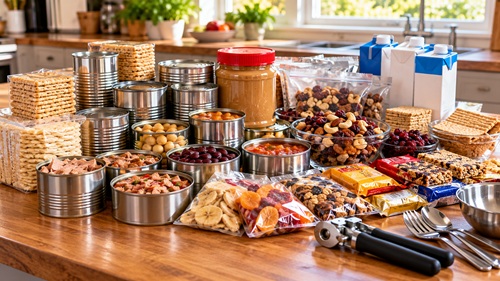
This doesn’t mean every emergency meal must come from a can or package. It means maintaining suitable alternatives when cooking isn’t possible. A family might have enough total food for several weeks but only a few days of ready-to-eat meals. If cooking remains unavailable, that shortage becomes important much earlier than the overall inventory suggests.
Consider how your household would eat during the first 24 hours of an outage if no cooking equipment were available. Everyone should have access to appropriate meals and snacks without depending on refrigeration or additional cooking water. If the available choices are inadequate, the inventory should identify which ready-to-eat foods are missing and how much additional food would be required.
Record ready-to-eat products separately from foods requiring soaking, boiling, heating, or refrigeration. This makes it easier to determine how long the household could continue eating if its normal cooking arrangements failed.
Dry Goods and Long-Term Food Storage
Rice, pasta, oats, dried beans, lentils, and other dry staples can form an economical part of an emergency food reserve. They are often available in larger quantities and can provide substantial dietary energy when stored appropriately. Their usefulness, however, depends on preparation requirements that should be considered during the inventory.
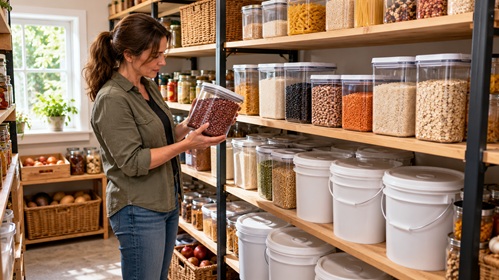
Dry beans may require soaking and extended cooking, while rice and pasta need water and heat. Flour and baking ingredients may be of limited immediate value without suitable equipment and additional ingredients. Freeze-dried and dehydrated foods introduce similar considerations because many require rehydration before they can be eaten.
A household storing several large bags of rice may have a substantial quantity of food energy available, but that energy cannot be counted as readily accessible if there is no safe cooking method or sufficient water for preparation. During the inventory, record package weights, estimated servings, storage condition, and any additional resources required to prepare the food.
Storage conditions also deserve attention. Heat, humidity, pests, and damaged packaging can reduce the quality or usability of dry goods. Containers should be appropriate for food storage, kept clean and dry, and protected from contamination. Products that have absorbed moisture, show evidence of pests, or have otherwise deteriorated should be evaluated carefully and excluded from the usable reserve when their safety cannot be established.
Canned Foods, Preserved Products, and Food Safety
Commercially canned foods are valuable because many can be stored without refrigeration until opened and can be eaten without additional cooking, provided they remain safe and suitable to consume. A varied selection of canned vegetables, fruit, beans, fish, meat, soups, and complete meals can help provide nutritional diversity while reducing dependence on cooking equipment.
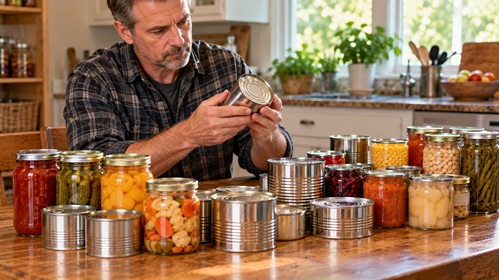
Canned products still require regular inspection. Look for leaking containers, swelling, severe rust, compromised seams, and other signs of damage. Do not taste suspicious food to determine whether it is safe. A best-before or best-quality date does not automatically mean a commercially canned product becomes unsafe the following day, but packaging condition, storage history, product characteristics, and applicable food-safety guidance remain important. Use-by or expiration dates may have different implications depending on the product and jurisdiction.
Food safety cannot always be determined by appearance, smell, or taste. Some dangerous contamination, including botulinum toxin, may be present without obvious warning signs. Home-canned foods require particular care because their safety depends on correct preparation and processing. Improper processing of low-acid foods can create a serious risk of botulism, so tested preservation methods appropriate to the food should always be used.
During the inventory, separate anything requiring disposal or further evaluation so it cannot accidentally be returned to the usable reserve. Record product quantities, packaging condition, date information, and storage locations. If the safety of a product cannot be established, don’t count it as dependable emergency food.
Nutrition and Special Dietary Requirements
An emergency food reserve should provide more than enough packages to fill a cupboard. A household may have substantial quantities of rice and pasta but limited protein, dietary fat, vegetables, or fruit. Those staples provide useful energy, but relying on them exclusively over an extended period may result in an unbalanced diet.
Consider the nutritional contribution of different food categories rather than assuming that all servings are equivalent. Shelf-stable protein sources may include canned fish, beans, lentils, nut butter, and other suitable products. Grains and starchy foods provide energy, while canned vegetables, fruit, and preserved foods contribute additional nutrients and variety. Dietary fats are also important because they provide concentrated energy, although oils, nuts, and other fat-containing foods should be stored according to their specific requirements and inspected for deterioration.
Specialized dietary products deserve their own inventory entries. Infant formula, allergy-safe foods, medically prescribed nutrition products, and foods suitable for people with chewing or swallowing difficulties may not be interchangeable with ordinary pantry staples. A household with adequate total calories can still have a serious shortage if one person cannot safely eat much of the stored food.
When evaluating nutritional suitability, consider whether the household can assemble balanced meals over the planned emergency period rather than simply counting individual food categories. The objective is to provide sufficient energy and appropriate nutrition using foods that household members can safely and realistically consume.
Cooking Equipment, Water, and Fuel Dependencies
A food inventory is incomplete if it ignores how the food will be prepared. A household might have enough rice, pasta, and dried beans for several weeks but only enough cooking fuel for a few days. The stored food hasn’t disappeared, but the ability to prepare it may be lost.
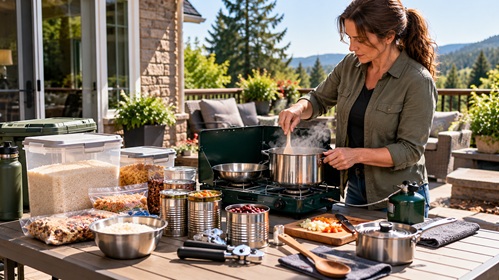
Examine cooking equipment alongside the food supply. Check whether you have a manual can opener, suitable utensils, cookware, safe cooking equipment, and sufficient water. If your emergency cooking method depends on fuel, estimate how much is available and how long it would last under realistic use. Test equipment safely and follow the manufacturer’s instructions.
Never operate charcoal grills, outdoor camping stoves, or other outdoor fuel-burning appliances inside homes, garages, tents, or enclosed spaces. Carbon monoxide can accumulate and become fatal. If cooking becomes impossible, the household should still have access to suitable ready-to-eat foods.
Food requiring boiling or rehydration also increases water demand. Record that additional requirement separately from drinking-water needs so it isn’t overlooked. A food reserve becomes more dependable when the equipment, water, and fuel required to use it are included in the inventory rather than assumed to be available.
Food Storage Conditions and Organization
Emergency food can remain in storage for months or years, but that doesn’t mean it should be forgotten. Food stored in hot garages, damp basements, or areas exposed to pests may deteriorate more quickly than expected. Temperature changes, humidity, damaged containers, and poor organization can affect its quality and usability.
Choose storage locations that are clean, dry, and appropriate for the foods being kept there. Protect products from pests and moisture, and follow manufacturer storage recommendations. Heavy containers should be placed on shelving capable of supporting their weight, while frequently used products should remain accessible. Longer-term reserves can be organized separately, provided household members know where to find them.
Avoid storing food beside fuels, pesticides, cleaning chemicals, or other substances that could contaminate it. If supplies are distributed across several rooms, record each location in the inventory. A household member should be able to locate essential foods without searching through every cupboard and storage container.
Food Rotation and Replacement
A food reserve becomes easier to maintain when it is connected to ordinary household routines. Products that are regularly eaten can be replaced during normal grocery shopping, reducing waste and making it less likely that older supplies will remain forgotten until their quality deteriorates.
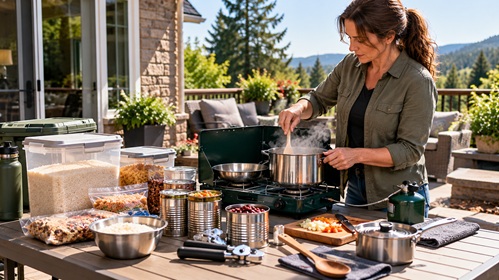
Arrange products so older suitable stock is generally used before newer purchases. Check packaging and date information during inspections, and record anything requiring replacement. Different foods have different storage characteristics, so commercially canned products, dry goods, oils, and specialized emergency meals should be inspected and rotated according to appropriate guidance.
An inventory can also reveal purchasing habits that aren’t particularly useful. If your household repeatedly buys food nobody enjoys, those products may remain untouched for years. Storing familiar foods that your household already eats often makes rotation simpler and reduces unnecessary spending.
A complete inspection at least every six months is a practical starting point, with more frequent checks for foods that require closer attention. Update the inventory whenever significant quantities are consumed, replaced, or moved. Keeping the record current is more useful than conducting one detailed inspection and then allowing it to become outdated.
Prioritize Essential Foods Before Optional Purchases
Building an emergency food reserve doesn’t have to involve expensive survival food packages or large purchases. For households with limited budgets, begin with familiar shelf-stable foods that provide usable meals, appropriate nutrition, and minimal preparation requirements. Ready-to-eat foods are particularly valuable when cooking is unavailable, while economical staples can expand the reserve when sufficient water and safe cooking arrangements are available.
Bulk purchases can save money when the food will be used before its quality deteriorates, but purchasing large quantities of unfamiliar products may create unnecessary waste. The inventory should help identify where additional spending will make the greatest difference rather than encouraging purchases simply because an item appears on a generic preparedness list.
If your inventory reveals shortages, address the most important ones gradually. Adding a few suitable products during regular shopping trips can build a useful reserve without requiring a large initial expense. Some improvements cost nothing. Reorganizing shelves, rotating older food, inspecting packaging, and calculating actual servings can make existing supplies more dependable.
Test Your Emergency Food Supply With a Three-Day Meal Plan
A useful inventory should reveal whether stored food can support actual meals under emergency conditions. Choose three consecutive days and plan breakfast, lunch, dinner, and appropriate snacks using only foods already included in your emergency reserve. Assume that refrigeration and normal electric cooking equipment may be unavailable, and consider whether each meal can be eaten without cooking or prepared using a safe alternative method.
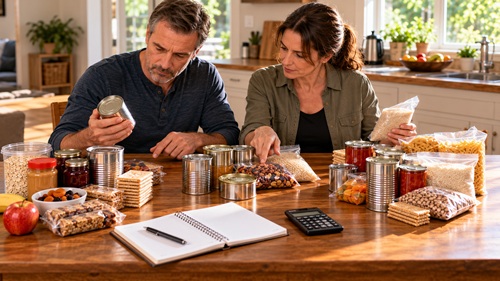
Account for everyone in the household, including dietary restrictions and specialized nutritional needs. As you work through the plan, record the food quantities used, estimated dietary energy, cooking water required, and whether suitable equipment and fuel are available. Pay particular attention to the first meal that becomes difficult to prepare.
Perhaps breakfast and lunch are straightforward, but dinner depends on cooking fuel that isn’t available. Maybe ready-to-eat foods are sufficient for only two days, even though the pantry contains several weeks of dry staples. A household may also discover that its meals provide enough energy but little nutritional variety, or that one family member cannot safely eat the available foods because of allergies or other dietary restrictions.
These findings are more useful than simply confirming that the pantry contains plenty of packages. They reveal where food availability, nutritional requirements, and preparation capabilities no longer match. If an essential meal cannot be prepared, record what is missing and whether the problem could be corrected through additional ready-to-eat food, a different ingredient, more cooking water, or a suitable alternative cooking method.
The exercise doesn’t require deliberately disconnecting utilities or creating unsafe conditions. Planning the meals on paper, followed by safe preparation tests where appropriate, can reveal many of the same weaknesses. Once the three-day plan is complete, compare the food consumed against the remaining inventory. This provides a more realistic starting point for estimating how long the household’s emergency food supply could last.
Determine When Your Food Supply Would Become Inadequate
An emergency food inventory becomes particularly useful when it identifies not only how much food is stored but also when the household might begin experiencing shortages. A pantry may contain enough total dietary energy for several weeks while having only a few days of ready-to-eat meals, specialized dietary products, or cooking fuel. Examining how those resources would be consumed over time can reveal weaknesses that a simple package count would miss.

On Day 1, the household may still have fresh food, functioning appliances, and access to familiar cooking arrangements. Some refrigerated products might remain safe to use for a limited period, depending on storage temperatures and the circumstances of the outage. Emergency food may not yet be needed in significant quantities, which can make the available reserve appear more substantial than it actually is.
By Day 7, conditions could be quite different. Refrigerated food that could not be kept at safe temperatures would need to be discarded, cooking fuel might be running low, and ready-to-eat products may already have been consumed. The remaining foods could require more water, preparation time, or equipment than the household can reliably provide. A family with plenty of rice and dried beans, for example, may discover that its ability to prepare those foods is becoming the limiting factor.
On Day 14, the assessment should consider what remains available rather than what was originally stored. Would every household member still have enough suitable food and dietary energy? Would there be sufficient drinking-safe water and fuel to prepare the remaining meals? Could specialized nutritional products, infant formula, or pet food have run out earlier? These questions help establish whether the food reserve can support the household throughout the intended emergency period.
The most important finding may be the first day an essential food requirement or preparation resource becomes inadequate. A household might have enough total calories for two weeks but only five days of suitable infant formula. Another might have several weeks of dry staples but lose its safe cooking capability on Day 4. In both situations, the overall food quantity provides a misleading picture of preparedness.
Record the earliest expected shortage, what causes it, and what would be needed to correct it. If the problem involves insufficient ready-to-eat meals, additional suitable food may be the answer. If cooking fuel is the limitation, changing the balance between ready-to-eat and preparation-dependent foods may be more practical than purchasing additional cooking equipment. Medical dietary requirements may call for a separate contingency plan developed with an appropriate healthcare professional.
The purpose of this assessment isn’t simply to determine whether some food remains on the final day. It’s to establish whether the household can continue providing safe, nutritionally suitable meals throughout the disruption.
Download Your Free Emergency Food Storage Inventory Checklist
The downloadable Emergency Food Storage Inventory Checklist provides a practical way to examine existing food supplies, calculate household requirements, and identify shortages that might otherwise go unnoticed. Rather than relying on estimates or memory, readers can use the workbook while inspecting their pantry, emergency storage containers, and other locations where food is kept.
The color-coded PDF covers ready-to-eat foods, canned goods, dry staples, preserved products, special dietary requirements, cooking equipment, food safety, storage conditions, and food rotation. Its inventory tables provide space for recording quantities, shortages, product condition, date information, and storage locations. This makes it easier to distinguish between food that is physically present and food that can actually be used during an emergency.
The workbook also includes food energy and duration calculations. Readers can estimate the total dietary energy stored, compare it with their household’s daily requirements, and calculate approximately how many days the reserve might last. These calculations complement the meal-planning assessment by showing where adequate calorie totals may conceal shortages in usable meals, nutritional variety, or foods suitable for particular household members.
Another important feature is the distinction between ready-to-eat foods and products requiring cooking or rehydration. Recording these separately helps households understand how their food supply would change if electricity, cooking fuel, or safe water became unavailable. The three-day meal-planning exercise and longer-duration assessment build on this information by helping identify the earliest point at which an essential food requirement might no longer be met.
The workbook includes space for corrective actions, replacement priorities, and future inspections. Once completed, it becomes a reference for maintaining the food reserve rather than a checklist that is filled out once and forgotten.
Why is this checklist worth using? Because knowing that food is stored somewhere in the house is not the same as knowing whether it can provide suitable meals for the people depending on it. A completed inventory makes those differences visible and provides a practical basis for correcting them.
Print the workbook and complete it while examining your actual supplies. Check package quantities, inspect containers, record preparation requirements, and identify anything that needs replacing. Keep the completed inventory with your emergency supplies and update it as foods are consumed, rotated, or added.
Download your free printable inventory checklist:
The 12-page, color-coded inventory checklist is formatted for US Letter paper (8.5 × 11 inches). It includes detailed food inventory tables, dietary energy calculations, meal-planning assessments, food supply duration estimates, storage and rotation records, and corrective-action sections to help households identify and address shortages.
Preparedness Action Plan
Begin by examining the food your household already owns. Check pantry shelves, cupboards, storage containers, and any other locations where emergency food is kept. Use the downloadable checklist to record quantities, package sizes, serving information, condition, and storage locations. There’s no reason to purchase additional food until you understand what is already available and whether it remains suitable for use.
Calculate the number of meals your household needs for its chosen emergency planning period. Include children, older adults, household members with dietary restrictions, and anyone requiring specialized nutritional products. Pet food should be recorded separately. Use package information to estimate total usable dietary energy, then compare that figure with your household’s estimated daily requirements. Remember that having enough calories doesn’t automatically mean having enough complete, nutritionally suitable meals.
Next, separate ready-to-eat foods from those requiring cooking or rehydration. Examine whether sufficient drinking-safe water, suitable equipment, and cooking fuel are available to prepare the foods you have stored. If a necessary resource is missing or unreliable, record that limitation rather than assuming the food will be usable. A large supply of dry staples may still be valuable, but it should not be treated as an immediately available meal reserve when the means of preparing it are uncertain.
Inspect storage conditions and identify products that are damaged, contaminated, or otherwise unsuitable. Separate questionable food from the usable reserve and follow appropriate food-safety guidance when deciding what must be discarded. Organize older suitable products so they can be used before newer purchases, and make a note of anything that needs replacing.
Once the inventory is complete, identify the shortages that could affect household nutrition and safety most quickly. If your budget is limited, concentrate on familiar shelf-stable foods, suitable ready-to-eat meals, and essential dietary products before purchasing specialized convenience foods or expensive storage equipment. A dependable food reserve can be built gradually by adding a few suitable products during regular grocery shopping.
Some improvements may not require spending money at all. Reorganizing shelves, checking packaging, rotating older food, and calculating actual servings can make existing supplies more dependable. Households that already have substantial food storage may find that better organization and a few carefully chosen additions provide more value than another large purchase.
Work through the three-day meal-planning exercise using only your emergency food supply. Identify the first meal that becomes difficult to prepare and determine whether the problem involves missing ingredients, insufficient water, unavailable cooking fuel, or unsuitable food choices. Extend the assessment to Day 7 and Day 14, or whatever planning period your household has selected. Record the earliest day an essential food requirement becomes inadequate and what would be needed to correct it.
Choose the three most important improvements and record them in the corrective-action section of the workbook. Establish realistic completion dates and verify that the changes have addressed the original shortages. Review the inventory at least every six months, after using significant quantities of stored food, or whenever household dietary requirements change.
Key Takeaways
An emergency food inventory should measure what a household can actually eat, not simply how many packages are stored. Meal coverage, dietary energy, and nutritional suitability are different considerations, and all three matter when evaluating whether a food reserve is adequate.
Preparation requirements can significantly affect the usefulness of stored food. Ready-to-eat products provide flexibility when cooking is unavailable, while dry staples and preserved foods may depend on additional water, fuel, or equipment. A dependable inventory accounts for those resources rather than assuming they will always be available.
Regular inspections help identify deteriorating products, unsuitable storage conditions, and food that needs rotation or replacement. They also reduce unnecessary purchases and make it easier to maintain a reserve built around foods the household already uses.
The three-day meal exercise and longer-duration assessment help reveal when an essential food requirement could become inadequate. Finding that weakness before an emergency provides an opportunity to correct it while supplies and services remain available.
The value of an emergency food reserve isn’t measured by how full the shelves look. It’s measured by how reliably those supplies can provide safe, suitable meals when they’re needed.
Explore More Emergency Preparedness Checklists
Building a dependable emergency food supply is just one part of household preparedness. Food storage also depends on having sufficient drinking water, safe cooking equipment, emergency power, and other essential resources.
Prepping Communities offers additional free, downloadable emergency preparedness checklists to help households evaluate their supplies, identify shortages, and maintain the equipment and resources they may need during an emergency.
Explore these related checklists to continue assessing and improving your household’s preparedness:
- 72-Hour Emergency Kit Inventory — Evaluate essential supplies for the first three days of an emergency.
- Two-Week Emergency Supplies Inventory — Assess whether your household has enough food, water, medical supplies, and equipment to manage a 14-day disruption.
Each checklist provides practical guidance and a printable inventory PDF to help you understand what you have, what may be missing, and what needs attention.
Explore the complete Prepping Communities Emergency Preparedness Checklist series to continue building and maintaining your household’s emergency supplies.
https://preppingcommunities.com/two-week-emergency-supplies-inventory/
https://preppingcommunities.com/72-hour-emergency-kit-inventory/
© Prepping Communities. This content is for informational purposes only and not professional advice. Use at your own risk.
Terms | Privacy | Guidelines