
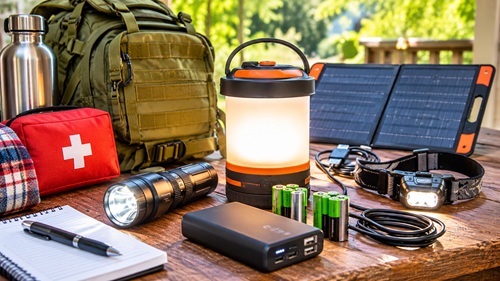
Choosing Reliable Lighting for Power Outages and Survival Situations
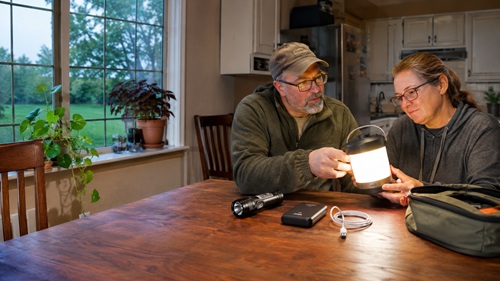
When the electricity goes out, lighting becomes one of the first things people notice. A familiar home can suddenly become difficult to navigate, everyday tasks take longer, and even finding basic supplies can become frustrating. An outage during daylight hours may seem manageable, but the situation changes considerably once darkness falls.
Most households have at least one flashlight tucked away in a drawer. Some also keep candles, battery-powered lanterns, or emergency lighting systems. The question is whether those supplies will actually meet the household’s needs during an extended power outage. A flashlight is useful when searching for something or moving between rooms, but it isn’t always the best choice for illuminating a larger area. Holding a flashlight while preparing food, treating an injury, repairing equipment, or organizing emergency supplies can become awkward.
Sometimes what you really need is a small light that can sit on a table, hang overhead, or attach to a nearby surface while leaving both hands free. Compact LED camping lights can make a practical difference in these situations because they provide portable area lighting without requiring fuel or an open flame.
Modern mini camping lights are small enough to fit into emergency backpacks, vehicle kits, or household storage containers. Depending on their design, they can provide several hours of area lighting, operate at different brightness levels, and recharge through a USB connection. Some models also include a built-in power bank capable of providing limited charging for a mobile phone or other small electronic device.
Those features sound useful, and many of them are. But not every compact camping light performs equally well. A model advertised as extremely bright may drain its battery quickly, while another offering an impressive runtime may achieve that figure only at its lowest brightness setting. Understanding what these lights can realistically do, how long they will operate, and how to keep them powered during an extended emergency is more important than simply purchasing the model with the most features.
Why Mini Camping Lights Matter During Emergencies
Emergency lighting serves several purposes beyond making a room more comfortable. People need enough light to move safely, identify obstacles, locate supplies, prepare food, and carry out essential tasks. In households with children, older adults, or people with limited mobility, inadequate lighting can increase the risk of falls and other accidents.
Consider a family experiencing an unexpected power outage during the evening. Someone needs to locate the emergency food supply, another person is checking the electrical panel, and someone else is trying to prepare dinner. A single flashlight may be useful for one of those activities, but it cannot provide convenient lighting for everyone at the same time. A small camping light placed on a kitchen counter can illuminate a broader area while allowing people to use both hands. Another light positioned near a hallway or bathroom can help household members move around without carrying a flashlight everywhere they go.
During an extended outage, repeatedly holding and repositioning a flashlight becomes frustrating. Preparing meals, washing dishes, organizing supplies, or reading instructions is considerably easier when a stable light source illuminates the work area. What might seem like a minor convenience during a short outage can become an important part of maintaining normal household activities when electricity remains unavailable for several days.
Compact camping lights can also be moved between rooms as needed. Rather than attempting to illuminate an entire house, a household can concentrate lighting where people are actually spending time. This approach reduces energy consumption and allows available batteries or rechargeable power supplies to last longer.
For households maintaining an emergency lighting inventory, several small lights distributed among important locations may be more practical than relying entirely on one large lantern. If one light fails, the others also provide a degree of redundancy. This is particularly useful when several household members need lighting for different activities at the same time.
Understanding Brightness, Battery Capacity, and Runtime
One of the first specifications people encounter when comparing camping lights is brightness, usually measured in lumens. Lumens describe the total amount of visible light produced by a source. Generally, a light with a higher lumen rating produces more light, although the way that light is distributed also affects how useful it will be.
A small camping light producing around 50 lumens may be adequate for low-level lighting inside a tent or beside a bed. A model producing 100 to 200 lumens may be more useful for reading, preparing simple meals, or illuminating a small room. For larger spaces or activities requiring greater visibility, 300 lumens or more may be beneficial, depending on the design of the light and the surrounding conditions.
These figures are general examples rather than fixed requirements. A light’s usefulness depends on its beam pattern, diffuser, mounting position, distance from the work area, and the amount of reflected light available. A narrow flashlight beam and a diffused camping lantern can produce the same number of lumens while serving very different purposes. This is why the highest brightness rating isn’t necessarily the best choice.
A bright light operating at maximum output may drain its battery quickly, while a lower setting may provide sufficient illumination for many ordinary tasks. During a prolonged emergency, the ability to reduce brightness can be more valuable than having an extremely powerful maximum setting. A light that can operate efficiently at several brightness levels gives households greater control over their available energy.
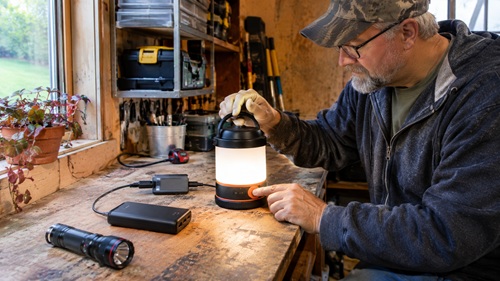
Battery capacity is another specification worth understanding. Rechargeable batteries are commonly described in milliamp-hours, or mAh, but that number doesn’t tell the whole story unless the battery voltage is also known. Watt-hours, or Wh, provide a more useful measurement of stored energy because they account for both battery capacity and voltage.
Consider a compact camping light containing a rechargeable battery rated at 3,000 mAh with a nominal voltage of 3.7 volts. That battery stores approximately 11.1 watt-hours of energy. If the light consumes two watts while operating, its theoretical runtime would be about 5.5 hours. Actual runtime may be shorter because of electronic losses, battery condition, temperature, and other factors.
Now imagine using the same light at a lower brightness setting that consumes only half a watt. Its theoretical runtime increases to approximately 22 hours. Over several evenings without electricity, reducing brightness to a comfortable level could allow the same battery to provide useful lighting for considerably longer.
This also explains why advertised runtime figures need careful interpretation. A manufacturer may claim that a light operates for 40 hours, but that figure may apply only to its lowest setting. A better question is how long the light will operate at a brightness level that is actually useful for the tasks you expect to perform.
Rechargeable Batteries, Power Banks, and Solar Charging
Rechargeable camping lights have become increasingly popular because they can be powered repeatedly without requiring a new set of disposable batteries after every use. Most compact rechargeable models use lithium-ion or lithium-polymer batteries. These batteries provide useful energy capacity for their size and can often be recharged through USB connections.
For everyday use and short emergencies, this arrangement is convenient. A light can be charged from a household outlet, portable power bank, vehicle USB connection, or compatible solar charging system. However, rechargeable lighting introduces a dependency that shouldn’t be overlooked. Once the battery is depleted, the light becomes unusable until another charging source is available.
Imagine discovering that the power has gone out during a winter storm. You retrieve your camping light from an emergency supply cabinet, only to find that its battery is nearly empty because it hasn’t been charged for several months. The light itself may be perfectly functional, but without another source of electricity, it provides little immediate benefit.
Lights powered by replaceable AA or AAA batteries offer a different advantage. Spare batteries can be stored separately and installed when needed, without waiting for a charging cycle. Both approaches have limitations. Disposable batteries eventually need replacement, and stored batteries can deteriorate or leak under unfavorable conditions. Rechargeable batteries also age, gradually losing capacity through use and storage. For many households, maintaining both rechargeable and replaceable-battery lighting provides greater flexibility than depending entirely on one technology.
Some mini camping lights also include USB power bank capabilities. This can be useful when someone needs enough phone power to send a message, make an emergency call, or briefly operate another small electronic device. However, the amount of energy available is often limited.
Consider a camping light containing approximately 11 watt-hours of stored energy. After accounting for electrical conversion losses, the usable energy delivered to a phone may be considerably lower. A modern smartphone may contain a battery storing roughly 12 to 20 watt-hours, depending on the model. A small camping light may therefore provide only a partial phone charge rather than fully recharging the device.
There is also a trade-off. Every unit of energy transferred to the phone is energy no longer available for lighting. During an emergency, that decision may matter. If someone needs enough phone power to contact emergency services, using part of the camping light’s battery may be worthwhile. But draining the household’s only dependable light to charge a phone could create another problem. For this reason, a built-in power bank is best treated as a backup feature rather than a replacement for a dedicated portable power bank.
Solar charging can provide another option, particularly during extended outages or off-grid travel. Some camping lights contain small integrated solar panels, while others can be charged through separate portable solar panels. The distinction is important because a tiny integrated panel may collect only a limited amount of energy, especially during cloudy weather or short winter days.
A larger portable solar panel may provide more useful charging capacity, but actual performance depends on available sunlight, panel orientation, temperature, and charging compatibility. A panel rated at 20 watts, for example, will not necessarily deliver 20 watts continuously. Its rated output is measured under specified test conditions, and real-world production may be considerably lower.
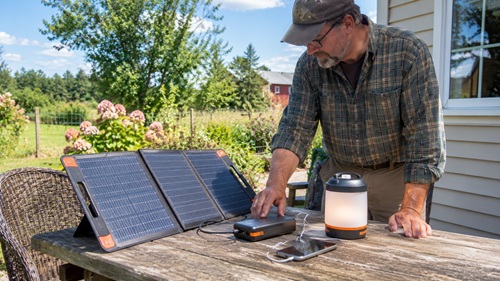
Solar charging equipment should be tested before an emergency. Some devices may stop charging when sunlight weakens and require reconnection when power becomes available again. A compatible power bank or charging controller may help manage fluctuating solar output, depending on the equipment. Solar charging can improve preparedness, but it should be treated as part of a tested backup power arrangement rather than an unlimited source of electricity.
Choosing Lights for Homes, Vehicles, and Bug-Out Bags
Different emergency situations create different lighting requirements. A light that works well on a kitchen counter may not be the best choice for an evacuation backpack, while a compact model designed for camping may not provide enough illumination for a large room.
Inside the home, area lighting is often the priority. A small lantern placed on a kitchen counter can make preparing food easier, while another positioned near a hallway or bathroom can reduce the risk of stumbling in darkness. For households with older adults, young children, or people with mobility limitations, maintaining safe access to stairs, exits, and frequently used rooms deserves particular attention.
Low-level lighting may be sufficient for overnight movement, while brighter illumination may be needed for cooking, reading, or repairs. Some camping lights include red-light modes that can help reduce disruption to night adaptation when used at low brightness. However, the benefit depends on the intensity of the light and how it is used.
For evacuation backpacks, size and weight become more important. Every item competes for limited space, particularly when someone may need to carry the pack for several hours or days. A compact camping light can provide useful area illumination without the weight of a traditional full-sized lantern.
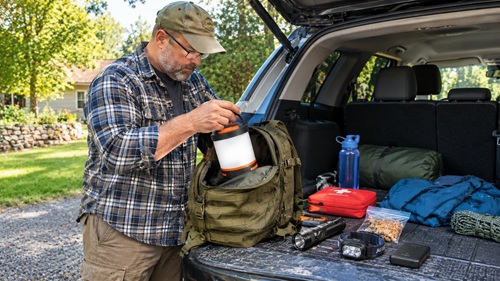
Models equipped with hanging hooks, clips, magnetic bases, or adjustable stands offer additional flexibility. A light can be suspended inside a tent, positioned on a table, or attached to a suitable surface while preparing food or organizing equipment. However, these features should be evaluated realistically. A magnetic base is useful only when a suitable metal surface is available, and a small hanging hook may not support the light securely during movement.
Water resistance is another important consideration. Camping lights are often advertised as waterproof or weather-resistant, but those descriptions aren’t interchangeable. An IP rating provides more specific information about protection against dust and water exposure.
For example, an IPX4-rated light is designed to resist splashing water, while an IPX7-rated product is designed to withstand temporary immersion under defined test conditions. Neither rating guarantees that a light will survive every outdoor condition, particularly if charging ports are left uncovered or seals become damaged.
Vehicle emergency kits introduce another concern: temperature. Rechargeable lithium-ion batteries can be affected by prolonged exposure to extreme heat or cold. High temperatures accelerate battery aging and may create safety concerns, while cold temperatures can temporarily reduce available capacity.
Most ordinary lithium-ion batteries should not be charged at or below freezing temperatures unless the battery and charging system are specifically designed and approved for those conditions. Charging at excessively low temperatures can cause internal lithium plating, permanently reduce battery performance, and increase safety risks.
A camping light stored in a vehicle throughout the year should therefore be inspected regularly and maintained according to the manufacturer’s temperature recommendations. For people who travel through remote areas or regions experiencing severe winter weather, it may be worth keeping a compact light in the vehicle while also carrying a backup flashlight with suitable spare batteries.
The important consideration is not simply whether a light fits into an emergency kit, but whether it will remain dependable under the conditions in which it is stored.
Emergency Lighting, Safety, and Practical Uses
A compact camping light can serve several purposes, but it shouldn’t be expected to replace every other type of emergency lighting. Different tasks require different forms of illumination, and understanding those differences can make emergency activities safer and easier.
Someone repairing a leaking pipe beneath a sink may find a headlamp more practical than a lantern sitting on the floor. A person inspecting electrical equipment may need a flashlight that directs light precisely toward the work area. During first aid, stable lighting can help people identify injuries, read instructions, and handle medical supplies. Serious medical emergencies may still require professional assistance, regardless of the available equipment.
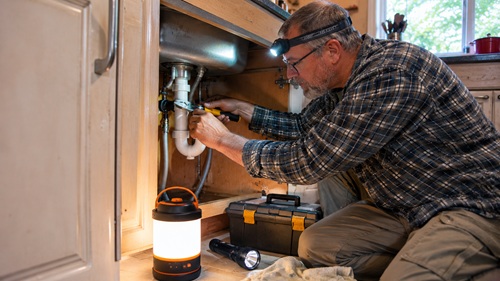
This is why a practical emergency lighting inventory should include different types of lights rather than relying entirely on one device. Camping lights are useful for general illumination, flashlights are better suited to directed lighting and navigation, and headlamps are particularly valuable when both hands must remain free.
Battery-powered LED lighting also provides an important alternative to candles. Candles introduce fire risks, especially around curtains, bedding, children, pets, and combustible materials. LED lights generally avoid the hazards associated with open flames, although their batteries and electronic components can still generate heat. Lights should not be covered with clothing, blankets, or other materials that restrict ventilation, and damaged or swollen rechargeable batteries should never be used.
Lighting can also contribute to personal safety by improving visibility and helping people identify hazards. A bright light may reveal obstacles, illuminate unfamiliar surroundings, or make it easier to locate a safe route. In some situations, it may also attract attention when someone needs assistance.
However, light should not be treated as a dependable method of deterring wildlife or threatening individuals. Animal responses to artificial light vary by species and circumstances. Some animals may retreat, while others may show little reaction. Bright lighting can also attract insects or reveal a person’s location. Likewise, illuminating an area doesn’t guarantee that unwanted visitors will leave.
For household security, lighting is most useful when combined with appropriate physical security measures, awareness of surroundings, and established emergency procedures.
Some camping lights include flashing or SOS functions. These may provide an additional signaling option, but their usefulness depends on visibility, weather, terrain, and whether anyone is in a position to notice the signal. Not every product advertising an SOS mode produces the internationally recognized Morse code distress sequence.
For wilderness travel, a dedicated emergency communication device, whistle, or other appropriate signaling equipment may be more dependable than relying entirely on a camping light.
What to Look for When Choosing a Mini Camping Light
There are many compact camping lights available, ranging from inexpensive basic models to more sophisticated products with rechargeable batteries, multiple lighting modes, and USB charging functions. Price alone doesn’t determine reliability, and a light with numerous advertised features may perform poorly if its battery capacity is small, its controls are difficult to operate, or its construction isn’t suitable for the conditions in which it will be used.
Brightness and runtime should be considered together. A light producing several hundred lumens for only a short period may be less useful during a prolonged outage than a lower-powered model capable of operating efficiently for many hours. Battery capacity, charging requirements, and replacement options also deserve attention.
A USB-C charging connection may be convenient because it can reduce the number of different cables a household needs to maintain. However, the device’s charging specifications should still be checked for compatibility with available power sources.
Physical design matters as well. A stable base, dependable hanging mechanism, accessible controls, and a useful range of brightness settings can make a small light considerably more practical. For emergency backpacks, compactness and low weight are important. For household use, longer runtime and stable area illumination may be higher priorities.
The best choice depends on where the light will be used and what tasks it is expected to support. Rather than choosing a model solely because it offers the most features, consider whether those features will actually improve the household’s ability to function during an emergency.
Testing and Maintaining Emergency Lighting
One of the simplest ways to evaluate a camping light is to use it during an ordinary evening without relying on household lighting. Turn off the room lights and attempt a few routine activities, such as preparing a simple meal, locating emergency supplies, reading printed instructions, or moving safely between rooms. This quickly reveals whether the light produces enough illumination and whether its design is practical.
It may also expose problems that aren’t obvious from product specifications. A light might be bright enough but difficult to position. Its lowest setting may still be too bright for overnight use, or its controls may be confusing in darkness.
Battery runtime should also be tested under realistic conditions. Charge the light fully, operate it at a brightness level you would actually use during an emergency, and record approximately how long it remains useful. If the light includes a power bank function, test whether it can charge your phone and how much battery capacity remains afterward. For solar-compatible models, verify that charging works with the intended panel and cable arrangement.
Testing doesn’t need to be complicated. The purpose is to identify limitations while normal electricity and replacement equipment are still available.
Maintenance is equally important because rechargeable batteries gradually lose capacity through aging and use. Leaving a device unused for years can result in a depleted battery, and some batteries may become permanently damaged if allowed to remain deeply discharged. For long-term storage, follow the manufacturer’s recommendations regarding charge level, temperature, and inspection intervals. Lithium-ion batteries generally benefit from being stored in moderate temperatures rather than extreme heat.
Lights powered by replaceable batteries should also be inspected for corrosion or leakage. For equipment that will remain unused for extended periods, storing spare batteries separately may reduce the risk of damage, depending on the manufacturer’s guidance.
Charging cables and connectors should be checked as well. A perfectly functional camping light becomes much less useful if its charging cable is missing or damaged. Households with several rechargeable devices may benefit from maintaining compatible cables and a dedicated charging location.
During routine emergency supply inspections, confirm that each light operates, that batteries remain serviceable, and that the necessary charging equipment is available. A device that has never been tested is an assumption in an emergency plan, not a verified capability.
Preparedness Action Plan
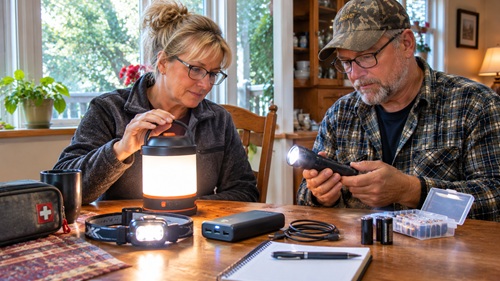
Begin by examining the emergency lighting already available in your household. Locate your flashlights, lanterns, headlamps, and other battery-powered lights, then test each one. Check whether the batteries are charged or whether suitable replacements are available. Pay particular attention to equipment that has been stored for months or years without use.
Next, consider how lighting would actually be used during a prolonged power outage. Identify the rooms where people would gather, prepare meals, access emergency supplies, or move during the night. Determine whether your existing equipment provides enough area lighting and whether additional portable lights would make those activities safer and easier.
If you’re considering a mini camping light, compare its brightness, battery capacity, runtime, charging requirements, and physical design. Look beyond the maximum lumen rating and determine how long the light can operate at a brightness level that would be useful for ordinary tasks.
For rechargeable models, identify how the battery would be replenished if household electricity were unavailable. A portable power bank, compatible solar panel, vehicle charging connection, or backup power system may provide options, but each should be tested before being relied upon.
Calculate your approximate lighting energy needs. For example, a light consuming one watt for five hours per evening would require five watt-hours of energy per day. Over a seven-day outage, that would amount to approximately 35 watt-hours, excluding charging losses. This simple calculation can help determine whether your available batteries and backup charging equipment are adequate.
Review your evacuation backpacks and vehicle emergency kits separately. A compact light suitable for a backpack may not be the best choice for permanent vehicle storage, particularly where temperatures become extreme. Make sure equipment is protected from moisture and physical damage, and follow manufacturer guidance for battery storage.
Finally, establish a routine for inspecting and testing emergency lighting. Recharge batteries as recommended, replace damaged equipment, and verify that charging cables and backup power sources remain available. A short household lighting exercise can be particularly useful. Spend an evening using only your emergency lights and identify any tasks that become difficult. Adjust your equipment and lighting arrangements based on what you discover.
Key Takeaways
Mini camping lights can be valuable additions to emergency preparedness supplies because they provide portable area lighting without requiring fuel or an open flame. Their compact size makes them useful for household power outages, evacuation backpacks, vehicle kits, and temporary off-grid situations.
Brightness alone doesn’t determine usefulness. Battery capacity, runtime at practical brightness levels, charging compatibility, durability, and ease of positioning all influence how well a light will perform during an emergency. A light with adjustable brightness settings can conserve energy while still providing sufficient illumination for everyday tasks.
Rechargeable models offer convenience, but they depend on access to a charging source. Lights using replaceable batteries provide an alternative, and maintaining more than one lighting option can reduce dependence on a single power source. Built-in power bank functions may provide limited emergency charging for communication devices, but small camping lights generally cannot replace dedicated power banks or larger backup power systems.
Solar charging can extend operating time when suitable equipment and sunlight are available, although actual performance should be tested rather than assumed. Emergency lighting should also be selected according to the task. Camping lights provide useful area illumination, while flashlights and headlamps are often better suited to navigation, inspections, repairs, and other activities requiring directed light.
The most important step is to test the equipment before an emergency. A small light that has been charged, maintained, and proven useful under realistic conditions can be more dependable than a larger, more expensive device that has never been taken out of its packaging.
Reliable emergency lighting doesn’t have to be complicated. A few carefully chosen lights, supported by realistic battery and charging plans, can make a substantial difference when normal electricity is unavailable.
© Prepping Communities. This content is for informational purposes only and not professional advice. Use at your own risk.
Terms | Privacy | Guidelines