
Are You Prepared for a Medical Emergency?
Prepping Communities | Emergency Preparedness Checklists
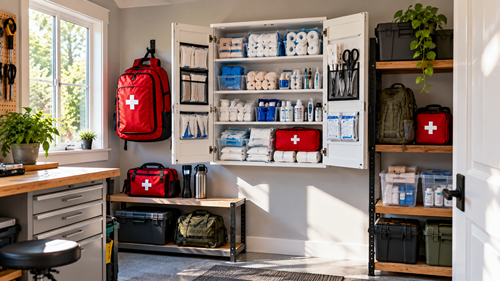
Most households have a first-aid kit somewhere in the house. It might be stored in a bathroom cupboard, kitchen drawer, utility room, or emergency backpack. Some families also keep smaller kits in their vehicles or take them along when travelling. These supplies are usually purchased with good intentions, but once stored, they may go months or even years without being inspected.
During an emergency, that lack of attention can become a problem. A minor cut may be difficult to manage when sterile dressings have been used and never replaced. A bandage may have deteriorated inside its packaging, a thermometer may have stopped working, or essential medication may be missing. Even a well-stocked kit can prove inadequate if nobody knows where it is or how to use its contents.
Consider what might happen during an extended power outage, severe storm, earthquake, or other disruption that delays access to medical services. A household member suffers a minor injury, but the nearest clinic is closed, transportation is unavailable, or emergency responders are dealing with more serious incidents. Having appropriate first-aid supplies readily available can help household members provide basic care while seeking professional assistance when necessary.
A Home First-Aid Kit Inventory helps households examine their existing medical supplies, identify shortages, inspect equipment condition, and determine whether their first-aid arrangements reflect the needs of the people who depend on them. It also encourages households to consider whether they have the knowledge and training required to use those supplies safely.
The accompanying downloadable color checklist provides space to record quantities required, quantities available, shortages, expiration or replacement dates, equipment condition, and storage locations. It also supports household-specific medical requirements, predictable medical consumable calculations, separate home and vehicle kit assessments, a practical kit inspection exercise, and a Day 1, Day 7, and Day 14 supply review.
The objective isn’t to assemble the largest possible collection of medical equipment. It’s to maintain an accessible, dependable first-aid kit containing supplies that household members can use safely and appropriately, while recognizing that ongoing medical needs require additional planning.
Why a First-Aid Inventory Matters
First-aid kits often begin as complete packages purchased from a pharmacy, outdoor equipment retailer, or emergency preparedness supplier. Their contents may be appropriate for certain minor injuries, but a commercially assembled kit isn’t necessarily designed around the needs of a particular household.
A family with young children may use adhesive bandages and basic wound care supplies frequently, while someone living with an ongoing medical condition may depend on specialized supplies that are not included in an ordinary kit. Households in remote areas may also need to consider longer delays before professional medical assistance becomes available.
Over time, the contents change. Bandages are removed, medications are used, sterile packages become damaged, and batteries lose their charge. Unless someone checks the kit, the household may continue assuming it contains everything originally purchased.
An inventory replaces that assumption with a documented assessment. It helps establish what is available, what remains suitable for use, and which items require replacement. It also reveals whether supplies are distributed sensibly between the home, vehicles, workplaces, and evacuation bags.
The process can save money. Rather than purchasing another complete first-aid kit, a household may discover that only a few essential supplies need replacing. In other cases, the inventory may reveal that a kit contains plenty of adhesive bandages but lacks suitable wound dressings, disposable gloves, or other frequently needed items.
Begin With Your Household’s Medical and First-Aid Needs
Before examining the kit itself, consider who may need to use it and what kinds of situations it should reasonably support. A household of two adults may have different requirements from one that includes young children, older relatives, or people with disabilities or ongoing medical needs. Allergies, prescribed medications, mobility limitations, and medical equipment requirements can affect which supplies should be available.
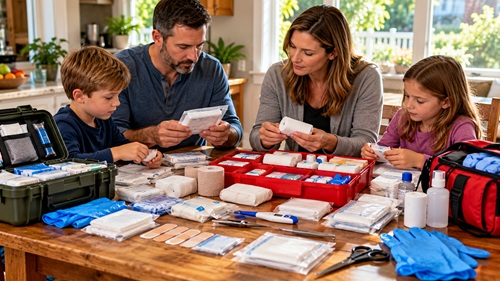
Children may require age-appropriate products, while some household members may need assistance administering medication or managing medical equipment. Anyone who depends on essential prescriptions or specialized medical supplies should have an appropriate continuity plan developed with their healthcare professional. This may include arrangements for authorized refills, suitable storage, backup equipment, and access to professional care if normal services become unavailable.
Location also influences preparedness. A household in an urban area with nearby medical facilities may have different access challenges from one in a rural community where transportation or severe weather can delay care. Travel, outdoor activities, and workplace conditions may introduce additional requirements.
Record these circumstances before deciding what to purchase. The inventory should reflect actual household needs rather than a generic list of equipment that may never be used.
Understanding the Difference Between First Aid and Ongoing Medical Care
A first-aid kit and a personal medical continuity plan serve related but different purposes. A first-aid kit primarily supports immediate care for injuries and certain emergencies. It may contain wound dressings, bandages, gloves, basic instruments, and other supplies that help someone provide initial assistance while determining whether professional medical attention is necessary.
Ongoing medical care involves different requirements. Someone who depends on prescription medication, medical consumables, monitoring equipment, or an electrically powered medical device may need those resources every day, regardless of whether an injury occurs. These supplies are not necessarily part of a conventional first-aid kit, but their availability can become critical during an extended disruption.
For example, a household may have a complete first-aid kit with enough bandages and dressings for numerous minor injuries while having only a few days of a prescribed medical consumable remaining. The first-aid kit is not necessarily deficient, but the household’s broader medical preparedness has a significant weakness.
The inventory should distinguish between supplies intended for immediate first aid and those required for continuing prescribed care. Both deserve attention, but their quantities, storage requirements, replacement schedules, and contingency arrangements may be different. A complete first-aid kit does not automatically mean a household is medically prepared for a prolonged emergency.
Basic First-Aid Supplies and Wound Care
Basic wound care supplies form an important part of most household first-aid kits. Minor cuts, scrapes, and abrasions are common injuries, and having suitable materials available makes it easier to provide initial care while monitoring for complications.
Begin by examining adhesive bandages, sterile gauze pads, non-adherent dressings, rolled gauze, medical tape, and wound cleaning supplies. Check whether the kit contains a useful range of sizes rather than large quantities of one type. A small adhesive bandage may be suitable for a minor cut but inadequate for a larger abrasion requiring a sterile dressing.
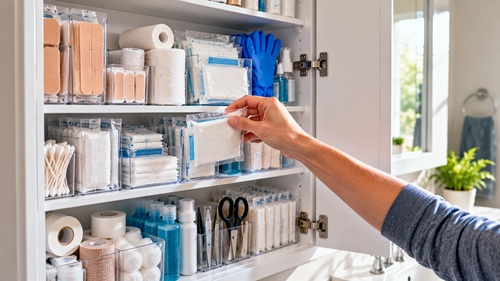
Inspect packaging carefully. Sterile supplies should remain sealed and protected from moisture, dirt, and damage. If sterile packaging has been opened, torn, or otherwise compromised, the product should not be treated as sterile.
Quantity matters as well. A household may have enough supplies for one minor injury but very little remaining if dressings need to be changed over several days. Record how many usable dressings are available and whether additional supplies may be appropriate for the household’s circumstances.
Basic first aid should not be confused with medical treatment for serious injuries. Deep wounds, uncontrolled bleeding, signs of infection, and other concerning conditions require appropriate professional assessment. First-aid supplies support initial care; they do not eliminate the need for medical assistance.
Bleeding Control and Injury Support
Bleeding control supplies deserve careful consideration because the equipment needed for a serious injury differs from the materials commonly used for minor cuts. A household first-aid kit may contain absorbent dressings, rolled gauze, and other materials suitable for applying direct pressure. Additional equipment, such as commercial tourniquets or specialized trauma dressings, may be appropriate in some circumstances, particularly when household members have received relevant training.
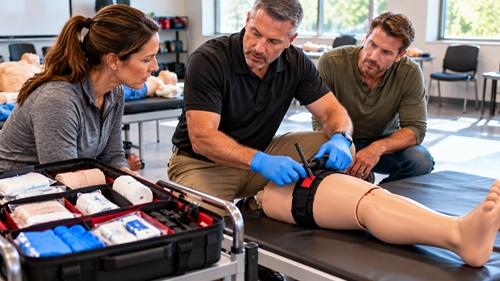
For serious bleeding, the priority is recognizing the emergency, contacting emergency services, and providing appropriate immediate care using current first-aid guidance. Advanced bleeding-control equipment should be selected and used in accordance with recognized training, with attention to the circumstances in which it is indicated.
Bandages and wraps used for minor injury support should also be inspected. Check whether elastic bandages retain their elasticity, whether triangular bandages remain clean and intact, and whether cold packs or other supportive supplies are suitable for use.
Record the equipment available and whether household members have completed relevant bleeding-control instruction. This helps identify both missing supplies and situations where additional training may be necessary.
Infection Prevention and Personal Protective Equipment
Providing first aid involves protecting both the injured person and the individual assisting them. Disposable gloves, hand hygiene supplies, and appropriate protective barriers can help reduce exposure to blood and other potentially infectious materials.
Examine the condition and quantity of disposable gloves, ensuring that suitable sizes and materials are available. Some people have sensitivities to latex or other products, so household requirements should be considered when selecting supplies. Hand sanitizer, soap, protective masks where appropriate, eye protection, and safe waste disposal materials may also be useful. Their suitability depends on the situation, and they should be stored and used according to manufacturer instructions.
Inspect gloves and other protective equipment for deterioration, damaged packaging, and unsuitable storage conditions. A supply that has been exposed to excessive heat or moisture may not remain dependable.
The inventory should also consider how contaminated materials would be handled during a prolonged disruption. Used dressings, gloves, and other waste need to be managed safely, particularly if normal waste collection or sanitation services are unavailable.
Basic Medical Instruments and Monitoring Equipment
Many first-aid kits include simple instruments such as scissors, tweezers, and thermometers. These items can be useful, but only if they remain clean, functional, and accessible.
Check that scissors operate properly, tweezers are undamaged, and any reusable instruments can be cleaned according to their intended use. A digital thermometer should be tested periodically, with spare batteries available if required.
Some households may also own blood pressure monitors, pulse oximeters, or other personal monitoring equipment. These devices can support prescribed care or provide useful information, but their readings require appropriate interpretation and should not replace professional medical assessment.
If monitoring equipment is included in the emergency inventory, record its condition, power requirements, maintenance instructions, and whether household members know how to operate it.
Over-the-Counter Medications and Personal Medical Supplies
Medications require more careful inventory management than ordinary bandages or equipment. Products may have specific storage requirements, expiration dates, age restrictions, contraindications, and interactions with other medicines.
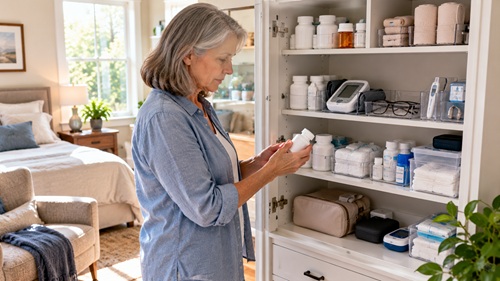
Examine any over-the-counter medications included in the first-aid kit, such as pain or fever medicines, allergy medications, and oral rehydration products. Record the product, quantity, expiration date, and whether it is appropriate for the household members who might use it.
Medication should remain in its original packaging whenever practical, with instructions and identifying information available. Products should be stored according to their labels and kept secure from children and anyone who might use them incorrectly.
Prescription medications and specialized medical supplies deserve separate attention. A household member who depends on daily medication, emergency allergy treatment, insulin, or another essential therapy may require a continuity plan that accounts for refill restrictions, temperature control, transportation, and possible interruptions in pharmacy access.
Do not discontinue, ration, share, or change prescribed medication without appropriate professional guidance. Where regulations permit, discuss emergency refill arrangements and suitable backup supplies with a pharmacist or prescribing clinician.
An inventory can reveal important weaknesses, but it cannot determine whether a medication is medically appropriate for a particular person. That decision should remain with qualified healthcare professionals.
Calculate How Long Essential Medical Consumables Could Last
Unlike food and drinking water, first-aid supplies cannot always be measured against a predictable daily consumption rate. Injuries and illnesses are uncertain, and the number of dressings, bandages, or other supplies required may change considerably depending on circumstances.
Regularly used medical consumables are different. Some household members depend on a known quantity of supplies each day, making it possible to estimate how long their current inventory could last if replacement supplies became unavailable.

For these items, divide the usable quantity available by the normal daily consumption rate.
Quantity available ÷ normal daily use = estimated days of coverage
For example, if a household member uses four prescribed medical consumables each day and has 40 usable items available, the supply represents approximately 10 days of coverage at the current rate.
This calculation can help identify predictable shortages involving certain testing supplies, prescribed consumables, disposable equipment components, or other regularly used products. It should not be applied indiscriminately to medications with variable dosing, treatments requiring professional supervision, or supplies whose consumption depends on an unpredictable medical event.
The estimate also assumes that every item counted remains suitable for use and that the normal consumption rate does not change. A product that requires refrigeration, specialized storage, or an electrically powered device may become unavailable even when physical supplies remain.
Record the quantity available, normal daily use, estimated days of coverage, expiration or replacement date, and established replacement arrangements. If the calculation reveals that an essential supply could run out before the household’s intended emergency planning period ends, discuss appropriate continuity arrangements with the relevant healthcare professional or supplier.
The purpose is to recognize potential shortages early, not to encourage people to reduce prescribed use or alter treatment to make supplies last longer.
Special Requirements for Children, Older Adults, and Dependents
A first-aid kit should reflect the people who live in the household rather than assume everyone has identical needs. Families with infants or young children may require age-appropriate medical supplies, thermometers, and prescribed products. Older adults may rely on glasses, hearing aids, mobility equipment, or medications that require additional planning.
Someone with limited mobility may need first-aid supplies stored where they can be reached without assistance. A person who uses medical equipment requiring electricity may need a backup power arrangement and a plan for obtaining professional assistance if that equipment becomes unavailable.
Pets may also have medical needs, but human medications and veterinary products should not be treated as interchangeable. Pet-specific supplies and emergency veterinary contacts are best recorded separately, with treatment decisions guided by a veterinarian.
These requirements should be documented so the household can identify shortages that would not appear on a standard commercial first-aid kit checklist.
Home, Vehicle, and Evacuation First-Aid Kits
Keeping every first-aid supply in one location may not be practical. An injury can occur while travelling, working outdoors, or evacuating, when the main household kit is inaccessible. A home kit can contain a broader selection of supplies, while a vehicle or evacuation kit may need to be smaller and more portable. The contents should reflect the situations in which each kit might be used.

Storage conditions are especially important in vehicles. High temperatures, freezing conditions, and moisture can damage medications, adhesives, and other supplies. Items sensitive to temperature may be unsuitable for long-term vehicle storage, even when they remain useful in a properly maintained household kit.
During the inventory, examine each kit separately. Record what is available, which supplies have been duplicated, and whether essential items can be reached quickly. A well-stocked home kit does not necessarily provide adequate preparedness when household members are away from home.
Storage Conditions, Expiration Dates, and Replacement
First-aid supplies should be stored in clean, dry locations protected from moisture, contamination, and unsuitable temperatures. Equipment should remain organized so that important items can be located without searching through unrelated supplies.
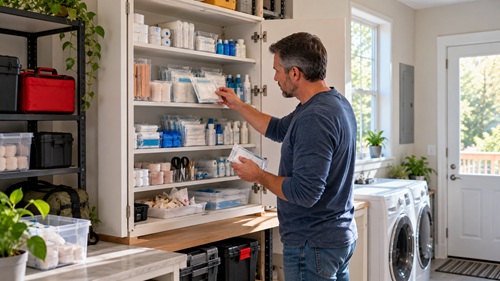
Inspect sterile packaging, adhesives, elastic materials, medications, and battery-powered equipment. Some products have printed expiration dates, while others may need replacement because of deterioration, damage, or manufacturer recommendations. A product without a printed expiration date should not automatically be considered usable indefinitely; its condition, storage history, and intended purpose still matter.
Record replacement requirements during the inventory rather than relying on memory. Supplies that are damaged, expired where the date affects safe use, or otherwise unsuitable should be separated from usable stock.
A complete inspection at least every six months is a practical starting point, with additional checks after using the kit, replacing medications, travelling, or changing household medical requirements.
First-Aid Knowledge and Training Are Part of Preparedness
A household can own an extensive collection of medical equipment and still be poorly prepared to respond to an injury. Having appropriate supplies is important, but recognizing when and how to use them is equally valuable.
Basic first-aid training helps people recognize common emergencies, provide appropriate initial assistance, and understand when professional medical care is necessary. Cardiopulmonary resuscitation training, including the use of an automated external defibrillator where appropriate, can also be valuable. Recognized bleeding-control training may be relevant for households that maintain specialized trauma equipment.
During the inventory, record which household members have completed first-aid, CPR/AED, or bleeding-control training, along with the dates of their most recent courses and any recommended refresher instruction. Training requirements and renewal recommendations vary between organizations and jurisdictions, so readers should follow the guidance associated with their certification or course.
Practical capability should also be considered. Someone may have completed a course several years ago but no longer feel confident locating equipment or recalling the appropriate response to an emergency. A refresher course or supervised skills practice may provide greater benefit than purchasing additional medical products.
The inventory should identify equipment shortages and training gaps. A first-aid kit becomes more dependable when household members know where supplies are stored, understand their intended use, and recognize when professional assistance is necessary.
Distinguish Essential Supplies From Optional Equipment
Building a dependable first-aid kit does not require purchasing every medical product advertised to emergency preparedness enthusiasts. For households with limited budgets, begin with appropriate supplies for common minor injuries, basic wound care, personal protection, and essential household medical needs. Ensuring that existing supplies are complete, accessible, and suitable should generally take priority over purchasing advanced equipment.
Specialized trauma equipment, additional monitoring devices, and other advanced products may be useful in particular circumstances, but their value depends on the household’s needs and the training available. Some improvements cost little or nothing. Organizing existing supplies, checking expiration dates, replacing missing dressings, and making emergency contact information accessible can improve readiness without purchasing another complete kit.
A practical purchasing decision should consider whether the equipment addresses a genuine household requirement and whether someone can use it appropriately. This helps avoid spending money on specialized products while more basic shortages remain unresolved.
Test Your First-Aid Kit With a Practical Inspection Exercise
A first-aid inventory should do more than establish how many supplies are stored. It should also reveal whether household members can locate and access essential equipment when they need it.
Begin by asking another household member to retrieve the main first-aid kit without assistance. Record approximately how long it takes and whether the person encounters any difficulty finding or accessing it. This simple exercise can reveal whether everyone knows where the kit is stored and whether it can be reached quickly. A complete kit locked in a cupboard may be of limited immediate use if nobody knows where the key is kept.

Once the kit is available, examine how easily common supplies can be located. Without opening sterile packaging unnecessarily, identify the adhesive bandages, gauze dressings, disposable gloves, medical tape, and other basic materials. Note whether these supplies can be found without emptying the entire container, whether their packaging remains intact, and whether the recorded quantities match what is actually available.
Next, examine the kit’s organization and the information stored with it. Are supplies grouped logically? Are medication instructions, emergency contacts, and relevant medical information accessible to authorized household members? Can someone locate a sterile dressing, disposable gloves, or other basic equipment without emptying the entire container? A kit may contain everything needed for a minor injury but still be difficult to use if supplies are mixed together or stored in unfamiliar locations.
Check any battery-powered equipment according to the manufacturer’s instructions. A thermometer that no longer operates or a monitoring device with depleted batteries should be recorded as requiring attention rather than assumed to be available. Examine reusable instruments for damage and confirm that any equipment requiring maintenance has been inspected appropriately.
The exercise should also establish whether household members know how to contact emergency services, communicate their location, and recognize when an injury or illness requires professional medical assistance. This can be assessed through discussion and locating contact information without making unnecessary emergency calls or attempting medical procedures beyond anyone’s training.
Record approximately how long it took to retrieve the kit, whether essential supplies could be located without difficulty, and which problems were discovered. There is no need to establish an arbitrary time limit. The purpose is to identify unnecessary delays, confusion, inaccessible equipment, or missing information that could complicate an emergency response.
Record these findings in the downloadable inventory checklist, including any missing supplies, equipment failures, accessibility problems, or training needs. Assign corrective actions to the most important deficiencies and confirm that the improvements have been completed. A short inspection exercise can reveal practical weaknesses that would otherwise remain unnoticed until someone needs the kit.
Recording Medical Supply Shortages and Replacement Priorities
Once the first-aid kit has been inspected, determine which shortages could affect the household most seriously. Not every missing item carries the same importance. A shortage of ordinary adhesive bandages may be inconvenient, while the absence of an essential prescribed medical consumable or a critical piece of medical equipment could have more immediate consequences for someone who depends on it.
Begin by comparing available quantities against actual household requirements. For ordinary first-aid supplies, consider the kinds of minor injuries the kit is intended to support, how frequently supplies have been used, and whether appropriate replacements are available. Because injuries cannot be predicted reliably, there is no universal number of dressings or bandages that guarantees adequate preparedness for a particular period.
Regularly consumed medical products can be evaluated more precisely. Record the usable quantity available, normal daily consumption, estimated days of coverage, expiration or replacement date, and established arrangements for obtaining additional supplies. Where a product requires refrigeration, electricity, or specialized equipment, document those dependencies as well.
For example, someone who uses three prescribed medical consumables daily and has 24 available has approximately eight days of supply remaining at the normal rate. If the household is preparing for a 14-day disruption, the calculation identifies a potential six-day gap. That shortage should prompt a discussion about appropriate replacement or continuity arrangements with the relevant healthcare professional or supplier, not an attempt to reduce prescribed use.
The inventory should also distinguish between products that are missing and products that are physically present but unsuitable. Damaged sterile packaging, deteriorated adhesives, expired medications where expiration affects safe use, and equipment that no longer functions should not be counted as dependable supplies.
Prioritize deficiencies according to their potential consequences. Essential prescribed care requirements, appropriate protective equipment, basic wound care supplies, and reliable access to emergency assistance generally deserve attention before optional accessories or specialized equipment that household members are not trained to use.
Record the required improvement, its priority, the person responsible, and a realistic completion date. This turns the inventory into a practical maintenance record and helps households address important shortages without purchasing everything at once.
Assess Your First-Aid Supplies on Day 1, Day 7, and Day 14
A first-aid inventory becomes more useful when it considers how supplies and medical capabilities might change during an extended disruption. Unlike food and drinking water, however, first-aid supplies cannot always be measured against a predictable daily consumption rate. Injuries and illnesses are uncertain, and the quantity of dressings, bandages, or other materials required may vary considerably depending on circumstances.
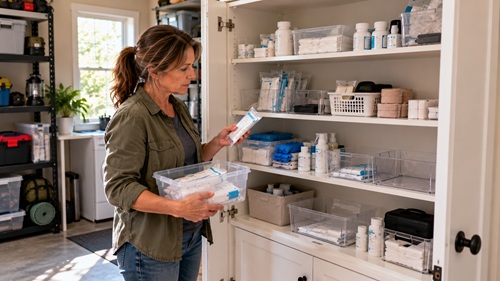
The assessment should distinguish between predictable medical supply requirements and unpredictable first-aid needs. Regularly consumed medical products can often be evaluated using established consumption rates, while supplies intended for unexpected injuries should be assessed according to their condition, suitability, accessibility, and the household’s ability to obtain professional assistance.
On Day 1, the household may have access to a complete first-aid kit, functioning medical equipment, normal pharmacy services, and reliable transportation. The inventory should establish whether essential supplies are immediately accessible, whether household members know how to locate and use them appropriately, and whether prescribed care arrangements would remain dependable if normal services were interrupted.
By Day 7, circumstances could be different. Repeated dressing changes may have reduced available wound care supplies, prescribed medical consumables may be running low, and transportation or pharmacy access could remain disrupted. Someone who depends on electrically powered medical equipment may also be approaching the limits of their backup power arrangements. These possibilities should be evaluated using actual household requirements rather than assuming that every medical resource will be consumed at the same rate.
On Day 14, the assessment should focus on whether essential medical needs can continue to be met safely. A household might still have plenty of ordinary first-aid supplies while lacking sufficient prescribed consumables, replacement batteries, or other resources required for ongoing care. The first-aid kit itself may remain adequately stocked even though the household’s broader medical preparedness has become inadequate.
Consider someone who uses four prescribed medical consumables daily and has 40 available. At the normal consumption rate, those supplies provide approximately 10 days of coverage. If the household is preparing for a 14-day disruption, the inventory identifies a potential shortage after Day 10. This provides an opportunity to investigate authorized replacement arrangements and professionally approved contingency plans before an emergency occurs.
Unpredictable injuries require a different approach. A household cannot reliably calculate how many injuries will occur during a two-week emergency, but it can inspect whether appropriate supplies are available, whether household members have relevant training, and whether professional medical assistance can be contacted when necessary.
The most important finding is often the first essential medical supply or capability that could become inadequate, rather than the total number of products remaining in the kit. Record the expected shortage date for regularly consumed supplies, identify equipment or training limitations, and document the corrective action required.
The assessment should not encourage households to attempt medical procedures beyond their training or delay necessary medical care. Its purpose is to identify foreseeable gaps while professional advice, replacement supplies, and emergency planning resources remain available.
Download Your Free Home First-Aid Kit Inventory Checklist
The downloadable Home First-Aid Kit Inventory Checklist provides a practical way to examine existing first-aid supplies, identify shortages, inspect equipment condition, and maintain the resources household members may need during an emergency.
The color-coded PDF covers basic wound care, bleeding control equipment, bandages and injury support, infection prevention, personal protective equipment, medical instruments, over-the-counter medications, and household-specific medical requirements. It also provides space to assess first-aid supplies stored in vehicles, evacuation bags, and other locations.
The inventory sections help readers record quantities required, quantities available, shortages, product condition, expiration or replacement dates, and storage locations. These records make it easier to identify supplies that have been consumed, damaged, or overlooked during previous inspections.
The checklist also supports the assessment of regularly consumed medical supplies. Readers can record normal daily use, calculate estimated days of coverage, and identify potential shortages before the end of their emergency planning period. These calculations are intended for predictable consumable requirements and should not be used to estimate unexpected injuries or justify changing prescribed treatment.
The practical inspection exercise encourages households to determine whether first-aid kits are accessible, organized, and familiar to the people who may need them. Training records can help document first-aid, CPR/AED, and recognized bleeding-control instruction, along with recommended refresher dates.
The Day 1, Day 7, and Day 14 assessment helps readers consider how supplies and medical capabilities might change during an extended disruption. Corrective-action records provide space for documenting missing items, replacement priorities, responsible household members, and target completion dates.
Completing the checklist helps establish the difference between simply owning a first-aid kit and maintaining a dependable collection of supplies that household members can access and use appropriately.
Print the checklist and complete it while examining your actual first-aid supplies. Check packaging, inspect equipment, review expiration dates, and record anything requiring attention. Keep the completed inventory with your emergency preparedness records and update it whenever supplies are used or replaced.
Download your free printable inventory checklist:
The printable checklist is designed for US Letter paper and provides organized inventory tables, equipment inspection records, household medical requirements, and corrective-action planning. Before publishing, the PDF should be checked to ensure its worksheets fully support the medical consumable calculations, training records, and practical inspection assessment described in this revised posting.
Preparedness Action Plan
Begin by locating every first-aid kit maintained by your household, including those stored at home, in vehicles, and in evacuation bags. Examine each kit separately rather than assuming that supplies available in one location will be accessible during every emergency. Use the downloadable checklist to record the actual contents, quantities, condition, and storage locations.
Inspect sterile dressings, bandages, protective equipment, medical instruments, and other supplies for damage, deterioration, or missing components. Check expiration and replacement dates where applicable, and separate products that are no longer suitable for their intended use. Equipment requiring batteries or other power sources should be tested according to manufacturer instructions.
Next, consider household members who depend on specialized medical supplies or prescribed care. Record regularly consumed medical products separately from ordinary first-aid supplies and calculate their estimated days of coverage where a predictable consumption rate exists. If the inventory reveals a potential shortage, discuss appropriate replacement or continuity arrangements with the relevant healthcare professional or supplier.
Review the organization and accessibility of each kit. Ask another household member to locate the main first-aid kit and identify commonly needed supplies without assistance. Record unnecessary delays, missing items, and equipment that cannot be accessed easily. Check whether emergency contact information is available and whether household members understand how to obtain professional medical assistance.
Examine household training records and identify whether anyone needs basic first-aid, CPR/AED, or bleeding-control instruction. Recognized training can improve the practical value of supplies already owned and help household members recognize situations requiring immediate professional assistance.
Once the inventory is complete, prioritize improvements according to their importance. Essential prescribed care requirements, basic wound care supplies, suitable protective equipment, and the ability to obtain emergency assistance should generally take priority over optional accessories or advanced equipment that household members are not trained to use.
If your budget is limited, address shortages gradually. Replacing missing dressings, organizing existing supplies, checking batteries, and making emergency contact information accessible may improve preparedness without purchasing an entirely new kit. More specialized equipment can be considered when there is a demonstrated need and appropriate training.
Work through the Day 1, Day 7, and Day 14 assessment to identify predictable medical supply shortages and limitations that could affect access to care. Record the earliest expected shortage, the resources required to address it, and any professionally approved contingency arrangements.
Choose the three most important improvements and document them in the corrective-action section of the checklist. Establish realistic completion dates and verify that each correction has addressed the original problem. Review first-aid supplies at least every six months, after significant use, or whenever household medical requirements change.
Key Takeaways
A dependable first-aid kit is not defined by the number of products it contains. Its usefulness depends on whether the supplies are appropriate for the household, remain in suitable condition, can be accessed when needed, and are supported by the knowledge required to use them safely.
Basic first-aid supplies and ongoing medical requirements should be evaluated separately. A household may have sufficient bandages and dressings for minor injuries while facing an important shortage of prescribed medical consumables or equipment needed for continuing care. Calculating estimated days of coverage for regularly used supplies can help identify these predictable weaknesses without attempting to forecast unexpected injuries.
Regular inspections reveal missing products, damaged packaging, expired supplies, and equipment that no longer functions properly. Practical accessibility checks and recognized first-aid training are equally important because even a well-stocked kit may be of limited use if household members cannot locate its contents or recognize when professional assistance is necessary.
The Day 1, Day 7, and Day 14 assessment helps households identify the earliest essential medical supply or capability that could become inadequate during an extended disruption. Recording these findings provides a practical basis for prioritizing improvements, maintaining supplies, and developing appropriate contingency arrangements.
The value of a first-aid kit isn’t measured by how much medical equipment it contains. It’s measured by whether the right supplies, knowledge, and access to professional care are available when someone needs help.
Explore More Emergency Preparedness Checklists
Maintaining a dependable first-aid kit is an important part of household preparedness, but medical supplies are only one of the resources people may need during an emergency. Safe drinking water, suitable food, communication equipment, and other essential supplies all contribute to maintaining household safety when normal services are disrupted.
Prepping Communities offers additional free emergency preparedness checklists to help households evaluate their existing resources, identify shortages, and maintain the supplies they may depend on during an extended emergency.
The 72-Hour Emergency Kit Inventory helps readers assess essential supplies for the first three days of a disruption, while the Two-Week Emergency Supplies Inventory examines whether household resources could support a longer interruption to normal services.
The Emergency Food Storage Inventory provides guidance for evaluating stored food, calculating meal requirements, inspecting storage conditions, and estimating how long a household’s food reserve could last. The Emergency Drinking Water Inventory complements that assessment by helping readers calculate water requirements, inspect stored drinking water, evaluate treatment equipment, and identify when safe water supplies could become inadequate.
Each posting includes preparedness guidance and a downloadable inventory checklist designed to help readers assess what they already own and determine which improvements deserve attention.
Explore the complete Prepping Communities Emergency Preparedness Checklist series to continue evaluating and improving your household’s readiness.
© Prepping Communities. This content is for informational purposes only and not professional advice. Use at your own risk.
Terms | Privacy | Guidelines