
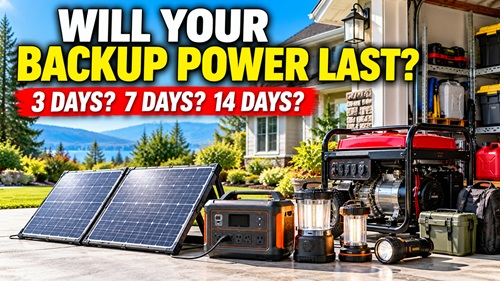
How Long Could Your Household Function Without Electricity?
Prepping Communities | Emergency Preparedness Checklists
Most households depend on electricity far more than they realize. Lighting, refrigeration, communication, heating and cooling equipment, water pumps, and medical devices all rely on a dependable power supply. When electricity is available, these systems operate quietly in the background. When the power goes out, the extent of that dependence can become apparent within hours.
A short outage may be little more than an inconvenience. A prolonged disruption can create more serious problems, particularly when food begins warming in refrigerators, mobile phones lose their charge, electric well pumps stop supplying water, or essential medical equipment can no longer operate.
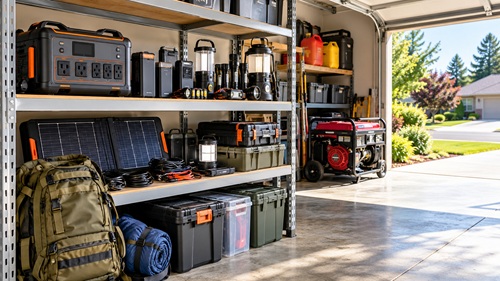
Many households own some form of emergency power equipment. A flashlight may be stored in a kitchen drawer, a portable power bank may be tucked into a backpack, or a generator may sit in the garage waiting for the next storm. Having these items is useful, but their presence doesn’t necessarily mean the household can support its essential electrical needs for very long.
A portable battery station may have sufficient capacity to recharge phones and operate several LED lights but be unable to run a refrigerator for an extended period. A generator may provide considerable electrical output but become useless when its fuel supply is exhausted. Solar panels may recharge batteries on clear days while producing very little energy during prolonged cloudy weather.
An Emergency Power Equipment Inventory helps households identify essential electrical requirements, inspect existing equipment, calculate energy consumption, estimate backup power duration, and recognize weaknesses before a prolonged outage occurs.
The accompanying downloadable color checklist provides worksheets for recording equipment condition, battery capacity, generator readiness, fuel supplies, solar charging capability, essential device requirements, and expected operating duration. It also includes a practical equipment-testing assessment and a Day 1, Day 7, and Day 14 review to help determine which electrical capabilities could become unavailable first.
The objective isn’t to keep every household appliance operating during an emergency. It’s to establish which electrical services matter most, what equipment can support them, and how long those arrangements could remain dependable without grid electricity.
Why an Emergency Power Inventory Matters
A household may have several backup power devices without knowing their combined capabilities. One power bank might be fully charged, another may have deteriorated after years of storage, and a portable battery station may never have been tested with the equipment it is expected to operate.
The same uncertainty applies to generators. A machine that started successfully last year may now have a discharged starting battery, contaminated fuel, or a maintenance problem. Even when it operates properly, its electrical output may be insufficient for certain appliances or its fuel consumption may be greater than expected.
An inventory replaces assumptions with documented information. It establishes which equipment is available, whether it functions properly, which devices it can safely support, and what resources are required to keep it operating. Battery capacity, fuel availability, charging arrangements, and electrical compatibility all influence how dependable the equipment will be during an extended outage.
Understanding these limitations helps households decide which electrical devices deserve priority, where maintenance is needed, and whether existing equipment can meet essential requirements without unnecessary purchases.
Identify Your Household’s Essential Electrical Needs
Before examining generators or battery stations, determine which electrical devices the household genuinely needs during an outage. For some households, the immediate priorities may be emergency lighting, mobile phone charging, and a battery-powered radio. Others may depend on electrically powered medical equipment, refrigeration for temperature-sensitive medication, a private well pump, or equipment necessary to maintain safe indoor temperatures.
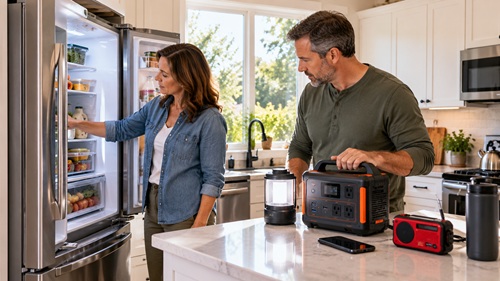
These requirements should be evaluated according to the consequences of losing power. Equipment supporting immediate health and safety needs deserves attention before appliances used primarily for comfort or entertainment. A household may want to operate a television, coffee maker, or other familiar appliance, but doing so could consume energy needed for communication, refrigeration, or essential medical equipment.
It helps to distinguish between electrical loads that are critical to immediate safety, those needed to maintain essential household functions, and those that provide convenience. The distinction will vary between households. A refrigerator may be important for food preservation, but it could become essential for someone storing temperature-sensitive medication. A private well pump may be the only practical way to access household water.
Consider a family with a portable battery station capable of operating several small devices. If that same station is expected to support a refrigerator, communication equipment, and a medical device simultaneously, its stored energy may be exhausted much sooner than anticipated. Reducing nonessential electrical demand could extend the operating time of critical equipment without requiring a larger battery.
The inventory should identify each essential device, its electrical requirements, and the consequences if it becomes unavailable. This provides a practical basis for deciding which equipment deserves backup power first and which activities could be reduced or suspended during an extended outage.
Understanding Watts, Watt-Hours, and Battery Capacity
One of the most common sources of confusion in emergency power planning is the difference between electrical power and stored energy. Watts (W) describe the rate at which a device uses electrical power, while watt-hours (Wh) describe how much energy is consumed or stored over time.
A device consuming 50 watts continuously for one hour uses approximately 50 watt-hours of energy. If it operates for ten hours at the same consumption rate, it uses approximately 500 watt-hours.
This distinction matters because a power station advertised as having a 1,000-watt output does not necessarily contain 1,000 watt-hours of stored energy. Output rating and battery capacity describe different capabilities.
For example, a portable power station rated to deliver 1,000 watts might be capable of operating a 700-watt appliance, provided the equipment is electrically compatible and startup requirements remain within the station’s limits. However, if the battery contains only 500 watt-hours of energy, that appliance could exhaust the available reserve in well under an hour once conversion losses and internal consumption are considered.
The example illustrates two separate questions. Can the power station safely operate the device, and how long can it continue supplying the required energy? Both must be answered before treating the equipment as a dependable backup source.
When evaluating emergency power equipment, consider the maximum continuous output, any applicable surge rating, the nominal battery capacity, and the estimated usable energy. These measurements provide a more accurate picture of what the equipment can accomplish.
Calculate Your Household’s Daily Electrical Requirements
A practical starting point is to estimate how much energy each essential device consumes during a typical day without grid electricity. For equipment operating at a relatively constant power level, multiply its wattage by the number of hours it will be used.
Device power consumption (W) × hours used per day = daily energy consumption (Wh)
A 10-watt LED light operating for five hours uses approximately 50 watt-hours. A 50-watt device operating continuously for eight hours uses approximately 400 watt-hours. These calculations are straightforward when power consumption remains relatively stable.
Other household appliances are more complicated. Refrigerators, freezers, pumps, and heating equipment frequently cycle on and off rather than operating continuously. Their maximum or running wattage does not necessarily represent their average consumption throughout the day.
For example, a refrigerator drawing 120 watts while its compressor operates does not necessarily consume 2,880 watt-hours every day. That figure would assume the compressor operated continuously for 24 hours. Actual consumption depends on how frequently it runs, surrounding temperatures, appliance efficiency, door openings, and other conditions.
Where practical, use measured energy consumption or manufacturer energy-use information rather than estimating daily demand from maximum wattage alone. An appropriate plug-in electricity monitor may help measure compatible household appliances, while permanently connected equipment may require manufacturer information or professional assessment.
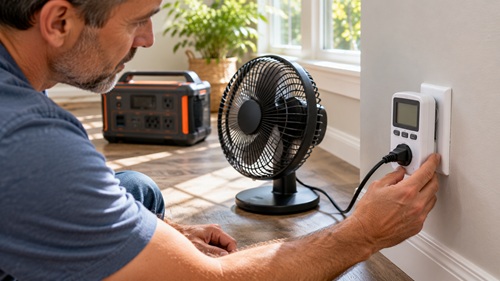
The combined daily energy requirements of essential devices provide a starting point for evaluating backup power capacity. The estimate should reflect how equipment would actually be used during an outage rather than assuming every appliance will operate normally.
Calculate How Long Your Backup Battery Could Last
A portable power station may have a stated battery capacity of 1,000 watt-hours, but not all of that energy will necessarily be available to connected appliances. Inverter losses, internal consumption, battery condition, temperature, and operating characteristics can reduce usable capacity.
For illustration, assume a 1,000-watt-hour battery station provides 850 watt-hours of usable AC energy after losses. If a connected device consumes 50 watts continuously, the estimated runtime would be:
850 Wh ÷ 50 W = approximately 17 hours
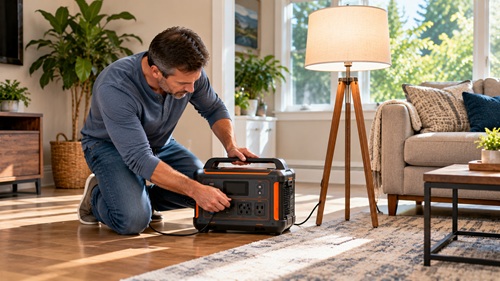
This estimate assumes a relatively steady load. Actual runtime may differ, especially when devices have variable consumption or the battery station uses additional energy while operating.
For households using several devices, the combined electrical load must be considered. Two devices consuming 50 watts each create a continuous load of approximately 100 watts, reducing the estimated runtime of the same 850-watt-hour reserve to about 8.5 hours before additional variations.
A more realistic assessment compares manufacturer specifications with appropriate equipment-testing results. If a device operates for substantially less time than expected, that difference should be investigated rather than ignored.
The calculation also reveals why reducing electrical demand can be valuable. Replacing a power-hungry light with an efficient LED lantern, limiting unnecessary charging, or operating selected appliances only when needed may extend the useful duration of the same stored energy.
The downloadable checklist provides space for nominal battery capacity, estimated usable energy, connected electrical loads, calculated runtime, and actual tested duration. Together, these measurements provide a more dependable basis for planning than advertised battery capacity alone.
Emergency Lighting Equipment
Lighting is one of the easiest electrical needs to overlook because many households already own flashlights and portable lanterns. The more important question is whether those lights work, whether suitable batteries are available, and whether they can provide useful illumination throughout an extended outage.

Inspect flashlights, LED lanterns, headlamps, rechargeable lights, and other portable lighting equipment. Check their condition, brightness settings, operating modes, and power requirements. Equipment that has been stored for years may have corroded battery contacts or depleted rechargeable batteries.
Consider where lighting is needed. A small flashlight may be adequate for moving between rooms, while an LED lantern can provide more useful area lighting for cooking, caregiving, or other activities. Headlamps may be helpful when both hands are needed.
Rechargeable lighting should be assessed alongside the equipment required to recharge it. A lantern that operates for several hours may still be unsuitable for a two-week disruption if there is no dependable charging arrangement.
Battery-powered lighting is generally preferable to candles and other open flames during emergencies because it avoids introducing unnecessary fire hazards.
Portable Power Banks and Charging Equipment
Portable power banks are useful for maintaining mobile phones and other small electronic devices, but their actual capabilities vary considerably. Some are designed primarily for occasional phone charging, while larger units may support tablets, radios, and other USB-powered equipment.

The advertised capacity may be expressed in milliamp-hours, which cannot be compared directly with watt-hours without considering battery voltage and conversion losses. A power bank with a large advertised capacity may still provide fewer complete device charges than expected.
Examine the rated capacity, available output connections, supported charging standards, and devices that can be charged. Check whether suitable cables and adapters are available. A power bank that uses an unfamiliar connector or cannot deliver the output required by an essential device may provide less practical value than its capacity suggests.
Test important charging arrangements before an emergency. Confirm that the power bank accepts a charge, that its output ports function, and that it can recharge the devices assigned to it. The results can then be recorded alongside the power bank’s specifications and condition.
Portable Battery Power Stations and Inverters
Portable battery power stations can provide more substantial emergency electrical capability than ordinary power banks. Depending on their design, they may support lighting, communications, small appliances, refrigeration, and certain medical devices.
Equipment compatibility matters. A power station must have sufficient continuous output for the connected load and adequate surge capability for equipment that draws additional power during startup.
Refrigerators, pumps, and other motor-driven appliances may require considerably more power when starting than during normal operation. A battery station that appears sufficient based on running wattage alone may shut down when the appliance attempts to start.
Inverters also introduce efficiency losses, and some devices require particular electrical characteristics for reliable operation. Check manufacturer requirements before relying on a power station to operate sensitive equipment.
The inventory should establish the power station’s battery capacity, continuous output rating, surge rating, charging methods, battery condition, and maintenance requirements. Where practical and safe, testing with the actual equipment it is intended to support can reveal compatibility problems that are not obvious from specifications alone.
Emergency Generators and Fuel Requirements
Fuel-powered generators can provide substantial emergency electricity, but their usefulness depends on more than their rated output. A generator must be maintained, supplied with suitable fuel, operated within its electrical limits, and positioned safely. Its ability to support essential household devices should be confirmed through appropriate testing.
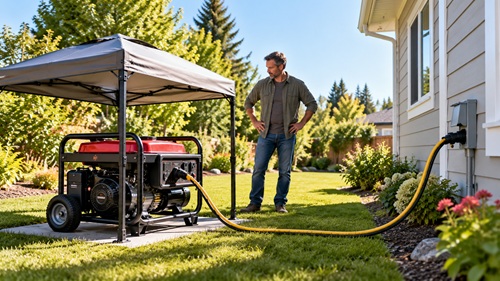
Portable fuel-burning generators must never be operated indoors, inside garages, or in enclosed or partially enclosed spaces. Carbon monoxide can accumulate rapidly and cause fatal poisoning. Generators should be operated outdoors, well away from doors, windows, vents, and other building openings, following manufacturer instructions and applicable safety guidance.
Connecting a generator to household electrical wiring requires appropriate transfer equipment installed in accordance with local electrical regulations. Improvised connections can endanger occupants, utility workers, and emergency responders.
Fuel availability is another limitation. A generator may operate essential equipment for several hours or days, but the duration depends on fuel consumption, electrical load, and the amount of safely stored fuel available.
Calculate Your Generator’s Estimated Fuel Duration
A useful planning calculation compares the quantity of usable fuel with the generator’s expected consumption at the intended electrical load.
Usable fuel available ÷ fuel consumption per hour = estimated operating hours
For example, if a generator consumes approximately one litre of fuel per hour at the planned load and the household has 12 litres of usable fuel, the estimated operating duration is approximately 12 hours.
This does not mean the generator can necessarily operate continuously for that entire period without interruption. Manufacturer operating limits, maintenance requirements, safe refuelling procedures, and other practical considerations may affect how the fuel can be used.
Fuel consumption also changes with generator design, electrical load, maintenance condition, and fuel type. A generator operating near its rated capacity may consume fuel at a different rate than one supplying only a few essential devices. Manufacturer consumption information and appropriate operating tests can provide more useful estimates than assuming a fixed fuel-use rate.
Only fuel that is safely and legally stored, suitable for the equipment, and realistically accessible should be included in the inventory. This may include usable fuel already in the generator’s tank and additional fuel stored in approved containers, provided its condition and storage history are appropriate. Fuel stored in damaged containers, under unsuitable conditions, or beyond its usable storage life should not automatically be counted as dependable.
The estimated operating duration should also account for manufacturer-required maintenance, safe refuelling procedures, and any operating interruptions that may be necessary. The inventory should establish whether the generator can support essential electrical requirements and how quickly its usable fuel reserve could become inadequate.
A generator that works perfectly but has no dependable fuel supply is not a complete long-term backup power solution.
Solar Panels and Renewable Charging Systems
Solar charging can extend the usefulness of emergency battery storage, particularly when grid electricity remains unavailable for several days.
Portable solar panels may be capable of recharging power banks or battery stations, while larger systems may support additional household electrical requirements. Their usefulness depends on sunlight, weather conditions, panel orientation, shading, charging equipment, and battery compatibility.
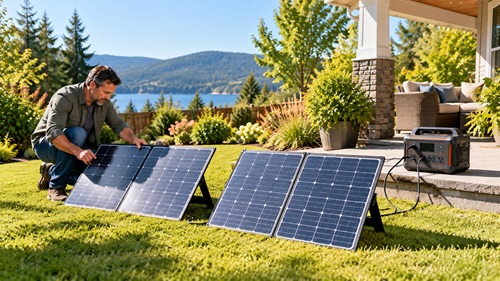
A panel advertised as producing 200 watts will not necessarily deliver that output throughout the day. Its rated capacity represents performance under specified test conditions, while actual generation varies with environmental conditions. This becomes especially important during winter, prolonged cloudy weather, or emergencies involving smoke and reduced sunlight.
Households with rooftop solar installations should also confirm whether their systems can operate when utility electricity is unavailable. Many conventional grid-connected solar systems automatically shut down during an outage unless they include suitable backup-capable equipment and approved electrical arrangements. Having solar panels on the roof does not necessarily mean having access to electricity when the grid fails.
A complete inventory should identify the solar equipment available, its rated output, the devices it can charge, and the results of actual charging tests. Cables, connectors, charge controllers, mounting equipment, and other components necessary for operation are part of the system and should not be overlooked.
A household relying on solar power must also consider what happens when several consecutive days provide very little usable sunlight. Additional stored energy, reduced electrical demand, or another safe charging method may be necessary.
Understanding Daily Energy Replenishment and Shortages
Stored battery capacity is only part of an extended emergency power plan. Households also need to understand whether they can replace the energy being consumed each day.
A battery station may provide enough electricity for several days when fully charged, but that reserve will gradually decline if daily consumption exceeds the energy supplied by solar panels, generators, or other charging arrangements.
The basic calculation is:
Daily energy consumption − daily energy replenishment = daily energy deficit
For example, suppose a household’s essential devices consume 500 watt-hours per day, while its solar charging arrangement provides an average of 200 watt-hours per day under the conditions being assessed. The resulting deficit is approximately 300 watt-hours per day.
If the household begins with 1,200 usable watt-hours of stored energy, a daily deficit of 300 watt-hours would theoretically exhaust that reserve after approximately four days. This estimate assumes the stated replenishment represents energy actually available after charging losses, that the household can use the full planned battery reserve, and that daily consumption remains unchanged. Actual duration may differ because of weather, battery condition, charging limitations, and variations in device use.
This example illustrates why a household can continue generating some electricity while still moving toward a power shortage. Solar panels may be working correctly, but their output may not be sufficient to replace the energy being consumed.
The opposite situation is also possible. If reliable daily replenishment equals or exceeds essential consumption, stored energy may be maintained or restored, subject to battery capacity, charging efficiency, and equipment limitations.
For emergency planning, compare normal expected replenishment with a reduced-output scenario. A solar system that performs well during clear summer weather may provide substantially less energy during winter storms or prolonged cloud cover.
The objective is to determine whether the household’s energy reserve is being maintained, replenished, or gradually depleted. That information is more useful for extended preparedness than simply knowing how much energy a battery can store when fully charged.
Backup Power for Essential Medical Equipment
Some households depend on electrically powered medical equipment that cannot simply be switched off during an outage. Certain devices have built-in batteries, while others require continuous external power or specialized backup arrangements. Their electrical requirements, operating limitations, and tolerance for interruptions can vary considerably.

Medical devices may have specific requirements concerning power quality, battery compatibility, operating temperatures, or uninterrupted operation. These should be confirmed with the manufacturer, healthcare professional, or equipment supplier rather than assumed from the device’s stated wattage alone.
A calculated battery runtime does not necessarily establish that a medical device can be supported safely for that duration. Testing, professional guidance, and appropriate backup arrangements remain important. Households should not deliberately disconnect essential medical equipment to conduct an emergency preparedness exercise.
Where essential medical care depends on electricity, the inventory should identify the available backup arrangements, their verified operating limitations, and the circumstances that would require outside assistance or relocation to an appropriate care facility.
Refrigeration, Freezers, and Temperature-Sensitive Supplies
Refrigerators and freezers can become important electrical priorities during an extended outage, particularly when they contain essential food or temperature-sensitive medications. Their energy requirements vary with appliance size, efficiency, ambient temperature, how frequently doors are opened, and other operating conditions. Unlike devices that draw a relatively constant amount of electricity, refrigerators and freezers operate in cycles, making their daily energy consumption more difficult to estimate from a single wattage rating.

A refrigerator might consume 120 watts while its compressor is running but use considerably less energy over a full day because the compressor operates intermittently. However, warmer indoor temperatures, frequent door openings, and additional food placed inside can increase consumption. During an outage, these variations may shorten the operating duration of a portable battery station or increase generator fuel consumption.
The inventory should establish the appliance’s normal daily energy consumption, startup power requirements, and whether the available backup equipment can support it safely. Manufacturer energy-use information provides a useful starting point, while an appropriate electricity monitor may offer a more realistic measurement under actual household conditions. Motor-driven appliances may require substantially more power during startup than during normal operation, so both requirements must be considered.
Food safety is another important consideration. A refrigerator that loses power may maintain safe temperatures for a limited period if its doors remain closed, but that duration depends on the appliance and surrounding conditions. As a general emergency planning reference, an unopened refrigerator may keep food safe for approximately four hours, while a full freezer may maintain suitable temperatures for approximately 48 hours, or around 24 hours if half full. These are approximate guidelines, not guarantees. Food safety decisions should be based on actual temperatures, elapsed time, and applicable public-health guidance rather than appearance or smell alone.
Temperature-sensitive medications require particular attention because their storage requirements may differ from those of ordinary refrigerated food. Some products must remain within a specified temperature range, and exposure to unsuitable conditions can affect their effectiveness. Households should confirm medication storage requirements and emergency arrangements with a pharmacist or healthcare professional rather than assuming that keeping a refrigerator cool enough for food will also protect every medication.
Consider a household that owns a portable battery station capable of operating a refrigerator for several hours. If the battery is also needed for communication equipment, lighting, or an essential medical device, its available energy must be shared between those requirements. Maintaining refrigeration continuously may not always be practical, and any alternative operating arrangement must be evaluated against actual temperature requirements and food safety considerations.
The inventory should identify which refrigerated items are essential, how much electrical energy is required to maintain appropriate temperatures, and what alternative arrangements are available if backup power becomes inadequate. For some households, reducing unnecessary refrigeration loads may extend the useful duration of stored electricity. For others, maintaining a specific temperature-sensitive medical supply may take priority over preserving ordinary food.
The objective is to determine whether the household can maintain safe storage conditions for essential refrigerated supplies throughout the intended emergency period. If existing backup equipment cannot meet those requirements, the inventory should identify the limitation and establish what additional resources or contingency arrangements may be necessary.
Test Your Emergency Power Equipment Before an Outage
An emergency power inventory should establish more than whether equipment is present and appears undamaged. It should determine whether essential devices can operate from their assigned backup sources, whether the necessary connections are compatible, and whether actual performance is consistent with the household’s calculations.
Begin with a suitable noncritical device whose power requirements are known. Confirm that the backup source can support its continuous and startup demands, then conduct a controlled test according to the manufacturer’s instructions. Observe whether the device operates normally and check for overload warnings, unexpected shutdowns, excessive heating, or other signs of a problem.
For a portable battery station, record the starting charge level, connected load, test duration, and remaining charge. Compare the observed performance with the calculated runtime. For example, if the battery was expected to operate a device for eight hours but testing suggests only six hours of coverage, investigate the difference. Battery condition, inverter losses, internal power consumption, and inaccurate load estimates may all contribute.
The test should also establish whether the equipment can be recharged afterward. Confirm that the intended charging cables and connectors are available and that charging equipment operates correctly. Where solar panels are involved, record the conditions under which the test occurred, since actual charging performance can vary substantially with sunlight and weather.
Fuel-powered generators must be tested outdoors, well away from building openings, following manufacturer instructions. Any connection to household circuits must use properly installed transfer equipment. Essential medical devices should not be disconnected for testing; backup arrangements for these devices require appropriate manufacturer, supplier, or healthcare professional guidance.
Record the calculated performance, observed results, discrepancies, and corrective actions in the inventory checklist. Equipment should be considered dependable only to the extent that its compatibility, condition, and operating limitations have been adequately established.
Assess Your Emergency Power on Day 1, Day 7, and Day 14
A household may have enough backup electricity for the first several hours of an outage but lack a dependable way to maintain essential services over several days. The assessment should examine how stored energy, generator fuel, and replenishment capabilities would change as the disruption continues.
On Day 1, batteries may be fully charged, generator fuel may be available, and essential appliances may still be operating normally. The priority is to confirm which devices can be supported safely, establish their expected energy consumption, and reduce unnecessary electrical demand.
By Day 7, stored energy and fuel may be substantially depleted. Several days of poor weather could also have limited solar charging. The household should consider whether its replenishment arrangements can keep pace with essential consumption and whether any critical device is approaching the limits of its available power.
On Day 14, the assessment should focus on whether essential electrical services remain available, not simply whether a battery still contains some charge. Communication equipment may remain operational while a water pump, refrigerator, or another important household system can no longer be supported.
For example, if essential equipment consumes 500 watt-hours daily and charging supplies only 200 usable watt-hours, the household experiences a daily deficit of 300 watt-hours. With 1,200 usable watt-hours initially stored, that deficit would theoretically exhaust the reserve after approximately four days, assuming consistent demand, replenishment after charging losses, and full availability of the planned battery reserve.
The most important finding is the first expected loss of an essential electrical capability. Record the affected equipment, the cause of the shortage, and the safe alternative or corrective action required. This provides a clearer basis for planning than waiting until every battery or fuel container is empty.
Download Your Free Emergency Power Equipment Inventory Checklist
Knowing how much backup electricity your household needs is only part of emergency preparedness. Keeping an accurate record of available equipment, battery capacity, generator fuel, charging arrangements, and operating limitations helps establish whether those resources can support essential needs during an extended outage.
The free Emergency Power Equipment Inventory Checklist provides a practical, printable workbook for assessing your household’s emergency electrical capabilities. It includes inventory tables for lighting, portable power banks, battery stations, generators, fuel supplies, solar charging systems, medical equipment, refrigeration, communication devices, and other electrically dependent household systems.
The checklist also includes worksheets for calculating daily electrical consumption, estimating battery runtime, determining generator fuel duration, and comparing energy consumption with available replenishment. Dedicated sections support practical equipment testing, Day 1, Day 7, and Day 14 assessments, and corrective-action planning.
Print the checklist and complete it while inspecting your actual equipment. Record shortages, equipment condition, maintenance requirements, and the improvements needed to keep essential electrical services operating safely.
Preparedness Action Plan
Begin by identifying the electrical devices and household systems that would be most important during an outage. Consider medical equipment, water pumps, heating and cooling requirements, refrigeration, lighting, and communication. Distinguish immediate safety needs from other essential functions and appliances that could be temporarily disconnected to conserve energy.
Inspect the backup equipment already available and establish its operating condition, electrical specifications, and maintenance requirements. Calculate essential daily energy consumption, estimated battery runtime, generator fuel duration, and expected replenishment from solar panels or other charging arrangements. Use appropriate measured information and manufacturer specifications wherever possible.
Conduct the practical equipment-testing exercise using compatible noncritical devices and safe operating procedures. Compare calculated performance with observed results, document any discrepancies, and confirm that charging arrangements work as intended. Equipment that has not been adequately tested should be identified as unverified.
Once the inventory is complete, prioritize improvements according to their consequences. Households with limited budgets may be able to improve preparedness by reducing electrical demand, replacing damaged charging cables, maintaining existing batteries, or correcting equipment compatibility problems before purchasing additional power systems.
Use the Day 1, Day 7, and Day 14 assessment to identify when an essential electrical capability could become inadequate. Consider both expected conditions and a more demanding scenario involving reduced solar production, increased consumption, or limited generator fuel.
For each significant deficiency, record the problem, affected essential device or system, proposed correction, priority, responsible household member, and target completion date. Verify that corrective actions have been completed and that the original problem has been resolved. Review the inventory at least every six months, after significant equipment use, or whenever household requirements change.
Key Takeaways
Emergency power preparedness involves more than owning a generator, battery station, or collection of rechargeable devices. A dependable arrangement must provide sufficient electrical output, usable stored energy, compatible connections, and safe operating conditions for the equipment the household considers essential.
Understanding watts, watt-hours, battery runtime, and generator fuel consumption allows households to estimate what their existing equipment can support. Comparing daily energy demand with actual replenishment reveals whether stored reserves can be maintained or will gradually decline during an extended outage.
Practical testing is equally important because equipment specifications do not always predict real-world performance. Batteries deteriorate, charging arrangements can fail, and electrical devices may require more power than expected. Recording these limitations before an emergency makes it easier to correct weaknesses without the pressure of an ongoing disruption.
The Day 1, Day 7, and Day 14 assessment helps identify which essential electrical capability could become unavailable first. That finding provides a practical basis for conserving energy, prioritizing improvements, and establishing safe contingency arrangements.
The value of an emergency power system isn’t measured by how much equipment a household owns. It’s measured by whether essential electrical needs can be supported safely and reliably for as long as the disruption lasts.
Explore More Emergency Preparedness Checklists
Emergency power is closely connected to other areas of household preparedness. Refrigeration affects food storage, electrically powered pumps influence water access, and communication and medical equipment may depend on reliable charging arrangements. Evaluating these resources together helps households recognize dependencies that might otherwise be overlooked.
Prepping Communities offers additional free emergency preparedness checklists to help households evaluate existing supplies, identify shortages, and maintain resources they may depend on during an extended disruption.
The 72-Hour Emergency Kit Inventory helps households assess supplies for the first three days of an emergency, while the Two-Week Emergency Supplies Inventory examines whether household resources could support a longer interruption.
The Emergency Food Storage Inventory helps readers evaluate stored food, plan meals, and estimate supply duration. The Emergency Drinking Water Inventory provides calculations and inspection guidance for maintaining safe water supplies. The Home First-Aid Kit Inventory complements these resources by examining medical supplies, personal healthcare requirements, equipment condition, and first-aid training.
Each posting includes practical preparedness guidance and a downloadable inventory checklist. Explore the complete Prepping Communities Emergency Preparedness Checklist series to continue assessing and improving your household’s readiness.
© Prepping Communities. This content is for informational purposes only and not professional advice. Use at your own risk.
Terms | Privacy | Guidelines