
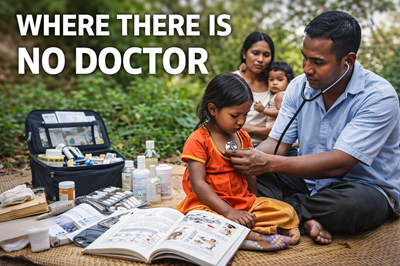
This publication, titled “Where There Is No Doctor”, is a comprehensive, field-tested medical handbook designed for situations where professional healthcare is unavailable or limited. Originally created for rural and remote communities, the book is built around a powerful idea: that ordinary people, with the right knowledge, can prevent and treat many common health problems themselves. As explained in the introduction (page 12), the goal is not to replace doctors entirely, but to empower individuals and communities to take responsibility for their own health and act effectively when help is far away.
The guide covers an incredibly wide range of topics, from basic hygiene and disease prevention to diagnosing illnesses and providing first aid. The table of contents (pages 5–11) shows how extensive it is—covering areas like nutrition, infections, wounds, childbirth, child health, and common diseases. It also includes practical instructions on examining a sick person, recognizing danger signs, and deciding when outside medical help is necessary. This makes it not just a reference book, but a step-by-step training manual for real-world situations.
A major strength of the book is its emphasis on prevention and community health, not just treatment. It explains how sanitation, clean water, proper nutrition, and education can prevent many of the most common causes of illness. For example, sections on cleanliness and disease prevention highlight how issues like diarrhea are often tied to poor sanitation and nutrition (page 21), showing that long-term health solutions require addressing root causes, not just symptoms.
The manual also provides detailed guidance on handling emergencies and medical situations in the field, including injuries, infections, and chronic conditions. Chapters on first aid (page 75 and beyond) include treating wounds, burns, fractures, poisoning, and more. It even covers advanced topics such as childbirth, infectious diseases, and the proper use of medicines, making it one of the most complete self-care medical guides available.
Another key theme is community involvement and knowledge sharing. As emphasized in the section for health workers (page 16), the book encourages teaching others, working together, and combining traditional knowledge with modern medical practices. It promotes the idea that health care is not just about individuals, but about building stronger, healthier communities through shared responsibility and cooperation.
Overall, this PDF is a foundational preparedness and survival resource, offering practical, real-world medical knowledge that can be applied in both everyday life and crisis situations. For preppers, homesteaders, and anyone focused on self-reliance, it serves as an essential guide to maintaining health and treating illness when access to modern healthcare systems is limited or unavailable.
Published by: Hesperian Health Guides
1919 Addison St., #304
Berkeley, California 94704 • USA
hesperian@hesperian.org • www.hesperian.org
Copyright © 1977, 1992, 2011 by Hesperian
First English edition: October 1977
Revised English edition: May 1992
Twelfth printing: October 2011
ISBN: 978-0-942364-15-6
© Prepping Communities. This content is for informational purposes only and not professional advice. Use at your own risk.
Terms | Privacy | Guidelines