
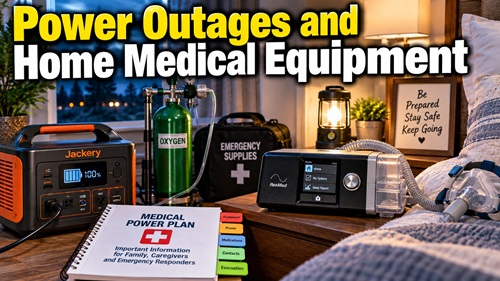
Planning for Extended Disruptions
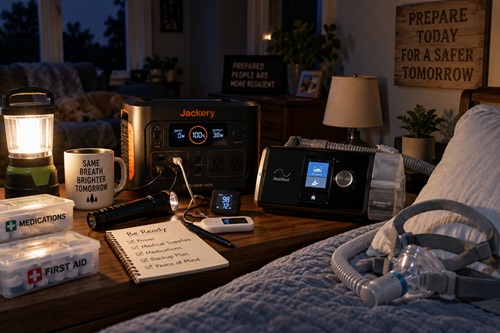
A power outage is inconvenient for most households. For someone who depends on electrically powered medical equipment, however, the same outage can become a medical emergency.
CPAP and BiPAP machines, oxygen concentrators, feeding pumps, suction equipment, nebulizers, powered mobility equipment, medication refrigerators, monitoring equipment, and other devices may depend on electricity every day. Some are needed only for several hours. Others may need to operate continuously. The preparedness challenge is therefore not simply finding a way to “keep the lights on.” It is maintaining essential medical care when the electrical system supporting that care disappears.
This distinction matters because many common outage preparations are designed around comfort. A household may have flashlights, a small power station, several extension cords, and perhaps a generator. That can be adequate for an ordinary blackout. Medical preparedness requires a different standard. The household needs to know exactly what must continue operating, how much electricity it requires, how long available backup systems can support it, what happens when those systems are exhausted, and at what point remaining in the home is no longer safe.
The objective is continuity of care.
Start With the Medical Need, Not the Generator
It is tempting to begin emergency-power planning by shopping for batteries, solar generators, or conventional generators. That reverses the process.
Start with the person.
Identify every medical device that could be affected by an outage and determine how important each device is to the person’s health. Some equipment may tolerate temporary interruptions. Other equipment may not. These decisions should be discussed with the person’s physician, respiratory therapist, pharmacist, home-care provider, or medical-equipment supplier before an emergency.
Create a written inventory containing the device name, model number, normal operating requirements, power supply, battery type, approximate battery runtime, charging requirements, manufacturer contact information, equipment supplier, and any medically approved alternative that could be used during an outage.
Do not assume that two devices performing similar functions have identical power requirements. The manufacturer’s specifications for the actual equipment being used should always be the starting point.
The household should also understand what happens when each device loses power. Does it simply shut off? Does it have an internal battery? Does it sound an alarm? Will it automatically restart when power returns? Does it lose its settings? Does someone need to manually restart it?
Those details become extremely important at 2:00 a.m. during a blackout.
Determine How Much Electricity You Actually Need
Backup-power planning becomes much easier once electricity is treated as something that can be measured.
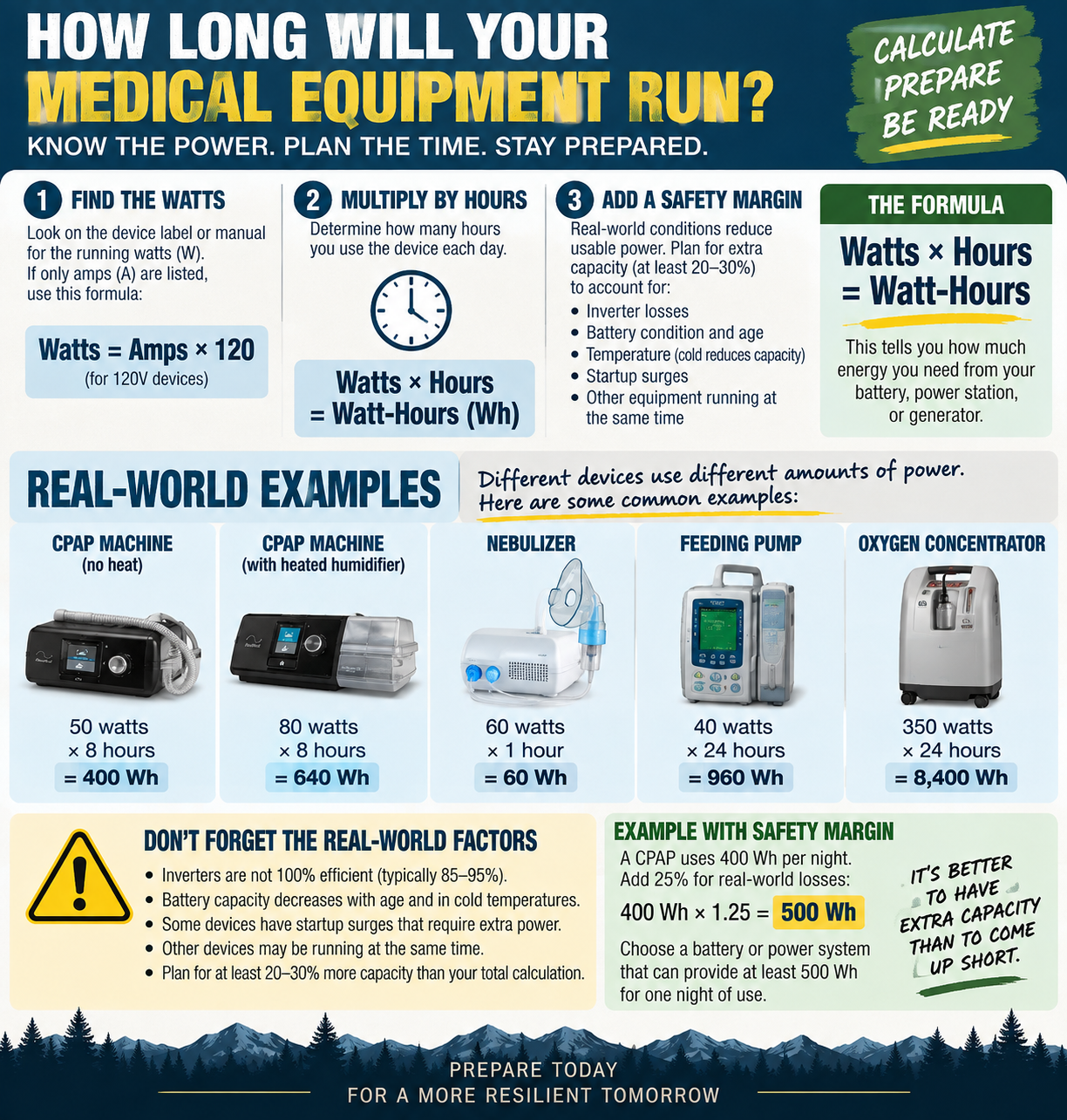
Electrical equipment generally lists its power requirements somewhere on the device or power adapter. The most useful measurement for outage planning is watt-hours because watt-hours describe how much energy the device consumes over time.
A simple estimate is:
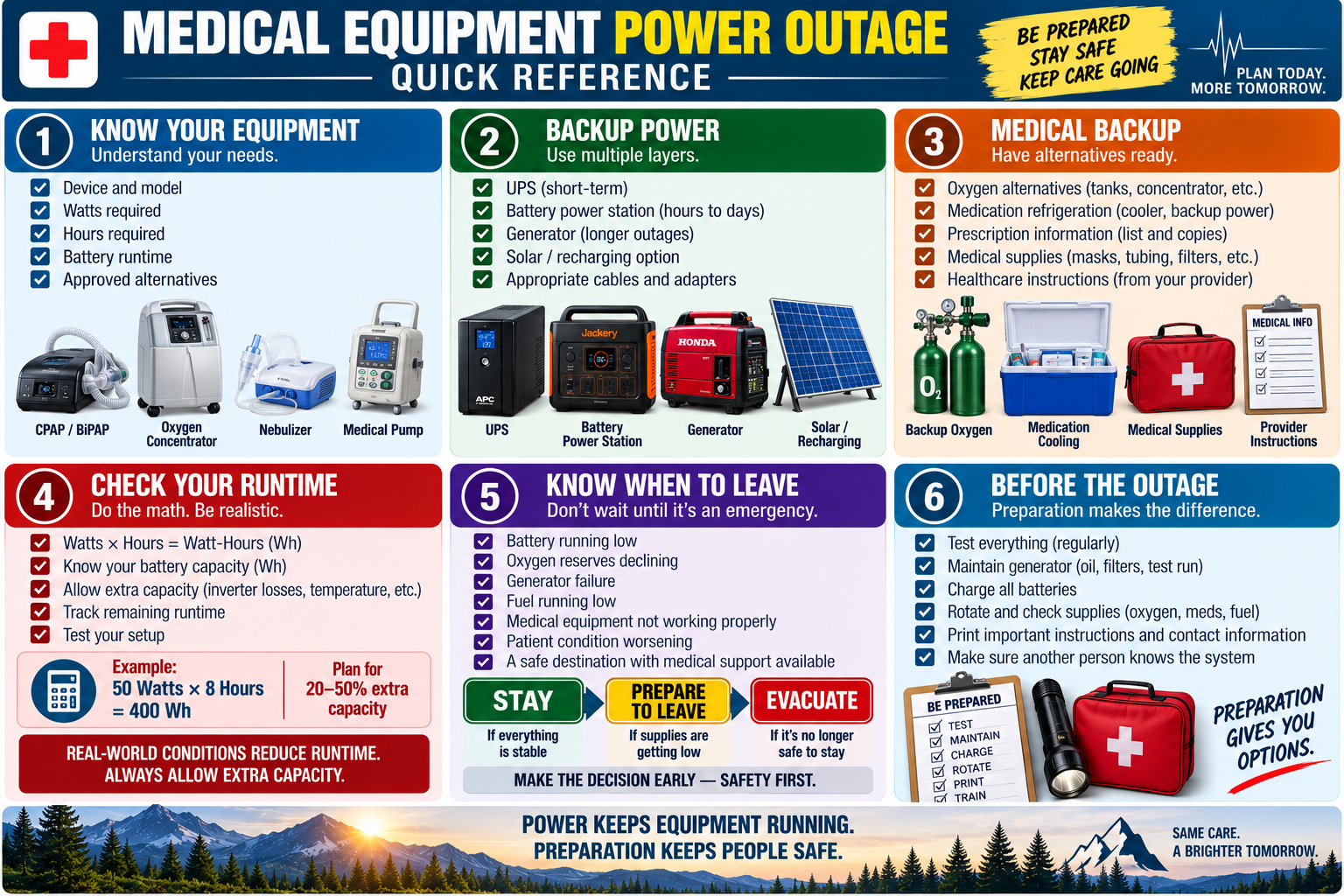
Watts × Hours of Operation = Watt-Hours Required
For example, suppose a medical device consumes approximately 50 watts and operates for eight hours.
50 watts × 8 hours = 400 watt-hours
That means the device theoretically requires about 400 watt-hours of energy for one night’s operation.
Real-world requirements will normally be higher because batteries, inverters, cables, chargers, and power supplies are not perfectly efficient. Battery capacity may also decline with age, temperature, and repeated use. A system that appears adequate on paper should therefore have additional capacity rather than being sized to the absolute minimum.
Continuous equipment creates a much larger challenge.
A device consuming 350 watts for 24 hours would theoretically require:
350 × 24 = 8,400 watt-hours
That is 8.4 kilowatt-hours every day.
Suddenly, a portable battery that looks enormous in a store may represent only a fraction of the energy required.
This is why every medically dependent household should perform its own calculation rather than relying on general statements such as “this power station will run a CPAP” or “this generator can handle medical equipment.”
The important question is not whether something can power the device.
The important question is:
How long can it power the device under realistic conditions?
Think in Layers
Medical backup power should not depend upon one piece of equipment.
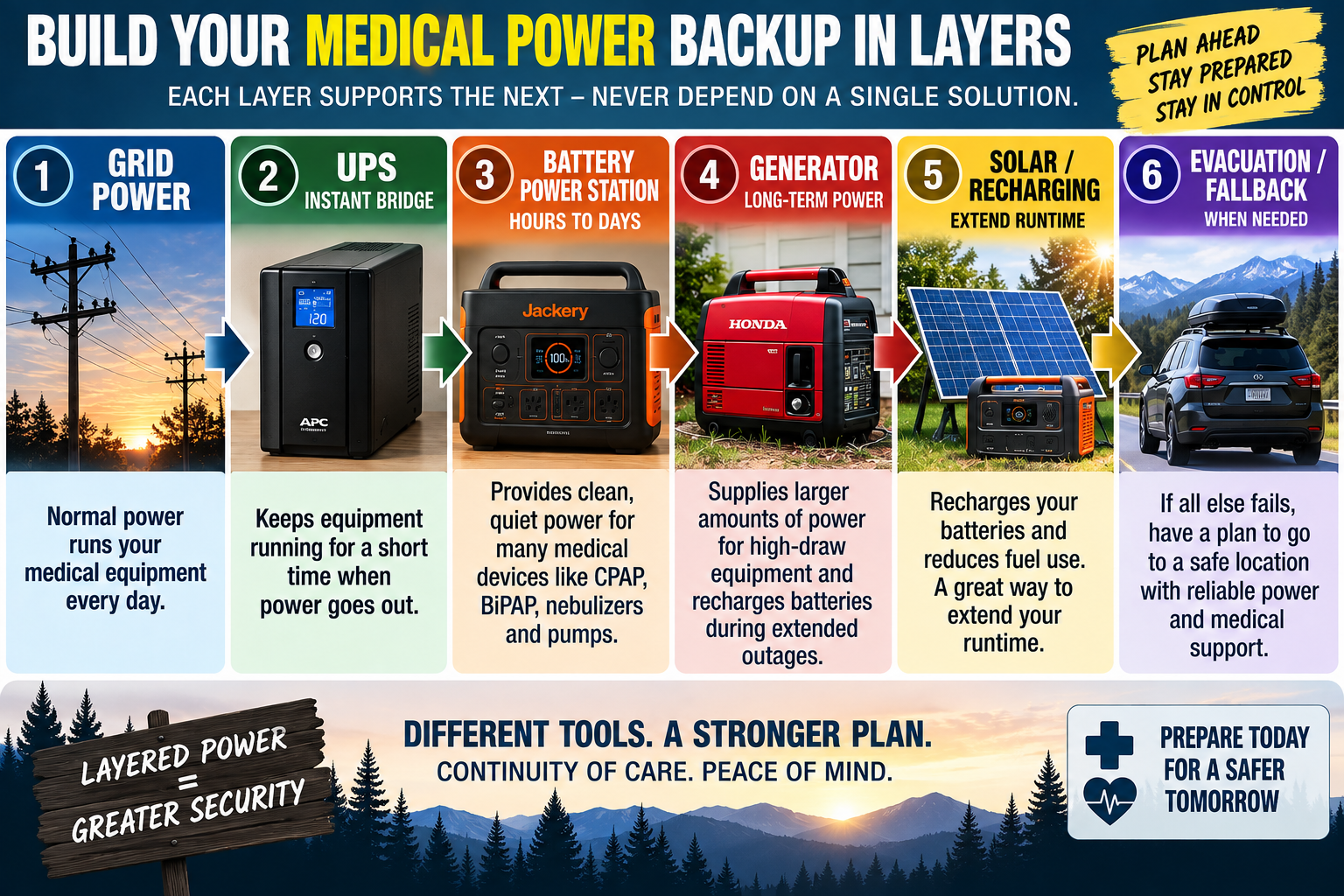
A stronger system uses several layers that cover different stages of an outage.
The first layer handles the instant electricity disappears. Certain medical devices should not suddenly lose power or reboot unexpectedly. Where appropriate for the equipment, an uninterruptible power supply, commonly called a UPS, can provide a short bridge between grid failure and the household’s primary backup system.
A UPS should generally be viewed as transition power rather than long-duration emergency power. Its job may simply be to keep equipment operating while someone wakes up, recognizes the outage, retrieves the larger battery system, or starts the generator.
The next layer may be a portable battery power station. These systems can be extremely useful because they operate silently, can be used indoors according to manufacturer instructions, require no fuel while discharging, and can provide immediate electricity.
Their limitation is stored energy.
Every watt-hour consumed has to eventually be replaced.
For lower-power equipment, a properly sized battery may provide many hours of operation. High-draw equipment operating continuously can exhaust even substantial battery systems surprisingly quickly.
That leads to the next layer: sustained power.
For longer outages, this may involve a generator, larger battery bank, solar charging system, vehicle-based charging capability, or some combination of these technologies.
The strongest preparedness system is usually not battery or generator.
It is battery and generator, with additional charging options where practical.
The battery provides quiet, immediate electricity. The generator provides larger amounts of energy and can recharge batteries. Solar may extend endurance when conditions allow. Each system compensates for weaknesses in another.
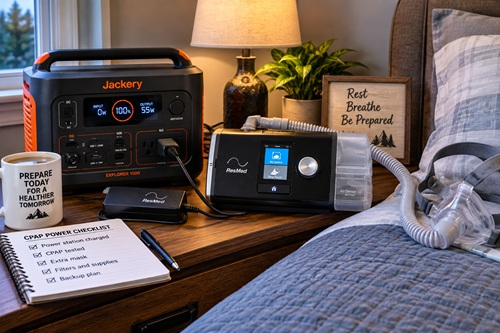
CPAP and BiPAP Planning
Sleep-related breathing equipment deserves particular attention because CPAP and BiPAP machines are common in homes.
The first step is determining the actual consumption of the specific machine.
Features such as heated humidification and heated tubing can significantly affect power consumption. A physician or equipment provider may be able to advise whether certain features can safely be disabled during an emergency to conserve energy. This should be determined beforehand rather than improvised during an outage.
Some machines can operate from DC power using manufacturer-approved adapters. Avoiding unnecessary conversion from battery DC to household AC and back again may improve efficiency, depending upon the equipment.
A household relying on CPAP or BiPAP should perform an overnight test of its backup system under safe, controlled conditions.
Charge the battery fully, operate the machine exactly as it would normally be used, and check the remaining capacity in the morning.
That real-world test is much more useful than a manufacturer’s theoretical runtime estimate.
Oxygen Concentrators Require Much More Planning
Home oxygen presents a different preparedness problem.
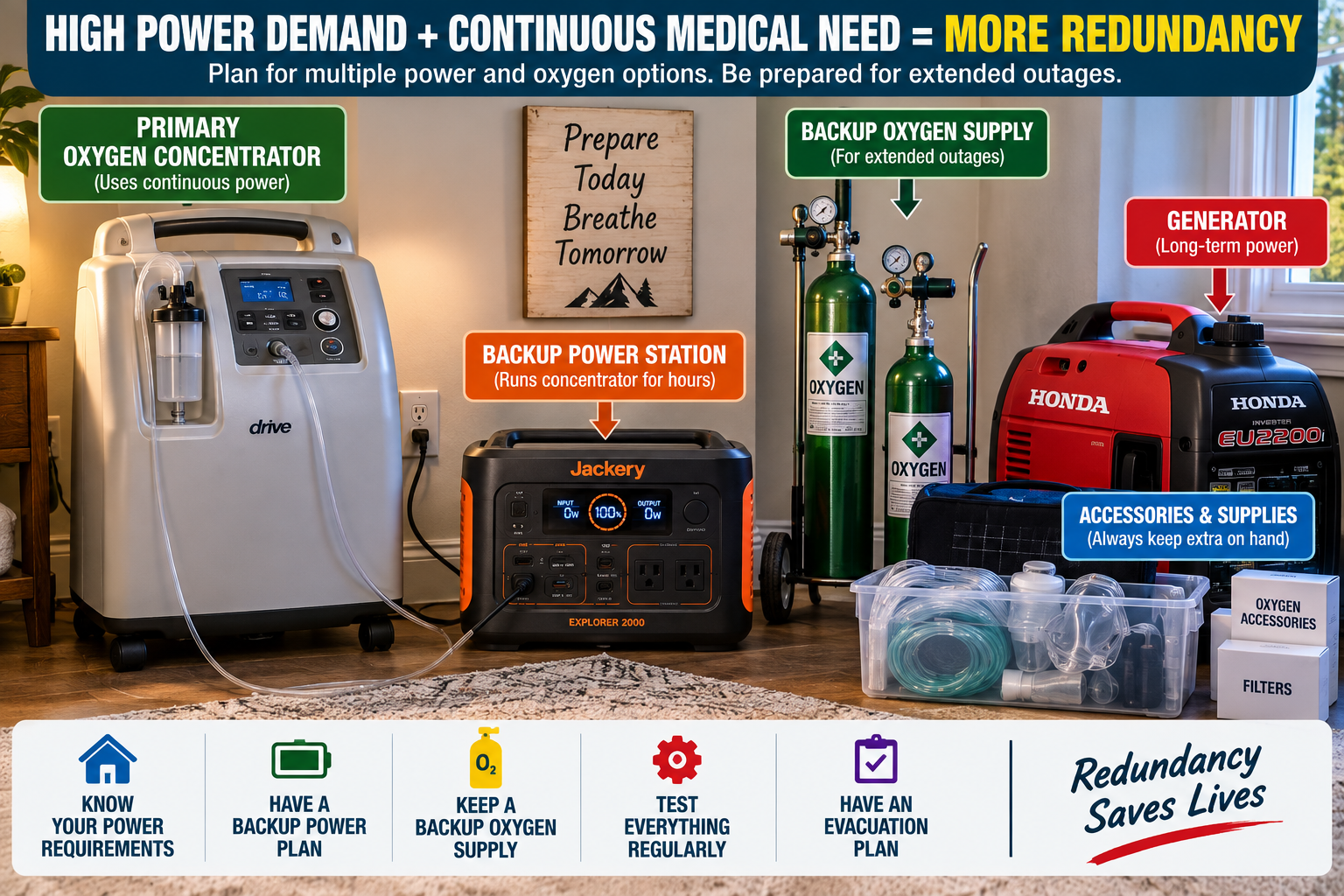
An oxygen concentrator does not merely consume electricity. It uses electricity to produce the oxygen supply itself. When electricity disappears, the patient’s oxygen-production capability may disappear with it.
Many concentrators also consume substantially more power than smaller medical devices and may operate continuously.
This makes relying exclusively on a portable power station potentially dangerous.
Households using oxygen concentrators should work with their oxygen supplier and healthcare provider to establish an outage plan. Depending upon the patient’s medical requirements, this might include approved backup oxygen cylinders, battery-powered equipment, alternative concentrators, evacuation arrangements, or other medically appropriate solutions.
The important preparedness principle is redundancy.
There should ideally be another medically approved way of maintaining the required oxygen supply if the primary concentrator or its power source becomes unavailable.
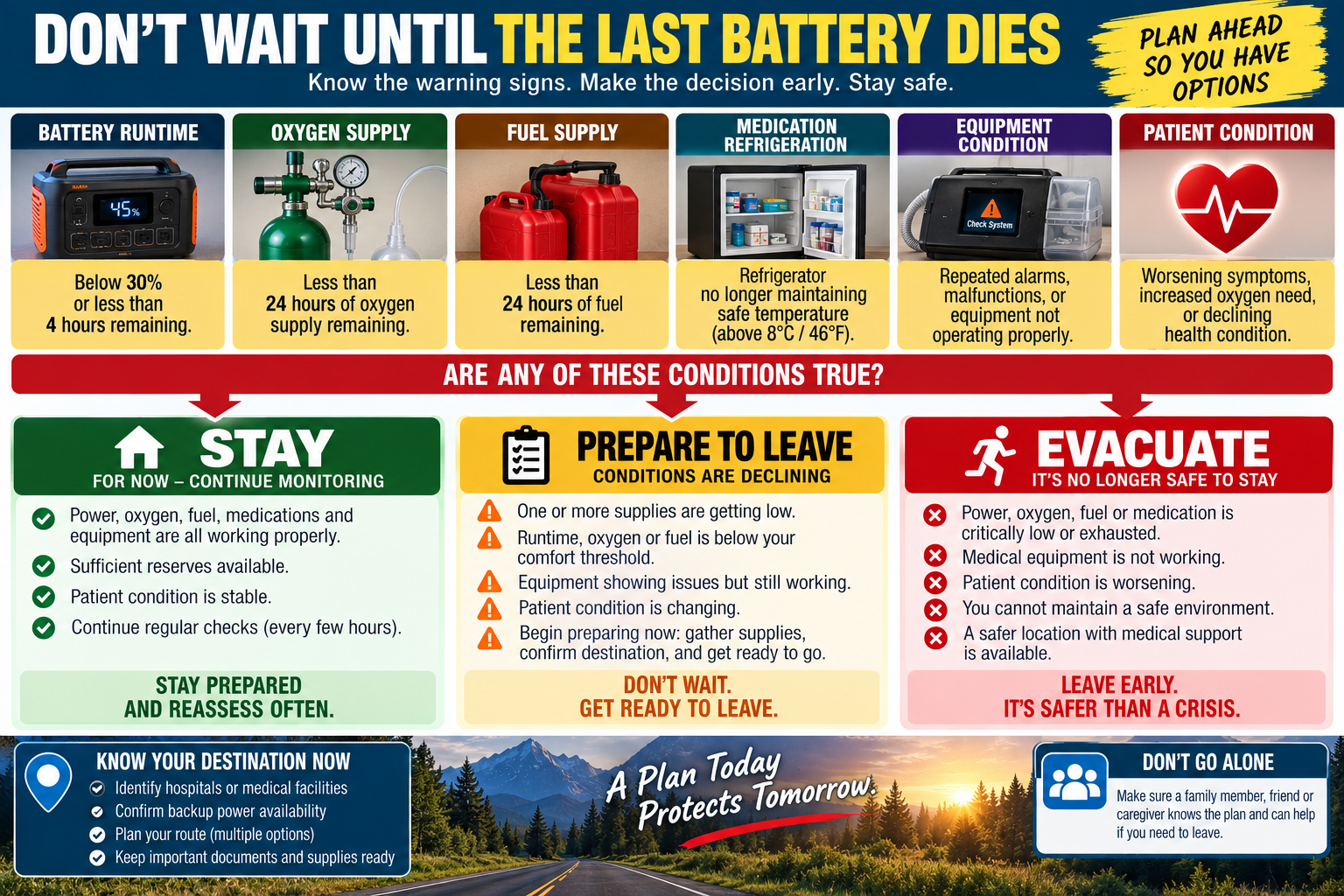
The amount of remaining oxygen should also become part of the household’s evacuation decision.
Do not wait until the last cylinder or final battery is nearly exhausted before deciding what to do.
Medication Can Depend on Electricity Too
Medical power preparedness extends beyond machines.
Some medications require temperature-controlled storage. An extended outage can therefore threaten medications even when the person does not use electrically powered medical equipment.
Know which household medications require refrigeration and what temperature range must be maintained. Obtain storage guidance from the pharmacist or manufacturer rather than guessing.
A refrigerator should normally remain closed as much as possible during an outage because every opening introduces warmer air.
For longer disruptions, a properly prepared cooler, monitored refrigeration system, generator-powered refrigerator, portable powered cooler, or other approved method may become necessary.
A thermometer is particularly valuable because “it still feels cold” does not tell you whether a medication remained within its required temperature range.
Medication preparedness should also include adequate legitimate supplies, copies of prescriptions where appropriate, pharmacy information, medication lists, allergies, dosages, physician contact information, and a plan for obtaining replacements if the local pharmacy cannot operate.
Generator Safety Becomes Medical Safety
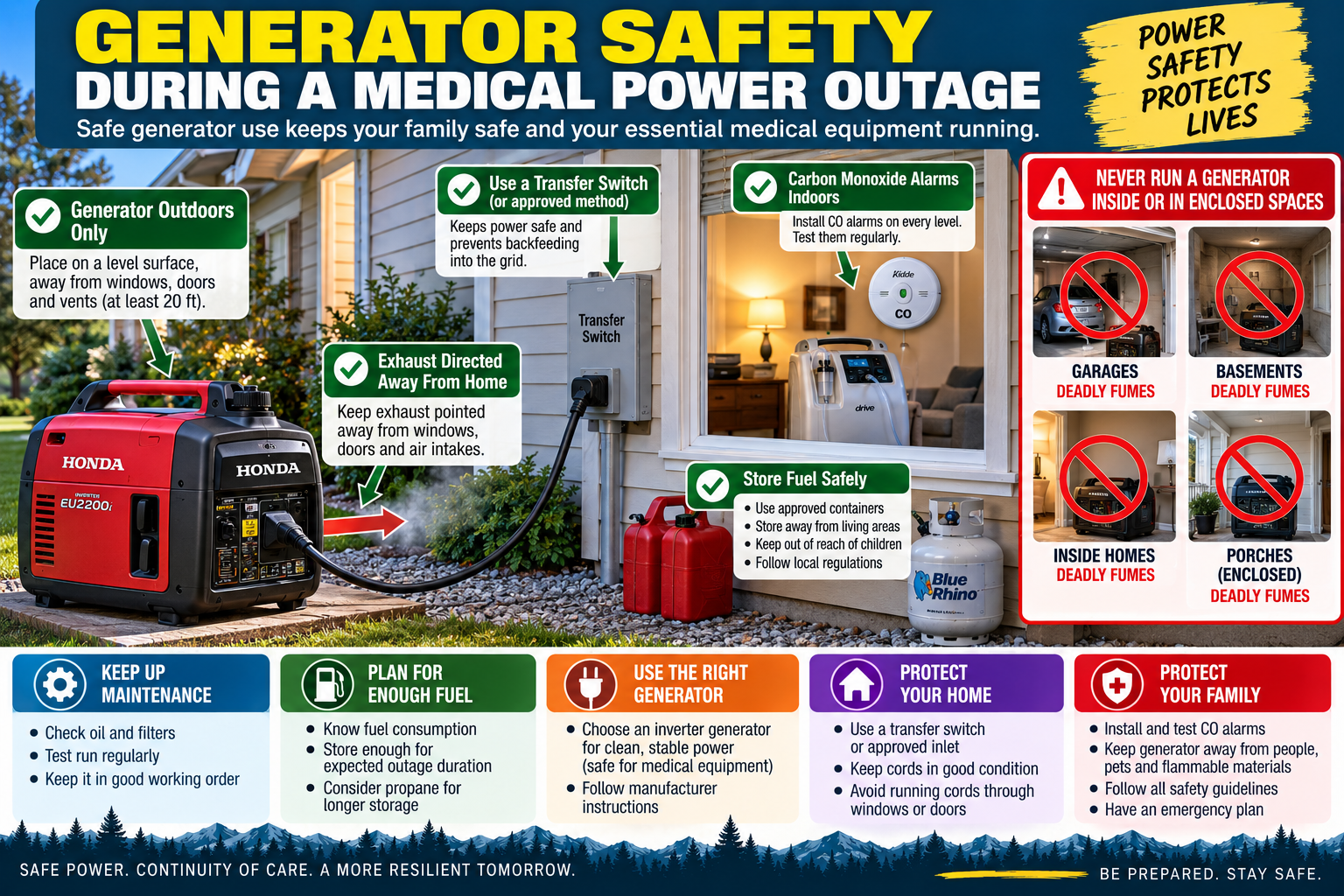
Generators can provide enormous value during extended outages, but they introduce their own hazards.
The most important is carbon monoxide.
A portable generator must never be operated inside a house, garage, basement, enclosed porch, or other unsafe enclosed or partially enclosed area. Follow manufacturer and public-safety guidance for safe outdoor placement, exhaust direction, electrical connection, and required distance from structures and openings.
Working carbon-monoxide alarms are an essential part of generator preparedness.
Fuel also becomes part of the medical-support system.
If a generator is necessary to operate critical medical equipment, running out of fuel is no longer merely inconvenient. Fuel availability directly affects continuity of care.
Determine the generator’s actual fuel consumption under realistic loads and calculate how much runtime the household can support.
Then test it.
Generators that sit unused for years cannot automatically be assumed to work during an emergency. Starting batteries discharge. Fuel deteriorates. Carburetors develop problems. Oil needs changing. Extension cords disappear. Connections corrode. People forget the startup procedure.
A medical backup generator should be treated more like emergency equipment than lawn equipment.
It needs inspection, testing, maintenance, fuel management, and a known operating procedure.
Pure Sine Wave Power and Sensitive Equipment
Medical devices contain electronics, motors, sensors, chargers, and control systems that may be sensitive to power quality.
When selecting battery inverters, UPS systems, or generators for medical equipment, determine what the device manufacturer recommends. Many modern backup systems provide pure sine wave AC output, which more closely resembles normal utility power.
Never assume that because a plug physically fits, the electrical source is appropriate for the medical device.
Check voltage, frequency, wattage, surge requirements, grounding requirements, inverter specifications, and manufacturer guidance.
If uncertainty exists, contact the medical-equipment supplier or manufacturer before connecting the device.
Solar Can Extend an Outage Plan, but It Is Not Guaranteed Power
Solar charging is valuable because it can replenish stored energy without consuming fuel.
But solar should be understood realistically.
Cloud cover, smoke, snow, shading, latitude, season, panel orientation, daylight hours, and temperature can dramatically change production.
A solar panel advertised at a particular wattage will not necessarily produce that amount continuously throughout the day.
Therefore, solar is best incorporated into a layered system rather than treated as guaranteed daily electricity.
During favorable conditions, solar may substantially reduce generator runtime and fuel consumption. During poor conditions, the household must still have another way to maintain critical medical loads.
Fuel Is Stored Runtime
If a generator forms part of the medical plan, fuel should be thought of as stored operating time.
Instead of asking, “How much gasoline should we have?” ask:
How many hours of medical support does this fuel provide?
Suppose testing shows that a generator consumes a certain amount of fuel while supporting the household’s critical loads and recharging batteries. That number can be converted directly into estimated operating hours.
This allows the household to manage fuel strategically.
It may not be necessary to operate a generator continuously. A carefully designed system may allow the generator to run periodically to operate larger loads and recharge batteries, while batteries provide quieter overnight power.
Any fuel storage must follow applicable fire codes, local regulations, manufacturer instructions, and safe-storage practices.
Know What Happens When the Backup Fails
Every backup system eventually has a limit.
Batteries become depleted.
Fuel runs out.
Generators fail.
Solar production drops.
Equipment breaks.
Roads become blocked.
That means a complete medical preparedness plan needs one additional layer:
What happens when the backup plan stops working?
For medically dependent households, this should include predetermined evacuation triggers.
A trigger could be based on remaining battery runtime, remaining oxygen supply, generator failure, fuel reserves, indoor temperature, medication refrigeration, worsening medical condition, or the estimated duration of the outage.
The specific trigger depends upon the patient’s medical situation and should be developed with appropriate healthcare professionals.
The important principle is deciding beforehand.
Emergency decision-making becomes much more difficult when someone is sick, the house is dark, communications are failing, and the family suddenly realizes there are only four hours of battery remaining.
Register for Utility Medical Programs, but Don’t Depend on Them
Some electrical utilities maintain programs for customers who rely on medically necessary electrical equipment.
These programs can be worthwhile. Depending upon the utility, they may provide outage notifications, emergency-planning information, or other assistance.
However, registration should never be mistaken for guaranteed electricity.
A storm, wildfire, earthquake, equipment failure, cyberattack, or major grid disruption may affect thousands of customers simultaneously. Even if a utility knows that someone in the home uses medical equipment, physical damage to transmission lines or local infrastructure may make rapid restoration impossible.
Register when an appropriate program exists.
Then prepare as though electricity may still remain unavailable.
Build a Medical Power Information Folder
An extended outage may occur when the person who normally understands the equipment isn’t home.
That creates another vulnerability.
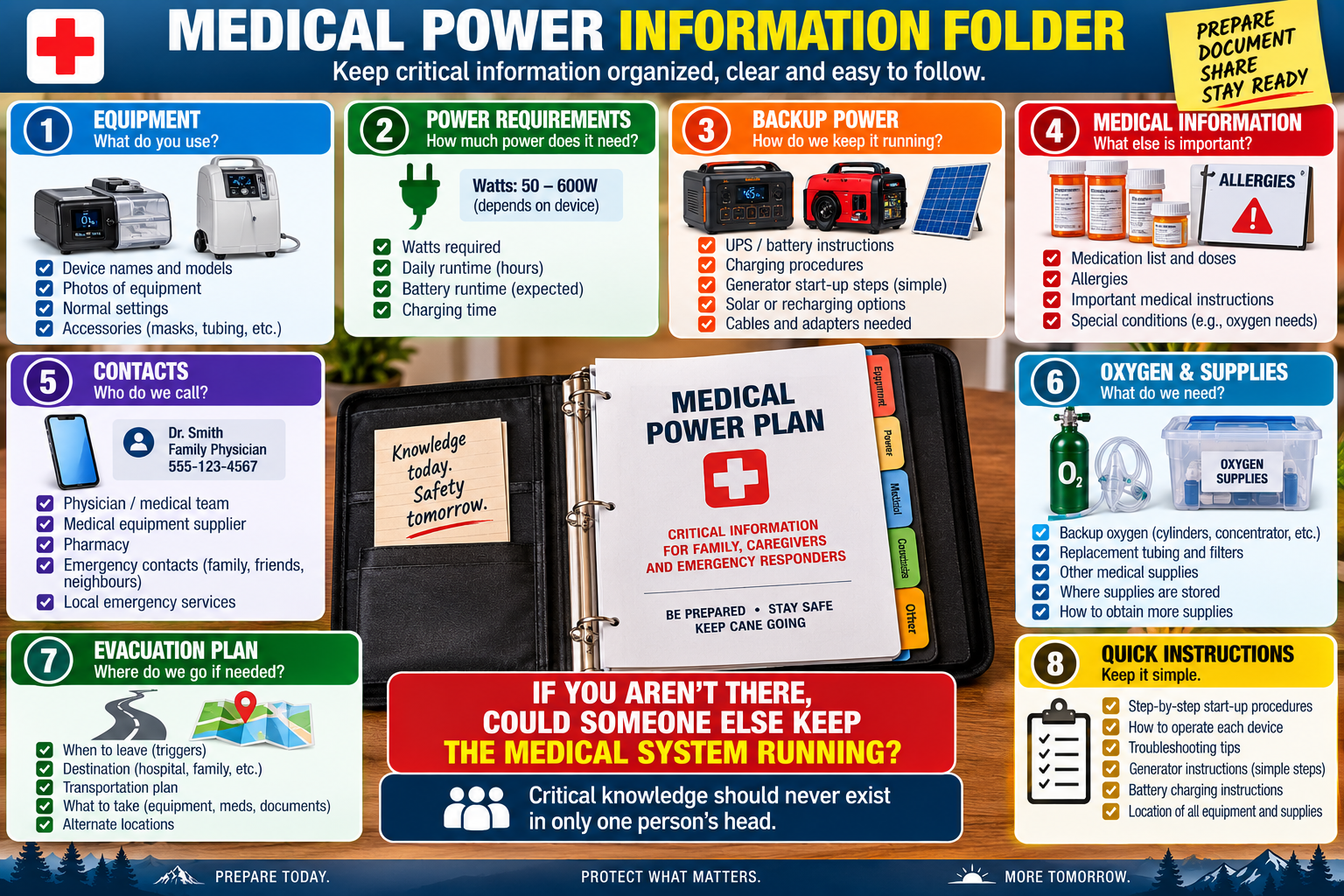
Create a printed medical-power folder that another family member, caregiver, neighbour, or responder could understand.
Include equipment names, photographs if useful, power requirements, battery information, charging instructions, generator procedures, emergency contacts, physician information, medical-equipment supplier numbers, medication information, allergies, evacuation destinations, and the location of backup supplies.
Instructions should be simple enough to follow under stress.
If starting the generator requires remembering twelve steps that only one person understands, the household does not have a resilient generator plan.
The same principle applies to batteries, oxygen cylinders, medication storage, and medical equipment.
Preparedness means transferring critical knowledge from someone’s memory into a form that remains available when that person cannot provide it.
Test the Entire System Before You Need It
Owning backup equipment is not the same as having backup capability.
Run a controlled outage exercise.
Turn off nonessential household electricity and operate the medical equipment from the planned backup system.
Measure battery consumption.
Start the generator.
Recharge the batteries.
Test extension cords and adapters.
Verify that the equipment operates correctly.
Check how long everything actually lasts.
Make sure another household member can perform the procedure.
The exercise may reveal problems that were invisible on paper: a missing adapter, an undersized inverter, a generator that will not start, unexpectedly high power consumption, a battery that has lost capacity, or an extension cord that cannot safely handle the load.
Finding these problems during an afternoon test is inconvenient.
Finding them during a three-day blackout can be dangerous.
Plan Beyond 72 Hours
Three days is a useful preparedness milestone, but it should not automatically be treated as the maximum duration of an outage.
Major storms, wildfires, earthquakes, floods, infrastructure failures, and widespread emergencies can disrupt electricity and transportation considerably longer.
Ask what changes on day four.
Then day seven.
What happens when stored fuel is depleted?
What happens when batteries cannot be recharged?
What happens if roads are blocked?
What happens if the pharmacy is closed?
What happens if the oxygen supplier cannot make deliveries?
What happens if the person maintaining the equipment becomes sick?
Long-duration preparedness exposes dependencies that short outage planning can hide.
The objective does not necessarily have to be remaining home indefinitely. In many cases, evacuation to somewhere with dependable electricity and medical support will be safer.
Preparedness provides enough margin to make that decision deliberately rather than being forced into it after every backup has already failed.
Preparedness Action Plan
Begin by identifying every electrically dependent medical need in the household. Record the actual equipment model, electrical requirements, operating schedule, battery capability, and medically acceptable alternatives.
Calculate approximate daily energy requirements and compare those requirements against the usable capacity of existing backup systems.
Develop multiple layers of backup rather than depending upon one battery or generator.
Discuss outage procedures with healthcare providers and equipment suppliers, particularly for oxygen, respiratory equipment, refrigerated medications, feeding equipment, and other medically important devices.
Establish safe generator procedures and maintain appropriate carbon-monoxide protection.
Determine how batteries will be recharged during a prolonged outage.
Create a printed medical-power information folder.
Establish clear evacuation triggers.
Finally, test the complete system under controlled conditions and repeat the exercise periodically.
A backup system that has never been tested is still an assumption.
Key Takeaways
A power outage becomes a fundamentally different emergency when someone depends upon electricity for medical care.
The most important preparation is not simply purchasing a generator or large battery. It is understanding the entire chain required to keep that person safe: the medical device, electricity consumption, batteries, charging capability, fuel, replacement supplies, medication storage, equipment knowledge, trained caregivers, communications, transportation, and access to professional medical care.
Build the system in layers so the failure of one component does not immediately eliminate medical capability.
Know exactly how much energy essential equipment consumes.
Maintain medically appropriate alternatives wherever possible.
Establish evacuation triggers before reserves become critically low.
Keep the necessary knowledge available in printed form.
And most importantly, test the plan.
During an extended outage, the household should not be discovering how its medical backup system works.
It should already know.
Disclaimer
This preparedness lesson is for general educational purposes and is not medical or electrical advice. Medical equipment, oxygen systems, medication storage, and individual medical requirements vary significantly. Consult qualified healthcare professionals, medical-equipment suppliers, manufacturers, electricians, utilities, and appropriate emergency authorities when developing a backup-power plan. Never alter prescribed treatment or medical-device settings without appropriate medical guidance. Always operate generators, batteries, fuels, oxygen systems, and electrical equipment according to manufacturer instructions and applicable safety requirements.
© Prepping Communities. This content is for informational purposes only and not professional advice. Use at your own risk.
Terms | Privacy | Guidelines