
An Amish-Inspired Recipe
Prepping Communities | Emergency Food Preparedness and Self-Sufficiency
A power outage doesn’t have to last very long before preparing meals becomes more complicated. The refrigerator begins warming, electric cooking appliances are unavailable, and families may need to conserve whatever fuel or backup electricity they have. During a longer disruption, even preparing breakfast can become a task that requires planning. This is where simple pantry ingredients can make a real difference.
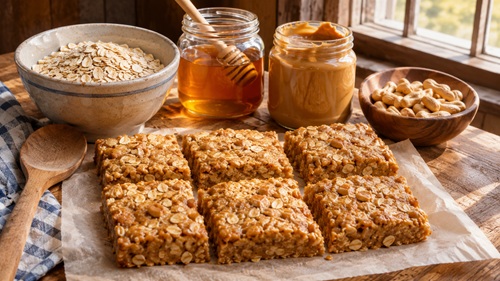
A household with rolled oats, peanut butter, honey, and nuts can prepare a substantial, calorie-dense food without using an oven, stovetop, or electric mixer. The ingredients are familiar, relatively inexpensive, and useful for preparing other meals as well. When combined into homemade energy bars, they provide a convenient way to supplement emergency food supplies without consuming cooking fuel.
Recipes sometimes promoted as forgotten Amish survival bars from the 1930s have attracted attention because they promise hundreds of calories per serving and often claim to last for years without refrigeration. Those claims deserve some caution. Although traditional Amish food preparation has long emphasized home-produced ingredients and established cooking practices, the historical origins of this particular survival bar recipe have not been verified. Research examining recipes published in the Amish magazine Family Life documents a tradition of home cooking and recipes shared among households, but it does not establish the origins of these modern survival bars.
The useful lesson isn’t that an old recipe has somehow solved the problem of emergency food storage. It’s that ordinary ingredients can be combined into practical food when modern conveniences are unavailable. Learning to make these bars also provides an opportunity to understand calorie requirements, ingredient versatility, safe storage, and the difference between having food available and having enough food to support a household through an extended emergency.
What Traditional Pantry Cooking Can Teach Modern Preppers
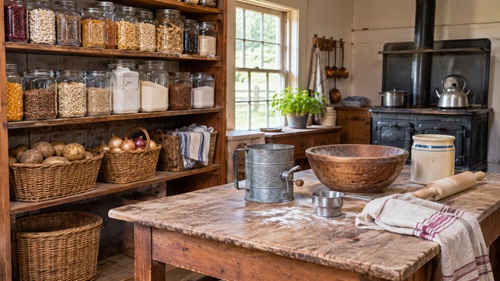
One of the most useful principles of traditional food preparation is keeping ingredients that can serve several purposes. Flour can become bread, biscuits, flatbread, or dumplings. Oats can be prepared as porridge, incorporated into baked foods, or combined with other ingredients to make energy bars. Dried beans, rice, and other grains can form the foundation of meals when fresh foods are difficult to obtain. This approach gives a household more flexibility than relying entirely on prepared meals that require refrigeration or particular cooking appliances.
Imagine two households experiencing a week-long power outage. Both have enough food stored, but one relies heavily on frozen convenience meals and electrically powered cooking equipment. The other has a mixture of canned foods, dry staples, ready-to-eat products, and ingredients that can be prepared in different ways. The first household may need to use considerable backup power or cooking fuel to make its food usable, while the second has more choices about what to prepare and when.
Neither household is automatically better prepared simply because of the foods it owns. The important difference is whether its food supplies match the equipment, water, and energy resources that will remain available during the disruption.
Traditional Amish households offer one example of food preparation organized around household production and practical skills. Historical accounts describe the importance of kitchens, pantries, seasonal preservation, and food prepared using manual or non-electric equipment. Amish practices have varied across communities and generations, however, and should not be treated as one universal method. For modern preppers, the principle worth adopting is straightforward: maintain versatile ingredients and learn how to use them under different circumstances.
Why High-Calorie Foods Matter During an Emergency

Emergency food planning often begins with a question about duration. Does the household have enough food for three days, one week, or two weeks? That is a useful starting point, but the number of packages in storage doesn’t reveal how much nourishment they actually provide.
During a prolonged emergency, ordinary activities may require more physical effort than usual. Carrying water, gathering firewood, clearing storm debris, moving supplies, or walking when transportation is unavailable can increase energy requirements. Cold conditions can add further demands, especially when people are working outdoors.
Food provides the energy needed for these activities, and calorie-dense ingredients are particularly useful when preparation time, storage space, or carrying capacity is limited. A homemade bar containing approximately 500 calories can provide a meaningful amount of energy in a relatively compact portion. It may be convenient during an evacuation, while working outdoors, or when preparing a complete meal is impractical.
However, calories are only part of the nutritional picture. A bar made from oats, peanut butter, honey, and nuts supplies carbohydrates, fats, and some protein, but it does not provide the full range of nutrients needed for sustained health. These bars are best treated as a supplement to other emergency foods rather than a complete meal replacement.
Choosing Ingredients That Serve More Than One Purpose
The ingredients in this recipe were selected because they are useful individually and work together without cooking. Rolled oats provide most of the structure. They contain carbohydrates, fiber, and some protein, and they can be used in many other recipes. Their versatility makes them a practical pantry staple, particularly when stored according to the manufacturer’s guidance.
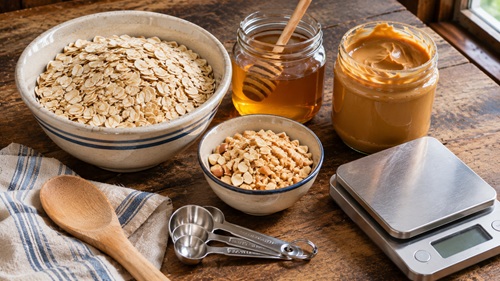
Peanut butter contributes concentrated calories from fats, along with protein. It also helps bind the oats together. Commercially prepared peanut butter is convenient because it has a relatively consistent texture, although different brands may contain different amounts of oil, sugar, and salt.
Honey provides sweetness and helps the mixture hold together. It also contributes carbohydrates that the body can use for energy. Although honey can have good keeping qualities when stored on its own, combining it with other ingredients produces a different food with different storage characteristics.
Chopped peanuts add texture and additional calories. Their fat content is useful nutritionally, but it also means they can become rancid during storage, particularly when exposed to heat, light, and oxygen.
A major advantage of these ingredients is that they do not have to be reserved exclusively for emergencies. They can be used in ordinary meals and replaced as needed, helping households maintain a rotating pantry rather than allowing food to sit untouched for years. This approach is particularly useful for families working within a limited preparedness budget. Money spent on versatile ingredients can support everyday meals while also contributing to emergency readiness.
Recipe: No-Bake Amish-Inspired Emergency Survival Bars
This original recipe is inspired by traditional pantry cooking rather than presented as an authenticated historical Amish preparation. It uses four main ingredients and requires no cooking. The finished bars are intended for short-term use, not as validated long-term shelf-stable rations.
Recipe Details
| Yield | 6 substantial bars |
| Estimated calories | Approximately 500 per bar |
| Preparation time | 15–20 minutes, plus optional chilling |
| Cooking required | None |
| Main equipment | Mixing bowl, spoon, scale, shallow container |
Ingredients
-
300 g rolled oats
-
200 g commercially prepared peanut butter
-
150 g honey
-
50 g chopped roasted peanuts
-
1 teaspoon ground cinnamon (optional)
- A small pinch of salt (optional)
Preparation Instructions
1. Prepare the ingredients. Wash your hands, clean the preparation surface, and measure the ingredients. A kitchen scale provides more consistent results than estimating quantities by eye.
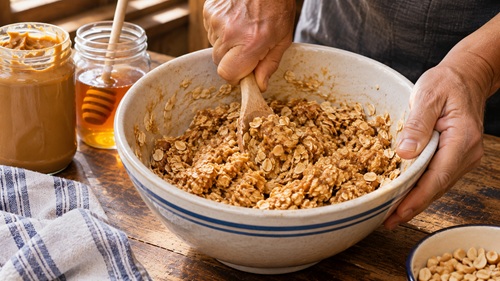
2. Combine the dry ingredients. Place the rolled oats, chopped peanuts, cinnamon, and salt into a large mixing bowl. Stir until evenly distributed.
3. Add the peanut butter and honey. Mix thoroughly with a sturdy spoon until the oats are evenly coated. The mixture should become thick and sticky enough to hold together when compressed.
4. Press into a container. Line a shallow food-safe container or baking dish with parchment paper. Transfer the mixture into the container and press firmly into an even layer. Compacting the ingredients helps prevent the bars from crumbling.
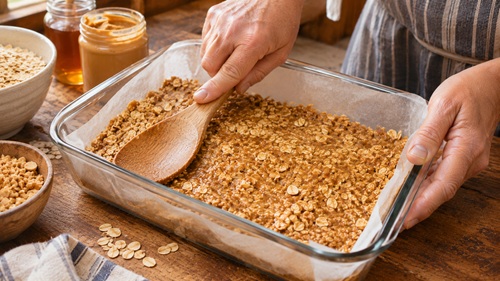
5. Allow the mixture to firm up. Cover and refrigerate until firm enough to cut neatly. If refrigeration is unavailable, the mixture can be formed into portions and eaten promptly, although the texture may be softer.
6. Divide into six portions. Cut the mixture into six approximately equal bars. Weighing the portions will help maintain a consistent calorie estimate.
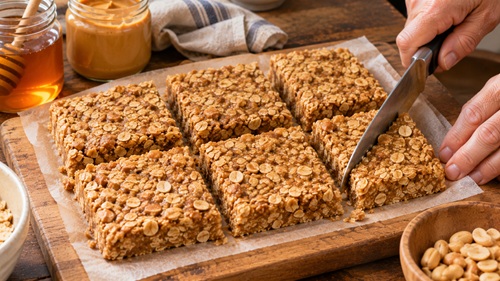
7. Package and label. Place the bars in clean food-safe containers or wrappers. Record the preparation date and ingredients, including peanuts, which are a major allergen.
Storage Guidance
Store the finished bars in a covered, food-safe container in the refrigerator and plan to consume them within one week. Comparable no-bake oat-and-peanut-butter recipes published by food and nutrition organizations recommend refrigerated storage for up to seven days.
For longer storage, individually wrap the bars and place them in suitable freezer-safe packaging. Comparable recipes provide freezing guidance, although the exact storage life of this particular formulation has not been scientifically established. These are conservative handling recommendations rather than a validated shelf life for this recipe.
If refrigeration is unavailable during a power outage, prepare only what can be eaten promptly using safe ingredients and clean equipment. Do not assume that vacuum sealing or airtight packaging will make the bars suitable for extended room-temperature storage.
For an example of storage guidance for a comparable recipe, see the Food Bank of Northern Nevada’s No-Bake Peanut Butter Oat Bars.
How Many Calories Does Each Bar Provide?
The recipe produces approximately 3,000 calories in total, depending on the brands and quantities used.
|
Ingredient |
Quantity |
Estimated calories |
|---|---|---|
| Rolled oats | 300 g | 1,137 |
| Peanut butter | 200 g | 1,196 |
| Honey | 150 g | 456 |
| Roasted peanuts | 50 g | 290 |
| Total | 700 g | 3,079 |
| Per bar (6 portions) | About 117 g | 513 |
These are approximate values based on representative nutritional information. Ingredient brands and varieties can differ, so the labels on the products actually used are the best starting point for a household calculation. The USDA FoodData Central database provides nutritional reference information for common foods and ingredients.
To calculate the calories in a homemade recipe, determine the energy provided by each ingredient, multiply by the amount used, and add the results together. Divide that total by the number of finished portions.
For example, if the complete mixture provides 3,079 calories and is divided into six equal bars:
If the same mixture is divided into twelve smaller bars, each portion provides approximately 257 calories. The total amount of energy hasn’t changed. Only the portion size has.
This distinction becomes important when preparing emergency food for several people. A household can have plenty of individually wrapped bars while still having far fewer total calories than expected.
What Twelve Emergency Bars Actually Provide for a Family
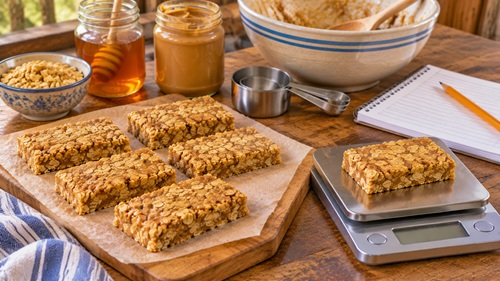
Consider a family of four preparing for a three-day disruption. They make twelve homemade bars containing approximately 500 calories each. The bars are easy to portion, require no cooking, and can be eaten without utensils. Together, those twelve bars provide approximately 6,000 calories.
If the family divides them equally over three days, each person receives one bar per day. That provides approximately 500 calories per person daily from the bars. For many adults, that would represent only a fraction of their daily energy requirements, so the family would need additional food to maintain adequate nourishment.
This doesn’t make the bars a poor emergency food choice. It simply clarifies their role. One bar might provide a convenient breakfast or a substantial snack while other stored foods supply the remainder of the day’s meals.
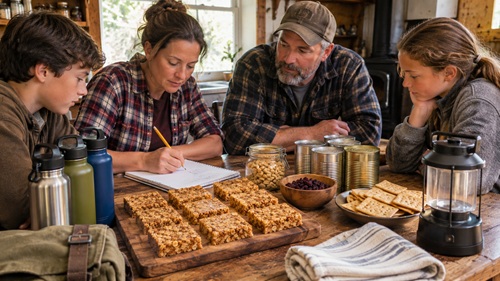
The same calculation can be applied to commercial emergency rations, canned foods, dried staples, and ready-to-eat meals. Counting packages is useful for inventory management, but calculating calories provides a clearer picture of how much energy is actually available.
Nutritional variety also matters. A household should consider protein sources, fruits and vegetables, essential nutrients, dietary restrictions, and the needs of children or people with medical conditions. The goal is to ensure that emergency supplies can support people adequately, not merely that there is something available to eat.
Preparing Food Without Using Backup Electricity
One practical advantage of homemade energy bars is that they can be prepared without consuming cooking fuel or electricity. During an extended outage, a household may be operating from a gasoline generator, propane generator, solar power system, or portable battery station. Each arrangement has limitations.
Fuel-powered generators depend on available fuel, while battery systems depend on stored energy and whatever charging arrangements remain functional. Solar charging can help replenish batteries, but actual production varies with weather, season, and equipment.
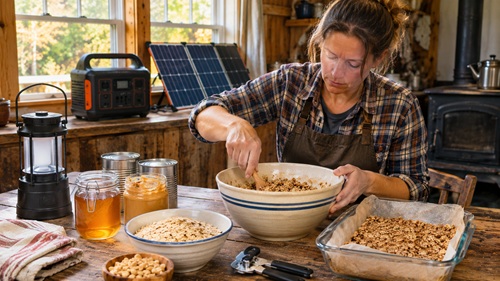
Cooking appliances can consume substantial amounts of electricity. When backup power is limited, families may prefer to reserve it for refrigeration, communication equipment, water pumps, lighting, or other essential needs. A no-bake recipe avoids that particular demand and allows the household to conserve its available energy for more critical functions.
However, preparing food without electricity still requires some basic resources. Clean utensils and food-safe preparation surfaces remain necessary. If the household’s water supply has been interrupted, safe water may need to be reserved for essential hygiene and cleaning.
Temperature can also affect the preparation process. Peanut butter may become firmer in a cold kitchen, making the mixture harder to combine. In warm conditions, the bars may soften and become sticky. These details are easy to manage under ordinary circumstances, but they become more noticeable when the household is operating without normal conveniences. Practicing the recipe ahead of time helps establish whether it can be prepared comfortably with the equipment and ingredients already available.
Can Homemade Survival Bars Be Stored for Months or Years?
One of the most common misconceptions about homemade survival food is that ingredients with a relatively long storage life automatically produce a finished product with the same characteristics. That isn’t necessarily true.
The safety and keeping quality of a finished food depend on several factors, including its ingredients, available moisture, acidity, preparation method, packaging, and storage conditions.
Food scientists use the term water activity to describe the water available for microbial growth. It is different from simply measuring how much water a food contains. A product can appear dry while still requiring careful evaluation before being considered suitable for unrefrigerated storage.
Fats introduce another concern. Peanuts and peanut butter contain oils that can oxidize over time, leading to rancidity and declining food quality. Packaging can help reduce exposure to moisture, oxygen, and contamination, but vacuum sealing or using oxygen absorbers does not automatically make an unvalidated homemade food safe for long-term storage.
The USDA describes shelf-stable foods as products that can safely be stored at room temperature. Many commercially processed foods meet this description because their ingredients and processing methods support that use. A homemade recipe should not be assumed to have equivalent characteristics without appropriate evaluation. For additional guidance, see USDA Food Safety and Inspection Service — What Does Shelf Stable Mean?.
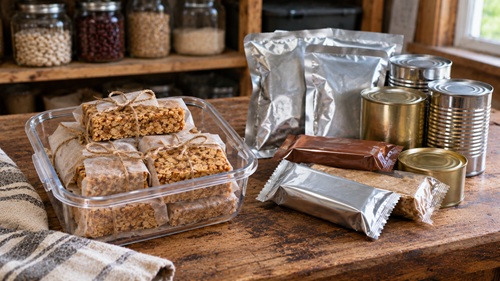
For emergency food expected to remain stored for months or years, commercially packaged products with documented shelf lives are generally a more dependable choice. Homemade bars remain useful for short-term needs, but they should be used within their limitations rather than relying on unverified storage claims.
Building an Emergency Pantry That Works When the Power Is Out
A dependable emergency pantry should contain foods that can be prepared under different conditions. During the first day of an outage, a household may still have refrigerated foods that need to be used while they remain safe. If the disruption continues, shelf-stable products become increasingly important.
Canned beans, fish, vegetables, fruit, and other ready-to-eat foods can contribute nutrients without requiring extensive preparation. Crackers, appropriately packaged nut butters, dried fruit, and commercially manufactured snack bars provide additional choices.
Dry staples such as rice, pasta, oats, and beans can support larger meals, but they require suitable water and cooking arrangements. This is where planning becomes important. A family may have enough dry food to last several weeks but discover that preparing it requires more cooking fuel or water than expected.
A useful emergency food inventory should therefore consider not only what foods are available but also what is needed to make them usable.
For households in different parts of the world, food choices will naturally vary. Oats and peanut butter may be common in some regions, while other grains, nut or seed products, and locally available staples may be more practical elsewhere. The principle remains the same: choose foods that are familiar, suitable for the household, and usable with the resources likely to be available during a disruption.
Practicing the Recipe as a Preparedness Exercise
Making these bars is a useful opportunity to test more than a recipe. Choose a day when the kitchen is functioning normally, but deliberately avoid using powered equipment. Measure the ingredients, mix everything by hand, and form the bars using basic utensils.
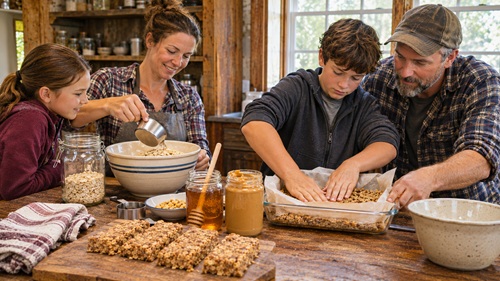
Pay attention to how easily the ingredients combine. The mixture may initially appear too dry, but continued stirring and firm compression can help it hold together. If the bars crumble, check whether the ingredients were measured accurately and whether the mixture was pressed firmly enough.
Once prepared, have household members try the bars. Consider whether the portions are too large, whether the texture is comfortable to eat, and whether the flavor would remain appealing if the bars were eaten during a stressful situation. A food that looks practical on paper may be less useful if family members dislike it or have difficulty eating it.
Record the ingredient quantities and calorie calculations so the recipe can be repeated consistently. If ingredients are changed, recalculate the nutritional values rather than assuming the result will remain the same.
The exercise also provides an opportunity to examine the household’s emergency food arrangements. Are the ingredients easy to locate? Are manual preparation tools available? Is there a safe water supply for cleaning? Would the recipe still be practical if the kitchen were cold or lighting were limited? These are small questions, but they can reveal weaknesses that would otherwise remain unnoticed until an emergency occurs.
Preparedness Action Plan
Begin by reviewing the foods already included in your emergency supplies. Identify which products can be eaten without cooking and which depend on electricity, refrigeration, water, or cooking fuel. Consider what would remain available during an extended disruption and whether those foods would provide adequate nourishment for everyone in the household.
Prepare a small batch of Amish-inspired emergency bars using the recipe provided. Measure the ingredients, calculate the total calories, and divide the mixture into consistent portions. Keep the finished bars under appropriate storage conditions and use them as short-term food rather than assuming they can remain safely stored at room temperature for extended periods.
Ask household members to evaluate the finished bars. Consider their taste, texture, portion size, and suitability for different ages and dietary requirements. Record any changes to the recipe and adjust the calorie calculations accordingly.
Next, calculate the approximate calories available in the household’s entire emergency food supply. Compare the results with realistic needs for three days, seven days, and fourteen days. Include nutritional variety and individual dietary requirements rather than relying on calorie totals alone.
Examine where emergency foods are stored. Supplies kept in vehicles, garages, sheds, or other locations exposed to extreme temperatures may require different products or more frequent replacement. Follow manufacturer storage guidance and maintain a practical rotation schedule.
For emergency bags and long-term reserves, prioritize appropriately packaged shelf-stable foods with documented storage instructions. Keep versatile pantry ingredients available for preparing additional food when conditions permit.
Finally, practice preparing several meals or substantial snacks without electricity. Knowing how to use ordinary ingredients with manual equipment can make the household more adaptable when normal cooking arrangements are unavailable.
Key Takeaways
Homemade Amish-inspired survival bars demonstrate how ordinary pantry ingredients can be turned into compact, calorie-dense food without electricity. Oats, peanut butter, honey, and nuts can be combined with basic kitchen equipment to make substantial portions suitable for short-term use.
The recipe produces approximately six bars containing around 500 calories each, depending on the ingredients and portion sizes. Calculating those calories helps households understand how much energy their food supplies genuinely provide.
The most important distinction is between food that requires no cooking and food that is safe for long-term storage. Homemade bars should not be assumed to last for months or years at room temperature simply because their individual ingredients are commonly stored in pantries.
Commercially packaged emergency foods with documented shelf lives are generally more dependable for supplies that may remain stored for extended periods.
Traditional approaches to pantry cooking offer valuable lessons in ingredient versatility, practical skills, and reducing dependence on modern conveniences. Those lessons become more useful when combined with current food-safety knowledge and realistic emergency planning.
The real value of learning to make emergency food isn’t finding one recipe that promises to solve every problem. It’s developing the ability to work with available ingredients, understand their nutritional contribution, and keep a household fed when ordinary cooking, shopping, and refrigeration are disrupted.
© Prepping Communities. This content is for informational purposes only and not professional advice. Use at your own risk.
Terms | Privacy | Guidelines