
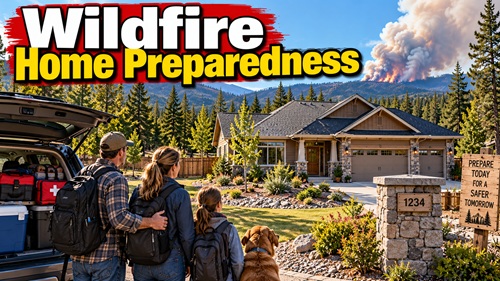
How to Protect Your Home Before a Fire Arrives
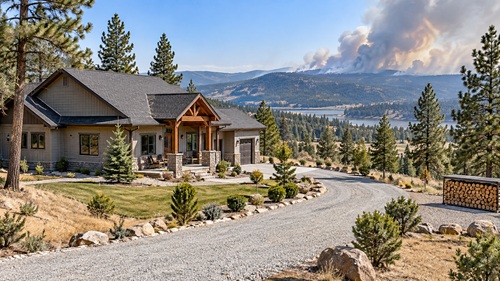
Wildfires are different from many emergencies because the threat can begin far away while the danger to your home develops very quickly. A fire does not have to reach your property for your house to be at risk. Wind can carry burning embers far ahead of the main fire, depositing them on roofs, decks, landscaping, firewood, outdoor furniture, and other combustible materials. This means wildfire preparedness is not simply about cutting down trees or keeping a garden hose nearby. It is about understanding how a home can ignite and then reducing as many of those ignition opportunities as possible before the fire ever gets close.
A well-prepared property may still be exposed to extreme wildfire conditions, and no amount of preparation can guarantee that a structure will survive. However, homeowners can improve the odds by reducing combustible material around the house, hardening vulnerable parts of the building, maintaining defensible space, protecting critical utilities, and preparing a reliable evacuation plan. The central principle is simple: do the work before the fire forces you to make decisions under pressure.
Understand How Wildfires Threaten a Home
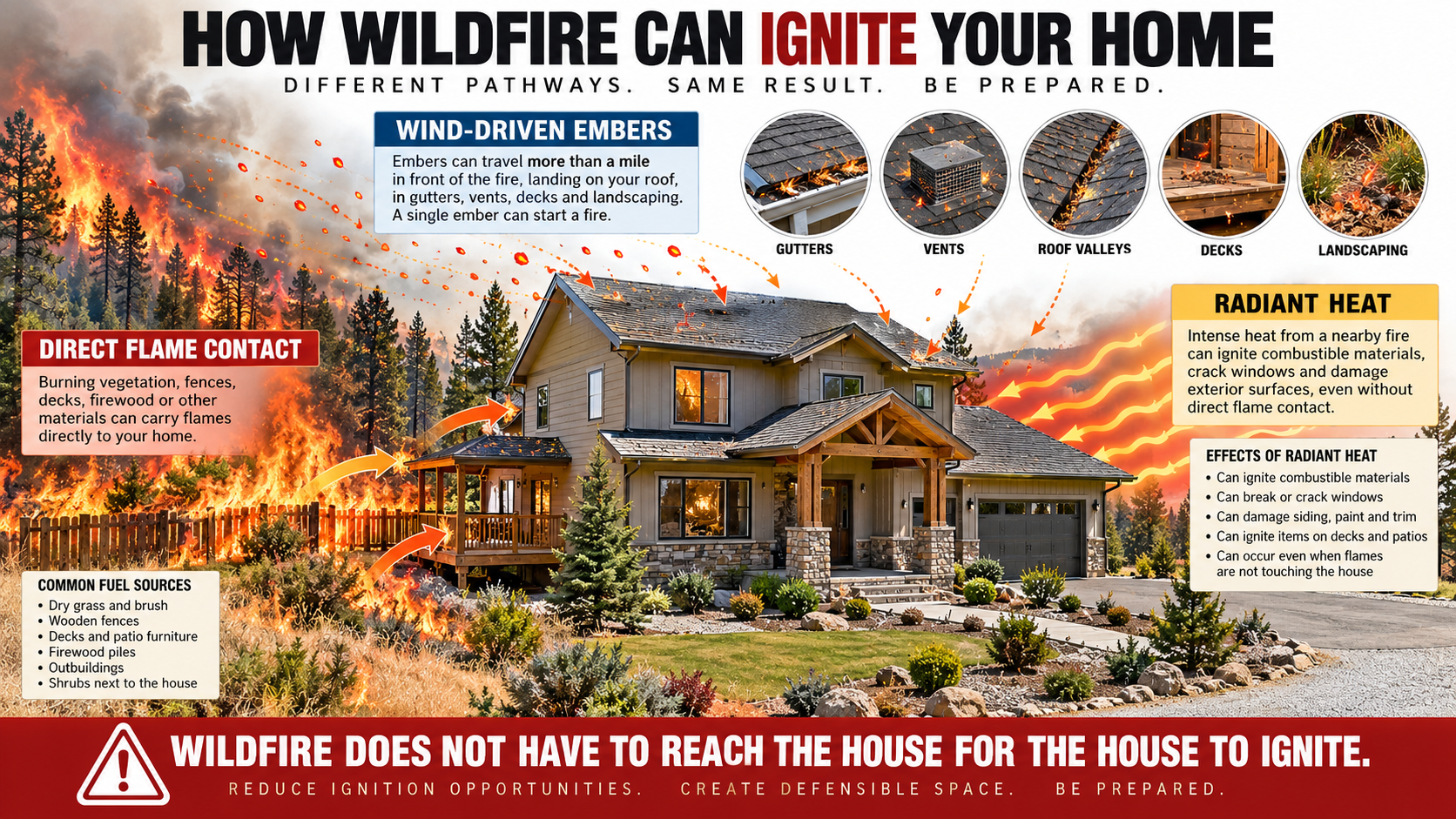
One of the most important lessons in wildfire preparedness is that the wall of flame shown in dramatic wildfire footage is only part of the threat. A home can be damaged or destroyed by direct flame contact, intense radiant heat, or wind-driven embers. Direct flame contact occurs when burning vegetation, fences, decks, sheds, firewood, or other materials allow flames to physically reach the structure. Radiant heat can damage windows and heat combustible materials enough to ignite them even without direct contact. Embers can be even more deceptive because they may travel ahead of the main fire and settle in places that appear harmless, such as gutters, roof valleys, decks, attic vents, mulch beds, or piles of dry leaves.
This changes how a homeowner should think about wildfire defense. The goal is not to create an imaginary barrier that no wildfire can cross. The more realistic goal is to make it as difficult as possible for fire to find an easy pathway into the home. A house surrounded by unmanaged fuels and combustible materials presents many opportunities for ignition. A house that has been cleaned, maintained, hardened, and surrounded by well-managed space presents fewer. Wildfire preparedness is therefore about breaking the chain of ignition one weak point at a time.
Start With the Home Itself
Wildfire preparation should begin at the structure and work outward. This may seem counterintuitive because most people first look at the forest, brush, or grass surrounding the property. However, clearing land farther away provides limited benefit if embers can easily enter an attic, ignite debris in the gutters, or land in combustible material piled directly against the siding.
A useful exercise is to walk slowly around the home and look at it from the perspective of a burning ember. Examine the roof, gutters, vents, windows, decks, stairs, porches, fences, sheds, and utility areas. Look closely at corners where leaves collect, spaces underneath decks where storage may accumulate, areas where vegetation touches the building, and places where wooden fencing connects directly to the structure. These small details matter because wildfires often exploit vulnerabilities that homeowners overlook during normal property maintenance.
Keep the Roof Clean and Maintain It
The roof is one of the largest surfaces exposed to falling embers, which makes regular roof maintenance an important part of wildfire preparation. Leaves, pine needles, twigs, moss, and other debris can collect in roof valleys, behind chimneys, around skylights, and inside gutters. During hot and dry weather, these materials can become excellent tinder.
Clean the roof and gutters regularly during wildfire season, especially if trees overhang the home. At the same time, inspect for damaged or missing shingles, loose tiles, deteriorated flashing, and other gaps that may allow embers to reach combustible materials underneath. If a roof eventually requires replacement, wildfire resistance should be considered alongside cost, weather resistance, durability, and local building requirements. Roof maintenance may appear routine, but during wildfire conditions it becomes part of the home’s fire-defense system.
Pay Particular Attention to Vents
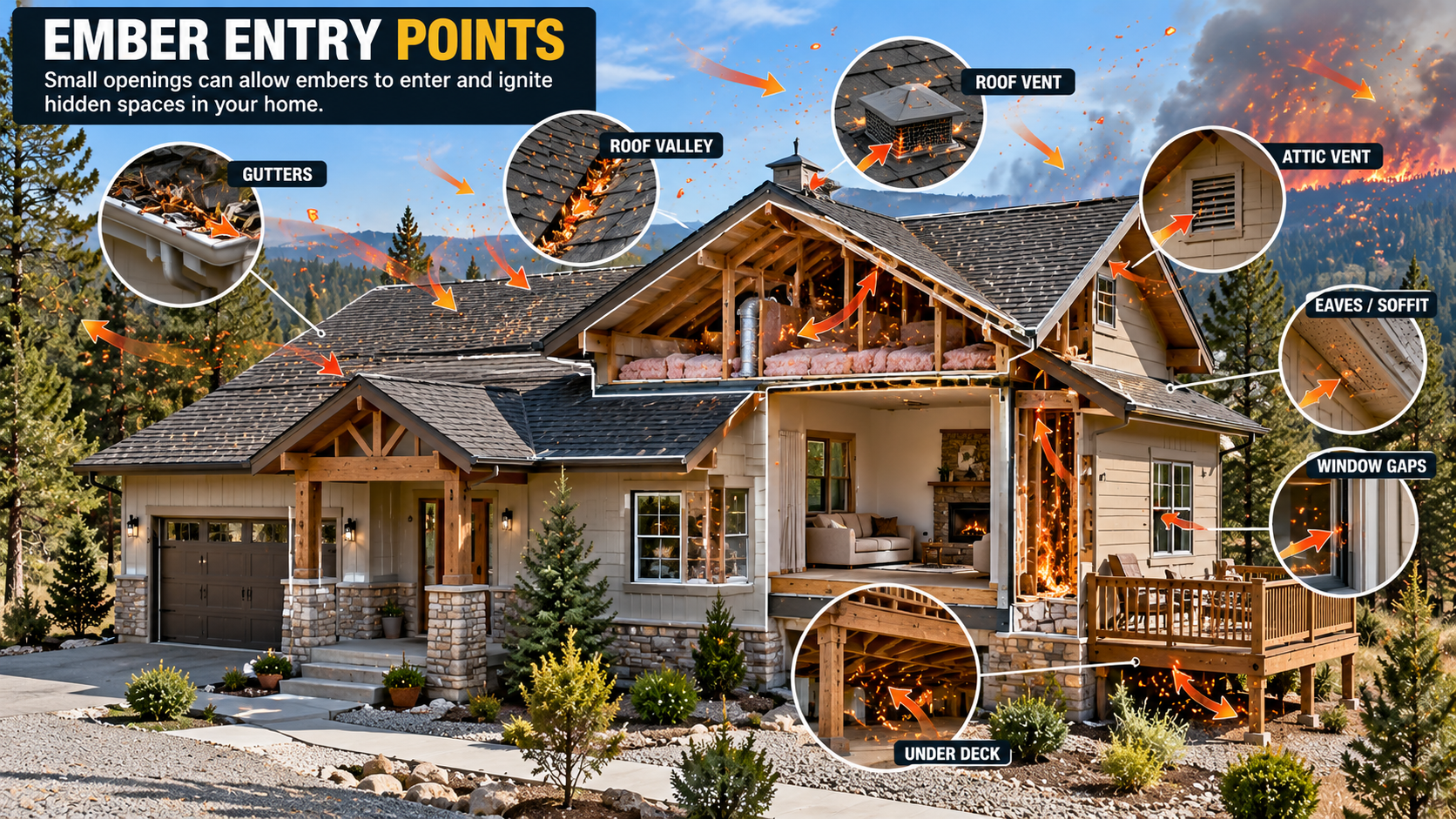
A house requires ventilation, but vents can also provide a pathway for embers to enter concealed spaces. Attics, eaves, and crawl spaces can contain dry wood, insulation, dust, stored materials, and other combustible components. If embers enter one of these spaces and ignite something inside, the fire may become established before anyone realizes what is happening.
Exterior vents should be checked for damaged screens, open gaps, debris, and other conditions that could make ember entry easier. Ember-resistant vent designs and fine metal screening may help when they are suitable for the structure and consistent with local building requirements. However, ventilation openings should not simply be blocked without proper guidance because doing so may create moisture, equipment, or building-code problems. The goal is to reduce ember entry without creating another hazard.
Create a Low-Combustibility Area Immediately Around the House
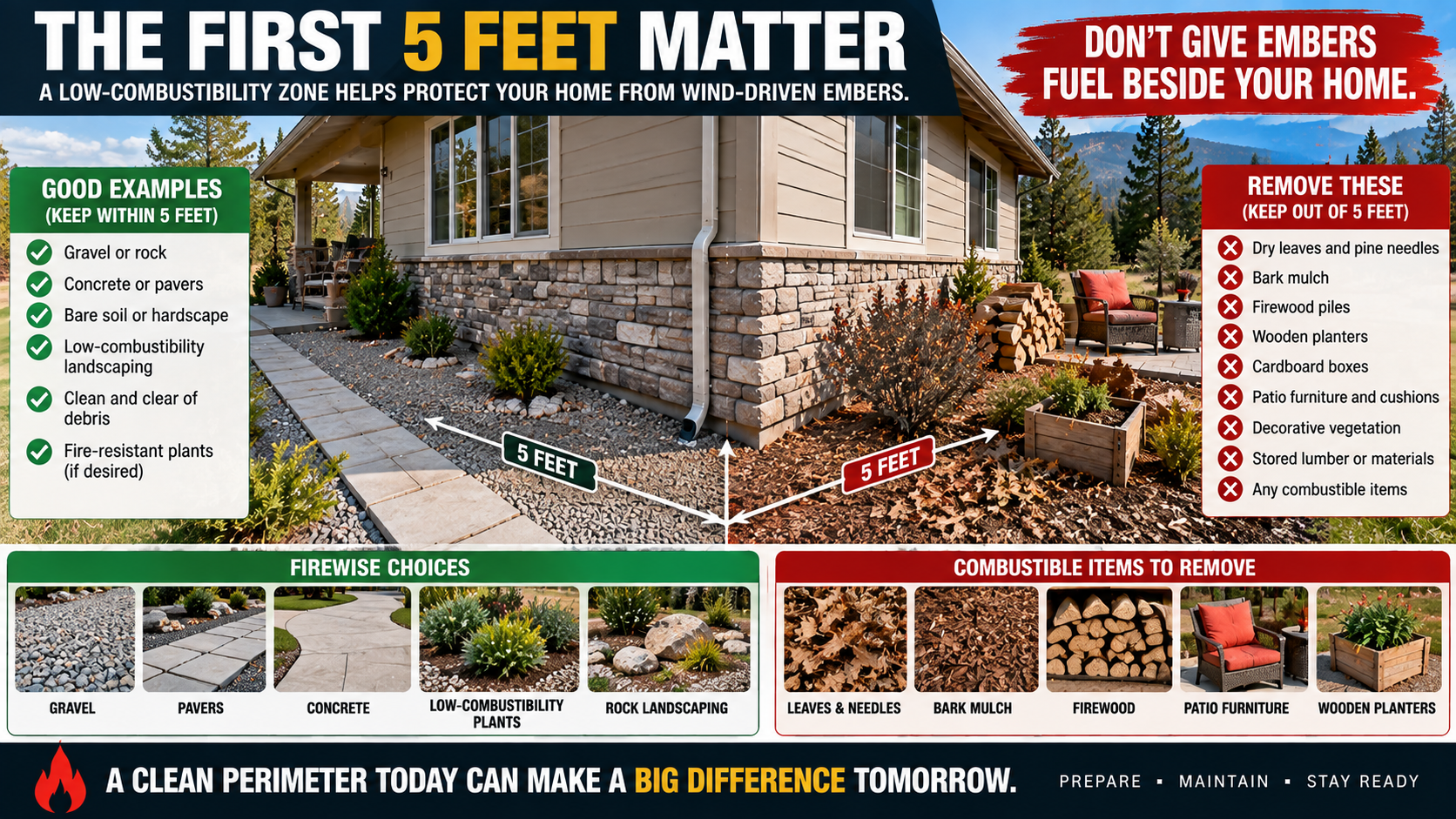
The first few feet around the structure deserve special attention because combustible material in this area can create a direct bridge from an ember to the home. Dry leaves, bark mulch, dead grass, decorative vegetation, cardboard, stored lumber, firewood, patio cushions, wooden planters, doormats, and other ordinary household items can all become fuel when wildfire conditions are severe.
A practical objective is to keep roughly the first five feet around the structure as low in combustibility as possible, where site conditions and local requirements allow. Rock, gravel, concrete, pavers, and similar noncombustible materials can help create separation between the house and surrounding vegetation. Particular attention should be given to corners, sheltered areas, and places under roof overhangs where wind tends to deposit leaves and needles. These small accumulations can become dangerous because they allow embers to settle into concentrated fuel instead of landing on a surface that will not burn.
Do Not Forget What Is Under the Deck
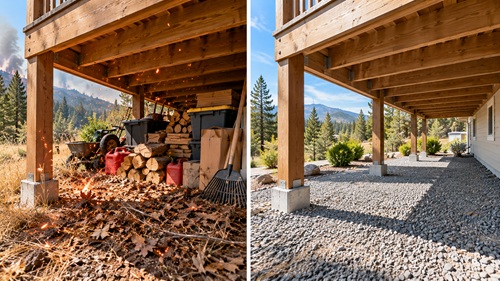
Decks are one of the easiest places for homeowners to overlook combustible material. Leaves can accumulate underneath them, grass may grow beneath elevated sections, and people often use these areas for storing lumber, cardboard, outdoor furniture, firewood, tools, or other equipment. A deck can therefore become both an ember trap and a fuel source.
The area beneath decks, stairs, balconies, and porches should be inspected regularly. Dead vegetation and unnecessary combustible storage should be removed where practical. It is also important to examine where the deck connects to the house. If fire becomes established on or beneath a combustible deck, that connection can provide a direct route for flames and heat to reach the main structure.
Firewood Needs Its Own Plan
A large stack of seasoned firewood is intentionally dry and combustible, which makes its location important during wildfire season. Firewood stacked directly against the house may be convenient in winter, but during hot and dry conditions it can become a significant fuel source beside the structure.
Where practical, the main firewood supply should be stored away from the home and other important buildings. Seasonal adjustments may also make sense, with smaller quantities kept nearby in colder months and relocated when wildfire risk increases. Scrap lumber, pallets, brush piles, and construction materials should be treated in the same way because they can create similar hazards. The preparedness principle is simple: avoid placing concentrated fuel where fire can easily use it to reach the house.
Build Defensible Space Outward From the Home
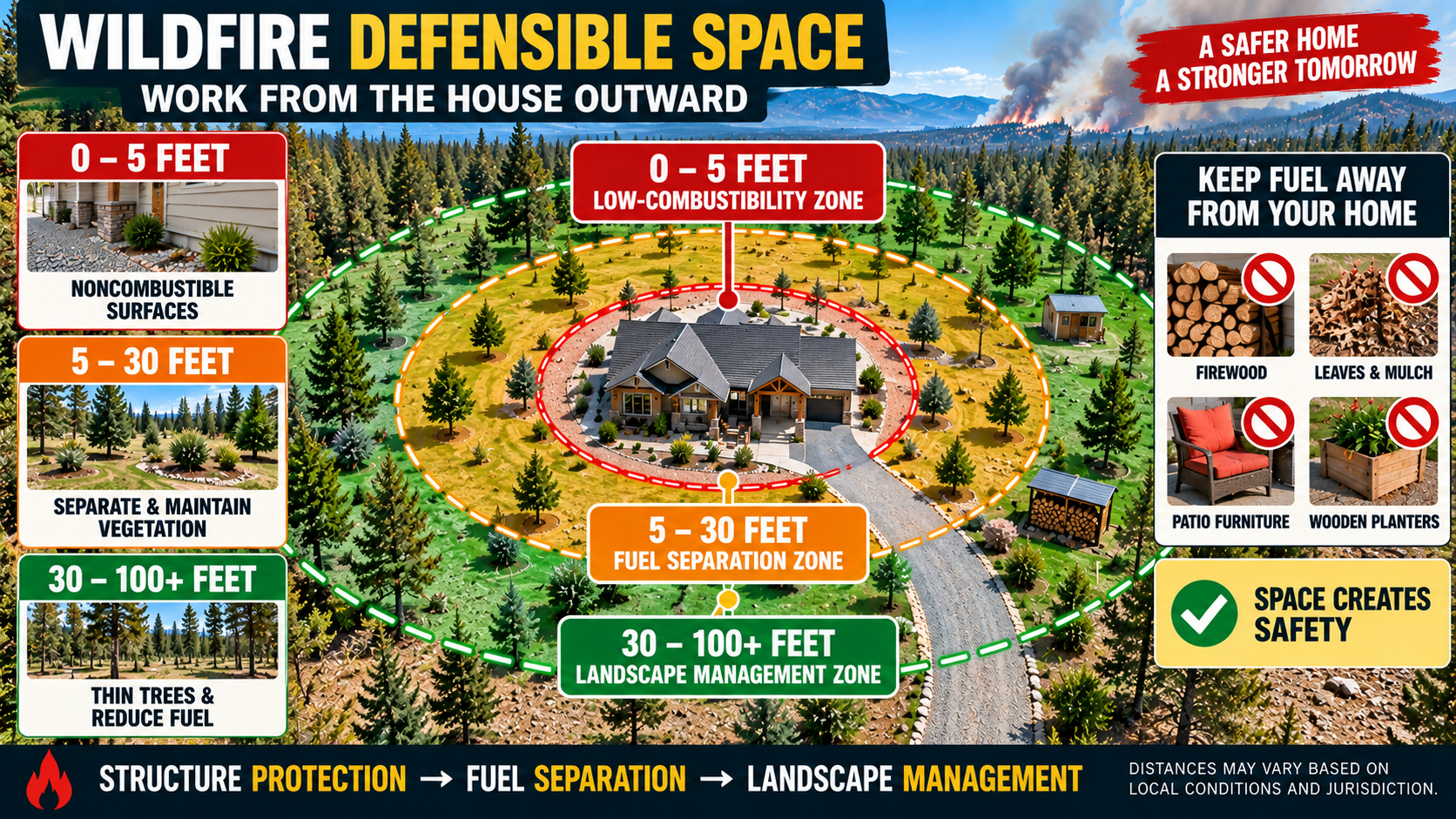
Once the immediate area around the structure has been addressed, attention should move outward into the surrounding property. The objective changes as distance increases. Immediately beside the house, the focus is on preventing ignition. Farther away, the goal becomes reducing the continuity and intensity of available fuels so that fire has greater difficulty moving toward the structure.
A practical way to think about this is in broad zones. The first several feet around the house are primarily about protecting the structure from ignition. The next several dozen feet are about separating fuels and keeping vegetation from forming a continuous pathway. Farther from the home, the focus shifts toward managing vegetation so fire is less likely to approach the property as a high-intensity wall of flame. The exact distances will vary depending on terrain, local requirements, vegetation, lot size, and whether the property is flat or sloped, but the concept remains the same: structure protection closest to the home, fuel separation in the middle, and landscape management farther out.
Manage the Area Closest to the House
The area surrounding the immediate perimeter should not become a continuous carpet of fuel. Dead grass, fallen branches, dense shrubs, overgrown weeds, and unmanaged vegetation can allow fire to move steadily toward the structure. Grass should be maintained appropriately for local conditions, dead plant material should be removed, and shrubs and trees should be arranged in a way that breaks up continuous vegetation.
Hard surfaces such as driveways, walkways, patios, gravel areas, and retaining walls can be especially useful because they divide the landscape and interrupt fuel continuity. This does not make a property fireproof, but it forces an advancing fire to repeatedly encounter areas where there is less available fuel. The more often that continuity is broken, the harder it becomes for surface fire to move easily from the outer property to the home.
Understand Ladder Fuels
Wildfire can behave very differently depending on whether it remains near the ground or climbs upward into shrubs and tree canopies. Low vegetation can act as a ladder by carrying flames from grass into shrubs, from shrubs into low branches, and then from lower branches into taller trees. Once fire reaches the canopy, intensity can increase dramatically.
The goal of managing ladder fuels is to interrupt this vertical connection. Dead lower branches should be removed, and vegetation should be arranged so that flames cannot easily move from ground-level fuels into the crowns of trees. Pruning practices will vary by tree species, local ecosystem, and wildfire guidance, so homeowners should avoid damaging healthy trees simply to meet a fixed number. What matters most is understanding the principle: fire should not be given an easy staircase from the ground into the canopy.
Manage the Extended Property
Farther from the house, the objective is not necessarily to create a barren landscape. Instead, the goal is to reduce heavy fuel accumulations and prevent dense vegetation from forming uninterrupted pathways toward the developed part of the property.
Dead branches, excessive ground debris, heavy brush, and tightly packed young trees can all contribute to fire intensity. Vegetation should also be managed around sheds, barns, propane installations, generators, workshops, and other structures or equipment. The overall aim is to influence how fire behaves as it approaches the property. A lower-intensity ground fire presents a very different challenge from a fast-moving crown fire supported by dense and continuous fuel.
Outbuildings Matter More Than They Appear
A shed does not have to touch the main house to threaten it. If an ember ignites a woodshed, detached garage, workshop, fence, or other structure, that burning object can generate heat, flames, and additional embers closer to the home. Outbuildings should therefore be included in the same wildfire-preparedness system as the main structure.
Their roofs should be kept free of debris, vegetation should be managed around them, and vents and openings should be inspected. Homeowners should also consider what is stored inside and around these buildings because fuel containers, lumber, cardboard, machinery, and other combustible materials can increase the severity of a fire if the building ignites. The property should be treated as one connected system of potential ignition sources rather than a house surrounded by unrelated objects.
Examine Your Fences
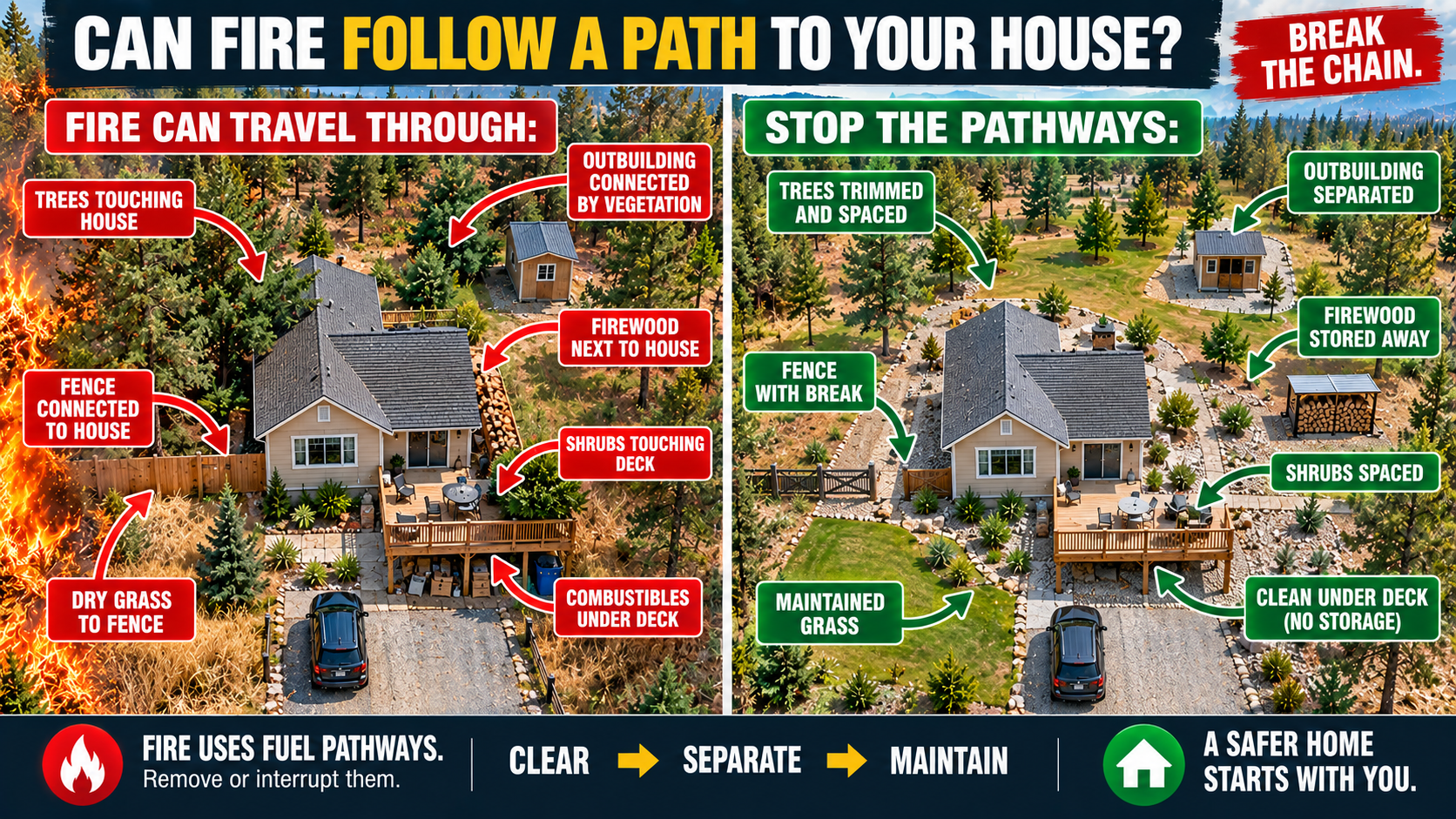
Fences can become another overlooked pathway. A combustible wooden fence that extends from vegetation directly to the house may allow flames to move closer to the structure. The section where a fence connects to a building is particularly important because it may provide a direct combustible bridge.
When fencing is repaired or replaced in wildfire-prone areas, it may be worth considering whether a noncombustible transition near the house could reduce this risk. The same basic principle continues to apply throughout the property: break the chain between available fuel and the structure.
Propane, Fuel, and Utility Areas
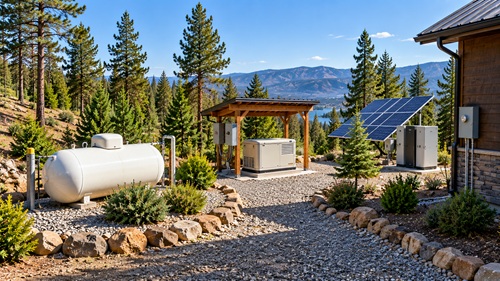
Rural and off-grid properties often contain propane tanks, generators, fuel storage, solar equipment, batteries, pumps, workshops, and other infrastructure that may not exist on a typical urban lot. These systems need their own wildfire assessment.
Vegetation should be managed around stationary propane tanks according to applicable codes and supplier guidance. Combustible storage should not accumulate around generators or fuel systems. Emergency responders should also be able to identify and reach important utility equipment where necessary. Homeowners should understand how propane, electricity, natural gas, and other systems are shut down safely, but should not assume that every wildfire situation requires personally shutting everything off. Utility procedures vary, and evacuation should never be delayed to perform a task that can be left to trained professionals or emergency authorities.
Your Driveway Is Part of Your Wildfire Plan
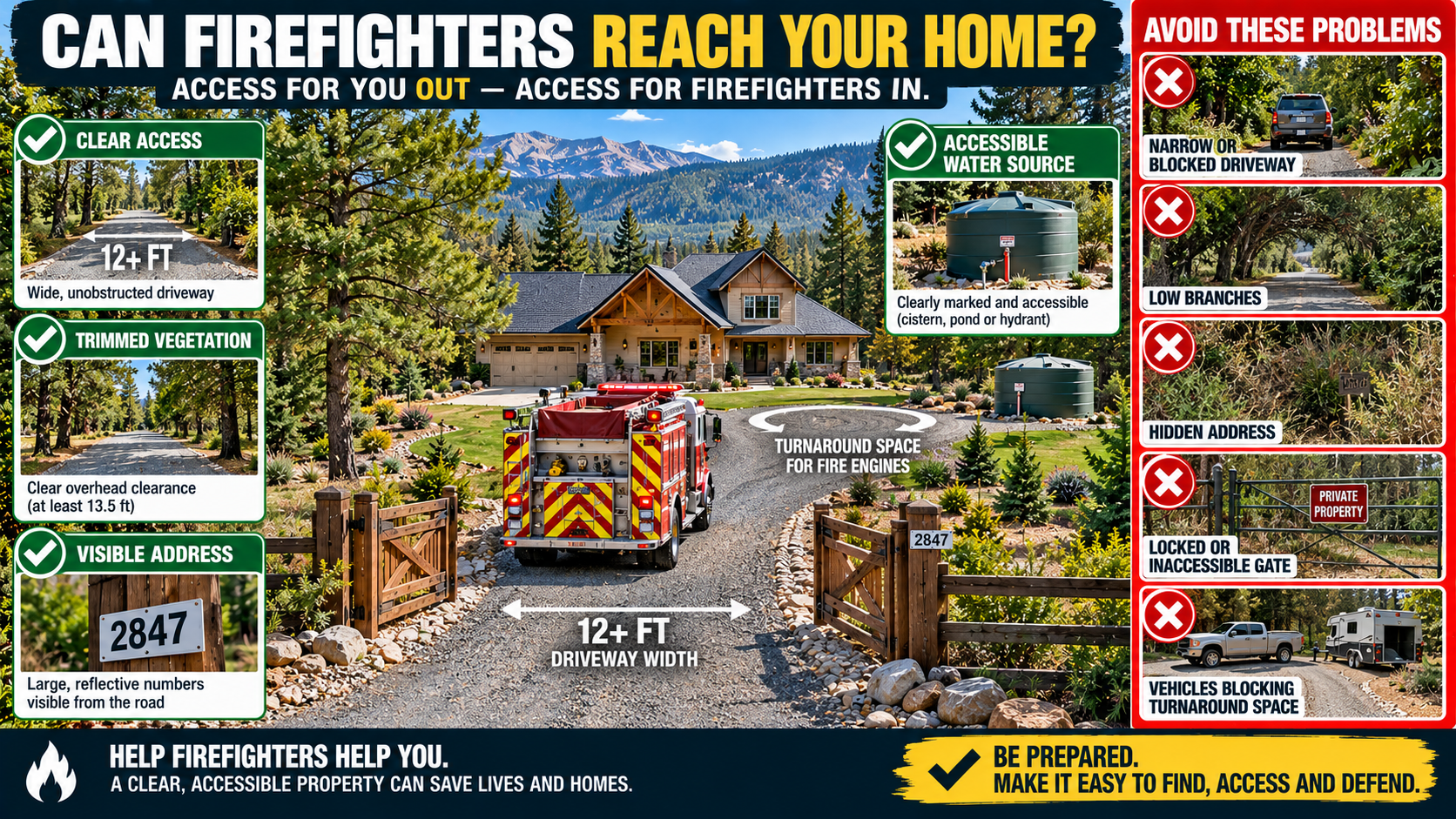
A rural driveway is more than an entrance. During a wildfire, it may become both your evacuation route and the route firefighters use to reach the property. If it is too narrow, blocked by vegetation, difficult to identify, or lacks a safe turnaround area, emergency access may be limited.
Homeowners should consider whether large emergency vehicles could reasonably travel the route, whether overhanging branches or parked equipment could create obstructions, and whether the property address remains visible through smoke or darkness. It is also worth thinking about what would happen if a fallen tree blocked the only exit. A house may be defensible in every other respect, but firefighters may still be unable to protect it if they cannot safely reach and leave the property.
Prepare for Smoke as Well as Flames
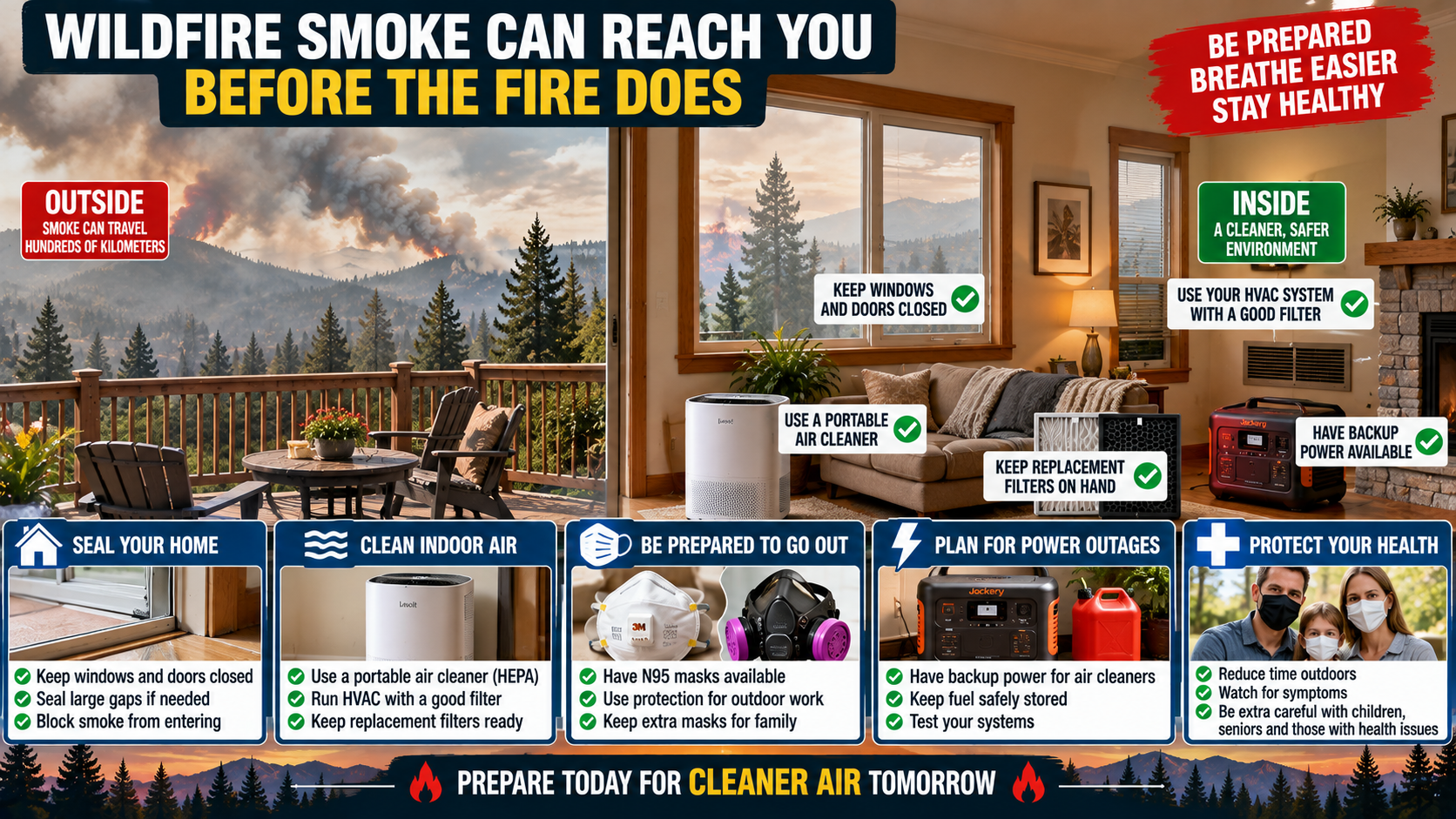
A wildfire does not have to reach your community to create dangerous conditions. Smoke can travel over enormous distances and may affect areas far removed from active fire. Homeowners should therefore prepare for two separate problems: direct wildfire exposure and prolonged smoke.
When smoke becomes severe, doors and windows may need to remain closed, and homeowners should understand how their heating, ventilation, and air-conditioning systems handle outside air. Portable air cleaners and replacement filters can be useful, but they also depend on electricity. A wildfire that causes a power outage may therefore create a second problem if indoor air-cleaning equipment can no longer operate.
Appropriate respiratory protection may also be useful when smoke exposure cannot be avoided. Public-health guidance should be followed because loose-fitting masks, wet cloths, and makeshift coverings do not provide the same protection as properly selected respiratory equipment.
Prepare Your Water Supply Before Fire Season
Water is an important resource, but homeowners should not build their entire wildfire plan around the assumption that they will defend the house with a garden hose. Municipal water pressure can fall, electric well pumps can stop during outages, hoses can melt, pumps can fail, and smoke or heat may make it unsafe to remain outside.
Rural homeowners who depend on wells should understand what happens if electricity is lost. Those with tanks, ponds, pools, cisterns, or other water sources should know whether those sources can actually be accessed during an emergency and whether local fire crews could use them. Water is best treated as one layer of preparedness rather than the foundation of the entire plan. It should never become a reason to ignore or delay an evacuation order.
Make the Property Easy for Firefighters to Understand
Emergency crews arriving at an unfamiliar property may have only a short time to decide whether it is safe and practical to defend. A clearly visible address, open access route, identifiable water source, and safe turnaround area can make that decision easier.
Rural or complicated properties may benefit from a conversation with the local fire department or wildfire authority before fire season. Fire crews can often identify access problems, vegetation hazards, water limitations, or other concerns that a homeowner may overlook. Preparing the property for emergency response is part of wildfire resilience because even a well-managed home may receive less help if responders cannot safely operate around it.
Build a Wildfire Evacuation System Before You Need It
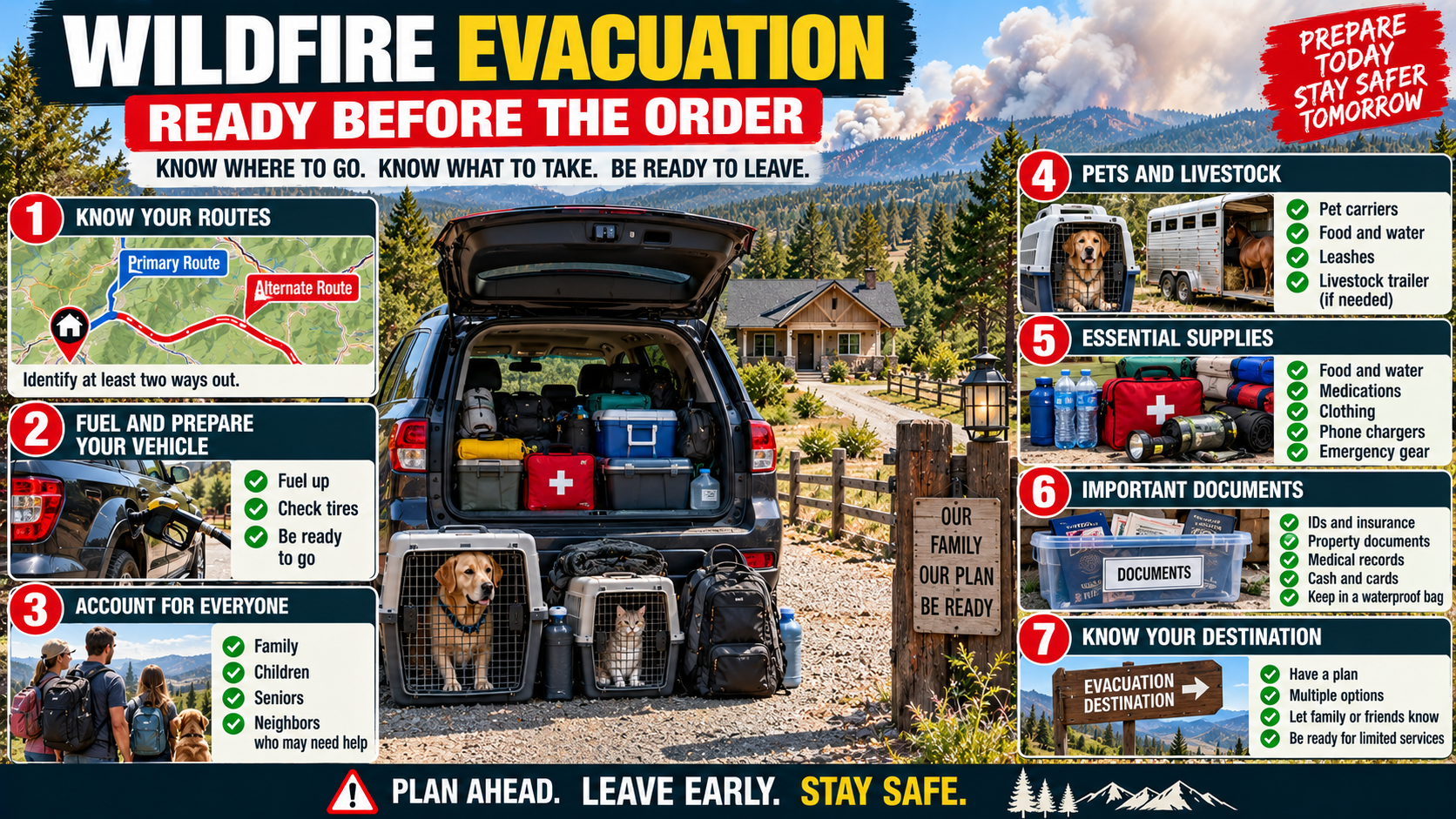
Preparing the structure is only half of wildfire readiness. The people inside it must also be prepared to leave quickly. A household should know where it can go, which routes are available, how family members will communicate if separated, and how children, older adults, people with disabilities, pets, and livestock will be moved.
Vehicles should be maintained, and fuel levels or battery charge should not routinely be allowed to fall critically low during periods of elevated wildfire risk. If animals require trailers, the tow vehicle, hitch, tires, lights, brakes, keys, and loading arrangements should be checked in advance. Wildfire evacuation is a poor time to discover that a trailer tire is flat, a gate cannot be opened, or an animal has never been trained to load.
Preparedness is strongest when evacuation procedures have been practiced before they are needed. Even a simple household discussion can make a major difference because it replaces uncertainty with an agreed plan.
Create a Wildfire Grab-and-Go System
Some belongings are difficult or impossible to replace, and important information may become hard to access once a household is displaced. Identification, insurance records, property information, medication details, emergency contacts, financial records, and pet or livestock documents should be organized in advance.
Digital copies are useful, but they should not be the only copies available. Power and internet access may be unreliable during an evacuation, and cloud access may not be practical when a family is moving quickly. A secure waterproof pouch containing essential paper copies can provide a dependable offline backup. Household emergency supplies should also be organized so that evacuation becomes a matter of collecting a prepared kit rather than searching room by room while conditions deteriorate.
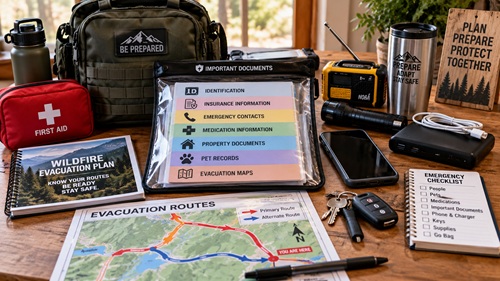
Know What You Would Take
Many people assume they will have plenty of time to pack before leaving. Sometimes they do, but wildfire conditions can change rapidly. Priorities should therefore be established before fire season.
People and animals come first, followed by essential medications, medical equipment, identification, critical documents, communication devices, suitable clothing, water, food, and necessary emergency supplies. Sentimental items can be identified in advance if time allows, but they should never delay evacuation. The more decisions made under normal conditions, the fewer difficult choices remain when smoke, traffic, alerts, and uncertainty increase stress.
Photograph Your Property Before Wildfire Season
One of the easiest preparedness measures is to create a visual record of the home and its contents. A phone or camera can be used to document each room, including closets, cabinets, appliances, electronics, tools, furniture, workshops, sheds, vehicles, and other valuable property.
Major items should be recorded clearly enough to help identify what was owned, and serial numbers can be photographed where practical. Copies of this documentation should be stored somewhere that remains accessible if the house and primary devices are lost. Reconstructing the contents of an entire household from memory after a disaster is extremely difficult, so this is the kind of task that is much easier to complete before anything happens.
When Wildfire Conditions Become Serious
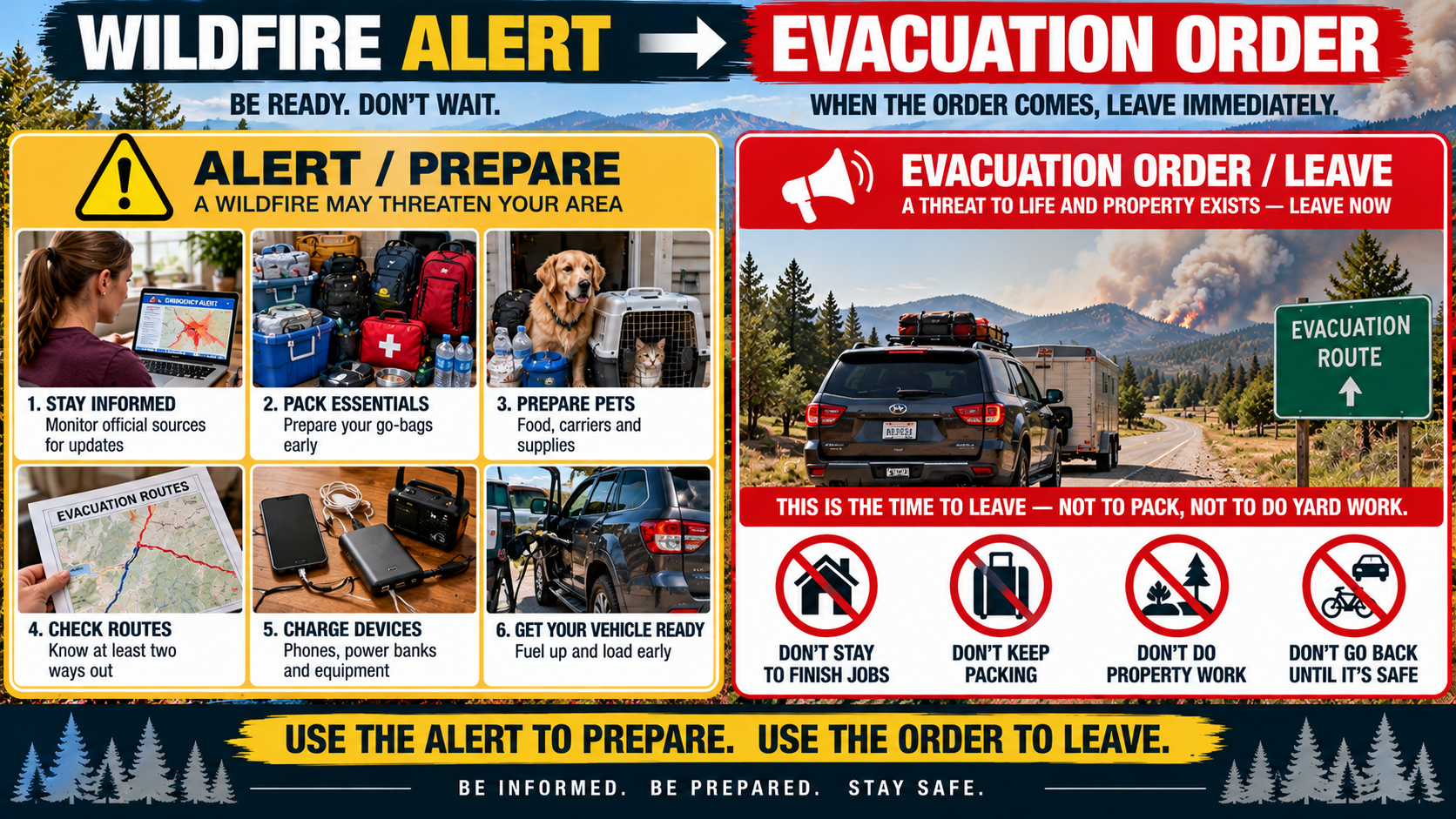
Wildfire preparedness should become more active as local risk increases. Official fire information, evacuation notices, weather forecasts, road conditions, and emergency communications should be monitored closely. Phones and battery banks should be charged, vehicles should be ready, important documents and medications should be together, pets and livestock should be prepared, and household members should know where everyone is.
If authorities indicate there is time and it remains safe, easily combustible outdoor items can be moved away from structures. However, last-minute property work should never consume the time needed to evacuate. Once conditions begin to deteriorate, the value of protecting belongings falls rapidly compared with the importance of leaving safely.
Understand the Difference Between an Alert and an Order
Wildfire terminology differs by jurisdiction, but many emergency systems distinguish between a warning or alert that tells residents to prepare and an evacuation order that directs them to leave. Homeowners should learn the terminology used in their area before fire season begins.
An alert should not be treated as permission to ignore the situation until flames are visible. It is the period when vehicles should be loaded, animals prepared, routes confirmed, and official information monitored closely. If an evacuation order is issued, the household should leave. Wildfire behavior can change quickly when wind, dry vegetation, terrain, and extreme heat combine.
Do Not Depend on Your Phone Alone
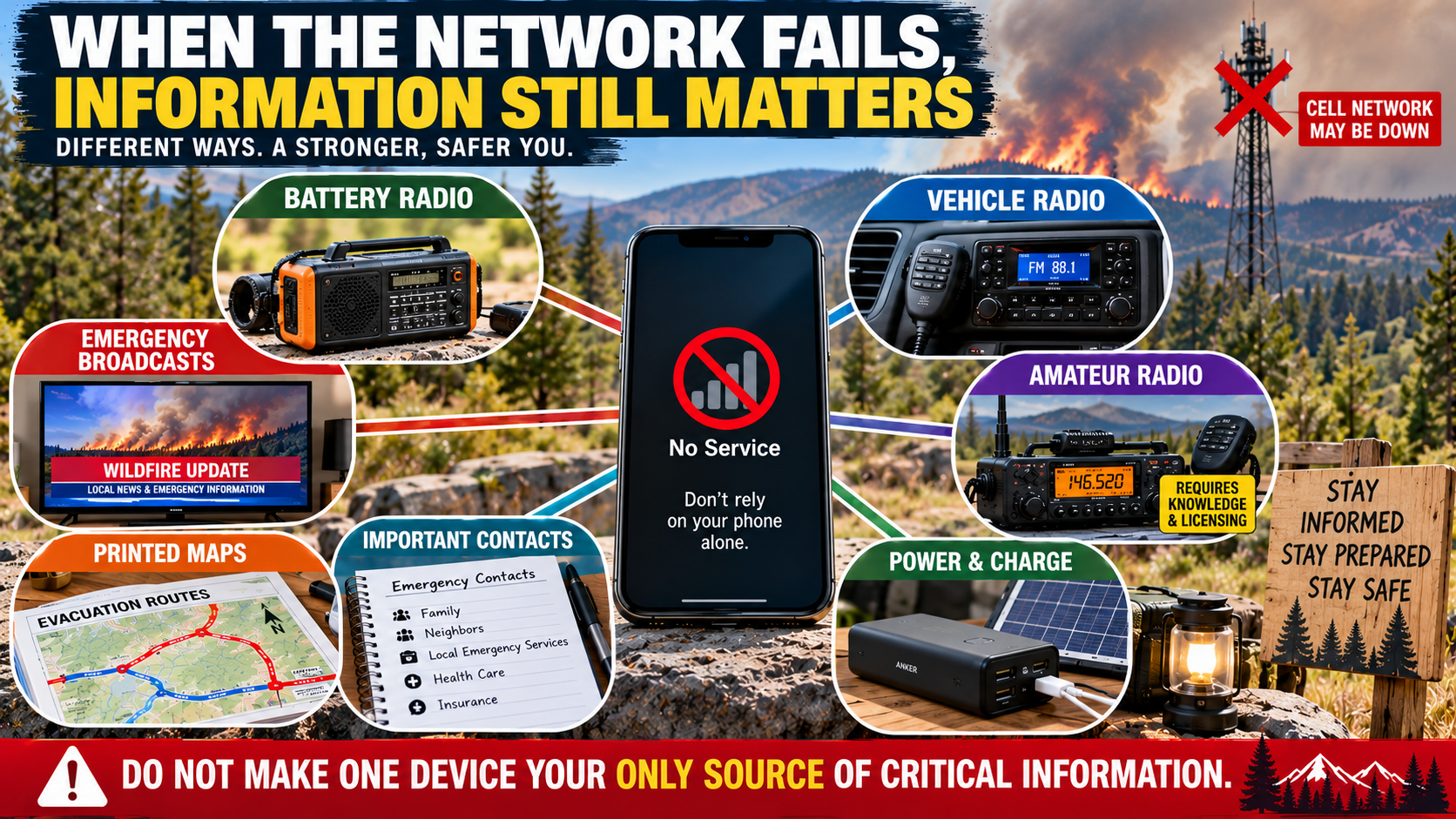
Modern emergency communication depends heavily on cellular networks and internet services, but wildfire can damage power systems, overload networks, and disrupt infrastructure. A household that depends entirely on a smartphone may lose access to maps, contacts, instructions, and updates at the moment those things are needed most.
Alternative ways of receiving information should therefore be part of the plan. Depending on location, this may include battery-powered radio, vehicle radio, local emergency broadcasts, weather radio, community notification systems, or amateur radio where legally appropriate. Important phone numbers and addresses should also exist on paper, and evacuation maps should be downloaded or printed in advance. Wildfire preparedness becomes much stronger when loss of internet access does not mean loss of critical knowledge.
Prepare for the Possibility That You Cannot Return Quickly
An evacuation may last much longer than expected. Road closures, active fire operations, damaged utilities, unstable trees, structural hazards, and lingering hot spots may prevent residents from returning for days or longer.
Evacuation kits should therefore include enough essential medication, medical supplies, chargers, clothing, food, water, pet supplies, and documentation to bridge the period between leaving home and reaching stable accommodations. It is also wise to avoid assuming that fuel stations, stores, banks, pharmacies, and other services will be fully available near the affected area. Wildfire disruptions often extend beyond the burn zone.
Returning Home Requires Caution
The danger does not automatically end when the flames move away. A property can still contain damaged power lines, weakened trees, unstable structures, damaged propane equipment, hot spots, ash pits, contaminated water, and other hazards.
Residents should not return until authorities indicate that it is safe. Once access is permitted, damaged areas should be approached carefully and major cleanup should not begin until conditions have been assessed. Where appropriate, damage should be documented for insurance purposes before items are moved or discarded. Utilities, insurers, emergency authorities, and qualified professionals may all need to be involved before the property can safely return to normal use.
Wildfire Preparedness Is Property Maintenance
Wildfire preparation should not be treated as a one-time project. Vegetation grows back, leaves return, branches fall, gutters refill, firewood gets moved, outdoor furniture changes, and new equipment or structures are added to the property. A home that was well prepared several years ago may no longer be well prepared today.
Seasonal inspections should therefore become part of normal property maintenance. Spring is often a useful time for larger cleanup and vegetation work, while high-risk periods require continued inspection and removal of new debris. Autumn cleanup can also reduce the amount of combustible material that remains around structures. The goal is not perfection but continual improvement. Every weakness removed is one less pathway available to fire.
Think in Layers
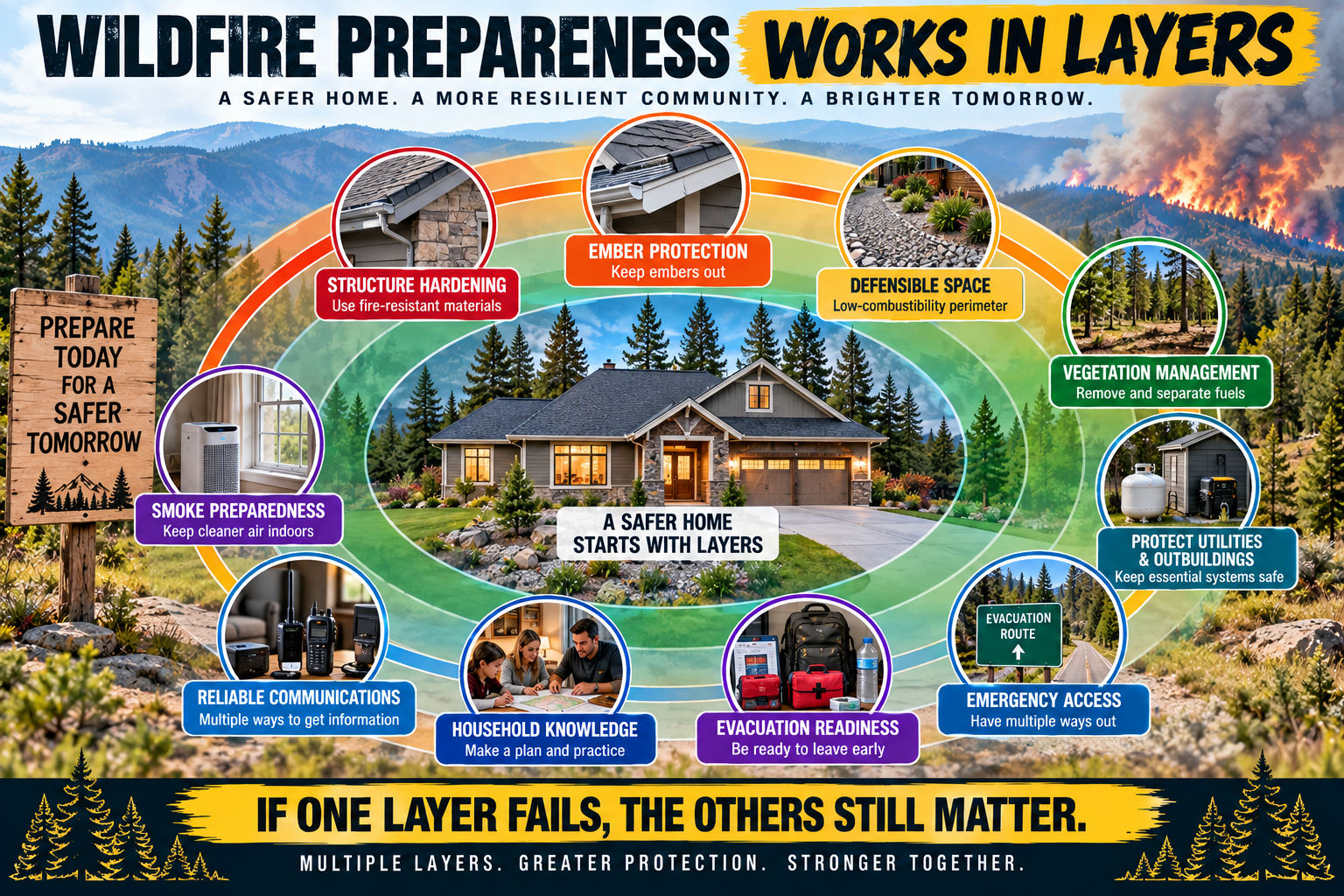
No single wildfire precaution should carry the entire burden of protecting a household. A cleared yard cannot compensate for every vulnerable building component, and a fire-resistant roof cannot compensate for large amounts of fuel piled against the walls. A well-prepared home also provides little benefit if the people inside wait too long to evacuate.
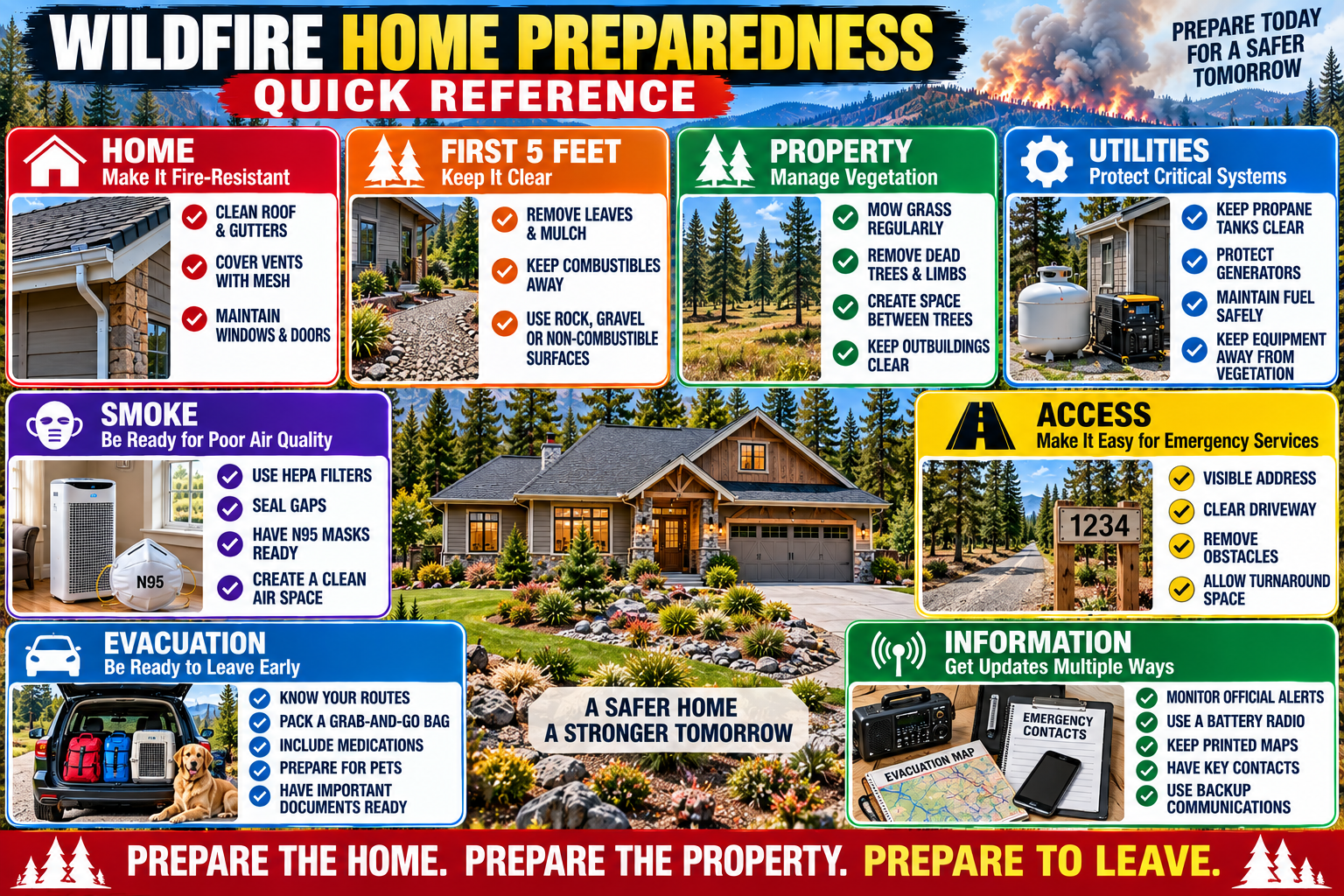
Strong wildfire preparedness uses multiple layers that support one another. The structure should be hardened, ignition sources should be reduced, surrounding vegetation should be managed, utilities and outbuildings should be protected, access routes should be maintained, smoke preparedness should be addressed, reliable information sources should be available, evacuation equipment should be ready, and everyone in the household should know when and how to leave. If one layer fails, the remaining layers still provide protection.
Preparedness Action Plan
Begin with a complete inspection of the house and property. Start at the walls of the home and look for anything that an ember could ignite within the first several feet. Remove accumulated leaves, needles, dead vegetation, wood, cardboard, and unnecessary combustible storage. Inspect the roof, gutters, vents, windows, deck, stairs, fencing, sheds, firewood, propane equipment, driveway, and vegetation.
Continue moving outward and look for continuous pathways that could carry fire toward the structure. Grass, shrubs, branches, fences, piles of wood, and closely spaced structures should all be considered potential links in the same chain. Wherever practical, reduce fuel continuity and create separation.
After the property inspection, shift attention to evacuation readiness. Confirm routes, vehicle condition, communication plans, emergency supplies, important documents, medications, pet or livestock arrangements, and alternative methods of receiving information. Make sure critical knowledge exists in a form that remains accessible even if power or internet service is lost.
Finally, make wildfire preparedness part of recurring seasonal maintenance. The strongest property is not the one that was prepared once. It is the one that continues to be inspected, maintained, and improved over time.
Key Takeaways
Wildfire home preparedness begins with understanding that embers, radiant heat, and nearby burning materials can ignite a structure even before the main fire arrives. The area immediately surrounding the home deserves the greatest attention because small amounts of combustible material can turn a minor ember exposure into a structure fire.
Protection should work outward from the building. Vulnerable parts of the house should be hardened, combustible material should be reduced near the structure, surrounding vegetation should be managed, and the extended property should be maintained in a way that reduces fuel continuity and fire intensity. Decks, fences, sheds, propane systems, driveways, utilities, and access routes should all be treated as part of the same wildfire-preparedness system.
Wildfire readiness also extends beyond protecting the structure. Smoke, power outages, communication failures, evacuation delays, and restricted access can all become serious problems even when flames never reach the property.
The strongest preparedness plan combines property protection with evacuation readiness. A wildfire-ready home is valuable, but a wildfire-ready household is essential.
Disclaimer
This material is intended for general preparedness education and is not a substitute for instructions from local fire departments, wildfire agencies, emergency-management authorities, building officials, utilities, insurers, or other qualified professionals. Wildfire behavior varies according to vegetation, weather, terrain, construction, and local conditions. Follow evacuation orders and official emergency instructions. Never remain in a dangerous area or delay evacuation in an attempt to protect property.
© Prepping Communities. This content is for informational purposes only and not professional advice. Use at your own risk.
Terms | Privacy | Guidelines