
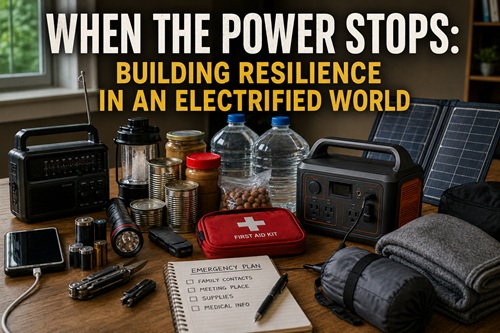
Most people think of electricity as a utility.
Flip a switch and the lights come on.
Plug in a device and it charges.
Open the refrigerator and food stays cold.
Turn on the tap and clean water appears.
Because electricity is available almost all the time, it becomes easy to overlook how many parts of modern life depend on it.
In reality, electricity powers far more than lights and appliances.
It supports communications networks.
It keeps food moving through supply chains.
It helps fuel stations operate.
It supports banking systems, healthcare facilities, transportation infrastructure, water treatment plants, and countless other services most people rely on every day.
The modern world is deeply interconnected.
When electricity is available, these systems function quietly in the background.
When electricity becomes unavailable, even temporarily, the effects can spread much further than many people expect.
Preparedness is not about fearing this possibility.
It is about understanding how modern systems work and taking practical steps to reduce the impact if those systems become disrupted.
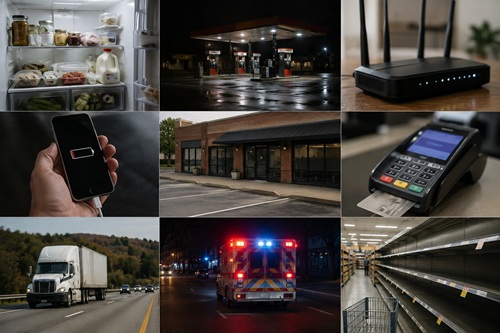 Understanding the Ripple Effects
When people imagine a power outage, they often picture sitting in a dark house.
That may be true during the first few hours.
However, extended outages create additional challenges.
Refrigerators and freezers begin warming.
Fuel stations may be unable to pump gasoline.
Internet service may become unreliable.
Cell phone batteries eventually run down.
Businesses may close temporarily.
Electronic payment systems may stop working.
Supply deliveries may be delayed.
Emergency services may become overwhelmed if large areas are affected.
The longer an outage continues, the more these challenges begin to overlap.
What starts as an inconvenience can become a much larger problem if households are completely dependent on systems that are no longer functioning.
The Goal Is Not Complete Independence
One common misconception about preparedness is that everyone should strive to become completely self-sufficient.
For most households, that is neither realistic nor necessary.
Modern infrastructure provides tremendous benefits.
Reliable utilities, transportation systems, communications networks, and grocery stores make everyday life possible.
Preparedness is not about rejecting those systems.
It is about recognizing that disruptions sometimes occur.
The goal is resilience.
Can your household remain comfortable if the power is out for several days?
Could you manage if stores were temporarily closed?
Would you have enough water, food, and supplies to avoid becoming part of the immediate rush?
Preparedness is often less about surviving extreme scenarios and more about maintaining stability when normal routines are disrupted.
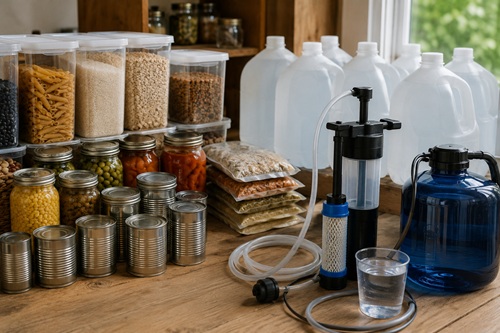 Start With Food and Water
The foundation of preparedness remains surprisingly simple.
Food and water come first.
Many households already have some food available, but most depend on frequent shopping trips and refrigerated storage.
Building a supply of shelf-stable foods provides flexibility during disruptions.
Examples include:
- Canned foods
- Rice
- Beans
- Pasta
- Oats
- Dry goods
- Freeze-dried foods
- Shelf-stable milk products
Water deserves equal attention.
Many preparedness organizations recommend storing at least one gallon of water per person per day as a starting point.
Additional water may be needed for sanitation, cooking, pets, and hygiene.
Water filtration and purification methods can provide additional layers of security if normal water sources become unavailable.
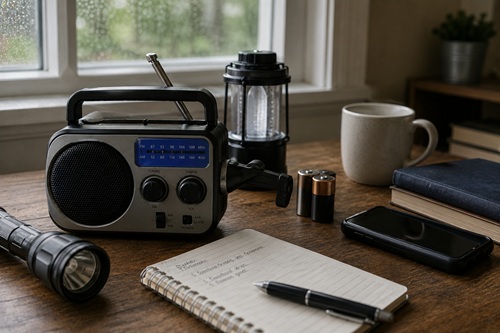 Maintaining Access to Information
Information becomes extremely valuable during emergencies.
Unfortunately, many modern communication systems depend on electricity.
Cell towers require power.
Internet infrastructure requires power.
Home networking equipment requires power.
A battery-powered or hand-crank radio remains one of the simplest ways to stay informed during an outage.
Weather radios can provide important updates regarding storms, evacuations, restoration efforts, and emergency instructions.
Reliable information often helps reduce uncertainty and improve decision-making.
Backup Power: Focus on Priorities
Many people immediately think about generators when discussing preparedness.
Generators can be useful, but it helps to start by identifying your actual needs.
Ask yourself:
- What devices are truly essential?
- How long do they need to operate?
- How much power do they require?
For some households, keeping phones charged may be sufficient.
For others, medical equipment, refrigeration for medications, communication devices, or work-related equipment may be priorities.
Potential backup power options include:
- Portable power banks
- Solar chargers
- Portable power stations
- Battery backup systems
- Generators
Preparedness does not require powering everything.
It requires maintaining the capabilities that matter most.
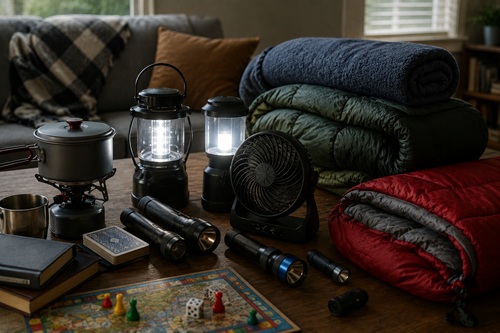 Household Comfort Matters Too
Many preparedness discussions focus exclusively on survival.
However, comfort can be important during prolonged disruptions.
Simple items can help maintain morale and reduce stress:
- Flashlights
- Lanterns
- Blankets
- Sleeping bags
- Battery-powered fans
- Books
- Games
- Alternative cooking equipment
Families often cope better with emergencies when routines can continue as normally as possible.
Preparedness is not just about getting through a situation.
It is also about remaining functional and comfortable while doing so.
Financial Preparedness Is Often Overlooked
Not all emergencies are physical emergencies.
Many create financial challenges.
Power outages can affect businesses, transportation, employment, and electronic payment systems.
Building an emergency fund can provide valuable flexibility when unexpected expenses arise.
Some households also choose to keep a small amount of cash available for situations where electronic payment systems are unavailable.
Financial preparedness may not be as exciting as gear or equipment, but it can be one of the most practical forms of resilience.
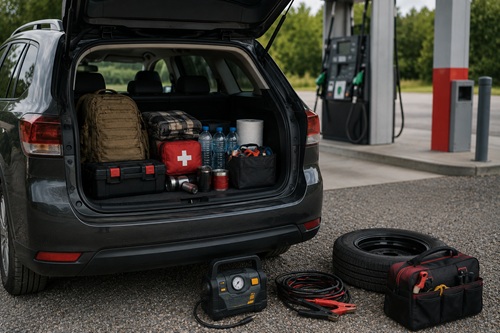 Transportation and Mobility
A reliable vehicle can provide transportation, shelter, charging capability, and access to resources.
Routine vehicle maintenance remains one of the simplest preparedness steps available.
Consider:
- Maintaining adequate fuel levels
- Keeping emergency supplies in your vehicle
- Carrying charging cables
- Having basic roadside equipment available
Transportation disruptions often affect people more quickly than they expect.
Planning ahead provides additional options when routes, services, or fuel supplies become limited.
Create a Family Communication Plan
One of the first concerns during an emergency is often family.
Where is everyone?
Are they safe?
How will they communicate?
Simple plans created before an emergency can prevent confusion later.
Discuss:
- Emergency contact information
- Meeting locations
- Out-of-area contacts
- Backup communication methods
The best communication plans are usually the simplest ones.
Everyone should know what to do without needing detailed instructions.
Build Preparedness Gradually
One of the biggest myths about preparedness is that it requires a large budget.
Most prepared households did not build their supplies overnight.
They added items gradually.
An extra case of water.
A few additional canned goods.
A flashlight.
A radio.
A first aid kit.
A backup battery.
Small steps taken consistently often produce meaningful results over time.
Preparedness is not about panic buying.
It is about steadily reducing vulnerabilities before they become problems.
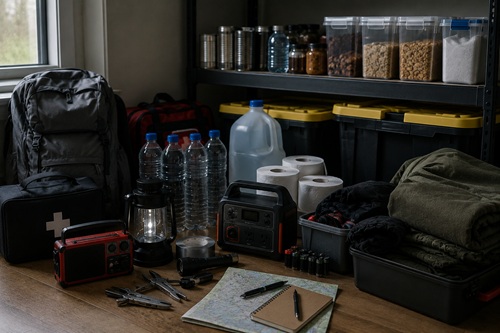 The Real Value of Preparedness
Perhaps the most important lesson from storms, blackouts, wildfires, and other emergencies is that preparedness is rarely about one specific event.
The supplies you store for a power outage may help during a winter storm.
The backup battery you purchase today may be useful during a wildfire evacuation.
The extra food in your pantry may help during a transportation disruption.
The communication plan you create today may prove useful during countless unexpected situations.
Preparedness works because many emergencies create similar challenges.
Access to information becomes more difficult.
Access to supplies becomes more limited.
Normal routines become disrupted.
The specific cause often matters less than the ability to adapt.
That is why preparedness is best viewed as a long-term investment rather than a reaction to a particular threat.
Every skill learned.
Every supply added.
Every plan discussed.
Every vulnerability reduced.
They all contribute to the same outcome:
More options.
And when circumstances become uncertain, having more options is often one of the most valuable forms of security a household can possess.
© Prepping Communities. This content is for informational purposes only and not professional advice. Use at your own risk.
Terms | Privacy | Guidelines