
One Plant With a Surprising Number of Uses
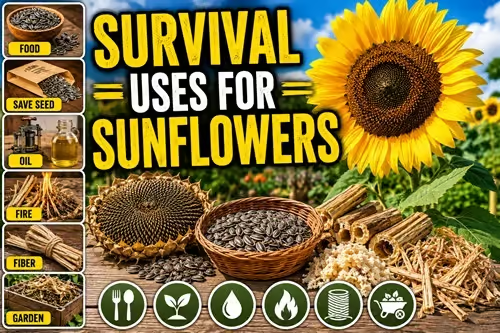
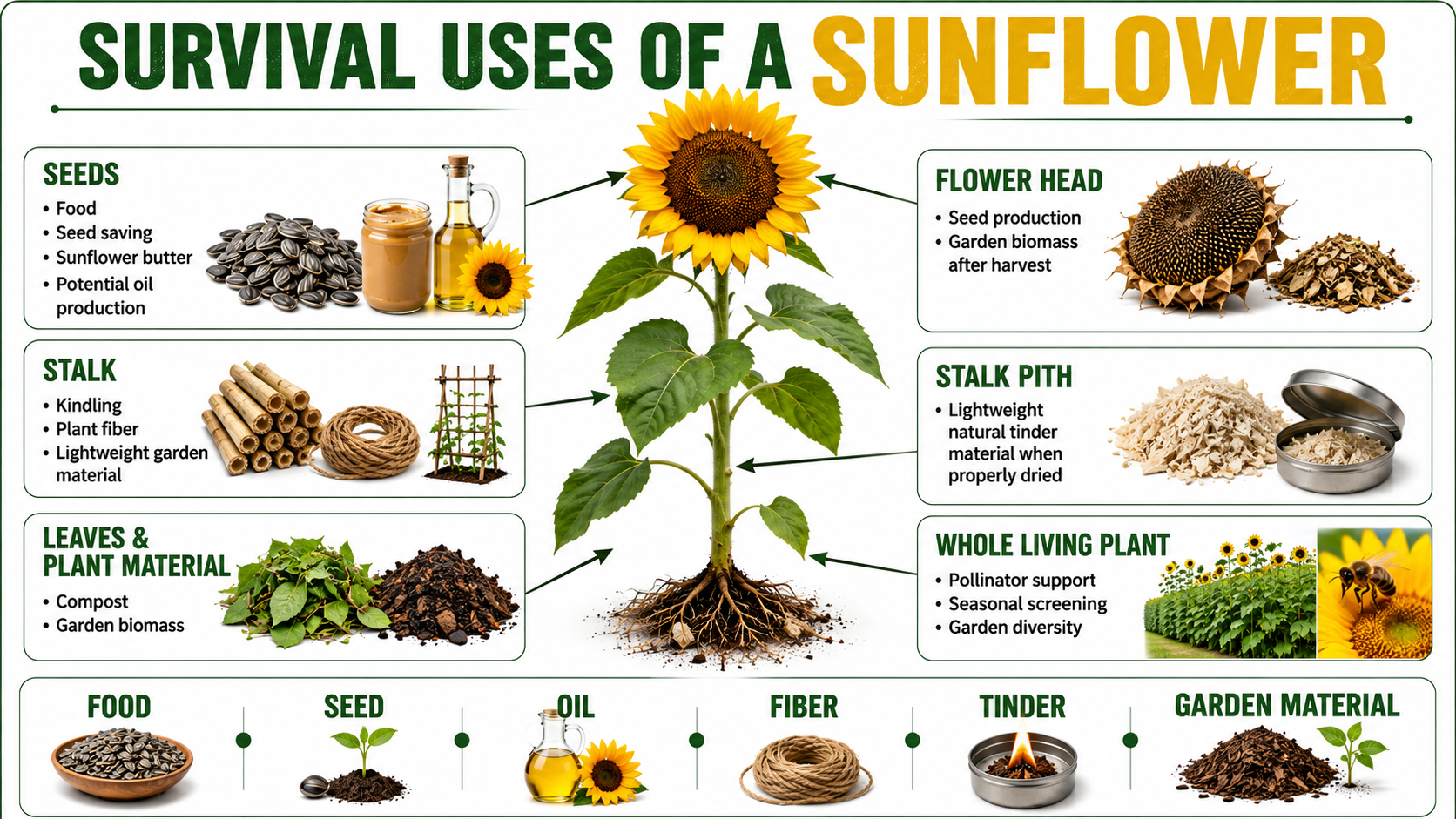
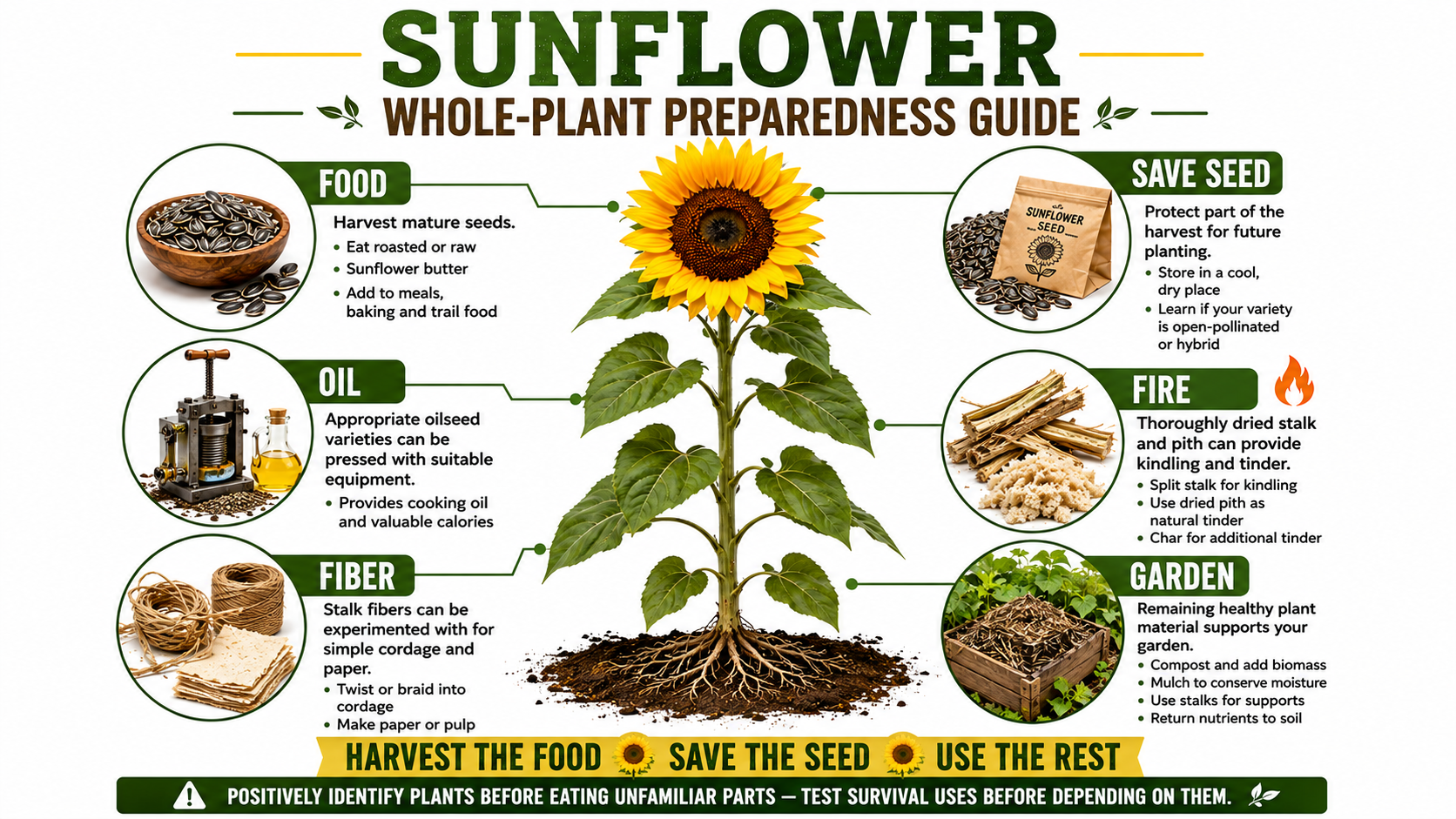
Sunflowers are usually grown for their seeds, appearance, or as a way to attract pollinators, but a mature sunflower produces much more useful material than most people realize. The seeds can provide food and potentially oil, the stalk can supply dry kindling and plant fiber, the inner pith can be used as lightweight tinder, the spent plant can contribute organic material to the garden, and mature seeds can be saved to grow another crop.
That makes sunflowers especially interesting from a preparedness standpoint. They are not a complete survival food and they won’t replace staple crops such as potatoes, beans, corn, squash, or grains, but they can fill several useful roles at once. A row of sunflowers can produce food while growing and leave behind useful material after the seed harvest is finished.
The key is learning to look at the entire plant rather than harvesting the seeds and throwing everything else away.
The Seeds Are the Most Valuable Part
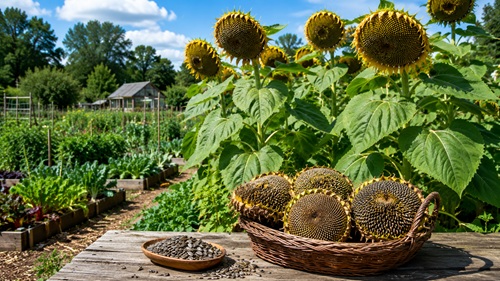
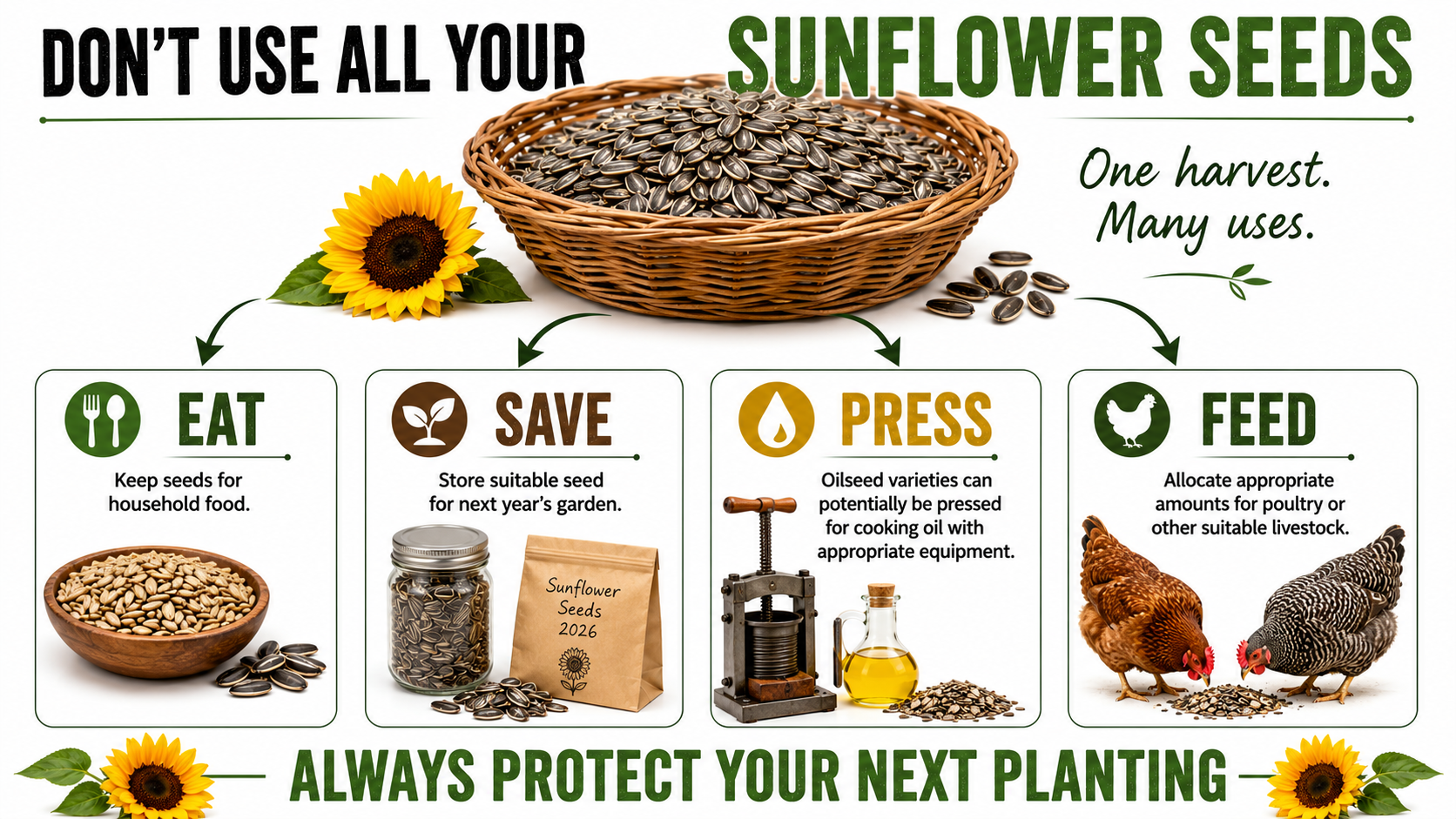
If food production is the priority, start with the seeds. Sunflower seeds provide something that can be difficult to produce in a survival garden: a concentrated source of calories and fat. They also provide protein and several useful nutrients. That makes them a good complement to garden crops that produce plenty of bulk but relatively little fat.
Mature seeds can be eaten raw or roasted, added to other foods, ground, or turned into sunflower-seed butter. Shelled seeds can also be crushed and incorporated into meals when ordinary ingredients are limited. Instead of expecting sunflower seeds to replace one specific food, think of them as another source of calories, fat, protein, and texture that can be incorporated into whatever food is available.
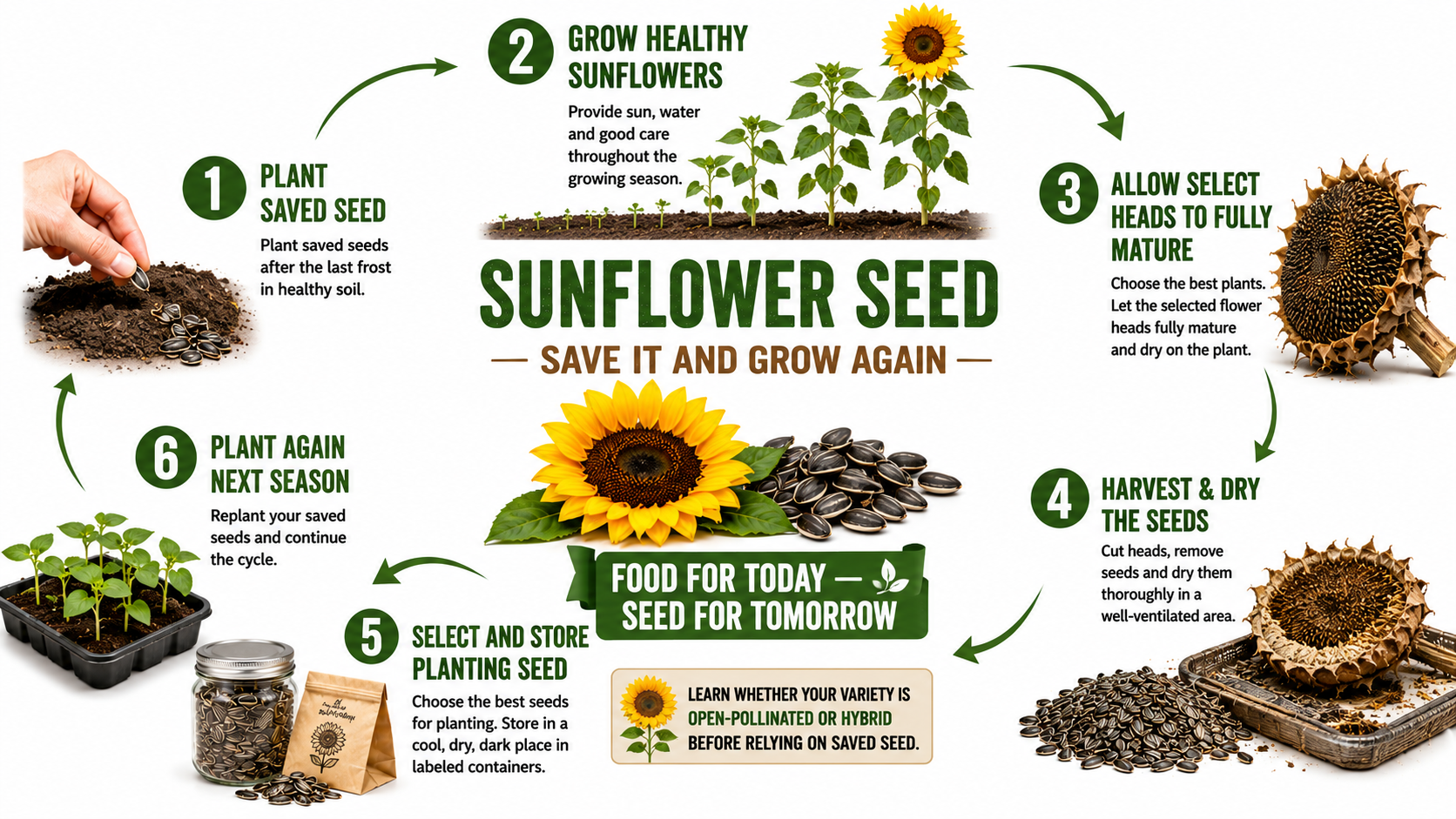
The seeds are also the part of the plant that allows the system to continue. If you are growing an appropriate open-pollinated variety and intend to produce another crop, don’t eat every seed you harvest. Select healthy, fully mature seed, dry it properly, label it, and protect it from moisture and pests for the following planting season.
In a long emergency, that distinction becomes important. A jar of sunflower seeds isn’t only food. Some of those seeds may represent next year’s crop.
Harvesting and Storing the Seeds
Allow the flower head to mature before harvesting it. As the plant finishes its life cycle, the flower begins drying and the seeds become firm and developed. Birds and other animals may discover the seeds before you are ready to harvest them, so some protection may be necessary if you want to keep most of the crop.
Once mature, cut the flower head with enough stem attached to make it easy to handle and continue drying it somewhere protected from rain and animals. When everything is sufficiently dry, the seeds can be worked out of the head by hand.
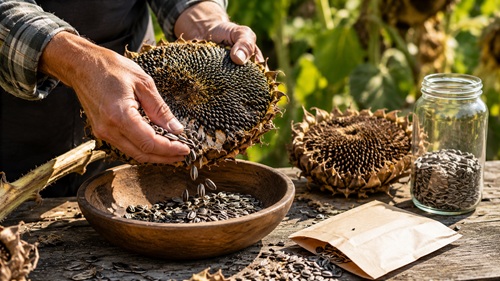
Drying is especially important if the seeds will be stored. Seeds sealed away while they still contain excessive moisture can mold and spoil. The same basic rule applies to many stored foods: don’t seal moisture into something you expect to keep for months.
Separate seed intended for planting from seed intended for eating and clearly label both. That prevents a surprisingly easy mistake – eating the seed you planned to put back into the ground.
Sunflower Seeds Can Produce Oil
Sunflowers can also contribute something that is often overlooked in discussions about survival gardening: oil.
Certain sunflower varieties are specifically suited to oil production. Their seeds can be pressed with appropriate equipment to extract sunflower oil. For someone interested in greater food independence, this can be an important capability because producing vegetables is considerably easier for many households than producing their own cooking fats.
This doesn’t mean planting a few sunflowers automatically gives you bottles of cooking oil. You need enough seed, an appropriate oilseed variety, pressing equipment, and knowledge of processing and storing the resulting oil. The process should be practiced before anyone plans to depend on it.
Even so, the possibility changes how sunflowers fit into a preparedness garden. They aren’t simply another vegetable. They can contribute to one of the harder nutritional resources to produce at home.
Don’t Throw Away the Stalk
Once the flower head is harvested, most gardeners cut down the stalk and consider the plant finished. From a preparedness perspective, that’s where the second half of the sunflower’s usefulness begins.
A large sunflower can produce a substantial stalk. Let it dry thoroughly and that stalk becomes lightweight woody and fibrous material that can be cut, split, crushed, or separated depending on what you need.
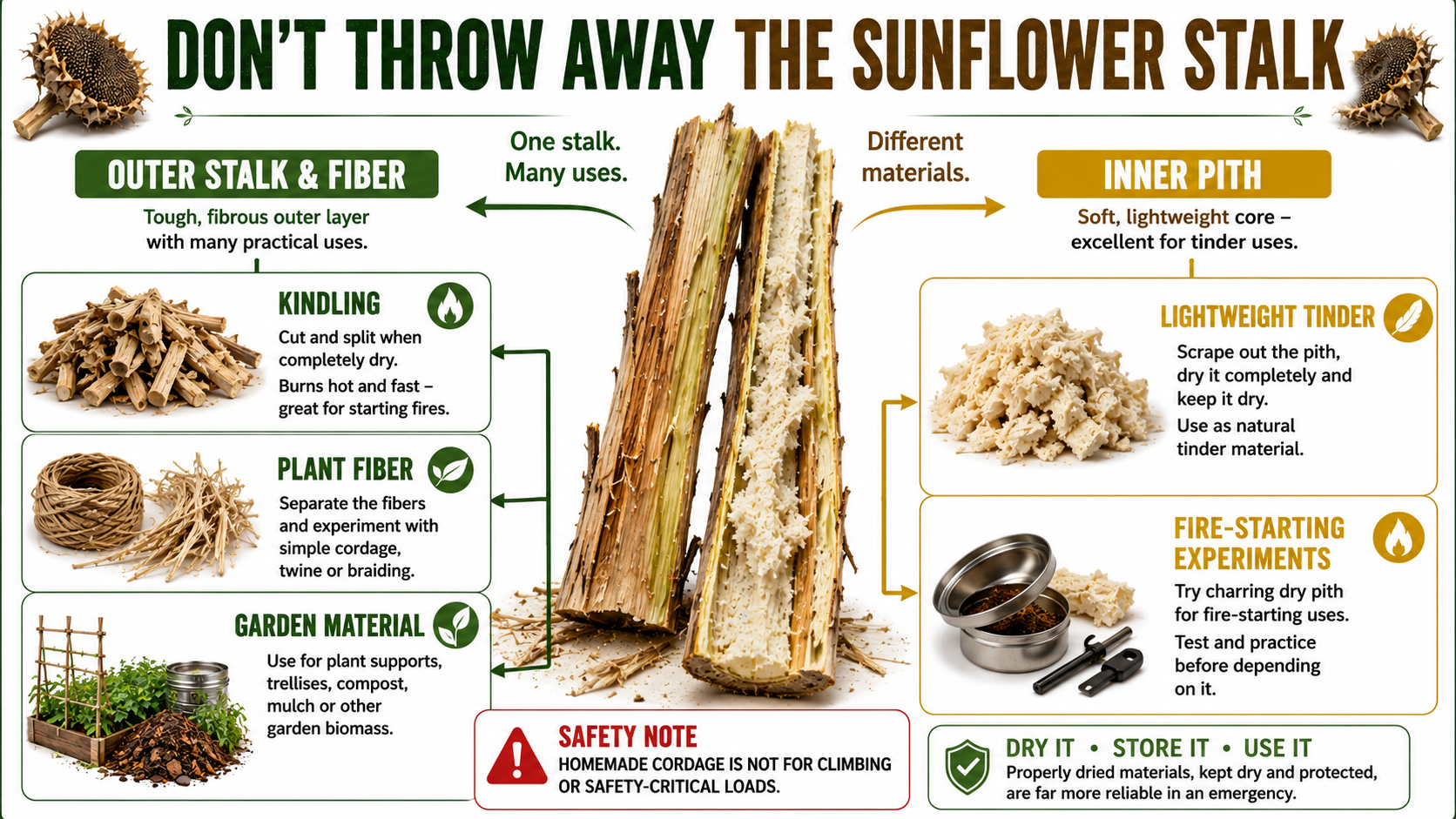
One of the easiest uses is kindling. Completely dry sunflower stalks can be cut or broken into smaller pieces and stored with firewood. They aren’t a substitute for dense hardwood because they burn relatively quickly, but fast-burning dry material is useful when you are trying to move a fire from fine tinder to larger fuel.
This also means you can get two resources from the same plant. The sunflower produces food first and fire-starting material afterward.
Turn the Stalk Into Kindling
For fire starting, let the stalk become completely dry before storing it. Cut it into manageable sections and then split some of those sections into thinner pieces.
Keep them somewhere protected from rain and ground moisture. When needed, combine the smallest dry material with your tinder and gradually add larger pieces before moving to normal firewood.
The important lesson isn’t that sunflower stalks are some magical fire-starting material. They are simply free combustible biomass produced by a crop you may already be growing. In a situation where resources matter, routinely throwing away useful dry plant material doesn’t make much sense.
There Is Useful Fiber in the Stalk
Split a mature sunflower stalk and you will notice that the outer portion is fibrous. Those fibers can be separated and experimented with for simple cordage and other projects.
Once the stalk is dry, try splitting it lengthwise and peeling or scraping the outer fibers away. Longer fibers can be worked together, twisted, or braided. This is useful practice even if the finished cordage isn’t particularly strong.
Homemade plant cordage should never automatically be trusted for climbing, lifting heavy loads, securing dangerous objects, or any other safety-critical job. Its strength can vary tremendously.
What makes the exercise valuable is learning the skill. Once you understand how plant fibers can be separated and twisted together, you begin recognizing other potential fiber plants around you. The same basic material can also be experimented with for handmade paper and other low-strength applications.
The Inside of the Stalk Is Different
The inside of a large sunflower stalk contains a soft, lightweight material called pith. Split the stalk lengthwise and the difference between the harder outer material and the soft center becomes obvious.
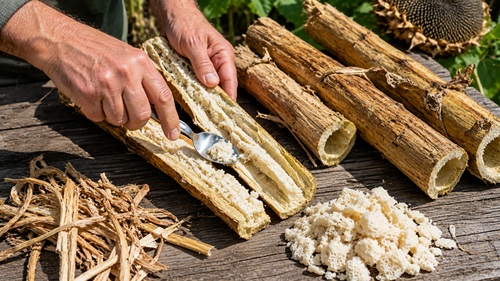
The pith can be scraped out with a spoon or another simple tool and dried. Once thoroughly dry, it becomes extremely lightweight and easy to crumble.
One of its more practical preparedness uses is tinder. Dry, porous plant material can catch and transfer heat much more readily than wet or dense material. Store thoroughly dried sunflower pith in a moisture-resistant container and experiment with it alongside other natural tinder.
The original source also experimented with drying and grinding sunflower pith into a very fine flour-like material. That is interesting as an experiment, but sunflower pith should not simply be presented as a proven substitute for ordinary flour. Anyone experimenting with unconventional plant foods should positively identify the plant and use reliable food-safety information before eating them.
For survival purposes, the more dependable lesson is that the inside of a stalk that normally ends up in the compost pile can provide lightweight material for fire-starting experiments and other practical uses.
Sunflower Material Can Be Charred for Fire Starting
Dry sunflower pith can also be experimented with as a charred tinder material. The source demonstrated heating dried pith under restricted oxygen so that it became carbonized material capable of accepting a spark.
For someone learning traditional fire-starting techniques, this is worth experimenting with under safe conditions. Charred natural materials can help catch a weak spark and hold an ember long enough to transfer it into a prepared tinder bundle.
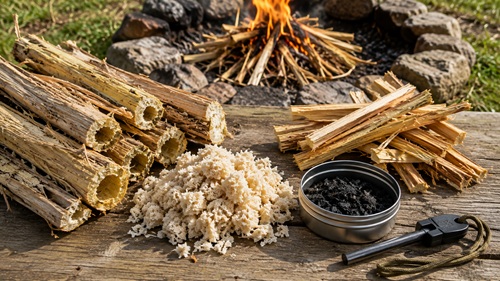
Keep the finished material dry and protected because very lightweight char can be fragile. Test it before depending on it. If a ferrocerium rod, flint-and-steel kit, or another fire-starting method is part of your emergency equipment, knowing which locally available materials actually work with it is much more valuable than discovering that during an emergency.
Do not confuse simple homemade char with properly manufactured activated carbon for drinking-water treatment. Charring plant material does not automatically produce a reliable purification medium, and it should not be depended upon to make unsafe water safe.
Use the Leftovers in the Garden
Not every part of a sunflower needs to become food or emergency equipment. Some of the remaining plant material is most useful by simply returning it to the garden.
Spent flower heads, leaves, stalk fragments, and other healthy plant material can contribute to compost and organic matter. Large stalks should usually be chopped or broken into smaller pieces if faster decomposition is desired.
Dry stalks can also be experimented with as lightweight plant supports, garden markers, temporary trellis material, or components in simple garden structures. Large sunflower stalks can be surprisingly rigid when dry, but they should not be confused with structural lumber.
Use them for jobs where failure won’t hurt anyone.
This is another preparedness principle worth remembering: a resource doesn’t have to perform an extraordinary job to be useful. If something grown on your property replaces a purchased garden stake, provides compost material, starts a cooking fire, or feeds an animal, it has already reduced your dependence on outside supplies.
Sunflowers Can Support Livestock and Wildlife
Sunflower seeds can also contribute to feeding appropriate poultry and other livestock. They shouldn’t automatically replace a nutritionally balanced feed program, but home-grown seed can become one component of a broader feeding strategy.
This gives a homestead several choices at harvest. Some seeds can be retained for household food, some reserved for planting, some allocated to animals, and some left on the plant for wildlife.
That flexibility becomes valuable when conditions change. During a normal year you may happily leave several flower heads for birds. During a poor harvest year, saving more seed for food and replanting may take priority.
Preparedness is partly about having resources, but it is also about having choices in how those resources are used.
Use Sunflowers While They Are Still Growing
Sunflowers begin providing value long before harvest.
Their flowers attract pollinators and other insects, while tall varieties can create temporary screening and limited seasonal shade. They can be planted along garden edges, around certain outdoor areas, or where their height serves a useful purpose.
Placement matters. A row of eight-foot sunflowers planted on the wrong side of a vegetable bed can shade crops that need full sunlight. Their roots also compete for water and nutrients.
Plan their location as part of the garden rather than treating them purely as decoration.
A well-positioned sunflower can provide seed, biomass, pollinator habitat, screening, and eventually useful stalk material without interfering with more important food crops.
Don’t Assume Every Part Should Be Eaten
It is tempting to describe sunflowers as plants where “everything is edible,” but that statement is too broad for a practical survival guide.
Sunflower is a common name covering multiple species and cultivated varieties, and different parts of plants can require different preparation or have very different culinary value. Even when a plant part has a history of being eaten, that doesn’t mean it should automatically become a major part of someone’s diet.
For emergency food, positive identification comes first.
Never eat a plant merely because it resembles a sunflower, and don’t experiment with unfamiliar wild plants when you are already hungry, dehydrated, sick, or far from medical care. Learn edible plants when conditions are normal and reliable references are available.
The safest and most useful food resource from the familiar cultivated sunflower remains the mature seed.
Save Seed and Make the Crop Renewable
A preparedness crop becomes considerably more valuable when you can reproduce it yourself.
Choose healthy plants with characteristics you want to keep, allow their seed heads to fully mature, and collect more planting seed than you think you will need. Dry it properly and store it somewhere cool, dry, dark, and protected from insects and rodents.
Don’t keep all of your seed in one container or one location. If moisture, rodents, mold, or an accident destroys that container, your entire planting supply can disappear at once.
Keeping some seed separate creates redundancy.
Also learn whether the sunflower variety you’re growing is a hybrid or open-pollinated variety. If reliable seed saving is part of your preparedness plan, that distinction matters.
Think of the Sunflower as a Small Resource System
The real preparedness value of a sunflower isn’t any one unusual survival trick. It’s the number of ordinary useful things that can come from a plant that is relatively straightforward to grow.
Harvest the mature seeds for food. Save some for next year. Learn whether oil production makes sense for your situation. Dry useful stalk material for kindling. Experiment with the fibers. Test the pith as tinder. Return unusable plant material to the compost pile. Use some of the harvest for appropriate livestock if needed.
Suddenly the sunflower isn’t just a flower growing at the edge of the garden.
It’s producing food, seed, biomass, fiber, tinder, garden material, animal-feed options, and the possibility of home-produced oil.
That is what makes a crop valuable from a preparedness standpoint.
Preparedness Action Plan
Plant several sunflowers during the next growing season rather than waiting until you need them. Choose varieties based on what you actually want to produce—large edible seeds, oilseed, biomass, or a combination of uses.
At harvest, don’t process every plant the same way. Save mature seed for eating and future planting. Dry several stalks and test them as kindling. Split one stalk and examine the fiber and pith. Try separating the fibers and making a short piece of cordage. Dry some pith and test how well it works with your normal fire-starting equipment.
Keep notes on what actually works.
Preparedness knowledge becomes much more useful once you’ve performed the skill yourself.
Key Takeaways
The sunflower deserves a place in a preparedness garden because it can provide several useful resources from one crop. The seeds are the most dependable resource, providing food, stored calories, fat, planting seed, and potentially oil. After harvest, dry stalks can provide kindling, fiber, lightweight garden material, and pith that can be experimented with as tinder.
The important lesson isn’t to find an exotic use for every inch of the plant. It is to waste less of what you grow and understand what each part can realistically provide.
Grow the sunflower. Harvest the food. Save the seed. Learn to use the remaining material while normal supplies are still easy to obtain.
Then, if you ever need those skills, the sunflower is no longer just something growing in the garden. It’s a resource you already know how to use.
© Prepping Communities. This content is for informational purposes only and not professional advice. Use at your own risk.
Terms | Privacy | Guidelines