
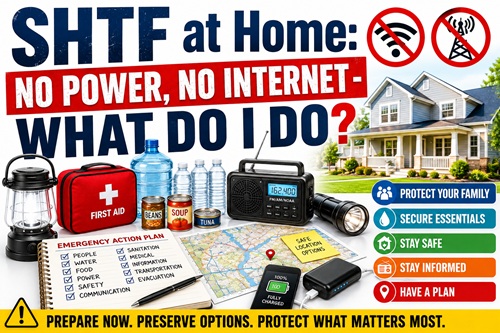
Offline Emergency Action Checklist
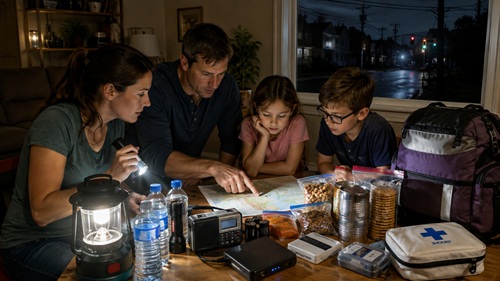
When the electricity goes out and the internet disappears, do not immediately assume the worst – but do not waste the first valuable hours either. Your first objective is to determine what has happened, account for everyone in your household, protect essential resources, gather reliable information, and prepare in case the disruption lasts much longer than expected.
Use this checklist from the top down. Skip anything that does not apply to your situation.
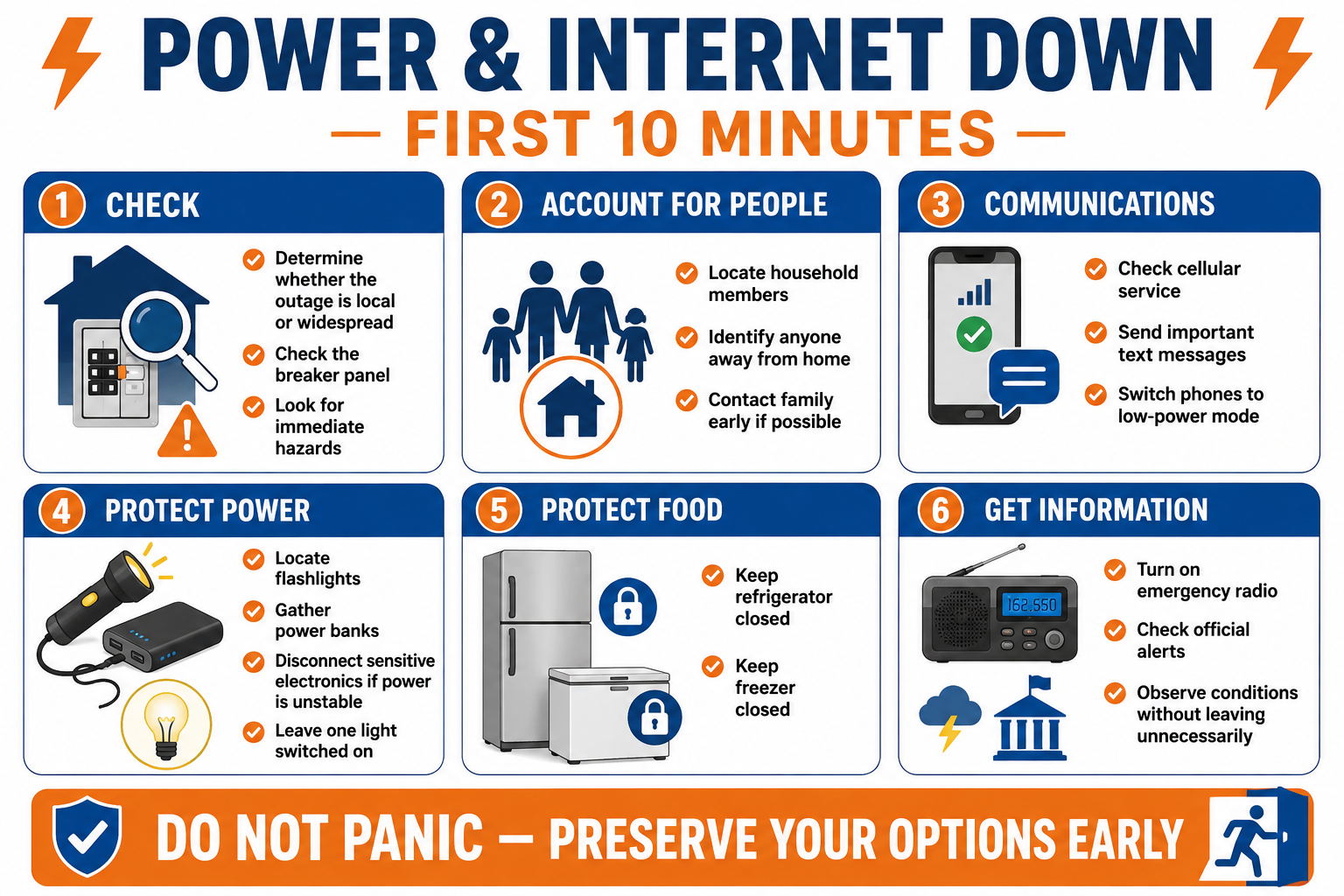
IMMEDIATE ACTIONS – FIRST 10 MINUTES
☐ Stay calm and determine whether the outage is local. Look outside for streetlights, neighboring homes, traffic signals, or other indications of a larger outage.
☐ Check your electrical panel. Make sure the problem is not simply a tripped breaker or household electrical fault.
☐ Do not repeatedly call emergency services. Call 911 only for an actual emergency.
☐ Locate every household member. Determine who is home, who is away, and where anyone outside the home was last expected to be.
☐ Locate flashlights immediately. Use flashlights and battery-powered lanterns instead of candles whenever possible.
☐ Check phones. Determine whether cellular voice, text messaging, or mobile data still works.
☐ Send necessary messages early. If family members are separated, communicate while networks are still functioning.
☐ Switch phones to low-power mode.
☐ Reduce screen brightness and unnecessary phone use.
☐ Turn off Wi-Fi and Bluetooth when they are not needed.
☐ Disconnect sensitive electronics if electrical service appears unstable. This can help protect equipment from surges when power returns.
☐ Leave one light switched on. This provides an immediate indication when electrical service returns.
☐ Do not open the refrigerator or freezer unnecessarily.
NEXT PRIORITY – FIND OUT WHAT IS HAPPENING
☐ Check a battery-powered or hand-crank radio.
☐ Check local emergency broadcasts if available.
☐ Try cellular data briefly if the network is operating.
☐ Send text messages rather than repeatedly attempting voice calls if networks are congested.
☐ Contact your designated out-of-area family contact if necessary.
☐ Listen for official emergency alerts.
☐ Observe what is happening outside without unnecessarily leaving your property.
☐ Determine whether traffic signals are operating.
☐ Look for unusual smoke, fire, flooding, police activity, evacuation traffic, or other obvious hazards.
☐ Do not travel toward disturbances simply to investigate.
☐ Write down important information as you receive it.
DETERMINE THE SCALE OF THE EVENT
Ask yourself:
☐ Is only my house affected?
☐ Is my neighborhood affected?
☐ Does the outage appear citywide?
☐ Are cellular networks functioning?
☐ Is municipal water still flowing normally?
☐ Are emergency broadcasts available?
☐ Are stores and fuel stations operating?
☐ Is there severe weather?
☐ Is there wildfire danger?
☐ Is there flooding?
☐ Is there a major accident or industrial emergency?
☐ Is there visible civil unrest?
☐ Are authorities recommending sheltering in place?
☐ Has an evacuation order or alert been issued?
The more systems failing simultaneously, the more seriously you should treat the situation.
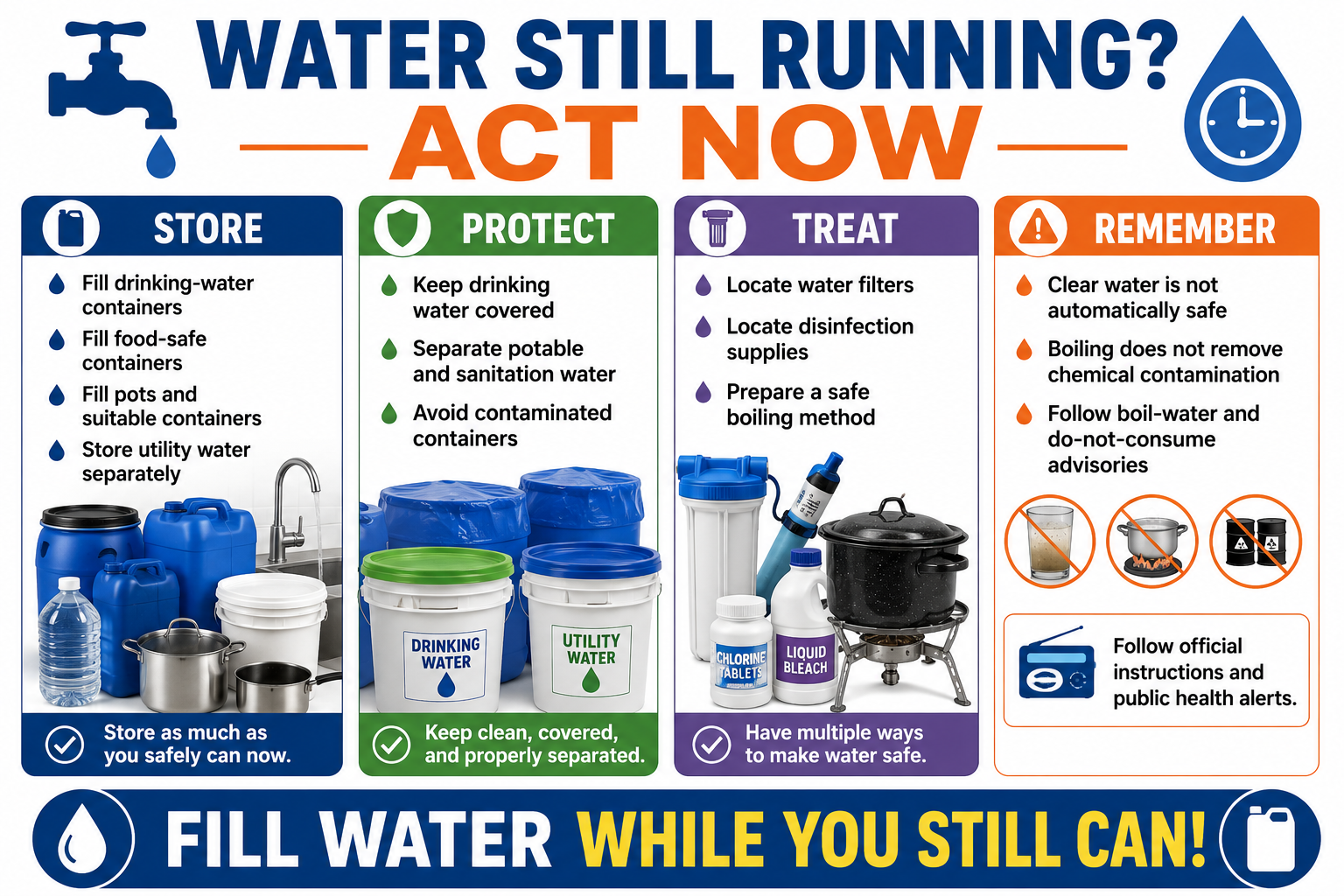
WATER – DO THIS EARLY
If there is any possibility that municipal water could fail, act while water is still available.
☐ Fill clean drinking-water containers.
☐ Fill additional food-safe containers.
☐ Fill pots and suitable containers with water.
☐ Fill appropriate containers for washing and sanitation.
☐ Consider filling a bathtub for utility water if appropriate.
☐ Keep drinking water separate from sanitation water.
☐ Identify your existing stored drinking water.
☐ Locate your water filters.
☐ Locate water purification or disinfection supplies.
☐ Locate equipment that can boil water safely without grid electricity.
☐ Determine whether your water heater can provide emergency water and review the correct procedure before attempting to drain it.
☐ If authorities issue a boil-water or do-not-consume advisory, follow it.
IMPORTANT
Do not assume clear water is safe.
Do not assume boiling removes chemicals, fuel, heavy metals, or other chemical contamination.
If the water source may have been chemically contaminated, use a known safe source instead whenever possible.
FOOD – PROTECT WHAT YOU HAVE
☐ Keep refrigerator doors closed.
☐ Keep freezer doors closed.
☐ Decide what food should be consumed first if the outage continues.
☐ Use perishable refrigerated foods before opening long-term emergency supplies when food-safety guidance permits.
☐ Move toward shelf-stable foods as the outage continues.
☐ Identify meals requiring no cooking.
☐ Inventory canned foods.
☐ Inventory dry foods.
☐ Inventory emergency foods.
☐ Locate a manual can opener.
☐ Determine how much safe cooking fuel you have.
☐ Begin conserving cooking fuel immediately if the outage appears prolonged.
☐ Do not consume questionable refrigerated food simply to avoid wasting it.
NEVER
Never operate charcoal grills indoors.
Never operate generators indoors.
Never operate outdoor camping stoves inside enclosed living spaces unless the equipment is specifically approved for indoor use.
Carbon monoxide can kill without warning.
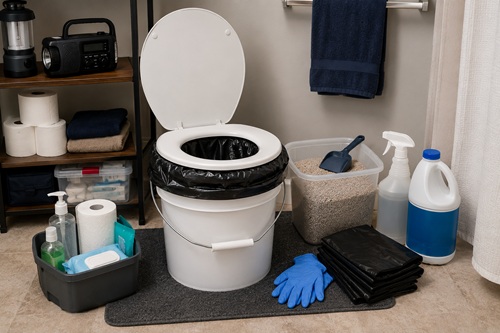
SANITATION – PREPARE BEFORE THE TOILET STOPS WORKING
☐ Determine whether toilets are flushing normally.
☐ Watch for sewer backups or unusual drainage problems.
☐ Locate heavy-duty garbage bags.
☐ Locate buckets or emergency toilet equipment.
☐ Locate toilet paper.
☐ Locate soap.
☐ Locate disinfectant.
☐ Locate disposable gloves if available.
☐ Locate absorbent material suitable for emergency sanitation.
☐ Establish a designated waste area away from food and drinking-water storage.
☐ Keep human waste isolated from living and food-preparation areas.
☐ Increase handwashing discipline immediately if normal sanitation begins failing.
Do not continue flushing toilets if sewage is backing up into the home.
LIGHTING
☐ Gather flashlights.
☐ Gather headlamps.
☐ Gather battery lanterns.
☐ Locate spare batteries.
☐ Place lighting where people could fall—stairs, bathrooms, hallways, and entrances.
☐ Give each household member a personal flashlight if possible.
☐ Conserve batteries.
☐ Avoid leaving unnecessary lights running.
☐ Cover windows if bright interior lighting makes the home conspicuous during a widespread blackout.
BACKUP POWER
☐ Inventory charged power banks.
☐ Prioritize phones and essential communications equipment.
☐ Charge only devices that actually matter.
☐ Use solar charging equipment if available and conditions permit.
☐ Determine how much generator fuel is available.
☐ Calculate approximately how long the available fuel must last.
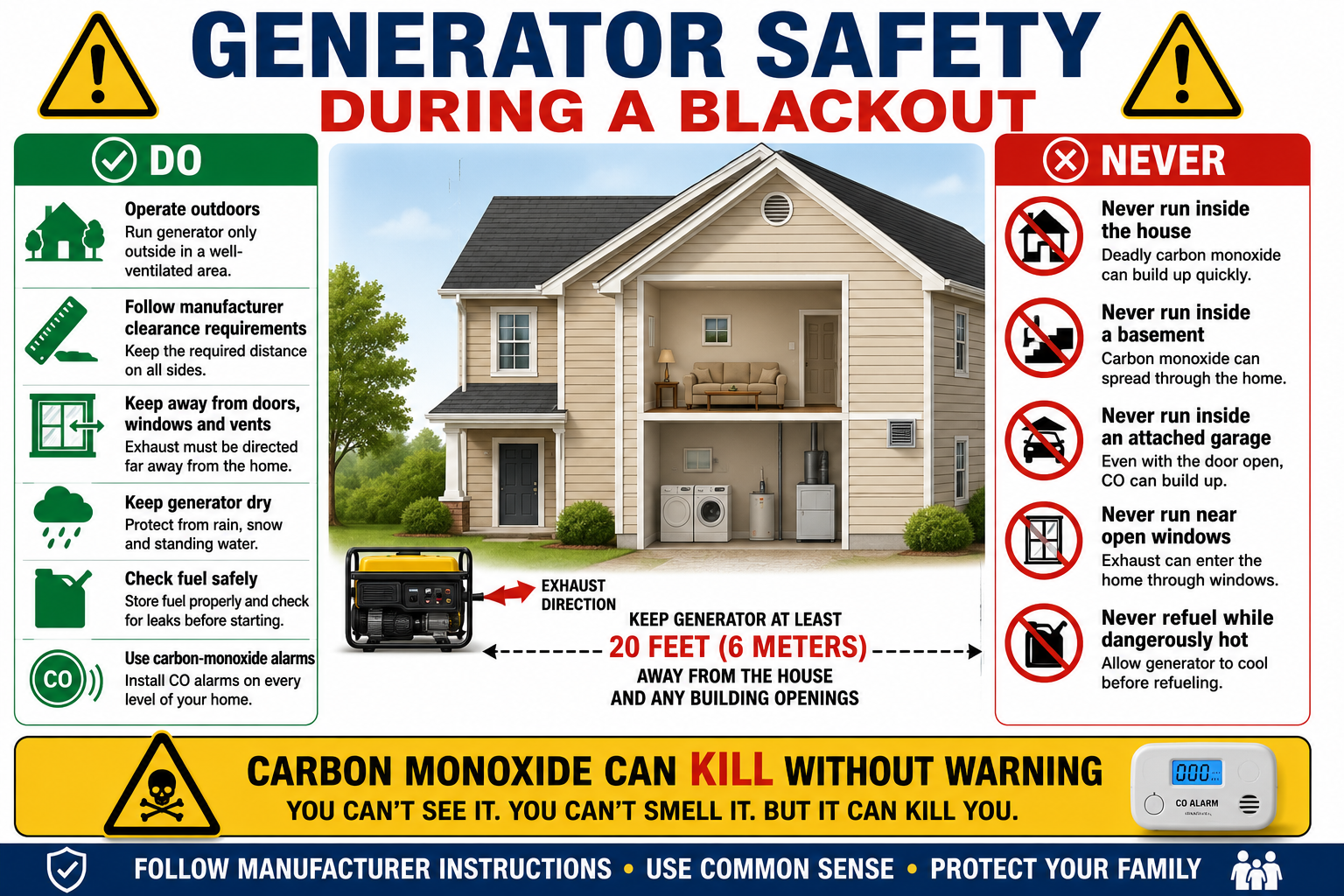
☐ Run generators only outdoors at a safe distance from doors, windows, vents, and occupied structures according to manufacturer instructions.
☐ Never run a generator inside a house, basement, attached garage, shed connected to the home, or other enclosed area.
☐ Confirm carbon-monoxide alarms are operating.
COMMUNICATION PLAN
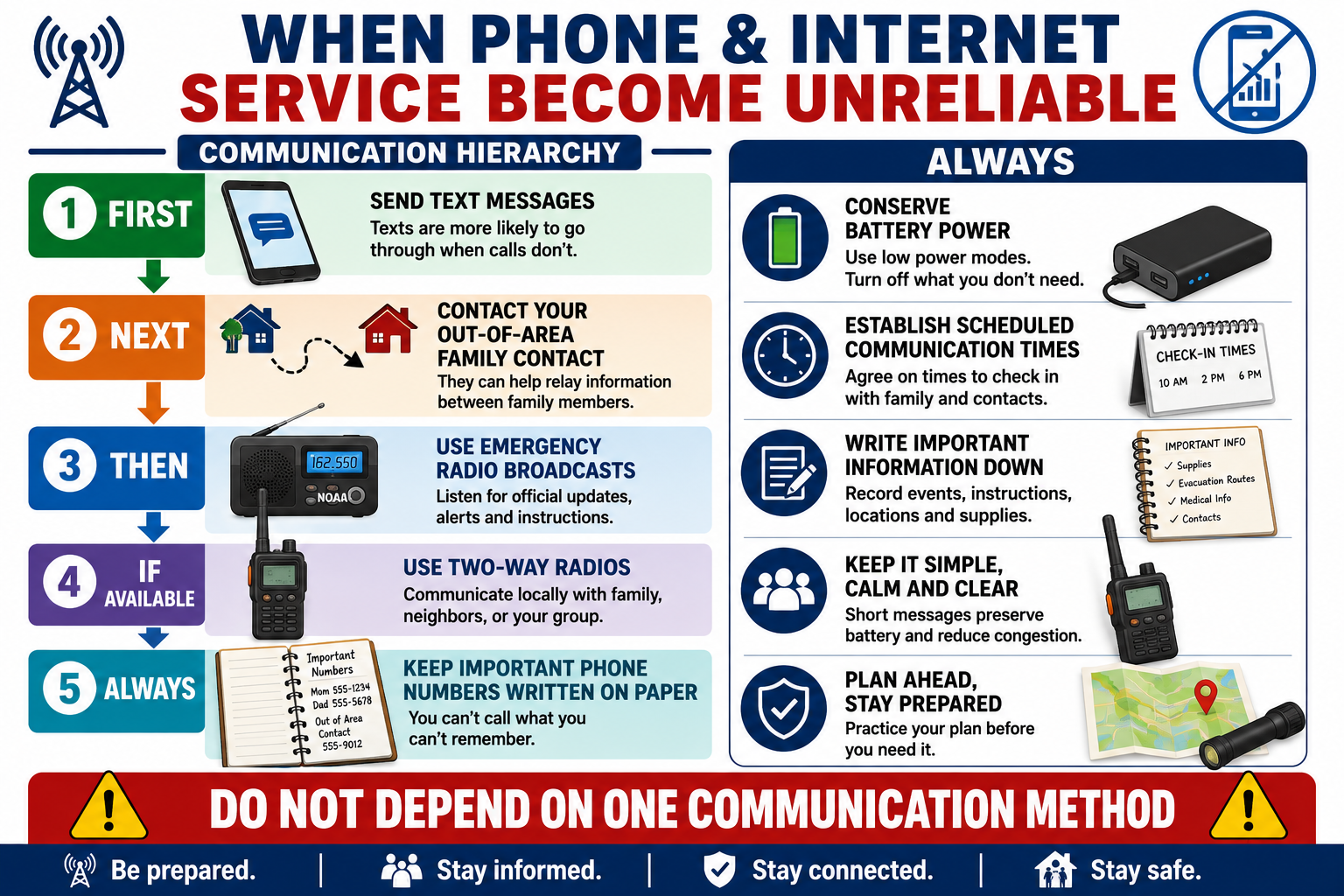
☐ Account for everyone.
☐ Contact separated family members early if possible.
☐ Use text messaging when voice networks are congested.
☐ Use the household’s predetermined out-of-area contact.
☐ Write down important telephone numbers.
☐ Establish specific communication times instead of leaving radios and phones operating constantly.
☐ Monitor emergency radio broadcasts periodically.
☐ Conserve phone batteries.
☐ If two-way radios are available, distribute them according to your household communications plan.
☐ Keep important information written on paper.
SECURITY – BECOME LESS NOTICEABLE
A blackout or infrastructure emergency does not automatically mean violence. Do not create unnecessary confrontation or assume everyone outside is dangerous.
Instead, become observant and discreet.
☐ Lock exterior doors.
☐ Lock accessible windows.
☐ Close garage doors.
☐ Secure sheds and outbuildings.
☐ Bring valuable portable equipment inside when practical.
☐ Keep emergency supplies out of public view.
☐ Avoid advertising generators, fuel, food, water, communications equipment, or other resources.
☐ Avoid discussing the size of your stockpile with strangers.
☐ Keep curtains or blinds closed when appropriate.
☐ Maintain exterior awareness.
☐ Know which neighbors are nearby.
☐ Avoid unnecessary nighttime travel.
☐ Do not approach disturbances.
☐ Do not confront people unless absolutely necessary to protect immediate safety.
☐ Maintain a low profile.
Your primary security strategy should be avoidance, distance, discretion, strong doors and locks, communication, and early recognition of danger.
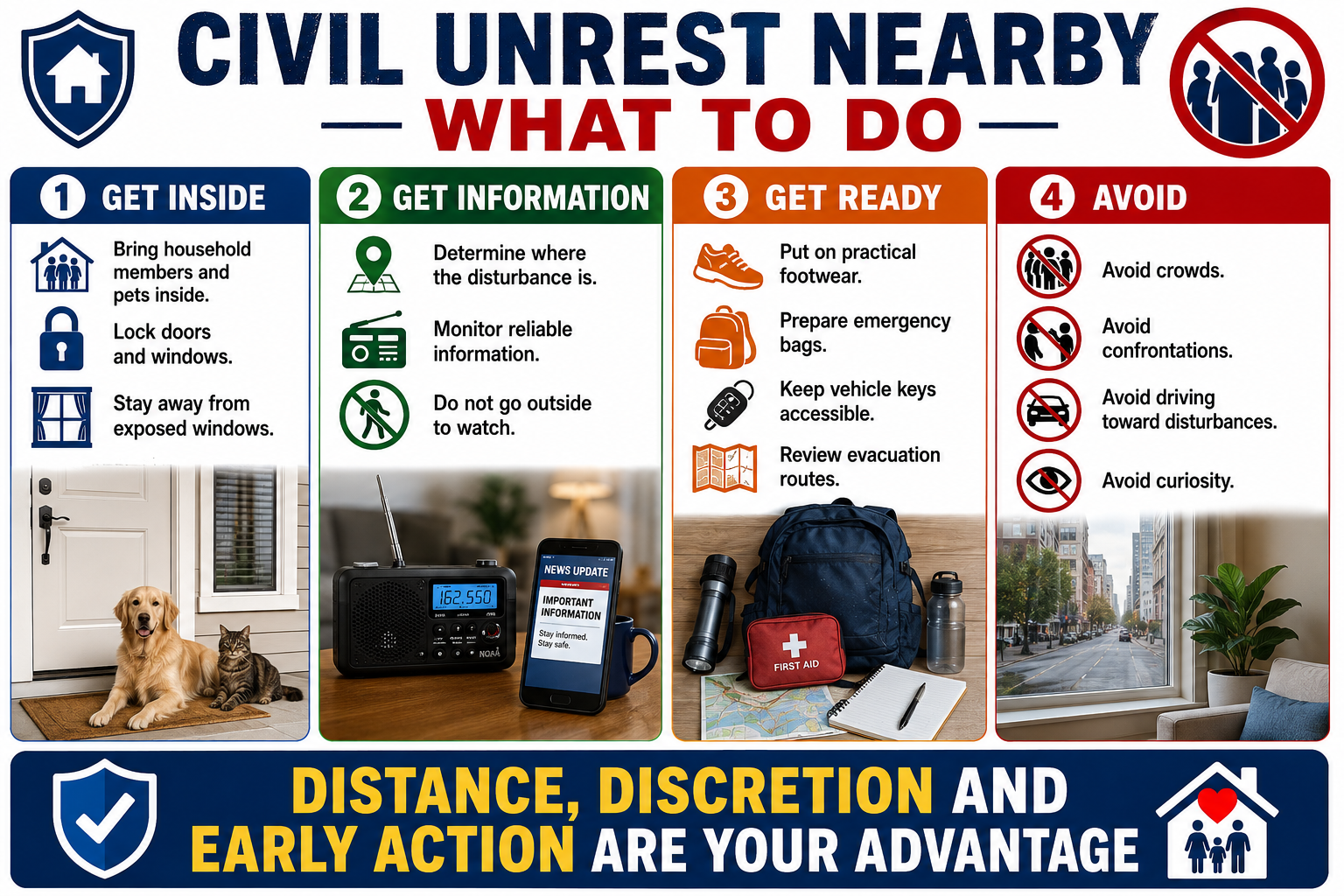
IF CIVIL UNREST BEGINS NEARBY
☐ Go inside.
☐ Account for everyone.
☐ Lock doors and windows.
☐ Stay away from street-facing windows.
☐ Bring pets inside.
☐ Monitor reliable information sources.
☐ Determine where the disturbance is occurring.
☐ Determine whether it is approaching your neighborhood.
☐ Avoid driving toward the disturbance.
☐ Do not go outside to watch.
☐ Do not photograph or record events from exposed positions.
☐ Identify the safest interior area of the home.
☐ Prepare evacuation supplies in case conditions deteriorate.
☐ Put shoes and practical clothing on.
☐ Keep vehicle keys immediately accessible.
☐ Review your evacuation routes.
☐ Identify routes that avoid the disturbance.
☐ Leave early if your predetermined evacuation conditions are reached.
TEMPERATURE CONTROL
If It Is Cold
☐ Close unused rooms.
☐ Concentrate household activity into a smaller living area.
☐ Put on layers before becoming cold.
☐ Use hats, socks, blankets, and sleeping bags.
☐ Protect water pipes from freezing where possible.
☐ Monitor vulnerable household members.
☐ Never use an outdoor grill or unsafe combustion heater indoors.
☐ Keep carbon-monoxide alarms operational.
If It Is Hot
☐ Close blinds on sun-facing windows.
☐ Use shaded areas of the home.
☐ Reduce strenuous activity.
☐ Drink water regularly.
☐ Use safe ventilation when outdoor conditions permit.
☐ Monitor children, older adults, pets, and anyone vulnerable to heat.
☐ Relocate before indoor temperatures become dangerous if a safe location is available.
MEDICAL CHECK
☐ Locate first-aid supplies.
☐ Locate prescription medications.
☐ Determine how many days of necessary medication remain.
☐ Identify medications requiring refrigeration.
☐ Identify electrically powered medical equipment.
☐ Determine backup-power requirements.
☐ Locate eyeglasses and necessary mobility equipment.
☐ Keep medical information available on paper.
☐ Identify anyone whose medical needs could require earlier evacuation.
Do not wait until the final battery or final medication dose before making relocation decisions.
VEHICLE CHECK
☐ Check the fuel level.
☐ Keep the vehicle available unless travel is necessary.
☐ Do not waste fuel investigating the outage.
☐ Locate vehicle emergency supplies.
☐ Put printed road maps in the vehicle.
☐ Keep vehicle keys in a known location.
☐ Park where the vehicle can leave without unnecessary maneuvering if practical.
☐ Identify primary and secondary evacuation routes.
☐ Consider whether roads, bridges, tunnels, railway crossings, or other choke points could become blocked.
☐ Do not run a vehicle inside a closed garage.
PREPARE TO EVACUATE – EVEN IF YOU ARE STAYING
Preparing to leave does not mean you must leave.
It means you preserve the option.
☐ Place bug-out bags where they can be reached immediately.
☐ Pack necessary medications.
☐ Pack identification.
☐ Pack important documents or protected copies.
☐ Pack water.
☐ Pack portable food.
☐ Pack communications equipment.
☐ Pack power banks and charging cables.
☐ Pack appropriate clothing.
☐ Pack basic hygiene supplies.
☐ Pack necessary pet supplies.
☐ Pack printed maps.
☐ Pack cash.
☐ Prepare seasonal clothing and footwear.
☐ Determine where you would actually go.
☐ Tell household members the evacuation plan.
☐ Establish a rally point if separated.
☐ Identify at least two routes.
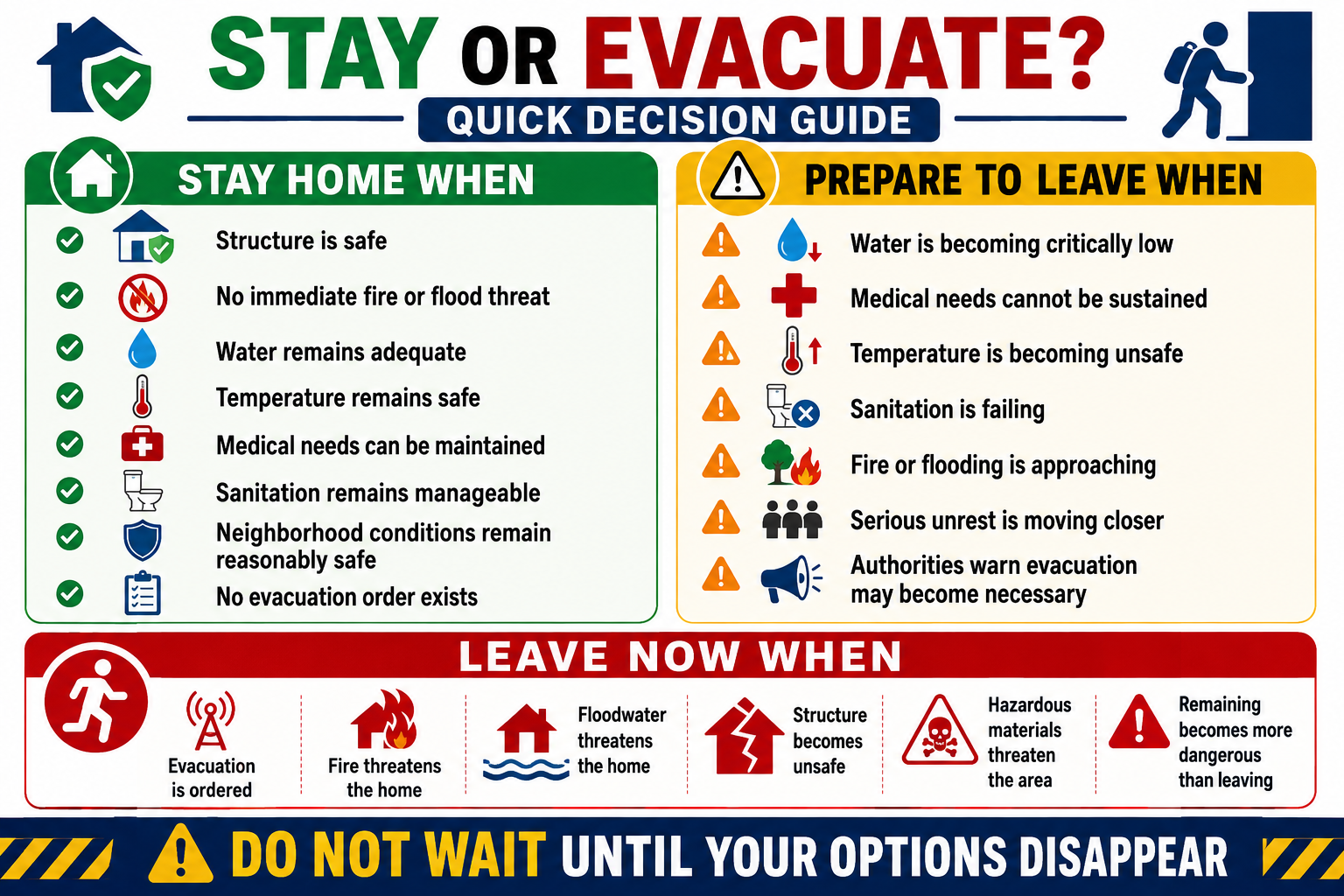
DO I STAY OR LEAVE?
STAY HOME IF:
☐ The structure remains safe.
☐ There is no immediate fire or wildfire threat.
☐ Flooding is not threatening the property.
☐ There is no dangerous chemical release affecting the area.
☐ Indoor temperatures remain manageable.
☐ Drinking water remains adequate.
☐ Essential medical needs can be maintained.
☐ Sanitation remains manageable.
☐ The neighborhood remains reasonably safe.
☐ Authorities have not ordered evacuation.
☐ Leaving would expose the household to greater danger.
PREPARE TO LEAVE IF:
☐ Water supplies are becoming critically low.
☐ Indoor temperatures are approaching unsafe levels.
☐ Essential medications or medical equipment cannot be maintained.
☐ Sanitation conditions are becoming unsafe.
☐ Fire or wildfire conditions are worsening.
☐ Flooding is approaching.
☐ Serious unrest is moving toward the neighborhood.
☐ The building is becoming unsafe.
☐ Authorities warn that evacuation may become necessary.
LEAVE WHEN:
☐ Authorities order evacuation.
☐ Fire threatens the home.
☐ Floodwater threatens the home.
☐ The structure becomes unsafe.
☐ A hazardous-material release threatens the area.
☐ Essential medical needs cannot safely be maintained.
☐ Remaining at the location clearly becomes more dangerous than leaving.
Do not wait for every other person in the neighborhood to make the same decision.
FIRST 24 HOURS
☐ Account for everyone.
☐ Determine the scale of the emergency.
☐ Secure drinking water.
☐ Protect refrigerated and frozen food.
☐ Establish communications.
☐ Establish lighting.
☐ Establish sanitation.
☐ Inventory medications.
☐ Inventory food.
☐ Inventory water.
☐ Inventory batteries.
☐ Inventory generator fuel.
☐ Check the vehicle fuel level.
☐ Monitor official information.
☐ Contact trusted neighbors if appropriate.
☐ Prepare evacuation equipment.
☐ Establish household responsibilities.
☐ Record important developments on paper.
24–72 HOURS
If electricity and communications have still not returned, shift from short-term outage thinking to resource conservation.
☐ Recalculate drinking-water supplies.
☐ Recalculate food supplies.
☐ Recalculate fuel supplies.
☐ Recalculate battery capacity.
☐ Reassess sanitation.
☐ Reassess indoor temperature.
☐ Reassess medical needs.
☐ Reassess neighborhood conditions.
☐ Check on trusted neighbors when safe.
☐ Reduce unnecessary power consumption.
☐ Reduce unnecessary cooking.
☐ Reduce unnecessary vehicle use.
☐ Establish regular radio monitoring periods.
☐ Establish household routines.
☐ Maintain hygiene.
☐ Maintain sleep schedules where possible.
☐ Continue monitoring evacuation routes.
☐ Reevaluate the stay-or-leave decision at least daily.
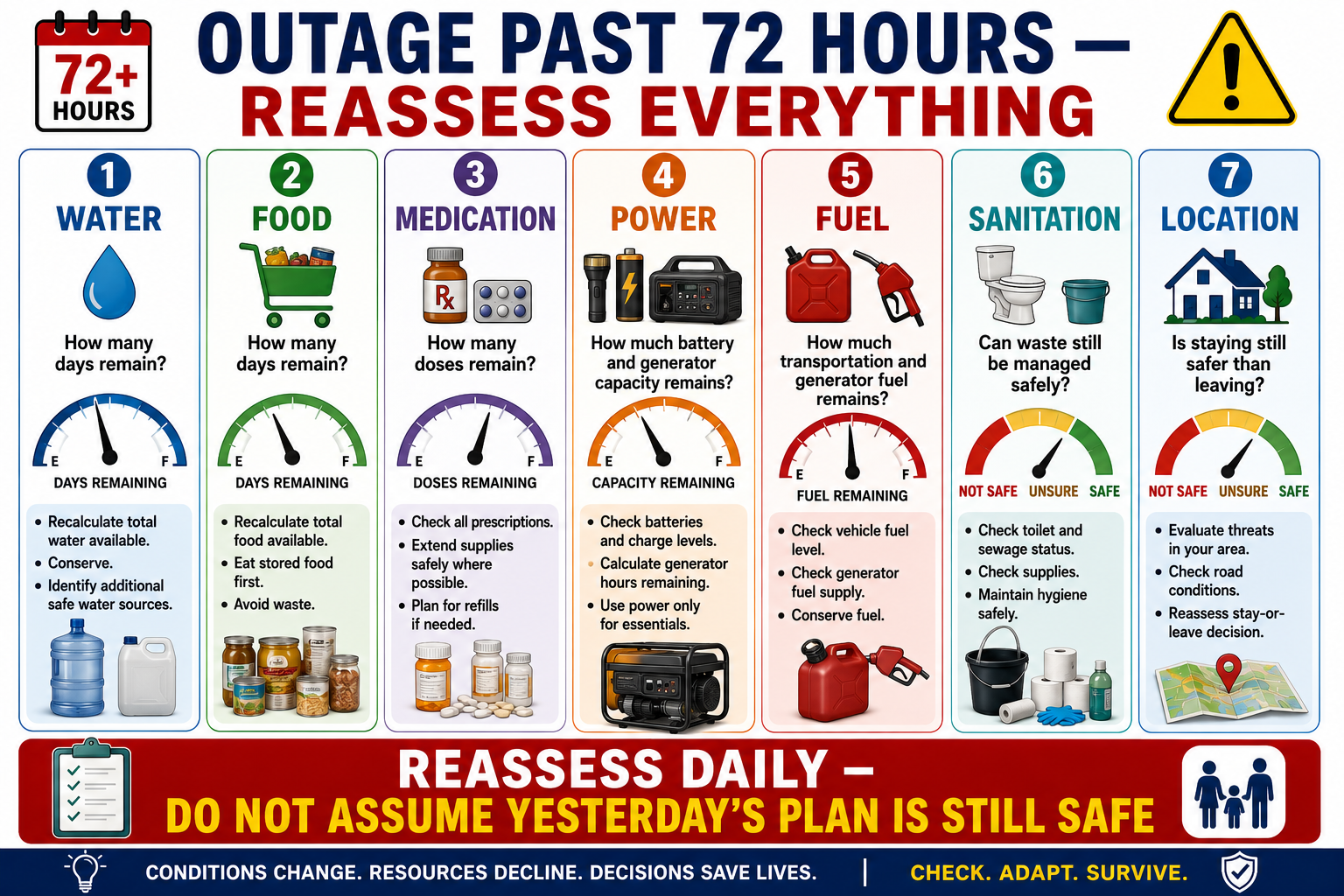
AFTER 72 HOURS
A disruption lasting longer than three days should be treated differently from an ordinary blackout.
☐ Calculate remaining drinking water in days.
☐ Calculate remaining food in days.
☐ Calculate remaining medications in days.
☐ Calculate remaining generator fuel in hours or days.
☐ Determine whether additional safe water can be obtained.
☐ Determine whether sanitation remains sustainable.
☐ Determine whether the home can remain safely heated or cooled.
☐ Determine whether emergency services remain functional.
☐ Determine whether local stores are operating.
☐ Determine whether fuel is available.
☐ Determine whether roads remain passable.
☐ Determine whether local authorities are providing assistance.
☐ Determine whether your planned evacuation destination remains accessible.
☐ Reassess whether leaving now is safer than potentially leaving later.
Do not consume resources at the same rate simply because you have a large stockpile.
The longer the emergency continues, the more valuable every remaining resource becomes.
IF YOU HAVE TO LEAVE ON FOOT
☐ Wear durable, comfortable footwear.
☐ Dress for the weather.
☐ Take water.
☐ Take necessary medications.
☐ Take identification.
☐ Take a printed map.
☐ Take a flashlight or headlamp.
☐ Take basic first aid.
☐ Take compact food.
☐ Take weather protection.
☐ Take a charged phone and power bank.
☐ Avoid overloaded packs.
☐ Avoid obvious disturbances.
☐ Avoid large crowds where practical.
☐ Use predetermined routes.
☐ Change routes if conditions become unsafe.
☐ Tell someone your destination if communications permit.
The goal is to reach safety, not carry every preparedness item you own.
DO NOT DO THESE THINGS
☐ Do not panic-buy supplies you should already have.
☐ Do not waste fuel driving around for information.
☐ Do not approach riots, fires, accidents, or disturbances out of curiosity.
☐ Do not spread unverified rumors.
☐ Do not advertise your supplies.
☐ Do not unnecessarily reveal your preparedness level.
☐ Do not open refrigerators and freezers repeatedly.
☐ Do not waste drinking water on tasks that can use non-potable water.
☐ Do not operate generators indoors.
☐ Do not use outdoor grills indoors.
☐ Do not ignore carbon-monoxide hazards.
☐ Do not drink questionable water without appropriate treatment.
☐ Do not assume boiling removes chemical contamination.
☐ Do not continue using plumbing if sewage is backing up.
☐ Do not wait until resources are completely exhausted before deciding to relocate.
☐ Do not evacuate without knowing where you are going unless remaining in place presents an immediate danger.
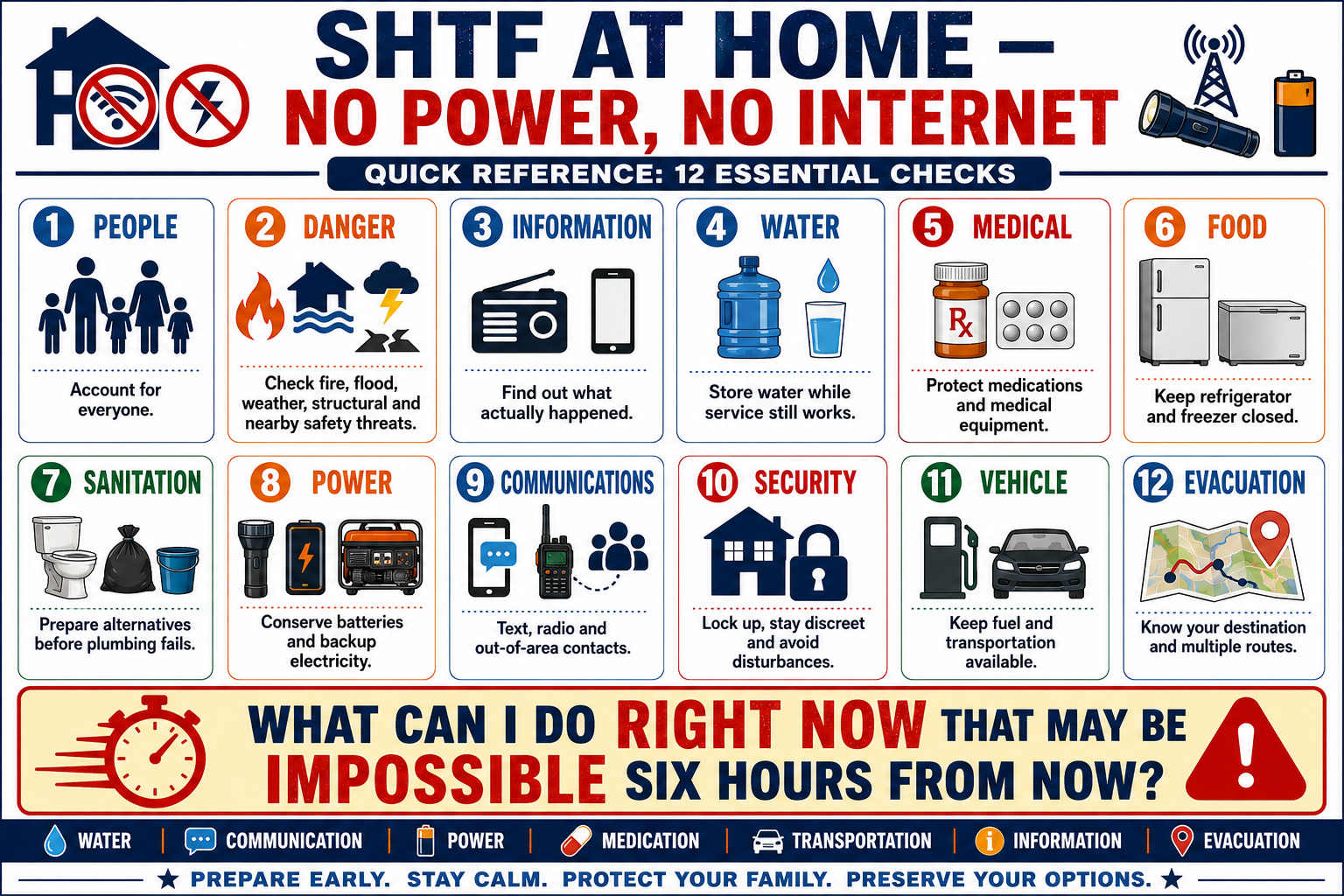
THE 60-SECOND EMERGENCY CHECK
If you return to this guide during a stressful situation and need the shortest possible version, start here:
PEOPLE — Is everyone accounted for?
DANGER — Fire, flood, violence, structural damage, severe weather, hazardous materials?
INFORMATION — What actually happened?
WATER — Do we have enough? Should containers be filled now?
MEDICAL — Does anyone need medication, refrigeration, electricity, or immediate care?
FOOD — Keep refrigerator and freezer closed.
SANITATION — Is water and sewage service working?
POWER — What backup electricity and fuel are available?
COMMUNICATIONS — Can family members communicate?
SECURITY — Doors locked? Anything unusual nearby?
TEMPERATURE — Can the house remain safely occupied?
VEHICLE — Fueled and ready if necessary?
ROUTES — Primary and alternate evacuation routes available?
DESTINATION — Where will we go if we leave?
DECISION — Is staying safer than leaving right now?
Then ask the most important question:
WHAT COULD I DO RIGHT NOW THAT MAY BECOME IMPOSSIBLE SIX HOURS FROM NOW?
Fill water containers.
Contact family.
Charge equipment.
Obtain reliable information.
Move a vehicle.
Prepare medications.
Secure the property.
Help a vulnerable family member.
Leave before roads become congested.
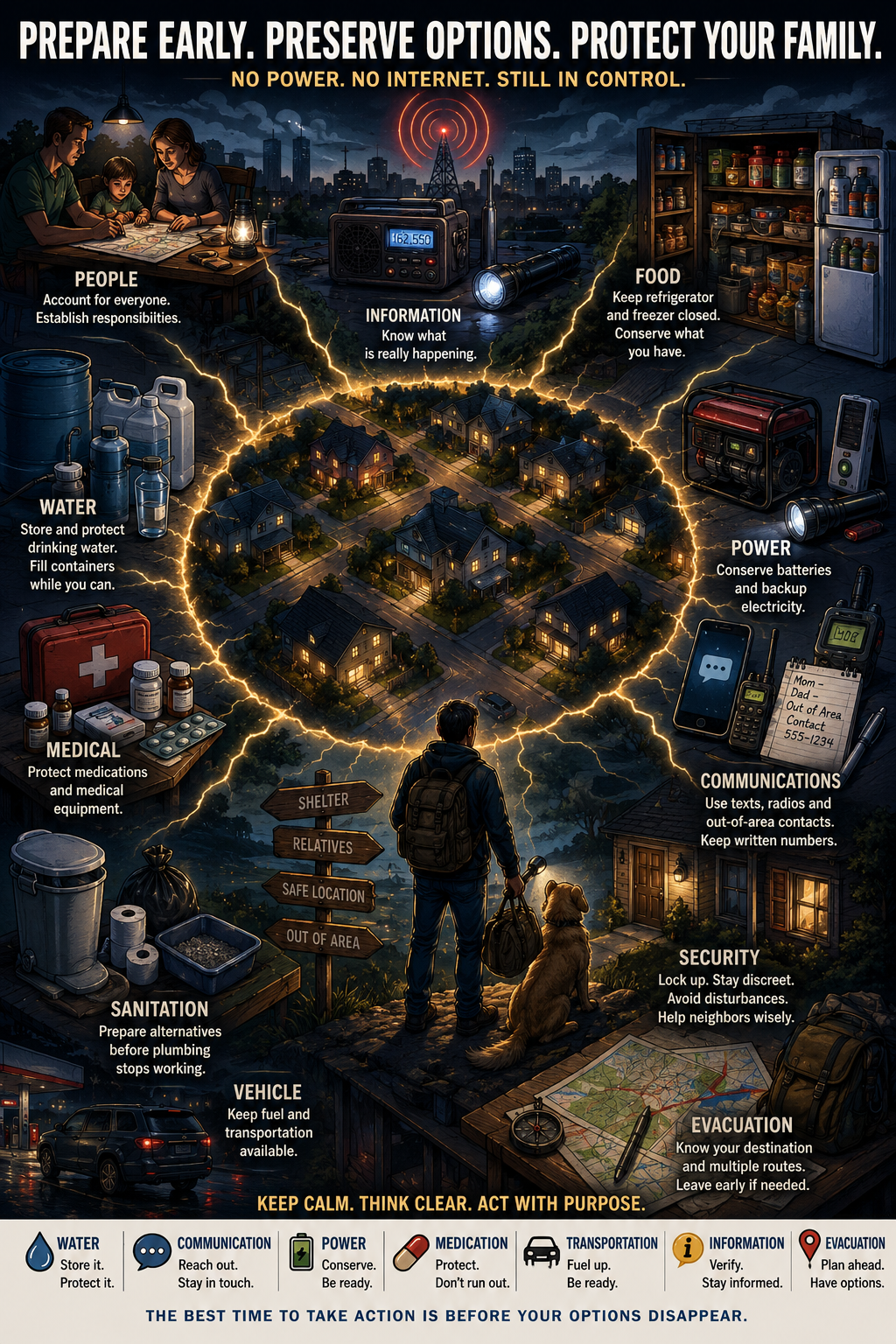
Preparation during the early stages of an emergency should concentrate on preserving options before those options disappear.
Preparedness Action Plan
Print this checklist and keep a physical copy with your household emergency supplies. Do not depend upon the same electrical grid or internet connection that may disappear during the emergency.
Walk through the checklist before an emergency and identify anything you cannot currently accomplish.
If you cannot provide wateo r without the municipal system, fix the water problem.
If you cannot cook without electricity, establish a safe alternative.
If you cannot communicate without the internet, establish another method.
If you do not know how to manage sanitation without running water, build a sanitation kit.
If you do not know where you would evacuate, establish destinations.
If you have only one route out of the neighborhood, find alternatives.
The objective is simple:
Know what to do before you need to do it.
Key Takeaways
When the power and internet disappear, begin with people, immediate hazards, information, water, medical needs, sanitation, food, communications, temperature, security, and transportation.
Do not automatically evacuate and do not automatically stay.
Continually determine which option is safer.
Protect resources early. Fill water containers while water is available. Communicate while networks work. Charge equipment while power remains. Prepare transportation before roads become congested. Establish sanitation before it becomes a problem.
Most importantly, preserve options.
The best time to perform an emergency action is often before everyone realizes that action has become necessary.
Disclaimer
This checklist is intended for general preparedness and emergency-planning purposes. Actual emergencies vary considerably. Follow evacuation orders, emergency alerts, public-health advisories, utility instructions, manufacturer safety requirements, and directions from appropriate local authorities. Never remain in a location threatened by fire, flooding, structural failure, hazardous materials, or another immediate life-safety hazard merely to complete this checklist.
© Prepping Communities. This content is for informational purposes only and not professional advice. Use at your own risk.
Terms | Privacy | Guidelines