
Which Chickens Are Right for Your Homestead?
Raising chickens is one of the more practical ways to begin producing food at home. A relatively small flock can provide hundreds of eggs each year while also producing manure for composting, consuming some appropriate kitchen and garden scraps, foraging for insects, and giving a household experience caring for a renewable food source.
The difficult part isn’t deciding that fresh eggs would be useful. It is deciding what kind of chickens should produce them.
There are chickens bred almost entirely around egg production, traditional breeds that provide both eggs and meat, heavy birds that tolerate cold well, lightweight birds better suited to hot weather, calm chickens that work well in a backyard, and active breeds that perform particularly well when allowed to forage. There are also commercial hybrids capable of tremendous egg production but which don’t reproduce predictably if you want to establish your own breeding flock.
That means there really isn’t a single “best” egg-laying chicken.
The better question is: which chickens are best for what you want your flock to accomplish?
For someone interested in greater household self-sufficiency, that distinction matters. Producing a large number of eggs is valuable, but so are hardiness, feed efficiency, temperament, foraging ability, climate tolerance, longevity, and the ability to produce future generations.
Understanding those differences before buying your first chicks can save a great deal of frustration later.
Start With What You Expect From the Flock
Before choosing a breed, decide what role chickens will have on your property.
If the objective is simply obtaining as many eggs as reasonably possible from a small number of birds, specialized laying chickens make sense. A household with limited backyard space may prefer four highly productive hens rather than maintaining eight lower-producing birds.
A homestead may have different priorities. Eggs may still be the primary objective, but the household might also want chickens that forage effectively, tolerate severe winters, provide some meat value, live in a mixed flock, or reproduce naturally.
Those requirements can change which chicken is the better choice.
A hen capable of producing 300 eggs annually isn’t automatically more useful than one producing 230. The lower-producing bird may be larger, calmer, more cold-hardy, more likely to hatch chicks, or better adapted to the environment where it actually lives.
Annual production numbers should therefore be used for comparison rather than treated as guarantees. Egg production changes with genetics, age, nutrition, health, daylight, temperature, stress, molting, and management. Even two hens of the same breed may perform differently.
Choose the flock around your household rather than building your household around the chickens.
Understanding High-Production Egg Layers
If maximum egg production is the priority, the White Leghorn deserves serious consideration. Leghorns have been selected for efficient egg production and productive strains can commonly produce somewhere around 280 to 320 large white eggs annually under good conditions.
Their relatively small body size is part of their advantage. Maintaining a large chicken requires energy and nutrients. A smaller laying bird can direct more of its nutritional intake toward producing eggs rather than maintaining body mass.
Leghorns are also active chickens and can be capable foragers. The tradeoff is that they tend to be more alert and flighty than some of the heavier traditional breeds. Someone looking for calm backyard chickens that enjoy being handled may prefer something else.
Climate matters as well. Their prominent single combs can be more vulnerable to frostbite during severe winter conditions, so a Leghorn that performs exceptionally well in a warm environment may require additional management in a northern climate.
Production hybrids provide another option for households primarily interested in eggs. Golden Comets, Black Sex Links, Red Sex Links, Gold Sex Links, and similar commercial crosses are developed to provide strong laying performance, and many can produce somewhere in the range of 250 to more than 300 eggs annually during their strongest production years.
Many of these hybrids also begin laying relatively early and can have manageable temperaments, making them attractive for beginners.
Their disadvantage becomes more important when long-term self-sufficiency is the objective. They are hybrids rather than established breeds that reliably reproduce the same characteristics generation after generation. Breeding two production hybrids together doesn’t simply create another generation of identical high-production birds.
If you’re comfortable purchasing replacement hens periodically, that isn’t necessarily a problem. If you eventually want your flock to reproduce itself, it becomes an important consideration.
Traditional Homestead Chickens Offer Something Different
A traditional dual-purpose chicken usually won’t outperform the most specialized commercial layer in raw egg numbers, but that isn’t necessarily what it was developed to do.
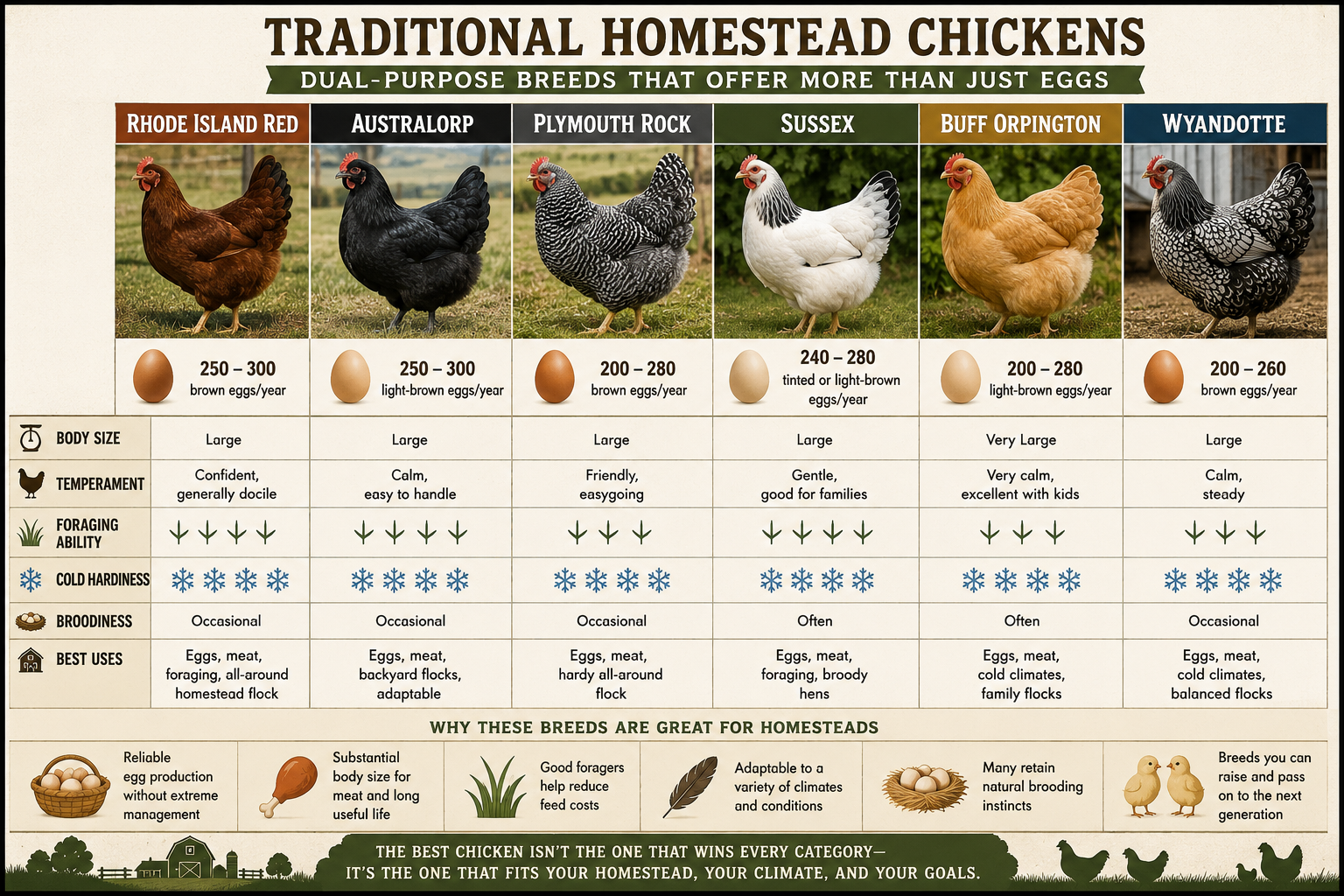
Rhode Island Reds are a good example. Productive laying strains can provide roughly 250 to 300 brown eggs annually while maintaining considerably more body size than a Leghorn. They are generally hardy, capable foragers and useful in a flock where chickens are expected to contribute more than eggs.
Australorps offer another particularly attractive balance. Good laying strains can produce somewhere around 250 to 300 light-brown eggs annually while remaining substantial enough to function as dual-purpose chickens. They are also generally known for manageable temperaments and adaptability.
For someone who wants good egg production but doesn’t want a flock built entirely around specialized commercial laying characteristics, the Australorp may be one of the strongest chickens to consider.
Plymouth Rocks follow the same general philosophy. The familiar Barred Rock isn’t normally selected to compete with a specialized layer for maximum production, but hens can still provide roughly 200 to 280 brown eggs annually while offering good body size, hardiness, and generally manageable behaviour.
Sussex chickens provide another traditional option. Productive birds may provide approximately 240 to 280 tinted or light-brown eggs annually while also functioning as substantial dual-purpose chickens. They can be good foragers, and some hens retain useful brooding instincts.
Buff Orpingtons generally produce fewer eggs than the highest-performing laying breeds, often somewhere around 200 to 280 annually depending upon the strain and conditions. What they offer in return is a larger body, heavy feathering, generally calm temperament, cold tolerance, and a greater tendency among some hens to become broody.
Wyandottes provide another useful combination of moderate egg production, substantial body size, and cold-weather suitability. Their compact rose comb can also be advantageous in very cold conditions because there is less exposed comb tissue than on chickens with large single combs.
None of these breeds necessarily wins every category.
That is precisely why they can make good homestead chickens.
Climate Should Influence the Chickens You Choose
Climate is easy to underestimate when selecting chickens because breed comparisons often concentrate primarily on annual egg numbers.
Someone living through long northern winters should think differently from someone raising chickens where summer heat is the greater challenge.
Australorps, Plymouth Rocks, Rhode Island Reds, Sussex, Orpingtons, and Wyandottes are among the traditional breeds worth investigating for colder environments. Their larger bodies and other characteristics can make them practical choices where winters are significant.
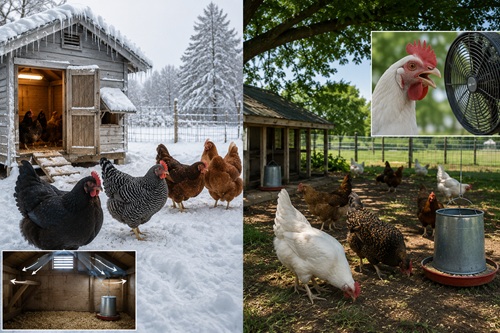
Cold-hardy doesn’t mean chickens can simply be left exposed to extreme conditions. They still require suitable shelter, dry bedding, appropriate ventilation, unfrozen drinking water, adequate nutrition, and protection from severe drafts.
Ventilation is particularly important. It can seem logical to seal a chicken coop tightly during winter to retain heat, but doing so can trap moisture and ammonia. A dry, well-ventilated coop that protects chickens from direct drafts is generally more useful than a damp enclosure sealed tightly against outside air.
Winter also affects eggs in another way.
Shorter daylight naturally reduces egg production in many hens. Some chicken keepers provide supplemental lighting while others allow the flock to follow its seasonal laying cycle. Either approach requires planning because summer production shouldn’t automatically be used to predict how many eggs will be available in January.
Hot climates create the opposite challenge. Large, heavily feathered chickens can require more attention during extreme heat. Shade, airflow, ventilation, and constant access to clean water become especially important. Lightweight breeds such as Leghorns generally cope with heat well, which may make them more attractive in warmer environments.
The best breed on paper isn’t necessarily the best breed where you live.
Egg Production Is Only Part of the Calculation
Suppose one chicken produces 300 eggs each year while another produces 240. The difference sounds substantial: 60 eggs.
But now consider everything else.
Does one require more feed? Does one forage better? Does one tolerate your winters with fewer problems? Does one remain productive longer? Does one frequently become broody and stop laying? Is one more susceptible to problems under your management conditions? Can you reproduce the bird yourself?
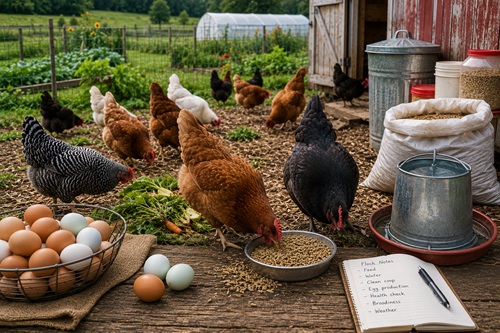
Those questions become increasingly important as chickens move from being a backyard hobby toward becoming part of the household food system.
Feed efficiency deserves particular attention because chickens don’t create eggs from nothing. Producing an egg requires protein, energy, calcium, vitamins, minerals, and water.
Commercial layer feed is formulated to provide those nutrients and is generally the simplest nutritional foundation for a productive laying flock. Foraging and appropriate kitchen or garden scraps can supplement the diet, but they shouldn’t automatically be considered replacements for balanced nutrition.
A hen producing several eggs each week is continually exporting nutrients from her body. Those nutrients have to be replaced.
Water is equally important. Chickens require reliable access to clean drinking water, and production can decline rapidly when water becomes unavailable.
From a preparedness perspective, that raises an important consideration. A flock may reduce dependence on purchased eggs while simultaneously creating dependence on purchased chicken feed.
The more chickens you keep, the more important feed storage, alternative feed resources, water availability, and good flock management become.
How Many Chickens Do You Actually Need?
A useful way to estimate flock size is to begin with how many eggs your household normally consumes.
One dozen eggs each week represents about 624 eggs annually. Two dozen per week is roughly 1,248 eggs. A household regularly consuming three dozen eggs each week uses close to 1,900 eggs over a year.
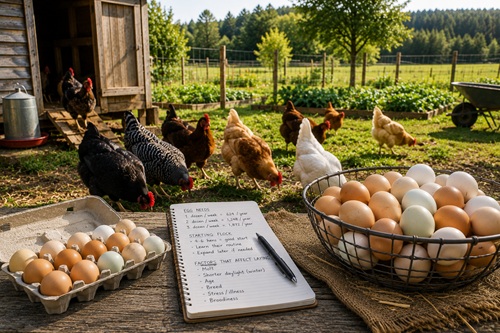
It might seem that four hens capable of producing 300 eggs annually would almost supply a household using two dozen eggs every week.
Real production isn’t that consistent.
Hens molt. Winter daylight becomes shorter. Birds age. Individual production varies. Illness or stress can temporarily interrupt laying, and some breeds become broody. A flock that theoretically produces exactly the number of eggs you require therefore provides very little margin.
For many households, four to six hens represents a practical starting point. That is enough to produce a meaningful supply of eggs while keeping the flock manageable for someone learning poultry care.
A household that eats large quantities of eggs, preserves them, bakes frequently, shares with family, or wants surplus production may eventually prefer eight, ten, or more hens.
There is little advantage in starting with a large flock simply because you have the space.
Begin with enough chickens to learn how they fit into your daily routine. Expanding an established flock is easier than discovering that you started with twice as many chickens as you wanted to manage.
You Don’t Need a Rooster for Eggs
One persistent misconception is that hens need a rooster before they can lay eggs.
They don’t.
A mature hen naturally produces eggs whether a rooster is present or not. Without a rooster, those eggs simply won’t be fertilized and cannot develop into chicks.
For a household interested entirely in eating eggs, an all-hen flock is usually simpler. There is no crowing, no need to manage breeding behavior, and some municipalities that permit hens prohibit roosters.
The decision changes if the long-term objective is maintaining a self-replacing flock.
Then the rooster becomes essential.
A Self-Replacing Flock Requires Different Thinking
Someone interested primarily in next year’s eggs can purchase productive hybrids and replace hens when production declines.
Someone thinking about the flock ten years from now may make different choices.
Established breeds such as Rhode Island Reds, Australorps, Plymouth Rocks, Sussex, Orpingtons, and Wyandottes can be maintained as breeding populations because their characteristics reproduce more predictably than those of commercial laying hybrids.
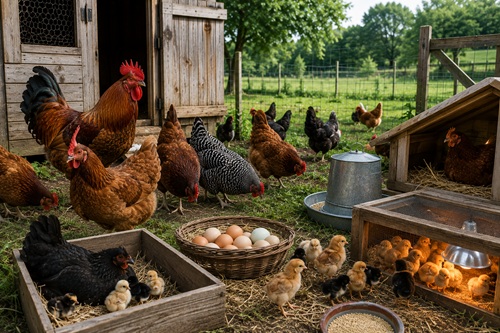
Creating a self-replacing flock requires more than keeping a rooster with the hens. You need fertile eggs, appropriate breeding stock, sufficient genetic diversity, broody hens or an incubation system, equipment and space for raising chicks, and a plan for the male chicks that will inevitably hatch.
Breeding also gives the household an opportunity to select chickens suited to its particular conditions.
Imagine keeping Australorps for several generations. Some hens may consistently produce more eggs through winter. Others may forage more effectively. Some may remain healthier, handle local weather better, or prove to be particularly good mothers.
Those characteristics can influence which birds you allow to reproduce.
Over time, the flock can become increasingly suited to the environment where it actually lives.
That is a very different objective from simply buying replacement laying hens every few years, and it may influence which chickens you choose from the beginning.
Broodiness Can Be Either a Problem or an Advantage
Broodiness occurs when a hen develops the instinct to sit on eggs and attempt to hatch them.
For someone interested exclusively in egg production, this can be inconvenient. A broody hen may dramatically reduce or stop normal egg production while attempting to incubate a clutch.
For someone trying to reproduce chickens without depending entirely upon an electric incubator, a reliable broody hen can be extremely valuable.
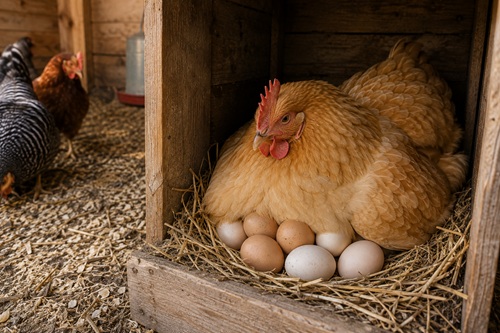
Orpingtons and some Sussex and other traditional breeds may retain stronger brooding tendencies than specialized production layers, although individual birds vary.
This illustrates an important principle when selecting chickens.
Characteristics that reduce maximum egg production aren’t always undesirable.
Sometimes they provide another capability that becomes more valuable than a few additional eggs.
Chickens Need More Than Feed
Housing has a direct effect on health and productivity.
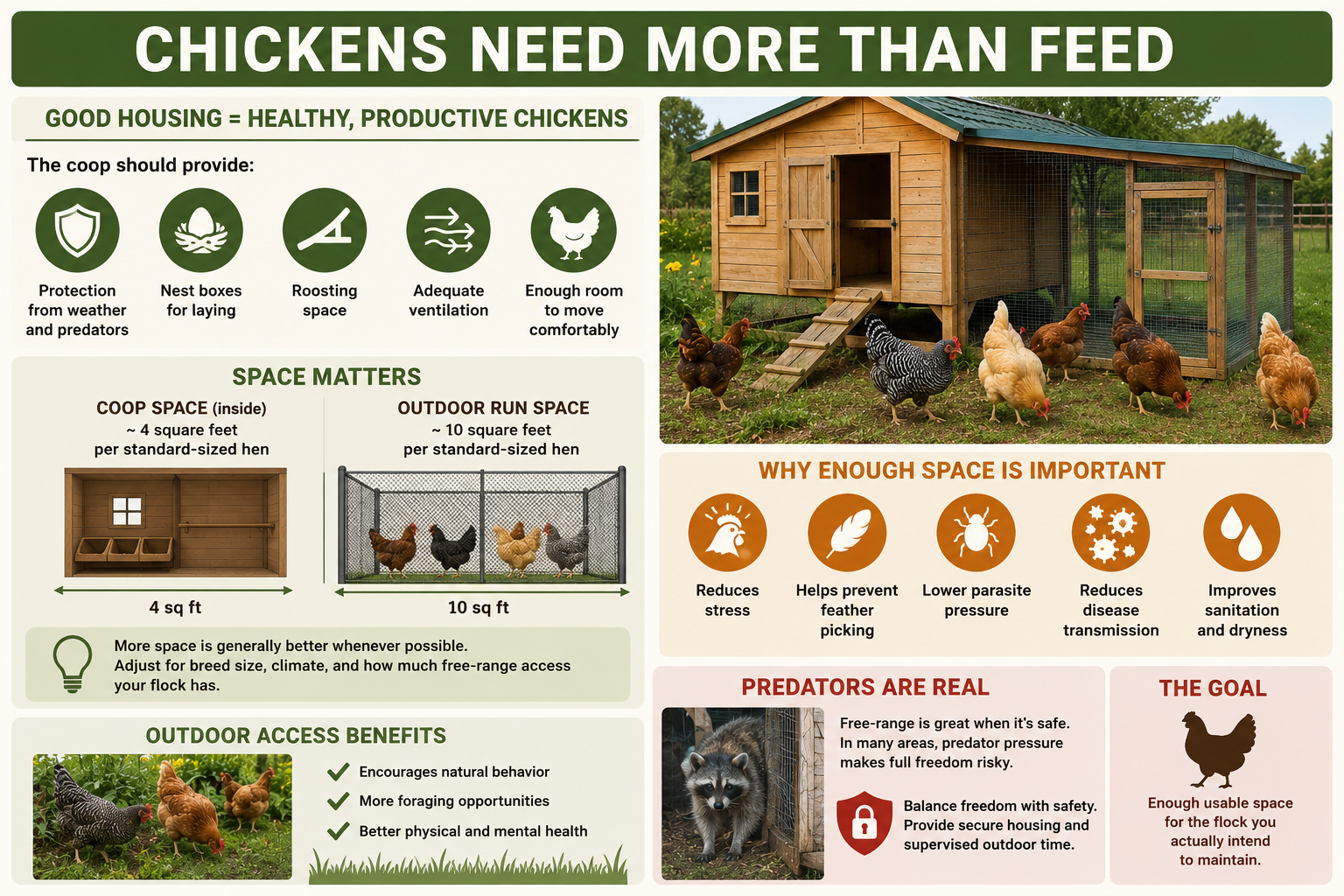
The coop needs to provide protection from weather and predators, somewhere for hens to lay eggs, suitable roosting space, adequate ventilation, and enough room for birds to move without excessive crowding.
Actual space requirements depend upon breed size, climate, housing design, free-range access, and how much time chickens spend confined. A commonly used starting point for standard-sized hens is roughly four square feet of coop space per bird and around ten square feet of outdoor run space per bird, with additional room generally beneficial where practical.
Overcrowding can contribute to stress, feather picking, sanitation problems, parasite pressure, disease transmission, and excessive moisture.
Giving chickens access to additional outdoor space can also allow more natural behavior and additional opportunities for foraging.
That doesn’t necessarily mean chickens need unlimited free range. In many locations, predator pressure makes completely unrestricted ranging impractical.
The goal is enough usable space for the flock you actually intend to maintain.
Predator Protection Is Part of Raising Chickens
Sooner or later, something else will discover your chickens.
Depending upon where you live, that could include raccoons, foxes, coyotes, weasels, mink, skunks, dogs, hawks, owls, bears, or other wildlife.
Predator protection should therefore be part of the original coop design rather than something added after chickens begin disappearing.
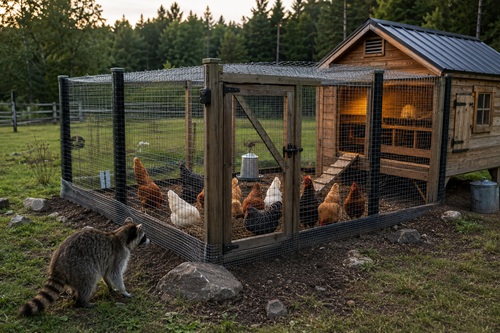
Chicken wire is useful for containing chickens, but lightweight wire shouldn’t automatically be considered adequate predator protection. Strong construction, secure mesh where appropriate, protected ventilation openings, dependable latches, and consideration for animals capable of digging underneath barriers are all important.
This matters even more when chickens form part of your household food supply.
A productive laying flock represents accumulated money, feed, labor, breeding potential, and future food. Losing several hens in one night can eliminate a significant portion of that investment.
Protecting the flock is therefore part of protecting the food system.
Consider a Mixed Flock Instead of Choosing One Breed
There is no rule saying every chicken in the flock has to be the same.
In fact, a mixed flock can be particularly useful for someone who has never raised chickens before.
Instead of purchasing six identical birds because somebody declared them the “best chicken,” you might raise several different breeds suited to your climate and objectives.
A household interested in traditional homestead chickens might keep a couple of Australorps, a couple of Rhode Island Reds, and a couple of Plymouth Rocks, for example.
Now the comparison happens on your own property.
You can observe which chickens forage most effectively, which remain healthiest, which handle winter best, which are easiest to manage, which continue producing when conditions become less favorable, and which simply fit your operation better.
After several years, that experience will tell you far more than a breed ranking.
A mixed flock can also spread some risk. Different breeds and individual bloodlines may respond differently to weather, stress, disease pressure, and seasonal conditions.
Diversity doesn’t guarantee resilience, but it can prevent the entire flock from depending upon exactly the same characteristics.
Matching the Chicken to the Job
Once the differences are understood, the decision becomes much easier.
| What Matters Most | Chickens Worth Considering |
|---|---|
| Maximum egg production | White Leghorn, Golden Comet, Sex Link hybrids |
| Strong eggs plus homestead usefulness | Australorp, Rhode Island Red |
| Cold-weather suitability | Australorp, Plymouth Rock, Wyandotte, Orpington, Sussex, Rhode Island Red |
| Calm backyard flock | Australorp, Orpington, Plymouth Rock, Sussex |
| Eggs and meat | Rhode Island Red, Australorp, Plymouth Rock, Sussex, Orpington, Wyandotte |
| Long-term breeding flock | Established breeds rather than production hybrids |
| Active foraging | Rhode Island Red, Sussex, Leghorn and other active traditional breeds |
| Blue eggs | Ameraucana or suitable Easter Egger lines |
The chart should be treated as a way to narrow the search rather than as a guarantee. Individual strains within a breed can vary substantially, and the breeder or hatchery supplying the chickens can be just as important as the breed name itself.
What Would Make a Good First Flock?
For someone whose primary objective is maximum egg production and who is comfortable buying replacement hens periodically, four to six good-quality production layers can be a very practical starting flock. White Leghorns or reputable production hybrids can produce an impressive number of eggs without requiring a large number of birds.
For someone approaching chickens from a homesteading or self-sufficiency perspective, a small flock of traditional dual-purpose birds may make more sense. Australorps and Rhode Island Reds are particularly strong candidates because they combine respectable egg production with characteristics useful beyond the egg basket.
Plymouth Rocks, Sussex, Orpingtons, and Wyandottes also deserve consideration depending upon climate, temperament preferences, meat value, and whether natural reproduction is eventually part of the plan.
For a first-time chicken keeper who isn’t sure which breed will perform best, a mixed flock of four to six hens may be the most informative choice of all.
The first year will teach you about housing, feed consumption, water requirements, winter management, predators, egg production, molting, temperament, and the amount of daily work chickens actually require.
The second and third years will teach you something equally important: how production changes as the birds age.
Only then can you really decide whether you want more chickens, different chickens, breeding chickens, or simply enough hens to keep fresh eggs on the table.
Before Bringing Chickens Home
The best time to solve chicken problems is before there are chickens in the coop.
Check whether chickens are permitted where you live and whether there are restrictions on flock size or roosters. Decide where the coop and run will be located and how predators will be excluded. Determine where feed will be stored so rodents and wildlife can’t easily reach it, and establish how drinking water will be kept available during both summer heat and freezing weather.
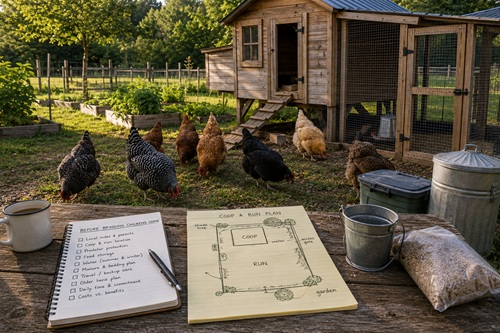
Think about manure and bedding as well. Properly managed chicken manure can become a valuable addition to compost and eventually return nutrients to the garden, but unmanaged manure quickly becomes a sanitation problem.
Consider what will happen when you travel, who can care for the flock if you’re unable to do so, and what your plan will be as hens grow older and production declines.
Most importantly, understand that chickens aren’t free eggs.
They require housing, fencing, feed, bedding, equipment, water, healthcare when necessary, protection, and daily attention. A small backyard flock may or may not produce eggs more cheaply than they can be purchased at a grocery store.
But cost isn’t the only reason to raise chickens.
You gain direct experience producing food. You control how the birds are managed. Manure can become a resource for the garden. A breeding flock can potentially produce future generations. And the knowledge gained from successfully keeping livestock remains useful regardless of what happens to the price of eggs.
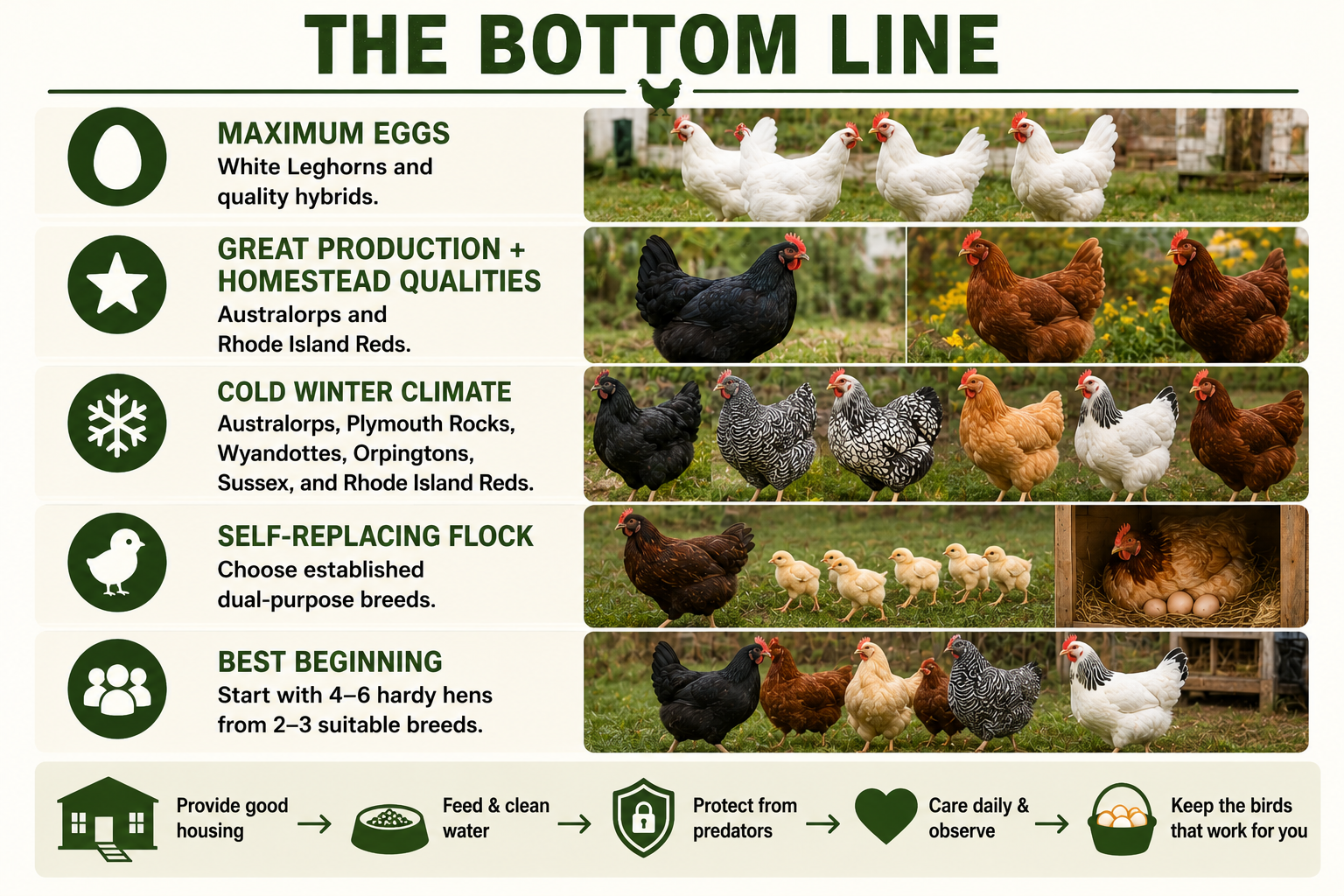
The Bottom Line
If you simply want as many eggs as possible from a small flock, White Leghorns and quality production hybrids are difficult to overlook.
If you want excellent egg production combined with the characteristics of a more traditional homestead chicken, Australorps and Rhode Island Reds are particularly strong starting choices.
If long winters are a major concern, Australorps, Plymouth Rocks, Wyandottes, Orpingtons, Sussex, and Rhode Island Reds are among the breeds worth investigating for your particular climate.
If you eventually want chickens capable of producing future generations without continually purchasing replacement birds, established dual-purpose breeds become more attractive than specialized laying hybrids.
For many households interested in becoming more self-sufficient, however, the best beginning may simply be four to six hardy hens from two or three suitable breeds.
Don’t worry about finding the perfect chicken before you begin.
Choose birds that match your climate and objectives, give them appropriate housing, nutrition, water, space, and protection, and then pay attention to what happens.
Within a few seasons, you will know which birds lay well, which tolerate your climate, which remain healthy, which forage effectively, and which are worth keeping or breeding.
At that point, you won’t be choosing chickens because they appeared on somebody else’s Top 10 list.
You’ll be choosing the chickens that have proven they work on your homestead.
© Prepping Communities. This content is for informational purposes only and not professional advice. Use at your own risk.
Terms | Privacy | Guidelines