
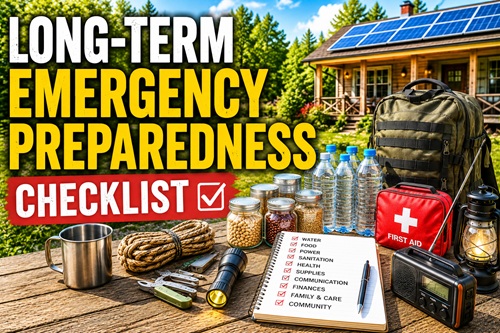
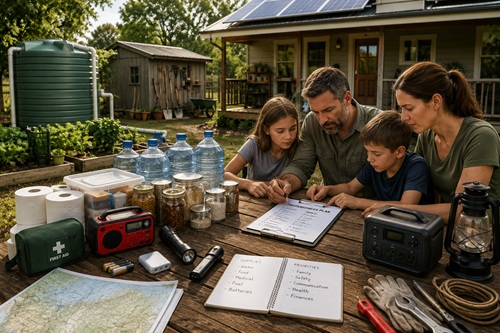
An emergency lasting several weeks or months creates very different challenges from a short power outage or temporary disruption. Stored supplies can help households through the beginning, but long-term resilience increasingly depends on sustainable routines, maintenance, repair, income, healthcare, communication, sanitation, resupply, and cooperation with others.
Use this checklist to prepare your household for extended disruptions by building systems that can continue functioning after the initial emergency supplies begin running low.
Household Planning
□ Identify the types of extended disruptions most likely to affect your household.
□ Consider how your household would function if normal services were disrupted for several weeks.
□ Identify essential daily household needs.
□ Determine which household members require additional assistance.
□ Identify responsibilities that cannot simply stop during an emergency.
□ Establish priorities for water, food, sanitation, health, shelter, communication, safety, and rest.
□ Create backup plans for important household functions.
□ Keep important emergency plans and information available on paper.
□ Review your long-term preparedness plan with everyone in the household.
Water
□ Calculate normal household water consumption.
□ Maintain an emergency supply of stored drinking water.
□ Use appropriate containers intended for potable water.
□ Identify additional water sources available in your area.
□ Maintain reliable methods for filtering and treating water.
□ Keep replacement filters and necessary water-treatment supplies available.
□ Understand which water sources may require treatment before use.
□ Maintain containers for collecting and transporting water.
□ Develop a method for safely distributing and rationing water if necessary.
□ Protect stored water from contamination.
□ Rotate stored water when appropriate.
□ Practice your backup water plan before an emergency.
Food
□ Maintain a rotating supply of shelf-stable foods.
□ Store foods your household already eats.
□ Include foods that require little or no cooking.
□ Include nutritionally varied foods rather than relying on a single food type.
□ Consider dietary restrictions, allergies, and medical requirements.
□ Maintain manual alternatives for electric kitchen equipment when practical.
□ Keep a manual can opener available.
□ Develop safe backup cooking methods.
□ Store necessary cooking supplies.
□ Learn basic food preservation techniques appropriate to your circumstances.
□ Maintain a system for tracking food inventory.
□ Use older stored foods first.
□ Develop longer-term food production options where practical.
□ Practice preparing meals using only stored foods and backup cooking equipment.
Sanitation and Hygiene
□ Store essential hygiene supplies.
□ Maintain soap and appropriate cleaning supplies.
□ Keep toilet paper and basic sanitation materials available.
□ Develop a backup sanitation plan if water or sewer services stop working.
□ Maintain suitable waste containers and bags.
□ Learn safe waste handling and disposal practices.
□ Keep food preparation areas separate from waste handling areas.
□ Maintain supplies for menstrual hygiene where required.
□ Include diapers and other dependent-care supplies where necessary.
□ Develop methods for washing clothing when normal laundry services are unavailable.
□ Protect drinking water from sanitation-related contamination.
□ Review sanitation procedures with household members.
Power and Energy
□ Identify household equipment that depends on electricity.
□ Determine which electrical devices are essential and which are optional.
□ Maintain flashlights and appropriate batteries.
□ Keep portable charging equipment available.
□ Maintain backup power systems where practical.
□ Test backup power equipment regularly.
□ Store and handle fuels according to applicable safety requirements.
□ Maintain safe ventilation around appropriate fuel-powered equipment.
□ Never operate combustion-powered equipment in enclosed living areas.
□ Reduce unnecessary energy consumption during extended outages.
□ Prioritize available power for essential equipment.
□ Maintain non-electric alternatives for important household functions where possible.
Heating and Cooling
□ Identify safe backup heating options appropriate to your home.
□ Identify ways to reduce heat loss during cold weather.
□ Maintain appropriate seasonal clothing and bedding.
□ Identify safe cooling strategies for extreme heat.
□ Know which household members are particularly vulnerable to temperature extremes.
□ Identify alternative locations that may provide safe heating or cooling.
□ Monitor indoor temperatures during prolonged outages.
□ Maintain appropriate ventilation.
□ Understand the risks associated with unsafe indoor heating equipment.
□ Include seasonal temperature planning in your emergency preparations.
Medical and Health Needs
□ Maintain an updated list of household medications.
□ Keep appropriate medication supplies according to medical and legal requirements.
□ Maintain a well-stocked first aid kit.
□ Keep important medical information available.
□ Maintain contact information for healthcare providers.
□ Identify medications or medical supplies requiring refrigeration or electricity.
□ Develop backup power arrangements for essential medical equipment where possible.
□ Maintain necessary mobility and accessibility equipment.
□ Keep replacement batteries or charging options for essential devices.
□ Identify people who may require regular assistance.
□ Establish backup caregivers.
□ Learn appropriate first aid skills.
□ Review medical preparations regularly.
Communication and Information
□ Maintain several ways of receiving emergency information.
□ Keep a battery-powered or hand-crank radio.
□ Maintain charged phones and backup charging equipment.
□ Keep important telephone numbers written on paper.
□ Establish an out-of-area emergency contact.
□ Develop household check-in procedures.
□ Establish primary and alternate meeting locations.
□ Identify official emergency information sources.
□ Verify important information before acting when time permits.
□ Avoid spreading unverified emergency information.
□ Consider communication options that do not depend entirely on internet access.
□ Practice your household communication plan.
Household Supplies and Inventory
□ Create an inventory of important emergency supplies.
□ Record quantities and expiration dates where appropriate.
□ Check inventory regularly.
□ Rotate stored supplies through normal household use.
□ Replace damaged or expired items.
□ Maintain spare batteries for essential equipment.
□ Keep replacement parts for critical household equipment where practical.
□ Store basic repair materials.
□ Maintain commonly used hand tools.
□ Keep instruction manuals for important equipment.
□ Store important information where it remains accessible without internet service.
□ Track consumption during an extended disruption.
Repair and Maintenance
□ Learn basic household repair skills.
□ Maintain essential hand tools.
□ Keep commonly needed fasteners and repair materials.
□ Learn how to safely shut off household utilities when necessary.
□ Know the location of water, electrical, and other utility controls.
□ Maintain emergency equipment according to manufacturer instructions.
□ Test generators, power stations, radios, lights, and other equipment periodically.
□ Repair small equipment problems before they become major failures.
□ Keep important maintenance instructions available offline.
□ Identify trusted local repair services where available.
□ Prioritize repairs that protect health, water, sanitation, shelter, and safety.
Financial Preparedness
□ Build an emergency fund where possible.
□ Keep a reasonable amount of emergency cash securely stored.
□ Maintain access to more than one payment method where practical.
□ Keep important financial account information protected.
□ Maintain copies of insurance information.
□ Review essential monthly expenses.
□ Identify expenses that could be temporarily reduced during an emergency.
□ Plan for temporary income interruption.
□ Understand important payment obligations.
□ Maintain contact information for employers, insurers, financial institutions, and essential service providers.
□ Avoid unnecessary spending of limited emergency resources.
□ Track household spending during extended disruptions.
Work and Education
□ Determine how household income could be affected by a prolonged disruption.
□ Identify work that may be possible without normal infrastructure.
□ Maintain essential work information and documents.
□ Keep important educational materials available offline.
□ Maintain basic school supplies for children.
□ Develop simple routines for continued learning.
□ Include reading, practical skills, and structured activities.
□ Protect time for children to play and socialize safely.
□ Maintain realistic expectations during difficult conditions.
□ Adjust work and education routines as conditions change.
Children and Dependents
□ Maintain supplies specifically needed by children and dependents.
□ Keep emergency contact information current.
□ Identify backup caregivers.
□ Maintain familiar comfort items.
□ Establish predictable daily routines.
□ Explain changing conditions in an age-appropriate way.
□ Include children in appropriate household tasks.
□ Maintain opportunities for play and learning.
□ Develop family reunification procedures.
□ Make sure children know which adults they can trust.
□ Review plans as children and household circumstances change.
Pets and Service Animals
□ Maintain an appropriate supply of food.
□ Store drinking water for animals.
□ Keep necessary medications available.
□ Maintain veterinary information.
□ Keep identification and vaccination records available.
□ Maintain carriers, crates, harnesses, or leashes where appropriate.
□ Include service animals in all evacuation and shelter plans.
□ Identify alternative caregivers.
□ Plan for waste management and sanitation.
□ Maintain familiar bedding or comfort items where practical.
□ Include animal supplies when calculating household storage requirements.
Resupply
□ Identify which supplies will eventually run out.
□ Estimate how quickly essential supplies are normally consumed.
□ Identify potential local resupply sources.
□ Maintain relationships with reliable local suppliers where practical.
□ Keep transportation options available.
□ Maintain appropriate fuel reserves where lawful and safe.
□ Identify alternatives if normal stores are unavailable.
□ Replace supplies before they reach critical levels when possible.
□ Avoid waiting until essential supplies are nearly exhausted before seeking replacements.
□ Recalculate supply priorities as conditions change.
Community Support
□ Get to know trusted neighbors.
□ Identify people who may need additional assistance.
□ Identify people with useful practical skills.
□ Establish reasonable ways to check on one another.
□ Share verified emergency information.
□ Coordinate assistance without compromising household security or privacy.
□ Identify local community resources.
□ Know where emergency shelters or reception centers may be established.
□ Participate in appropriate community preparedness activities.
□ Develop relationships before an emergency occurs.
□ Ask for help before a manageable problem becomes a crisis.
Daily Routine During Extended Disruptions
□ Establish regular waking and sleeping times.
□ Set daily priorities.
□ Schedule water collection or treatment.
□ Plan meals and food preparation.
□ Schedule sanitation and cleaning tasks.
□ Monitor essential supplies.
□ Check important equipment.
□ Review reliable emergency information.
□ Maintain appropriate physical activity.
□ Allow time for rest.
□ Include family or social time.
□ Include something enjoyable or meaningful in the daily routine.
□ Review changing conditions at a consistent time each day.
Protect Morale and Clear Thinking
□ Maintain a predictable household routine.
□ Divide responsibilities fairly.
□ Rotate difficult or exhausting tasks.
□ Allow household members appropriate private time.
□ Maintain regular meals whenever possible.
□ Protect normal sleep schedules.
□ Encourage appropriate physical activity.
□ Maintain social contact with trusted people.
□ Give children meaningful activities and routines.
□ Recognize progress and completed tasks.
□ Mark birthdays, holidays, or important occasions in simple ways.
□ Discuss problems before frustration becomes conflict.
□ Adjust expectations as conditions change.
Track Consumption
□ Record available water.
□ Record important food supplies.
□ Track medications.
□ Monitor hygiene supplies.
□ Track batteries and charging capacity.
□ Monitor fuel consumption.
□ Record important equipment problems.
□ Track financial resources.
□ Estimate how many days essential supplies may last.
□ Compare actual consumption with your original estimates.
□ Adjust household routines before shortages become critical.
Transition from Emergency Supplies to Sustainable Systems
□ Identify supplies that cannot easily be replaced.
□ Reduce dependence on disposable items where practical.
□ Repair equipment instead of automatically replacing it.
□ Shift toward renewable or reusable resources where appropriate.
□ Develop sustainable water collection and treatment options.
□ Expand food production where practical.
□ Improve household energy efficiency.
□ Develop reliable sanitation routines.
□ Strengthen local relationships and resupply networks.
□ Continue learning practical skills.
□ Preserve useful knowledge and instructions offline.
Common Mistakes to Avoid
□ Do not assume stored supplies alone will solve a long-term disruption.
□ Do not ration food or water so aggressively that household health and functioning are unnecessarily weakened.
□ Do not use irreplaceable supplies without considering future needs.
□ Do not consume fuel without tracking remaining quantities.
□ Do not ignore small equipment failures.
□ Do not allow sanitation problems to accumulate.
□ Do not depend entirely on one communication method.
□ Do not rely entirely on internet access for important information.
□ Do not wait until essential supplies are almost gone before seeking resupply.
□ Do not overlook financial preparedness.
□ Do not isolate your household unnecessarily from trustworthy community support.
□ Do not continue following an outdated plan when conditions have changed.
Maintenance
Review your long-term emergency preparedness plan at least twice each year and after any major change in your household.
□ Update emergency contacts.
□ Inspect stored food.
□ Inspect stored water.
□ Check medication and medical supplies.
□ Replace expired supplies.
□ Test backup power equipment.
□ Charge portable batteries and power stations.
□ Test radios and communication equipment.
□ Inspect tools and repair supplies.
□ Review financial preparations.
□ Update important documents.
□ Review plans for children, dependents, pets, and service animals.
□ Review seasonal heating and cooling requirements.
□ Practice selected emergency procedures.
□ Update your household supply inventory.
Key Takeaways
After completing this checklist, you should have:
✓ Enough initial supplies to stabilize your household during the early stages of an extended disruption.
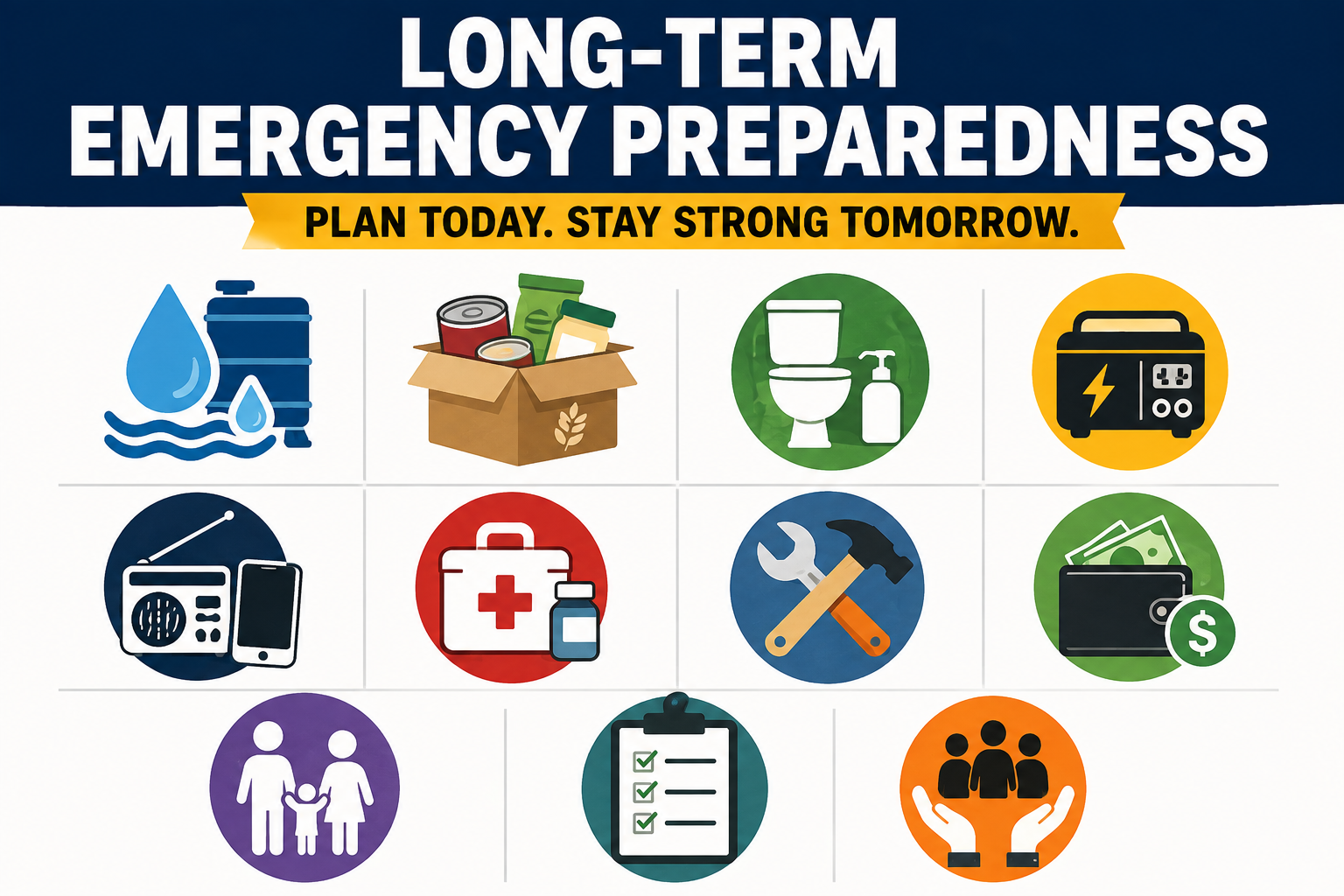
✓ Reliable plans for water, food, sanitation, power, healthcare, and communication.
✓ A system for monitoring consumption before shortages become critical.
✓ Backup options for essential household functions.
✓ Plans for income interruption, work, education, children, dependents, pets, and service animals.
✓ Basic repair and maintenance capabilities that can extend the usefulness of equipment and supplies.
✓ Resupply plans for resources that cannot be stored indefinitely.
✓ Daily and weekly routines that help protect physical health, morale, and clear thinking.
✓ Relationships with trusted people who can provide information, skills, assistance, and community support.
✓ A strategy for gradually transitioning from stored emergency supplies toward more sustainable systems.
Long-term preparedness is not simply about storing more supplies. As a disruption continues, the ability to maintain equipment, manage resources, solve problems, preserve health, adapt routines, find reliable information, and cooperate with trustworthy people becomes increasingly important. The goal is to build a household that can continue functioning as conditions change rather than simply waiting for normal services to return.
© Prepping Communities. This content is for informational purposes only and not professional advice. Use at your own risk.
Terms | Privacy | Guidelines