
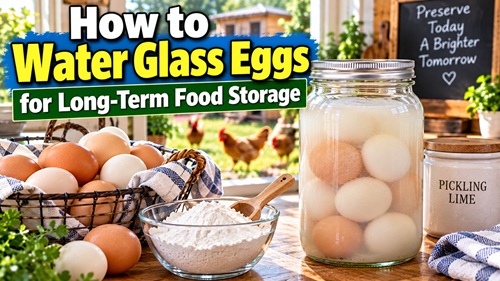
Egg production rarely stays constant throughout the year. Households raising laying hens may find themselves with far more eggs than they can use during productive spring and summer months, followed by substantially lower production during winter. That seasonal cycle naturally raises a preparedness question: how can surplus eggs be preserved for periods when fresh eggs aren’t readily available?
One traditional answer is water glassing.
Water glassing is an old method of storing shell eggs without refrigeration. Historical versions used sodium silicate, while a method commonly practiced by modern homesteaders uses food-grade pickling lime mixed with water. Fresh, unwashed eggs are submerged in the alkaline solution and stored in a cool, dark location.
The supplied source describes using this method for surplus eggs from home-raised chickens and emphasizes that the eggs must be fresh, clean, unwashed, and intact.
For preparedness, the appeal is obvious. The technique doesn’t depend upon a refrigerator or freezer remaining powered. However, anyone considering water glassing should understand both how the traditional method works and its food-safety limitations. Current university Extension guidance does not consider water glassing a scientifically validated method for safely storing eggs long term, so it shouldn’t be treated the same way as an approved modern preservation process.
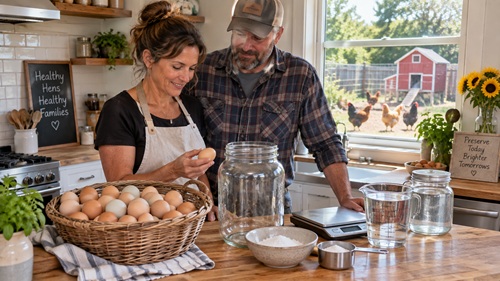
Understanding Water Glassing
The name can be confusing because modern water glassing generally doesn’t involve ordinary glass beyond the container itself.
Historically, “water glass” referred to sodium silicate. Modern homesteading instructions frequently substitute food-grade calcium hydroxide, commonly sold as pickling lime. The supplied source describes this modern version and notes that pickling lime is used instead of sodium silicate.
The basic concept is to place intact eggs into an alkaline lime-water solution while preserving the egg’s natural protective coating.
That coating is extremely important.
Why Fresh, Unwashed Eggs Are Required
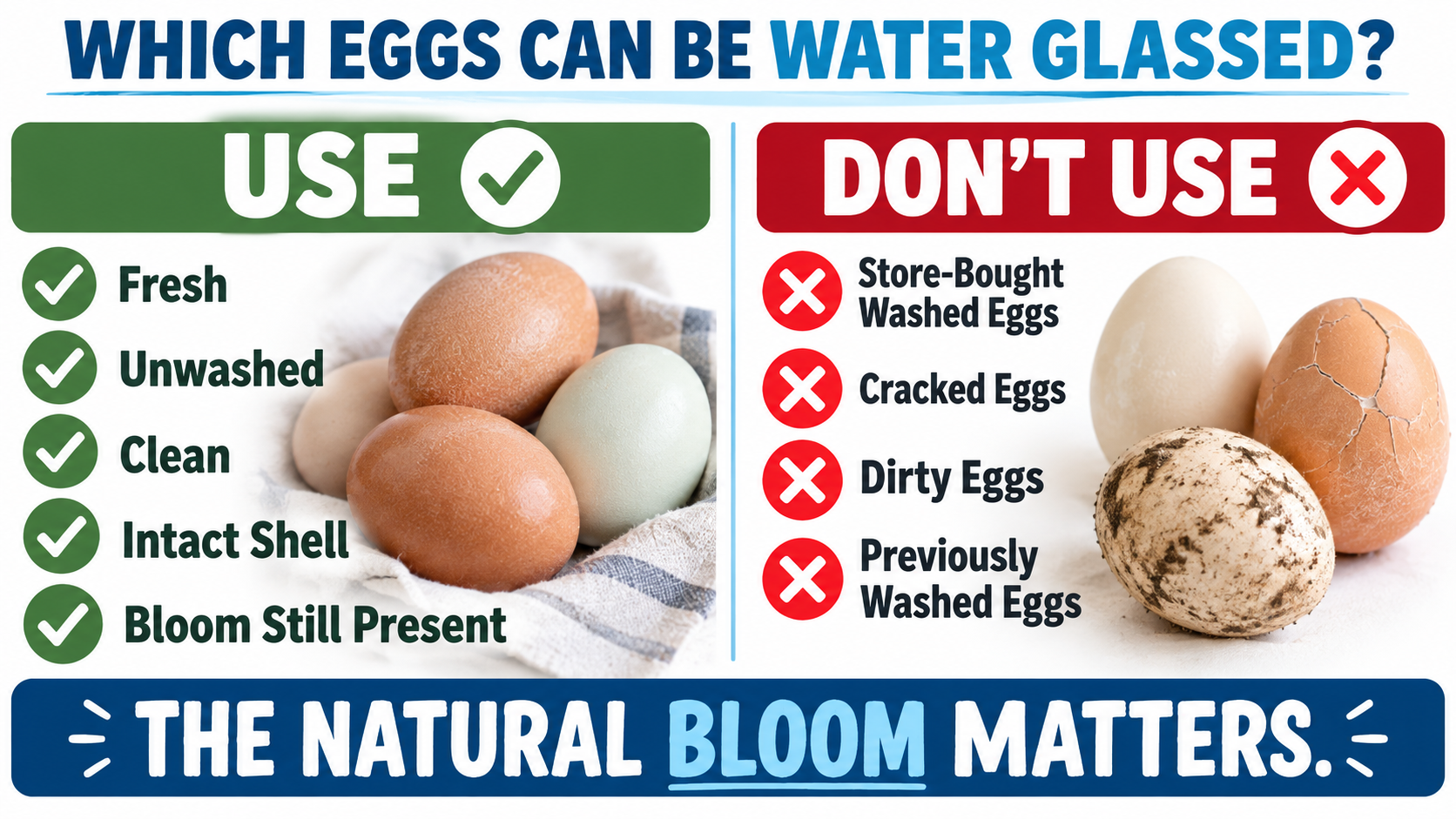
Freshly laid eggs have a natural coating over the shell called the bloom or cuticle. This protective layer helps reduce movement through the microscopic pores in the shell.
Washing an egg alters or removes that protection.
For this reason, traditional water-glassing instructions call for eggs collected directly from laying hens that haven’t been washed. Ordinary commercially washed supermarket eggs aren’t appropriate for the method. The source specifically calls for fresh, clean, unwashed eggs that haven’t been refrigerated and recommends checking every shell for cracks before storage.
The ideal egg is naturally clean when collected.
An egg covered in manure, mud, or significant contamination isn’t a good candidate simply because it hasn’t been washed. Traditional practitioners may gently remove a small amount of dry debris without wetting the shell, but heavily soiled eggs are better directed toward immediate appropriate use rather than long-term storage.
Cracked eggs should never be included.
One broken egg can contaminate the surrounding solution and potentially compromise the entire container.
The Traditional Water-Glassing Recipe
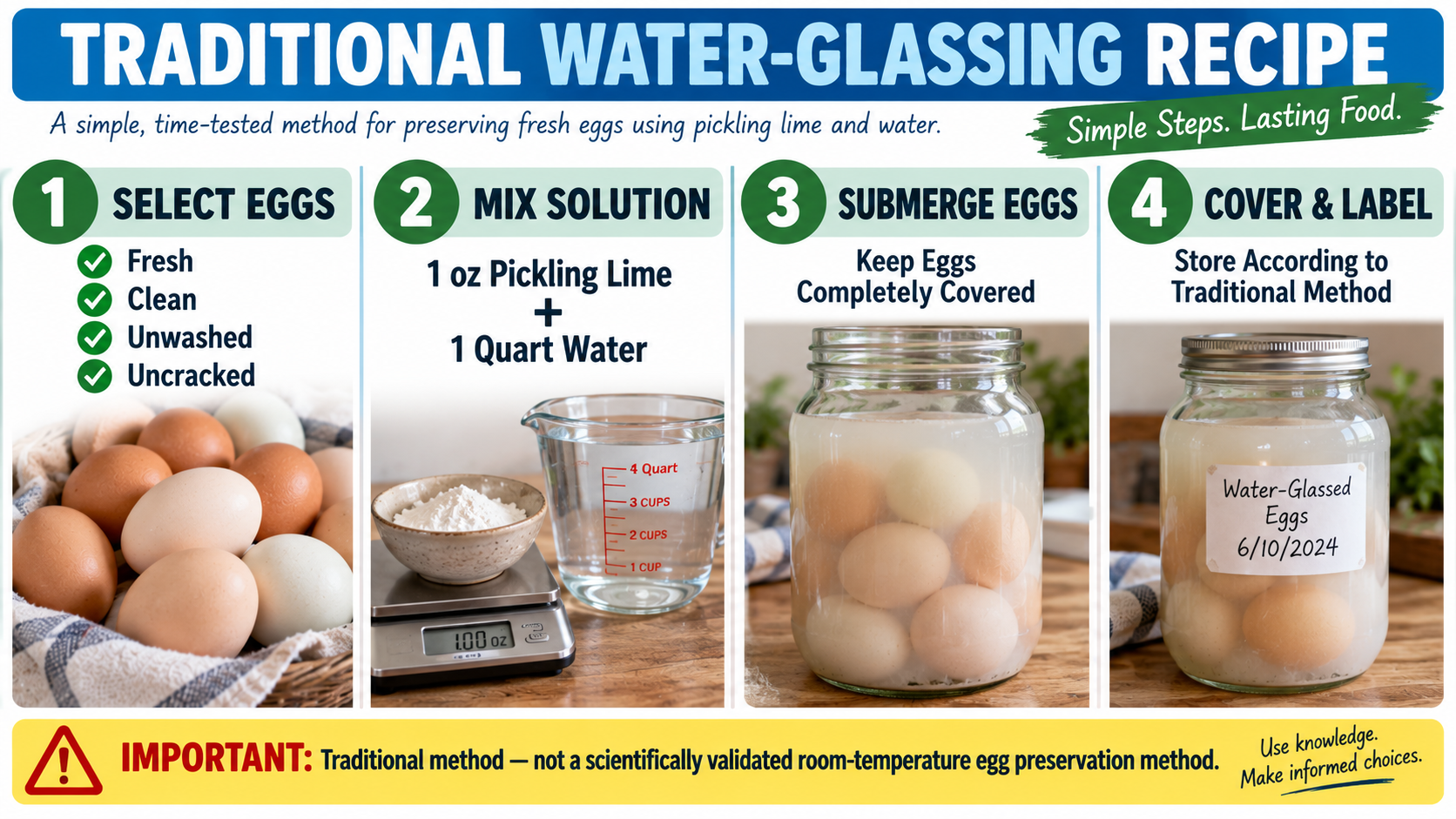
The following recipe documents the modern pickling-lime method described in the supplied source. The source uses approximately 16 eggs, one ounce of pickling lime, and one quart of filtered water for a half-gallon container.
Water-Glassed Eggs
Method: Traditional pickling-lime preservation
Container: Approximately ½-gallon wide-mouth glass jar
Yield: Approximately 15–18 eggs, depending upon egg and container size
Ingredients
15–18 fresh, clean, unwashed eggs
1 ounce food-grade pickling lime, measured by weight
1 quart chlorine-free or filtered water
Equipment
A clean wide-mouth half-gallon glass jar or other suitable food-safe container with a lid is useful because the opening should be large enough to lower eggs gently into the container without dropping them.
You’ll also need a kitchen scale for accurately weighing the pickling lime, a measuring container for the water, a mixing utensil, and a label or marker for dating the container.
Traditional Mixing Ratio
The basic ratio is:
1 ounce food-grade pickling lime to 1 quart water
Maintaining the ratio makes it easy to prepare larger quantities when needed. If additional solution is required, prepare another batch at the same ratio rather than estimating the amount of lime.
Preparing the Eggs
Begin with the freshest suitable eggs available.
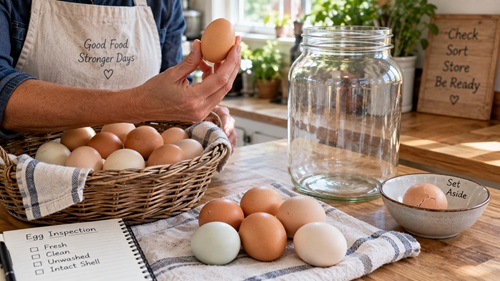
Inspect every egg carefully under good lighting. Look for hairline cracks, damaged shells, unusual contamination, or other defects.
Set questionable eggs aside.
Don’t wash eggs intended for traditional water glassing because doing so removes or damages the natural bloom upon which the method depends.
Handle the eggs gently. Lower them into the clean container rather than dropping them against one another.
A wide-mouth container makes this considerably easier and reduces the likelihood of accidentally cracking an egg.
Continue adding eggs while leaving enough room for the lime solution to completely surround and cover them.
Preparing the Lime Solution
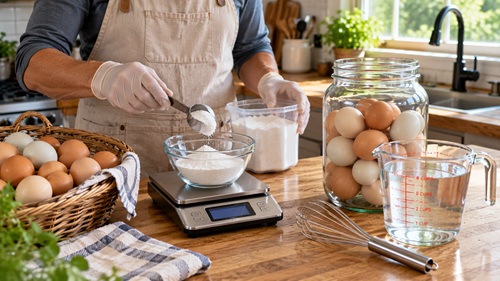
Measure one ounce of food-grade pickling lime by weight.
Add it to one quart of chlorine-free or filtered water and mix thoroughly.
The source recommends filtered water because chlorine in municipal water may interfere with the traditional process.
Pickling lime is strongly alkaline, so avoid inhaling its dust or getting it in your eyes. Handle it carefully and according to the manufacturer’s directions.
Once mixed, the solution will normally appear cloudy. Some settling of lime during storage is expected.
Covering the Eggs
Slowly pour the prepared lime solution over the eggs.
The eggs should remain completely submerged. Don’t leave the upper portion of an egg sticking above the solution.
If the container requires more liquid, prepare enough solution using the same lime-to-water ratio to maintain complete coverage.
Secure the container with its lid once the eggs are submerged.
Avoid repeatedly moving or shaking the container afterward. Eggs become more fragile with handling, and a cracked shell inside the container can compromise the batch.
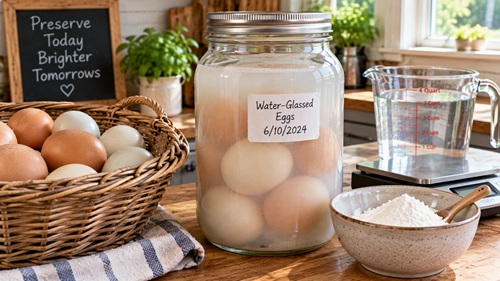
Label the Container
Every preserved-food container should tell you what it contains and when it was prepared.
At minimum, record:
Water-Glassed Eggs
Date Prepared
If several containers are being prepared throughout the laying season, dating each one makes it possible to use the oldest batch first.
Good labeling becomes increasingly important as a preparedness pantry grows. Memory isn’t an inventory system.
Traditional Storage Conditions
Traditional water-glassing instructions call for storing the covered container somewhere cool, dark, and protected from temperature extremes.
Direct sunlight should be avoided. The supplied source specifically warns that excessive heat and sunlight can damage eggs stored this way.
The container should also be located somewhere it won’t be routinely bumped or moved.
Traditional instructions commonly claim storage periods approaching a year. That claim should not be confused with a scientifically validated safe shelf life. Current Extension food-safety guidance does not validate room-temperature water glassing as a safe long-term egg-storage method.
That distinction is especially important for a preparedness pantry.
Why Modern Food-Safety Guidance Raises Concerns
The major limitation of water glassing is that an intact shell and preserved bloom don’t guarantee that an egg is microbiologically safe.
Eggs can contain Salmonella Enteritidis internally before the shell has even formed. An egg can therefore appear completely clean and normal while containing a pathogen.
Eggshells aren’t completely impermeable either. Their pores and membranes allow limited movement of gases and moisture, which is one reason modern food-safety authorities are cautious about immersing shell eggs in preservation solutions for long periods.
Penn State Extension advises against water glassing and notes that the safety of the traditional process hasn’t been scientifically established. Utah State University Extension similarly doesn’t recommend lime-water storage as a safe method for preserving eggs long term.
This doesn’t mean that every water-glassed egg will cause illness. Many homesteaders report using the method successfully.
It means that successful personal experience isn’t the same as a validated food-safety process.
For preparedness, that difference matters.
Removing Eggs From the Container
Traditional instructions call for removing only the eggs needed while leaving the remainder submerged.
The source recommends rinsing the shell after removing an egg from the lime solution and cracking eggs individually into a separate bowl before using them.
Cracking eggs individually is a sensible general kitchen practice whenever the condition of stored eggs is uncertain because one questionable egg doesn’t immediately contaminate the rest of the ingredients in a recipe.
However, appearance and smell alone cannot establish microbiological safety.
An egg that smells bad or looks abnormal should obviously be discarded, but a normal appearance doesn’t prove that harmful bacteria aren’t present.
Cooking Stored Eggs
Eggs should be thoroughly cooked, particularly when there is uncertainty surrounding their storage history.
Avoid treating water-glassed eggs as an appropriate choice for preparations relying on raw or lightly cooked eggs.
Cooking is an important food-safety control, but it shouldn’t be interpreted as validation of an unapproved storage method. Safe food preservation ideally combines appropriate sourcing, handling, storage, sanitation, and cooking rather than depending upon cooking to compensate for questionable storage.
Why Water Glassing Appeals to Preppers
The preparedness appeal of water glassing is easy to understand.
It requires no continuous electricity.
A household with laying hens may produce dozens of surplus eggs during one part of the year and very few during another. Being able to move some of that seasonal abundance forward would reduce dependence upon refrigeration and grocery availability.
The technique is also simple and inexpensive compared with purchasing a freeze dryer or maintaining large amounts of freezer capacity.
But preparedness shouldn’t be measured only by how long something can sit on a shelf.
The stored food eventually needs to be safe enough to eat.
That is why water glassing is best understood as traditional preservation knowledge with unresolved modern food-safety concerns, rather than an equivalent substitute for scientifically validated preservation methods.
Safer Alternatives for Preserving Extra Eggs
A household with surplus eggs has several alternatives.
Refrigeration remains the simplest approach for eggs intended for relatively near-term use.
Freezing is another useful option. Eggs can be removed from their shells and prepared appropriately for freezing in portions suitable for later cooking and baking.
Households with appropriate equipment may investigate validated freeze-drying procedures.
Commercially produced dehydrated or freeze-dried egg products provide another option for a preparedness pantry. These products are processed under controlled commercial conditions and can provide compact, shelf-stable protein without depending upon household refrigeration.
No single method needs to provide the entire solution.
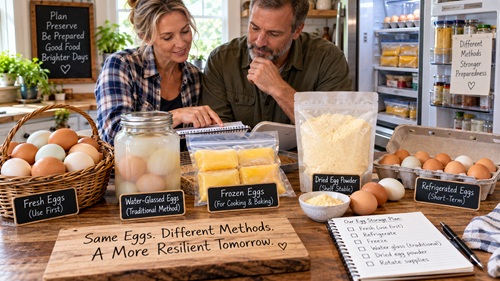
A resilient food-storage plan can combine fresh eggs, refrigerated eggs, frozen eggs, commercially dried eggs, and other protein sources.
Don’t Put Every Egg in One Preservation Basket
Water glassing illustrates a larger preparedness principle particularly well: redundancy matters.
Imagine a household storing its entire seasonal egg surplus in a freezer.
A prolonged power failure could threaten the entire supply.
Now imagine storing everything through one traditional shelf-stable method. A contamination or storage problem could threaten that entire supply instead.
Diversification reduces those single points of failure.
Use fresh food while it is abundant. Preserve some through validated methods. Maintain shelf-stable alternatives. Rotate stored food. Know how to cook with the ingredients being stored.
The objective isn’t to accumulate the largest possible quantity of eggs.
The objective is to maintain access to usable nutrition when circumstances change.
Traditional Water-Glassing Recipe at a Glance
Ingredients
15–18 fresh, clean, unwashed eggs
1 ounce food-grade pickling lime
1 quart chlorine-free or filtered water
Equipment
½-gallon wide-mouth glass jar with lid
Kitchen scale
Measuring container
Mixing utensil
Label and marker
Traditional Method
Inspect the fresh unwashed eggs and reject any with cracks, damage, or significant contamination.
Carefully place the eggs into the clean wide-mouth container.
Measure one ounce of food-grade pickling lime by weight for every quart of chlorine-free or filtered water.
Mix the lime and water thoroughly.
Pour the solution gently over the eggs until every egg is completely submerged.
Cover the container and label it with the preparation date.
Traditional instructions call for keeping the container in a cool, dark location away from sunlight and excessive heat.
When removing an egg, traditional instructions call for rinsing the shell and cracking the egg separately before incorporating it into other ingredients.
Important: This recipe documents a traditional preservation technique. Current university Extension food-safety guidance does not consider room-temperature water glassing a scientifically validated safe method for long-term egg preservation.
Preparedness Action Plan
If your household raises laying hens, begin by understanding the seasonal pattern of egg production. Track roughly how many eggs the flock produces during peak laying periods and how many the household normally consumes.
Develop a plan for surplus eggs before production peaks.
Use fresh eggs regularly, maintain appropriate refrigerated storage, and investigate validated freezing or freeze-drying methods if longer storage is required. Consider commercially processed dried eggs as another shelf-stable component of the preparedness pantry.
Learn about traditional methods such as water glassing because historical preservation knowledge is useful, but distinguish between understanding a technique and assuming that it meets modern food-safety standards.
Whatever preservation methods are chosen, label stored food, rotate it, protect it from damaging storage conditions, and learn how to prepare meals with it before an emergency.
Most importantly, diversify.
A resilient household shouldn’t depend upon one flock, one refrigerator, one freezer, one preservation technique, or one stored food.
Key Takeaways
Water glassing is a traditional method of storing fresh shell eggs in a lime-water solution without continuous refrigeration.
Modern homesteading instructions typically call for fresh, clean, unwashed eggs because the natural bloom must remain intact. Store-bought eggs that have been commercially washed aren’t appropriate for the traditional process.
The commonly described mixture uses one ounce of food-grade pickling lime for every quart of chlorine-free or filtered water, with the eggs kept completely submerged.
However, traditional use and modern food-safety validation are different things. Current university Extension guidance doesn’t recommend water glassing as a scientifically validated method for safely preserving shell eggs at room temperature for long periods.
For preparedness, the most resilient approach is to understand traditional knowledge while also using modern food-safety information to make storage decisions.
Preserve seasonal abundance, but diversify how it is preserved.
The objective of food storage isn’t simply to make food last.
It is to make sure useful, nutritious food is still available when the household actually needs it.
© Prepping Communities. This content is for informational purposes only and not professional advice. Use at your own risk.
Terms | Privacy | Guidelines