

Eggs are one of those foods that are easy to take for granted until they become difficult to get. Fresh eggs are fragile, require careful storage, and under normal household conditions depend on refrigeration. During a prolonged power outage, evacuation, supply disruption, camping trip, or other situation where refrigeration and grocery access become unreliable, dehydrated eggs provide a practical alternative.
For a prepper, the advantage is not that dehydrated eggs perfectly duplicate fresh eggs. Their advantage is that they allow you to keep a useful egg product in your food-storage system that can be used for breakfast, baking and everyday cooking when fresh eggs are unavailable. A relatively small amount can support many meals, and there are no shells to break during storage or transportation.
Dehydrated eggs come in several forms. Whole egg powder contains both the yolk and white and is generally the most versatile option. Scrambled egg products are designed mainly for breakfast dishes and may contain additional ingredients. Egg-white powder contains only the whites and is better suited to recipes specifically requiring egg whites.

Choosing Dehydrated Eggs for Your Pantry
For general preparedness, whole egg powder is usually the most useful place to start because it can be used in several different ways. It can provide eggs for scrambling and can replace whole eggs in many cooked recipes where eggs provide binding, structure or moisture.
Read the package carefully before buying. A product described as an egg “mix” may contain ingredients other than eggs. That is not necessarily a problem, but you should know what you are storing. Check the ingredient list, preparation instructions, storage requirements and manufacturer’s stated shelf life.
Do not begin by purchasing several large containers simply because a product advertises a long shelf life. Buy a smaller package and actually cook with it. Make scrambled eggs, pancakes or another familiar recipe. Different products can vary in flavor and texture, and it makes little sense to build a large emergency supply around something your household dislikes.

How to Reconstitute Dehydrated Eggs
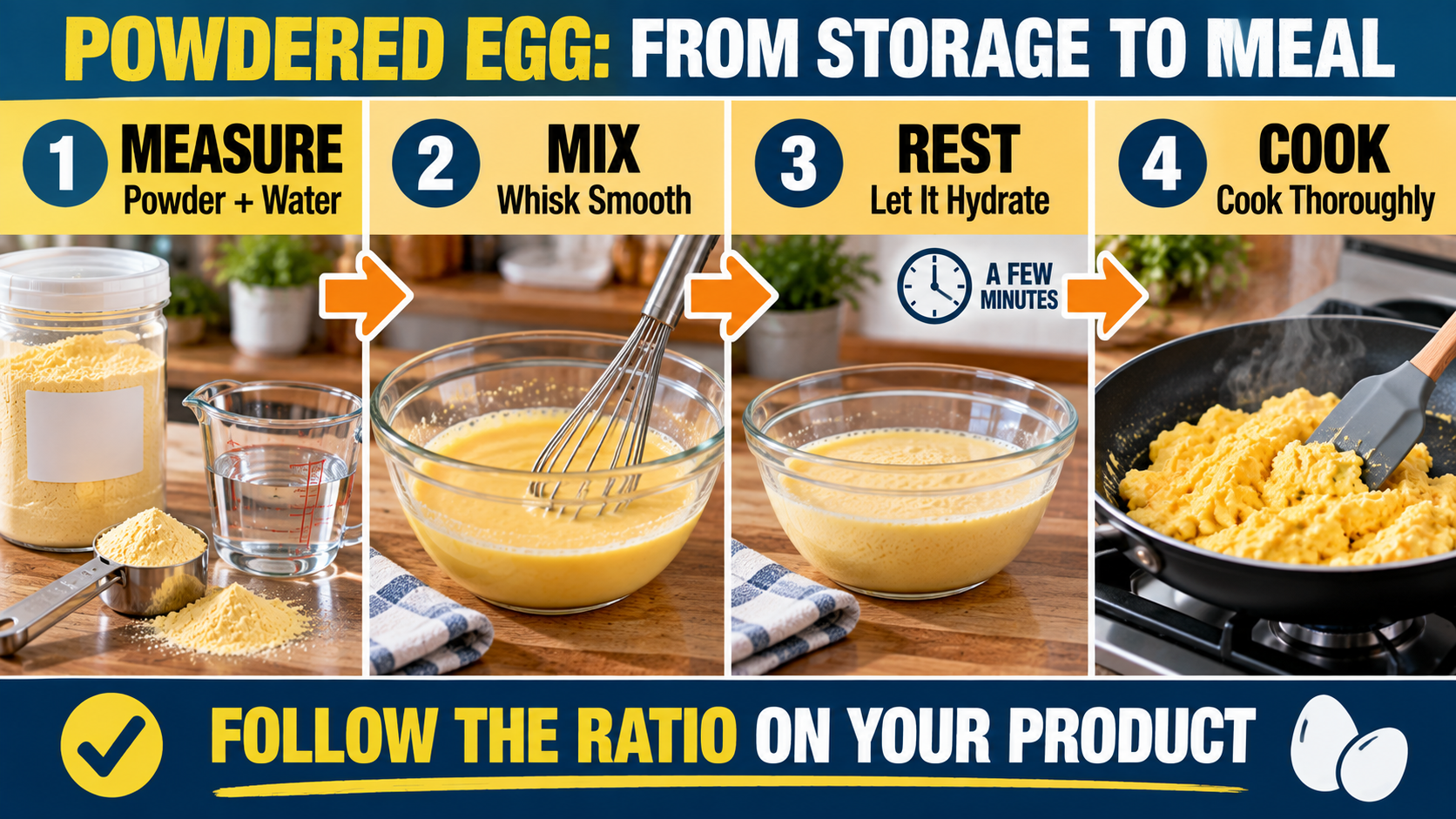
Reconstituting dehydrated eggs simply means replacing the water that was removed during processing. The supplied material gives a common example of approximately one tablespoon of whole egg powder combined with two tablespoons of water to replace one fresh egg. However, ratios can vary, so the directions on your particular product should always take priority.
Measure the powder and water rather than estimating them. Too much water can create a thin mixture, while too little can produce an unpleasant texture. Mix the powder and water thoroughly with a fork or small whisk until obvious dry lumps disappear. Allowing the mixture to rest briefly can help the powder absorb the water more evenly.
Only reconstitute what you intend to use. Once water has been added, the product should no longer be treated like a shelf-stable dry food. Handle the mixture as you would liquid egg and cook it promptly and thoroughly.
One useful preparedness exercise is to calculate the manufacturer’s ratio for several quantities. Work out how much powder and water you need for one, two, four, six and twelve eggs and write those measurements down. Keep the information with your food-storage records so you do not have to calculate it during an emergency.

Cooking Scrambled Dehydrated Eggs
Scrambled eggs are one of the easiest ways to learn how your particular product behaves. Reconstitute the amount required, mix thoroughly and give the mixture a short period to hydrate if the manufacturer recommends it.
Cook the eggs gently rather than using very high heat. Excessive heat can cause reconstituted eggs to become tough or rubbery. Use an appropriate amount of butter or cooking oil and move the eggs gently around the pan as they cook. Remove them once properly cooked rather than continuing until they become dry.
The finished product may not have exactly the same texture as eggs cracked directly into the pan. That is fine. The goal is to learn how to produce a meal your household will actually eat.
If the first batch is disappointing, adjust your cooking technique before deciding the product is bad. Lowering the temperature and avoiding overcooking can make a substantial difference.

Using Dehydrated Eggs in Baking
Baking is one of the strongest reasons to keep whole egg powder in a preparedness pantry. Eggs perform important functions in pancakes, muffins, cakes, breads, cookies and many other foods. Losing access to fresh eggs can therefore affect much more than breakfast.
The simplest approach is to reconstitute the number of eggs required by the recipe and use the resulting mixture as directed. Some products can also be added directly to the recipe’s dry ingredients while the corresponding amount of water is added to the liquids. The supplied material describes this method for foods such as muffins, pancakes, cakes, breads and cookies.
Test this with recipes you already know. If your household regularly makes pancakes, make your normal pancakes using powdered eggs. Do the same with bread, muffins or cookies. Record the exact measurements and results.
That gives you something far more useful than a generic instruction sheet. You begin building an offline collection of recipes that you already know work with the food in your emergency pantry.

Troubleshooting Common Problems
Lumps usually indicate a mixing or hydration problem rather than a need for additional water. Continue whisking and allow the mixture time to hydrate. A small whisk can work better than a fork when preparing several servings.
If scrambled eggs become rubbery, reduce the cooking temperature and watch how long they remain on the heat. Powdered eggs can respond differently from fresh eggs, and cooking them aggressively can produce poor results.
If a baked recipe does not turn out normally, check your measurements before changing the recipe. Make sure you correctly accounted for both the powder and the water required to replace the fresh eggs. Once you find a combination that works, record it.
These small observations become useful preparedness knowledge because you will not need to relearn them when supplies are limited.
Use Dehydrated Eggs for More Than Breakfast
Powdered eggs should not be thought of as nothing more than emergency scrambled eggs. Whole egg powder can potentially replace eggs in many fully cooked applications.
It can be useful in baked foods and casseroles and as a binding ingredient in foods such as meatballs or meatloaf. Depending on the product, reconstituted egg can also be useful for breading and egg washes. The source material similarly describes applications ranging from baking and binding to camping meals and emergency cooking.
This is important when planning an emergency pantry. The most valuable foods are often ingredients that can contribute to many different meals rather than foods with only one purpose.
Instead of asking what you can make with powdered eggs alone, look at how they interact with everything else you store. Flour, powdered milk, baking powder, cooking fats and powdered eggs can support pancakes and other baked foods. Dehydrated vegetables and seasonings can turn reconstituted eggs into a more complete breakfast. Powdered eggs can provide the binding ingredient for another meal made primarily from stored meat, grains or vegetables.
The goal is to build meals rather than simply accumulate individual ingredients.
Dehydrated Eggs for Camping and Evacuation
Fresh eggs are inconvenient to transport because they are fragile and require appropriate temperature control. Dehydrated eggs eliminate the shells and reduce storage complications, which can make them particularly useful for camping, RV travel and certain evacuation food kits.
Individual meal portions can be measured ahead of time. Keep the dry product protected from moisture and retain the preparation directions with it.
Remember that dehydrated foods require water. Part of the reason they are lighter and easier to transport is that their water has been removed. If powdered eggs are included in a mobile food plan, the water required to prepare them needs to be included in your overall water calculations.
Using Dehydrated Eggs During a Power Outage
A prolonged power outage creates a different problem. Fresh refrigerated foods may become increasingly difficult to protect, and repeatedly opening a refrigerator or freezer can accelerate warming.
Powdered eggs provide an alternative that can be stored outside the refrigerator until they are prepared. They can also help conserve whatever fresh eggs remain. Instead of using several fresh eggs to make pancakes or muffins, powdered eggs can potentially be used for those recipes while fresh eggs are reserved for meals where they are preferred.
That is an example of using food storage strategically rather than simply eating emergency foods because they are available.
Storing Dehydrated Eggs
Commercial dehydrated eggs should be stored according to the manufacturer’s instructions. Shelf life varies by product, processing method, packaging and storage conditions, so avoid assuming that a shelf-life claim for one product automatically applies to another.
Keep track of when products were purchased and rotate them into normal cooking. If a manufacturer provides separate storage instructions for opened packages, follow those instructions once the original container has been opened.
Moisture should be kept away from powdered food. Use clean, dry measuring utensils and close containers promptly. Do not hold an open container over a steaming pan, and never return powder to the package after it has contacted water or wet ingredients.
Before using a stored container, inspect the packaging. Look for damage or signs that moisture has entered. After opening it, pay attention to appearance and odor. The supplied material recommends discarding powdered eggs that develop an obviously rancid or abnormal smell.
When stored food appears questionable, replacing it is generally better than gambling on it.
A Note About Home-Dehydrated Eggs
Commercially dehydrated eggs and eggs dried in a household dehydrator should not automatically be treated as equivalent products.
This is particularly important from a food-safety standpoint. The supplied material acknowledges that the National Center for Home Food Preservation has not established a tested home-dehydration process for eggs and that Utah State University Extension advises against home dehydration of eggs because of food-safety concerns.
For dependable long-term emergency storage, commercially processed products with established manufacturer preparation and storage instructions provide a much clearer basis for planning.
Home food preservation should be based on validated methods rather than assuming that simply removing visible moisture makes a food safely shelf stable.
Practice While Fresh Eggs Are Available
The best time to learn how to cook with dehydrated eggs is when you do not need them.
Open a container and make breakfast. Use the product in pancakes. Try it in muffins, bread or another recipe your household already eats.
Write down what worked.
If your scrambled eggs were too firm, change the cooking temperature the next time. If your pancakes worked perfectly, record the measurements. If nobody in the household likes a particular brand, discover that before buying six cans of it.
This is how an unfamiliar emergency food becomes an ordinary pantry ingredient.
Build an Offline Egg Reference
Create a simple reference sheet specifically for the powdered eggs you store. Record the brand and product type, the manufacturer’s preparation instructions, the amount required to replace one egg and the measurements required for several eggs.
Then add recipes as you test them.
Your notes might eventually include the exact amount used for your household’s pancakes, muffins, bread, meatloaf and scrambled eggs. Include any cooking observations that made a noticeable difference.
Store a paper copy with the food and another in your offline preparedness library.
That way, years from now, you are not opening a container and trying to remember what you learned the first time you used it.

Preparedness Action Plan
Start with a small package of commercially dehydrated whole egg powder rather than immediately purchasing a large emergency supply. Read the ingredient list, preparation instructions and storage requirements.
Prepare a small batch of scrambled eggs using the manufacturer’s measurements. Mix them carefully and cook them gently. Pay attention to texture, flavor and how easily the product reconstitutes.
Next, choose one familiar baking recipe and substitute the powdered egg according to the product instructions. Record the exact measurements and the result.
Create a simple offline reference showing how much powder and water your product requires to replace one, two, four, six and twelve eggs. Add your successfully tested recipes to the same reference.
Once you know the product works for your household, determine how much belongs in your food-storage system and begin rotating it through normal cooking.

Key Takeaways
Dehydrated eggs are not a replacement for fresh eggs in every situation, and they do not need to be. Their preparedness value comes from providing another way to keep a versatile egg ingredient available when refrigeration, grocery access, transportation or normal supply chains become unreliable.
They can support breakfast, baking and many other cooked recipes while taking up relatively little pantry space. They are also easier to transport than fresh eggs, which makes them useful for camping and some evacuation situations.
The important part is not simply owning powdered eggs. Learn the correct preparation ratio for the particular product you store, cook with it several times, test it in familiar recipes and write down what works.
Once you have done that, dehydrated eggs stop being an unfamiliar emergency food sitting at the back of the pantry. They become another ingredient you already know how to use when fresh eggs are not available.
© Prepping Communities. This content is for informational purposes only and not professional advice. Use at your own risk.
Terms | Privacy | Guidelines