
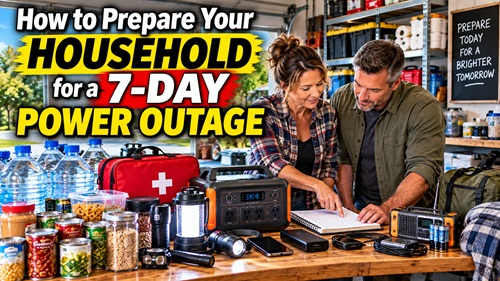
A power outage lasting a few hours is an inconvenience. Once an outage stretches into several days, however, everyday household systems begin to disappear one after another. Refrigeration becomes unreliable, electronic payments may become difficult, communications become harder, heating or cooling may be affected, and obtaining food, fuel, water, or other supplies can become increasingly challenging.
Preparing for a seven-day outage is a practical starting point because it forces a household to think beyond simply owning a flashlight and a few batteries. The objective is not to predict why the power might fail. Severe weather, equipment failures, wildfires, accidents, infrastructure damage, or other disruptions can all produce outages. What matters is developing enough household capability to continue functioning when electricity is unavailable.
Start With Water
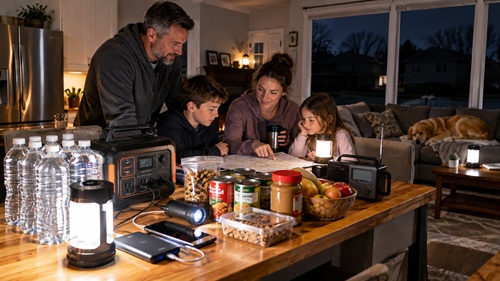
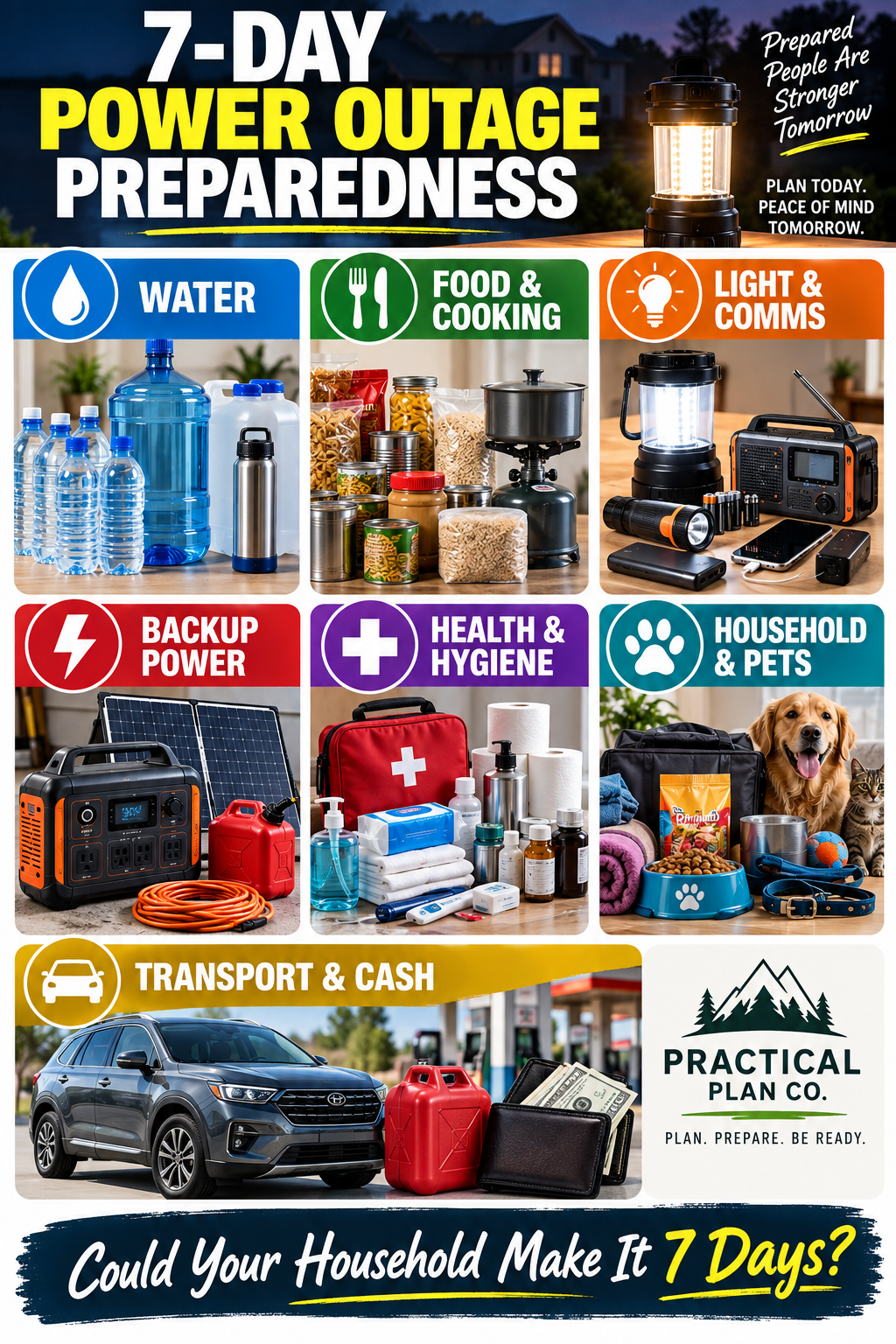
Water should be one of the first considerations. Store an appropriate emergency supply of drinking water for everyone in the household, including additional water for pets. Remember that water may also be needed for cooking, basic cleaning, sanitation, and personal hygiene.
Stored water is only part of the plan. Households should also identify possible backup water sources and have clean containers available if additional water must be collected or transported. If the safety of a water source becomes questionable during an emergency, follow local public-health guidance regarding treatment or use.
Build a Seven-Day Food Plan
Instead of simply accumulating emergency food, build seven days of actual meals. Choose foods your household normally eats and emphasize items that store well and require little refrigeration, water, fuel, or preparation.
Include the needs of infants, older family members, people with dietary restrictions, and pets. Keep a manual can opener available if canned foods are part of the plan.
Think about cooking as a separate preparedness problem. If your stove, microwave, or other normal appliances cannot operate, determine beforehand how food will be prepared safely. Any fuel-burning cooking equipment must be used according to its manufacturer’s instructions and never in a way that creates a carbon-monoxide or fire hazard.

7-Day Power Outage Meal Plan
| Day | Breakfast | Lunch | Dinner | Snack |
|---|---|---|---|---|
| 1 | Oatmeal + dried fruit | Crackers + peanut butter | Canned chili + crackers | Trail mix |
| 2 | Cereal + shelf-stable milk | Tuna + crackers | Rice + canned chicken & vegetables | Dried fruit |
| 3 | Oatmeal + peanut butter | Canned soup + crackers | Pasta + canned sauce | Nuts |
| 4 | Granola + dried fruit | Peanut butter + crackers | Rice + beans + canned vegetables | Applesauce |
| 5 | Oatmeal + raisins | Tuna + crackers | Canned stew + bread/crackers | Trail mix |
| 6 | Cereal + shelf-stable milk | Soup + crackers | Pasta + canned meat & sauce | Dried fruit |
| 7 | Oatmeal + peanut butter | Beans + crackers | Rice + canned chicken & vegetables | Nuts |
Prepare for Darkness and Lost Communications
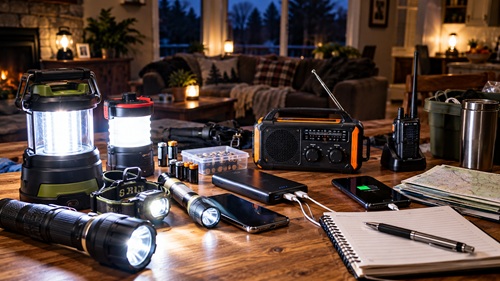
Every household member should know where flashlights or headlamps are kept. Spare batteries, rechargeable lights, and charged power banks can greatly improve comfort and safety during an extended outage.
Decide which electronics actually need power. Keeping one phone operating for communications may be far more important than attempting to power every household device.
Maintain another way of receiving emergency information if internet or cellular service becomes unreliable. A battery-powered or hand-crank radio can provide another information channel. Important telephone numbers should also exist somewhere other than a smartphone.
Understand Your Backup Power
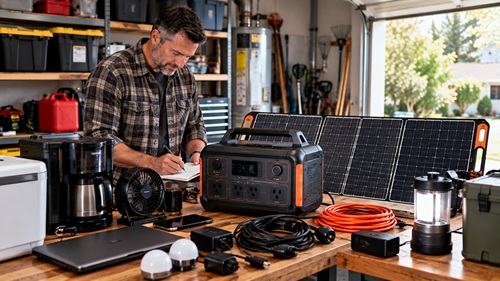
Generators, portable power stations, solar systems, and battery banks can be extremely useful, but owning backup equipment is not the same as having a backup-power plan.
Determine what your system can realistically operate and prioritize essential loads. Test equipment periodically and keep the correct cables, adapters, chargers, and manufacturer instructions with it. If fuel is required, understand the applicable storage requirements and equipment recommendations before an emergency occurs.
Fuel-burning generators must never be operated inside homes, garages, sheds, or other enclosed or improperly ventilated spaces. Carbon monoxide can accumulate rapidly and can be fatal.
Protect Health and Sanitation
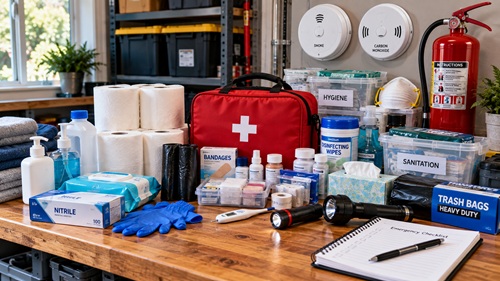
A week without normal utilities can turn relatively small problems into serious ones. Maintain a useful first-aid kit and consider how necessary medications and medical equipment would be managed during an extended outage.
Keep adequate hygiene and sanitation supplies, including soap, toilet paper, garbage bags, and other household necessities. Working smoke alarms and carbon-monoxide alarms become particularly important when households begin using unfamiliar heating, lighting, cooking, or backup-power arrangements.
Temperature should also be part of the plan. Losing electricity during extreme heat or cold can eventually make remaining at home unsafe.
Don’t Forget Transportation, Cash and Pets
Keep reasonable fuel or charge levels in vehicles rather than routinely allowing them to approach empty. An extended outage can disrupt gas stations and charging infrastructure at the same time that transportation becomes more important.
Keeping a modest amount of emergency cash can also provide another option if electronic payment systems are unavailable.
Pets require their own supplies. Maintain enough food, water, medications, carriers, leashes, and other necessities to care for them throughout the outage.
Finally, establish a basic household communication plan. Decide how family members will reconnect if separated and which relatives, friends, or neighbors may need checking on.
Identify Your Three Biggest Weaknesses
One of the most useful preparedness exercises is not asking “Do we have enough stuff?” but “Where would our household start having problems first?”
Walk through an imaginary seven-day outage from beginning to end. Consider water, food, refrigeration, cooking, lighting, communications, sanitation, medical needs, temperature, transportation, pets, and backup power.
Then identify the three weaknesses most likely to cause your household difficulty.
Those three weaknesses become your preparedness priorities. Correct them first before spending money on equipment that solves less important problems.
A seven-day plan will not prepare a household for every possible emergency, but it creates something much more valuable than a random collection of supplies: a tested foundation for functioning when the systems normally supporting everyday life are temporarily unavailable.
Preparedness Action Plan
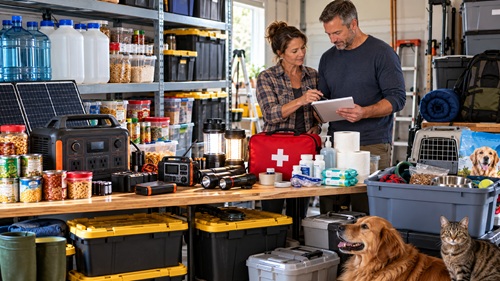
This week, walk through your home and mentally remove grid electricity for seven full days. Determine how you would obtain water, prepare meals, maintain lighting and communications, manage sanitation and medical needs, care for pets, and cope with extreme temperatures. Test any backup-power equipment you already own and identify your three largest capability gaps. Build the plan around closing those gaps rather than simply buying more emergency supplies.
Key Takeaways
Seven-day preparedness is about maintaining essential household functions rather than recreating normal life. Water, practical meals, safe cooking, lighting, communications, sanitation, medical requirements, temperature control, transportation, pets, and backup power should work together as one household system. The strongest plan also recognizes its limits and establishes the conditions under which leaving the home would become safer than remaining there.
Safety note: This preparedness material is intended for general educational and organizational purposes. Follow applicable local emergency guidance and manufacturer instructions for generators, batteries, fuels, cooking appliances, food storage, water treatment, electrical equipment, and other emergency systems.
© Prepping Communities. This content is for informational purposes only and not professional advice. Use at your own risk.
Terms | Privacy | Guidelines