
When someone is sick or injured, one of the first things you need to do is figure out what is actually wrong and whether their condition is stable or getting worse. In an emergency where professional medical care is delayed, a basic medical examination can give you important information to work with.
You are not trying to become a doctor or make a complicated diagnosis. The objective is much simpler: find the problem, check the person, take basic vital signs, write down what you find, and watch for changes.
Start With the Main Problem
Begin by asking the person what is wrong. In medical terms, this is the chief complaint. It might be something obvious such as a cut hand, injured ankle, fever, vomiting, chest pain, or difficulty breathing.
Ask when the problem started, what happened immediately beforehand, where it hurts, whether the symptoms are getting better or worse, and whether anything makes them better or worse. Also ask about important medical conditions, medications, and allergies.
Keep the examination focused. Someone who twisted an ankle does not normally need the same examination as someone complaining of shortness of breath.
If the person is unconscious, severely confused, having serious difficulty breathing, experiencing uncontrolled bleeding, showing signs of stroke, or has another obvious life-threatening condition, obtaining emergency medical help takes priority.
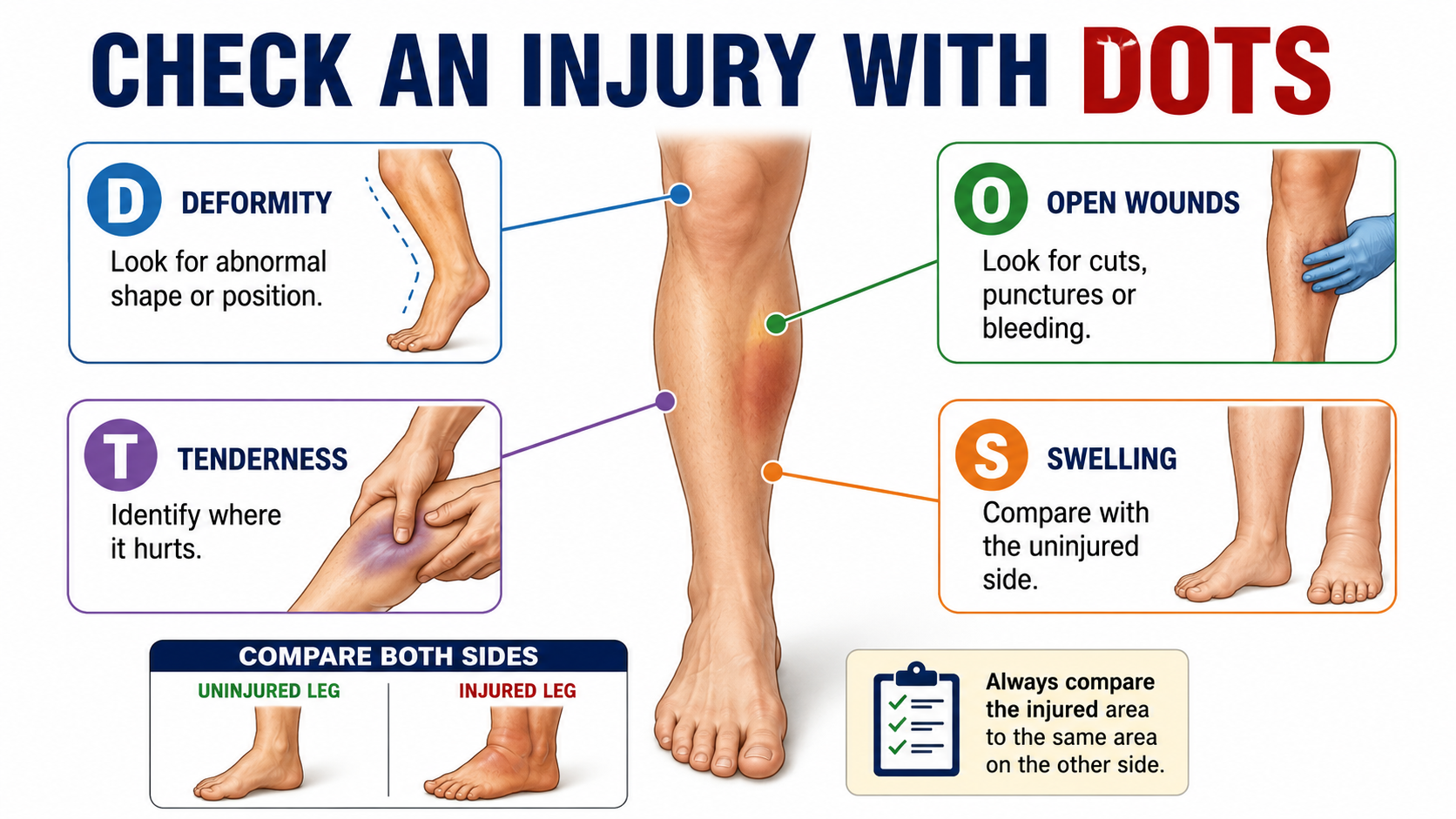
Examine Injuries Using DOTS
For injuries, DOTS gives you an easy way to remember what to look for:
- D — Deformity: Does anything look bent, displaced, or different from the opposite side?
- O — Open wounds: Are there cuts, punctures, abrasions, or bleeding?
- T — Tenderness: Where does it hurt when gently examined?
- S — Swelling: Is there swelling or bruising compared with the opposite side?
Compare an injured arm or leg with the uninjured side whenever possible. Differences in shape, position, swelling, skin color, temperature, movement, or sensation can provide useful clues.
Do not aggressively manipulate an injured area simply to determine how badly it is hurt.
Take the Vital Signs
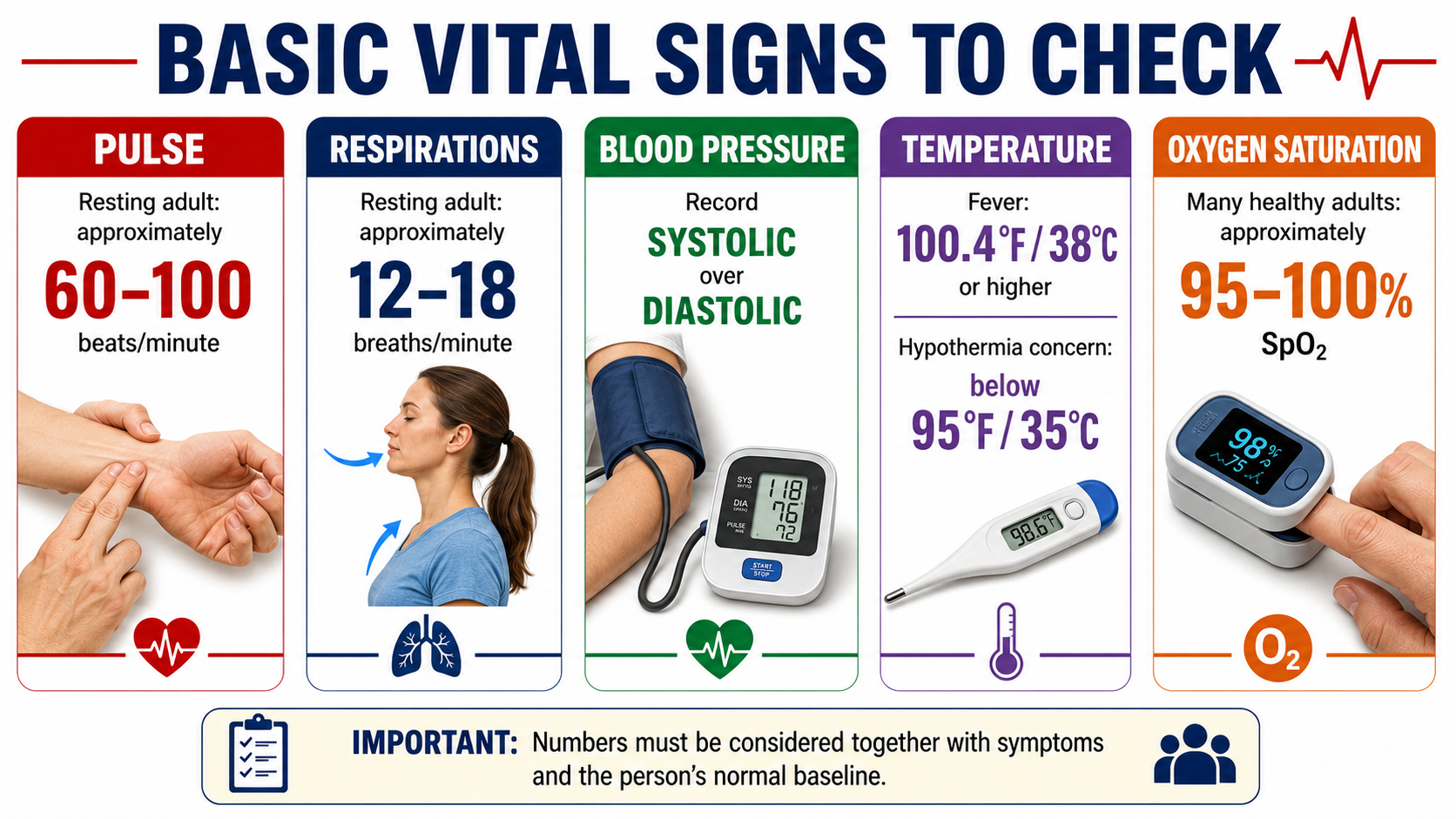
After dealing with immediate threats, take the person’s vital signs. These measurements provide a basic picture of how the body is functioning.
Record:
Pulse
Respirations
Blood pressure, if available
Temperature
Oxygen saturation (SpO₂), if you have a pulse oximeter
One unusual reading does not always tell you very much. What becomes especially useful is taking the same measurements again later and comparing them.
Always record the time with the readings.
Pulse
The easiest place to check a pulse is usually at the wrist on the thumb side. Place the pads of your index and middle fingers over the artery and press gently until you feel the heartbeat.
Do not use your thumb because it has a noticeable pulse of its own.
A typical resting adult pulse is roughly 60–100 beats per minute. Counting for a full minute gives the most accurate basic measurement.
Also notice what the pulse feels like. Is it regular? Irregular? Strong? Weak? A fast pulse can occur with exercise, fear, pain, fever, dehydration, blood loss, and many medical problems.
The number needs to be considered alongside what is happening to the patient.
Breathing
Watch the person’s chest or abdomen rise and fall. One complete rise and fall counts as one breath.
A typical resting adult respiratory rate is around 12–18 breaths per minute. Count for a full minute when possible.
Don’t just count breaths. Watch how the person is breathing.
Look for wheezing, gurgling, shallow breathing, unusually deep breathing, difficulty speaking, obvious effort to breathe, or a rapidly increasing breathing rate.
Someone breathing 18 times per minute comfortably is very different from someone breathing 18 times per minute while visibly struggling for every breath.
Oxygen Saturation
A small fingertip pulse oximeter can provide both the pulse rate and an estimate of blood oxygen saturation.
For many healthy people, an SpO₂ reading around 95–100% is common, although normal baseline readings can differ between individuals and with certain medical conditions.
Do not depend entirely on the device. Cold hands, movement, poor circulation, nail products, and other factors can interfere with the reading.
Pay attention to the person as well as the number. Difficulty breathing, confusion, bluish or gray skin, chest pain, severe weakness, or persistently low oxygen readings require serious attention.
Blood Pressure
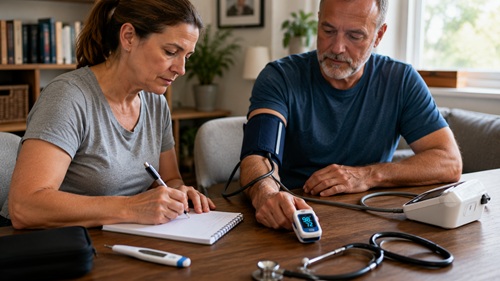
Blood pressure is written as two numbers, such as:
120/80 mmHg
The upper number is the systolic pressure, which represents pressure when the heart contracts. The lower number is the diastolic pressure, representing pressure between heartbeats.
Proper cuff size matters. A cuff that is too small can produce an artificially high reading, while an oversized cuff can produce an artificially low reading.
Blood pressure also changes with physical activity, pain, stress, medications, dehydration, illness, and many other factors. Whenever possible, allow the person to rest before taking the measurement.
If you keep a manual blood-pressure cuff and stethoscope in your preparedness medical supplies, learn how to use them now. Taking an accurate manual blood pressure requires practice.
Temperature
Temperature is another basic measurement that can help identify illness, hypothermia, or dangerous overheating.
A temperature of 100.4°F (38°C) or higher is generally considered a fever. A body temperature below 95°F (35°C) can indicate hypothermia.
Very high body temperature accompanied by confusion, collapse, altered mental status, or other signs of heat stroke is an emergency.
Remember that readings can vary depending on whether temperature is taken orally, in the ear, on the forehead, under the arm, or by another method. When keeping medical records, write down how the temperature was taken.
Look at the Person, Not Just the Equipment
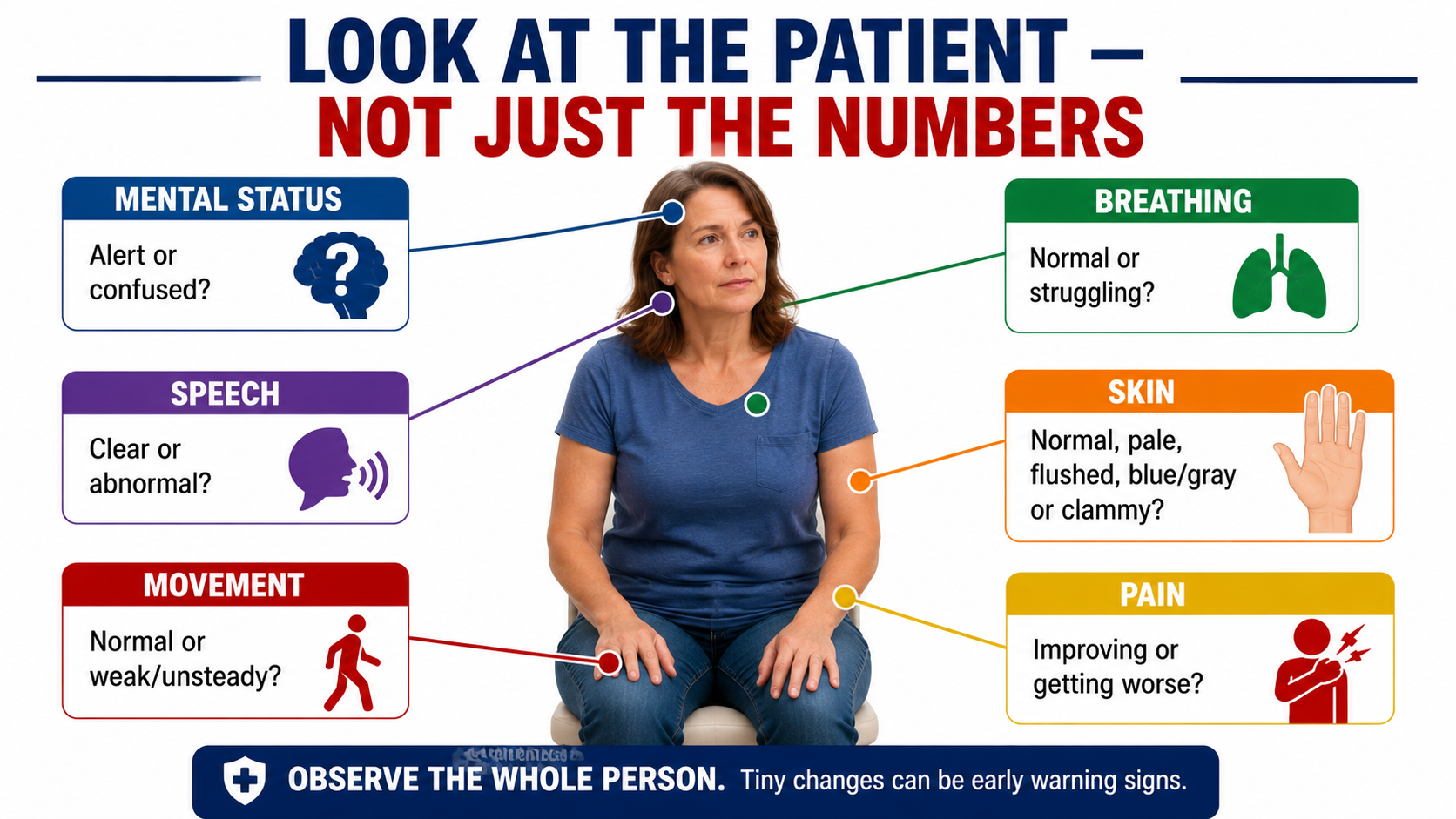
Vital signs are useful, but don’t become so focused on numbers that you stop looking at the patient.
Pay attention to their overall condition.
Are they alert and answering questions normally? Is their speech clear? Is their skin unusually pale, flushed, blue, gray, cold, sweaty, or clammy? Are they becoming weaker? Can they walk normally if their condition permits? Is their pain increasing? Are they becoming confused or unusually sleepy?
These observations can sometimes tell you that something is wrong before a piece of equipment does.
Keep Simple Medical Notes
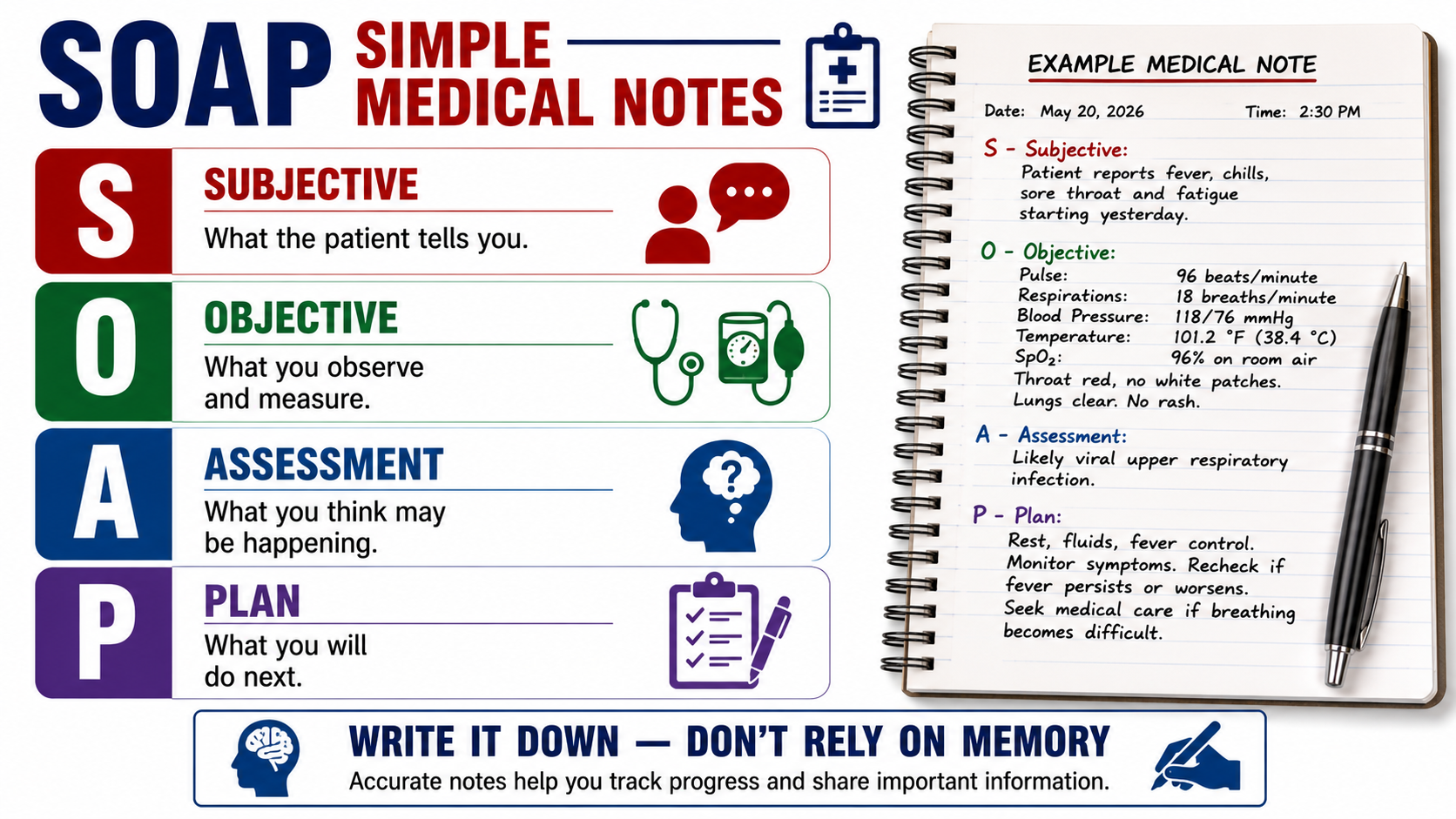
A useful way to document a medical problem is the SOAP method.
S — Subjective: What the person tells you.
O — Objective: What you actually observe and measure.
A — Assessment: What you believe may be happening.
P — Plan: What you are going to do next.
For example:
S: Patient twisted right ankle while walking downhill. Reports significant pain when putting weight on it.
O: Swelling around outside of ankle. Tender to touch. No open wound. Pulse 88. Temperature 98.6°F.
A: Possible sprain or fracture.
P: Stop weight-bearing, stabilize the ankle, monitor swelling and circulation, and obtain medical evaluation when available.
Keep the notes short. The purpose is to create a useful medical record, not write an essay.
Recheck the Patient
This is one of the most important parts of a basic medical examination.
Do not assume that because someone looked stable twenty minutes ago they are still stable now.
Take another set of vital signs when appropriate and compare them with the first set.
For example:
2:00 PM
Pulse: 86
Respirations: 16
BP: 122/78
Temperature: 99.0°F
SpO₂: 97%
3:00 PM
Pulse: 106
Respirations: 23
BP: 106/68
Temperature: 101.4°F
SpO₂: 93%
The second set of readings tells you something is changing.
That is why writing things down matters. Memory is unreliable during stressful situations.
Basic Examination Equipment
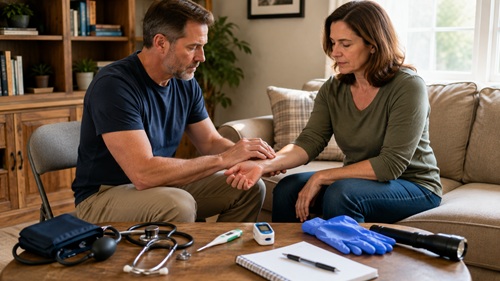
A preparedness medical kit should have a few basic diagnostic tools in addition to bandages and first-aid supplies:
- Digital thermometer
- Blood-pressure cuff
- Stethoscope
- Pulse oximeter
- Watch or timer
- Flashlight
- Disposable gloves
- Notebook and pens
More equipment isn’t necessarily better. Knowing how to use basic equipment correctly is more valuable than owning medical equipment you have never practiced with.
Practice taking vital signs on healthy family members. You will learn how to use the equipment while also getting an idea of what normal readings look like for the people you may eventually have to help.
A Simple Examination Routine
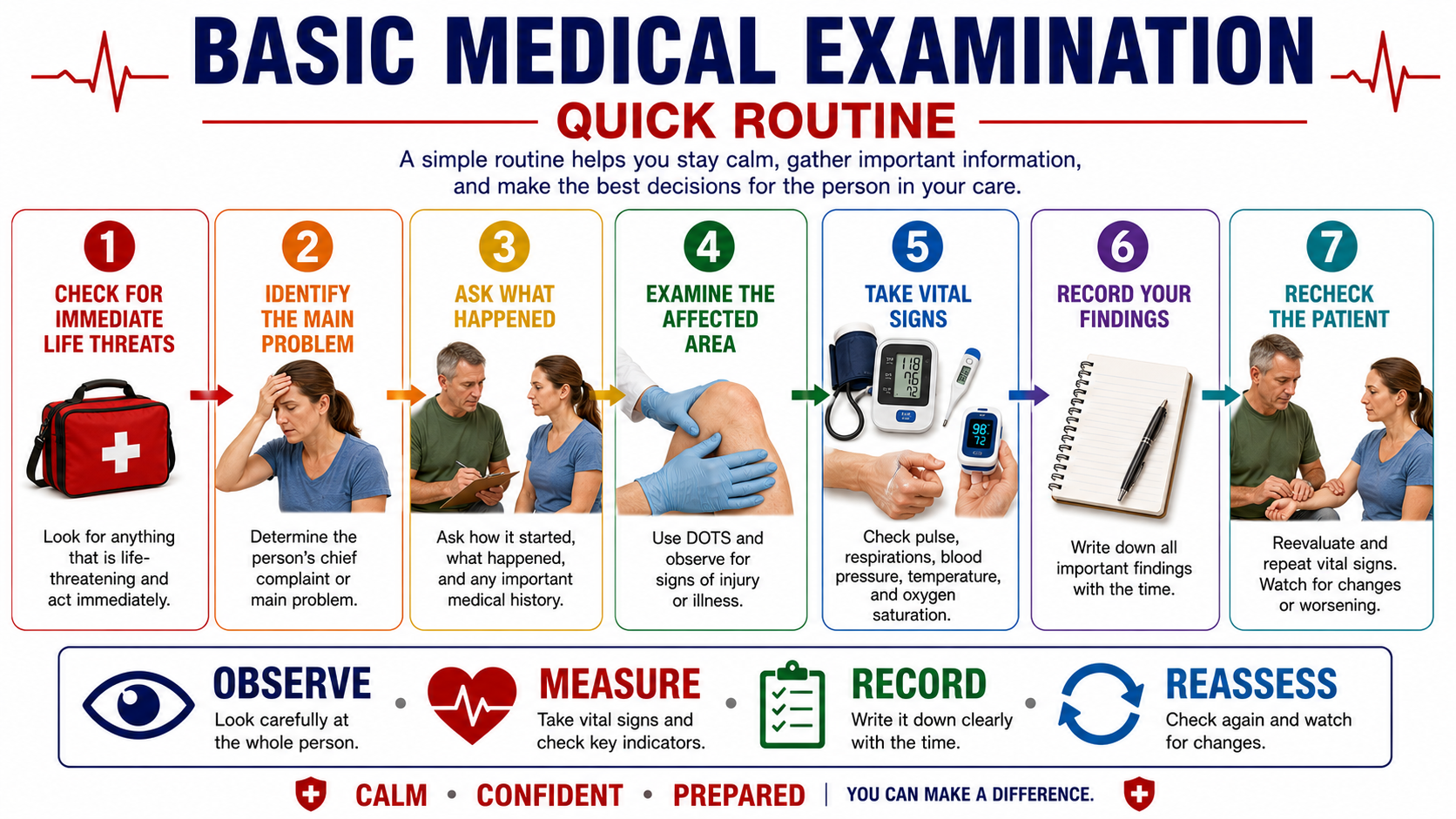
When someone becomes sick or injured, follow the same basic routine each time:
Check for immediate life threats → Identify the main problem → Ask what happened → Examine the affected area → Take vital signs → Record what you find → Recheck the person.
If you remember nothing else, remember four words:
Observe. Measure. Record. Reassess.
A basic medical examination will not replace professional medical care. But when help is delayed, knowing how to gather reliable information can help you recognize deterioration sooner, make better decisions, and provide useful information to medical professionals when they become available.
© Prepping Communities. This content is for informational purposes only and not professional advice. Use at your own risk.
Terms | Privacy | Guidelines