
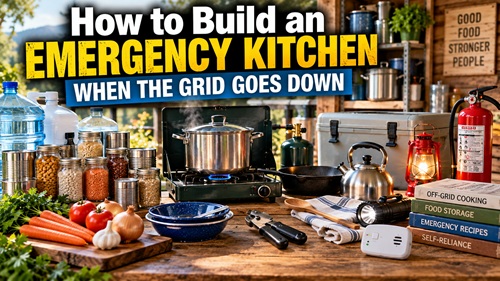
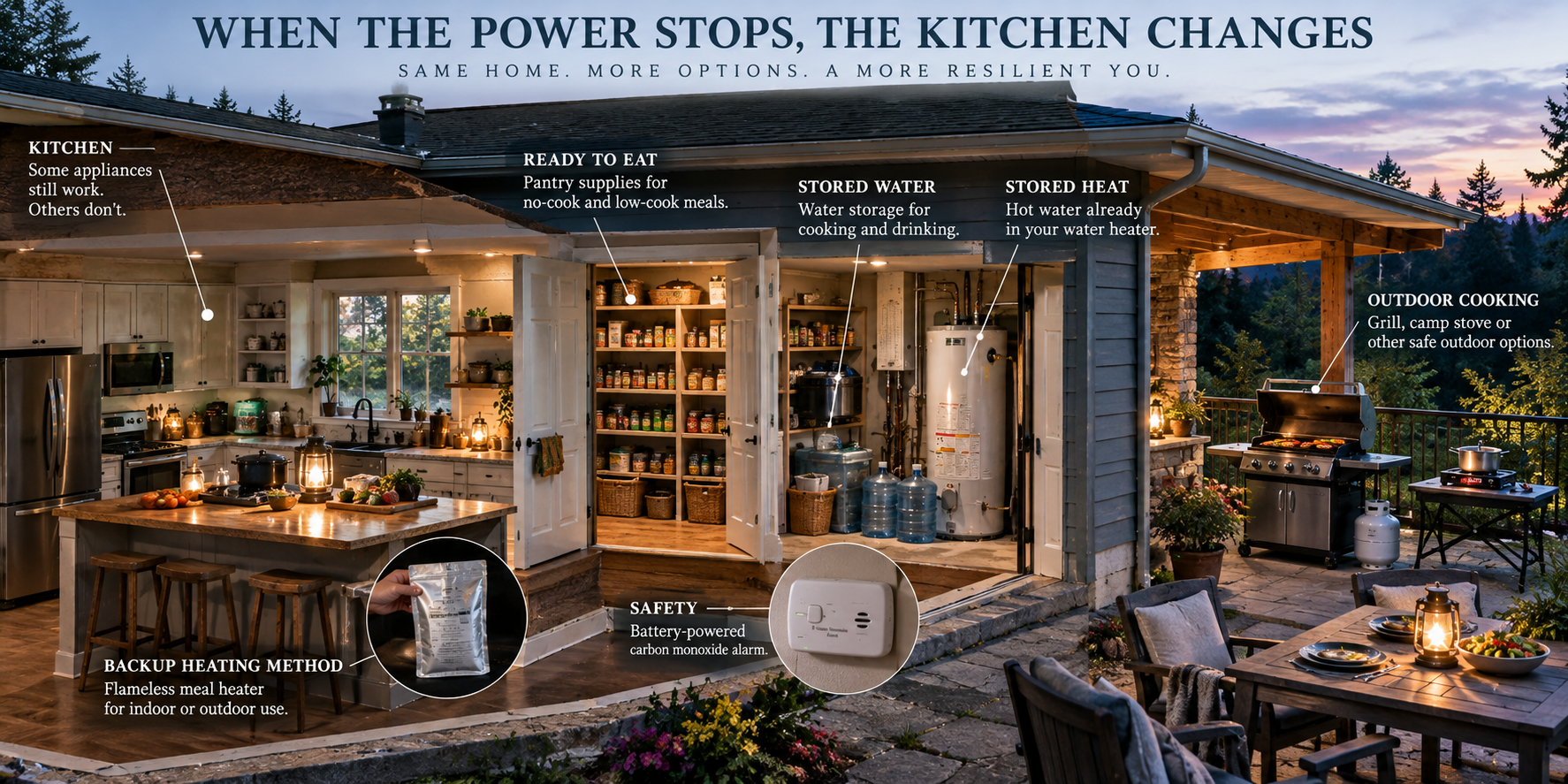
When the power goes out, most people immediately think about lights, heat, and refrigeration. The kitchen often comes later because there is food in the cupboards, food in the freezer, and perhaps even a gas stove sitting in the middle of the room. But having food and being able to safely turn that food into meals are two different things. A prolonged blackout changes the kitchen from a place of convenience into a small resource-management problem involving water, heat, fuel, refrigeration, food safety, and carbon monoxide.
The good news is that an emergency kitchen does not necessarily require an expensive collection of specialized survival equipment. Many homes already contain pieces of one. A barbecue, propane stove, insulated cooler, thermos, canned-food pantry, stored water, cookware, manual can opener, and other ordinary household items can all become useful parts of a grid-down cooking system. The goal is to identify those resources before the power fails and understand how to use them safely and efficiently.
A good emergency kitchen should provide several ways to accomplish the same basic tasks. You should be able to obtain safe water, prepare food without grid electricity, conserve fuel, protect refrigerated food for as long as practical, prepare meals requiring little or no cooking, and detect hazards created by alternative cooking methods. The more independent these capabilities are from one another, the more resilient the household becomes.
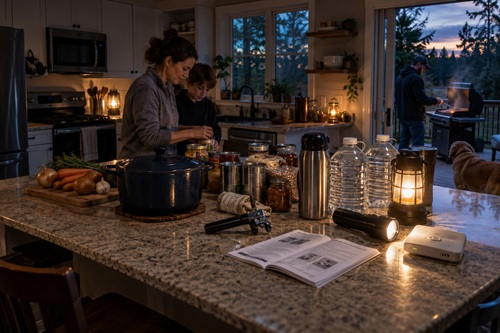
Find Out What Actually Works Without Electricity
Start with the kitchen you already have. Walk through it and identify everything that depends on electricity. An electric range, induction cooktop, microwave, toaster oven, air fryer, electric kettle, electric pressure cooker, coffee maker, and most countertop appliances will stop working unless you have sufficient backup electrical power.
Gas appliances require closer examination. A gas stove should never automatically be considered blackout-ready simply because natural gas service is still available. Many modern gas ovens use electric igniters, electronic controls, electrically operated safety systems, or other components that prevent normal operation when the power is off. Some gas cooktops may allow burners to be manually lit during an outage, while others should not be operated that way.
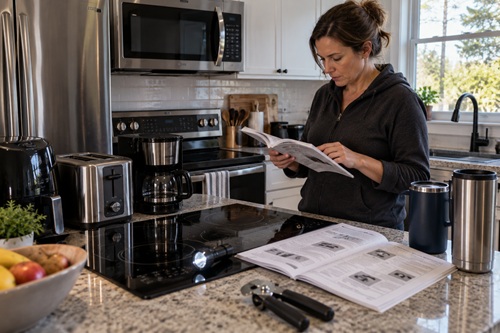
The correct answer is found in the manufacturer’s instructions for the specific appliance. Check those instructions now and keep a printed copy with your emergency information. Never attempt to bypass an ignition system, interlock, safety valve, or other protective feature just to make an appliance operate during a blackout.
This simple exercise may reveal something important: a kitchen filled with modern appliances can lose most of its cooking capability within seconds of a power failure. Knowing that beforehand gives you time to build alternatives.
Water Becomes Part of the Kitchen
Emergency cooking begins with water, not food. Municipal water may continue operating normally during a blackout, but prolonged or widespread electrical failures can affect pumping stations, treatment facilities, pressure, and other parts of a water system. If system integrity is compromised, authorities may issue a boil-water advisory or other instructions.
This is why stored potable water belongs in the emergency kitchen. If officials announce that tap water must be boiled or otherwise treated, follow the instructions issued by the local water authority. Do not assume that water is safe simply because it looks, smells, or tastes normal.
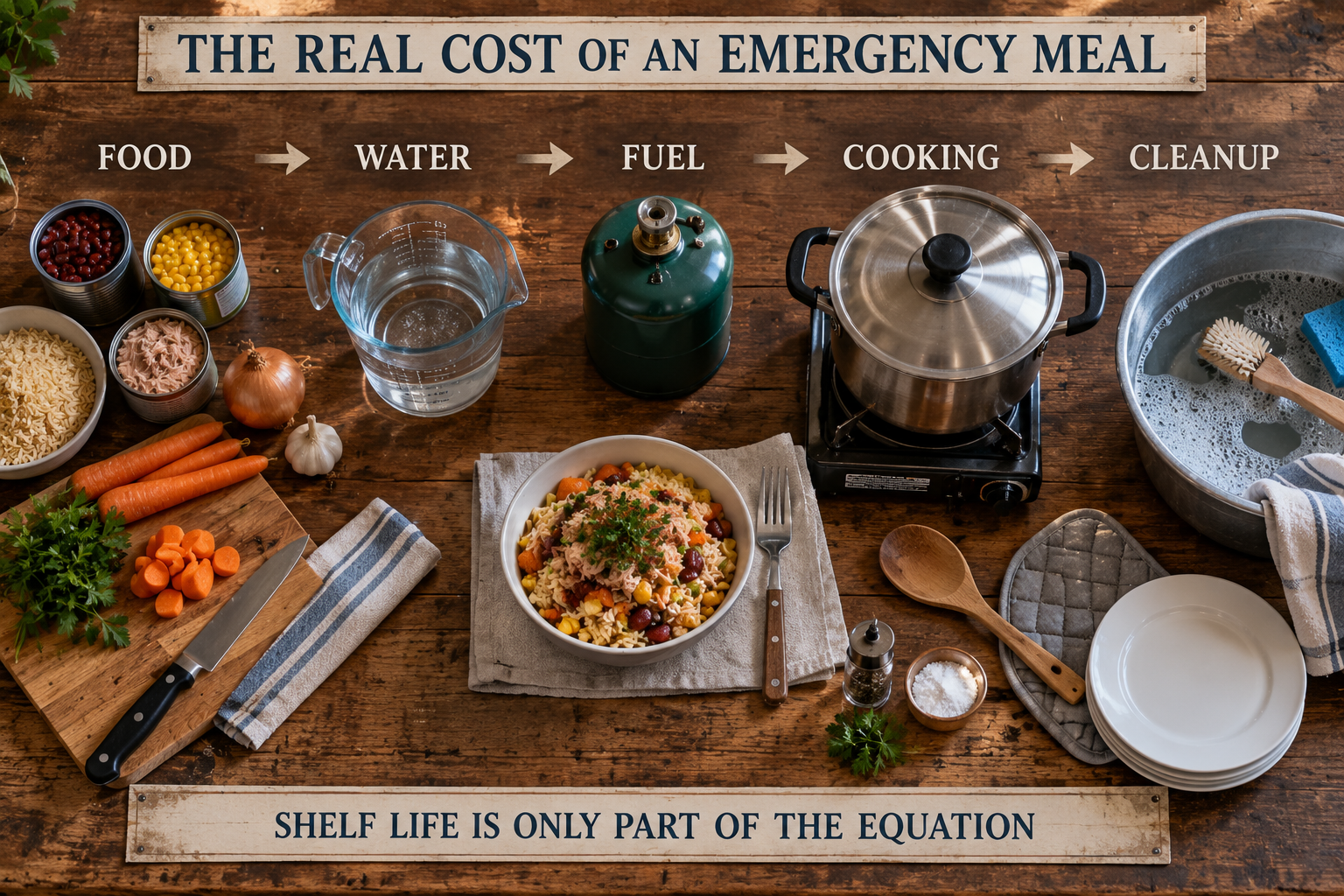
Water also changes the way emergency food should be evaluated. A package of dried beans, rice, pasta, dehydrated food, or freeze-dried meals may contain plenty of calories, but those calories may require substantial amounts of water and fuel before they can be eaten. If water must first be treated and then heated again for cooking, the true resource cost of that meal increases considerably.
Instead of judging stored food only by calories and shelf life, begin considering the water and fuel required to serve it. A food that lasts twenty-five years but requires considerable potable water and cooking fuel solves a different problem than a can of food that can be opened and eaten immediately.
That does not make dehydrated or freeze-dried foods poor preparedness choices. Their low weight, compact storage, and long shelf life can make them extremely valuable. It simply means a resilient pantry should contain different types of food rather than depending entirely on foods requiring water and heat.
Use Heat You Already Have
One of the best ways to conserve emergency fuel is to recognize heat that has already been produced. A conventional tank-style water heater, for example, is essentially an insulated container holding a significant quantity of water that may remain warm for some time after electrical power is lost.
Depending on the type of water heater, condition of the plumbing, water quality, outage circumstances, and local guidance, that stored water may have emergency uses. Warm water can be particularly useful for washing or other tasks that would otherwise require fuel to heat cold water.
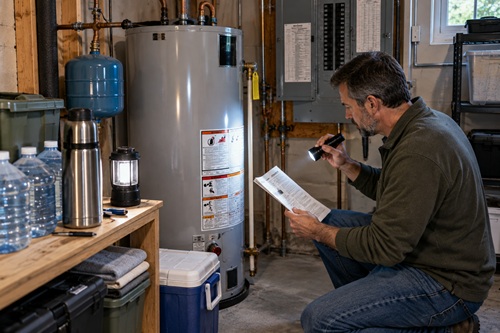
However, water from a household water heater should not automatically be assumed to be safe drinking water. Tank condition, sediment, plumbing materials, contamination, maintenance history, and local health guidance all matter. If potable water is required, properly stored drinking water is the safer starting point unless authoritative guidance indicates otherwise.
Homeowners should also learn how their particular water heater operates before an emergency. Electric water heaters can be damaged if their heating elements are energized while the tank is empty, and very hot water creates a serious scalding hazard. The objective is not to improvise with the appliance during a crisis but to understand it beforehand.
The larger preparedness principle is simple: before burning precious fuel to create heat, determine whether useful stored heat is already available.
Build More Than One Cooking Option
An emergency kitchen should never depend on a single cooking appliance. A propane grill may be excellent until the propane runs out. A charcoal grill becomes useless when the charcoal is gone. A camp stove can fail mechanically. High winds, heavy snow, wildfire restrictions, flooding, or extreme cold can make outdoor cooking difficult or impossible.
The solution is redundancy. A household might have a propane barbecue as its primary cooking method, a suitable camp stove as a secondary method, shelf-stable foods requiring no cooking as another layer, and perhaps an appropriate flameless heating method for certain packaged foods.
The exact combination will be different for every household. What matters is that the failure of one method does not eliminate the ability to eat.
Any appliance designed for outdoor use must remain outdoors. A garage with the door open should not automatically be considered outdoors. Neither should an enclosed porch, basement, shed, tent, vehicle, or other partially enclosed space. Manufacturer instructions determine where an appliance can safely operate.
Bad weather can make these rules inconvenient, but inconvenience is considerably easier to manage than carbon-monoxide poisoning or a structure fire.
Carbon Monoxide Is One of the Greatest Blackout Cooking Hazards
Alternative cooking and heating introduce one of the most serious dangers associated with extended power outages: carbon monoxide.
Carbon monoxide cannot be seen or smelled. People can be exposed without realizing what is happening, which makes proper equipment use and functioning alarms essential.
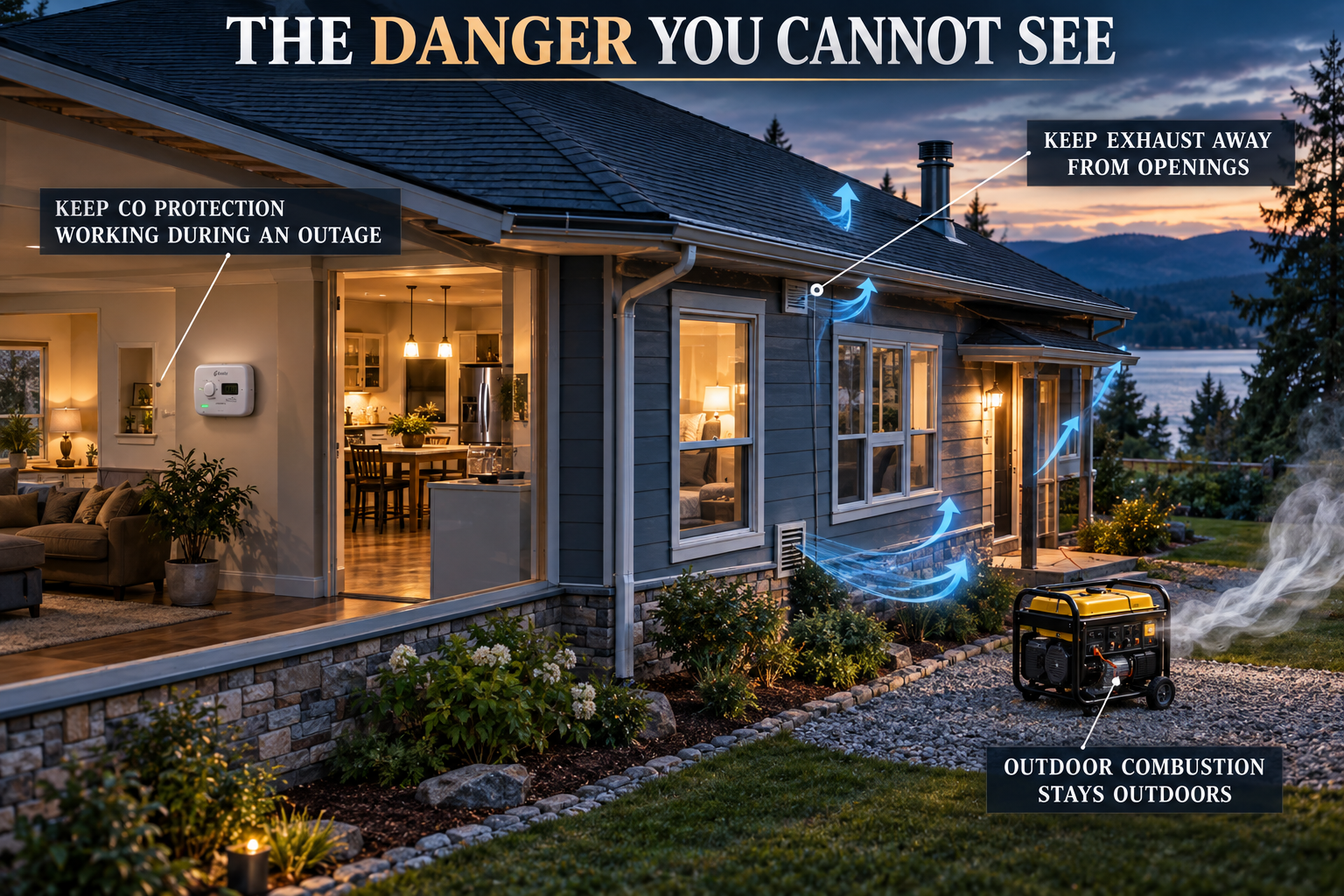
Never use a gas range or oven as a substitute for household heating. Never bring a charcoal or propane grill indoors. Never operate a portable generator inside a home, garage, basement, shed, enclosed porch, or other enclosed or partially enclosed area.
Generators should always be operated outdoors according to the manufacturer’s instructions and current safety guidance, positioned well away from doors, windows, vents, and other openings through which exhaust could enter the building.
A blackout also exposes an easily overlooked weakness in some homes: carbon-monoxide alarms that depend entirely on household electricity. If the alarm stops working when the power fails, protection can disappear precisely when alternative heating, generators, and cooking equipment begin being used.
Every emergency plan should therefore include carbon-monoxide alarms capable of continuing to operate during an outage, such as battery-powered models or properly designed units with battery backup. Test them regularly, maintain their batteries, and replace the alarm itself according to the manufacturer’s specified service life.
Alternative cooking equipment is useful. Carbon-monoxide protection is essential.
Treat Fuel Like a Stored Resource
Having a propane cylinder or bag of charcoal is only the beginning. During a long outage, the real question is how many useful meals that fuel can produce.
The answer depends on the appliance, burner rating, cooking temperature, weather, number of burners being used, and the food being prepared. Rather than relying on a general claim that a cylinder will last a certain number of days, check the appliance’s rated fuel consumption and develop a realistic estimate for your own equipment.
Then practice using less.
A lid is one of the simplest fuel-saving tools in the kitchen because it reduces heat loss and can shorten heating time. Matching the pot to the burner helps as well. Heating only the amount of water required for the meal prevents fuel from being wasted warming water that will simply be discarded.
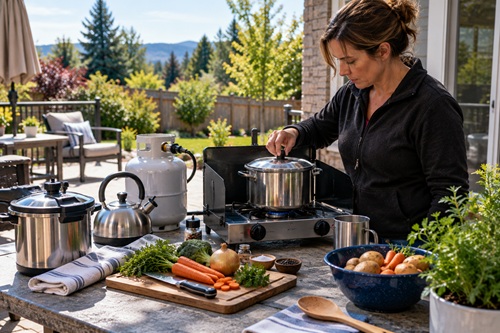
Meal selection matters too. During an extended outage, it makes little sense to spend hours simmering one food when another can provide similar nutrition with a fraction of the fuel. Pressure cookers designed for the heat source being used can substantially shorten the cooking time of many foods when operated according to their instructions.
Batch cooking can provide another advantage. If the stove is already operating, preparing enough food for more than one meal may use less fuel than repeatedly starting from cold cookware and ingredients.
The goal is not to produce the largest possible flame. It is to extract the greatest amount of useful cooking from the fuel available.
Learn Retained-Heat Cooking
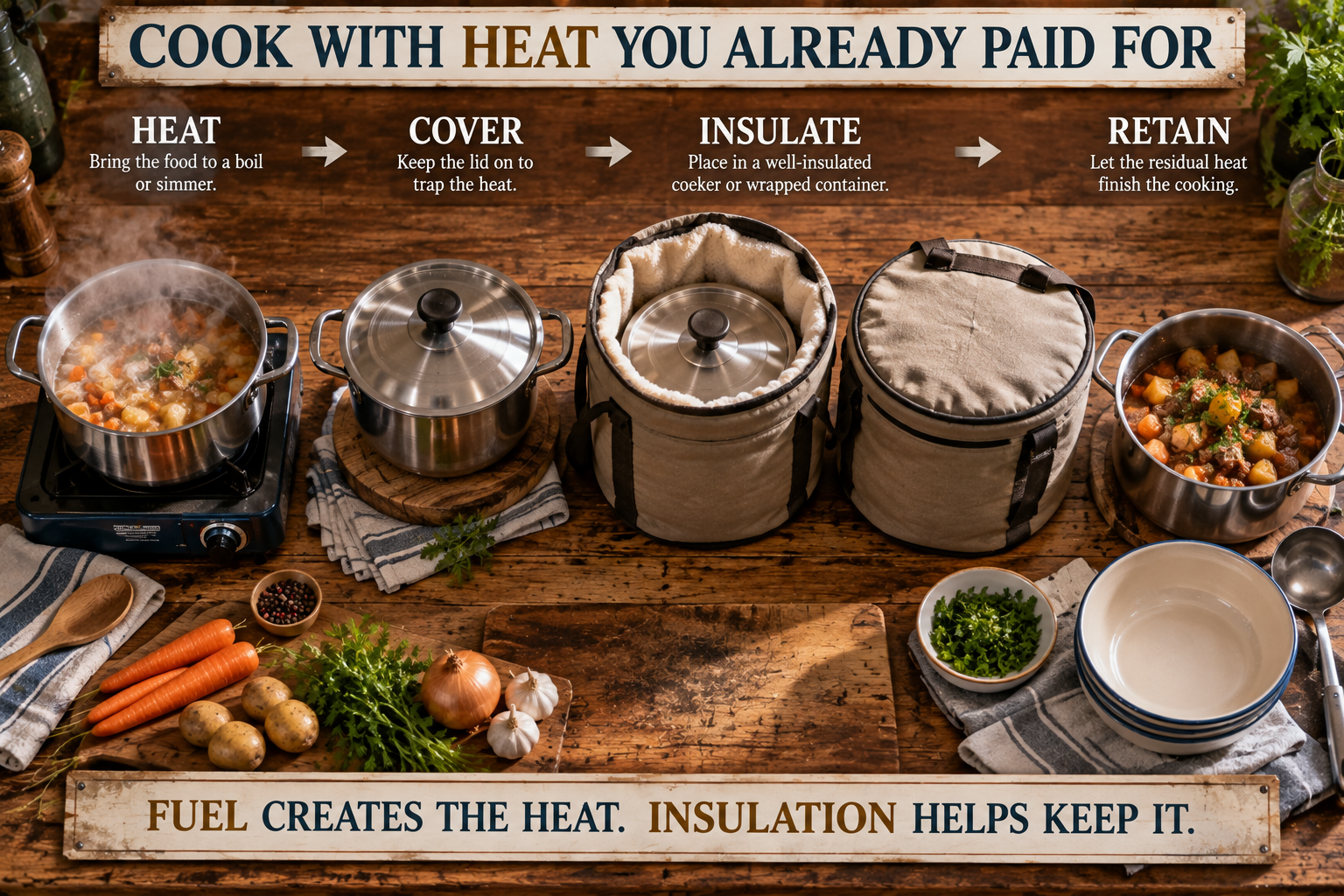
There is another way to reduce fuel consumption that predates modern electric slow cookers by generations. It is generally known as retained-heat cooking, fireless cooking, or historically as a haybox.
The concept is remarkably simple. Food is heated conventionally and then placed inside a highly insulated environment. Instead of continuing to burn fuel beneath the pot, insulation slows the escape of the heat already contained in the food and cookware.
Traditional versions used boxes packed with insulating materials such as hay. Modern approaches may use purpose-built thermal cookers or other properly designed insulated systems.
The method can be particularly useful for foods that normally require extended simmering because the active burner time can sometimes be reduced significantly. It illustrates an important principle of emergency cooking: fuel produces the heat, but insulation determines how long you get to keep it.
Retained-heat cooking must still be approached with proper food-safety knowledge. Different foods, quantities, containers, starting temperatures, and insulation systems lose heat at different rates. Food that remains too long within temperatures favorable to bacterial growth can become unsafe.
This is a technique to practice before an emergency, not one to discover by experimentation during a blackout. Use reliable instructions, monitor food temperatures when learning, and follow established food-safety guidance.
Once understood, however, retained heat can become an extremely useful part of a low-fuel kitchen.
Your Freezer Is Now on a Clock
The moment the electricity fails, refrigerated and frozen foods become time-sensitive resources. Keeping refrigerator and freezer doors closed preserves cold air and buys time, so avoid repeatedly opening them simply to check the food.
If the outage becomes prolonged, begin thinking about which foods should be consumed first. Perishable refrigerated foods and foods beginning to thaw may deserve priority over canned or dry foods that can remain safely stored for months or years.
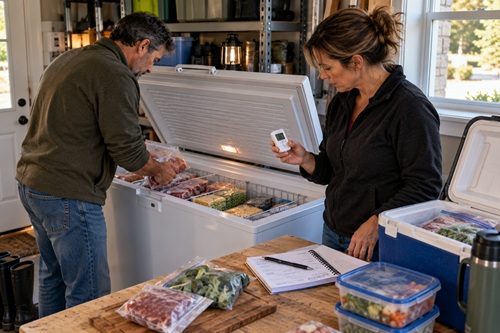
Food safety must always determine what can actually be eaten. Smell and appearance are not reliable ways to identify all dangerous food contamination. Follow current food-safety guidance concerning refrigeration temperatures, outage duration, thawing, refreezing, and disposal.
There is also little value in cooking an entire freezer full of food if the household cannot safely eat or preserve what has been cooked. Once meat or other perishables are cooked, they still require safe storage. Cooking simply moves the food from one safety timeline to another.
A better approach is to think in terms of safe consumption. Use vulnerable foods while they remain safe, share appropriate food when practical, preserve foods using methods you already understand, and protect shelf-stable supplies until they are actually needed.
Store Food That Doesn’t Need a Stove
A resilient emergency pantry should contain several levels of convenience. Some foods should be ready to eat immediately. Others may need only warming. Some may require hot water, while longer-storage staples may require considerable cooking.
This variety becomes extremely valuable when fuel or water is scarce.
Commercially canned foods can be particularly useful because many are already fully cooked. Appropriate canned soups, stews, beans, vegetables, fish, meats, and fruit can often be eaten without reheating when product instructions and food-safety conditions permit. Heating may improve the meal, but in many cases it is not what makes the food edible.
Other foods such as nut butters, crackers, shelf-stable cereals, suitable energy foods, and various commercially packaged meals can provide calories without using cooking fuel at all.
Freeze-dried and dehydrated foods still deserve a place in the pantry, but their preparation requirements should be included in planning. Read the directions on several meals you currently store and calculate how much potable water would be required to prepare them for the entire household for several days.
That simple exercise may reveal that your emergency food supply is also an emergency water requirement.
Flameless Heating Adds Another Layer
Flameless ration heaters provide another way of warming certain packaged foods without conventional combustion. These systems use a chemical reaction to generate heat and are commonly associated with military field meals, although similar heating products are available for civilian use.
Their preparedness value is not that they replace a stove. Their value is that they provide another independent heating method.
They also have limitations. Flameless does not mean that a product can automatically be used anywhere without ventilation or precautions. Some chemical heaters can release hydrogen gas while operating. They must be used according to their instructions, with whatever ventilation, placement, water quantities, and handling precautions the manufacturer specifies.
This is an important distinction because emergency preparedness should never exchange one hazard for another. A technology without an open flame may reduce one risk while introducing different considerations.
The purpose of adding it to the emergency kitchen is redundancy. If weather, equipment failure, or fuel availability eliminates one cooking method, another may remain available.
Don’t Forget the Water Used After Dinner
Water consumption does not end when the meal is served. Pots, pans, plates, cups, utensils, cutting boards, and preparation surfaces may all require cleaning.
During normal conditions that requirement is almost invisible because water flows freely from the faucet. During a water outage, every litre used for washing may have been carried, stored, filtered, disinfected, or boiled.
One-pot meals become much more attractive under those conditions. Using the same appropriate vessel for preparation and serving can reduce washing. Scraping cookware before cleaning also reduces the amount of water required.
Avoid questionable internet shortcuts that involve cooking food inside ordinary plastic storage bags unless the manufacturer specifically states that the product is suitable for that cooking method and temperature. Saving a small amount of washing water is not worth introducing unnecessary chemical, burn, or food-safety risks.
A well-designed emergency meal should therefore be evaluated from beginning to end: water to prepare it, fuel to cook it, equipment to serve it, and water to clean everything afterward.
Practice the Emergency Kitchen Before You Need It
The best way to evaluate an emergency kitchen is surprisingly simple: cook dinner without electricity.
Choose an ordinary evening when nothing is wrong and pretend the power has failed. Do not use the microwave, electric stove, air fryer, electric kettle, or other grid-powered cooking appliances. Prepare the meal using only the equipment and fuel that would actually be available during an outage.
Measure the water you use. Pay attention to how much fuel is consumed. Notice whether you have adequate lighting around the cooking area. Find out whether the manual can opener actually works. Determine whether the cookware fits your backup stove. Discover how inconvenient it is to carry everything outside in winter.
Then wash the dishes using only stored water.
That last part can be especially revealing.
A practice meal turns abstract preparedness into measurable capability. It may show that you need another propane cylinder, more ready-to-eat food, a better kettle, a second manual can opener, printed appliance instructions, additional stored water, or a safer outdoor cooking location.
Those are inexpensive problems to solve today and potentially serious problems to discover during a prolonged outage.
Build a Kitchen Around Capabilities, Not Gadgets
The objective of a grid-down kitchen is not to reproduce every convenience of a modern kitchen. You do not need to bake elaborate meals, operate every appliance, or maintain your normal cooking routine.
You need essential capabilities.
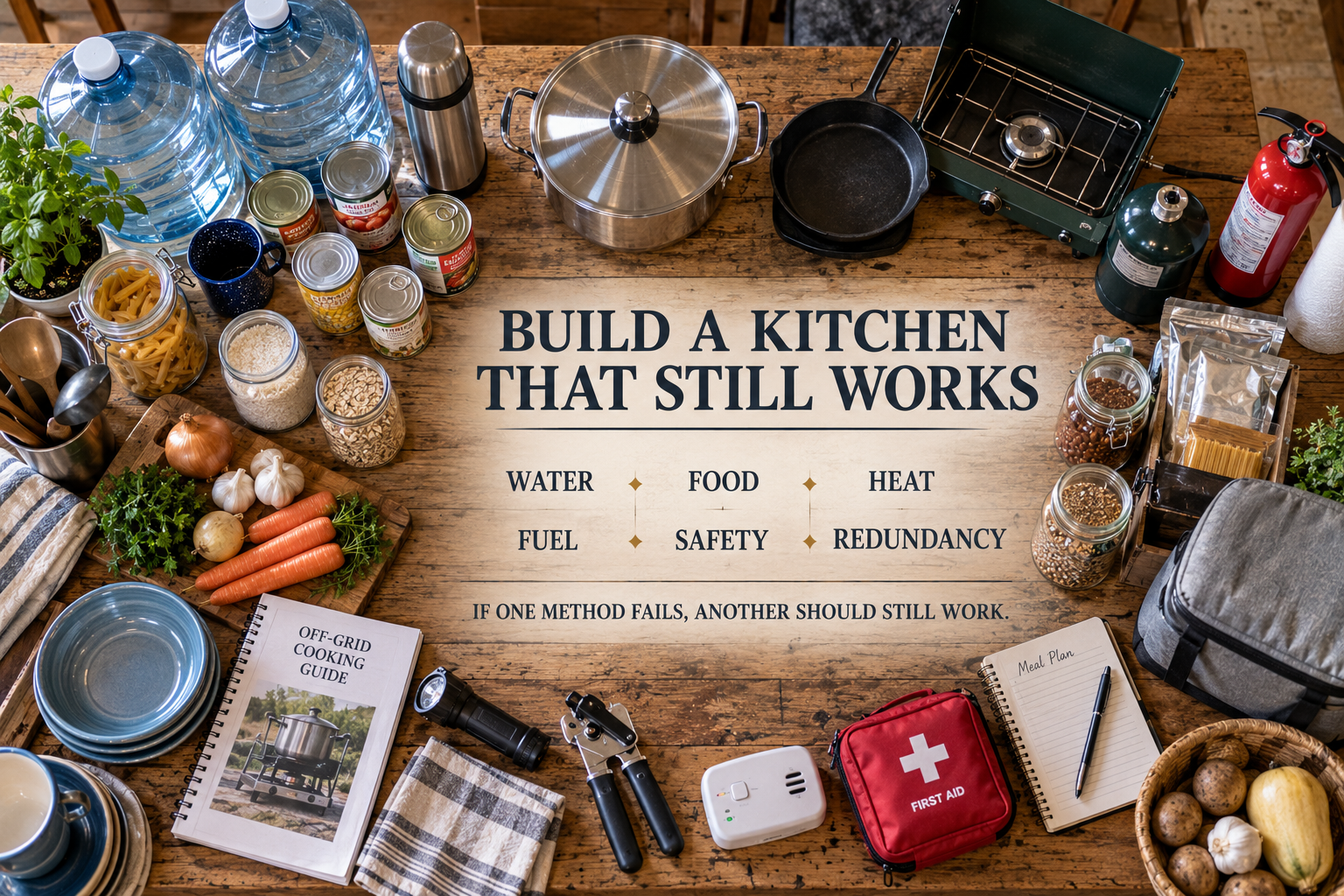
The household needs safe drinking water. It needs food that can be eaten without electricity. It needs at least one safe method of producing heat and preferably more than one. It needs enough compatible fuel to operate those methods. It needs ways of reducing fuel consumption. It needs a plan for refrigerated and frozen food. It needs foods requiring little or no preparation. And whenever combustion is involved, it needs reliable carbon-monoxide protection.
When those capabilities are independent of grid electricity, a power outage becomes much easier to manage.
The kitchen may look very different. Dinner might come from a covered pot on a propane stove instead of an electric range. Tomorrow’s meal might be partially prepared using retained heat. Lunch might be canned food requiring no cooking whatsoever. Drinking water might come from stored containers instead of the faucet.
That is not a failed kitchen.
That is an emergency kitchen doing exactly what it was designed to do.
Preparedness Action Plan
Begin by walking through your normal kitchen and identifying everything that becomes unavailable without electricity. Read the instructions for gas appliances and determine whether they can operate during an outage without bypassing safety systems. Locate your water heater, main water shutoff, carbon-monoxide alarms, fire extinguisher, outdoor cooking equipment, and emergency fuel.
Next, make sure the household has at least two practical ways of preparing food without grid electricity. Verify that the equipment, cookware, fuel, ignition methods, and safe outdoor operating location are actually available. Test carbon-monoxide alarms and make sure at least part of your detection system continues working when household electricity fails.
Then examine the pantry from a different perspective. Instead of organizing food only by shelf life, look at how much water and fuel each food requires. Make sure the pantry contains a useful balance of ready-to-eat foods, foods that only need warming, foods requiring hot water, and foods requiring longer cooking.
Finally, conduct a complete grid-down meal test. Prepare the meal, serve it, and clean everything afterward without using grid electricity or unlimited tap water. Record what you used and what went wrong.
The problems discovered during that exercise become your preparedness shopping and training list.
Key Takeaways
A blackout does more than switch off appliances. It changes the economics of the kitchen. Water becomes something that must be protected. Fuel becomes something that must be budgeted. Refrigerated food becomes time-sensitive. Cooking methods that once seemed old-fashioned suddenly become useful, and foods requiring almost no preparation become far more valuable.
The strongest emergency kitchen is therefore not built around one expensive survival stove or a mountain of specialized food. It is built around multiple ways to accomplish essential tasks.
Store water. Keep foods that can be eaten without cooking. Maintain independent cooking methods. Understand your fuel consumption. Preserve heat instead of constantly replacing it. Protect refrigerated foods while they remain safe. Reduce unnecessary washing. Maintain carbon-monoxide protection. Most importantly, practice the entire system before an emergency.
When the grid goes down, the household does not need a perfect kitchen.
It needs a kitchen that still works.
Disclaimer
This material is provided for general educational and preparedness purposes only. It is not a substitute for manufacturer instructions, professional safety advice, public-health guidance, fire codes, food-safety regulations, or directions from emergency authorities.
Fuel-burning appliances, generators, grills, camp stoves, charcoal equipment, and other combustion devices can cause fires, burns, explosions, and fatal carbon-monoxide poisoning when used incorrectly. Never use equipment indoors or in enclosed or partially enclosed spaces unless the manufacturer specifically approves the appliance for that use and all required ventilation and safety conditions are met. Never use a cooking appliance as a substitute for an approved home heating system.
Always follow manufacturer instructions for appliances, fuel containers, pressure cookers, chemical heaters, water heaters, carbon-monoxide alarms, and related equipment. Maintain functioning smoke and carbon-monoxide alarms and observe applicable fire restrictions and local regulations.
Food and water safety conditions can change during emergencies. When safety is uncertain, follow current instructions from local public-health authorities, water utilities, emergency-management agencies, and recognized food-safety authorities rather than relying on appearance, smell, taste, or improvised methods.
© Prepping Communities. This content is for informational purposes only and not professional advice. Use at your own risk.
Terms | Privacy | Guidelines