
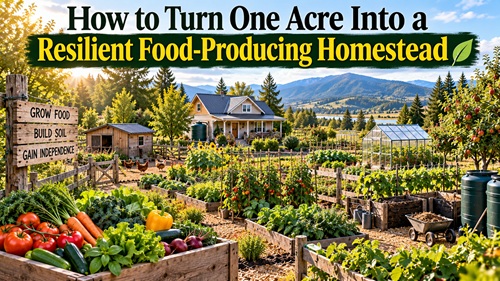
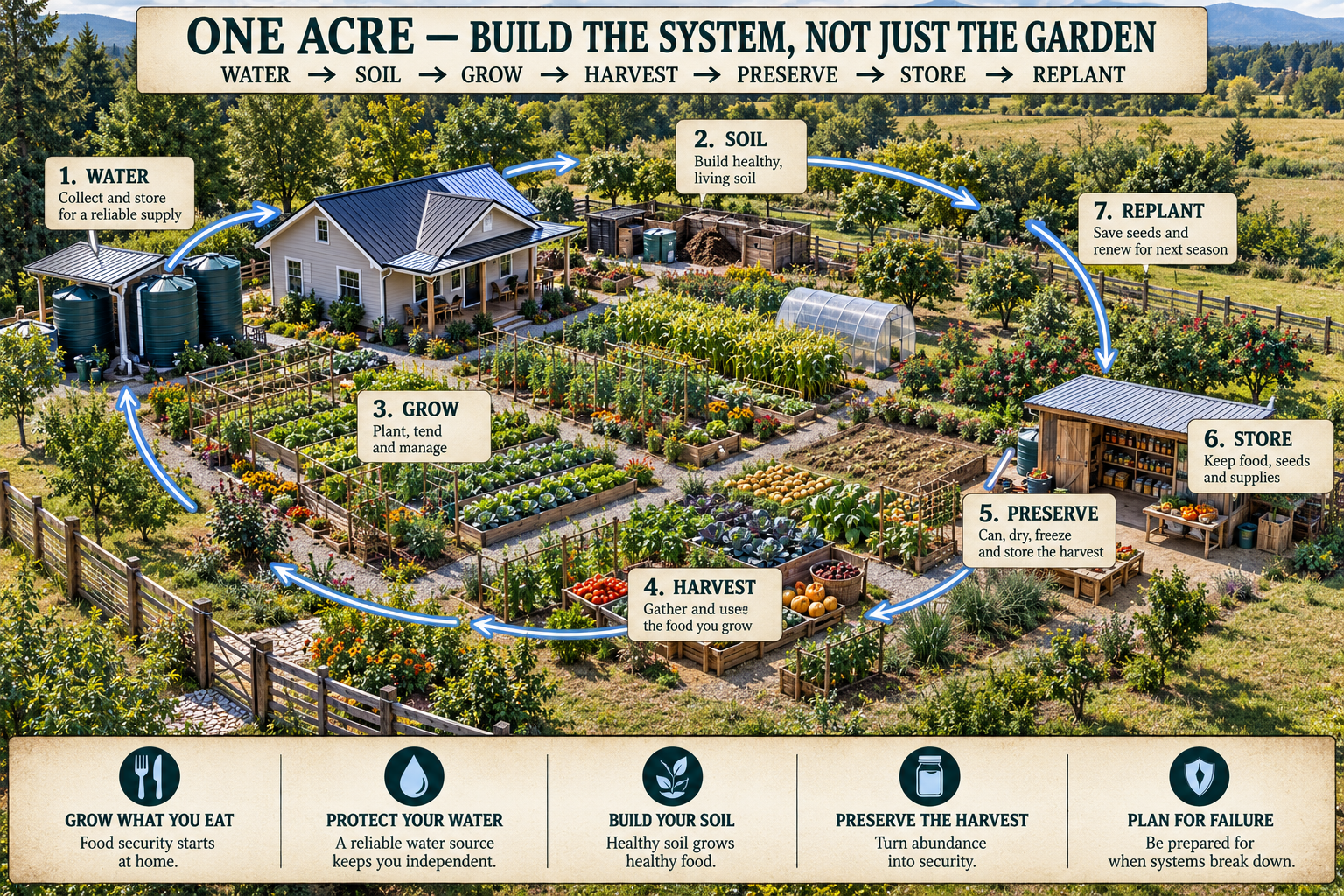
One acre is enough land to make a meaningful difference in a household’s food security, but only if the property is treated as a complete system rather than one large vegetable garden. With 43,560 square feet available, there can be room for annual vegetables, calorie-producing crops, fruit and berries, composting, water storage, preservation crops, pathways, working areas, and potentially small livestock where local regulations and conditions permit. The challenge is deciding where each component belongs and how much land should be devoted to it.
That is where many ambitious gardens go wrong. People naturally begin by thinking about what they want to plant, but preparedness requires looking beyond individual crops. A better approach is to consider what the property needs to continue producing useful food year after year with as little outside dependence as practical. That means thinking about seeds, fertile soil, dependable water, preservation, storage, tools, replacement seed, pest management, pollination, access routes, and the amount of human labor available to keep everything working.
The objective should not be maximum theoretical production. Garden yields vary enormously with climate, soil, water, pests, weather, experience, crop varieties, and growing season. A better goal is dependable production that the household can realistically maintain, harvest, preserve, store, and eat.
Start by Learning the Acre
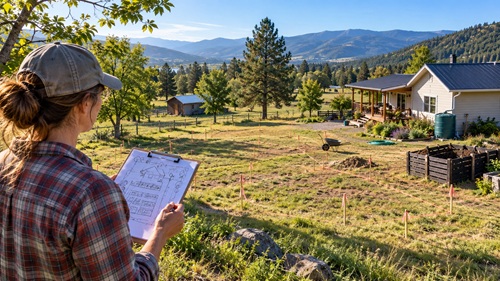
Before buying large quantities of seeds or deciding where garden beds should go, spend time learning the property. Watch where sunlight reaches the ground throughout the day and how that changes through the season. Notice where rainwater collects, which areas remain damp, where the ground dries quickly, where prevailing winds come from, and whether buildings, fences, slopes, or trees create unusual growing conditions.
Water access deserves particular attention. Consider where water currently comes from, how far it must travel to reach potential growing areas, and what would happen if the normal watering system became unavailable. A large garden that depends on dragging hoses hundreds of feet every day can quickly become difficult to maintain. The same principle applies to harvesting. Vegetables that need checking or picking almost every day should generally be closer to the house than fruit trees that may need attention only periodically.
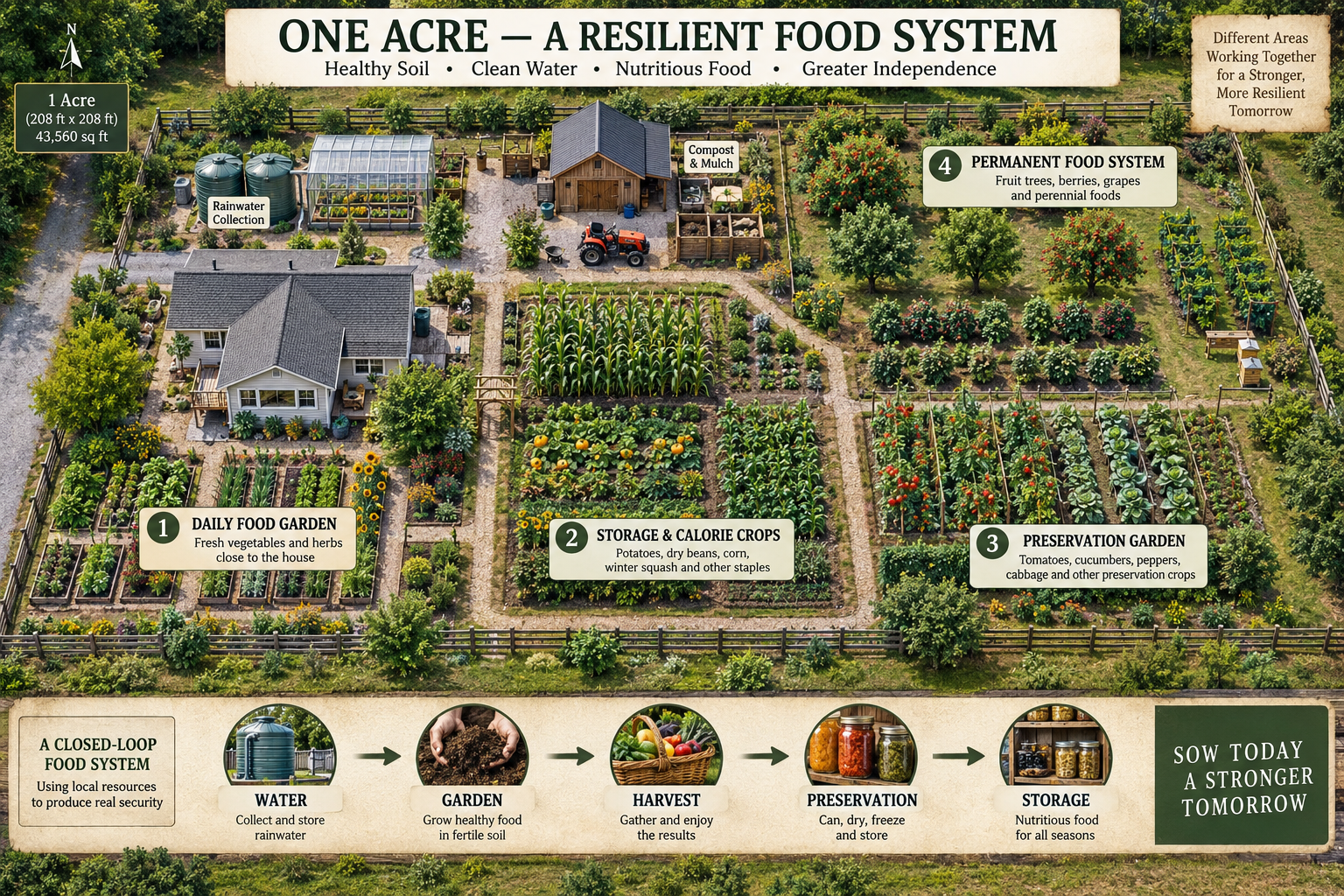
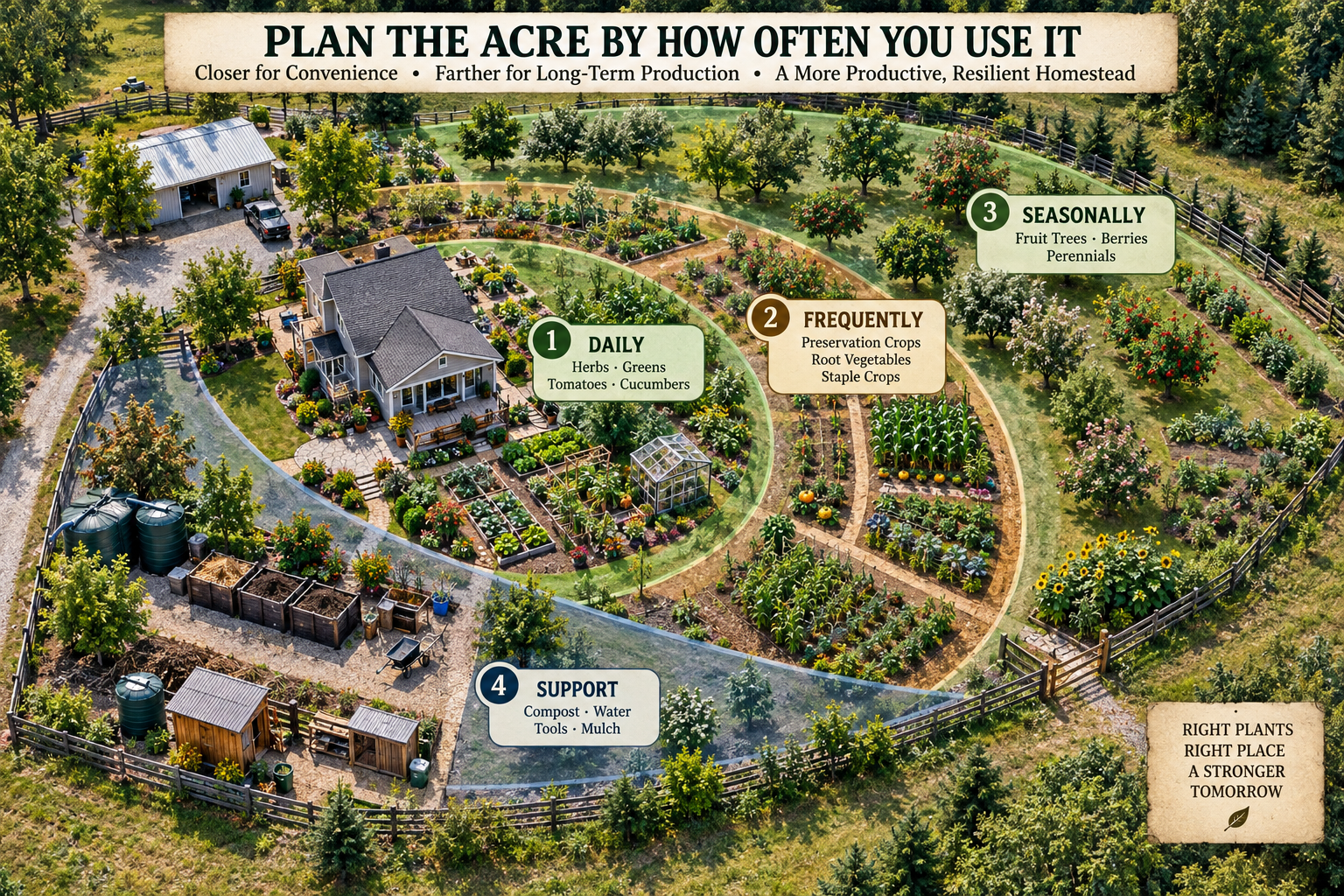
This creates a simple principle for designing the property: the more frequently something needs attention, the closer it should usually be to the center of daily activity. Instead of dividing the acre into perfect squares, organize it according to function, workload, sunlight, water, terrain, and the characteristics of the actual property.
The Daily Food Garden
The area nearest the house should normally contain crops requiring the most frequent attention. Tomatoes, salad greens, cucumbers, peppers, herbs, fresh beans, strawberries, seedlings, and other regularly harvested foods make sense here. It is also a good location for plants that need frequent watering or close monitoring for pests.
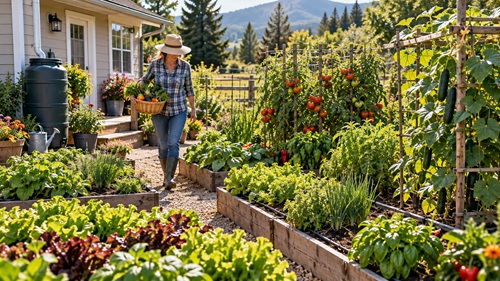
Think of this section as an outdoor extension of the kitchen. During the growing season, someone may walk through it every morning or evening. That regular presence makes a difference. A damaged irrigation line gets noticed before plants wilt badly. Insects can be discovered before they spread. Cucumbers are harvested before becoming oversized, and tomatoes are picked as they ripen.
This garden does not have to occupy a huge portion of the acre. In fact, making it too large can create unnecessary work. Its purpose is to provide a manageable and dependable flow of fresh vegetables and herbs throughout the growing season.
The Storage and Calorie Garden
This is where preparedness gardening begins to differ from an ordinary backyard vegetable garden. A household can produce huge quantities of lettuce, zucchini, tomatoes, and cucumbers while still growing relatively little food energy. A more resilient garden includes crops selected partly because they can provide substantial nutrition and remain useful after harvest.
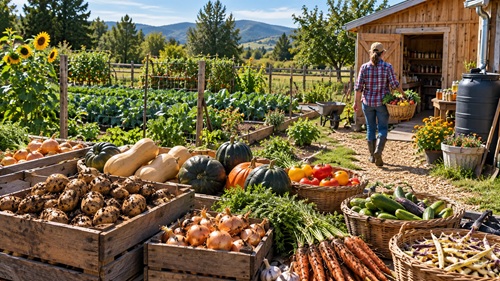
Depending on climate and household preferences, this could include potatoes, dry beans, winter squash, corn, sweet potatoes, Jerusalem artichokes, or other locally appropriate staple crops. Carrots, beets, parsnips, rutabagas, turnips, onions, and similar crops can add further storage potential.
Storage should influence what gets planted. A crop that produces heavily in September but cannot be preserved before it spoils may be less useful than a smaller harvest that remains edible for months. Consider how much food a crop can reasonably produce, whether the household actually eats it, how difficult it is to preserve, and how long it can be stored under the conditions available on the property.
This is also where diversification becomes important. Depending too heavily on one staple crop creates vulnerability. Disease, drought, insects, unusual temperatures, or poor timing can severely reduce a particular harvest. Several different staple crops provide more protection than trying to maximize production from only one.
The Preservation Garden
Some crops earn their place because they can be transformed into foods that remain useful long after the growing season ends. Tomatoes can become sauces and canned products. Cucumbers can become pickles. Cabbage can be fermented. Beans can be canned, frozen, or dried depending on the variety. Peppers, herbs, fruits, and many vegetables can be dehydrated.
A useful way to plan this section is to work backward from the pantry. Instead of simply deciding how many tomato plants will fit, consider how many jars of tomato products the household normally uses during a year. The same approach can be used with pickles, beans, sauces, dried herbs, frozen vegetables, and other preserved foods.
Preservation capacity should grow alongside production. Producing hundreds of pounds of food is not an advantage if there is insufficient time, equipment, storage, or experience to preserve it safely before it spoils. A resilient garden connects planting decisions with what happens after harvest.
Succession planting can make this easier. Instead of planting everything on the same weekend, some vegetables can be planted at intervals so they mature at different times. This extends the harvest and can prevent enormous quantities of produce from becoming ready all at once.
The Permanent Food System
One of the strongest long-term improvements to a food-producing property is establishing plants that do not have to be replanted every spring. Fruit trees, berry bushes, grapes, asparagus, rhubarb, perennial herbs, perennial onions, and suitable nut-producing plants can gradually create a second food system alongside the annual garden.
These plants require patience, which is exactly why they should be established early. Vegetables can begin producing within months, while fruit and nut trees may require years before producing meaningful harvests. Delaying their planting simply delays the point at which they become useful.
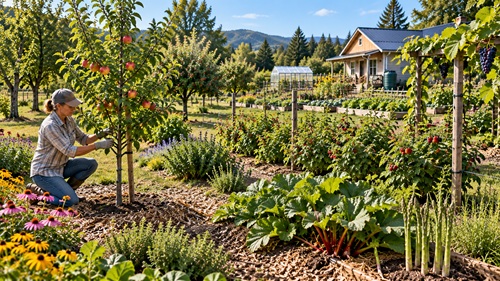
Where climate and space permit, planting different varieties with early, middle, and late harvest periods can spread production across the season. This can make harvesting and preservation easier while reducing the risk associated with having an entire fruit crop mature at the same time.
Perennial foods also provide a form of labor resilience. There may be years when injury, illness, work demands, equipment problems, or other circumstances make maintaining a large annual garden difficult. Established perennial plants can continue producing without the household having to rebuild the entire food system from bare soil every spring.
The Support System
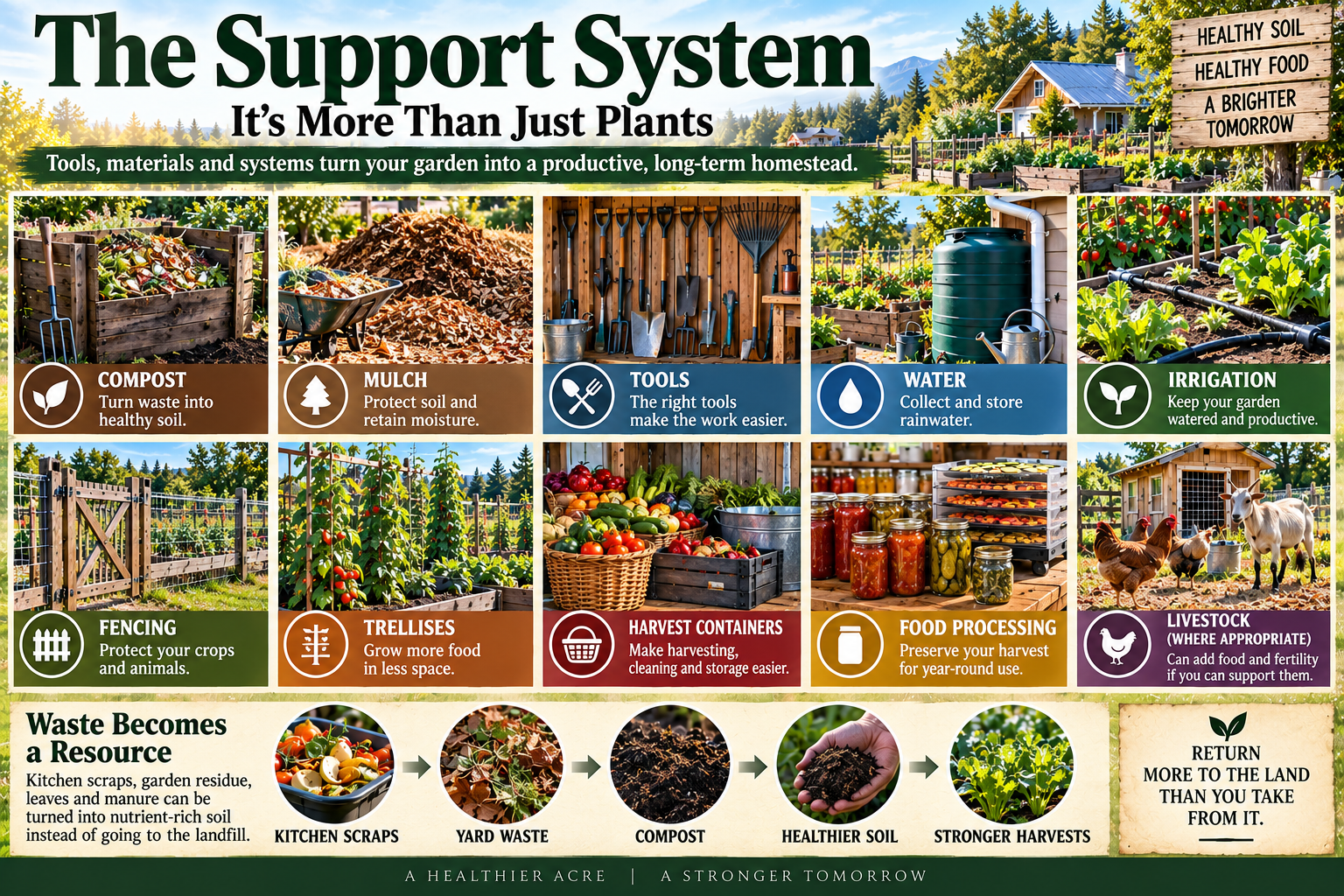
Some of the most important parts of a productive acre are not crops at all. Compost areas, stored mulch, leaves, manure where appropriate, tools, rainwater storage, irrigation equipment, potting areas, propagation supplies, fencing materials, harvest containers, trellises, and food-processing areas all contribute to whether the system actually works.
This is also where waste can begin becoming a resource. Garden residue can become compost. Fallen leaves can become mulch or eventually soil organic matter. Appropriate kitchen scraps can contribute to compost, and animal manure can contribute fertility when managed properly. Over time, the objective is to return more nutrients and organic material to the land rather than continually removing them and replacing everything with purchased products.
Small livestock may also have a place on some properties, but animals should not be treated as an automatic addition to a one-acre plan. Chickens, rabbits, goats, or other livestock introduce their own requirements for feed, water, shelter, fencing, waste management, health care, and predator protection. Animals increase resilience only when the household can sustainably support them.
Water Determines the Real Size of the Garden
The physical size of the property does not necessarily determine how much land can be cultivated. Available water often does. Before expanding the garden significantly, determine how it will be watered during the hottest and driest part of the growing season.
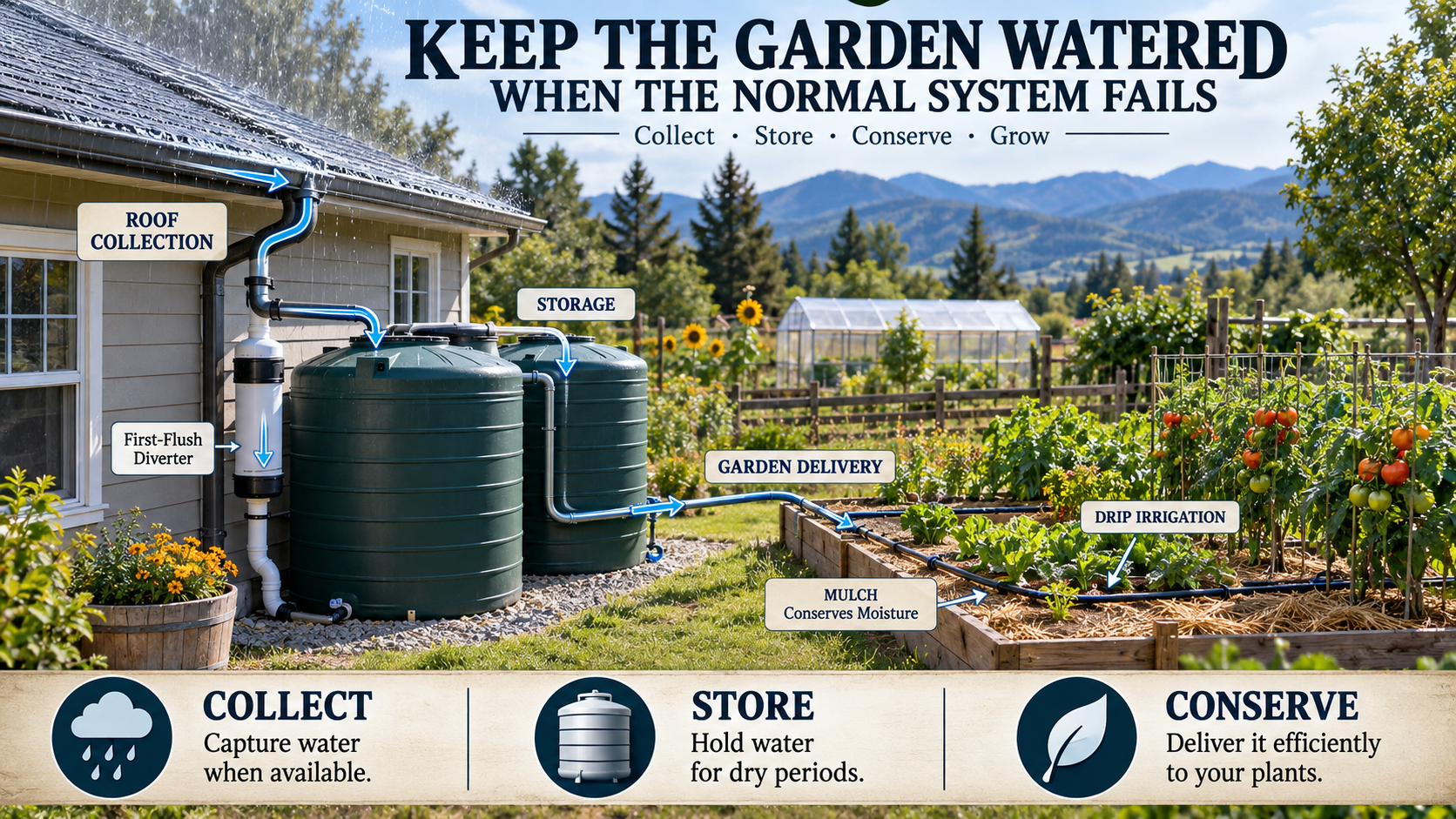
A garden dependent entirely on one hose and unlimited municipal water may function perfectly during normal conditions but become vulnerable during restrictions, outages, pump failures, or drought. Where permitted and practical, rainwater collection can provide an additional irrigation source. Roof runoff can be directed into barrels, tanks, or larger storage systems and held until needed.
Drip irrigation can improve efficiency by delivering water close to plant roots rather than spraying large areas unnecessarily. Mulch can further reduce moisture loss, moderate soil temperatures, suppress weeds, and eventually contribute organic matter to the soil.
Property elevation can also become useful. Where conditions permit, placing stored water above growing areas may provide some gravity-fed irrigation without depending entirely on electric pumps. The preparedness question is not simply how the garden will be watered today. It is how the household could keep its most important crops alive if the normal watering method suddenly stopped working.
Soil Is a Long-Term Preparedness Resource
Seeds receive much of the attention in gardening, but soil determines what those seeds can become. Productive soil stores moisture, supports roots, provides nutrients, and contains an enormous biological community involved in nutrient cycling and plant health.
Building soil should therefore be treated as a long-term preparedness project. Compost, mulch, cover crops, appropriate crop rotation, erosion control, and amendments based on actual soil needs can gradually improve growing conditions. Rather than attempting to correct every problem with purchased fertilizer each season, the goal is to develop soil that becomes more productive and resilient over time.
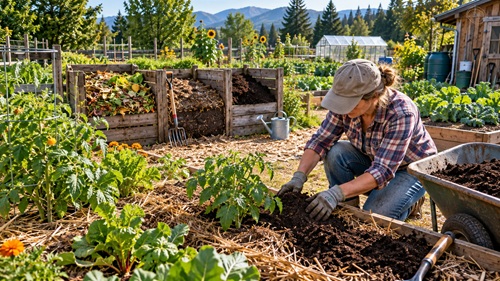
Keeping soil covered is particularly valuable. Mulches can reduce evaporation and weed pressure during the growing season, while appropriate cover crops can protect unused beds and contribute organic material. Compost returns some of what the property produces back into the growing system.
The strongest garden is not one that produces an impressive harvest for a single season while exhausting the soil. It is one capable of continuing to produce year after year.
Grow Food the Household Will Actually Eat
Maximum production means very little if much of the harvest is unwanted or wasted. Growing hundreds of pounds of a vegetable nobody likes creates work rather than food security.
Start with foods already used regularly in the household and gradually experiment with new crops. Keep simple records showing what varieties were planted, when they were planted, major problems encountered, approximate harvests, preservation results, and how much of the stored food was actually consumed.
After several seasons, these records become extremely valuable. They show which varieties perform well in the property’s particular microclimate, which crops deserve more space, which preservation methods are worth repeating, and which foods seemed useful in theory but remained untouched in storage.
Food security should be based on usable food, not impressive harvest numbers.
Preservation and Storage Complete the Food System
Growing food solves only part of the problem. A household that produces abundantly from July through September but cannot carry that food into winter still remains dependent on outside supplies for much of the year.
Preservation can include pressure canning, water-bath canning, dehydrating, freezing, fermenting, root cellaring, curing, dry storage, and other established food-safe methods appropriate to particular foods. Each method has advantages and limitations, and some depend on electricity while others do not.
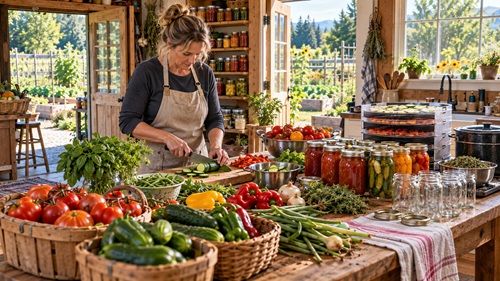
This is another reason diversity matters. A freezer filled with garden produce is convenient, but it concentrates a large amount of food behind a single dependency: continuous electricity. Combining frozen foods with properly canned, dehydrated, fermented, cured, and naturally stored foods creates more redundancy.
Storage conditions matter as much as preservation. Potatoes, onions, squash, apples, carrots, dried beans, grain, and other foods have different requirements for temperature, humidity, ventilation, darkness, and pest protection. Learning how food behaves in storage is part of learning how to grow it.
Build the Acre Gradually
Trying to develop an entire acre during the first season can turn an exciting project into an exhausting one. Thousands of square feet of newly cultivated soil can produce thousands of square feet of weeds. Every additional bed requires planting, watering, monitoring, harvesting, and eventually putting to rest for winter.
A better strategy is controlled expansion. Begin with a garden large enough to develop useful skills without becoming overwhelming. Establish composting and basic irrigation early. Plant several fruit trees and berry bushes during the first season so the waiting period for perennial production begins immediately.
During subsequent years, expand the storage garden, increase preservation capacity, improve water systems, establish additional perennials, experiment with staple crops, and develop better storage. Each year’s experience should influence the next year’s design.
This approach allows the property to grow alongside the household’s skills.
Design the Acre for Things to Go Wrong
Preparedness planning should assume that some crops will occasionally fail. A late frost may damage blossoms. An unusually wet summer may encourage disease. Drought may reduce yields. Insects may heavily damage one crop while leaving another relatively untouched.
Diversity creates protection against these failures. Several staple crops are better than one. Several varieties can be better than a single variety. Annual crops combined with perennial foods create another layer of redundancy. Early-, mid-, and late-season producers spread risk across time.
Seed saving can eventually add another layer of resilience. Learning to save suitable seed from open-pollinated crops reduces dependence on purchasing every seed every year and helps gardeners gradually identify varieties that perform well under their local conditions. This skill is best learned while commercial seed remains readily available, when mistakes are inconvenient rather than serious.
The same principle applies throughout the homestead. Have more than one way to water important crops. Use more than one preservation method. Grow foods that mature at different times. Maintain hand tools even when powered equipment is available. Keep more than one source of soil fertility.
Redundancy turns a productive garden into a more resilient food system.
From One Acre to Household Food Resilience
The real value of an acre is not how many plants can be squeezed onto it. Its value comes from connecting all of its components.
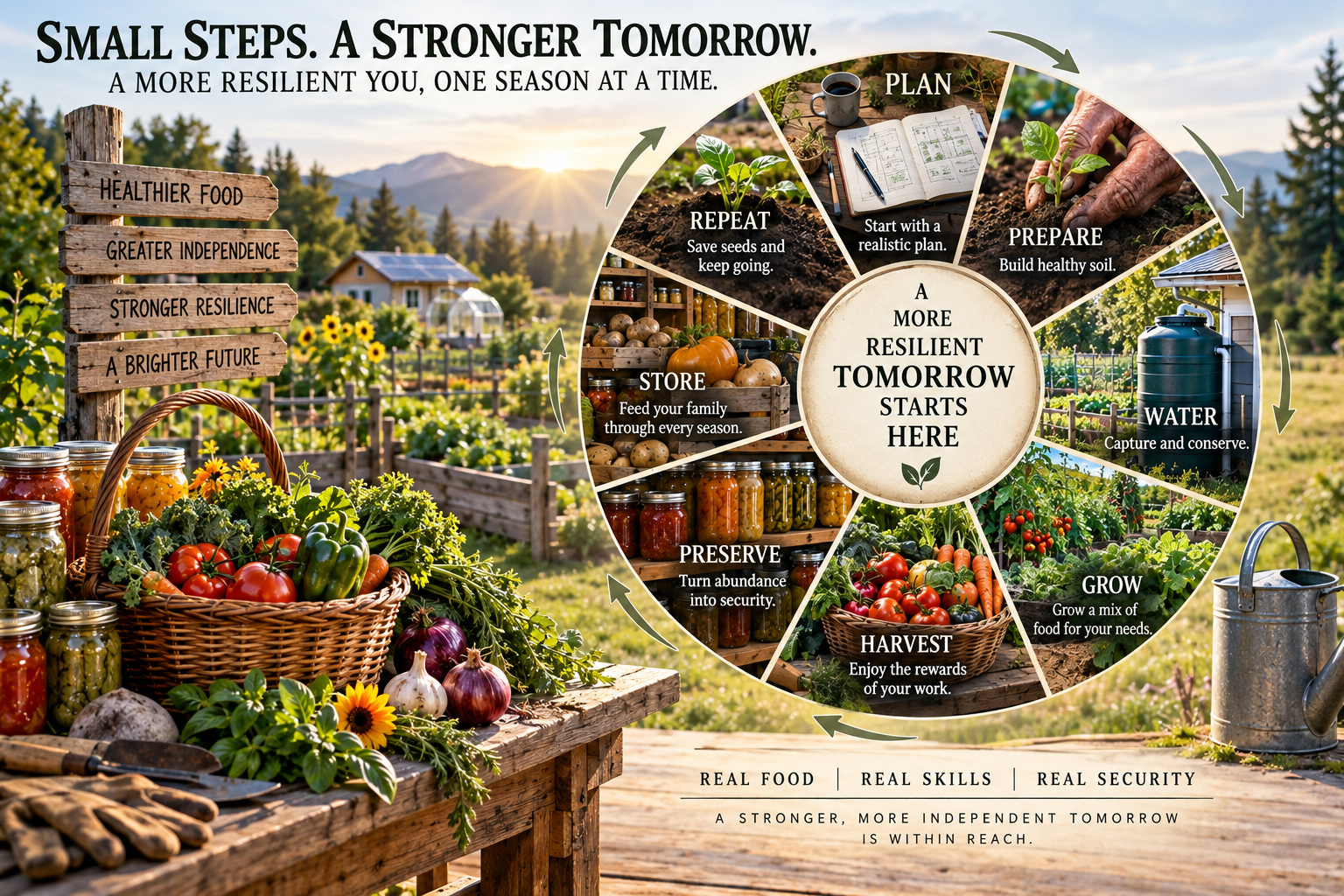
The annual garden supplies fresh food. Staple crops provide calories and storage potential. Preservation crops fill the pantry. Fruit trees and berries build long-term production. Compost returns nutrients to the soil. Mulch conserves moisture. Stored water protects crops during dry periods. Seeds support the next growing season. Preservation carries the harvest into winter, while good storage prevents that work from being lost.
Each part supports another.
That is the difference between having a large garden and developing a resilient food-producing homestead. The goal is not complete isolation from the outside world or an unrealistic promise that one acre can satisfy every household need. The goal is reducing dependency while increasing the household’s ability to produce, preserve, and manage more of its own food.
Preparedness Action Plan
Begin by drawing a simple map of the property and marking the house, buildings, fences, existing trees, sunny areas, shaded areas, slopes, wet ground, water sources, and practical access routes. Observe the property before committing permanent structures or perennial plants to particular locations.
Identify the best location near the house for frequently harvested vegetables. Then identify areas suitable for storage crops, preservation crops, and permanent fruit and berry production. Determine where compost, water storage, tools, harvest processing, and food storage could fit without interfering with productive growing space.
Choose a manageable area for the first season rather than attempting to cultivate the entire acre immediately. Use that first garden to learn the soil, water requirements, local pests, growing season, successful varieties, preservation workload, and realistic amount of land the household can maintain.
At the same time, begin building the parts that require years rather than months. Improve the soil. Start composting. Plant suitable fruit trees and berries. Develop backup water capacity. Learn preservation techniques. Experiment with storage crops and begin saving appropriate seeds.
Then expand from what actually works.
Over several seasons, individual garden beds, trees, water tanks, compost piles, storage areas, and preservation skills begin functioning together. The result is something much more valuable than a large vegetable garden: a food-producing system supported by experience, infrastructure, healthy soil, stored knowledge, and increasingly fewer outside dependencies.
Key Takeaways
A resilient one-acre homestead is built through thoughtful organization rather than simply planting as much ground as possible. Frequently tended crops should generally be convenient to reach, while storage crops, preservation crops, and permanent food plants can occupy areas appropriate to their maintenance requirements. Water, soil fertility, preservation, storage, seeds, tools, infrastructure, and human labor are every bit as important as the crops themselves.
The strongest system is not necessarily the one producing the largest harvest in a perfect year. It is the one capable of continuing to provide useful food when weather changes, a crop fails, water becomes limited, equipment stops working, or outside supplies become less dependable.
Most importantly, these systems should be developed before they are urgently needed. Gardening, preserving food, improving soil, saving seeds, storing crops, managing water, and maintaining perennial plants are learned skills. An acre that has been gradually improved and worked for several years can provide something that cannot be purchased at the last minute: a functioning food system and the experience required to keep it producing.
© Prepping Communities. This content is for informational purposes only and not professional advice. Use at your own risk.
Terms | Privacy | Guidelines