
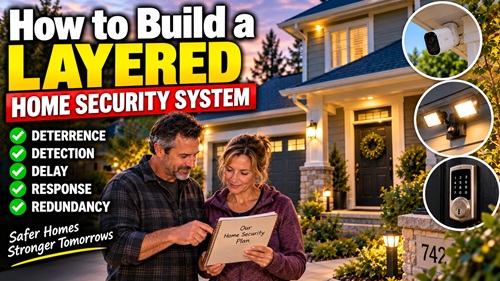
Home security is often approached as a shopping problem. Someone becomes concerned about burglary, trespassing, vandalism, or home invasion, so they buy a camera, install a better lock, add an alarm, or put a motion light over the garage. All of those things can be useful, but none of them by itself creates a secure home. Good home security comes from combining awareness, early warning, physical protection, household habits, communication, and emergency planning so that several layers support one another.
This is the basic idea behind layered home security. Instead of trusting one device or one barrier, the household creates several opportunities to discourage unwanted activity, notice it early, slow unauthorized access, and respond safely. If one layer doesn’t work, another remains. Someone approaching the property may first encounter good visibility and lighting. Their presence may then be detected by a camera, sensor, dog, or observant neighbor. If they continue toward the house, doors, locks, windows, and other physical barriers provide additional resistance. Meanwhile, the people inside have more time to understand what is happening and decide what to do.
The goal isn’t to turn an ordinary house into a fortress. A good security system should allow people to live normally while quietly reducing vulnerabilities around them. It should also recognize that security conditions can change during a prolonged blackout, severe storm, wildfire, earthquake, communications failure, or other emergency. Systems that normally depend on electricity, internet access, cellular service, alarm monitoring, streetlighting, and rapid emergency response may become less reliable. Prepared households should therefore understand not only how their security works during normal conditions, but what remains when some of those supporting systems disappear.
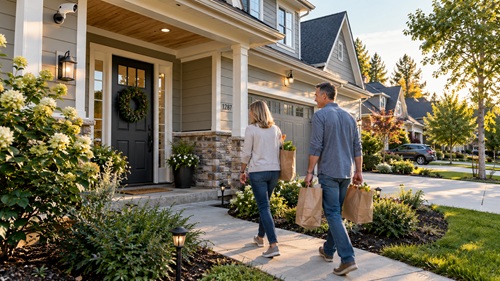
Start by Learning to See Your Property Differently
One of the most useful security exercises costs nothing. Walk around your property and deliberately look at it as though you have never seen it before.
Begin at the street, road, driveway, or property boundary and look toward the house. Notice the obvious route to the front entrance, but then examine the alternatives. Look at side yards, alleys, rear entrances, basement windows, fences, gates, decks, garages, sheds, utility areas, and portions of the property that aren’t easily visible from inside.
Pay particular attention to concealment. A large shrub may improve the landscaping while also creating a hidden area beside a window. A privacy fence may make the backyard more comfortable while preventing neighbors from seeing unusual activity. A shed, trailer, hedge, woodpile, or parked vehicle may create an area where someone could remain out of view.
Look at objects that could unintentionally make access easier. A ladder permanently stored beside the house, furniture close to a low roof, or other movable items may change how accessible parts of the property are.
Then repeat the entire exercise after dark.
This is important because darkness changes a property dramatically. Areas that appeared completely exposed during daylight can disappear into shadow. A bright porch light might illuminate the front door while leaving the walkway leading toward it almost invisible. Vegetation can create dark pockets, while glare from poorly positioned lighting can make surrounding areas harder to see.
Throughout the exercise, keep asking one question: How close could an unfamiliar person get to the house before someone inside would probably know they were there?
The answer provides a useful starting point for improving security.
Understand What Your Security System Needs to Accomplish
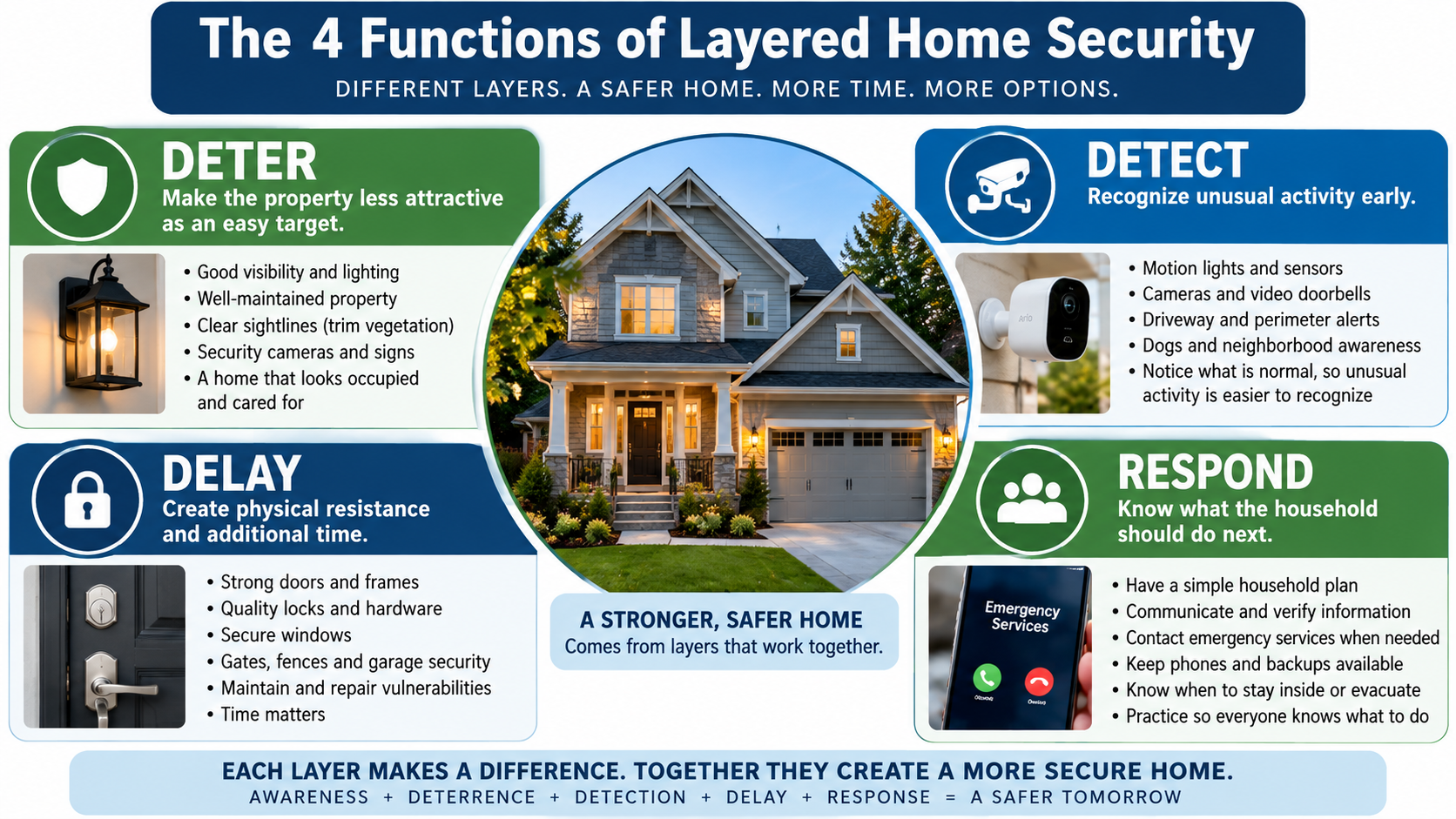
A practical home-security system should help accomplish four basic things: deterrence, detection, delay, and response.
Deterrence happens before someone attempts unauthorized entry. Good visibility, maintained property, appropriate lighting, controlled access, cameras, and signs that a household pays attention to its surroundings can make a property less attractive as an easy opportunity.
Detection tells the household that something is happening. Motion lighting, driveway alerts, door sensors, cameras, alarms, dogs, neighbors, and simple human awareness can all provide warning. The earlier that warning occurs, the more time occupants have to evaluate the situation.
Delay comes primarily from physical security. Doors, frames, locks, windows, gates, and other barriers create resistance. No ordinary home should be considered impossible to enter, but resistance still matters because time matters. A weak entrance that can be defeated immediately provides very little opportunity for occupants to react. A properly maintained entrance provides more.
Response is what the household does after recognizing the problem. This is often the weakest part of home-security planning. An alarm isn’t a complete plan if nobody knows what to do when it activates. Cameras aren’t a complete plan if the first response to seeing an unfamiliar person is to open the door and investigate.
A strong system addresses all four functions rather than concentrating entirely on equipment.
Reduce What Your Home Reveals
Some of the easiest security improvements don’t require buying anything.
Homes constantly reveal information about the people living inside. Packaging from expensive electronics placed beside the recycling may advertise a recent purchase. Valuable tools visible through a garage window can attract attention. Packages accumulating at the front door can suggest nobody is home. An overflowing mailbox, overgrown lawn, or several days of untouched snow may indicate an extended absence.
Online activity can reveal even more. Public vacation announcements, photographs posted while away from home, pictures of expensive purchases, and images showing the layout of a property can unintentionally provide information about possessions, routines, and occupancy.
This doesn’t mean becoming secretive or suspicious of everyone. It simply means recognizing that information has security value.
When leaving for an extended period, arrange for mail and packages to be handled. Avoid unnecessarily advertising an empty home. Keep expensive equipment from being plainly visible from outside. Consider what photographs reveal before sharing them publicly.
Security isn’t only about preventing someone from entering. It also involves avoiding unnecessary signals that might make the property attractive in the first place.
Improve Visibility Around Important Areas
A secure property doesn’t need to be completely exposed, but important approaches should be reasonably visible.
Concentrate on entrances, accessible windows, walkways, driveways, gates, garages, side passages, and other locations where someone could approach the structure.
Vegetation around these areas should be maintained so that it doesn’t provide unnecessary concealment or block lighting and cameras. This doesn’t mean removing every shrub or tree. Landscaping, privacy, and security can coexist. The objective is to avoid creating ideal hiding places immediately beside important entry points.
Lighting should support visibility rather than simply make the property extremely bright.
Entrances, walkways, parking areas, side passages, and commonly used approaches deserve particular attention. Motion-activated lighting can be useful because unexpected illumination can draw attention toward movement while making that movement easier to observe.
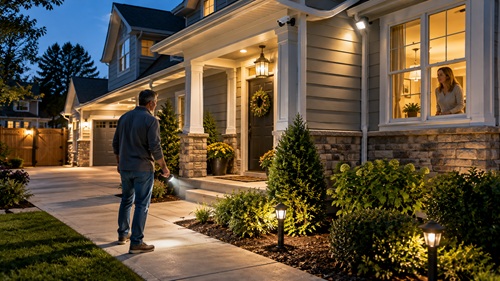
After installing or adjusting lighting, actually test it. Walk toward the property from different directions after dark. Stand where a visitor would stand and look toward the house. Then go inside and look outward.
A light that appears bright from outside may produce glare that makes it difficult for someone inside to see beyond the illuminated area. Testing reveals these problems much more effectively than simply looking at specifications on a package.
Create Early Warning
The farther away a potential problem can be detected, the more time the household has to understand it.
Early warning will look different depending on the property. On a rural acreage, someone may enter a driveway hundreds of metres from the house. A driveway alert or appropriately positioned camera can provide useful advance notice. In a suburban neighborhood, detection may begin at a sidewalk, driveway, side gate, or porch. Apartment residents may depend more heavily on controlled building access, hallway cameras, door viewers, or doorbell cameras.
Technology can extend awareness considerably, but it shouldn’t completely replace observation.
Become familiar with what normal activity around your home looks and sounds like. Know which vehicles normally belong nearby. Understand when deliveries usually arrive and which areas neighbors commonly use.
Recognizing unusual activity becomes easier when normal patterns are understood.
An unfamiliar vehicle isn’t automatically suspicious. Neither is an unexpected visitor or a motion light activating at night. Good situational awareness means noticing something, gathering information, and making a reasonable assessment rather than immediately assuming the worst.
Build Relationships With Neighbors
Trusted neighbors can provide something security technology often cannot: context.
A camera can show a vehicle, but a neighbor may know that it belongs to a contractor working nearby. A neighbor may notice that your garage door was accidentally left open, that a package has been sitting outside for several days, or that storm damage has occurred while you’re away.
This doesn’t require creating a formal neighborhood patrol.
Simply knowing several nearby households and having a reliable way to communicate can significantly improve local awareness. When neighbors trust one another enough to exchange useful information, every household gains additional eyes and ears.
These relationships become even more valuable during emergencies. A prolonged blackout, wildfire evacuation, severe storm, earthquake, or communications disruption may make local cooperation considerably more important than it is during normal conditions.
Neighbors may be able to share information when internet or cellular service is unreliable, check on a property when someone is away, identify hazards, or help determine whether unusual activity has an ordinary explanation. During larger emergencies, they may also be the closest available source of immediate assistance.
Good community security is built on relationships before those relationships are urgently needed.
Treat Exterior Doors as Complete Systems
A strong lock doesn’t automatically create a strong door.
An exterior door is a complete assembly consisting of the door itself, frame, hinges, strike area, locking hardware, surrounding structure, and the habits of the people using it.
Inspect every exterior door periodically. Make sure it closes completely and that the lock engages properly. Look for loose hardware, cracked or deteriorated frames, damaged hinges, misalignment, and other obvious weaknesses.
Pay attention to entrances that aren’t used frequently. Rear doors, basement entrances, patio doors, garage service doors, and secondary entrances often receive much less attention than the front door.
An attached garage deserves particular consideration. If someone gains access to the garage, the connecting door into the living area becomes another important security boundary. Treat it accordingly rather than assuming the outer garage door provides all the protection required.
Doors should also be evaluated according to how the household actually uses them. A door that is technically secure but routinely left unlocked because family members use it throughout the day represents a different problem than a weak door that needs physical repair. One requires better habits; the other requires better hardware or maintenance.
Check the door from both sides. Make sure household members can operate locks quickly from inside and that security improvements don’t interfere with emergency evacuation.
Physical security works best when the entire entry system is reasonably strong. Installing an expensive lock on a badly deteriorated frame doesn’t solve the underlying problem.
Evaluate Windows Carefully
Windows require a balance between security and emergency escape.
Begin by identifying which windows are realistically accessible from outside. Ground-floor and basement windows are obvious, but decks, porch roofs, fences, sheds, trees, retaining walls, and other structures may make upper-level windows easier to reach than expected.
Check whether accessible windows actually close properly and whether their locks engage.
Older windows sometimes appear locked even though worn hardware no longer holds them securely. Frames can shift, components can deteriorate, and locks can become loose over time. These basic maintenance problems should be corrected before considering more complicated security upgrades.
Look at the area immediately outside each accessible window as well. Dense vegetation may conceal activity. Stored objects may provide unintended access. Poor lighting may make it difficult to determine what is happening outside.
Window coverings also contribute to security in a different way. At night, a brightly illuminated interior can sometimes make household activities and possessions much easier to see from outside than occupants realize. Walk outside after dark while ordinary interior lights are on and observe what can actually be seen through uncovered windows.
This isn’t about keeping every curtain closed at all times. It is about understanding what the house reveals after dark and using blinds, curtains, or other appropriate coverings when privacy matters.
At the same time, remember that some windows may serve as emergency escape routes. Security modifications should never create a situation in which household members become trapped during a fire.
The strongest possible barrier isn’t automatically the safest solution.
A secure home must remain a home people can escape from during an emergency.
Don’t Forget the Garage and Outbuildings
Garages, sheds, workshops, barns, and other structures can contain thousands of dollars worth of equipment while receiving much less security attention than the house.
Tools, bicycles, generators, outdoor equipment, preparedness supplies, and vehicles may all have significant value. Some equipment stored outside the main residence could also potentially be used to cause additional property damage.
Walk through these areas using the same assessment process used for the house. Examine doors, windows, locks, lighting, visibility, and early warning.
Keep valuable equipment from being unnecessarily visible through windows. An open garage door can reveal tools, vehicles, storage shelves, generators, food-storage equipment, and other possessions to anyone passing the property.
Consider how often the garage is left open while someone is working elsewhere around the property. A garage that remains open for hours can expose both possessions and information about what the household owns.
Garage-door remotes deserve attention as well. Leaving a remote inside a vehicle parked outdoors may create another possible route into an attached garage.
If the garage has an interior door leading into the home, treat that door as another important security boundary. The fact that it is inside the garage doesn’t mean it should be treated like an ordinary interior door.
On larger rural properties, ask whether activity around an outbuilding would even be noticed from the residence. A shed or workshop may be far enough away that someone could spend considerable time around it without attracting attention.
Appropriate lighting, cameras, or simple sensors can help extend awareness to areas that would otherwise remain isolated.
Outbuildings should also be included in nighttime inspections. A security light that seems adequate during daylight planning may leave the rear of a barn or workshop completely dark once the sun goes down.
The lesson is to treat the property as a connected system rather than assuming security ends at the walls of the house.
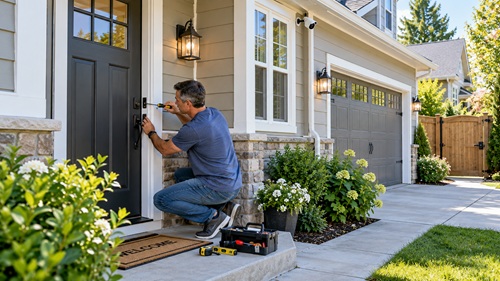
Make Cameras Provide Useful Information
A security camera shouldn’t merely produce video. It should answer useful questions.
Who approached the front entrance? Which direction did they come from? Did a vehicle enter the driveway? What happened beside the garage? Where did someone go afterward?
Camera placement should support those questions.
A camera mounted extremely high may provide a broad view while producing poor identifying detail. Strong sunlight can overwhelm an image during certain parts of the day. Headlights can create problems at night. Vegetation moving in the wind can generate unnecessary alerts.
A camera can also have an apparently excellent view when installed but gradually become less useful as trees and shrubs grow. Seasonal changes matter. Snow can change reflections and visibility. Leaves can obscure a view in summer that was completely clear during winter.
Testing matters.
Have someone approach from several realistic directions during daylight and darkness. Review the recordings rather than assuming the system works because the camera displays an image.
Look at what happens when a person is close to the door, farther down the walkway, beside a vehicle, or approaching from an unexpected direction. Determine whether the system provides the information the household would actually need.
Alerts should also be configured so they remain useful. If a camera generates so many unnecessary notifications that household members routinely ignore them, its value as an early-warning system is reduced. Adjust detection areas and settings appropriately when the equipment allows it.
Also determine what happens when supporting infrastructure fails. Does the camera continue recording when the internet goes down? Are recordings stored locally or only remotely? What happens during a power failure? How long does backup power last?
If recordings are important, understand how they are accessed and retained. A system that records useful information but automatically overwrites it before anyone realizes something happened may not provide the protection expected.
The purpose isn’t to avoid modern technology. Cameras can be extremely useful. The purpose is to understand exactly what the technology can and cannot do.
Understand the Difference Between Detection and Response
A camera detecting someone doesn’t automatically solve the problem.
This distinction is important because modern security products often emphasize notifications. A phone vibrates, an application displays an alert, or a camera identifies movement. That is detection.
The household still needs to interpret the information.
An alert may show a delivery driver, wildlife, a neighbor, a family member arriving unexpectedly, or something that requires greater attention. The purpose of early warning is to provide information and time, not to create automatic fear.
Household members should understand which alerts deserve immediate attention and which can simply be reviewed when convenient.
The same principle applies to alarms. An alarm should trigger a known response rather than confusion. Understand how the system communicates, who receives notifications, whether monitoring is involved, what happens during internet or cellular outages, and how false alarms should be handled.
Technology provides information. People still need to know what to do with it.
Control Keys, Codes, and Digital Access
Physical security depends upon controlling access.
Know who possesses keys to the home and approximately how many legitimate copies exist. When moving into a previously occupied property, changing or rekeying exterior locks may be appropriate because there may be no reliable way to know how many previous copies remain.
Avoid routinely placing spare keys in predictable outdoor locations.
If a trusted person needs emergency access, consider an arrangement appropriate for the household that doesn’t depend upon leaving a key somewhere obvious.
Electronic credentials deserve the same attention. Alarm PINs, garage codes, smart-lock credentials, camera accounts, and security applications function as digital keys.
Change access when someone who previously required it no longer does. This may become necessary after contractors finish long-term work, household arrangements change, or temporary access is no longer required.
Protect important security accounts with strong credentials, and protect the associated email account because password resets often depend upon email access.
Where supported, additional account protections such as multi-factor authentication can reduce the chance that a stolen password alone provides access to important security systems.
Also think about the phones and tablets controlling these systems. A smartphone may contain access to cameras, smart locks, garage controls, alarm systems, and household accounts. Protecting the device itself therefore becomes part of home security.
The underlying principle is simple: control who can authorize entry into the home, whether that authorization comes from a physical key, keypad, smartphone, or online account.
Protect Important Property Inside the Home
Layered security assumes that individual barriers can fail.
If someone does enter the residence, important possessions shouldn’t automatically become easy to locate and remove.
Identification documents, financial records, irreplaceable photographs, digital backups, sentimental items, and other important property deserve appropriate protection.
A safe can provide another layer, but understand what a particular safe is designed to protect against. Fire resistance and burglary resistance are different characteristics. A container designed primarily to protect documents from fire may not provide the same level of theft resistance as a security-oriented safe.
Where and how important property is stored also matters. Concentrating every valuable document, backup, and irreplaceable item in one easily accessible location can create a single point of failure.
Digital information deserves redundancy too.
Important household records can be encrypted and backed up separately so that theft, fire, flooding, hardware failure, or another emergency doesn’t eliminate the household’s only copy.
Consider the information a household would need after a major loss: identification records, insurance information, inventories, important contact information, property documentation, and other records needed to begin recovery.
Protecting these records doesn’t prevent an emergency, but it can make recovery considerably easier afterward.
Security therefore includes more than keeping someone outside the house. It includes protecting the information and resources the household would need if one of the outer security layers failed.
Create a Household Response Plan
The most important purpose of home security is protecting people.
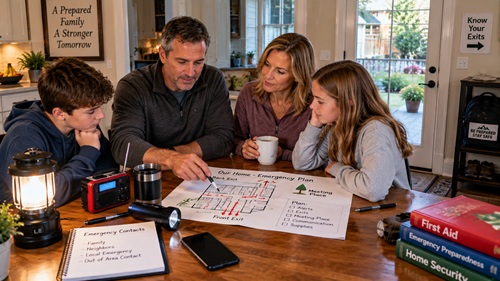
Every household should have a simple understanding of what to do if suspicious or dangerous activity occurs. Security equipment can provide warning and physical barriers can provide time, but those advantages can be wasted if everyone reacts differently or nobody knows what to do next.
Family members should know how to contact emergency services, where to gather if necessary, how to communicate with one another, and when evacuation may be safer than remaining inside.
Children should receive instructions appropriate to their age. They shouldn’t be expected to investigate strange noises, answer unexpected doors, or make complicated decisions during an emergency. Their instructions should be simple and familiar.
Depending on the layout of the home, a suitable room may provide a temporary gathering location while the situation is assessed and emergency services are contacted. The important principle is that household members shouldn’t automatically scatter through the house looking for the source of a problem.
Think about nighttime conditions in particular. Many people are at their least prepared immediately after waking. They may be disoriented, unable to see clearly, and unsure whether an unusual sound is important.
Keep basic communication and lighting accessible near sleeping areas. A charged phone and flashlight can make an enormous difference when an emergency begins during darkness.
The plan doesn’t need to predict every possible situation. It needs to be simple enough that household members can remember it when they’re tired, frightened, or confused.
Don’t Automatically Go Outside to Investigate
An unexpected sound outside at night naturally creates curiosity. Immediately opening the door or walking into the yard, however, can surrender the protection provided by the house before the situation is understood.
Gather information first.
Look from a safe position. Turn on exterior lighting. Check cameras if available. Listen for additional activity. Communicate with other household members.
A noise that initially sounds suspicious may turn out to be wildlife, weather, a fallen object, a neighbor, or something else with an ordinary explanation.
If circumstances appear genuinely threatening or criminal, contact emergency services rather than unnecessarily confronting someone.
The same principle applies to unexpected visitors. If someone claims to represent a utility, contractor, delivery company, government agency, or another organization and the visit wasn’t expected, their identity can often be independently verified before access is provided.
Don’t rely solely on a telephone number provided by the unexpected visitor. When verification is necessary, use contact information obtained independently from a trusted source.
A closed and secured door creates time and distance.
Use both.
Make Fire Safety Part of Home Security
A secure home must remain safe to escape from.
Smoke alarms, carbon-monoxide alarms, appropriate fire extinguishers, evacuation routes, and emergency exits should be considered alongside intrusion security.
This becomes particularly important when additional locks, reinforced doors, window security devices, gates, or other physical barriers are installed.
Any modification affecting an emergency exit should comply with applicable building and fire requirements. Household members should be able to leave quickly during a fire without searching for special tools or trying to remember complicated instructions.
Bedrooms deserve particular attention because occupants may need to escape without traveling through the rest of the house.
Walk through the home and consider what would happen if the normal exit became unusable. Does another practical escape route exist? Would everyone in the household understand how to use it?
Security measures can also affect emergency responders. Unusual barriers or complicated access arrangements may create problems during a fire or medical emergency. This is another reason to favor sensible, code-compliant security improvements rather than improvised measures that could create unintended hazards.
Security is supposed to reduce risk.
A modification that prevents unauthorized entry but traps the household during a fire simply exchanges one danger for another.
Determine What Works Without Electricity or Internet
Modern home security increasingly depends upon electricity and internet connectivity.
A valuable preparedness exercise is to imagine that both disappear tonight.
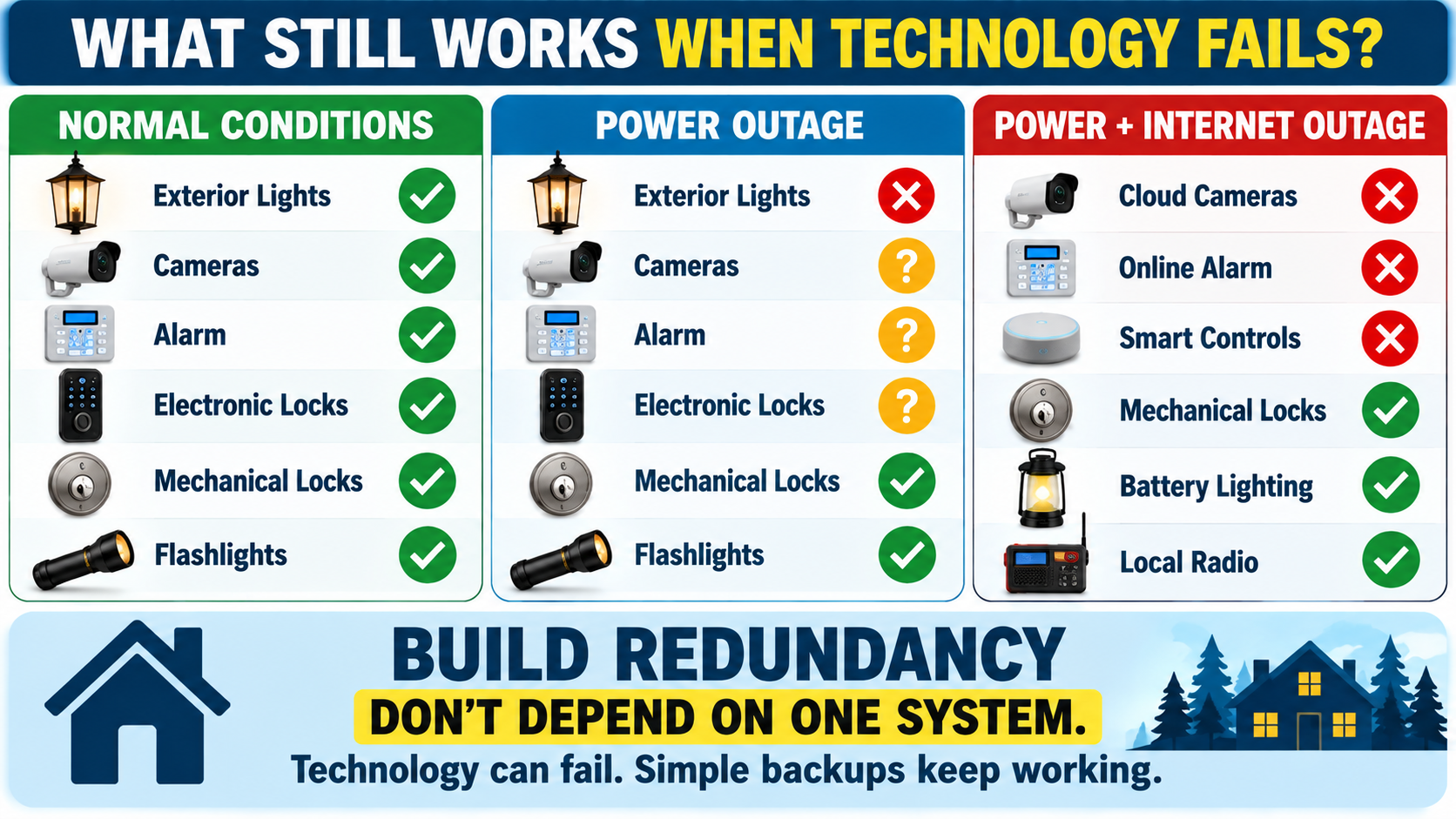
Which exterior lights continue working? Do cameras continue recording? Does the alarm function? Can electronic locks still be operated? Can the garage door still be secured? Can household members communicate? Can everyone safely move around the house?
These questions reveal hidden dependencies.
Some systems contain battery backups but only for limited periods. Others may continue functioning locally while losing remote access. Some cameras may record to local storage without internet connectivity, while others depend heavily on outside services.
Know which type of equipment you own.
Battery-backed lighting, rechargeable flashlights, power banks, locally recording cameras, and other appropriate backup systems can preserve selected capabilities.
Think about where backup equipment is stored as well. A flashlight in a basement utility room isn’t particularly helpful if the power fails while someone is upstairs in bed. Important backup equipment should be available where it is likely to be needed.
Simple mechanical systems remain valuable. A properly maintained door and mechanical lock don’t require internet access. A flashlight doesn’t depend upon cloud services. Curtains and blinds still provide privacy. A trusted neighbor doesn’t need an application to recognize unusual activity.
Preparedness means maintaining enough redundancy that one failure doesn’t eliminate every layer of protection.
Understand Your Electronic Security Dependencies
It is useful to think beyond the simple question of whether a device has electricity.
Modern security equipment may depend upon several separate systems. A camera might require household electricity, Wi-Fi, an internet connection, a remote server, a functioning mobile application, and a charged smartphone before every feature is available.
Any one of those dependencies can fail.
Smart locks, doorbell cameras, alarm systems, garage controls, environmental sensors, and other connected devices may have similar dependencies.
This doesn’t make connected equipment a bad choice. These systems can provide extremely useful capabilities during ordinary life.
The preparedness lesson is to understand the dependency chain.
Ask what happens when Wi-Fi fails but electricity remains available. Then ask what happens when the internet fails. Consider what happens if the phone controlling the system is lost, damaged, or has a dead battery.
Determine whether important equipment can still be operated manually.
Knowing the answers before a disruption makes it much easier to adapt when something stops working.
Prepare for Longer Disruptions
A short blackout and a multi-day emergency create very different security conditions.
Longer disruptions may remove streetlighting, interrupt communications, affect alarm systems, close businesses, delay repairs, and place additional demands on emergency services. Severe weather may damage fences, windows, gates, and doors at the same time that professional repairs become difficult to obtain.
Normal neighborhood patterns can change as well.
People may be outside at unusual hours checking generators, repairing storm damage, helping neighbors, clearing debris, or traveling to obtain supplies. This means unusual activity shouldn’t automatically be interpreted as suspicious activity.
Situational awareness becomes more important precisely because context has changed.
Ordinary household preparedness contributes directly to security during these situations.
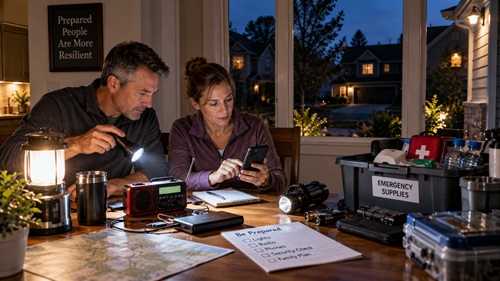
Stored food and water reduce unnecessary travel. Backup lighting improves nighttime awareness. Power banks can keep communication equipment operating. First-aid supplies increase household capability. Battery-powered radios can provide information when internet access or cellular communications become unreliable.
Backup power may help maintain selected security systems, but power should be prioritized according to actual household needs. Keeping communication equipment, essential lighting, medical equipment where applicable, and other important systems operating may be more valuable than attempting to power every electronic device in the house.
The more effectively a household can function at home, the fewer unnecessary risks it may need to take during unstable conditions.
During a prolonged emergency, preparedness and home security increasingly become parts of the same problem.
Pay Attention to Changing Conditions During an Emergency
A security plan that worked yesterday may need adjustment as an emergency develops.
A storm may knock out streetlights that normally illuminate part of the property. A damaged fence may create an opening that didn’t exist before. Fallen trees may block visibility. Evacuated neighboring homes may reduce normal activity around the area.
Conditions can continue changing for hours or days.
Periodically reassess the property rather than assuming the original security arrangement remains effective.
Walk around during safe conditions and look for storm damage, failed lighting, open gates, damaged fencing, blocked cameras, or other changes. At night, observe whether areas that were normally illuminated have become unexpectedly dark.
This is particularly important after severe weather. The most obvious problem may receive immediate attention while secondary security problems go unnoticed.
For example, a storm-damaged roof may understandably become the household’s primary concern, but the same event may also have knocked down part of a fence, disabled a camera, damaged an exterior light, or broken a window in an outbuilding.
Preparedness requires continually updating your understanding of the situation.
Maintain Basic Emergency Repair Capability
A security weakness doesn’t always result from deliberate activity.
A storm can break a window. Wind can damage a gate. A falling branch can damage a fence. A door can become misaligned. Hardware can fail.
Households should have basic tools and appropriate materials for temporary repairs suitable for their property.
The purpose isn’t to perform major structural repairs during an emergency. The purpose is to restore a reasonable level of security, weather protection, and safety until permanent repairs can be made.
If a storm breaks a window, for example, the immediate priority is to safely deal with broken glass, protect the opening from weather, and prevent people, animals, or additional debris from entering through the damaged area.
Build a basic repair capability around the actual construction of your home and property.
Useful supplies may include work gloves, eye protection, flashlights or headlamps, basic hand tools, suitable fasteners, heavy-duty tape, plastic sheeting, tarps, cordage, and other materials appropriate for temporarily covering or securing damaged areas.
Homes with fences, gates, sheds, barns, greenhouses, workshops, or other structures may require additional supplies specific to those structures.
Think about likely problems rather than accumulating random materials. A rural property with extensive fencing has different repair requirements than an apartment. A house in an area that experiences severe wind may have different priorities than one where heavy snow is the more common concern.
Owning tools isn’t the same as knowing how to use them.
Basic repair skills should be learned during normal conditions, when there is time to work carefully and obtain professional assistance if something goes wrong. Learn how your gates operate, how exterior doors are adjusted, where important household shutoffs are located, and what kinds of temporary repairs are appropriate for your property.
Knowing when not to attempt a repair is equally important.
Electrical hazards, structural instability, damaged gas systems, significant roof damage, floodwater, downed power lines, and other serious hazards may require qualified professionals or emergency services. Preparedness doesn’t mean taking unnecessary risks simply because tools are available.
Repair materials should also be stored somewhere they can reasonably be reached after an emergency. A complete repair kit locked inside a damaged or inaccessible outbuilding may not be particularly useful.
At the same time, tools should be stored securely so they aren’t unnecessarily available to unauthorized visitors.
After making an emergency repair, remember that temporary means temporary. A damaged door frame, broken window, compromised roof, electrical problem, structural damage, or other serious issue may require qualified professional assessment and permanent repair.
Don’t allow a temporary patch to create the impression that the original problem has been completely resolved.
Preparedness is about maintaining capability when normal services aren’t immediately available. Having basic repair materials, knowing how to use them, understanding their limitations, and recognizing when professional assistance is necessary can help a household restore an important layer of protection after storms, accidents, equipment failures, and other emergencies.
Make Security an Everyday Habit
Even excellent security equipment can be undermined by inconsistent household behavior.
A camera doesn’t compensate for a door that is routinely left unlocked. An alarm provides little protection if nobody remembers to activate it. A strong garage door doesn’t help much if the connecting door into the house is routinely ignored. Security works best when simple protective actions become normal household habits.
Develop a basic nighttime routine. Before going to bed, make sure exterior doors are secured, appropriate windows are closed, the garage is secure, keys are accounted for, and important exterior lighting and security equipment appear to be functioning normally.
The routine doesn’t need to take long. Once the household becomes accustomed to it, checking several important areas can become as ordinary as turning off the kitchen lights before going to bed.
A similar routine can be used before leaving home for an extended period. Check doors and windows, secure garages and outbuildings, deal with expected deliveries, and make sure appropriate security systems are operating.
Pay attention to unusual changes in routine as well. A family member arriving home late, contractors working on the property, visitors staying overnight, or someone temporarily using a different entrance can alter normal security habits. The system should be flexible enough to accommodate ordinary life without important protections being forgotten.
Household members should also know who is responsible for common tasks. If everyone assumes someone else closed the garage door, checked the back entrance, or activated the alarm, nobody may actually do it.
These actions shouldn’t become an obsessive ritual. The goal is the opposite. Once sensible security habits become routine, they require very little thought.
Household habits are one of the least expensive security layers available, yet they can determine whether every other layer actually works.
Test the System Instead of Assuming It Works
Installing security equipment isn’t the end of the process.
Test what you have.
Walk around the property during daylight and again after dark. Approach the house from the driveway, side yard, backyard, garage, and other realistic directions. Determine when motion lights activate, whether cameras capture useful information, and whether someone inside would actually notice that a person was approaching.
This exercise can reveal weaknesses that aren’t obvious during installation. A motion sensor may activate too late. A camera may have an unexpected blind spot. A bright exterior light may make it harder to see into the surrounding darkness. A driveway alert may fail to detect movement in part of the driveway.
Review recorded camera footage instead of simply confirming that the cameras are operating. Determine whether important details can actually be seen, whether nighttime images are useful, and whether lighting creates glare or deep shadows.
Check the system under different conditions when practical. Rain, snow, fog, seasonal vegetation, parked vehicles, holiday decorations, and other changes around a property can affect visibility and sensor performance.
Doors and windows should also be checked periodically. Confirm that locks engage properly, hinges remain secure, frames haven’t deteriorated, and windows still close as intended. Gates, garage doors, exterior lights, alarms, sensors, and other components deserve the same attention.
Weather, ordinary use, building movement, corrosion, dead batteries, software changes, and simple wear can gradually weaken systems that once worked perfectly.
Backup systems need testing too.
If a security device supposedly has battery backup, find out how it actually behaves when utility power disappears. Determine which cameras continue recording without internet access. Understand approximately how long important batteries are expected to operate.
If equipment has a manual or mechanical override, make sure appropriate household members know how to use it. Discovering an unfamiliar emergency-release mechanism during a blackout is much harder than learning how it works beforehand.
Testing turns assumptions into knowledge.
A household that has actually tested its security arrangements understands its capabilities far better than one that simply owns security equipment.
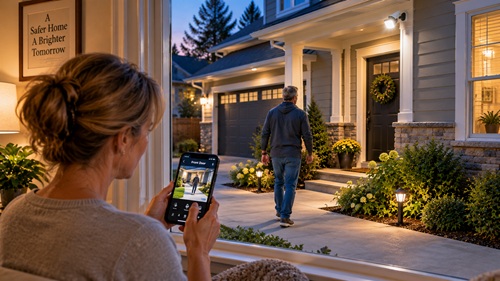
Practice the Household Response
Security equipment should be tested, but the people using it should practice as well.
Consider several realistic situations and discuss what everyone would do. An exterior motion alert occurs late at night. Someone repeatedly knocks on the door when nobody is expected. An alarm activates downstairs. The electricity fails while everyone is asleep. A severe storm damages a window. A wildfire or another emergency requires immediate evacuation.
The purpose isn’t to frighten household members or create elaborate drills. It is to remove uncertainty.
Everyone should understand that they don’t need to personally investigate every problem.
Depending on the situation, one person may gather children while another contacts emergency services. Someone may check available cameras or exterior lighting without opening the door. During another emergency, evacuation rather than remaining inside may be the safest response.
Household members should also understand that different emergencies require different actions. A suspected intrusion, house fire, wildfire evacuation, earthquake, medical emergency, and prolonged blackout aren’t the same situation.
The household doesn’t need a complicated procedure for every imaginable event. Instead, people should understand several basic principles: communicate, gather information when it is safe to do so, protect vulnerable household members, maintain access to emergency exits, contact appropriate assistance, and avoid taking unnecessary risks.
Practice should remain simple enough that people can remember what to do when they’re tired, frightened, or confused.
A complicated plan that nobody remembers is less useful than a straightforward plan everyone understands.
Test Security at Night
Night deserves its own security assessment because many vulnerabilities become more obvious after dark.
Turn off ordinary household activity and look at the property under the conditions that normally exist late at night.
Can you see the driveway from inside?
Can you determine why a motion light activated without opening an exterior door?
Are important walkways visible?
Do cameras provide useful nighttime images?
Are flashlights available where people actually sleep?
Can household members safely move through the house if utility power fails?
Look outside from the same windows or viewing points you would realistically use after hearing an unusual sound.
Exterior lighting can appear very different from inside the house. Reflections from interior lights may make windows difficult to see through. Bright exterior fixtures may create glare. Dark areas beyond an illuminated porch may be difficult to observe.
Try turning interior lights off and comparing visibility.
The objective isn’t to develop surveillance routines. It is to understand the physical environment in which a nighttime emergency would actually occur.
The first time you experience your home in emergency lighting shouldn’t be during a real emergency.
Test What Happens During a Power Failure
A simulated power failure can reveal another set of weaknesses.
This doesn’t require shutting down critical household equipment or creating unnecessary risk. The exercise can be as simple as turning off ordinary lights and temporarily avoiding equipment that would normally disappear during an outage.
Notice what changes.
Can everyone locate a flashlight without using a phone light?
Are stairs and hallways safe to navigate?
Do battery-powered motion lights activate?
Can exterior doors still be operated normally?
Can the garage be opened or secured manually if necessary?
Which security devices remain functional?
Can household members communicate with one another?
If backup power is available, decide in advance which systems deserve priority rather than attempting to power everything.
A power-outage exercise often reveals that small items matter enormously. A flashlight stored in the correct place, a charged power bank, a working battery lantern, and knowledge of how a garage-door release operates may be more immediately useful than sophisticated equipment that has lost power.
Keep Security Equipment Maintained
Security equipment gradually becomes less reliable if it isn’t maintained.
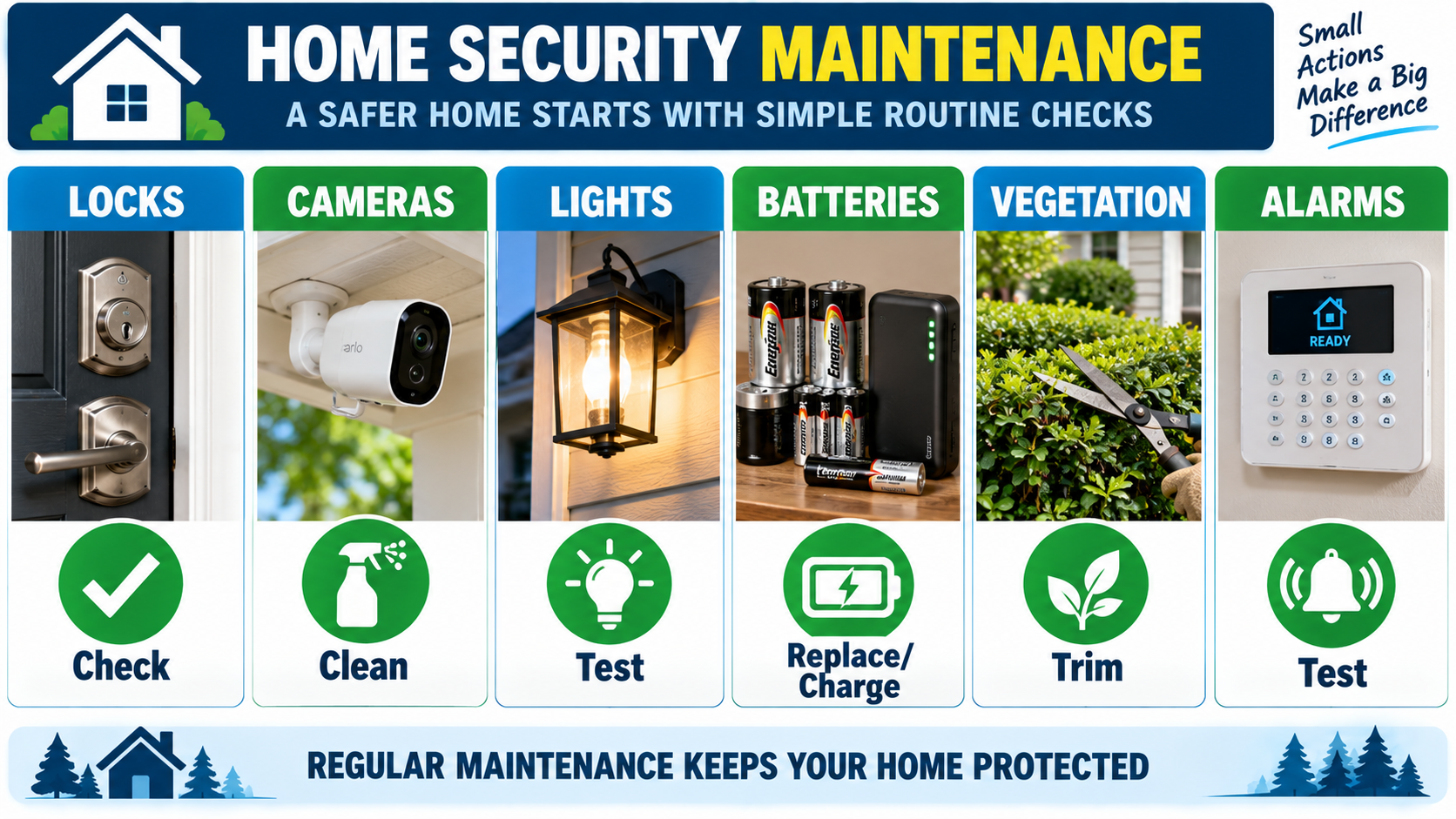
Batteries weaken. Camera lenses become dirty. Vegetation grows into viewing areas. Motion sensors shift. Exterior fixtures become damaged. Door hardware loosens. Weather seals deteriorate. Software may require updates.
Create a reasonable maintenance schedule based on the equipment you own.
This doesn’t need to become complicated. Security equipment can be checked alongside other seasonal household maintenance.
When changing smoke-alarm batteries or inspecting emergency supplies, check security lighting and backup batteries. When trimming vegetation, look at camera views and exterior visibility. When preparing the property for winter, inspect gates, locks, exterior doors, and other hardware exposed to weather.
The objective is to catch gradual deterioration before it becomes an important weakness.
A security system should be treated more like a smoke alarm than a piece of furniture. It has a job to perform, and periodically confirming that it can still perform that job is part of owning it.
Learn From False Alarms
False alarms and unnecessary alerts can become useful training information.
If a motion light repeatedly activates because of an animal, determine whether its positioning or sensitivity can be improved. If a camera constantly sends notifications because tree branches move in the wind, adjust the detection area if the system allows it.
If household members routinely ignore an alert because it activates too frequently, that alert has lost much of its early-warning value.
The objective isn’t necessarily to eliminate every false notification. Outdoor environments naturally contain movement. The goal is to make alerts useful enough that household members don’t become conditioned to ignore them.
When something unexpected activates a sensor, use the event to understand the system better.
What caused it?
Was the event recorded?
Could you determine what happened without going outside?
Did the notification reach the correct people?
Did the system behave the way you expected?
Small incidents can provide valuable opportunities to test the system without waiting for a serious emergency.
Identify the Weakest Layer
After completing a home-security assessment, resist the temptation to immediately purchase more equipment.
Instead, identify the weakest part of the existing system.
A house may have several expensive cameras but a deteriorated rear-door frame. Another property may have excellent doors and locks but no useful indication that someone has entered a long rural driveway. A household may depend heavily on electronic security while having almost no backup lighting or power.
Another home may already have good equipment but poor security habits. Doors aren’t consistently secured, garage remotes are left in vehicles, passwords are unnecessarily shared, or nobody checks whether security equipment is still functioning.
The weakest layer may even be something extremely simple.
Perhaps the side gate no longer closes properly. Maybe a large shrub has grown across the view from a window. Perhaps the household has no flashlight near the bedrooms. Maybe everyone assumes someone else checks the garage before bed.
Those weaknesses deserve attention before additional features are added.
Improving the weakest layer usually provides more practical benefit than strengthening something that is already adequate.
This approach also makes security improvements more affordable. Instead of trying to create a perfect system immediately, improve the most important weakness, reassess the property, and then address the next one.
Over time, the entire system becomes stronger.
Don’t Confuse More Equipment With Better Security
Security products can be useful, but purchasing equipment can create a false sense of progress.
A homeowner may install another camera because adding technology feels productive even though the actual weakness is a rear door that doesn’t close properly. Another household might purchase a sophisticated alarm while routinely leaving a garage window unsecured.
Before buying another security product, identify the problem it is supposed to solve.
If the problem is poor visibility, improve visibility.
If the problem is a weak entry point, repair or strengthen that entry point.
If the problem is late detection, improve early warning.
If the problem is dependence on electricity, develop appropriate backup capability.
If household members don’t know what to do during an emergency, improve and practice the response plan.
Security equipment should solve identified problems rather than become a collection of disconnected devices.
A relatively simple system that has been carefully planned, maintained, and tested can provide more practical value than an expensive collection of equipment that nobody fully understands.
Build Security in Affordable Stages
A strong home-security system doesn’t need to be completed in one weekend.
Begin with weaknesses that can be corrected inexpensively.
Repair doors and windows that don’t close properly. Replace failed lighting. Trim vegetation that blocks important views. Account for household keys. Establish nighttime routines. Make sure everyone knows where flashlights and communication devices are located.
Then address more significant physical weaknesses according to priority and budget.
If an exterior door or frame needs repair, that may deserve attention before purchasing another electronic device. If the property has a major nighttime blind spot, lighting may be the next logical improvement. If people can approach a rural residence without being noticed, early warning may become the priority.
Technology can then be added where it provides a clear benefit. Cameras, sensors, alarms, backup power, and other systems can extend awareness and provide additional layers, but they should be selected because they solve an identified problem.
This staged approach is particularly useful from a preparedness perspective because it encourages capability rather than consumption.
A household with modest equipment that understands its property, maintains its doors and windows, knows its neighbors, has backup lighting, and practices sensible security habits may be better prepared than a household with expensive technology that has never been tested.
Security should become stronger over time without becoming financially overwhelming.
The important measure isn’t how much money has been spent.
It is whether the household has become better at discouraging problems, detecting them early, delaying unauthorized access, and responding safely when something happens.
Reassess Security When Life Changes
A home-security assessment shouldn’t be performed once and then forgotten.
Properties change over time. Trees and shrubs grow. Fences deteriorate. Doors shift. Exterior lights fail. Children get older. Vehicles change. Household schedules change. New neighbors move in. Renovations create different entrances or alter sightlines. Garages, sheds, and outbuildings may begin storing equipment that wasn’t there when the original security plan was developed.
Technology changes too.
A camera system that worked perfectly several years ago may eventually stop receiving software updates. Batteries lose capacity. Online services change. Equipment fails. Devices that depend upon cloud services may eventually lose features or support.
Major household changes should therefore trigger another security review.
Walk the property again and ask the same questions you asked during the original assessment. What can be seen? What can’t? What has changed? Which equipment still works? Have new blind spots appeared? Are old security measures still appropriate?
A growing tree may now block a camera. A new shed may create concealment beside the house. A teenager who now arrives home independently may need different access arrangements. A new vehicle may block a camera’s view when parked in its normal location.
Even positive improvements can create unexpected effects. A new privacy fence may improve comfort while reducing visibility. New landscaping may improve appearance while creating concealment. A home addition may introduce another exterior door that needs to be incorporated into nighttime routines.
Security should evolve with the household rather than remain frozen at the moment the equipment was originally installed.
Adjust Security to Seasonal Changes
Seasonal conditions can alter the security characteristics of a property considerably.
Summer vegetation may create concealment that doesn’t exist during winter. Heavy snow can block gates, interfere with sensors, change access routes, or create large banks that make fences easier to cross. Fallen leaves can cover walkways and interfere with some equipment. Long winter nights increase the amount of time households depend upon exterior lighting.
Seasonal weather can affect batteries and electronics as well.
A security assessment performed during one season may therefore provide an incomplete picture of the property.
Pay attention to these changes during normal seasonal maintenance. When trimming shrubs, look at sightlines. When preparing for winter, inspect exterior lighting, gates, doors, locks, cameras, and backup power. After major snow accumulation, look at how access around the property has changed.
This doesn’t require conducting a complete security audit every few months.
It means recognizing that the environment surrounding the home is constantly changing and occasionally looking at those changes through a security lens.
Home Security During a Wider Emergency
Home security can change significantly when an entire community is experiencing disruption.
A prolonged blackout may remove streetlights and disable some residential security equipment. Communications outages can make information harder to obtain. Severe storms can damage fences and buildings. Wildfires, floods, earthquakes, and other emergencies can cause unusual movement through neighborhoods. Emergency services may also be dealing with many incidents simultaneously.
These conditions don’t mean that crime will automatically increase.
They do mean that households may have fewer of the systems and services they normally depend upon.
Preparedness reduces that vulnerability.
A household with stored water, food, lighting, communications, first-aid supplies, backup power, and basic repair capability has fewer reasons to immediately leave home in search of necessities. Household members can concentrate on evaluating conditions and deciding whether remaining home or evacuating is appropriate.
This is one of the less obvious connections between preparedness and security.
Every essential need that can be safely met at home potentially reduces unnecessary exposure during a disruption. A household that doesn’t need to immediately search for water, batteries, food, flashlights, or basic medical supplies has more flexibility.
That flexibility is valuable.
Expect Normal Patterns to Change During Emergencies
Situational awareness becomes more complicated during a community-wide emergency because ordinary patterns may disappear.
People may be outside at unusual hours. Neighbors may be running generators, clearing debris, moving vehicles, checking properties, helping relatives, or traveling to obtain supplies.
Emergency workers, utility crews, contractors, volunteers, and unfamiliar vehicles may appear in areas where they normally wouldn’t be seen.
An empty house may suddenly have several people around it because relatives have arrived to check for damage.
These changes demonstrate why situational awareness should never be reduced to simply noticing something unfamiliar.
Context matters.
Observe what is happening, gather available information, communicate with neighbors when appropriate, and distinguish unusual activity from genuinely concerning behavior.
Preparedness should improve judgment rather than replace it with suspicion.
Community Relationships Become More Important
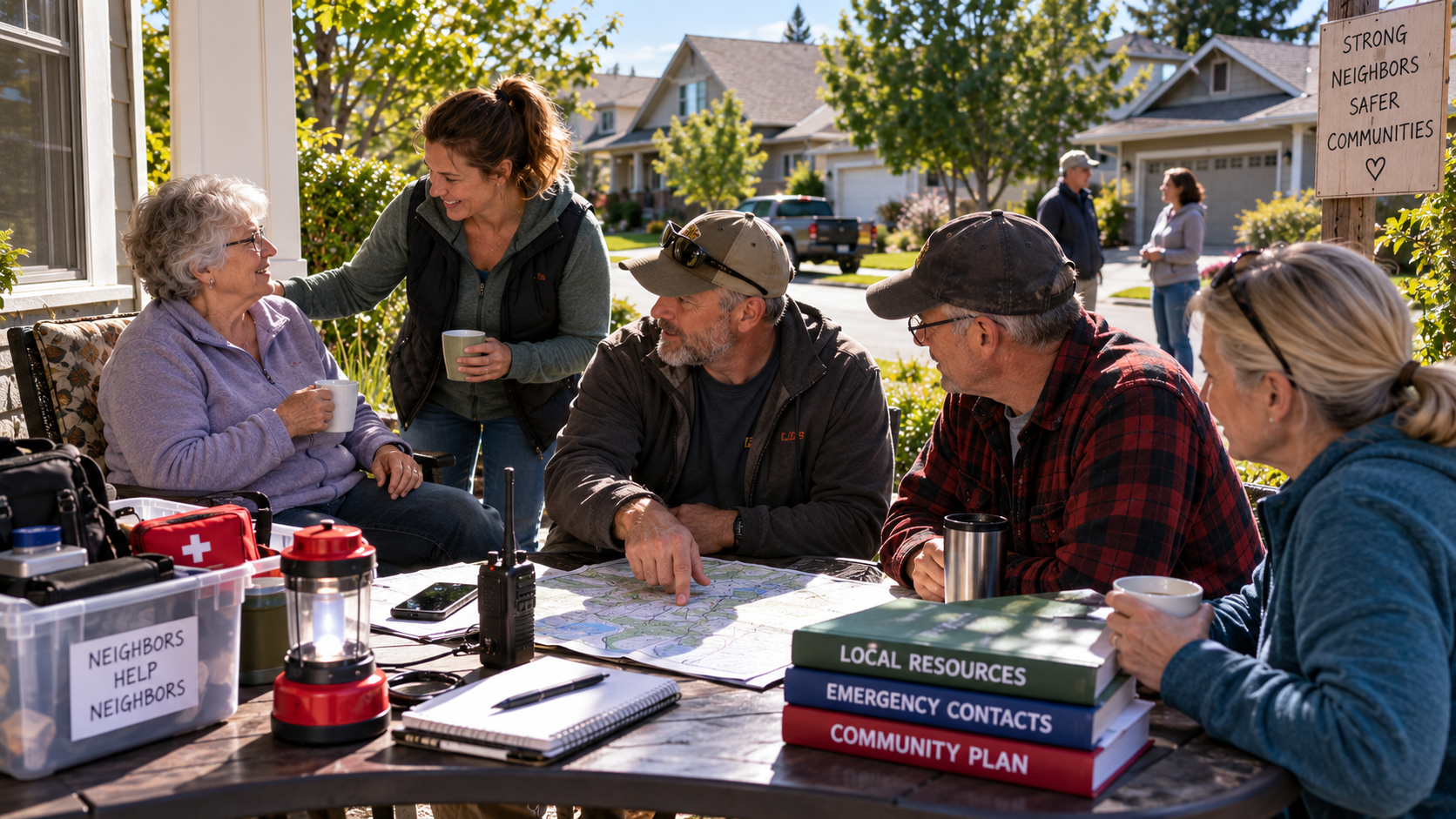
During widespread disruptions, nearby households may become some of the most immediately useful sources of information and assistance.
Neighbors can exchange information about road conditions, outages, evacuation notices, damaged infrastructure, local hazards, and changing conditions.
They can check on elderly or vulnerable residents, notice damage to an unattended property, help clear debris, or share information when internet and cellular communications are unreliable.
This doesn’t mean every neighborhood needs to become a formal preparedness organization.
Even basic relationships matter.
Knowing who lives nearby, having several trusted contact numbers, and being comfortable checking on one another can create a small but meaningful layer of community resilience.
A resilient neighborhood can provide capabilities that no individual camera, alarm, or security product can duplicate.
Know When Remaining Home Is No Longer the Safest Choice
Home security shouldn’t create the assumption that remaining home is always the correct decision.
Some emergencies make evacuation necessary.
Wildfires, floods, hazardous-material incidents, structural damage, gas leaks, and official evacuation orders can quickly make a normally secure home unsafe.
This is why home security must remain connected to broader emergency planning.
A household should know how it would leave if necessary, what essential items would be taken, how family members would reconnect if separated, where vehicles are normally kept, and which evacuation routes may be available.
Security measures shouldn’t make evacuation unnecessarily difficult.
Gates, locks, reinforced doors, and other protective systems should be understood well enough that household members can operate them quickly when leaving becomes necessary.
The purpose of preparedness is to preserve options.
Sometimes the safest option is staying home.
Sometimes it is leaving early.
Good planning makes both possible.
Avoid Turning Preparedness Into Paranoia
Home security should increase confidence rather than make people afraid of their surroundings.
Learning to recognize vulnerabilities doesn’t mean assuming that every unfamiliar vehicle, unexpected visitor, nighttime sound, or motion alert represents a threat.
Most unusual events have ordinary explanations.
Good situational awareness means noticing something, gathering information, and making a reasonable decision based on what is actually happening.
This distinction matters because fear can lead to poor decisions.
Someone who assumes every noise represents danger may rush outside unnecessarily. Someone who remains calm is more likely to use lighting, cameras, observation, communication, and other available information before deciding what to do.
The objective is awareness without obsession.
A prepared household should understand its surroundings while continuing to live normally within them.
Preparedness should create options.
The more options a household has, the less pressure there is to make rushed decisions.
Security Should Protect Normal Life
The ultimate purpose of home security isn’t to spend every evening thinking about security.
A good system should quietly support normal life.
Doors close and lock properly. Lighting makes the property easier to navigate. Cameras provide information when needed. Household members understand basic emergency procedures. Important records are protected. Neighbors know one another. Backup lighting and communications are available if normal systems fail.
Most days, nothing unusual will happen.
That is exactly how a security system should function.
The household develops sensible habits, maintains its equipment, periodically reassesses vulnerabilities, and then gets on with everyday life.
Security becomes part of preparedness rather than the center of it.
A well-designed system should actually reduce the amount of uncertainty the household experiences. People know that doors work properly. They know where flashlights are located. They understand what their cameras can see. They know which neighbors they can contact. They have a plan for outages and emergencies.
That knowledge creates confidence.
Think of Home Security as a Complete System
The central lesson is that home security isn’t a lock, camera, alarm, fence, dog, safe, or piece of technology.
It is the relationship between protective layers and the people using them.
Imagine someone approaching your property.
How close could they get before being noticed?
What would reveal their presence?
Could you safely determine why they were there without immediately opening the door?
If they attempted unauthorized entry, would the home’s physical security provide meaningful resistance?
Would everyone inside know what to do?
Now imagine that the electricity fails.
Which protections remain?
Remove internet service.
What still works?
Imagine that a major storm or community-wide emergency delays outside assistance.
Can the household continue functioning safely while conditions are assessed?
Every answer of “I don’t know” identifies something worth investigating.
Every answer of “nothing” may identify a security gap worth improving.
This is how layered home security should be built. The objective isn’t to predict every possible threat or make a property impossible to enter. It is to create enough overlapping capability that the failure of one layer doesn’t leave the household without options.
Build Security Around Time and Options
There is another useful way to think about the entire system.
Security creates time.
Early warning gives you time before someone reaches the house. Lighting gives you time to observe. Cameras give you time to gather information. Doors and locks provide time by creating resistance. Communication gives you time to seek assistance. Backup systems provide time when normal infrastructure fails. Food, water, power, and other preparedness supplies give you time before you need to leave home during a disruption.
Time creates options.
Without warning, people are forced to react immediately.
With warning, they can observe.
With information, they can make better decisions.
With physical protection, they may have more time to contact assistance.
With preparedness supplies, they may be able to remain safely at home rather than entering uncertain conditions simply because they need basic necessities.
This is why home security and preparedness fit together so naturally.
Both are ultimately about preserving options when normal conditions change.
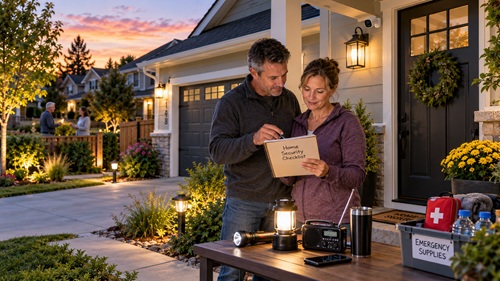
Preparedness Action Plan
Begin by walking around your property during daylight and after dark. Examine the property boundary, driveway, walkways, landscaping, exterior lighting, entrances, accessible windows, garage, outbuildings, and areas that are difficult to observe from inside. Determine how close an unfamiliar person could realistically approach before someone inside would probably become aware of them.
Next, inspect the physical condition of the home. Make sure exterior doors close and lock properly, windows function as intended, gates and fences are maintained, and garages and outbuildings receive appropriate attention. Correct obvious maintenance problems before investing heavily in additional security technology.
Evaluate visibility and early warning separately. Determine whether important approaches can be observed and whether lighting, cameras, sensors, neighbors, or other systems provide useful notice of unexpected activity. Test these systems during both daylight and darkness rather than assuming they work.
Review your cameras and alarms according to what information they actually provide. Make sure important areas are covered, notifications remain useful, and household members understand what the equipment does when electricity or internet access fails.
Examine technological dependence throughout the system. Determine what happens to cameras, alarms, electronic locks, communications, garage access, and lighting when electricity or internet service disappears. Establish reasonable backup capability using appropriate battery power, flashlights, mechanical security, local recording, or other systems suitable for the household.
Review who has physical and digital access to the property. Account for keys where practical, update unnecessary access codes, protect important security accounts, and make sure spare access methods are handled responsibly.
Consider what happens if an exterior security layer fails. Protect important records and valuables appropriately, maintain backup copies of critical information, and make sure household members know where to go and how to communicate during an emergency.
Make fire safety part of the assessment. Ensure that security improvements don’t interfere with emergency escape and that household members understand how they would leave if normal exits became unusable.
Develop basic repair capability for the property so that damaged windows, gates, doors, fencing, or other components can be temporarily secured when professional assistance isn’t immediately available. Learn the skills during normal conditions and understand which repairs should be left to qualified professionals.
Build simple security habits into everyday life. Develop a short nighttime routine, maintain equipment, check batteries, and periodically confirm that doors, windows, cameras, lights, alarms, and backup systems continue functioning as expected.
Practice several realistic household scenarios. Keep the response simple enough that everyone understands their role without needing to remember complicated procedures.
Then identify the weakest layer.
Don’t automatically purchase more equipment. Fix the problem that creates the greatest vulnerability first. Reassess the system afterward and identify the next priority.
Finally, repeat the assessment whenever the property, household, technology, or surrounding environment changes significantly.
The objective isn’t perfection.
The objective is a home where unusual activity is more likely to be noticed early, unauthorized access is more difficult, household members have additional time to respond, essential protections continue through common disruptions, and everyone understands what to do when normal conditions change.
Key Takeaways
Effective home security is built from overlapping layers rather than a single product. Visibility, early warning, maintained doors and windows, controlled access, useful cameras, household habits, communication, neighbors, backup capability, emergency repair skills, and practiced response all contribute to the system.
Security equipment is most valuable when it solves an identified problem. Before purchasing additional technology, determine where the actual weakness exists and improve that area first.
Technology should complement rather than completely replace mechanical security, household awareness, basic skills, and preparedness. Electricity, internet access, cellular communications, cloud services, and outside assistance can become unreliable during emergencies, making simple backup systems valuable.
Home security must also remain compatible with fire safety and emergency evacuation. Protecting people is more important than protecting possessions, and a security improvement that prevents safe evacuation can create a new hazard.
Preparedness adds another important dimension. Food, water, lighting, communications, backup power, first aid, community relationships, and emergency repair capability can help a household remain functional when normal systems are disrupted. The ability to remain safely at home without immediately searching for basic necessities can itself become an important security advantage.
Neighbors matter because security isn’t limited to the property line. Trusted local relationships can provide information, context, assistance, and additional awareness during both ordinary life and wider emergencies.
Testing matters because equipment that hasn’t been tested is partly an assumption. Walk the property, review camera footage, test lighting, inspect physical security, understand backup systems, and practice simple household responses.
Most importantly, think of security as a way of creating time and options.
Early warning creates time to understand what is happening. Physical protection creates time to respond. Communication creates options for obtaining assistance. Preparedness supplies create options when normal services aren’t available. Knowledge and practice create options when technology fails.
The goal isn’t to live in fear of what might happen.
The goal is to create a home that gives the people inside more warning, more time, more options, and a better ability to respond when something does happen.
© Prepping Communities. This content is for informational purposes only and not professional advice. Use at your own risk.
Terms | Privacy | Guidelines