
Salad dressing probably isn’t something most people think about storing for an emergency. There are obviously much more important foods to worry about. But dressing is also one of those products that is so easy to make from basic ingredients that there really isn’t much reason to depend completely on bottles from the store.
Knowing how to make your own becomes especially useful when you are eating from a garden, working through stored foods, or simply trying to make meals from whatever happens to be available. Cabbage, greens, beans, pasta, rice and vegetables can all get pretty repetitive. A simple dressing or sauce can completely change the meal.
The useful skill isn’t memorizing twenty different recipes. It is understanding how a dressing works well enough that you can make one from what you have.
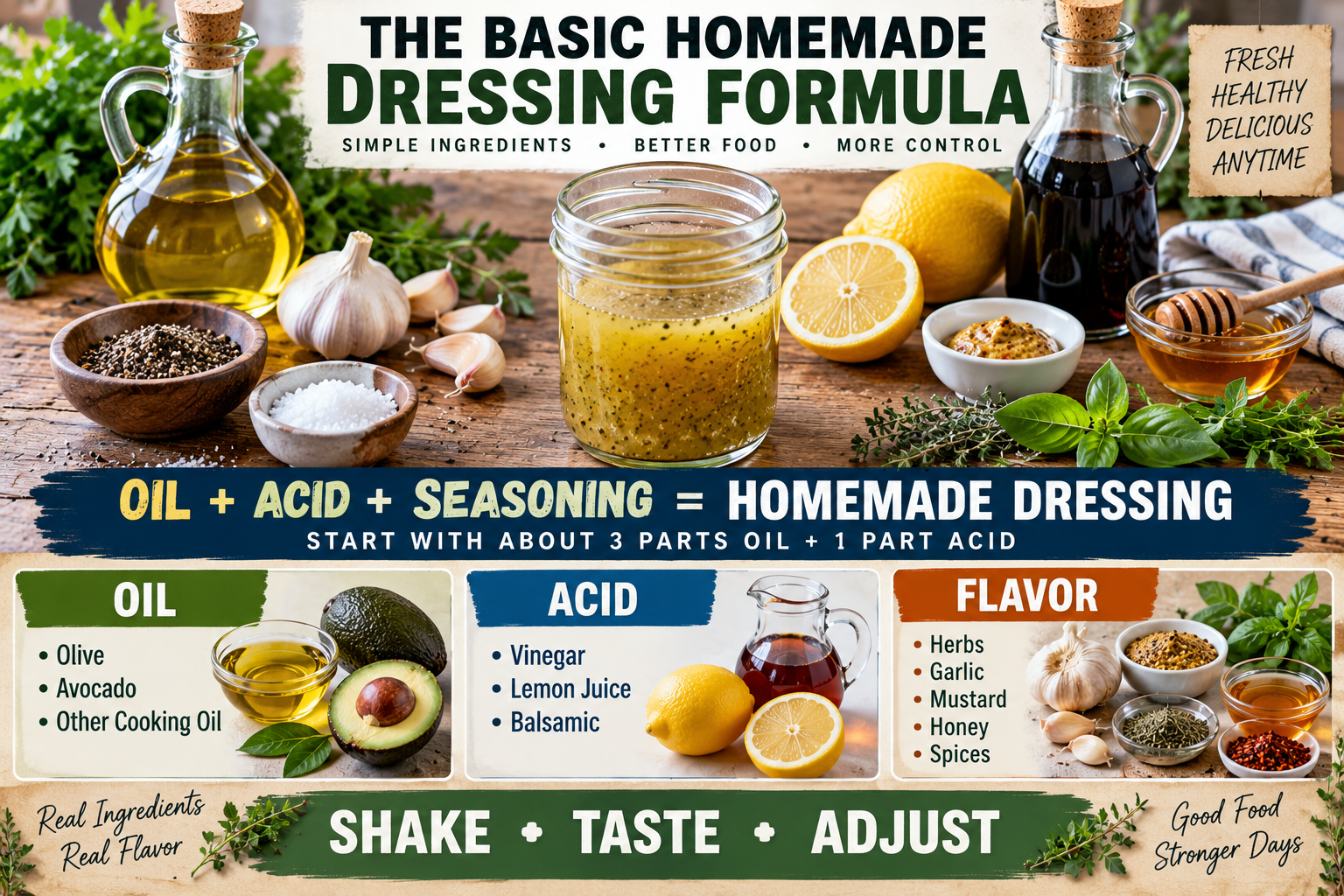
The Basic Dressing Formula
Most simple dressings are built around a fat and an acid. Usually the fat is oil and the acid is vinegar or citrus juice.
A good starting point is about three parts oil to one part acid. That isn’t a rule you have to follow exactly. Some people like a sharper dressing and use more vinegar or lemon juice. Others prefer something milder and use more oil.
Put the ingredients in a jar, close the lid and shake it. Then taste it.
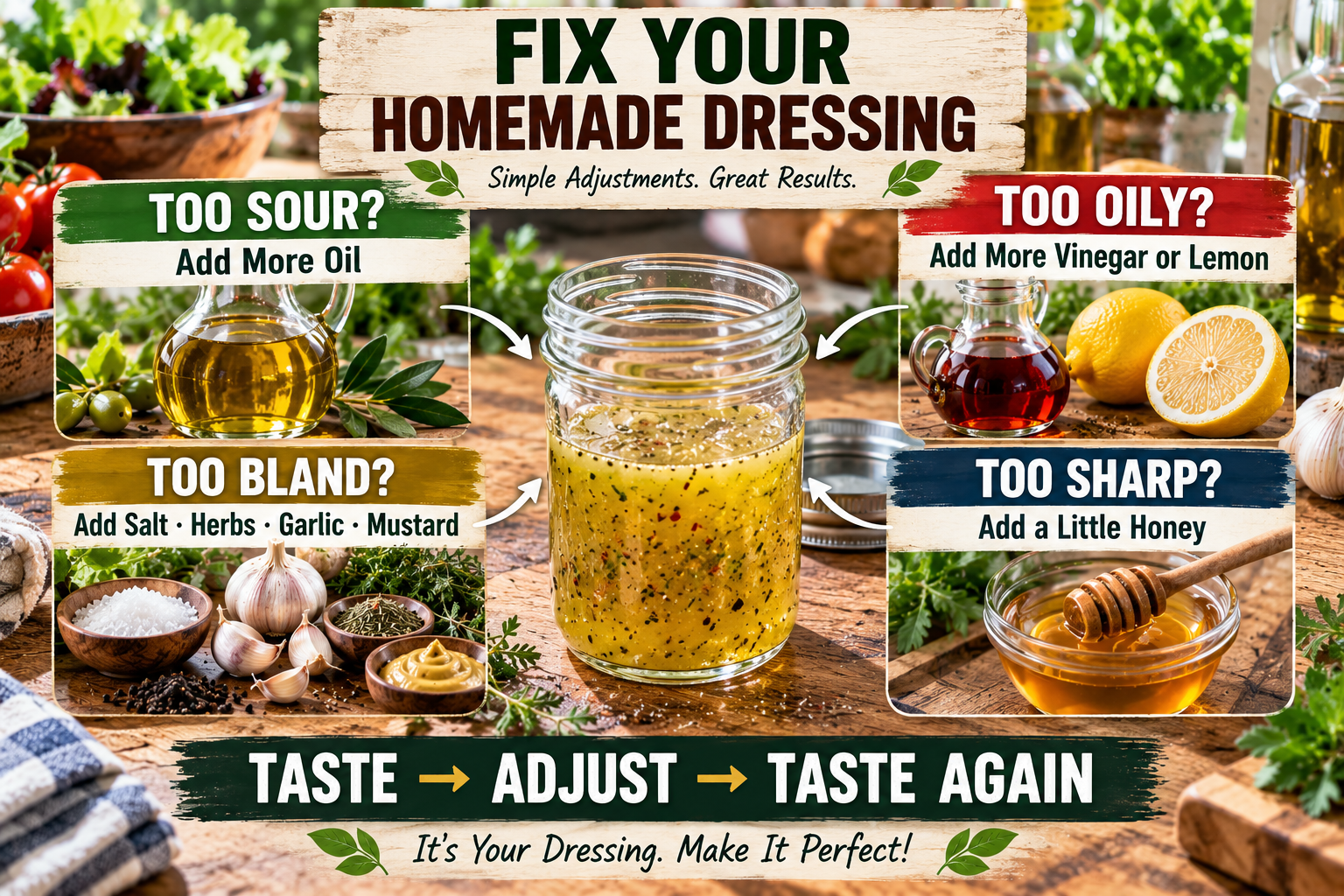
If it is too sharp, add a little more oil. If it tastes too oily or flat, add a little more vinegar or lemon juice. Salt brings the flavors together, while herbs, garlic, mustard, pepper, honey and spices can take the same basic mixture in completely different directions.
Once you understand that, you already know how to make dozens of dressings.
Simple Garlic, Ginger and Lemon Dressing
This is a good dressing to start with because it uses only a few ingredients.
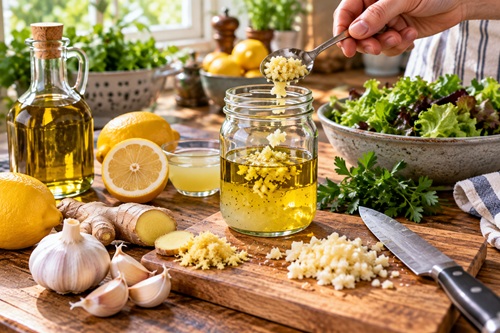
Finely mince 2 cloves of garlic and a small thumb-sized piece of fresh ginger. Add the juice of 1 lemon and approximately 1/4 cup olive oil. Mix everything thoroughly or put it into a jar and shake it.
That’s the basic dressing.
From there you can change it depending on what you have. A little honey makes it sweeter. Cayenne or another hot pepper gives it some heat. Turmeric changes both the flavor and color. Mashed avocado can turn it into something much creamier, while nutritional yeast can give it a more savory flavor.
You don’t need all of those additions. The point is that one basic dressing can become several different dressings simply by changing one or two ingredients.
Basic Pantry Vinaigrette
If you have oil, vinegar and salt, you can make a vinaigrette.
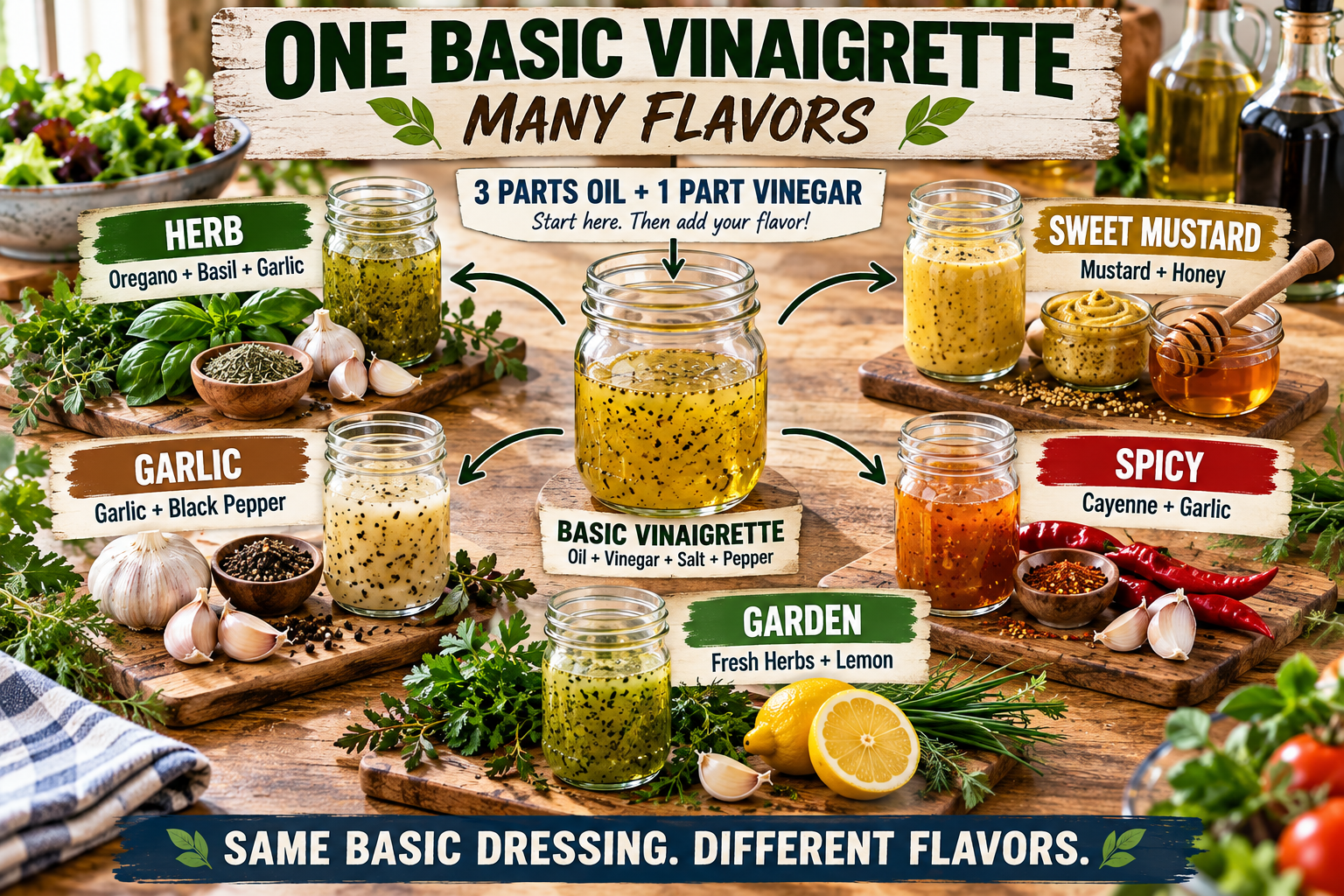
Start with about 3 tablespoons of oil and 1 tablespoon of vinegar. Add a small pinch of salt and some black pepper if you have it. Shake everything together in a jar and taste it.
From there, look through the pantry.
Dried oregano and basil will take it in one direction. Mustard gives it more bite and helps the mixture come together. Honey balances a sharp vinegar. Garlic or onion powder adds another layer of flavor. Dill works especially well with cucumbers and other fresh garden vegetables.
This is why dried herbs and seasonings are so useful to keep around. They take very little storage space, last a long time when properly stored, and can make the same basic foods taste completely different.
Honey Mustard Dressing
Honey mustard is another easy dressing that can be made without much measuring.
Combine oil with a smaller amount of vinegar, then add mustard and honey. Start small with both because you can always add more.
Shake or whisk everything together until it becomes smooth. Taste it and adjust from there. More honey makes it sweeter, more mustard makes it sharper, and a little additional vinegar gives it more bite.
This works as more than a salad dressing. It can be used with cooked vegetables, cold pasta, sandwiches, chicken or as a simple dipping sauce.
That is another useful thing to remember about homemade dressings. They don’t have to stay on salad.
Turmeric Dressing
For something with a stronger flavor, combine 1/4 cup extra virgin olive oil, 2 tablespoons apple cider vinegar, 1 teaspoon freshly grated turmeric or 1/2 teaspoon dried turmeric, 1/4 teaspoon black pepper, 1 small minced garlic clove, a pinch of salt and, if desired, 1 teaspoon honey.
Put everything into a small jar and shake it well. Letting it sit for a little while allows the flavors to blend.
This is a good example of how spices already stored for cooking can be used to create something completely different. You don’t necessarily need a separate collection of ingredients specifically for making dressings.
Creamy Yogurt Herb Dressing
If you have reliable refrigeration, plain yogurt makes an easy base for creamy dressing.
Combine about 1/2 cup plain Greek yogurt, 2 tablespoons olive oil, 1 tablespoon lemon juice, 1 minced garlic clove, and whatever fresh or dried herbs you have available. Chives, parsley, basil and dill all work well.
Add a little salt and mix everything together. If the dressing is too thick, add a small amount of water until you get the consistency you want.
Because this dressing contains yogurt, it needs to remain refrigerated and should be treated as a perishable food. That makes it less useful during a long power outage unless you have dependable backup refrigeration, but it is a useful way to turn yogurt and garden herbs into another meal component while those foods are available.
A Simple Savory Dressing
Nutritional yeast can also be used to make a more savory dressing.
Combine approximately 3 tablespoons nutritional yeast, 1/4 cup olive oil, 2 tablespoons apple cider vinegar, 1 tablespoon Dijon mustard, 1 small minced garlic clove, a little salt and about 2 tablespoons water.
Whisk or shake everything together until smooth. Add a little more water if you want a thinner dressing.
The nutritional yeast gives the mixture a stronger savory flavor, which can be useful when simple vegetables, grains or beans are starting to taste repetitive.
Tomato Herb Vinaigrette
Fresh tomatoes from the garden can also become part of a dressing rather than simply being added to the salad.
Combine 2 tablespoons olive oil, 2 tablespoons balsamic vinegar, 1 small seeded tomato, 1 teaspoon dried Italian herbs, 1 small minced garlic clove, and a little salt and black pepper.
Blend the ingredients until smooth.
If you don’t have electricity, finely chop or crush the tomato and mix everything by hand instead. The texture will be rougher, but it will still work.
That is an important habit with offline cooking: don’t abandon a recipe just because the appliance normally used to make it isn’t available. Ask what the appliance was actually doing and whether you can accomplish the same basic job another way.
Use Your Garden for Flavor
A garden can supply much more than the main part of a meal.
Garlic, onions, tomatoes, peppers, basil, dill, parsley, chives and many other herbs can all become ingredients in dressings and sauces. If you grow herbs, preserving some by drying them gives you access to those flavors long after the growing season has ended.
This becomes especially valuable when your basic foods don’t change very much.
You might have cabbage several times in one week, for example. One meal could use a sweet vinegar dressing. Another could use garlic and herbs. Another could use mustard. Another could use something spicy.
The cabbage hasn’t changed.
The experience of eating it has.
Dressings Can Help With Food Fatigue
This is where a simple cooking skill starts becoming genuinely useful in a longer emergency.
Stored food often consists of relatively basic ingredients. Rice, beans, pasta, grains, canned vegetables and whatever is coming from the garden may form a large part of the diet.
Eating those foods isn’t necessarily the problem. Eating them prepared exactly the same way over and over can be.
Sauces, seasonings and dressings give you a way to create variety without storing completely different meals.
Oil, vinegar, mustard, honey, dried herbs and spices take up relatively little space compared with the number of different flavors they can produce.
Learning how to use them gives you more options from the food you already have.
Making Dressing Without Electricity
Most homemade dressings require no electricity at all.
A jar with a tight-fitting lid is one of the easiest tools. Add the ingredients, close the jar and shake it hard.
If you don’t have a jar, use a bowl and fork, whisk or spoon.
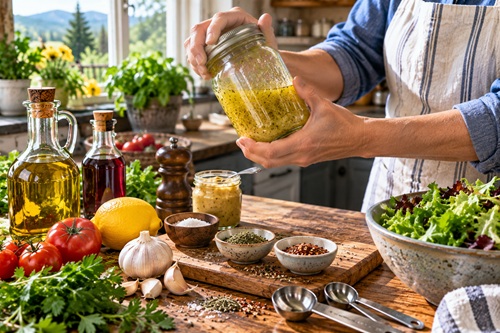
Ingredients that normally go into a blender can usually be chopped, minced, mashed or crushed by hand. The finished dressing might not be perfectly smooth, but that doesn’t matter much.
This is another reason these recipes work well as an offline food skill. They require very little equipment.
Food Safety Matters
Homemade dressings do not automatically have the storage life of commercially bottled products.
Be especially careful when fresh garlic or other fresh ingredients are mixed with oil. Fresh garlic stored improperly in oil can create conditions where dangerous bacteria can grow. Do not make a large batch of garlic-and-oil dressing and assume it is safe to leave at room temperature.
Keep homemade dressings refrigerated when the ingredients require refrigeration and make relatively small quantities that can be used quickly.
The source recommends refrigerating homemade dressings and using dressings containing raw garlic within about one week.
During an extended outage without dependable refrigeration, shelf-stable ingredients such as dried garlic, dried onion, dried herbs, vinegar, mustard and seasonings may be more practical.
Also remember that simply adding some vinegar or lemon juice does not automatically make a homemade dressing safe for long-term room-temperature storage. Shelf-stable preservation requires properly tested recipes and controlled acidity.
When refrigeration is uncertain, make small batches and use them promptly.
Build Flavor Into Your Food Storage
There isn’t much reason to build a separate “salad dressing stockpile.” The better approach is to store ingredients that can do several jobs.
Oil is useful for cooking and dressings. Vinegar can be used in cooking, dressings and food preservation when following tested recipes. Salt and pepper are basic cooking ingredients. Mustard, honey, garlic and dried herbs can be used across dozens of meals.
That makes these ingredients valuable because they aren’t dedicated to one recipe.
A few basic ingredients can create a surprising amount of variety.
Learn to Make Dressing Without Measuring
Recipes are useful when you’re learning, but eventually try making a dressing without one.
Pour some oil into a jar. Add a smaller amount of vinegar. Add a pinch of salt and whatever seasoning sounds good.
Shake it.
Taste it.
Too sharp? Add some oil.
Too oily? Add more acid.
Too bland? Add salt, mustard, garlic or herbs.
Too acidic? A small amount of honey or another sweetener can help balance it.
Keep adjusting until it tastes right.
Doing this a few times teaches you far more than memorizing exact measurements. Eventually you’ll be able to look at the ingredients you have and figure out what you can make from them.
Key Takeaways
Homemade salad dressing is a simple food skill, but it teaches something much more useful: how to work with ingredients instead of depending entirely on finished products.
Once you understand the basic combination of oil + acid + seasoning, you can make all kinds of dressings from whatever is available.
Vinegar, lemon juice, garlic, mustard, honey, herbs, spices and garden produce can completely change the flavor of otherwise basic foods. The same ingredients can also be used for cooking, sauces, marinades and other meals, which makes them much more useful to store than products that only serve one purpose.
The best way to learn is simply to start making dressings. Taste them, change them and figure out what each ingredient does.
Eventually you won’t really need the recipe.
And that is the part worth knowing offline: you don’t need to remember dozens of dressings. You just need to understand how to make one from what you have.
© Prepping Communities. This content is for informational purposes only and not professional advice. Use at your own risk.
Terms | Privacy | Guidelines