

A greenhouse is usually built for growing food, starting seedlings, and extending the growing season. But an attached greenhouse can potentially serve another valuable purpose. During sunny winter days, it can collect a surprising amount of solar energy, and some of that heat can be transferred into the house rather than simply being lost outdoors.
For a prepared household, this creates an interesting opportunity. The greenhouse can produce food while also acting as a supplemental solar heat collector. It will not eliminate the need for a furnace, wood stove, heat pump, or other dependable heating system, particularly during long periods of cloudy or extremely cold weather. What it can do is reduce the amount of conventional heat required when conditions are favorable.
That becomes especially valuable during a prolonged power outage or fuel shortage. If sunlight can provide even several hours of useful daytime heating, stored fuel can be conserved for nighttime and periods when solar heat is unavailable.
The important part is understanding that a greenhouse does not automatically heat a house simply because the two structures are connected. Heat has to be collected, moved, stored where practical, and prevented from flowing in the wrong direction after the sun disappears.
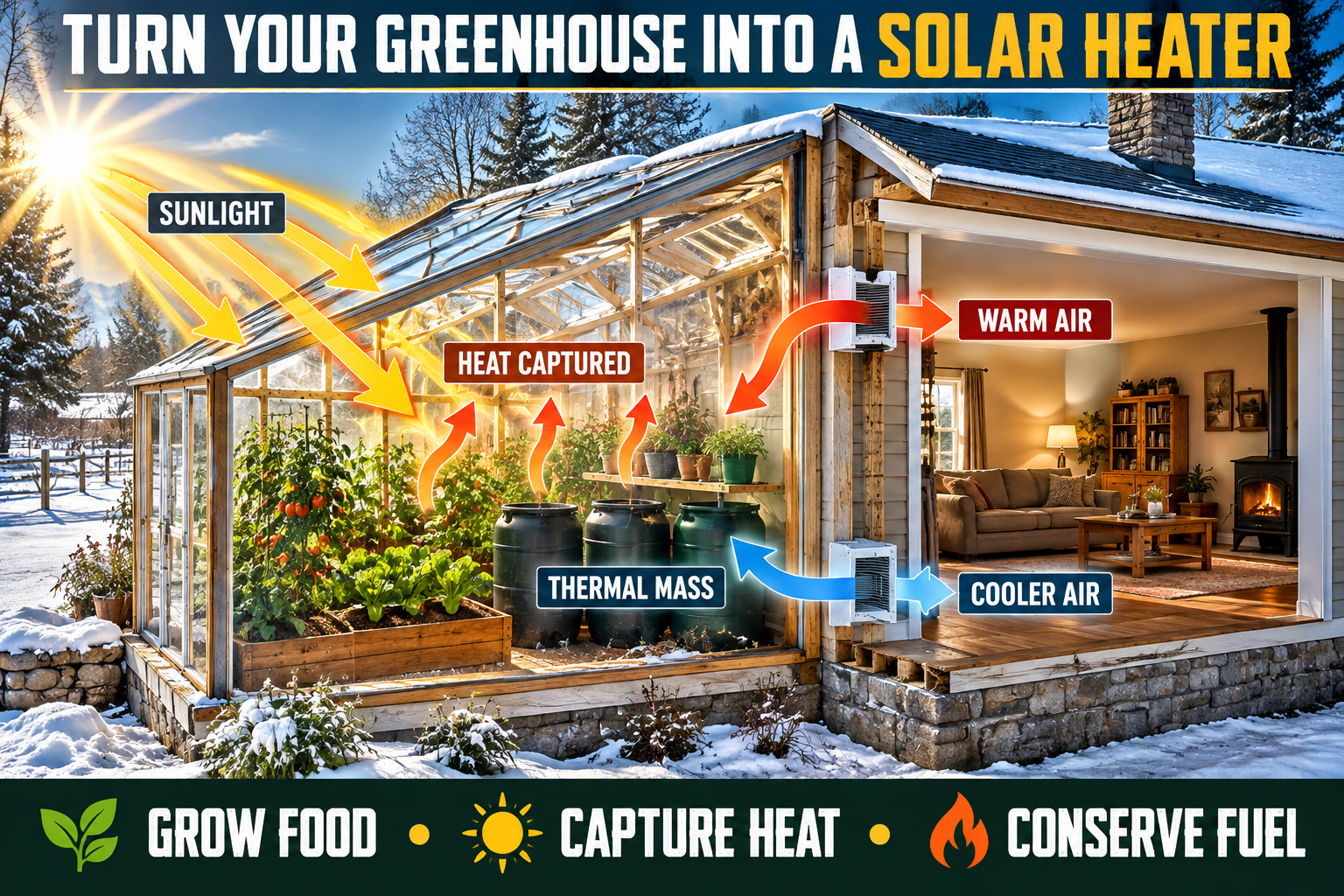
The Greenhouse Is Already a Solar Collector
Anyone who has entered a greenhouse on a sunny winter day has experienced the basic principle. Sunlight enters through the transparent or translucent covering and strikes the floor, soil, containers, shelving, plants, walls, and other surfaces. Those materials absorb some of the solar energy and become warmer. They then transfer heat to the surrounding air.
That is why a greenhouse can become considerably warmer than the outdoor environment even when there is snow on the ground.
Normally, much of that accumulated energy eventually escapes through the greenhouse covering, frame, foundation, ventilation openings, and air leakage. An attached greenhouse creates an opportunity to intercept some of that heat before it is lost.
The basic system is simple. The sun provides the energy, the greenhouse collects it, and the house uses some of the excess heat.
The challenge is controlling when that transfer occurs.
Think of the Greenhouse as a Separate Heating Zone
The greenhouse and house should be treated as two separate thermal zones rather than one large room.
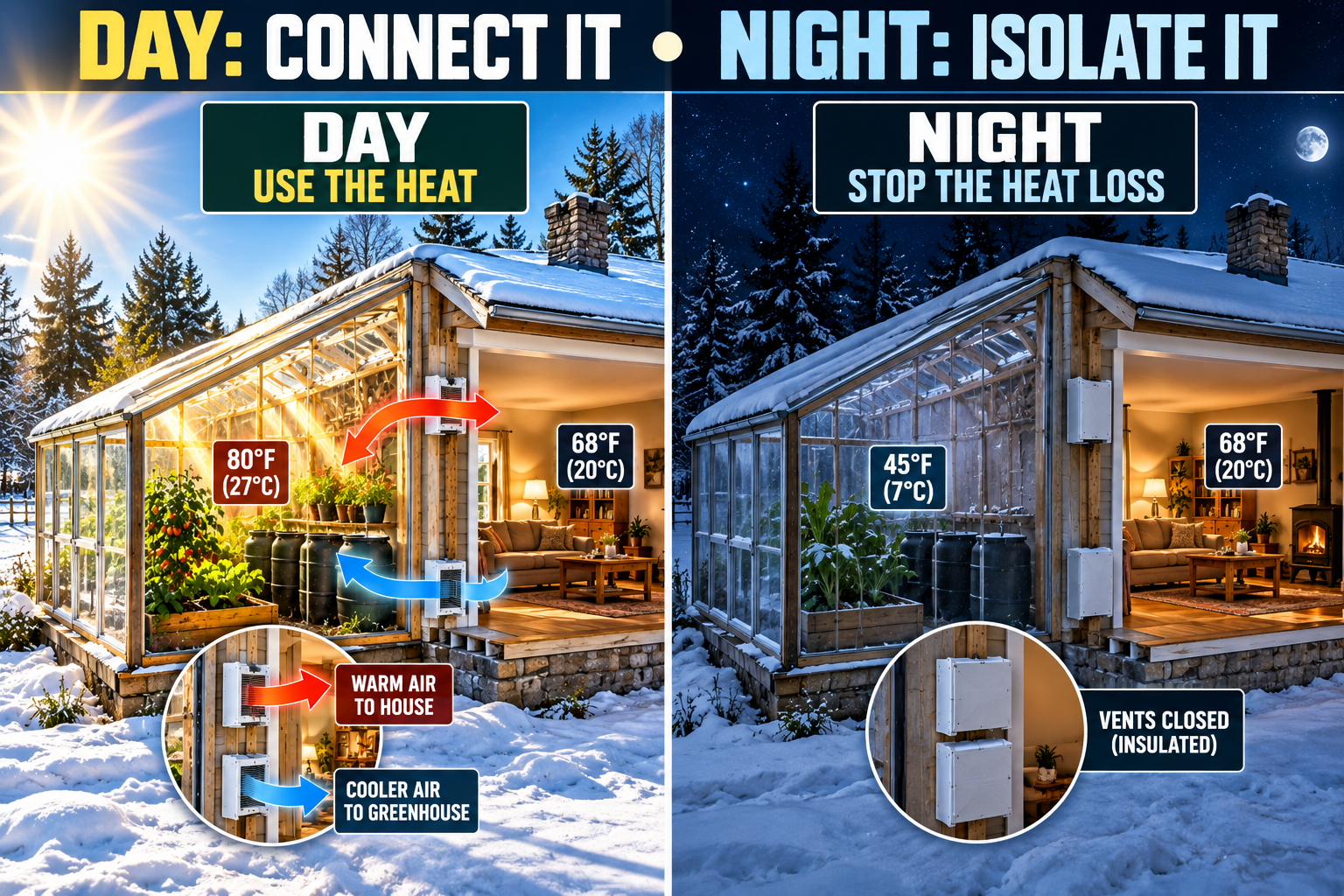
Imagine a clear winter afternoon. The house is 68°F (20°C), while direct sunlight has raised the greenhouse to 80°F (27°C). The greenhouse now contains useful heat, so moving some of its warm air into the house makes sense.
Several hours later, the sun has gone down. The house may still be 68°F, but the greenhouse could have fallen to 45°F (7°C). Now the direction of the temperature difference has reversed.
If the greenhouse remains openly connected to the house, household heat can begin escaping into the greenhouse. Instead of saving heating energy, the greenhouse becomes another source of heat loss.
This is one of the most important principles of the entire system. Connect the greenhouse thermally to the house when the greenhouse is warmer, and isolate it when the greenhouse is colder.
A successful greenhouse-heating system is therefore as much about preventing unwanted heat loss as it is about collecting heat.
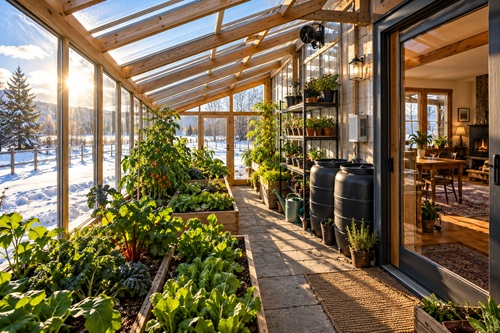
The Simplest Greenhouse Heating System
The simplest arrangement requires very little technology. An attached greenhouse, sunroom, or enclosed porch may already have a door or window connecting it to the house.
When the greenhouse becomes significantly warmer than the interior of the home, the opening can be used to allow some of that warm air inside. When greenhouse temperatures begin falling, the opening is closed again.
This can work surprisingly well as an experiment because it allows the homeowner to determine whether there is actually enough excess heat to justify building a more permanent system.
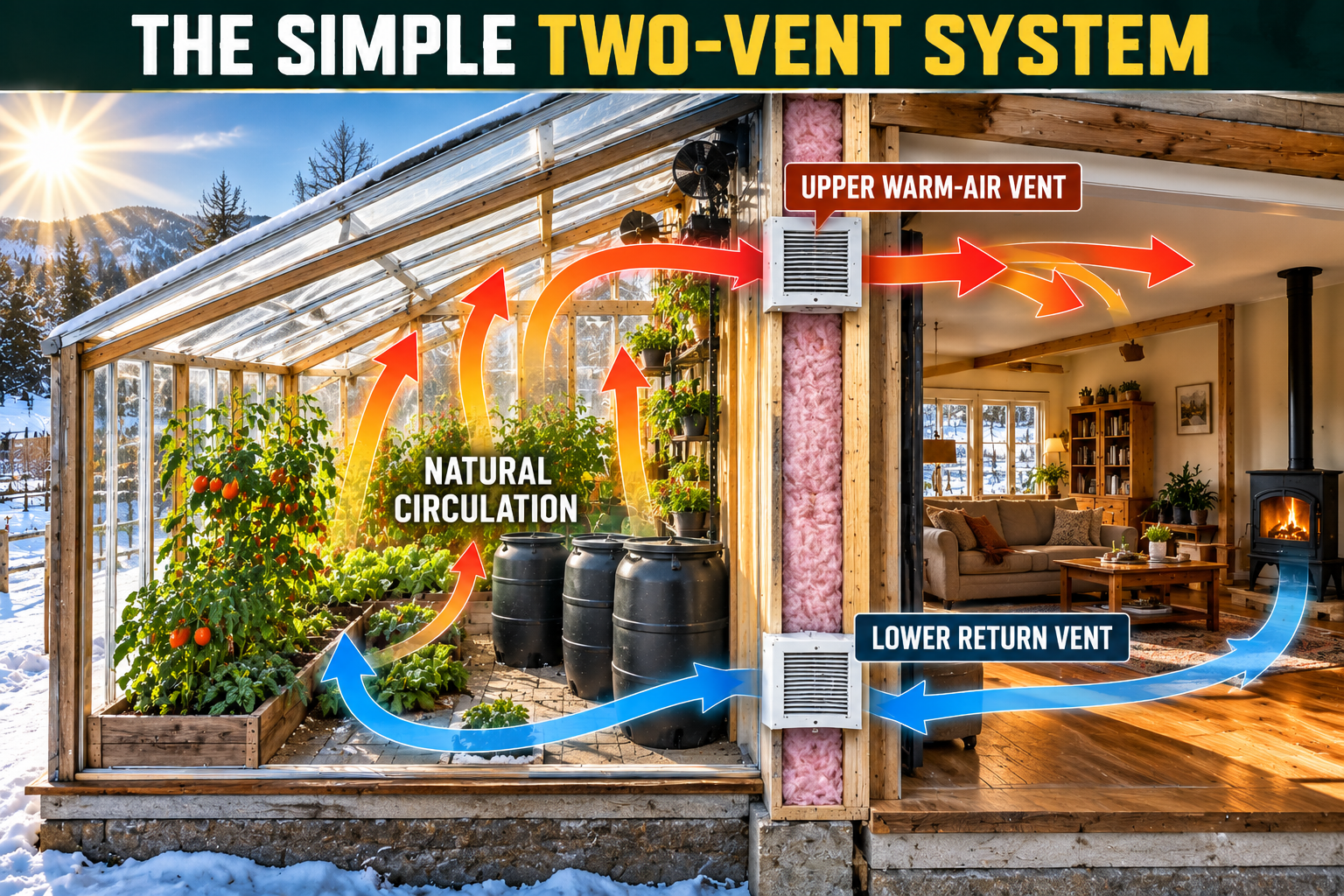
However, opening a door is not necessarily the most efficient way to transfer heat. Warm greenhouse air naturally rises, so a dedicated opening located relatively high between the greenhouse and house can take advantage of that tendency.
A second opening positioned lower can provide a return path for cooler household air.
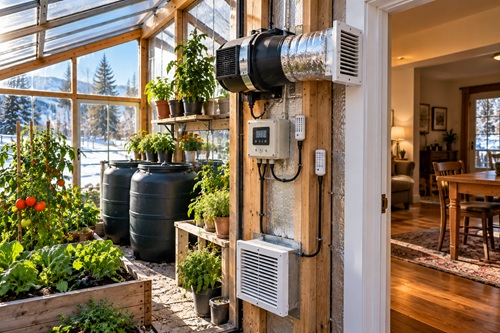
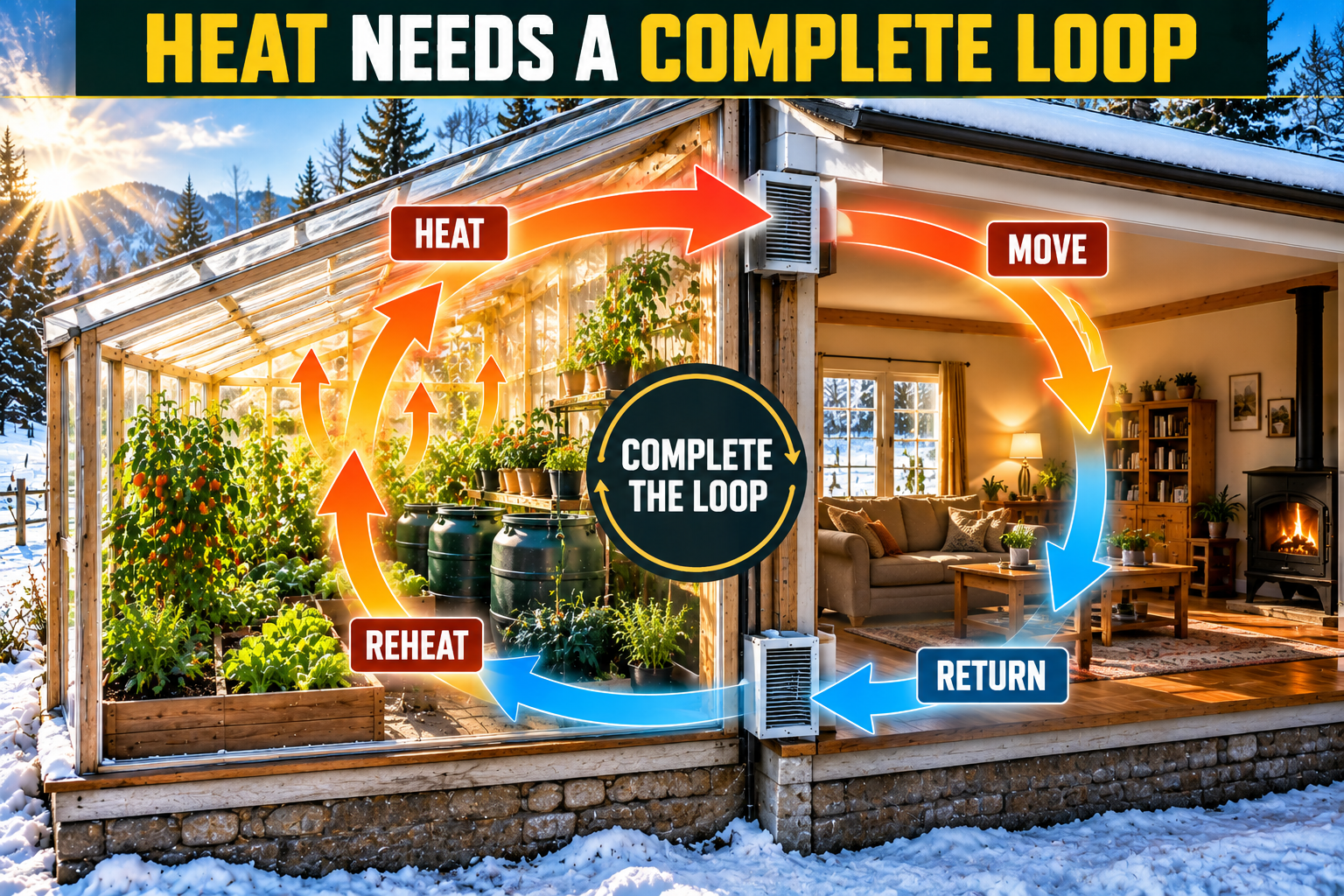
The result is a basic circulation loop. Warm greenhouse air moves into the house through the upper opening while cooler household air returns to the greenhouse through the lower opening. The returning air is warmed by the greenhouse and continues circulating as long as there is a sufficient temperature difference.
The exact effectiveness of natural circulation depends heavily on the building layout. A system that works well through a short wall opening may perform poorly through a long horizontal duct.
A Small Fan Can Make a Major Difference
Natural convection is useful because it does not require electricity, but a small circulation or duct fan can move considerably more heat.
The fan can be installed to move warm greenhouse air into the house whenever greenhouse temperatures are sufficiently high. A return vent allows cooler household air to flow back into the greenhouse.
This creates controlled circulation rather than simply allowing two rooms to exchange air randomly.
The fan does not necessarily need to operate continuously. In fact, continuous operation would be undesirable because there will be many times when the greenhouse has no useful heat to provide.
A thermostat can turn the fan on only when the greenhouse reaches a predetermined temperature. An even better arrangement uses a differential temperature controller that compares the temperature in the greenhouse with the temperature inside the house.
Instead of saying, for example, “run the fan whenever the greenhouse reaches 75°F,” the controller effectively says, “run the fan whenever the greenhouse is sufficiently warmer than the house.”
That distinction matters.
If the house is already 74°F and the greenhouse is 75°F, there may be little reason to run the fan. If the house is 65°F and the greenhouse is 80°F, there is a much more useful temperature difference available.
Automation also prevents one of the biggest weaknesses of a manually operated system: forgetting to shut it down when the greenhouse begins cooling.
Do Not Forget the Return Air
Moving warm air into the house requires somewhere for the displaced air to go.
This is easy to overlook.
If a fan continuously pushes greenhouse air into a relatively tight house without a suitable return path, pressure differences can restrict airflow. The fan may run while moving far less air than expected.
A return opening allows cooler household air to move back toward the greenhouse, completing the circulation loop.
Ideally, the system should also prevent unwanted reverse airflow after the fan stops. Backdraft dampers, closable vents, insulated covers, or other appropriate controls can help isolate the two spaces.
During a cold winter night, the goal should be to make the greenhouse-to-house connection effectively disappear from a thermal standpoint.
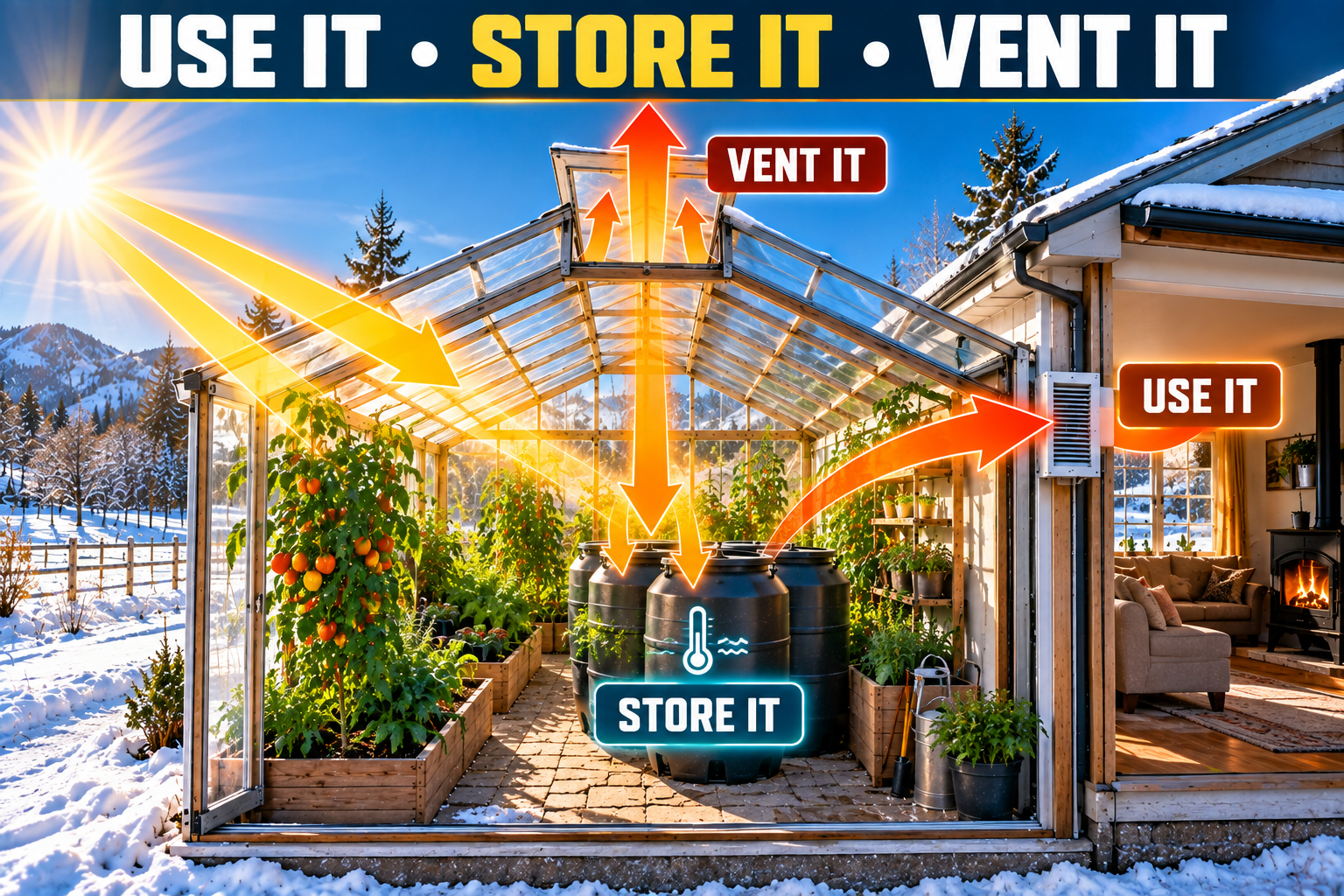
Store Some of the Heat Instead of Using It Immediately
One weakness of solar heating is obvious: the sun does not shine at night.
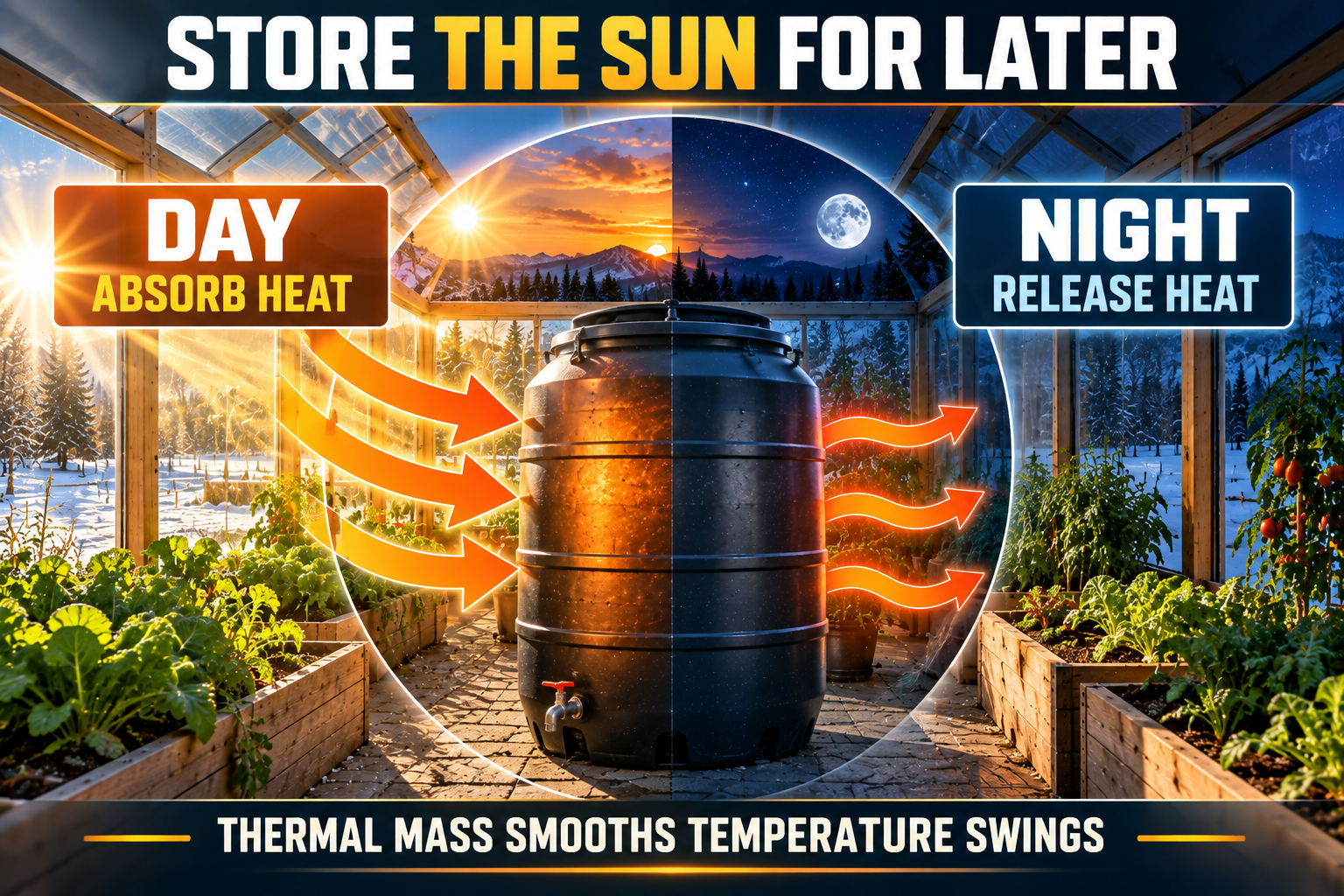
A greenhouse may become extremely warm during the afternoon and then lose that heat rapidly after sunset. Thermal mass can reduce that temperature swing by storing some of the day’s solar energy.
Water is particularly useful because it can absorb a substantial amount of heat.
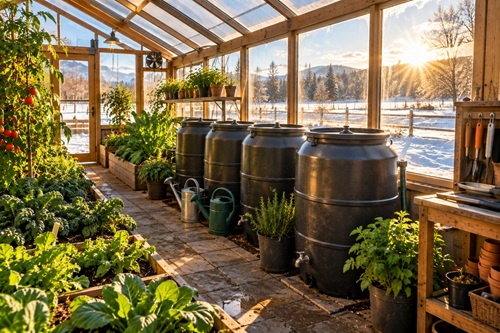
Large water containers placed inside the greenhouse absorb energy as greenhouse temperatures rise. When the greenhouse begins cooling, the stored heat gradually moves back into the surrounding air.
Concrete, stone, brick, soil, and other dense materials can perform a similar function.
This does not create energy. Thermal mass simply changes when some of the collected energy becomes available.
A barrel of water sitting in the greenhouse will not generate heat overnight. It absorbs heat that was already present during the day and releases some of it later.
The greater the useful thermal mass, the more stable greenhouse temperatures can become.
For a preparedness greenhouse, that stability has two benefits. It can help protect plants from rapid temperature changes while also extending the period during which useful heat remains available.
Water Barrels Can Serve More Than One Purpose
Water storage becomes particularly interesting from a preparedness perspective because it can potentially perform several jobs.
Stored water provides thermal mass. Depending on the water source, container, treatment, and intended use, appropriately managed water reserves may also contribute to irrigation or emergency water planning.
This is an example of a broader preparedness principle: whenever practical, infrastructure should perform more than one useful function.
However, water containers should be chosen and positioned carefully. A large volume of water is extremely heavy. A 55-gallon container holds hundreds of pounds of water, so floors and supports must be capable of carrying the load.
Containers also need to be protected against leakage, contamination, freezing, and accidental damage.
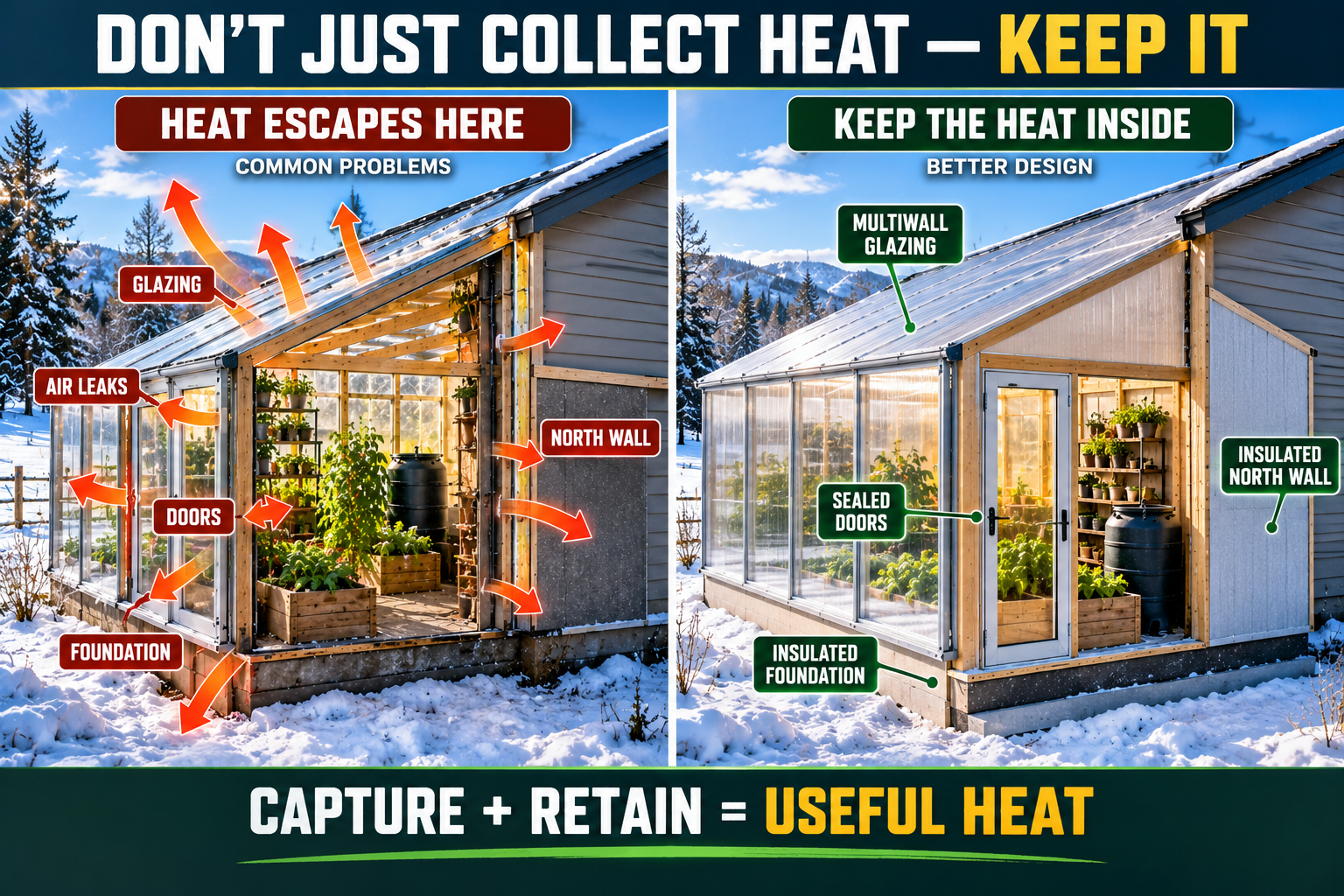
Insulation Can Be as Important as Collecting Sunlight
It is easy to focus entirely on bringing more sunlight into a greenhouse, but keeping useful heat from immediately escaping is just as important.
Greenhouse glazing generally insulates far less effectively than a conventional insulated house wall. This means a greenhouse can gain heat rapidly while sunlight is available and lose it rapidly once solar input disappears.
Multiwall polycarbonate, good door seals, reduced air leakage, insulated foundation edges, and appropriate nighttime insulation can substantially improve performance.
In some designs, portions of the greenhouse that receive little useful winter sunlight can be insulated more heavily.
The north side is particularly worth considering in the Northern Hemisphere. A north wall may contribute relatively little direct solar gain during winter while still providing a large surface through which heat can escape.
Depending on the greenhouse’s growing requirements and design, an insulated north wall can sometimes make more sense than transparent glazing on every surface.
The objective is not simply to build the brightest greenhouse possible. It is to find a useful balance between solar gain, plant requirements, and heat retention.
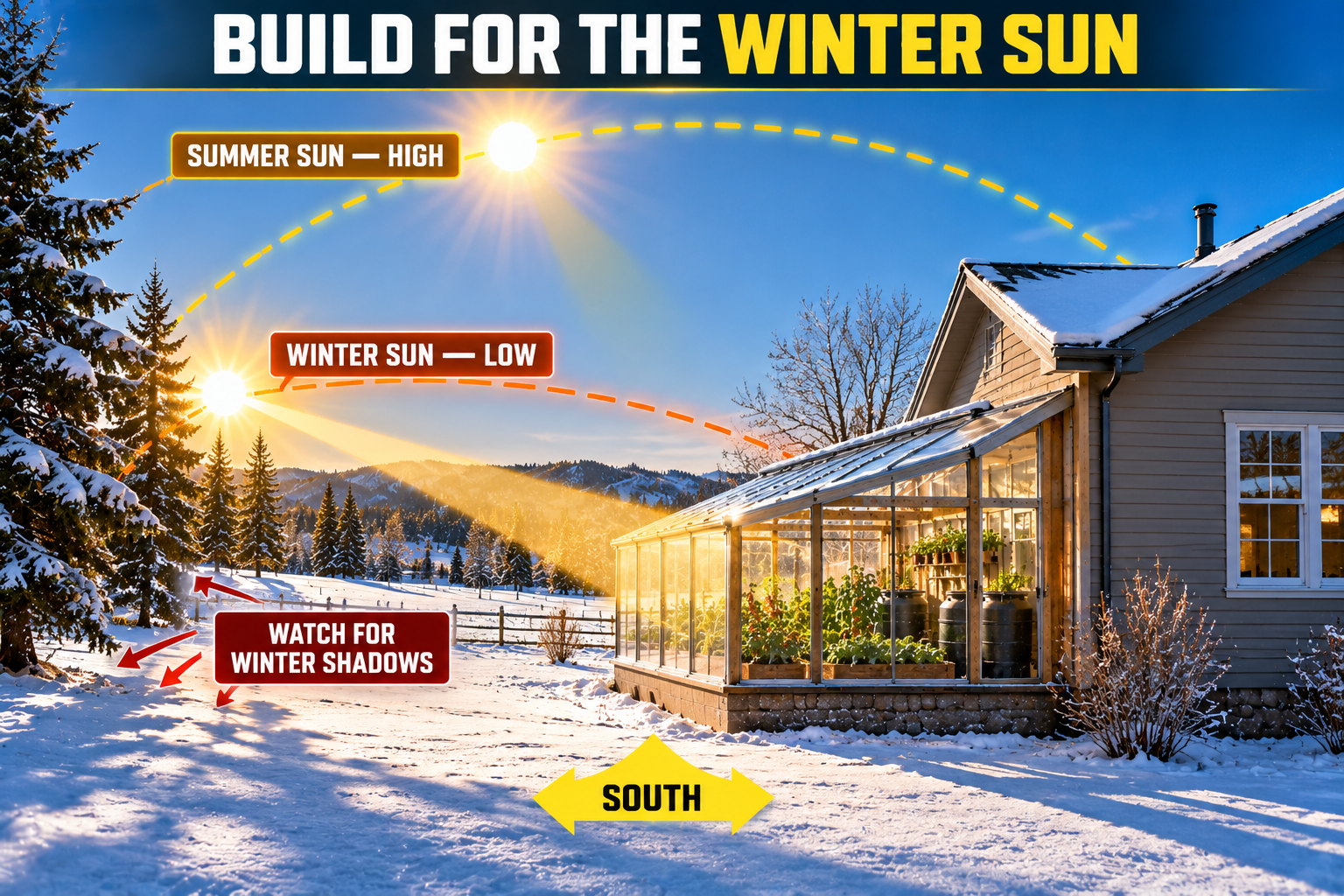
Winter Sun Matters More Than Summer Sun
A greenhouse intended to contribute to household heating should be evaluated based on winter solar exposure.
This can produce very different results from looking at the property during summer.
The sun travels lower across the southern sky during winter in the Northern Hemisphere. Trees, neighboring buildings, hills, fences, and even parts of the house itself can cast long winter shadows.
A location that receives abundant summer sunlight may receive surprisingly little direct sunlight in December or January.
Before investing heavily in a greenhouse for solar heating, observe the proposed location during the colder months. Determine when direct sunlight actually reaches the area and how many useful hours of exposure are available.
For this application, winter sunshine is the resource being harvested.
A Greenhouse Can Also Become Too Hot
One of the strange realities of greenhouse heating is that excessive heat can become a problem even during cold weather.
A bright sunny day can rapidly raise greenhouse temperatures. Plants that benefit from the warmer environment can become stressed if temperatures climb too high.
The house can absorb some of this excess heat, but it cannot necessarily absorb all of it.
A greenhouse still needs conventional temperature-control measures such as roof vents, automatic vent openers, doors, exhaust fans, or shade systems.
The objective should not be to trap every possible bit of solar heat. The greenhouse still has to remain a suitable growing environment.
Household heating is a useful secondary function, not a reason to sacrifice the primary greenhouse environment.
Humidity Can Become a Problem Inside the House
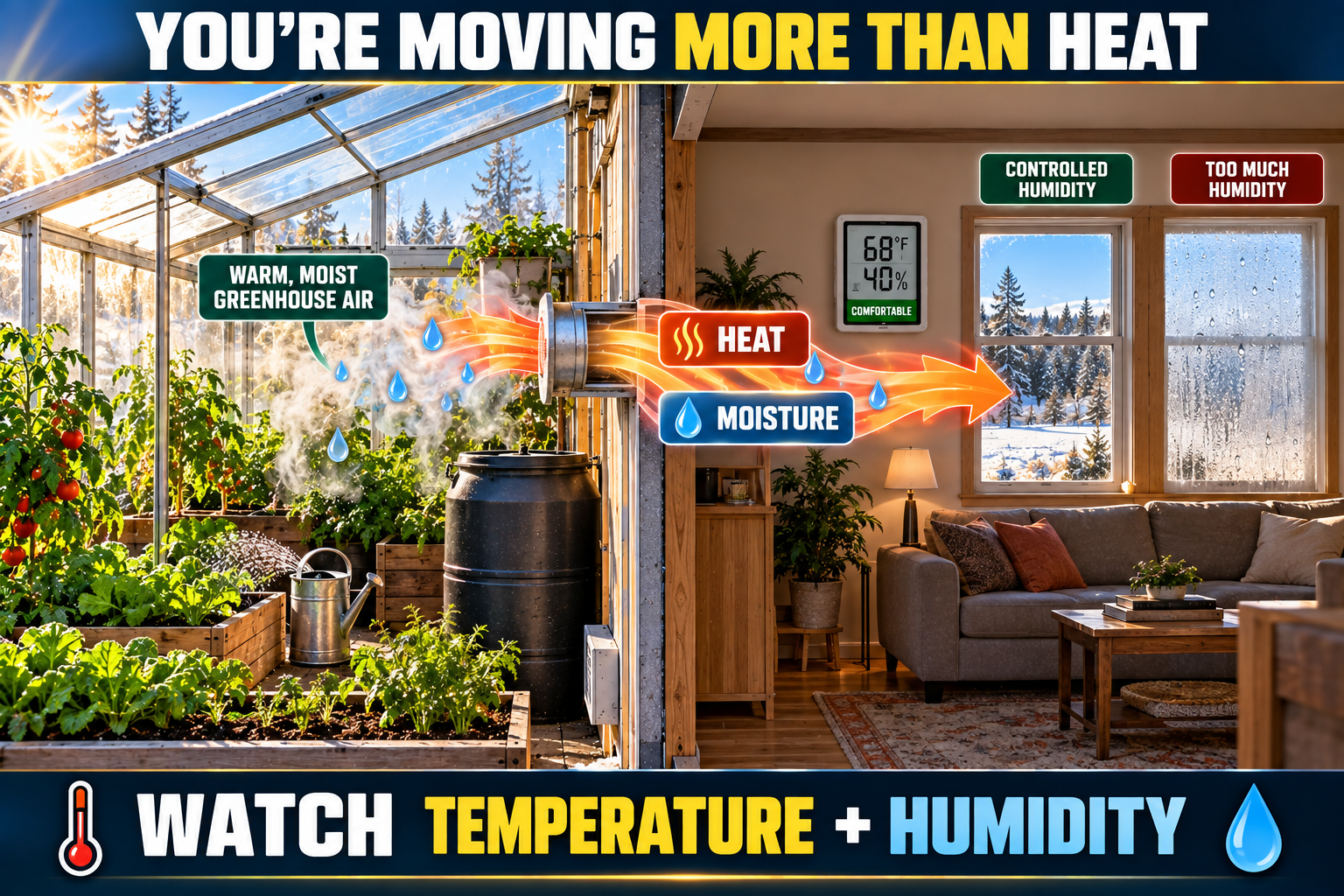
Greenhouses naturally contain moisture.
Plants release water vapor, wet soil evaporates moisture, and watering increases humidity. When greenhouse air is transferred directly into the home, that moisture comes with it.
During a dry winter, some additional humidity may be comfortable. Excessive humidity, however, can cause condensation on windows and other cold surfaces.
More seriously, moisture can migrate into walls, ceilings, attics, and other building cavities where persistent condensation can contribute to mold and structural damage.
This is why temperature should not be the only measurement in the system.
Place inexpensive humidity meters in both the greenhouse and house. If indoor humidity begins climbing excessively or condensation starts appearing, reduce direct greenhouse airflow and investigate the cause.
Heat is useful. Moisture damage is not.
Greenhouse Air Quality Matters Too
A greenhouse connected directly to a home’s air supply should be treated differently from a detached greenhouse.
Soil, compost, fertilizers, pesticides, mold, dust, and other materials may affect air quality. Anything capable of releasing harmful fumes should be kept away from a greenhouse that shares air with occupied living spaces.
Fuel, gasoline, solvents, pesticides, and similar chemicals should never be casually stored there simply because the greenhouse provides convenient space.
Combustion heating deserves particular caution.
An unvented propane, kerosene, or other fuel-burning heater should never be treated as a convenient way to heat greenhouse air and then circulate that air into the house. Carbon monoxide and other combustion products can create a potentially fatal hazard.
Any combustion appliance must be installed, vented, operated, and maintained according to applicable codes and manufacturer requirements.
Heat Can Be Transferred Without Sharing Greenhouse Air
A more sophisticated design can capture greenhouse heat without directly circulating greenhouse air throughout the house.
A heat exchanger allows heat to move between two air streams while limiting direct mixing. This can help separate greenhouse humidity and contaminants from household air.
Water can also be used as a heat-transfer medium in more advanced systems. Solar heat collected in or around the greenhouse can warm water, which can then store and transport some of that energy.
These systems introduce pumps, plumbing, controls, heat exchangers, freeze protection, and additional failure points, so they are not automatically better from a preparedness standpoint.
Complexity should earn its place.
For many households, a simple, understandable system that can be repaired with common components may be more resilient than an elaborate system that performs slightly better but becomes useless when one specialized component fails.
What Happens During a Power Outage?
This is where greenhouse heating becomes particularly interesting for preparedness.
A conventional furnace may have fuel available but still require electricity for its blower, controls, ignition system, pumps, or other components. A heat pump obviously depends heavily on electrical power.
A greenhouse receives its primary energy directly from the sun.
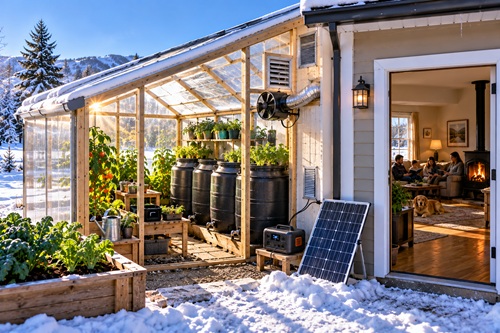
If heat transfer relies entirely on natural convection, some operation may continue without electricity. If a small fan is needed, its electrical requirement may be modest enough to operate from a small battery system, solar panel, portable power station, or other backup source.
This means a properly designed greenhouse system could continue providing some daytime heating even during an extended grid failure.
It should never be assumed that this will keep a house safely warm by itself. Cloudy weather, snow accumulation, extreme cold, short winter days, and nighttime heat loss can all drastically reduce its contribution.
The real preparedness value is fuel conservation.
If the greenhouse supplies useful heat for four or five hours on a sunny winter day, the household may be able to reduce how much firewood, propane, natural gas, heating oil, or stored electrical energy is consumed during those hours.
Over a prolonged emergency, those savings can accumulate.
Measure Before You Build
One of the best things about this concept is that it can be tested before spending much money.
If an attached greenhouse, sunroom, enclosed porch, or similar solar space already exists, place temperature sensors inside the greenhouse and house and another outdoors.
Record the temperatures through several winter days.
Pay particular attention to sunny days, partly cloudy days, completely overcast days, and very cold nights.
Determine when the greenhouse first becomes warmer than the house, how large the temperature difference becomes, how long that difference lasts, and how rapidly the greenhouse cools after sunset.
Those measurements reveal far more than assumptions will.
If the greenhouse regularly becomes substantially warmer than the house for several hours during winter, there may be useful solar energy available.
The next experiment can be as simple as opening the connecting door for a short period and observing what happens.
Only after proving that useful heat exists does it make sense to consider permanent vents, fans, controllers, dampers, thermal mass, or more sophisticated heat-transfer equipment.
Build the System in Layers
A resilient greenhouse heating system does not need to be built all at once.
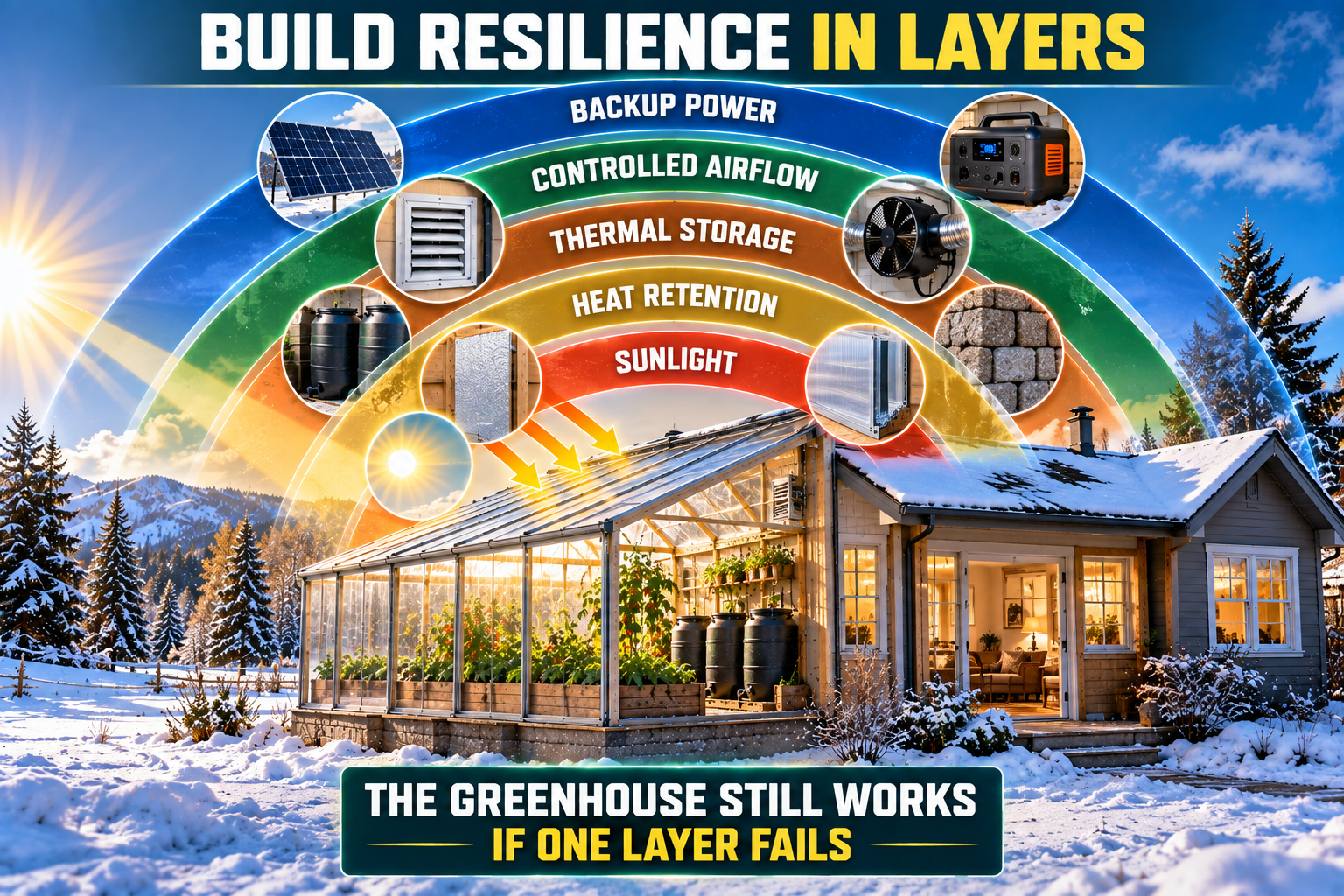
Start with the greenhouse itself and its ability to capture useful winter sunlight. Improve heat retention through sensible insulation, sealing, and thermal mass. Then add controlled heat transfer into the house.
After that, automatic protection against reverse airflow, excessive temperatures, and humidity can make the system easier to operate. Backup power can be added for small fans and controls if necessary.
The important point is that each improvement should add capability without making the entire system dependent on that one component.
If the automatic controller fails, the vents should still be operable manually. If the circulation fan stops, some passive heat movement may still be possible. If the heating function cannot be used at all, the greenhouse should still remain useful for growing food.
A resilient system should lose capability gradually rather than becoming completely useless because one component failed.
Do Not Design Around the Best Day
A greenhouse can perform spectacularly on a bright, clear winter afternoon. That does not mean it will perform the same way during a week of heavy cloud, snow, or extreme cold.
Preparedness systems should be designed around difficult conditions rather than their best performance.
Greenhouse solar heating should therefore be considered a supplemental heating layer, not the sole household heat source.
A prepared household might combine passive greenhouse heat with a conventional heating system, wood stove, stored fuel, improved insulation, warm-room planning, backup electricity, and other measures.
The greenhouse reduces demand on those resources whenever nature provides the opportunity.
When the sun disappears, the household still has another way to stay warm.
The Bigger Preparedness Lesson
The real value of this idea goes beyond saving money on heating.
Preparedness becomes stronger when important systems can perform multiple functions.
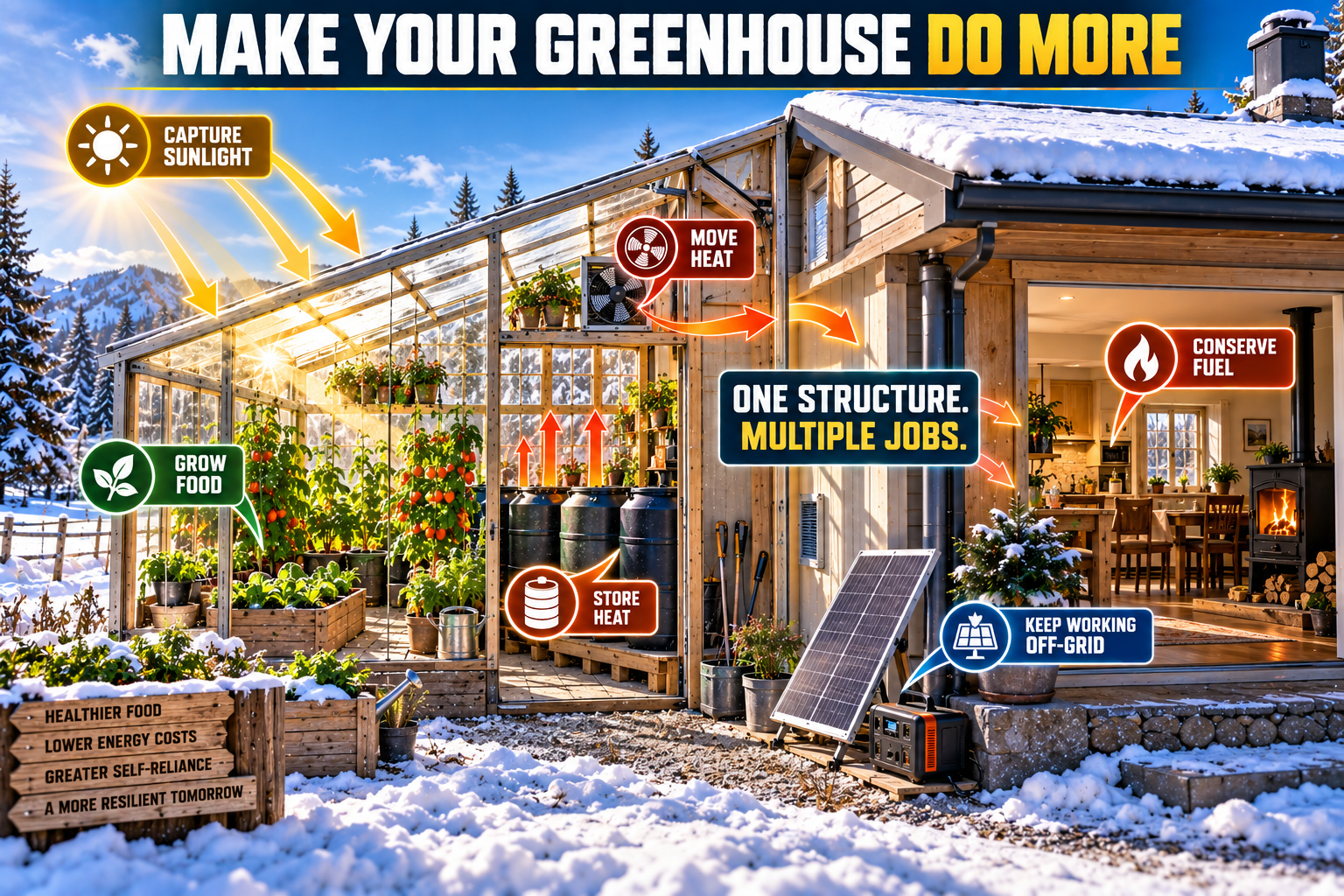
A greenhouse can grow vegetables, start seedlings, extend the growing season, protect plants from frost, provide a sheltered workspace, capture solar energy, create a thermal buffer beside the house, and potentially reduce household heating demand.
That is a considerable amount of capability from one structure.
It also changes the way a household thinks about energy. Instead of asking only how much fuel is available, it becomes useful to think about how much energy the property can collect, conserve, store, and use before stored fuel is required.
That mindset applies far beyond greenhouses.
Insulation conserves energy. South-facing windows collect it. Thermal mass stores it. Trees and shade help control it. Solar panels convert it. A resilient property uses these resources together instead of depending entirely on one heating system and one fuel supply.
Preparedness Action Plan
Begin by evaluating whether the property has an attached greenhouse, sunroom, enclosed porch, or suitable location with meaningful winter solar exposure. Do not begin by purchasing fans, controllers, or thermal-storage equipment. Begin by measuring.
Record indoor, greenhouse, and outdoor temperatures through different winter conditions. Determine whether the greenhouse consistently produces useful excess daytime heat and how long that heat remains available.
If the results are promising, experiment with controlled airflow between the greenhouse and house. Observe both temperature and humidity. Determine where warm air naturally accumulates and where cooler return air can travel.
Only then consider permanent vents, a small circulation fan, backdraft protection, automatic temperature control, additional insulation, and thermal mass.
Design every connection so the greenhouse can be isolated from the house when it becomes colder. Make sure excessive greenhouse temperatures can still be vented safely. Monitor household humidity and keep potential contaminants away from any greenhouse sharing air with living spaces.
Finally, maintain an independent heating system capable of keeping the household safe when solar energy is unavailable.
The objective is not to replace dependable heating with a greenhouse. The objective is to make the greenhouse another useful layer in the household’s energy system.
Key Takeaways
An attached greenhouse can do considerably more than grow plants. With good winter solar exposure, it can capture energy that would otherwise never enter the home and provide useful supplemental daytime heating.
The key is controlling that energy rather than simply connecting the greenhouse to the house. Warm greenhouse air should be used when it provides an advantage, while reverse heat flow must be prevented when the greenhouse becomes colder. Thermal mass can store part of the day’s energy, insulation can slow its loss, and controlled airflow can move useful heat where it is needed.
For preparedness, the greatest benefit may be conservation rather than complete heating independence. Every hour that free solar heat reduces the demand on firewood, propane, electricity, or another stored energy source extends those resources.
A greenhouse that can grow food, collect solar heat, reduce fuel consumption, and continue providing useful capability during a disruption is more than a gardening structure. It becomes part of the home’s resilience system.
© Prepping Communities. This content is for informational purposes only and not professional advice. Use at your own risk.
Terms | Privacy | Guidelines