
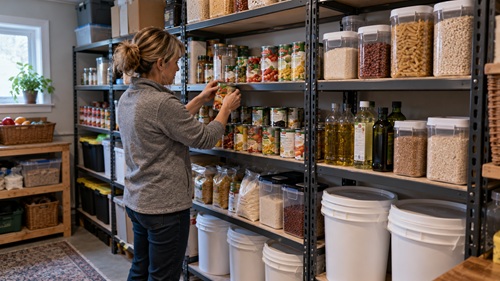
What You Have, What You Need, and How Long It Will Last
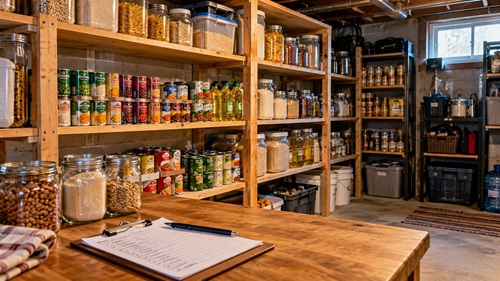
Prepping Communities | Food Storage and Emergency Preparedness Training
A pantry full of food can provide a reassuring sense of security. Shelves lined with canned vegetables, bags of rice, dried beans, pasta, and freeze-dried meals certainly look like preparedness. But what happens when a household actually needs to depend on those supplies for 30 days?
That is when the difference between having food stored and having a workable emergency food plan becomes apparent.
A household might have enough rice to last several months but only enough protein for two weeks. There may be plenty of canned goods but no reliable way to cook the dry foods. Some supplies may be stored in several locations, making it difficult to know how much is actually available. Other products may have been forgotten long enough for their packaging or quality to deteriorate.
A food storage inventory helps uncover these problems before an emergency occurs. More importantly, when combined with meal planning, nutritional calculations, and a regular maintenance routine, it gives households a way to correct them.
This Prepping Communities training guide teaches members how to evaluate existing supplies, calculate realistic food requirements, recognize misleading inventory totals, prioritize purchases, and develop a sustainable system for managing emergency food.
Seven free printable PDF worksheets accompany the lessons. Each is designed to help members complete a practical assessment rather than simply collect another form for their preparedness binder. The worksheets can be completed gradually as members work through the guide, then revisited as their household supplies and circumstances change.
1. Understanding What You Already Have
The first step toward improving emergency food storage is determining exactly what is already available. This sounds simple until food has accumulated in kitchen cupboards, basement shelves, freezers, storage totes, and emergency kits. Many households have more food than they realize in certain categories and considerably less than they need in others.
Rather than attempting to inventory everything at once, begin with one storage area. Examine each item, record its name, package size, quantity, and location, and check the packaging for visible damage. When that area is complete, move to the next. Working through one location at a time makes the process manageable and reduces the likelihood of overlooking supplies.
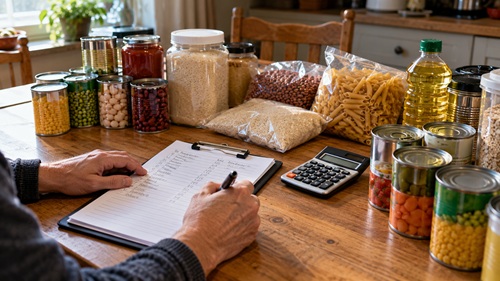
Package sizes matter. Recording that a household owns eight bags of rice is not particularly helpful if some contain 500 grams and others contain five kilograms. Recording the total weight provides information that can later be used for meal and calorie calculations. The same principle applies to canned foods, cooking oils, powdered milk, and other products sold in different sizes.
Consider a household that discovers it has 20 kilograms of rice, 10 kilograms of dried beans, 30 cans of vegetables, six cans of meat, and two litres of cooking oil. The shelves may appear well stocked, but the inventory immediately raises questions about nutritional balance and how many complete meals those supplies can provide. The household has a substantial quantity of grains and legumes, but its supply of ready-to-eat protein and cooking fats may be comparatively limited.
Grouping foods into categories makes these shortages easier to recognize. Grains, proteins, vegetables, fruits, fats, breakfast foods, beverages, and cooking essentials can each be tracked separately. These categories do not need to be complicated. Their purpose is to help household members understand the composition of their food supply rather than simply counting containers.
Once everything is recorded, look for patterns. Large quantities of one ingredient alongside very small quantities of another may indicate that purchasing decisions have been driven more by sales or convenience than by actual meal requirements. Supplies stored in difficult-to-access locations may also create problems during an emergency, particularly if household members do not know where to find them.
It is equally important to distinguish between food that is physically present and food that is realistically usable. Products with damaged packaging, suspected contamination, or unsuitable storage histories should not automatically be counted as dependable emergency supplies. Frozen foods also require separate consideration because their availability during an extended power outage depends on temperature, duration, and available backup power.
An inventory should reveal more than a list of possessions. It should establish the starting point for a practical food storage plan and help households recognize which improvements will provide the greatest benefit.
Downloadable Food Storage Inventory Worksheet
Use the Food Storage Inventory Worksheet to record the supplies in each storage location. Begin with one cupboard, shelf, or container and document actual quantities, package sizes, and locations. Continue until the household has an accurate record of its stored food. Once the inventory is complete, review the entries and identify at least three shortages, storage concerns, or organizational problems requiring attention.
The completed worksheet should give the household a reliable picture of its existing supplies and establish the information needed for the meal-planning and food requirement calculations that follow.
2. Planning Food Storage Around Complete Meals
One of the easiest mistakes to make when building emergency food storage is counting ingredients without considering how they will become meals. A household might have enough pasta for 30 dinners but only enough sauce and protein for ten. It may have enough flour for several months of baking but lack the yeast, baking powder, oil, or cooking fuel needed to use it as intended.
The solution is to plan around meals that household members already know how to prepare. Familiar meals are easier to organize, generally require ingredients the household already understands, and reduce the need to experiment with unfamiliar foods during stressful conditions.
Begin by identifying several breakfasts, lunches, and dinners that are regularly prepared at home. For each meal, determine the ingredients and quantities required to feed everyone. Then compare those requirements against the food storage inventory.
For example, suppose a family of four prepares spaghetti using 500 grams of pasta, one jar of sauce, and one can of meat per family meal. The household has ten packages of pasta, six jars of sauce, and four cans of meat. Although there is enough pasta for ten family meals and enough sauce for six, the available meat limits that particular recipe to four complete meals.
This calculation is important because purchasing more pasta would not immediately increase the number of times the family could prepare the planned meal. Additional meat would help initially, but once the meat supply increased beyond six cans, the sauce would become the next limiting ingredient.
The calculation can be repeated for any meal. Divide the available quantity of each required ingredient by the quantity needed to prepare one household meal. Round the result down to the number of complete meals that can be prepared, then identify the ingredient with the smallest result. That ingredient determines how many times the particular recipe can be made without substitutions.
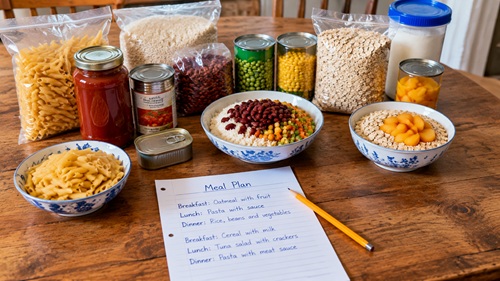
Of course, recipes can be adjusted. A family might replace canned meat with beans or lentils, prepare a vegetable-based sauce, or use different ingredients already in storage. Those alternatives can increase flexibility, but they should be recorded as separate meal options so the inventory does not count the same ingredients toward several meals that cannot all be prepared.
This is where food storage planning becomes more useful than simply counting supplies. A household that understands how its ingredients fit together can recognize which foods are essential to several different meals and which products offer greater flexibility.
Portion sizes and nutritional value also matter. A meal containing all the planned ingredients may still provide insufficient energy or protein if portions are too small. Households should consider whether each meal can reasonably satisfy the people being supported rather than assuming that any combination of ingredients represents an adequate meal.
Cooking conditions introduce another consideration. A recipe that depends on an electric oven may not be practical during a prolonged power outage. Some meals may require substantial cooking water or fuel, while others can be prepared with minimal heating. A useful emergency meal plan should include options for different operating conditions, including situations where refrigeration or normal cooking equipment is unavailable.
Downloadable Emergency Meal Planning Worksheet
Use the Emergency Meal Planning Worksheet to select at least five familiar household meals and record the ingredients needed to prepare them. Compare those requirements against the existing inventory and calculate how many times each meal can be made without purchasing additional food.
Pay particular attention to the ingredient that limits each recipe. By the time the worksheet is complete, the household should know which meals are currently practical, how many complete family servings are available, and which missing ingredients would make the greatest difference.
3. Calculating How Much Food Your Household Needs
Knowing how many meals are available is useful, but households must also determine whether those meals provide enough energy and nutrition. A family preparing for 30 days needs to consider the number of people being supported, their individual energy requirements, the nutritional composition of stored foods, and the resources required to prepare them.
A practical starting point is to estimate daily energy needs for each household member. These requirements vary with age, body size, physical activity, pregnancy, medical circumstances, and other factors. A single calorie allowance should not automatically be assigned to everyone.
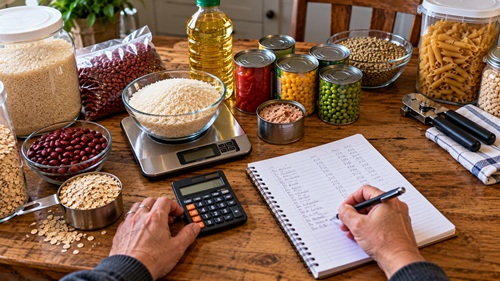
For illustration, consider a household of four using an average planning figure of 2,000 calories per person per day. This is a simplified example rather than a universal nutritional recommendation, but it demonstrates how the calculations work.
Multiplying 2,000 calories by four people produces a household requirement of 8,000 calories per day. Multiplying that daily requirement by 30 days produces a planning target of 240,000 calories. This gives the household a measurable starting point for evaluating its existing supplies.
The next step is to estimate how much energy is already stored. Suppose the household has 20 kilograms of dry white rice, 10 kilograms of dried beans, 24 cans of meat containing 170 grams each, 30 cans of vegetables containing approximately 398 millilitres each, 10 kilograms of rolled oats, and four litres of cooking oil.
Using approximate nutritional values, the rice provides 72,000 calories, the dried beans 34,000 calories, the canned meat 6,000 calories, the vegetables 3,000 calories, the oats 38,000 calories, and the cooking oil 32,000 calories. These are illustrative estimates, and actual values should be calculated from the nutrition information on the products being stored.
Adding these quantities produces approximately 185,000 calories.
The household’s planning target is 240,000 calories, so subtracting 185,000 from 240,000 reveals a shortage of approximately 55,000 calories. Dividing the stored calories by the household’s estimated daily requirement of 8,000 calories produces approximately 23.1 days of theoretical energy coverage.
This calculation is valuable because it replaces guesswork with a measurable result. However, it would be a mistake to conclude that the household is fully prepared for 23 days simply because it has enough stored energy to reach that number.
Calories do not automatically translate into complete meals, nutritional adequacy, or food that can be safely prepared under emergency conditions.
Recognizing a Misleading Food Inventory
Consider what happens when the household compares its calorie calculation with its meal plan. Suppose the planned menu uses two cans of meat each day. With 24 cans available, that particular menu can only be followed for 12 days before the canned meat is exhausted.
The household still has other food available after those 12 days. Rice, beans, oats, and other ingredients can continue providing energy and some essential nutrients. However, the original meal plan can no longer be followed without substitutions.
The household therefore has approximately 23 days of theoretical calorie coverage but only 12 days of the specific menu that requires two cans of meat daily.
This does not mean the family has only 12 days of food. It means the inventory has revealed a weakness in the planned meals that must be addressed.
That distinction is one of the most important lessons in food storage planning. A household can have substantial quantities of food while still lacking the right combination of ingredients to maintain its intended meals.
The same problem can occur with breakfast foods, cooking fats, vegetables, powdered milk, or other ingredients used regularly. If one essential component is exhausted, the household may need to change recipes, reduce variety, or rely more heavily on a smaller selection of foods.
A reliable assessment should therefore examine theoretical energy coverage and practical meal coverage separately.
Understanding Nutritional Balance
Reaching a calorie target is an important part of food storage planning, but it does not automatically mean a household has enough nutritious food to remain healthy throughout an extended emergency. A family could theoretically store 30 days of calories almost entirely in rice, pasta, and cooking oil, yet still lack sufficient protein, essential vitamins, minerals, and dietary variety.
Protein deserves particular attention because it supports the maintenance and repair of body tissues, immune function, and other essential processes. Dried beans, lentils, canned fish, canned meat, powdered milk, and suitable shelf-stable alternatives can contribute protein to an emergency food supply. The quantity required varies between individuals, so households should consider the needs of everyone they expect to support rather than relying on a single assumption.
Fats are another important consideration. They provide concentrated energy, contribute essential fatty acids, and help the body absorb certain vitamins. Cooking oils, nuts, seeds, and other suitable shelf-stable foods can contribute to these requirements. However, products containing fats may deteriorate in quality over time, making proper storage and rotation particularly important.
Vitamins and minerals are sometimes overlooked because many common emergency staples provide substantial calories without offering a complete range of micronutrients. Including appropriate canned vegetables, fruits, legumes, fortified foods, and other shelf-stable products can improve dietary variety. The household should evaluate the nutritional composition of its overall meal plan rather than assuming that storing a large number of different products automatically guarantees nutritional adequacy.
Dietary restrictions introduce additional responsibilities. A person with a food allergy, medically prescribed diet, or other nutritional requirement may not be able to rely on the same emergency meals as everyone else. These needs should be identified during planning, not discovered when normal grocery shopping is unavailable.
Food preparation requirements must also be considered. Dry beans may require soaking and lengthy cooking, while rice and oats need water and suitable preparation methods. A household relying heavily on dry staples must ensure that sufficient water, fuel, and cooking equipment are available.
The most useful conclusion from the example is not simply that the household needs another 55,000 calories. It needs additional food selected to improve energy coverage, nutritional balance, meal variety, and practical preparation options.
Downloadable Household Food Assessment Worksheet
Use the Household Food Assessment Worksheet to record the number of people being supported, estimate individual daily energy needs, and calculate requirements for the chosen preparedness period. Compare those requirements with the approximate calories available in storage, then examine whether the existing supplies can support the household’s planned meals.
The completed worksheet should identify the estimated energy shortfall, any nutritional concerns, and the practical limitations that could prevent stored food from being used. This gives the household a more realistic understanding of its preparedness than a simple count of packages or containers.
4. Keeping Food Storage Organized and Rotated
An emergency food supply should be maintained rather than simply stored and forgotten. Even properly packaged foods can lose quality over time, especially when exposed to excessive heat, moisture, pests, sunlight, or fluctuating storage temperatures. Poor rotation can also result in older products being overlooked while newly purchased items are consumed first.
A practical rotation system begins with the principle of first in, first out, commonly abbreviated FIFO. When new supplies are purchased, older suitable stock is moved toward the front of the shelf and newer products are placed behind it. This makes it easier to use existing supplies before they deteriorate in quality.
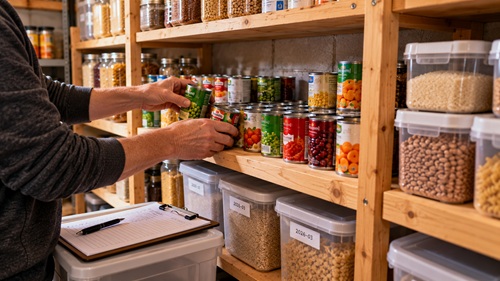
However, FIFO is an organizational method, not a food safety guarantee. A newly purchased item with a shorter usable life may need attention before an older item, and any product with compromised packaging should be assessed independently of its date.
For example, suppose a household has six cans of soup purchased last year and another six purchased this month. The older cans would normally be used first, provided they have been stored properly and remain in acceptable condition.
During a storage inspection, however, one of the older cans is found to be bulging. That can should not be treated as ordinary rotation stock. Bulging, leaking, or otherwise suspicious canned foods may present serious safety risks and should not be opened or tasted to determine whether they are safe.
Date markings also require careful interpretation. Best-before dates generally relate to expected quality rather than automatically indicating when food becomes unsafe. Use-by dates and other safety-related instructions may have different meanings depending on the product and applicable regulations. Households should follow product-specific storage guidance and recognize that food safety depends on more than the printed date.
Storage conditions deserve regular attention. Most shelf-stable foods benefit from cool, dry, clean environments with stable temperatures. Damp basement corners, garages exposed to extreme temperatures, and areas vulnerable to pests can shorten usable storage life.
A household storing dry goods in a basement should periodically inspect containers for moisture, damaged seals, and pest activity. Food should be kept in suitable containers and positioned to reduce exposure to water, contamination, and physical damage.
A practical review routine might involve checking frequently used pantry supplies each month and conducting a more comprehensive inspection of long-term storage every three months. The review should identify items that need rotation, storage areas requiring improvement, and products that should be removed because of safety concerns.
Downloadable Storage and Rotation Review Worksheet
Use the Storage and Rotation Review Worksheet to inspect at least ten stored food products. Record date markings, packaging condition, storage location, and any action required. Identify which suitable items should be rotated into everyday meals and whether storage conditions need improvement.
The completed worksheet should provide a prioritized rotation plan and help prevent avoidable food loss while maintaining appropriate food safety precautions.
5. Making Food Storage Purchases More Affordable
Building an emergency food supply can become expensive when purchases are made without a clear plan. It is easy to spend money on discounted products, bulk packages, and emergency food kits without knowing whether those purchases actually improve household preparedness.
An inventory changes the purchasing process. Instead of asking what food is on sale, households can begin asking which missing supplies would make the greatest difference.
Consider the household from the earlier example. It has 20 kilograms of rice, 10 kilograms of dried beans, 24 cans of meat, 30 cans of vegetables, 10 kilograms of oats, and four litres of cooking oil. Its theoretical energy supply falls approximately 55,000 calories short of the illustrative 30-day target.
Purchasing another large quantity of rice might reduce that energy shortage, but it would not necessarily improve the household’s ability to prepare a balanced selection of meals. The existing inventory already contains substantial quantities of grains and legumes. Additional protein sources, vegetables, fruits, suitable fats, and foods requiring little or no cooking may provide more useful improvements.
Imagine that the family has set aside C$100 to improve its emergency food storage this month. Rather than spending the entire amount on one bulk product, it decides to address several shortages identified through its inventory and meal plan.
Using hypothetical prices, the family allocates C$36 toward twelve cans of fish or meat, C$18 toward twelve cans of vegetables, and C$15 toward six cans of fruit. It spends another C$12 on two litres of cooking oil, C$9 on six cans of beans, and C$10 on two kilograms of oats. Together, these purchases use the entire C$100 budget.
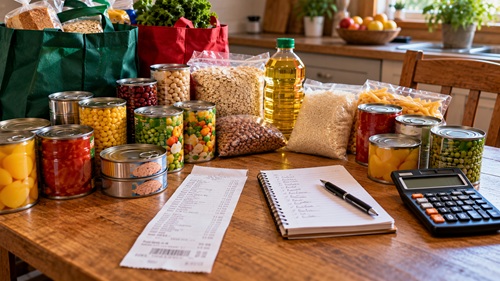
These purchases would not automatically eliminate the household’s calorie shortage or guarantee complete nutritional coverage. Their purpose is to demonstrate how a limited budget can address several different weaknesses rather than simply increasing the quantity of an ingredient already held in abundance.
The family should check actual prices, nutrition labels, package sizes, and dietary requirements before making its final purchasing decisions. A household preparing for a prolonged power outage might prioritize ready-to-eat foods, while one with dependable alternative cooking equipment and sufficient water may find economical dry staples more practical.
Once a desired storage quantity has been established, the remaining amount can be calculated by subtracting the current usable quantity from the target. If a household wants 48 cans of vegetables and currently has 30, it needs another 18 cans. The same calculation can be applied to cooking oil, grains, canned meat, breakfast foods, and other supplies. The important consideration is that purchasing targets should be based on realistic meal requirements rather than arbitrary quantities.
It is also useful to distinguish between immediate shortages and longer-term improvements. A household that has only a few days of drinking water may need to address that weakness before purchasing additional varieties of emergency food. Similarly, a family with substantial quantities of dry ingredients but no alternative cooking equipment may benefit more from correcting that dependency than from expanding its food inventory.
Shopping priorities should be reviewed as supplies improve. Once one shortage has been corrected, another may become the limiting factor. This is a normal part of preparedness planning and demonstrates why an accurate inventory is more useful than a fixed shopping list that never changes.
Building food storage gradually can also make preparedness more sustainable. Purchasing a few carefully selected items during regular grocery trips allows households to expand their supplies without creating unnecessary financial pressure. Over time, small improvements can produce a meaningful reserve, particularly when purchases are guided by an established plan.
Downloadable Food Storage Shopping and Budget Worksheet
Use the Food Storage Shopping and Budget Worksheet to transfer shortages identified during the inventory and meal-planning exercises into a practical purchasing plan. Record the quantity currently available, the desired storage quantity, the amount still needed, and the estimated cost of each purchase.
Once the information has been recorded, prioritize the purchases according to their importance to the household’s emergency meal plan. The completed worksheet should provide a realistic shopping strategy that fits the available budget while addressing the most significant preparedness weaknesses.
6. Remembering the Non-Food Supplies
Emergency food storage depends on more than the food itself. Every stored ingredient has certain requirements that must be met before it can be safely prepared and consumed. A household might have enough dried beans to provide hundreds of servings, but those beans become much less useful if there is insufficient water or cooking fuel. Similarly, a large supply of canned foods can become inconvenient when nobody can locate a working manual can opener.
These are not necessarily problems with the food inventory. They are problems with the supporting resources needed to make the food usable.
A complete preparedness assessment should therefore examine the equipment, consumable supplies, and household capabilities associated with food preparation. This includes identifying which resources are essential, which are reusable, and which will eventually be exhausted during a prolonged disruption.
Start by selecting several meals from the emergency meal plan and mentally preparing each one without relying on normal household services. Imagine that electricity has been unavailable for three days. The refrigerator is no longer dependable, the electric stove cannot be used, and the household is conserving water.
How would breakfast be prepared? Could lunch be served without heating? Would dinner require a cooking method that is no longer available?
These questions often reveal shortages that a traditional food inventory overlooks.
For example, a family may have stored pasta, canned sauce, and canned meat for several meals. Preparing that food normally requires a pot, water, a suitable heat source, utensils, and a way to clean cooking equipment afterward. If any of those resources are unavailable, the family may need to change its meal plan.
If the household has a camping stove, it must also determine whether there is sufficient fuel, whether the stove can be operated safely, and whether household members understand its operation. Fuel-burning camping stoves, charcoal grills, generators, and similar equipment must not be used inside homes, garages, tents, or other enclosed spaces where carbon monoxide can accumulate. Equipment should always be operated according to the manufacturer’s safety instructions.
Water deserves particular attention. The amount required for food preparation is separate from drinking and sanitation needs. A household relying heavily on dry foods should account for soaking, cooking, and cleaning requirements when developing its water storage plan.
Some foods are more demanding to prepare than others. Dried beans can require lengthy cooking, while certain canned foods can be eaten without heating. Maintaining a selection of ready-to-eat foods can reduce dependence on cooking fuel and water during an emergency.
A useful preparedness exercise is to calculate how much cooking fuel is required for a typical day’s meals. This can be estimated using the equipment manufacturer’s specifications and refined through safe practice under normal conditions. Once the household understands its approximate daily fuel consumption, it can compare that requirement against the amount stored.
The inventory should also distinguish between durable equipment and consumable supplies. A manual can opener may remain useful for years if properly maintained, while cooking fuel, dish soap, cleaning materials, and water treatment supplies require periodic replacement.
Households should also consider alternative methods. If the primary cooking arrangement becomes unavailable, is another safe option available? Are there meals that require no heating? Can drinking water still be accessed and treated when normal services are interrupted?
The objective is not to accumulate every possible piece of emergency equipment. It is to ensure that the supplies already stored can actually be used under the conditions the household is preparing for.
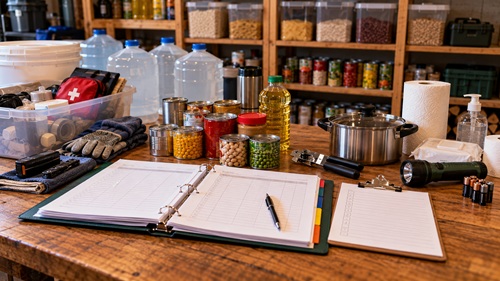
Downloadable Non-Food Supplies Inventory Worksheet
Use the Non-Food Supplies Inventory Worksheet to identify the equipment, water, fuel, utensils, and sanitation supplies required to prepare meals from your emergency food storage. Begin by selecting three meals from the household’s emergency meal plan and identifying everything needed to prepare and serve them.
Record which resources are available, which are missing, and which would eventually be exhausted during an extended disruption. The completed worksheet should reveal the non-food dependencies most likely to prevent the household from using its stored food.
7. Maintaining an Accurate Inventory Without Making It a Chore
One of the biggest challenges with food storage inventories is keeping them accurate after the initial assessment has been completed.
A household may spend an entire weekend counting supplies, recording quantities, and organizing shelves. Six months later, however, the inventory may no longer reflect what is actually available. Food has been consumed, new products have been purchased, and some supplies may have been moved to different storage locations.
Unless these changes are recorded, the inventory gradually becomes unreliable.
The solution is not to spend hours updating records every week. It is to establish a simple routine that fits naturally into everyday household activities.
When groceries are purchased, newly added emergency supplies should be recorded. When food is removed from long-term storage for everyday use, the quantity should be adjusted. These updates can be made immediately or recorded on a small note kept near the pantry and transferred to the main inventory during the next review.
For households that regularly rotate stored food into everyday meals, maintaining an accurate inventory may require more frequent adjustments. A separate long-term emergency reserve that is rarely accessed may require less frequent quantity updates, although storage conditions should still be inspected periodically.
A practical starting point is to spend approximately ten minutes each month reviewing frequently used supplies. During this review, check whether recorded quantities remain reasonably accurate, identify products that should be rotated, and update the shopping list to reflect shortages.
Every three months, conduct a more comprehensive inventory review. Compare recorded quantities against the food actually stored, inspect packaging and storage conditions, review the household’s meal plan, and determine whether existing supplies still support the intended preparedness period.
The quarterly review also provides an opportunity to reassess household requirements. A change in family size, dietary needs, available storage space, or emergency planning goals may affect the quantities and types of food that should be maintained.
This routine helps prevent the inventory from becoming outdated without turning food storage management into a time-consuming administrative task.
Why an Offline Copy Still Matters
Digital records are convenient, but emergency preparedness should not depend entirely on electricity, an internet connection, or access to a particular device.
A prolonged outage, damaged computer, inaccessible cloud account, or lost phone could prevent a household from accessing important inventory information. Maintaining a printed copy provides a straightforward alternative.
The printed inventory should include the date it was last updated, the locations of important supplies, and any information household members need to understand the records. It should be kept somewhere accessible, such as a preparedness binder, and updated whenever significant changes occur.
It is also important that more than one household member knows where the inventory is stored and how to use it. A carefully maintained record provides limited value if the person responsible for managing it is unavailable during an emergency.
The goal is to ensure that anyone responsible for household food preparation can determine what supplies are available, where they are stored, and how they can be used.
Downloadable Offline Inventory and Review Log
Use the Offline Inventory and Review Log to record where the household’s primary inventory is maintained, where printed copies are stored, when the records were last updated, and when the next review is scheduled.
Identify another household member who can access and understand the inventory. The completed worksheet should establish a manageable maintenance routine that keeps food storage information accurate and accessible even when normal digital services are unavailable.
8. Putting Your Food Storage Inventory to the Test: A Seven-Day Winter Power Outage

Imagine a family of four living in a rural community during the middle of winter. A severe storm brings down power lines, closes several roads, and interrupts electricity across the region. Initially, the family expects power to return within a few hours. By the following morning, however, the utility provider indicates that restoration could take several days.
The household has a well-stocked pantry, a freezer containing meat and vegetables, several containers of drinking water, and a camping stove intended for emergency cooking. At first glance, the family appears reasonably prepared.
But as the outage continues, several practical questions begin to emerge.
The refrigerator is no longer maintaining its normal temperature. The freezer may remain cold for a limited period, but its contents cannot automatically be assumed safe throughout a week-long outage. The electric stove is unavailable, and the family must now prepare meals using alternative equipment.
This is where an accurate food storage inventory becomes particularly valuable.
Determining Which Food Should Be Used First
The family begins by reviewing its inventory and identifying foods that require refrigeration or freezing. These products need to be assessed according to their actual temperatures and the length of the outage.
An unopened refrigerator generally maintains safe temperatures for approximately four hours during a power outage. A full freezer may maintain safe temperatures for approximately 48 hours, while a half-full freezer may maintain them for approximately 24 hours, provided the doors remain closed. These are general estimates rather than guarantees. Actual food safety depends on temperature measurements, appliance conditions, and how frequently doors are opened.
Perishable foods that have been above safe refrigeration temperatures for too long may need to be discarded. The family should not attempt to save questionable food simply because it represents a significant financial investment.
Shelf-stable foods provide a more dependable foundation for meals when refrigeration becomes uncertain.
By consulting the inventory, the family can quickly identify canned soups, beans, fish, vegetables, fruit, crackers, oats, and other foods that do not depend on refrigeration before opening.
The inventory also shows where these products are stored, preventing unnecessary searching through dark cupboards or cold storage areas.
Planning Seven Days of Meals
The family now needs to determine whether its available supplies can support everyone for the expected duration of the outage.
Using the earlier illustrative requirement of 2,000 calories per person per day, the household estimates that four people will require approximately 8,000 calories daily. Over seven days, that represents approximately 56,000 calories.
This does not mean the family should simply select any combination of foods adding up to 56,000 calories. The meals must also provide suitable nutrition, adequate portions, and ingredients that can be prepared with the available equipment.
The family begins by reviewing its Emergency Meal Planning Worksheet. Oatmeal prepared with safely heated water may provide a practical breakfast. Canned fish, crackers, and fruit could provide a lunch requiring little preparation. Rice and beans with canned vegetables may provide an evening meal, provided enough water and fuel are available for cooking.
Rather than repeatedly choosing meals at random, the family develops a seven-day menu using ingredients already identified in the inventory. This helps prevent important ingredients from being consumed too quickly and reduces the possibility of discovering halfway through the outage that the remaining food cannot be combined into practical meals.
The menu also reveals opportunities to conserve fuel. Some meals can be eaten without heating, while others can be prepared in larger batches when safe storage and handling are possible. Without reliable refrigeration, however, cooked leftovers cannot simply be kept at room temperature for later use.
Calculating Water Requirements
Water becomes another important consideration.
Suppose the family uses a basic emergency planning allowance of four litres of water per person per day for drinking and limited food preparation. For four people over seven days, that represents 112 litres.
However, this allowance is only a starting point. The actual quantity needed may be greater depending on the meals being prepared, activity levels, individual needs, and sanitation arrangements.
A menu containing substantial quantities of dried beans, rice, and pasta may require additional cooking water. If the household relies on water-intensive meals, it must account for those requirements separately.
The family discovers that it has 100 litres of stored potable water. Although that sounds substantial, it is already 12 litres below the illustrative seven-day allowance, even before considering additional water requirements.
The inventory has revealed a shortage that might otherwise have gone unnoticed.
The family must now adjust its plan by identifying safe additional water sources, reducing unnecessary water use, and selecting meals that require less water to prepare. Drinking and essential hygiene needs should not be compromised simply to preserve a particular menu.
Evaluating Cooking Fuel
The camping stove provides an alternative to the electric range, but its usefulness depends on the amount of fuel available and the meals the family intends to prepare.
Suppose the household has four fuel canisters in storage. Without knowing the stove’s fuel consumption, the type and size of the canisters, and the cooking time required for planned meals, it cannot reliably determine whether that supply will last seven days.
Cooking dried beans may require considerably more fuel than heating canned soup. Preparing rice, boiling water, and washing cookware also affect overall requirements.
The family should therefore estimate fuel consumption using the stove manufacturer’s specifications and, preferably, previous experience with the equipment.
Alternative cooking equipment must be used according to its safety instructions. Fuel-burning camping stoves, charcoal grills, and similar equipment should not be operated inside homes, garages, tents, or other enclosed spaces where carbon monoxide can accumulate.
The family may decide to use more ready-to-eat foods during the outage and reserve its cooking fuel for meals that genuinely require heating.
This is another example of how food storage planning extends beyond the food itself.
Recognizing What the Inventory Reveals
By the third day, the family has a much clearer understanding of its preparedness.
The household has enough shelf-stable ingredients to prepare several days of meals, but its original menu depended too heavily on refrigerated products. Its stored water is below the illustrative planning allowance, and its cooking fuel supply has not been tested against actual meal requirements.
None of these problems would necessarily have been obvious simply by looking at the shelves.
The inventory has not eliminated the emergency, but it has helped the family make informed decisions before supplies become critically low.
After power is restored, the family can use the experience to improve its preparedness. It may decide to store additional water, expand its selection of ready-to-eat foods, test its alternative cooking equipment, and revise its meal plan to reduce dependence on refrigeration.
This is the real value of a food storage inventory. It does not merely record what a household owns. It helps reveal whether those supplies can perform their intended purpose under realistic emergency conditions.
Preparedness Action Plan
The most effective way to understand household food storage is to work through the complete planning process rather than simply reading about it. Members are encouraged to set aside a weekend, or several evenings, to complete the seven accompanying worksheets and establish a dependable starting point for their emergency food storage system.
Begin with the Food Storage Inventory Worksheet and physically inspect the supplies already available. Work through kitchen cupboards, pantry shelves, freezers, basement storage, and emergency containers, recording actual quantities, package sizes, and locations. This first exercise establishes the foundation for everything that follows.
Once the inventory is complete, use the Emergency Meal Planning Worksheet to identify familiar meals and determine how many times each can be prepared using existing ingredients. Pay attention to the products that limit the number of complete meals available, particularly ingredients used in several different recipes.
The Household Food Assessment Worksheet should then be used to estimate the energy requirements of everyone in the household. Calculate the approximate calories available in storage, compare them against the desired preparedness period, and identify nutritional or practical preparation concerns. Remember that having sufficient calories does not automatically mean having a balanced food supply or enough complete meals.
Next, inspect storage conditions and food rotation using the fourth worksheet. Identify older suitable products that should be incorporated into everyday meals, examine packaging for damage, and determine whether any storage areas require improvement.
The Shopping and Budget Planner turns these findings into a purchasing strategy. Rather than buying additional supplies at random, prioritize the ingredients and resources that will correct the most important shortages. Establish a budget that allows improvements to be made gradually without creating unnecessary financial pressure.
The Non-Food Supplies Inventory should then be used to evaluate the equipment, water, cooking fuel, and sanitation supplies required to prepare stored meals. Consider how these requirements would change during an extended power outage or other disruption affecting normal household services.
Finally, complete the Offline Inventory and Review Log. Establish where printed records will be stored, identify who in the household can access them, and schedule regular updates. A short monthly check and a more comprehensive quarterly review can provide a practical starting point.
Once all seven worksheets have been completed, review the results together. The purpose is not to produce seven perfectly completed forms. It is to develop a clearer understanding of household capabilities and identify the improvements that matter most.
© Prepping Communities. This content is for informational purposes only and not professional advice. Use at your own risk.
Terms | Privacy | Guidelines