
Understanding How Long Your Household Food Supply Will Really Last
Many families know the frustration of spending hundreds of dollars on groceries, filling their cupboards, and discovering only a week later that they are already running short of food. With household budgets under pressure, making groceries last longer has become an important part of managing everyday expenses. For families interested in emergency preparedness, it also raises a concern: how long could the household continue feeding itself if purchasing additional groceries suddenly became difficult or impossible?
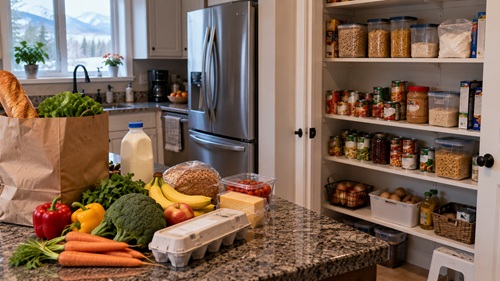
A pantry filled with canned goods, rice, pasta, flour, beans, and other staples can provide a reassuring sense of security. However, the amount of food visible on the shelves does not necessarily reflect how long those supplies will last. A large bag of rice may provide substantial energy, while several cans of vegetables may contribute fewer calories but supply important nutrients. Other ingredients may require water, cooking fuel, or additional foods before they can be prepared into meals.
The difference becomes particularly important during prolonged power outages, natural disasters, unemployment, transportation disruptions, or other circumstances that interfere with normal grocery shopping. When a family must depend on what it already has, understanding the quantity, nutritional value, and usability of stored food becomes essential.
This preparedness lesson explains how to calculate household food requirements, estimate the energy available in stored supplies, evaluate nutritional balance, and identify practical improvements. The objective is not simply to accumulate more groceries. It is to develop a reliable household food supply that can support everyday needs while providing additional security during difficult times.
Why Groceries Disappear Faster Than Expected
Most households purchase groceries according to their immediate needs rather than measuring how much food they consume over time. A family may plan several dinners before shopping but overlook breakfasts, lunches, snacks, larger portions, or changes in household routines. As a result, food purchased with the expectation that it will last a week may be consumed considerably sooner.
Food waste can also reduce the amount available. Fresh vegetables may spoil before they are prepared, leftovers can remain forgotten in the refrigerator, and partially opened packages may deteriorate before they are finished. These losses may seem small individually, but over several weeks they can represent a meaningful amount of food and money.
Another problem is the difference between having ingredients and having complete meals. A cupboard may contain rice, pasta, flour, and canned vegetables, but the household may depend on fresh meat, dairy products, sauces, or other ingredients to prepare its usual meals. When those additional ingredients run out, the remaining food may become more difficult to use.
Understanding household consumption is therefore an important starting point. Families can learn a great deal by observing which foods are used most frequently, how much is required for normal meals, and what tends to be wasted. This information can help them make better purchasing decisions while providing a foundation for emergency food planning.
What Makes a Household Food Supply Reliable?
A reliable food supply must provide enough energy to support the people who depend on it, but quantity is only one consideration. Stored food must also be safe, nutritionally suitable, accessible, and practical to prepare.
For example, a household may have several months of dried beans and rice but no dependable cooking method during a power outage. Another may have a freezer filled with meat but no backup power or plan for preserving that food if electricity is unavailable. In both situations, the quantity of food stored may create a misleading impression of preparedness.
Storage conditions also influence reliability. Food exposed to excessive moisture, heat, pests, or damaged packaging may become unusable before it is needed. A pantry that is regularly inspected and rotated may therefore provide greater practical security than a larger collection of neglected supplies.
The most useful approach is to evaluate food storage as a household system. The family needs adequate food, safe water, appropriate cooking resources, suitable storage conditions, and the knowledge required to use its supplies. Understanding these relationships makes it possible to identify weaknesses before an emergency occurs.
Calculating Your Household’s Food Requirements
One of the most useful preparedness skills is learning how to estimate the amount of food energy a household requires. Food energy is measured in calories, and every person needs a certain amount to maintain normal bodily functions and daily activities.
Calorie requirements vary according to age, body size, health, and physical activity. An adult performing demanding physical labour may require considerably more energy than someone with a sedentary lifestyle. Children have different nutritional requirements, while pregnant or breastfeeding individuals may need additional calories.
For general preparedness calculations, 2,000 calories per person per day can serve as an illustrative reference because it is commonly used on nutrition labels. However, this is not a universal nutritional recommendation. Families should adjust their estimates to reflect individual needs.
Step 1: Calculate Daily Household Calories
The first calculation establishes the household’s estimated daily energy requirement. When everyone is assigned the same planning estimate, the calculation is straightforward.
Daily Household Calories = Number of People × Estimated Daily Calories per Person
For example, consider a family of four using an illustrative requirement of 2,000 calories per person.
4 people × 2,000 calories = 8,000 calories per day
This household would require approximately 8,000 calories each day under the planning assumption. Over seven days, that requirement would increase to 56,000 calories, while a 30-day period would require approximately 240,000 calories.
7-Day Calculation: 8,000 × 7 = 56,000 calories
30-Day Calculation: 8,000 × 30 = 240,000 calories
These figures demonstrate why counting cans, packages, or buckets does not provide a reliable estimate of food duration. The amount of energy stored matters more than the number of containers occupying shelf space.
For households with different individual requirements, a more accurate approach is to add each person’s estimated daily calorie needs rather than assigning everyone the same value.
Step 2: Calculate How Long Your Pantry Could Last
Once the household’s daily energy requirement is established, the next step is to estimate how much usable food energy is available.
Days of Food Energy = Total Usable Pantry Calories ÷ Daily Household Calories
Consider two adults whose combined estimated requirement is 4,400 calories per day. If their pantry contains 132,000 calories of usable food, the calculation would be:
132,000 calories ÷ 4,400 calories per day = 30 days
This means the household theoretically has enough stored energy for approximately one month. However, the calculation does not establish whether the pantry contains 30 days of nutritionally adequate meals.
The result assumes that the counted food is safe, edible, accessible, and suitable for consumption. It also does not account for missing ingredients, cooking water, fuel, or nutritional imbalances.
Calorie calculations should therefore be treated as a starting point for evaluating food supplies rather than a guarantee of how long a family can remain adequately fed.
How to Calculate Calories in Individual Pantry Foods
Most packaged foods provide nutritional information identifying the number of calories per serving and the number of servings contained in the package. Multiplying these values provides an estimate of the total food energy available.
Total Package Calories = Calories per Serving × Number of Servings
Suppose a bag of rice contains 50 servings, with each serving providing 160 calories.
50 servings × 160 calories = 8,000 total calories
If a household requires approximately 8,000 calories daily, the bag would theoretically provide one day of food energy. However, the family would still require other foods to meet its nutritional needs.
For bulk foods without individual nutrition labels, calorie estimates can be calculated using the edible weight and reliable nutritional information. Actual values vary according to food variety, product formulation, and preparation method, so package information should be used whenever available.
When calculating stored calories, only edible food should be counted. Containers, packaging, bones, and other discarded materials do not contribute to the household’s food supply.
This method allows families to develop a more accurate understanding of what they have stored and how much energy those supplies represent.
How Adding Foods Extends Your Emergency Pantry
Consider a household with two adults requiring approximately 4,400 calories per day. Their existing emergency pantry contains 22,000 calories, theoretically providing five days of food energy.
The family decides to strengthen its reserve by gradually adding familiar foods that are affordable, versatile, and relatively easy to store.
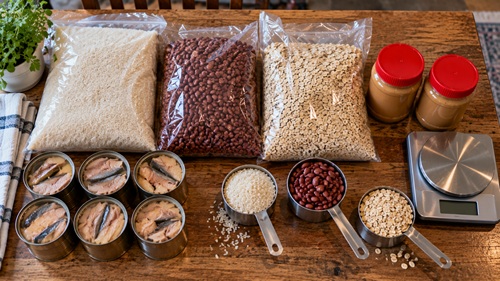
A five-pound bag of dry white rice provides approximately 8,250 calories. Adding this bag increases the pantry total to 30,250 calories, extending the theoretical food supply to almost seven days.
Adding Five Pounds of Rice
22,000 existing calories + 8,250 rice calories = 30,250 total calories
30,250 ÷ 4,400 = 6.9 days of food energy
The family then purchases four pounds of dried beans, providing approximately 6,000 additional calories, depending on the variety. Beans also contribute protein, fibre, and minerals, making them a useful complement to rice.
Adding Four Pounds of Dried Beans
30,250 existing calories + 6,000 bean calories = 36,250 total calories
36,250 ÷ 4,400 = 8.2 days of food energy
Next, the household adds three pounds of rolled oats, contributing approximately 5,100 calories. Oats provide an additional breakfast option and can be incorporated into baking and other meals.
Adding Three Pounds of Rolled Oats
36,250 existing calories + 5,100 oat calories = 41,350 total calories
41,350 ÷ 4,400 = 9.4 days of food energy
The family also adds two 16-ounce jars of peanut butter, contributing approximately 5,300 calories. Peanut butter provides energy, protein, and dietary fats and can be consumed without cooking.
Adding Two Jars of Peanut Butter
41,350 existing calories + 5,300 peanut butter calories = 46,650 total calories
46,650 ÷ 4,400 = 10.6 days of food energy
Finally, the household adds six cans of fish, averaging approximately 180 calories per can. These contribute another 1,080 calories while improving the variety of protein sources available.
Adding Six Cans of Fish
46,650 existing calories + 1,080 fish calories = 47,730 total calories
47,730 ÷ 4,400 = 10.8 days of food energy
Through these additions, the household has increased its theoretical food supply from five days to almost eleven days. More importantly, it has expanded the range of foods available rather than simply accumulating additional quantities of one staple.
All calorie values in these examples are rounded planning estimates. Actual values depend on product variety, package size, and nutritional composition.
Three Household Pantries: How Long Could They Last?
To understand how food storage changes as a household becomes more prepared, consider three hypothetical pantries belonging to the same family of four. For these examples, the combined daily energy requirement is estimated at 8,000 calories.
These are illustrative calculations rather than actual household survey results. Their purpose is to demonstrate how different quantities of food translate into estimated days of energy.
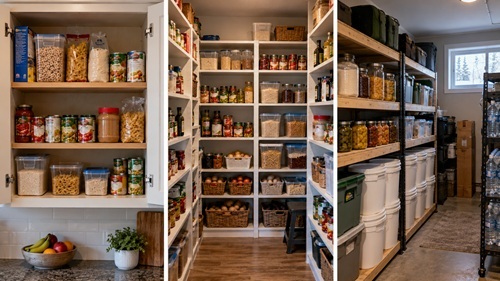
The Everyday Household Pantry
The first household maintains a modest supply of groceries for normal weekly cooking. Its cupboards contain pasta, rice, breakfast cereal, canned goods, flour, cooking oil, and other common ingredients.
Although the pantry appears reasonably stocked, its estimated 64,000 calories would provide only eight days of food energy for four people.
Everyday Household Pantry Calculation
64,000 stored calories ÷ 8,000 daily household calories = 8 days
This calculation may overstate the number of practical meals available if the household normally depends on additional fresh ingredients. A family with several boxes of pasta but little sauce or protein may need to change its normal meal preparation considerably.
The lesson is that an ordinary kitchen pantry can contain fewer usable meals than its appearance suggests.
The Expanded Emergency Pantry
The second household has gradually purchased additional rice, dried beans, oats, pasta, canned fish, canned vegetables, peanut butter, flour, and other cooking supplies.
Its stored food contains approximately 256,000 calories, theoretically providing 32 days of energy for four people.
Expanded Emergency Pantry Calculation
256,000 stored calories ÷ 8,000 daily household calories = 32 days
This household has greater flexibility because its supplies include several types of ingredients that can be combined into different meals. Soups, stews, rice dishes, pasta meals, and breakfasts can be prepared using stored foods.
However, the family still needs to verify that the available ingredients provide appropriate nutrition and can be prepared using its existing cooking resources.
The Long-Term Storage Pantry
The third household has accumulated a substantial reserve containing dry staples, canned foods, cooking oils, powdered ingredients, and other preserved products.
With approximately 800,000 calories available, the pantry theoretically provides 100 days of energy for four people.
Long-Term Storage Pantry Calculation
800,000 stored calories ÷ 8,000 daily household calories = 100 days
The larger reserve offers considerably more protection against extended disruptions, but its usefulness depends on the types of food stored. If most calories come from rice, flour, pasta, sugar, and cooking oil, the family may have sufficient energy while lacking important nutrients or ingredients needed for varied meals.
A pantry containing 100 days of calories does not automatically provide 100 days of nutritionally adequate meals. This is why food storage planning must consider nutritional composition as well as quantity.
Why Nutritional Balance Matters
Inexpensive staples such as rice, beans, oats, and pasta are valuable because they provide affordable energy and can form the foundation of many meals. However, a pantry built almost entirely around a limited selection of foods may not provide all the nutrients required for long-term health.
The body requires protein to maintain and repair tissues, dietary fats for essential biological functions, and vitamins and minerals for metabolism, immune function, bone health, and other processes. A person may consume enough calories while still developing nutritional deficiencies if important food groups are consistently missing.
A household that relies heavily on grains can improve nutritional variety by adding suitable protein-rich foods, vegetables, fruits, and sources of dietary fat. Dried beans and lentils contribute protein and fibre, while canned fish, meat, powdered milk, nuts, seeds, and fortified foods may provide additional nutrients. Preserved vegetables and fruits can also contribute vitamins, minerals, and variety.
Food allergies, medical dietary requirements, and household preferences should influence purchasing decisions. Food that someone cannot safely consume should not be counted as part of that person’s usable emergency supply.
The objective is to build a pantry that can support both energy requirements and nutritional health. Purchasing a greater variety of appropriate foods is often more useful than simply increasing the quantity of one inexpensive staple.
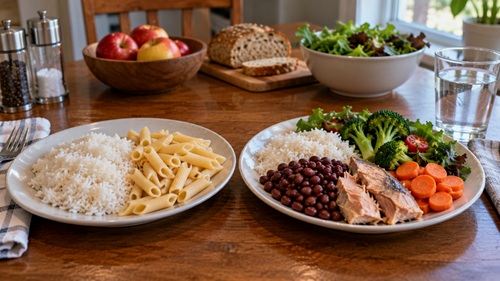
Increasing Meal Calories Without Significantly Increasing Grocery Costs
Families facing financial hardship may benefit from learning how to prepare substantial meals using affordable ingredients already available in their cupboards. Combining staple foods with suitable sources of protein and dietary fat can increase meal energy while improving nutritional variety.
Oatmeal provides a useful example. A serving prepared with water may contain approximately 150 calories, depending on the amount used. Adding one tablespoon of peanut butter contributes approximately 95 additional calories, along with protein and dietary fats.
Example: Oatmeal with Peanut Butter
Oatmeal = 150 calories
Peanut butter = 95 calories
150 + 95 = 245 total calories
Rice and beans offer another affordable combination. One cup of cooked white rice provides approximately 205 calories, while half a cup of cooked black beans contributes approximately 115 calories. Adding one tablespoon of cooking oil contributes another 120 calories when the recipe and individual dietary requirements make that addition appropriate.
Example: Rice and Beans
Cooked rice = 205 calories
Cooked beans = 115 calories
Cooking oil = 120 calories
205 + 115 + 120 = 440 total calories
Potatoes can also provide the foundation for inexpensive meals. A medium baked potato may contain approximately 160 calories. Adding half a cup of cooked beans and a quarter cup of shredded cheddar cheese creates a more substantial meal with additional protein and other nutrients.
Example: Baked Potato with Beans and Cheese
Baked potato = 160 calories
Cooked beans = 115 calories
Shredded cheese = 110 calories
160 + 115 + 110 = 385 total calories
These examples demonstrate how familiar ingredients can be combined to create more substantial meals. Actual calorie values vary by product and portion size, and increasing calories is only appropriate when it helps meet individual energy needs.
Learning to prepare affordable meals from basic ingredients can reduce dependence on expensive convenience foods while improving the usefulness of a household pantry.
The Household Food Resilience Assessment
Calorie calculations help estimate food quantity, but households also need to understand how their supplies would function when normal circumstances change. A useful assessment considers what would happen if grocery shopping became unavailable, electricity failed, income was interrupted, or an emergency continued longer than expected.
Each situation reveals different weaknesses and provides an opportunity to improve preparedness before those weaknesses become serious problems.
When Grocery Shopping Becomes Unavailable
Imagine that severe weather or transportation disruptions prevent a family from purchasing groceries for ten days. Electricity and running water remain available, but no additional food can be obtained.
Under these conditions, the household must rely entirely on its existing ingredients. The family may discover that it has enough pasta for several meals but insufficient sauce, or that its supply of baking ingredients is missing essential items needed for familiar recipes.
A practical assessment involves reviewing the foods available and determining whether the household could prepare breakfasts, lunches, dinners, and appropriate snacks throughout the disruption.
The objective is to identify missing ingredients and improve the pantry before grocery access becomes unreliable.
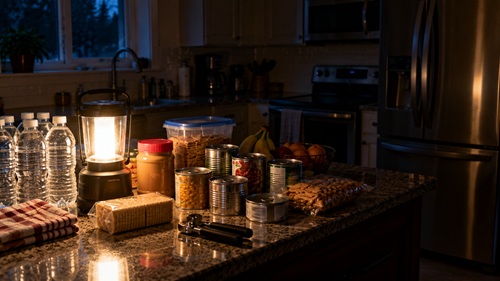
When Electricity Is Unavailable
A prolonged power outage creates additional challenges because refrigeration, freezing, and electric cooking appliances may become unavailable.
Food safety becomes particularly important. A refrigerator that remains closed generally keeps food cold for up to four hours during a power outage. A full freezer may maintain safe temperatures for approximately 48 hours, while a half-full freezer may maintain them for approximately 24 hours if the door remains closed. Actual safety depends on food temperatures and conditions.
Perishable refrigerated foods should be discarded after four hours without power or another adequate cold source. Frozen foods that still contain ice crystals or have remained at safe refrigeration temperatures may be suitable for cooking or refreezing. Appliance thermometers can help households make safer decisions.
Shelf-stable foods that require little or no cooking become particularly valuable when electricity is unavailable. Ready-to-eat canned beans, canned fish, nut butters, crackers, and other suitable foods can provide meal options without relying on electric appliances.
Families should also evaluate their backup cooking equipment. Outdoor grills, charcoal burners, and camping stoves that produce carbon monoxide must never be used inside homes, garages, or enclosed spaces.
This assessment helps determine which stored foods remain dependable when normal kitchen equipment cannot be used.
When Household Income Is Interrupted
Financial hardship can create a food emergency even when grocery stores remain fully operational. Unemployment, illness, reduced working hours, or unexpected household expenses may leave families struggling to afford their normal grocery purchases. Unlike a natural disaster, where access to food may be physically restricted, a financial emergency can make food difficult to obtain simply because the household no longer has sufficient money available.
Consider a family that experiences a sudden reduction in income. Mortgage or rent payments, utilities, insurance, transportation, and other essential expenses continue, but the money available for groceries becomes limited. Under these circumstances, a well-maintained pantry can provide temporary financial relief by allowing the family to prepare meals from food already purchased.
A household with stored rice, beans, pasta, oats, canned vegetables, and other familiar ingredients may be able to reduce grocery spending while continuing to prepare meals. Instead of purchasing everything required for the coming week, the family can use existing supplies and direct its remaining grocery budget toward fresh foods and essential ingredients that are unavailable in storage.
The financial value of a pantry depends partly on how it was established. Food purchased gradually during normal shopping trips can provide useful protection against unexpected expenses. However, purchasing large quantities of emergency supplies using high-interest credit may create additional financial problems. Families should avoid sacrificing essential household expenses or accumulating unnecessary debt simply to reach a particular food storage target.
This scenario demonstrates that emergency food preparedness is not exclusively about natural disasters or supply chain disruptions. A dependable pantry can also provide flexibility during difficult financial circumstances, helping households maintain access to food while adjusting to changes in income.
When an Emergency Lasts Longer Than Expected
Some emergencies continue considerably longer than initially anticipated. Severe weather may delay the reopening of transportation routes, supply disruptions may take weeks to resolve, or a household experiencing financial hardship may require more time than expected to recover.
A family that originally prepared for a short interruption may discover that its food supplies must support the household for an extended period. Under these circumstances, an accurate inventory becomes particularly valuable because it allows the family to understand what remains available and identify shortages before essential foods are exhausted.
Families should monitor their supplies and make reasonable adjustments to meal planning, but reducing food consumption below nutritional requirements is not a sustainable preparedness strategy. Prolonged inadequate calorie intake can affect physical strength, concentration, immune function, and overall health. Children, pregnant individuals, older adults, and people with medical conditions may face additional risks.
The most effective response is to recognize developing shortages early and identify dependable ways to obtain additional food. Depending on the circumstances, this may involve purchasing available supplies, accessing community food programs, contacting local food banks, or coordinating assistance with neighbours and family members.
Extended emergencies also demonstrate the importance of community relationships. Households that maintain connections with local growers, community organizations, and neighbours may have additional options when their own resources become limited. Preparedness should improve a family’s ability to manage disruptions, but it does not require complete independence from others.
Why Water and Cooking Fuel Are Essential to Food Preparedness
One of the most important considerations in emergency food planning is whether stored ingredients can be prepared when normal household services become unavailable. Many inexpensive staples require clean water and sufficient heat before they can be safely consumed. Rice, dried beans, pasta, and dehydrated foods are useful storage products, but their preparation requirements must be included in the household’s emergency plan.
A family that stores large quantities of dried beans may have substantial food energy available, but those beans require water and cooking time. If the household loses access to running water or electricity, preparing them may become difficult. Some foods can be soaked or prepared using alternative methods, but these approaches still require appropriate resources and food safety precautions.
Emergency preparedness guidance commonly recommends storing at least one gallon, approximately 3.8 litres, of water per person per day as an initial allowance for drinking and sanitation. This is a basic planning reference rather than a guarantee that every household’s needs will be met. Additional water may be required for cooking, hygiene, pets, medical needs, or hot weather.
For a family of four, the basic daily water requirement would be approximately 15.2 litres. Over seven days, that requirement would increase to approximately 106.4 litres before accounting for additional needs.
Example: Calculating Emergency Water Requirements
Daily Water Requirement = Number of People × Litres per Person per Day
4 people × 3.8 litres = 15.2 litres per day
Seven-Day Water Requirement = Daily Water Requirement × 7 Days
15.2 litres × 7 days = 106.4 litres
This calculation provides a starting point for water storage planning. However, families should examine their stored foods to determine whether additional cooking water will be required. A pantry containing substantial quantities of dried foods may have different water requirements from one containing ready-to-eat canned products.
Cooking fuel must also be considered. Households that depend on electric stoves may need an alternative method of preparing food during prolonged power outages. Suitable equipment may include properly installed wood-burning appliances, approved indoor cooking systems, or outdoor cooking equipment used in accordance with manufacturer instructions.
Fuel-burning camping stoves, charcoal grills, and outdoor cooking appliances must never be used inside homes, garages, or enclosed spaces because of the risk of carbon monoxide poisoning. Families should understand the safety requirements of their equipment and practise using it before an emergency occurs.
Food storage and water preparedness should therefore be planned together. A pantry is only dependable when the household has the resources and knowledge required to prepare its contents safely.
Why Food Storage Conditions Matter
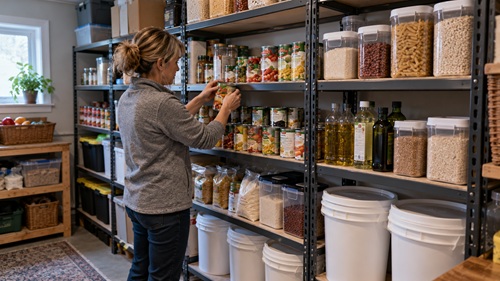
Food purchased for emergency preparedness represents an investment in household security. When stored products deteriorate because of heat, moisture, pests, damaged packaging, or improper handling, that investment can be lost before the food is ever needed.
Different foods have different storage requirements. Dry grains and legumes generally benefit from cool, dry environments and packaging that protects against moisture and insects. Cooking oils are sensitive to heat, light, and oxidation, while foods containing higher amounts of natural fats may deteriorate more quickly than low-fat dry staples.
White rice, for example, generally has a longer potential storage life than brown rice because brown rice contains oils in its bran layer that can become rancid. Whole-grain flour, nuts, peanut butter, and cooking oils also require more careful rotation than many low-fat dry foods.
Canned products should be stored according to manufacturer recommendations and inspected periodically. Containers showing bulging, leakage, severe damage, or other signs of compromised packaging should not be consumed. Food should never be tasted to determine whether a suspicious container is safe.
Families should also understand the difference between food quality and food safety. Best-before dates generally indicate the period during which a properly stored product is expected to maintain its intended quality. They do not necessarily mean that food becomes unsafe immediately after the printed date. However, the safety of any product depends on its type, packaging integrity, storage conditions, and handling.
A practical rotation system can help households maintain the quality of stored food. By incorporating suitable pantry ingredients into normal meals and replacing them as they are used, families can reduce waste while keeping their emergency supplies familiar and accessible.
Regular inspections are especially valuable for households storing food in basements, garages, sheds, or other areas where temperature and humidity may fluctuate. Not every location is suitable for long-term food storage, and environmental conditions should be considered before selecting a storage area.
The objective is to preserve the usefulness of the food already purchased. Proper storage and rotation can provide more practical value than continually adding supplies without monitoring their condition.
Developing Food Preparation and Preservation Skills
A household pantry becomes more useful when family members understand how to prepare meals from basic ingredients. Cooking skills provide flexibility, allowing people to make practical substitutions, combine inexpensive foods, and prepare meals without relying entirely on packaged convenience products.
For example, dried beans can be used in soups, stews, and rice dishes, while oats can be prepared as porridge or incorporated into baking. Potatoes can be boiled, roasted, mashed, or combined with other ingredients to create substantial meals. Learning several ways to prepare familiar foods can make limited supplies more versatile.
These skills should be practised under normal circumstances. Preparing unfamiliar ingredients for the first time during an emergency may result in wasted food, unnecessary fuel consumption, or meals that household members are unwilling to eat. Regular cooking experience helps families understand preparation times, portion sizes, and the resources required.
Food preservation can provide additional benefits by extending the usefulness of seasonal produce and other suitable foods. Freezing, dehydrating, fermenting, and canning are established preservation methods, but each has different requirements and limitations.
Freezing depends on reliable electricity and sufficient freezer capacity. Dehydrating reduces moisture and storage volume but requires appropriate drying, packaging, and storage conditions. Fermentation requires tested procedures and suitable environmental conditions to maintain food safety.
Home canning requires particular care. Low-acid foods, including most vegetables, meat, poultry, fish, and many soups, require processing in an appropriate pressure canner using research-tested instructions. Ordinary pressure cookers and electric multicookers should not be assumed to provide safe substitutes. Processing times, pressures, jar sizes, and altitude adjustments must follow the tested procedure because improper preservation can result in serious illness, including botulism.
Families interested in preservation should begin by learning one method thoroughly before expanding into more complicated techniques. This allows them to understand the equipment, costs, storage requirements, and safety procedures involved.
The purpose of developing these skills is to make household food supplies more flexible and dependable. A family that knows how to prepare basic ingredients and safely preserve suitable foods has more options when grocery access becomes limited or household finances are strained.
Building and Maintaining a Pantry on a Limited Budget
For many households, the greatest obstacle to improving food preparedness is the cost of purchasing additional groceries. When income is already being consumed by housing, utilities, transportation, and other essential expenses, accumulating a large emergency food reserve may be unrealistic.
A more sustainable approach is to build additional supplies gradually using foods already included in normal household meals. This reduces the risk of purchasing unfamiliar products that may never be used and allows families to improve preparedness without making a major financial commitment.
Consider a household that regularly prepares meals using rice, pasta, beans, canned tomatoes, and vegetables. When one of these products is available at a favourable price, purchasing an additional package may gradually increase the amount stored at home. Over time, these purchases can create a useful reserve while remaining part of the family’s normal grocery routine.
Comparing unit prices can help determine whether larger packages provide genuine savings. Bulk purchases may be economical, but only when the household can afford them, store them correctly, and use them before they deteriorate. Purchasing more food than can be safely stored or consumed may ultimately increase waste rather than reduce expenses.
Meal planning can also improve the value of grocery purchases. Families that review their existing ingredients before shopping may discover that several meals can be prepared without purchasing additional supplies. This approach helps reduce duplicate purchases and encourages the use of perishable foods before they spoil.
Gardening may supplement household food supplies where growing conditions, available space, time, and resources permit. Even modest gardens can contribute vegetables and herbs, although they should not be assumed to provide all the calories required by a household. Larger growing areas and suitable crops may offer additional opportunities, but the costs of seeds, soil, water, equipment, and labour must be considered.
The objective is to develop a working pantry that supports everyday meals while providing an additional reserve for difficult circumstances. Food preparedness should strengthen household financial stability rather than create additional debt or unnecessary expenses.
Creating a Household Food Inventory
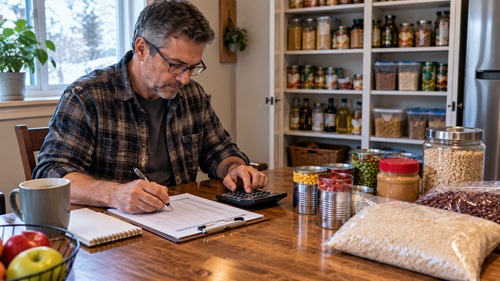
A household food inventory helps families understand exactly what they have available and which supplies may need attention. Without an inventory, food stored in different cupboards, containers, or rooms can easily be forgotten, resulting in unnecessary purchases or products deteriorating before they are used.
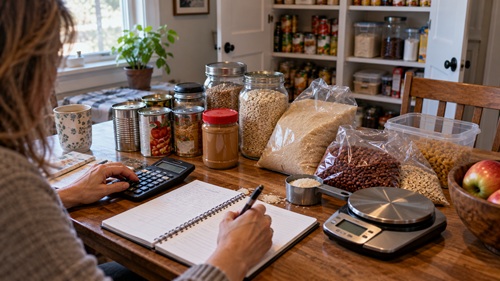
An effective inventory records the type of food, quantity available, package size, storage location, and information needed for safe rotation. Nutritional labels can be used to estimate the calories available in packaged foods, while bulk products may require estimates based on edible weight and reliable nutritional information.
Once the inventory is complete, the household can calculate its approximate stored food energy and compare that total with its estimated daily requirements. This provides a measurable starting point for determining whether the current reserve meets the family’s preparedness objectives.
The inventory should also help identify missing ingredients. For example, a family may have substantial quantities of rice and pasta but limited protein-rich foods, or it may have enough canned products but insufficient cooking water. Recognizing these gaps allows future purchases to address specific needs rather than simply increasing the amount of food stored.
Recording storage locations and relevant dates can also improve rotation. Products that should be used sooner can be incorporated into normal meals, while newer supplies can be stored appropriately for later use.
A notebook, spreadsheet, or printed worksheet can all serve this purpose. The most important consideration is that the information remains accurate and accessible. Keeping a printed copy may be useful during emergencies when electronic devices or internet access are unavailable.
A well-maintained inventory transforms a collection of stored groceries into a resource that the household can evaluate and manage.
Understanding the Limits of Stored Food
Even a carefully planned emergency pantry contains a finite amount of food. As supplies are consumed, the household must eventually replenish them. This means that food storage should be understood as one component of preparedness rather than a permanent solution to every possible disruption.
A family with 30 days of food may be well positioned to manage a short interruption in grocery deliveries, but a disruption lasting several months would require additional resources. Increasing stored supplies can extend the available time, while alternative sources of food may provide additional options.
Local farmers, community gardens, seasonal markets, food cooperatives, and relationships with neighbours can contribute to household resilience. These resources may not remain available during every emergency, but developing connections before they are needed can improve a family’s ability to respond to changing circumstances.
Households should also consider how their preparedness requirements may change over time. A growing family, changes in employment, dietary needs, or new medical requirements may affect which foods should be stored and how much is needed.
The goal is not complete independence from every food system. It is to reduce unnecessary vulnerability by maintaining dependable supplies, useful skills, and practical options for obtaining additional food when necessary.
Download Your Free Household Pantry Assessment Worksheet
Understanding how long food supplies might last is an important part of preparedness, but the greatest value comes from applying that knowledge to the household’s actual circumstances.
Prepping Communities has created a free Household Pantry Assessment Worksheet to help families calculate daily food requirements, inventory stored supplies, estimate the number of days of food energy available, and identify weaknesses in their preparedness.
The worksheet also helps households evaluate nutritional variety, emergency water requirements, cooking capabilities, and practical improvements that can be made over time.
By completing the assessment, families can move beyond estimating their preparedness based on the appearance of a full pantry and begin making decisions supported by measurable information.
Download the worksheet, review your existing food supplies, and use the results to develop a more dependable household food reserve.
Preparedness Action Plan
Begin by observing how your household uses food during a normal two-week period. Pay attention to the ingredients purchased most frequently, the meals prepared regularly, and any food discarded before it can be eaten. This provides a realistic understanding of household consumption and may reveal opportunities to reduce waste before purchasing additional supplies.
Next, calculate the approximate daily calorie requirements of everyone in the household. Consider age, physical activity, and individual nutritional needs rather than assuming that every person requires the same amount of energy. Add these requirements together to establish an estimated daily household total, then calculate how much food energy would be needed for one week, two weeks, and one month.
Conduct a pantry inventory by recording the quantities of shelf-stable foods available. Use the nutritional information printed on packages to estimate the total calories stored. For bulk foods, use reliable nutritional information based on edible weight. Add the calories together and divide the total by the household’s estimated daily requirement to determine how long the available energy might theoretically last.
After completing the calculation, examine the nutritional variety of the pantry. Determine whether the household has suitable sources of protein, dietary fats, fruits, vegetables, and other important nutrients. Consider whether the stored ingredients can be combined into practical meals and whether those meals are appropriate for everyone who will consume them.
Evaluate how the household would prepare food during a disruption involving electricity or water. Confirm that safe drinking water, appropriate cooking equipment, necessary fuel, and basic utensils are available. Identify foods that could be consumed without cooking if conventional appliances become unavailable.
Inspect storage areas for moisture, pests, damaged packaging, and products that require rotation. Incorporate stored foods into everyday meals where practical and replace them gradually as household finances allow.
Finally, establish a realistic improvement plan based on the weaknesses identified during the assessment. Prioritize the foods and resources that would make the greatest difference to household security. Rather than attempting to purchase a large emergency reserve immediately, make gradual improvements that fit within the household budget.
Repeat the assessment periodically as food supplies, household needs, and financial circumstances change. The purpose is not to achieve a perfect pantry but to develop a dependable food supply that becomes more useful and resilient over time.
Skills Learned
Completing this preparedness lesson provides households with a practical method for evaluating food supplies using measurable information rather than relying on the appearance of a full pantry. Readers learn how to estimate daily household calorie requirements, calculate the energy available in stored foods, and determine approximately how long those supplies might last.
The lesson also explains how to evaluate nutritional balance, recognize weaknesses in meal preparation capabilities, and understand the importance of safe water, cooking equipment, and suitable food storage conditions.
Through the household resilience scenarios, readers learn to consider how grocery shortages, prolonged power outages, financial hardship, and extended emergencies could affect their access to food. These exercises encourage families to identify weaknesses before they become urgent problems.
Readers also develop an understanding of how food inventories, responsible purchasing, basic cooking skills, and appropriate preservation methods can improve the usefulness of household supplies while helping control everyday grocery expenses.
Most importantly, the lesson demonstrates that meaningful food preparedness does not necessarily require expensive equipment or enormous quantities of stored groceries. A dependable pantry is developed through practical planning, regular maintenance, and gradual improvements based on actual household needs.
The real measure of food preparedness is not how many cans, bags, or buckets are stored on the shelves. It is whether those supplies can realistically support the people who depend on them when normal access to food becomes difficult.
© Prepping Communities. This content is for informational purposes only and not professional advice. Use at your own risk.
Terms | Privacy | Guidelines