
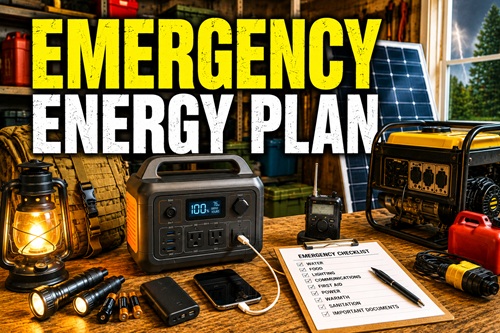
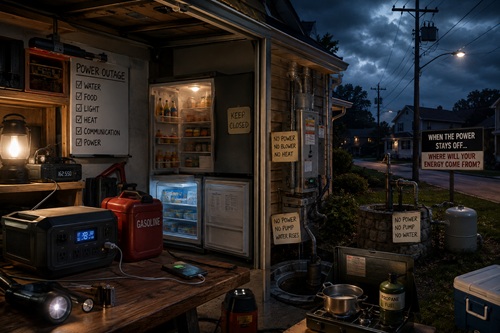
Most power outages are easy to dismiss because they don’t last very long. The lights go out, a few flashlights come out of a drawer, and within several hours everything is back to normal. That experience can create a false sense of security because a three-hour outage and a three-day outage are completely different problems.
Once an outage continues, electricity stops being merely a convenience. Refrigerators begin warming, freezers slowly thaw, phones need charging, batteries become depleted, electric cooking disappears, and homes supplied by private wells may lose running water. A gas or propane furnace may have plenty of fuel available and still be unable to operate because its blower, thermostat, ignition system, or circulation pump requires electricity. Sump pumps, sewage systems, security equipment, communications equipment, medical devices, and other systems may also depend upon power.
Preparing for an extended outage therefore starts with a simple question: where will the energy come from when the grid can no longer provide it?
The answer shouldn’t automatically be “a generator.” A generator can be extremely useful, but it is only one part of a reliable emergency energy plan. Fuel runs out. Batteries discharge. Solar production changes with weather and season. Mechanical equipment can fail. The better approach is to understand what your household actually needs and develop several practical ways to meet those needs.
Start With What You Actually Need
Before buying equipment, walk through your home and identify everything that depends upon electricity. Don’t just look at obvious appliances. Think about the systems behind normal household functions.
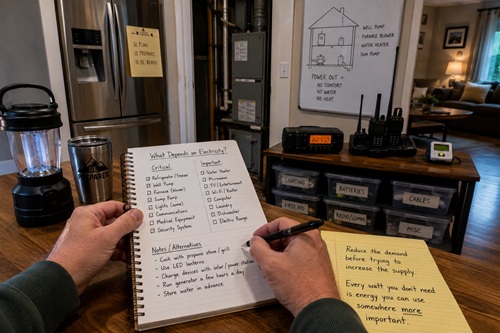
If you turn on a faucet, where does the water pressure come from? If you increase the thermostat, what electrical equipment makes the heat circulate? If heavy rain fills the drainage system around your home, does a sump pump keep the basement dry? If the power disappears in January, can your heating system operate at all?
Do the same thing with refrigeration, cooking, communications, lighting, sanitation, security, and any other essential household function.
Then decide what truly needs to remain operational.
Trying to maintain your normal lifestyle during an outage can require an enormous amount of energy. Maintaining essential household functions usually requires much less.
You probably don’t need every room illuminated. Several LED lanterns may be enough. You don’t necessarily need an electric range if you have another safe way to cook. Entertainment equipment can usually remain off. Laundry can wait. Many appliances that seem important during normal life become unnecessary during an emergency.
This is one of the most important principles of emergency energy planning: reduce the demand before trying to increase the supply.
Every watt you don’t need is energy that can be used somewhere more important.
Find Out How Much Power Your Essentials Require
Once you have identified essential equipment, determine how much electricity it actually consumes.
Most appliances have a label showing volts, amps, watts, or some combination of these. Manufacturer specifications can provide additional information. A plug-in electricity meter can also measure the real-world consumption of many standard household appliances.
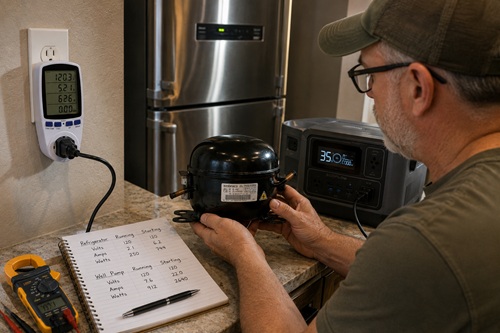
If an appliance lists volts and amps but not watts, a basic estimate can be made by multiplying volts by amps. A 120-volt device drawing 5 amps represents approximately 600 watts under those conditions.
However, don’t assume that an appliance always draws the same amount of electricity.
Equipment containing motors, pumps, or compressors may require considerably more power for a short period when starting. Refrigerators, freezers, well pumps, sump pumps, air conditioners, and some tools are common examples.
This startup demand matters when choosing generators, inverters, and battery power stations. A system may appear capable of operating a refrigerator based on its normal running consumption but shut down every time the compressor attempts to start.
Test critical equipment before an emergency whenever possible.
The manufacturer’s specifications tell you what should happen. A real-world test tells you what actually happens.
Build Your Emergency Energy in Layers
A resilient emergency energy system doesn’t have to be complicated, but it should avoid depending entirely upon one source.
Think of energy in layers.
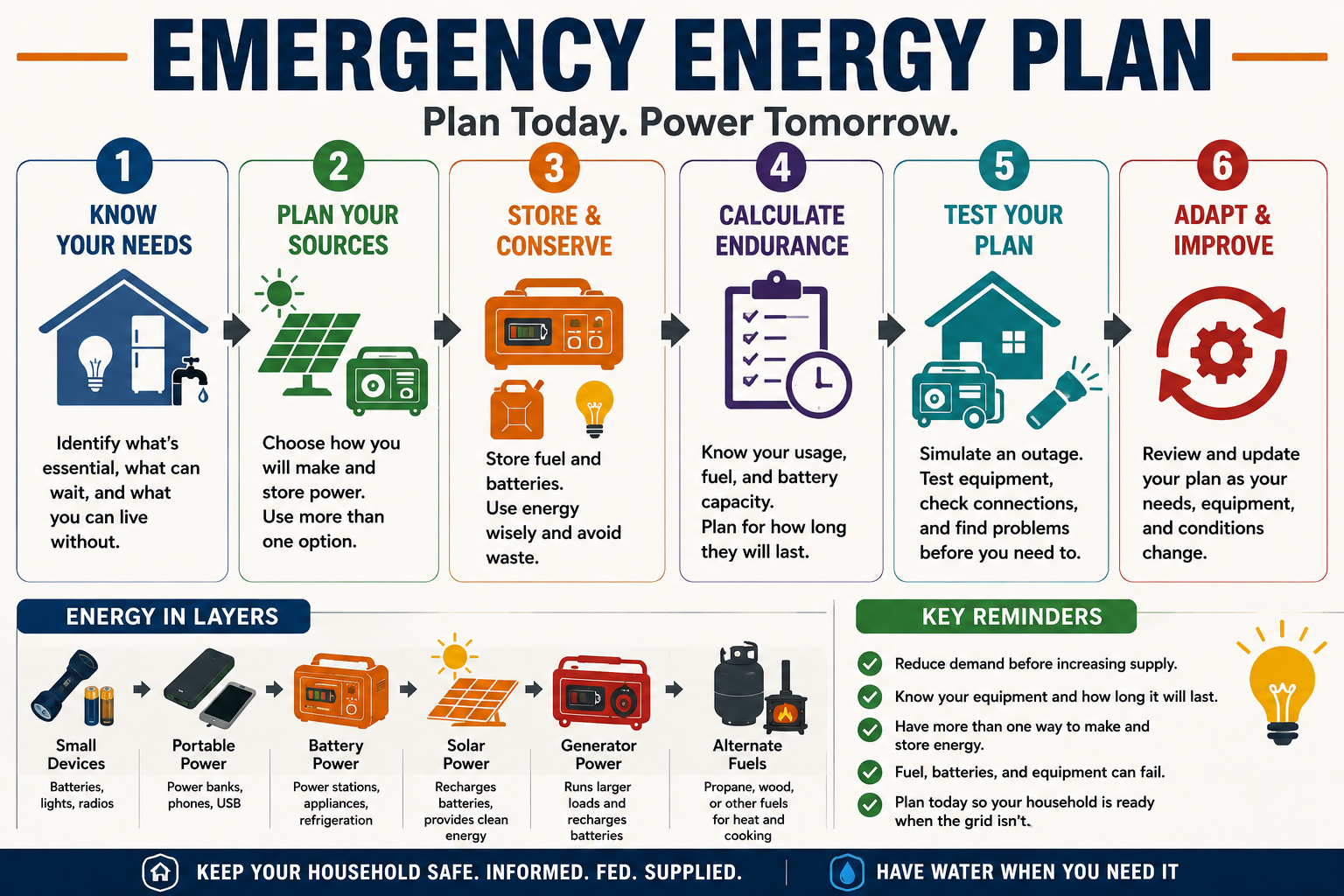
The smallest layer handles the smallest loads. Flashlights, radios, headlamps, and similar devices can operate from ordinary batteries or rechargeable batteries. Phones and USB equipment can use power banks. Larger battery stations can support communications equipment, computers, refrigeration, and other moderate loads. Solar panels can replenish stored electricity. A generator can handle larger electrical demands and recharge batteries. Propane, wood, or other appropriate fuels can provide cooking and heating without consuming electricity.
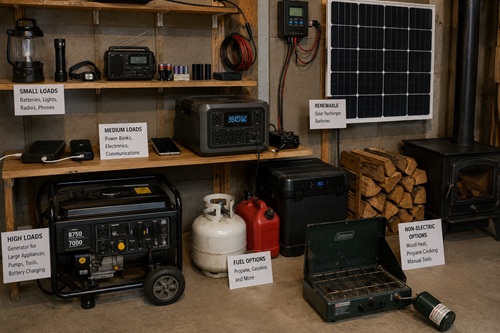
These systems can support one another.
Instead of running a generator all night to keep a few small devices operating, the generator can be used during the day to cool refrigeration equipment, pump water, operate larger loads, and recharge batteries. The generator can then be shut down while batteries handle small overnight requirements.
If generator fuel becomes scarce, solar may continue charging essential electronics. If several cloudy days reduce solar production, the generator can take over temporarily. If neither electrical source is available, non-electric cooking and heating systems may still function.
Redundancy doesn’t mean owning three of everything. It means having another way to accomplish essential tasks when the preferred method fails.
Make Emergency Lighting Simple
Lighting is one of the easiest energy problems to solve, so it shouldn’t consume much of your emergency power budget.
Modern LED flashlights, headlamps, and lanterns provide substantial illumination while using relatively little electricity. Headlamps are especially useful because they allow both hands to remain available for cooking, repairs, carrying supplies, checking equipment, or working outside.
Keep lights in known locations rather than storing every flashlight in one emergency container. If the power fails at night, you should be able to reach basic lighting without crossing a dark house.
Standardizing battery sizes also simplifies preparedness. Maintaining several different types of batteries for dozens of devices becomes unnecessarily complicated. Where practical, choose equipment that shares common battery sizes or USB charging connections.
Rechargeable lighting works well when you have several ways to recharge it, but disposable batteries provide useful redundancy. A combination of both can be more resilient than depending completely upon either.
Periodically test stored lighting equipment. Rechargeable batteries slowly lose their charge, disposable batteries can deteriorate, and equipment that worked when it was placed into storage may not work several years later.
Candles can provide emergency illumination, but open flames introduce additional fire risk during a situation in which emergency services may already be overwhelmed. LED lighting is generally a safer primary choice.
Protect Communications First
Small communications equipment provides enormous value for relatively little energy.
A smartphone can provide emergency alerts, stored documents, maps, weather information, photographs, messaging, and communications when networks remain available. Radios can provide information even when internet access becomes unreliable. Two-way radios may support local communications between household or group members.
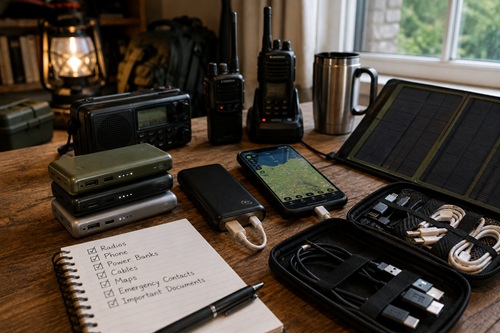
These devices consume comparatively little electricity, which makes them excellent candidates for power banks and small solar charging systems.
Keep several power banks rather than depending upon a single battery. This provides redundancy and allows power to be distributed among household members.
Store the necessary charging cables with the equipment. Having thousands of watt-hours of battery capacity doesn’t help much when the one cable needed to charge a critical device can’t be found.
During an extended outage, change how you use electronics. Reduce screen brightness, activate power-saving settings, disable unnecessary wireless functions, and avoid using emergency communications devices continuously for entertainment.
Energy conservation isn’t only about large appliances. Small savings repeated over many days can significantly extend your ability to communicate.
Understand What a Portable Power Station Can and Cannot Do
Portable battery power stations have become an extremely useful emergency tool. They combine rechargeable battery storage, charging electronics, USB outputs, DC connections, and an AC inverter in one relatively simple package.
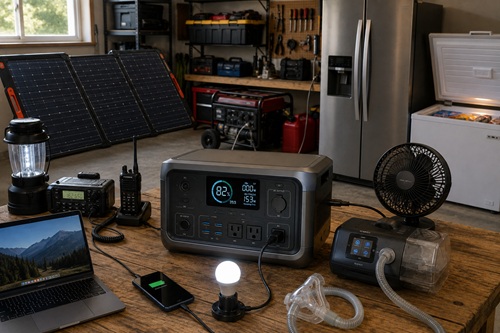
Depending upon their size, these systems can operate lights, laptops, radios, communications equipment, CPAP machines when properly matched to their requirements, refrigerators, freezers, and various small appliances.
The important thing to remember is that a battery doesn’t produce energy.
It stores energy.
Once the battery is empty, another energy source must recharge it.
That could be the electrical grid before an emergency, solar panels, a generator, or in some situations a vehicle.
When evaluating a battery system, look at both its power output and usable storage capacity. These describe different things. Output determines what equipment the system can operate at one time. Capacity helps determine how long it can operate that equipment.
A large inverter attached to a relatively small battery doesn’t create additional stored energy.
This is why emergency power planning should be based on actual energy consumption rather than impressive-looking equipment specifications.
Add Solar to Produce Energy Instead of Just Storing It
Solar becomes particularly useful during a prolonged outage because sunlight can replenish energy that has already been consumed.
A modest portable solar system may be enough to keep phones, radios, flashlights, rechargeable batteries, and small power stations operating for an extended period. Larger systems paired with adequate battery storage may support refrigeration and other household loads.
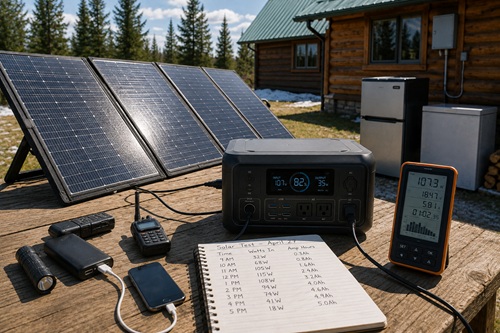
Solar production, however, should be estimated conservatively.
A panel rated at 200 watts doesn’t continuously produce 200 watts from sunrise until sunset. Clouds, shade, temperature, panel orientation, season, latitude, and available daylight all affect production.
This becomes especially important during winter in northern regions where days are shorter and the sun remains lower in the sky.
The most useful test is not the number printed on the solar panel. It is how much energy the system actually produces during a normal day where you live.
Set up the panels, connect the battery, and measure what happens.
Then compare your daily production with your daily consumption.
If you routinely consume more energy than you can replace, your battery bank will eventually become depleted regardless of how large it was when the outage started.
At that point you have two choices: increase energy production or reduce consumption.
Use a Generator Strategically
Fuel-powered generators remain one of the most practical ways to produce substantial amounts of emergency electricity.
They can operate refrigeration, pumps, tools, heating-system components, battery chargers, communications equipment, and other household loads. They can also restore a large amount of energy to battery storage relatively quickly.
The mistake is assuming the generator needs to operate continuously.
During a prolonged outage, fuel may become the limiting resource. A generator capable of running for days is useless once the fuel supply is exhausted.
A more efficient approach can be to operate the generator during planned periods. While it is running, cool refrigerators and freezers, pump water, charge battery banks, operate larger appliances, and complete other energy-intensive tasks.
Then shut it down.
Lighting, communications, and other small loads can operate from stored battery power until the next generator period.
This approach reduces fuel consumption, noise, generator wear, and unnecessary operating hours.
Calculate Fuel Before You Need It
Don’t estimate generator endurance by looking at the number of fuel containers in the garage.
Run the generator with realistic loads and determine approximately how much fuel it consumes over several hours. Use the manufacturer’s specifications as a starting point, but understand that actual consumption depends upon generator design and electrical load.
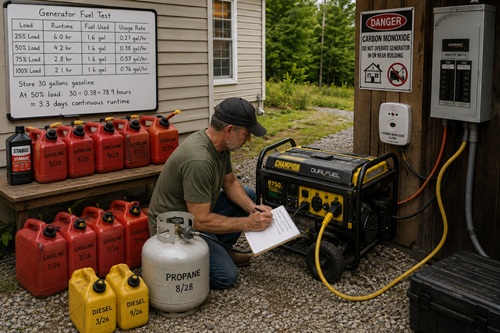
Then calculate how long your stored fuel would realistically last.
A supply that appears substantial can disappear quickly when a generator operates around the clock.
Fuel storage also needs to be managed safely. Use approved containers, keep fuel away from ignition sources and occupied living areas as appropriate, follow local requirements, and rotate fuels that degrade during storage.
Propane can provide another useful option. Properly stored propane has favorable long-term storage characteristics and can support generators, cooking appliances, and other equipment designed for it.
Dual-fuel or tri-fuel generators can increase flexibility by allowing the household to use more than one available fuel.
Fuel diversity becomes particularly valuable during regional outages. A gasoline generator doesn’t provide much resilience if gasoline cannot be obtained. Having another compatible energy source gives you another option.
Generator Safety Cannot Be Improvised
A generator solves one problem while introducing several serious hazards.
Combustion generators produce carbon monoxide. This gas cannot be seen or smelled and can kill people before they recognize what is happening.
Generators must be operated outdoors in accordance with manufacturer requirements and positioned safely away from doors, windows, vents, and other openings where exhaust could enter occupied buildings.
A garage isn’t made safe simply by opening the garage door.
Battery-backed carbon monoxide alarms should be installed and maintained anywhere combustion equipment could create exposure risks.
Electrical connections also need to be planned before the outage.
Never attempt to power household wiring by connecting a generator through an ordinary electrical outlet. Improper back feeding can create dangerous electrical conditions and potentially energize lines that utility workers believe are inactive.
If a generator will supply household circuits, an appropriate transfer system or other approved equipment should be installed in accordance with applicable electrical requirements by a qualified professional.
Emergency electricity should make the household safer, not introduce another emergency.
Don’t Waste Electricity Producing Heat
Electrical resistance heating consumes a tremendous amount of energy compared with LED lighting, communications equipment, or small electronics.
That makes electric space heaters, electric ranges, electric kettles, and similar heating appliances difficult loads for smaller battery systems.
If you have alternative ways to safely produce heat, use them strategically.
A properly installed wood stove can heat living space without consuming large amounts of electricity. Propane appliances designed and approved for their intended application may provide other options. Cooking can often be moved to outdoor propane equipment, barbecues, or other suitable methods.
The point isn’t to eliminate electrical heating appliances from normal life. It is to recognize that during an emergency they can rapidly consume limited stored electricity.
Save electrical energy for functions that are harder to replace.
Prepare a Non-Electric Way to Cook
Food storage and energy planning should be developed together.
A pantry containing large quantities of food that requires long cooking times also represents a large stored-energy requirement.
Rice, dry beans, pasta, grains, and other staples are valuable foods, but some require considerable heat to prepare. If your emergency cooking plan depends entirely upon limited propane or other fuel, cooking time becomes important.
Maintain at least one safe method of preparing food without grid electricity. Depending upon your circumstances, that could be an outdoor propane stove, barbecue, wood-fired cooking system, solar cooker, or another appropriate method.
Practice with it before an emergency.
Learn how long it takes to boil water, how much fuel common meals require, which cookware performs well, and how weather affects the system.
Pressure cooking can reduce cooking time for many foods when an appropriate heat source is available. Soaking certain dried foods before cooking can also reduce fuel requirements. Retained-heat cooking can allow food to continue cooking using stored heat after it has been brought to temperature.
Keep some foods that require little or no cooking as well.
Every meal that doesn’t require substantial heating preserves fuel for later.
Treat Refrigeration as Stored Food Energy
A freezer full of food represents months of work and potentially hundreds or thousands of dollars. Protecting it may be one of the highest-value uses of emergency electricity.
The simplest action is also one of the most effective: keep the door closed.
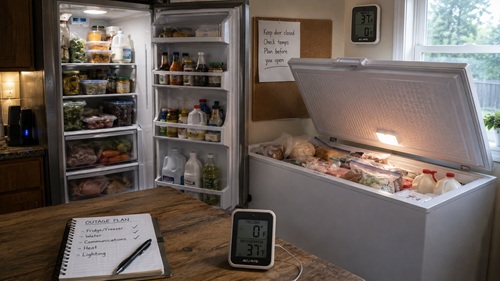
Know what you need before opening the refrigerator or freezer. Organize food so frequently needed items can be retrieved quickly.
Keep appliance thermometers inside. During an extended outage, temperature matters more than guessing how long the electricity has been off.
A fuller freezer generally retains cold better than a mostly empty one because the frozen contents provide thermal mass. Containers of frozen water can help fill unused space, provided enough room is left in each container for expansion.
Those containers can later be transferred to coolers and eventually become usable water after thawing.
If backup power is available, refrigeration may not necessarily need to operate continuously. Depending upon conditions, equipment can sometimes be powered periodically to restore safe temperatures and then disconnected while the doors remain closed.
Monitor actual temperatures and follow appropriate food-safety guidance rather than relying on smell or appearance to determine whether perishable food is safe.
Remember That Water May Depend on Electricity
For households using private wells, electricity and water are directly connected.
Once the pressure tank is depleted, the taps may stop working until the pump receives power again.
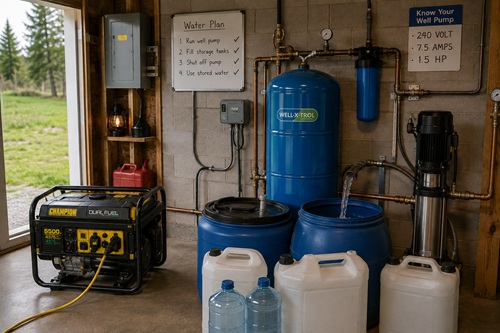
Determine the electrical requirements of your well pump before buying emergency equipment. Many well pumps require different voltage and startup capacity than ordinary household appliances.
Instead of operating the pump continuously, use available generator power to replenish stored water.
Fill appropriate containers while power is available and then shut the pump and generator down. The stored water can support drinking, cooking, sanitation, and other household needs until another pumping period is necessary.
This is an effective way to convert a short period of generator operation into many hours of water availability.
The same thinking applies to other systems. Run high-demand equipment when substantial power is available, store the result whenever possible, and then return to low-energy operation.
Your Vehicle Is Another Energy Resource
A vehicle contains fuel, an alternator, a starting battery, and electrical outlets, making it another potential layer in an emergency energy system.
USB and 12-volt connections can recharge phones, radios, power banks, and other small electronics. Appropriate equipment may allow additional charging capability.
But don’t turn your emergency transportation into a stationary household battery.
Protect the vehicle’s ability to start. Draining the starting battery to operate household electronics could leave you without transportation when evacuation or emergency travel becomes necessary.
Vehicle engines also produce carbon monoxide. Never run a vehicle in an enclosed garage or other location where exhaust can accumulate or enter occupied areas.
Think of the vehicle as a backup charging resource rather than unlimited electricity.
Match the Energy Source to the Job
Different energy sources are useful for different purposes. Instead of forcing one system to handle everything, assign each household requirement to the source that can handle it efficiently.
| Household Need | Practical Primary Option | Secondary Option | Main Consideration |
| Lighting | LED rechargeable lights | Disposable batteries | Very low energy requirement |
| Phones | USB power banks | Solar or vehicle charging | Conserve battery life |
| Radio | Rechargeable/battery radio | Solar charging | Maintain information access |
| Refrigerator | Battery station | Generator | Monitor actual temperature |
| Freezer | Generator/battery system | Ice/cooler strategy | Minimize door opening |
| Well pump | Properly sized generator | Stored water | Startup load can be substantial |
| Sump pump | Battery backup/generator | Secondary pump | Test under realistic conditions |
| Small electronics | Battery station | Power banks | Avoid unnecessary consumption |
| Cooking | Non-electric cooking system | Secondary fuel source | Ventilation and fire safety |
| Heating | Appropriate non-electric heat | Backup power for heating controls | Heating requires substantial energy |
| Battery recharging | Solar | Generator or vehicle | Have more than one charging source |
| Heavy electrical loads | Generator | Large battery/inverter system | Running and startup requirements |
There is no universally correct combination. An apartment, suburban home, rural acreage, and off-grid property will have very different requirements. Build the system around your actual household rather than somebody else’s equipment list.
Test the System by Practicing an Outage
The most valuable thing you can do after developing an emergency energy plan is test it.
Choose a safe time and simulate several hours without grid electricity.
Use your emergency lights. Charge your phone from your backup system. Prepare a meal without the electric stove. Connect the refrigerator to the power source intended for it. Start the generator and operate the loads you expect it to support. Set up the solar panels and see what they actually produce.
Pay attention to the small problems.
Maybe the extension cord doesn’t reach the freezer. Perhaps the generator is much harder to move than expected. Maybe the battery station won’t start the refrigerator compressor. You might discover that a supposedly charged flashlight is dead, the solar charging cable is missing, or the well pump requires more generator capacity than expected.
Those are exactly the problems you want to discover while the electrical grid is still working.
Emergency Energy Checklist
Use this checklist after developing your system rather than treating it as a shopping list. The objective is to determine whether each essential function has been addressed.
- Identify the household systems that depend upon electricity.
- Determine which electrical loads are truly essential.
- Determine running and startup requirements for critical equipment.
- Establish emergency lighting that requires very little energy.
- Maintain spare and rechargeable batteries.
- Keep several USB power banks charged.
- Store the correct charging cables with emergency equipment.
- Maintain a battery-powered or rechargeable radio.
- Establish a method for keeping refrigerators and freezers cold.
- Keep thermometers inside refrigeration equipment.
- Establish at least one safe non-electric cooking method.
- Maintain an appropriate cooking-fuel supply.
- Determine whether the home’s heating system requires electricity.
- Determine how a private well will operate without grid power.
- Store water so pumping doesn’t have to occur continuously.
- Determine whether sump pumps or other critical systems need backup power.
- Calculate realistic generator fuel consumption.
- Store and rotate generator fuel appropriately.
- Establish a safe outdoor generator operating location.
- Maintain working carbon monoxide alarms with battery backup.
- Use an approved method for supplying household circuits from a generator.
- Determine the usable capacity of battery power stations.
- Test battery systems with the equipment they are expected to operate.
- Measure realistic solar production under local conditions.
- Maintain more than one way to recharge critical batteries.
- Test the complete emergency energy plan before it is needed.
Preparedness Action Plan
Start without buying anything. Walk through your home and identify every important function that disappears when the electricity stops. Determine what must continue working, what only needs to operate occasionally, and what you can live without.
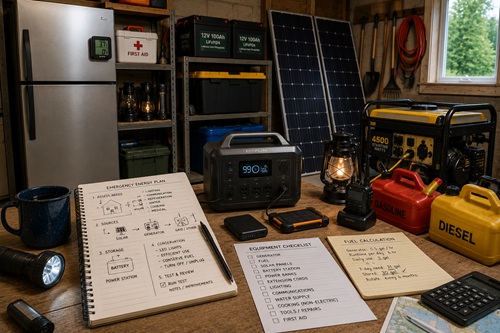
Next, match each essential requirement with an energy source. Lighting might use rechargeable batteries. Communications might use power banks backed by solar. Refrigeration might operate primarily from a battery station with a generator available for recharging. Water might be pumped during scheduled generator periods and stored for later use. Cooking might move entirely away from electricity.
Then determine endurance. Don’t simply ask how much equipment you own. Ask how long it will actually operate. Calculate generator fuel consumption, battery capacity, expected solar production, cooking fuel requirements, and the energy demands of essential equipment.
Finally, test everything together.
A generator that has never powered your actual equipment, solar panels that have never charged your battery station, and a camp stove that has never cooked a family meal are still assumptions.
The objective isn’t to reproduce normal life indefinitely without the grid. It is to maintain the essential functions that keep the household safe, informed, fed, supplied with water, and operational while using limited energy intelligently.
When the power stays off, the most important question isn’t how much backup equipment you own.
It is whether you already know where your next watt of usable energy is coming from.
Preparedness Action Plan
An emergency energy plan should begin with understanding your household rather than buying more equipment. Identify the functions that would create real problems if they disappeared for several days, then decide which ones must operate continuously, which can operate periodically, and which can simply wait until grid power returns.
From there, look at the complete system rather than individual pieces of equipment. Determine how electricity will be produced, how it will be stored, and how you will conserve it. Consider how long your batteries will last, how they will be recharged, how much generator fuel you can realistically maintain, how weather could affect solar production, and what alternatives remain if your preferred energy source becomes unavailable.
Pay particular attention to resources that cannot easily be replaced during a widespread outage. Fuel that normally takes ten minutes to purchase may become difficult to obtain. Several cloudy days can reduce solar production. Batteries eventually reach their limits, and mechanical equipment can fail. Your plan should still provide a way to maintain your highest-priority needs when one part of the system is unavailable.
Once the plan is established, put it through a realistic test. Simulate an outage for several hours and operate from the equipment and resources you intend to depend upon. This is where seemingly minor weaknesses become obvious. An extension cord may not reach, an appliance may draw more starting power than expected, charging may take longer than anticipated, or fuel consumption may be considerably higher than your calculations suggested.
Correct those problems while normal electricity is available.
The goal isn’t to recreate everyday life indefinitely without the grid. It is to keep the household safe and functional while making limited energy resources last as long as reasonably possible. During a prolonged outage, knowing what not to power can become just as important as knowing how to produce electricity.
A reliable emergency energy plan therefore isn’t measured by the size of the generator, the number of solar panels, or the capacity of the battery bank. It is measured by whether those resources work together and whether you have another option when one of them doesn’t.
If the grid went down tonight and remained unavailable for the next week, you should already have a reasonable idea of how you would maintain your most important household functions and how long your available resources could support them.
That is when backup equipment becomes an emergency energy system you can actually depend on.
© Prepping Communities. This content is for informational purposes only and not professional advice. Use at your own risk.
Terms | Privacy | Guidelines