
Fire is one of those basic capabilities that becomes much more important when something goes wrong. A fire can provide warmth, boil water, dry wet clothing, provide light, cook food, and make an unexpected night outdoors considerably more manageable. The problem is that knowing how to build a fire doesn’t help much if the tools needed to start one are sitting at home.
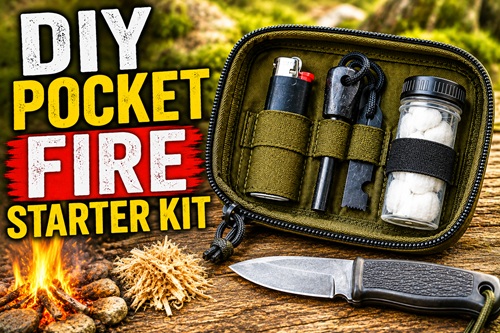
That’s the idea behind a pocket fire starter kit. Instead of carrying a large fire-making kit packed with equipment, build a small system that can stay in a jacket pocket, daypack, vehicle emergency kit, hunting pack, or bug-out bag. It should be small enough that carrying it doesn’t become a nuisance, but capable enough to give you several ways to get a fire going.
The most important principle is redundancy. Don’t build the entire kit around one lighter, one ferrocerium rod, or one piece of tinder. Fire starting becomes considerably more difficult when you’re cold, wet, tired, injured, or working with damp natural materials. A good pocket kit gives you an easy first option and at least one reliable backup.
What You’ll Need
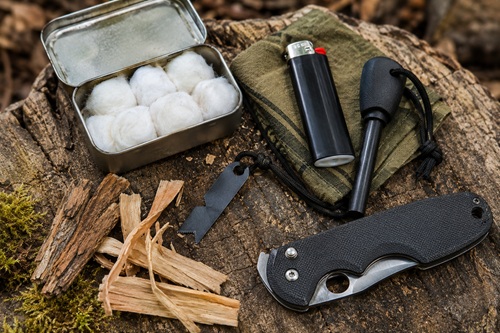
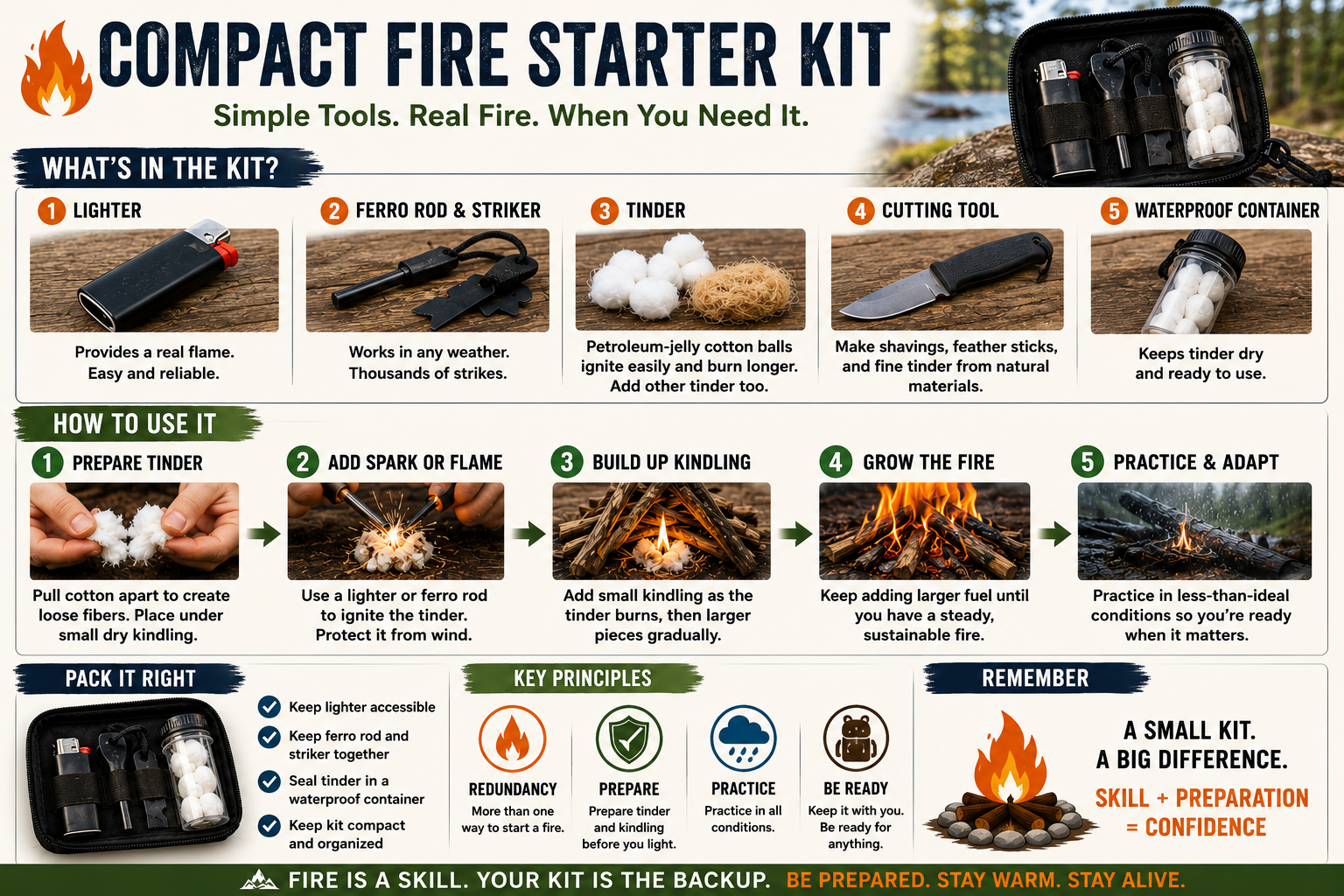
You don’t need much to build one. A practical pocket kit can contain a small disposable butane lighter, a compact ferrocerium rod with a striker, several homemade petroleum-jelly cotton balls, a small waterproof container for the tinder, and a compact cutting tool where appropriate and lawful.
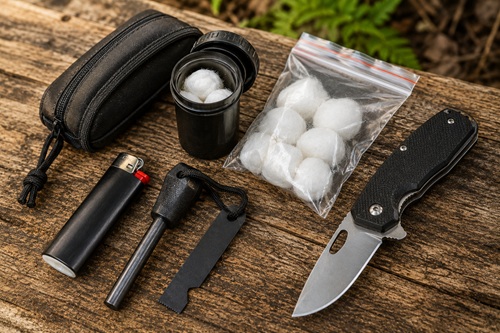
A small zippered pouch, metal tin, or heavy-duty resealable plastic bag can hold everything together. If the kit will regularly be exposed to rain, snow, canoeing, kayaking, or other wet conditions, use a genuinely waterproof container or place the entire kit inside a waterproof bag.
The finished kit should remain small. If it becomes large enough that you stop carrying it, you’ve defeated much of its purpose.
Start With a Simple Lighter
Your first ignition source should usually be the easiest one to operate. A small disposable butane lighter works well because it produces an actual flame rather than simply producing sparks.
That difference matters.
When you’re trying to ignite slightly damp tinder or get thin wood shavings burning, being able to hold a flame against the material for several seconds can be much easier than trying to catch a brief shower of sparks.
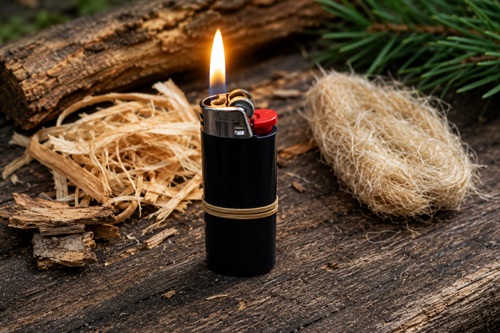
Choose a reliable lighter and test it before putting it into the kit. Make sure the striker turns easily and produces a strong flame.
A mini lighter saves space, while a standard-sized lighter provides more fuel and can be easier to operate with cold hands. Either can work. The important thing is choosing something dependable rather than simply choosing the smallest lighter available.
Store it where the fuel control can’t accidentally be held open by other equipment. Don’t pack it against sharp objects that could damage the lighter body.
Cold temperatures can also make butane lighters perform poorly. If you’re outdoors in freezing weather, carrying the lighter inside your clothing can help keep it warmer.
That limitation is also one reason the lighter shouldn’t be your only ignition source.
Add a Ferrocerium Rod
The second ignition method should work differently from the lighter. A compact ferrocerium rod is an excellent choice.
A ferro rod produces extremely hot sparks when scraped with a hard-edged striker. Unlike a lighter, it doesn’t depend on liquid or pressurized fuel, and a good rod can provide thousands of strikes.
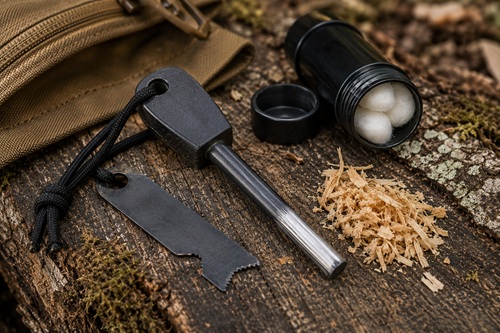
Choose a ferro rod large enough to grip securely. Extremely tiny rods save space but can become frustrating to use, particularly when your hands are cold or wet.
If the ferro rod has a dark protective coating, scrape a small section away before putting it into your emergency kit. New ferro rods are often coated to prevent corrosion, and that coating must be removed before the rod produces its best sparks.
Practice with it before depending on it.
Hold the ferro rod close to the tinder. Rather than violently swinging the striker forward and scattering your tinder everywhere, another useful technique is holding the striker relatively steady and pulling the ferro rod backward. This can throw sparks into the tinder without knocking the tinder bundle apart.
The goal isn’t to create the largest shower of sparks possible. The goal is to put those sparks exactly where they’re needed.
Make Petroleum-Jelly Cotton Fire Starters
One of the easiest homemade tinder options is a cotton ball combined with petroleum jelly.
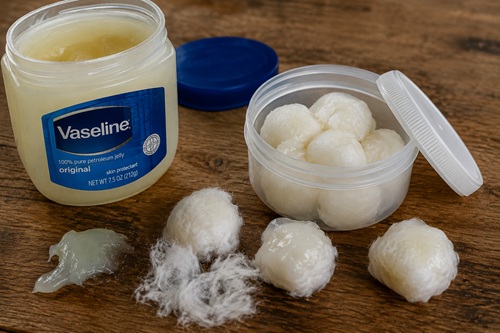
Start with ordinary cotton balls and petroleum jelly. Work a small amount of petroleum jelly into each cotton ball with your fingers or a disposable glove. The cotton should be coated but doesn’t need to become a completely saturated lump of jelly.
Leave some of the cotton fibers capable of being pulled apart.
That becomes important when you actually use one.
Store the finished cotton balls in a small waterproof container. A small screw-top plastic container works well. A compact pill-style bottle can also work if it closes securely and is clean and dry.
Several cotton balls take up very little space, so it’s easy to carry enough for multiple fires.
Prepare the Tinder Before Lighting It
Don’t simply pull out a petroleum-jelly cotton ball and immediately put a lighter against the compact ball.
Pull it apart first.
Stretch and tease the cotton until you expose a loose mass of fine fibers. Those fibers provide a much larger surface for sparks or flame to catch.
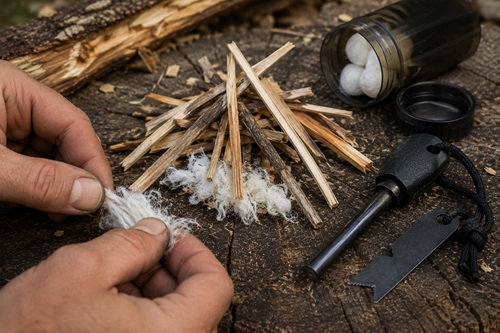
Place the prepared cotton underneath your smallest dry kindling.
When sparks from the ferro rod land in the exposed cotton fibers, they can ignite quickly. The petroleum jelly then helps extend the burn, giving you more time to ignite the wood above it.
That extra burning time is one of the main advantages over extremely fast-burning tinder.
You can prepare several cotton balls at home and experiment with different amounts of petroleum jelly. The goal is finding a balance between easy ignition and useful burn time.
Carry More Than One Tinder
Even if petroleum-jelly cotton balls are your primary tinder, adding a second type of dry tinder can improve the kit without adding much weight.
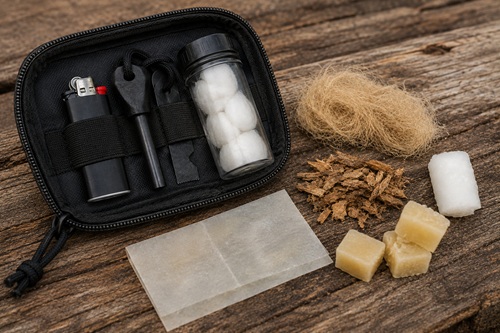
A small piece of waxed paper, commercially prepared tinder, dry jute fiber, or another known fire-starting material can provide another option.
The important distinction is between an ignition source and tinder.
Your lighter and ferro rod provide ignition. The cotton balls and other prepared materials provide tinder. Neither replaces the need for kindling and progressively larger fuel.
Keeping both ignition and tinder redundant makes the overall system much more dependable.
Add a Cutting Tool
A compact knife or suitable cutting tool can dramatically increase what you can do with the kit because it allows you to prepare natural tinder and kindling.
The key is producing progressively smaller pieces of combustible material.
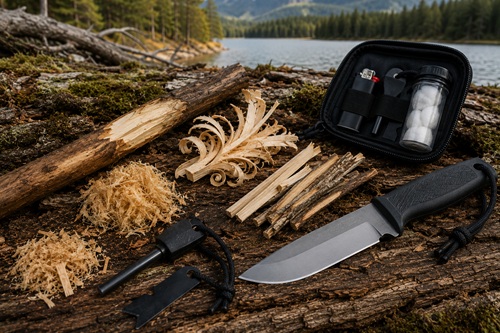
If the outside of a stick is damp but the inside remains dry, carefully removing the wet outer material may expose usable dry wood underneath. You can then create thin shavings from that interior wood.
Feather sticks are another useful technique. Instead of completely cutting shavings away from a dry stick, make repeated shallow cuts that leave thin curls attached to the wood. Those curls provide plenty of surface area for a small flame to ignite.
You can also scrape dry wood to create very fine material capable of catching a ferro-rod spark.
The smaller and thinner the material, the easier it generally is to ignite.
This is why a cutting tool belongs in a fire kit even though it doesn’t actually create fire. It helps turn the materials around you into something your ignition sources can use.
Build a Small Tinder Bundle
When you need a fire, don’t immediately start striking the ferro rod.
Prepare everything first.
Find the driest location available and gather your fuel before lighting anything. You’ll want your prepared tinder, very small dry kindling, slightly larger sticks, and eventually larger fuel.
Think of the process as a progression.
The tinder catches the initial spark or flame. The tinder ignites very thin kindling. The thin kindling ignites pencil-sized material. That material then ignites progressively larger sticks.
Trying to jump directly from a cotton ball to a large piece of firewood usually results in failure.
If conditions are wet, spend considerably more time preparing materials before attempting ignition. Look underneath dense evergreen branches, inside standing dead wood, beneath logs, or inside split pieces of wood for material protected from rain.
Pack the Kit in Layers
Once you’ve gathered the components, arrange them so you can reach the most important items quickly.
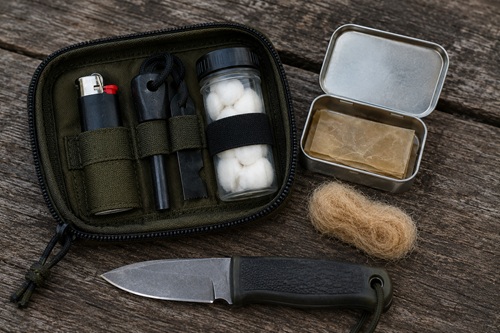
Keep the lighter somewhere accessible rather than buried underneath everything else. Keep the ferro rod and its striker together. Tinder should remain sealed against moisture.
If your knife normally rides separately in a pocket or on your belt, it doesn’t necessarily have to fit inside the fire kit itself. The important thing is that the complete system stays with you.
A compact kit might contain a lighter, ferro rod and striker, five or six prepared cotton balls, secondary tinder, and a small waterproof container.
That’s enough to provide several independent attempts without creating a bulky package.
Waterproof the Kit
A fire kit that becomes soaked when you need it isn’t much of an emergency kit.
Even equipment that tolerates moisture benefits from waterproof storage because the tinder is particularly important to protect.
A small waterproof pouch or container provides the first layer of protection. Individually sealing the tinder provides another.
You can test your container at home. Put a dry piece of tissue inside, close the container, and expose the outside to water. Check afterward to see whether moisture reached the tissue.
Don’t discover that your supposedly waterproof container leaks during an actual emergency.
Practice With the Actual Kit
One of the biggest mistakes is assembling emergency equipment and never using it.
Take your pocket kit outside and start a controlled fire under safe and legal conditions.
Try the lighter.
Then put it away and start another fire using only the ferro rod and prepared tinder.
Practice pulling apart the cotton correctly. Learn how close the ferro rod needs to be. Find out how much small kindling you need before moving to larger pieces.
Then try making tinder from dry wood using your cutting tool.
You may discover that something that looked perfect when packed doesn’t work particularly well with cold hands or that your ferro rod is too small to grip comfortably.
Finding that out in your backyard is useful.
Finding it out when you’re cold and miles from home isn’t.
Practice in Less-Than-Perfect Conditions
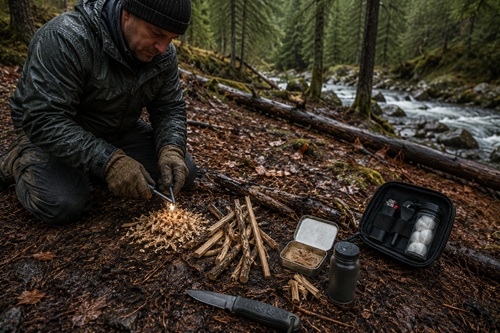 Once you’re comfortable starting a fire in good conditions, practice when conditions aren’t ideal.
Try after rain when the ground and outer surfaces of the wood are damp. Learn where protected dry material tends to remain. Practice splitting or shaving damp sticks to reach dry interior wood.
Try wearing gloves.
Try preparing the fire while sitting rather than standing comfortably over it.
You can even deliberately leave your lighter in your pocket and practice using only the ferro rod.
The objective isn’t to make fire starting unnecessarily difficult. It’s to learn which parts of the process become difficult when circumstances change.
A fire kit should make the job easier, but skill is what allows you to adapt when the easy method doesn’t work.
Don’t Waste Your Tinder
Prepared tinder is a limited resource when you’re away from home.
Before using one of your cotton balls, make sure everything else is ready.
Build your fire lay. Gather plenty of small kindling. Have the next sizes of wood within reach. Protect the area from wind where practical.
Only then ignite the tinder.
If you light your only prepared tinder and then start wandering around looking for sticks, there’s a good chance the flame will disappear before you’re ready to use it.
The same principle applies to lighter fuel.
Preparation saves ignition attempts.
Inspect the Kit Regularly
A pocket fire starter kit doesn’t require much maintenance, but it shouldn’t disappear into the bottom of a pack for ten years without being checked.
Periodically inspect the lighter for damage and make sure it still contains fuel. Check the ferro rod for corrosion and make sure the striker is still attached. Inspect the tinder container for cracks or moisture.
Replace anything questionable.
If you’ve used tinder during a camping trip, refill it when you get home rather than telling yourself you’ll remember later.
The best emergency kit is one that is ready before the emergency begins.
Make Several Kits
Once you’ve built and tested one pocket fire kit, making several more is inexpensive and useful.
Keep one with your primary outdoor equipment. Another can go into a vehicle emergency kit. Others can be stored with hunting equipment, fishing gear, a bug-out bag, emergency shelter supplies, or a day-hiking pack.
The advantage isn’t having a giant collection of fire starters.
It’s increasing the chances that one is actually with you when something unexpected happens.
Why a Pocket Fire Kit Is Worth Carrying
Fire-making equipment is inexpensive, lightweight, and compact compared with what it can provide.
A lighter may handle most situations. If it fails, you still have the ferro rod. If your surroundings are wet, you have prepared tinder. If the prepared tinder is lost or exhausted, a cutting tool and fire-making knowledge may allow you to produce tinder from the materials around you.
That’s the kind of redundancy worth building into emergency equipment.
More importantly, making the kit teaches you to think beyond simply owning gear. You’re learning how ignition, tinder, kindling, fuel, moisture, wind, and preparation work together.
The pocket kit simply gives you better tools for applying that knowledge.
A good DIY pocket fire starter kit should be small enough that you’ll actually carry it, simple enough that you know how to use everything inside, protected from moisture, and redundant enough that the failure of one item doesn’t leave you without another way to make fire.
© Prepping Communities. This content is for informational purposes only and not professional advice. Use at your own risk.
Terms | Privacy | Guidelines