
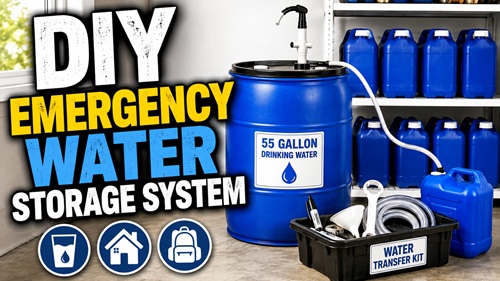
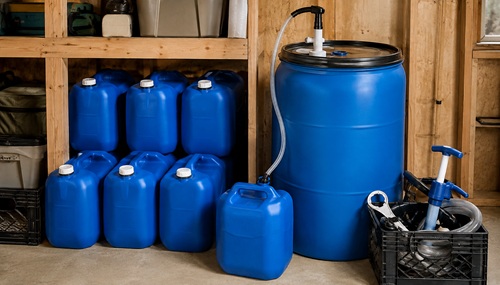
Water storage is one of the simplest preparedness projects to start, but it is also one of the easiest to do poorly. Buying a few containers and filling them with water is better than having nothing, but a useful emergency water reserve should be built as a complete system. You need enough water for the people in the household, containers that are safe for drinking water, a place that can support the weight, and a practical way to move and dispense that water when the normal water system stops working.
The best setup usually combines smaller portable containers with larger stationary storage. Smaller containers are easier to carry, move through the house, load into a vehicle, or take with you if you have to leave. Larger containers provide much more capacity but quickly become too heavy to move once filled. The source material makes this distinction clearly, describing smaller 5- and 7-gallon containers as useful portable storage while a 55-gallon barrel is essentially something that stays where it was filled.
The goal of this project is to create a home water reserve that gives you both options.
Start With a Realistic Water Target
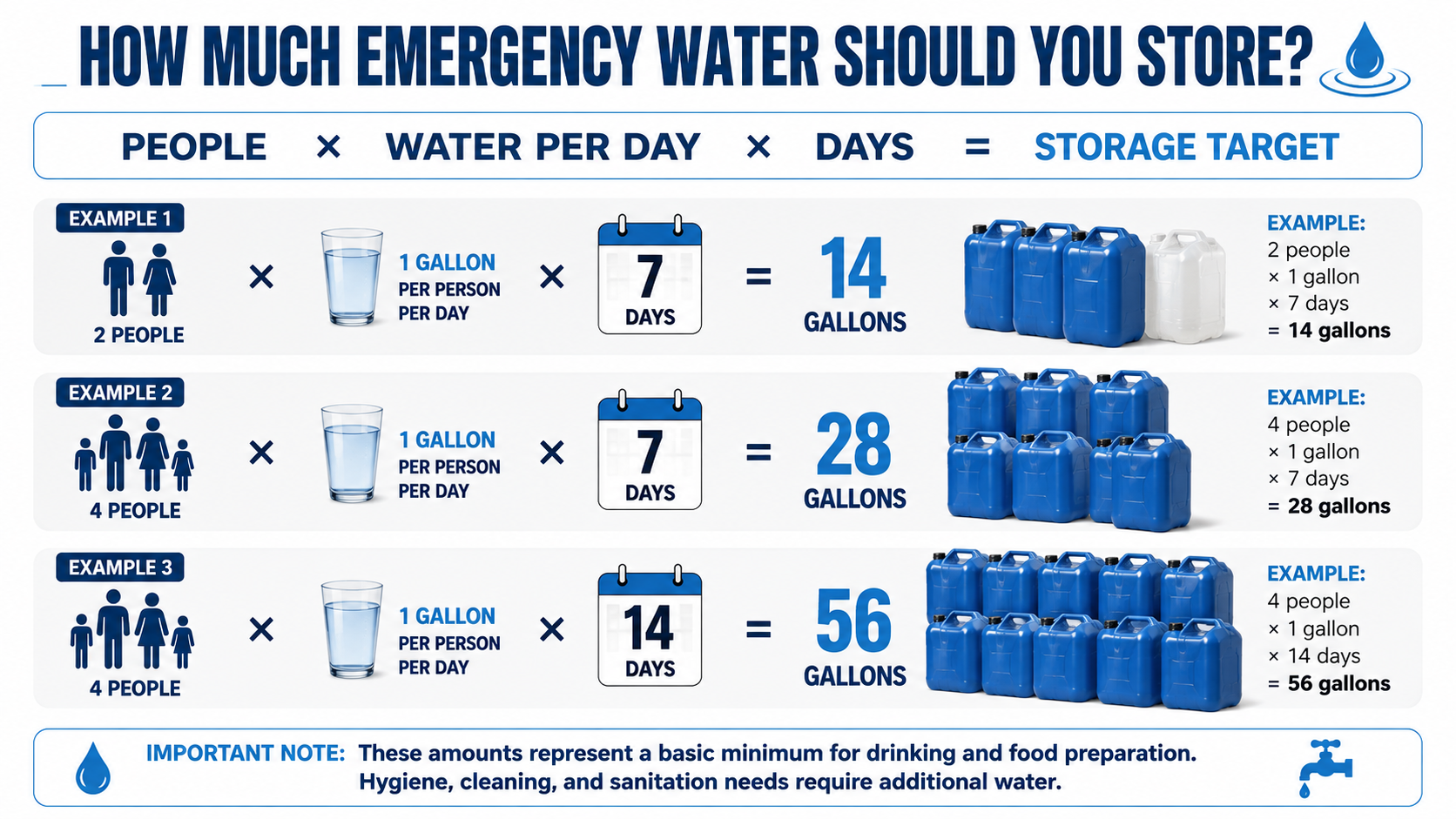
Before buying containers, decide how much water you actually want to store. A useful starting calculation is the number of people in the household multiplied by the amount of water needed per person each day, multiplied again by the number of days you want the reserve to last.
Using one gallon per person per day as a basic emergency planning amount, two people would need about 14 gallons for one week. Four people would need about 28 gallons for one week and roughly 56 gallons for two weeks. The source material also uses approximately one gallon per person per day as a basic emergency planning figure and encourages building the reserve gradually rather than trying to establish a massive supply immediately.
That number should be treated as a starting point for drinking and basic food preparation, not your total household water requirement. Washing hands, cleaning cookware, basic hygiene, pets and sanitation can use considerably more. Once the basic drinking-water reserve is established, additional water can be added for those jobs.
Combine Portable and Bulk Storage
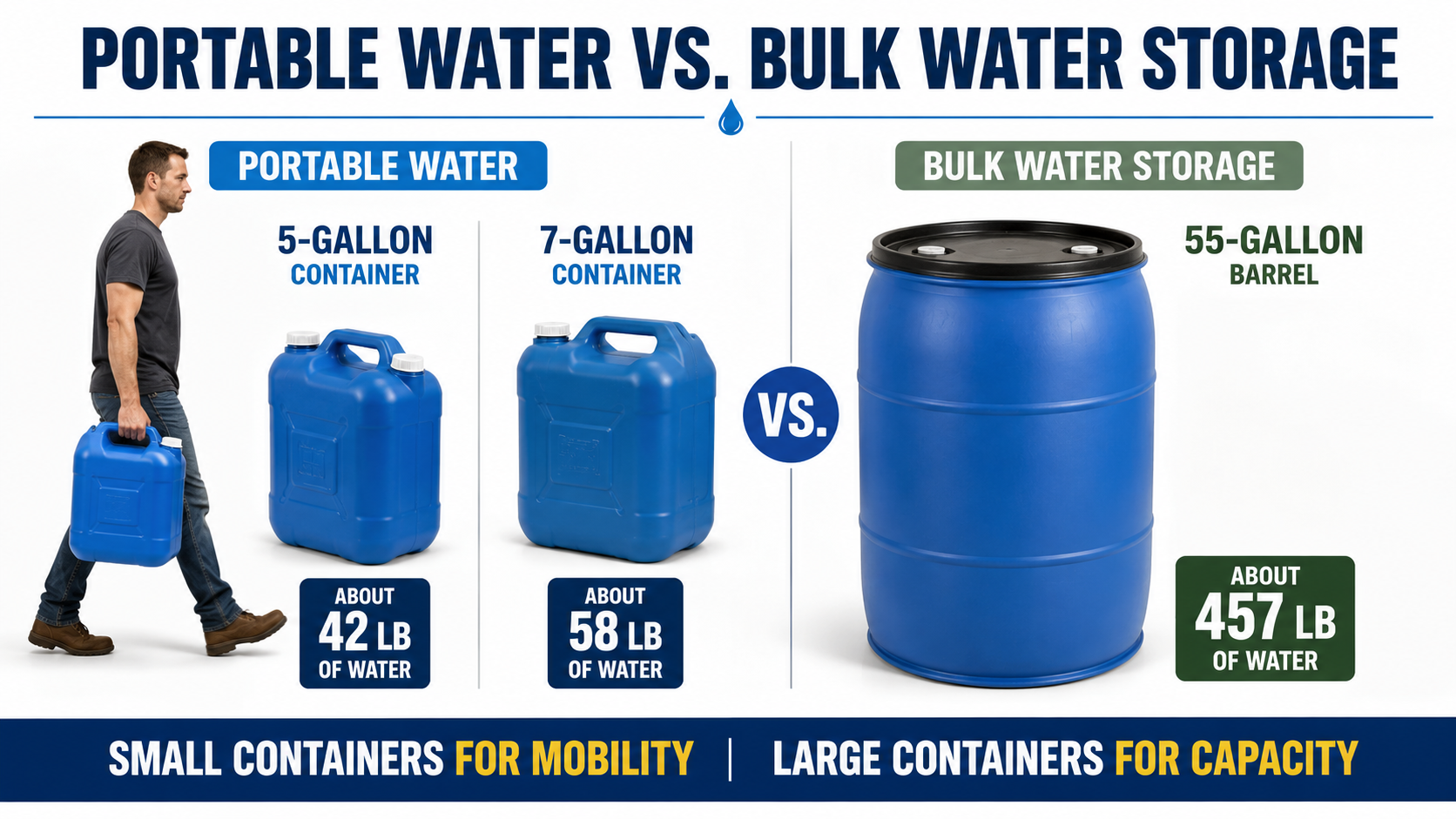
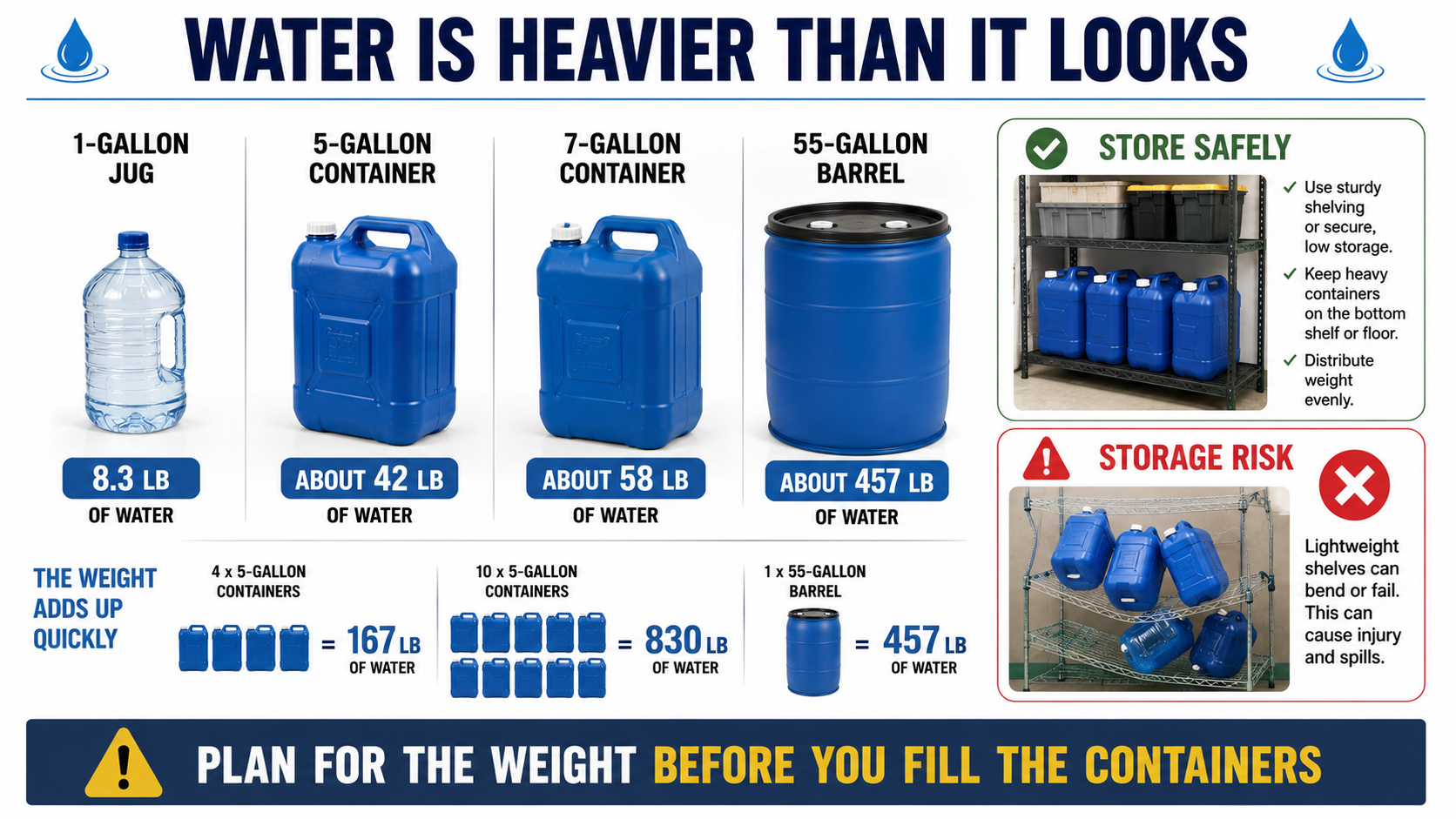
It is tempting to think that one large water barrel is the easiest solution, but water becomes extremely heavy. A gallon of water weighs roughly 8.3 pounds. Five gallons is around 42 pounds, seven gallons is close to 58 pounds and 55 gallons weighs roughly 457 pounds before the weight of the barrel itself is added.
That changes how the system needs to be designed.
Five-gallon containers are heavy but still manageable for many adults. Seven-gallon containers provide more capacity but can become awkward. A full 55-gallon barrel should be considered stationary. Once filled, you are not realistically going to pick it up and move it to another part of the house.
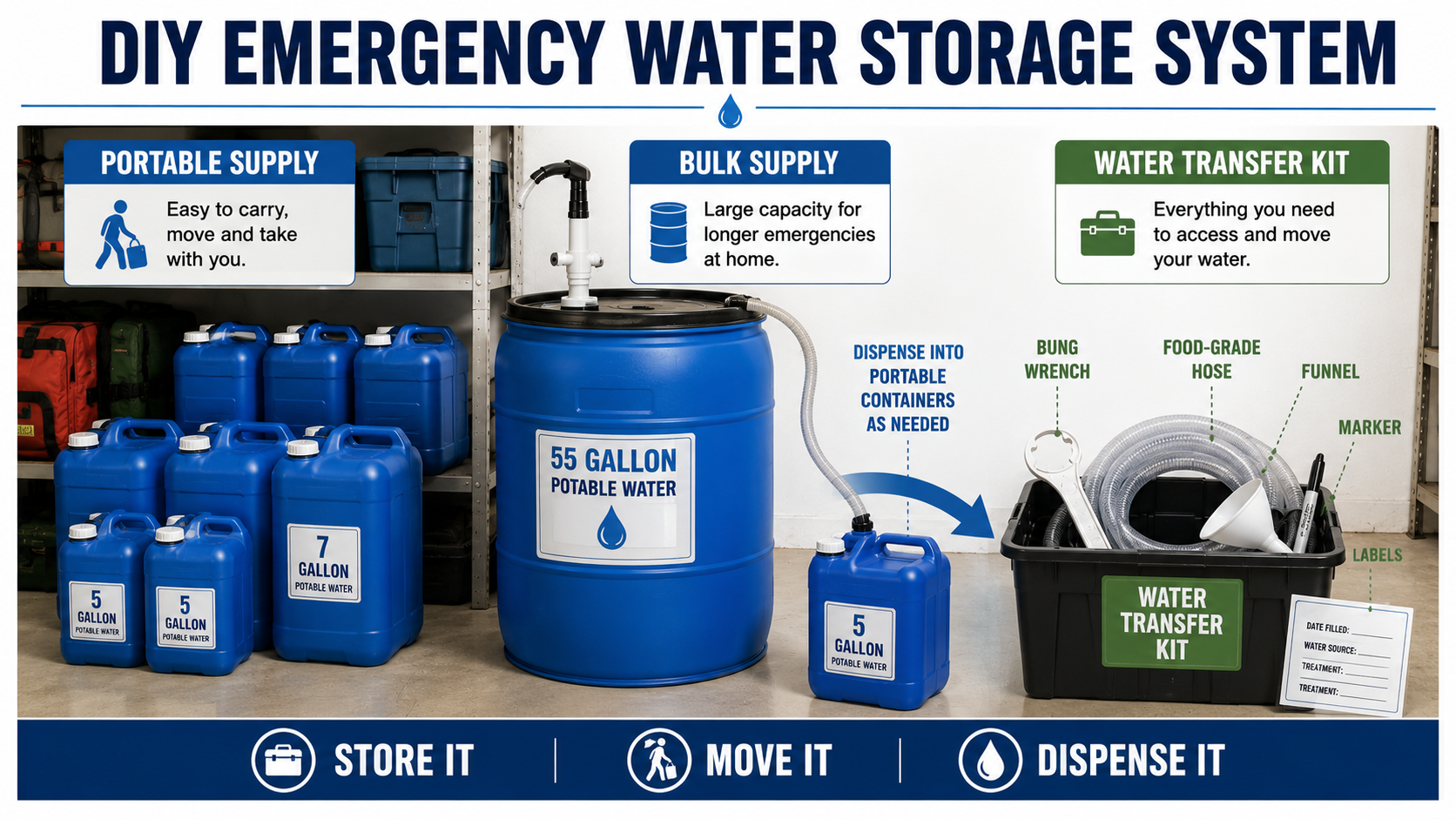
For that reason, a practical home system might contain several smaller potable-water containers along with one larger barrel. The smaller containers provide flexibility. They can be moved into the kitchen, loaded into a vehicle during an evacuation or given to another family member. The large barrel becomes the reserve that remains at home.
Using several containers also creates redundancy. If one container leaks, develops a damaged seal or becomes contaminated, you have not necessarily lost the entire water supply.
Choose the Storage Location Before You Fill Anything
Large water containers should be placed where they are going to remain before they are filled. A 55-gallon barrel that seemed easy to move when it was empty becomes a nearly 500-pound object when full.
The location needs to be strong, level and protected. A basement floor, sturdy storage room or another structurally appropriate location may work well. Smaller containers can often be distributed around the house in closets, storage rooms or other protected spaces instead of concentrating all of the water in one place.
Stored water should also be protected from excessive heat and direct sunlight. The source material specifically recommends keeping stored water in a cool location and out of sunlight.
Freezing is another consideration. Water expands when it freezes, which can damage some containers. A garage or shed that experiences severe winter temperatures may not be the best location for drinking-water storage unless the system has been designed for those conditions.
You should also think about what surrounds the water. Heavy objects should not be stored above containers where they could fall and damage them. Containers should remain accessible rather than becoming buried behind years of stored household items.
Use Containers Intended for Drinking Water
Not every plastic barrel is suitable for potable-water storage. For drinking water, use containers specifically manufactured and sold for that purpose.
Used barrels can sometimes be found cheaply, but the difficulty is knowing exactly what they previously contained. A barrel may look perfectly clean while still having residues that you cannot see or smell.
The source material takes the same cautious approach by recommending new containers for drinking water and reserving questionable used containers for sanitation purposes rather than relying on them as a potable supply.
That does not mean a used container has no preparedness value. A clearly identified non-potable barrel can still hold water for toilet flushing, cleaning or other utility purposes. It simply should never become confused with your drinking-water supply.
Clean and Prepare the Containers
Even a new water container should be prepared before it is filled. Follow the container manufacturer’s instructions and current guidance from your local public-health authority for cleaning and sanitizing potable-water containers.
Pay attention to the parts people often overlook. Caps, threads, gaskets, handles and dispensing equipment can all introduce contamination. Once the container is clean, avoid touching the inside surfaces with dirty hands or setting the cap on a contaminated surface.
The original material likewise emphasizes preparing and sanitizing containers before using them for long-term water storage.
If bleach or another disinfectant is used during preparation, follow current public-health instructions and the concentration shown on the product label. Household bleach formulas and strengths can vary, so an old universal number of drops should not automatically be applied to every product.
Fill the Water Containers
Fill potable containers from a known safe drinking-water source. Keep the hose, funnel or other filling equipment clean so that a sanitized container is not contaminated during the filling process.
Large barrels should already be in their permanent location before this begins.
Once the container is filled, close it securely and inspect the cap and seams for leakage. If anything appears damaged or does not seal properly, deal with the problem now rather than discovering it during an emergency.
This is also a good point to think about how you will actually use the water. A 55-gallon barrel with no way to remove the water is not a complete system.
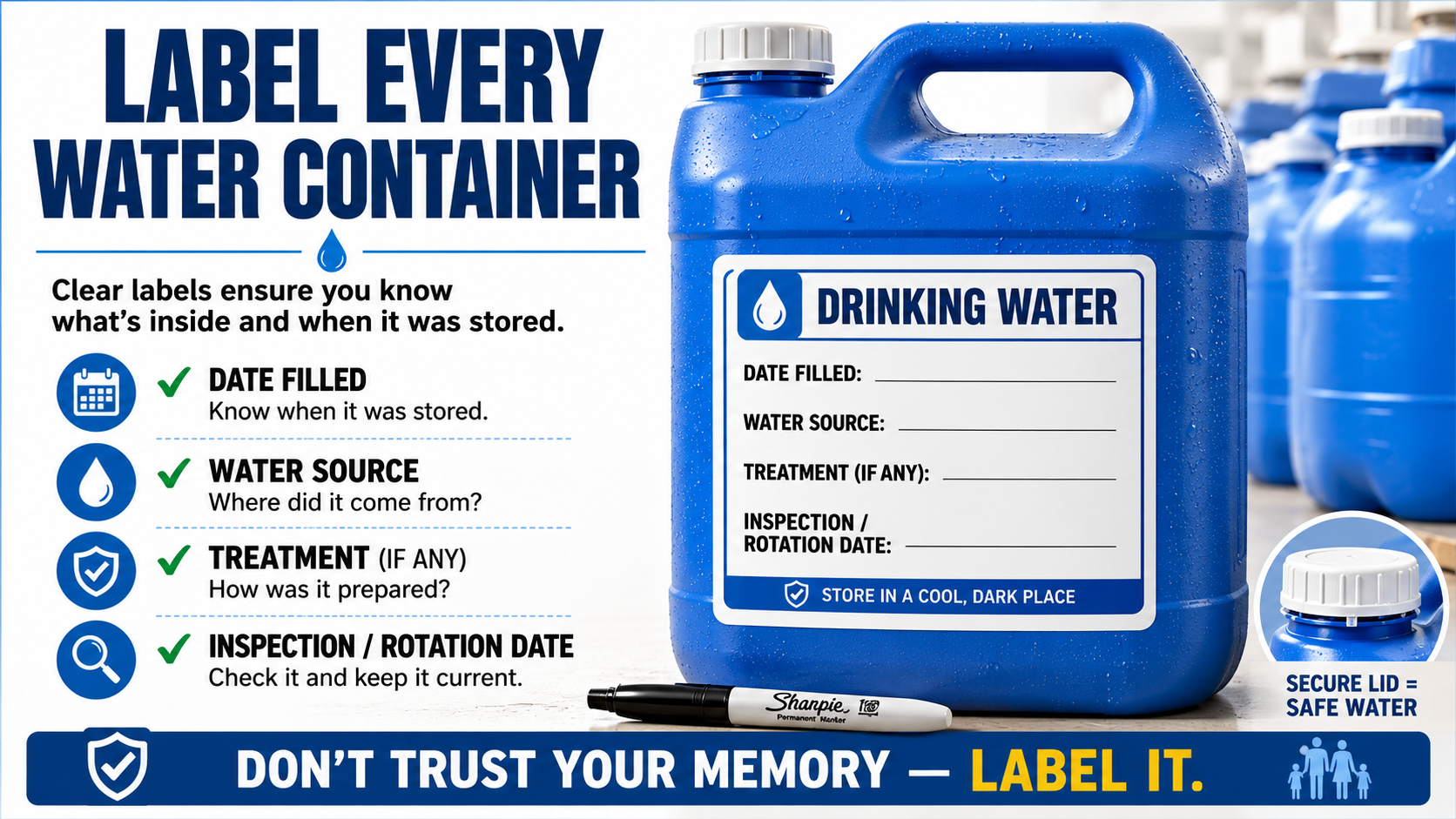
Label Every Container
Every container should be clearly marked.
At minimum, record that the container holds drinking water, the date it was filled, where the water came from, any treatment that was performed and when you intend to inspect or rotate it.
The source material also recommends dating water containers and recording relevant treatment information so the owner knows when the water was stored and when it may require attention.
This may seem unnecessary when you only have two containers, but it becomes important as the system grows. Months later, two identical barrels can look exactly the same even though one may have been filled years before the other.
Do not depend on memory.
Make Sure You Can Get the Water Out
Bulk water storage creates another problem that does not exist with small jugs. You need a practical way to dispense it.
A 55-gallon barrel may require a bung wrench to open the cap and a manual pump or siphon to remove the water. The source material specifically mentions both the bung wrench and water pump as important accessories for a large barrel.
Keep those tools beside the barrel.
Do not store the pump in one shed, the bung wrench in another toolbox and the water in the basement. During an emergency, all the parts of the system should be together.
A simple transfer kit can make this easier. A small tote stored beside the water could contain the manual pump, bung wrench, food-safe hose, clean funnel, waterproof marker, replacement labels and any instructions needed for the equipment.
Then test it.
Pump water from the barrel into a smaller container before an emergency happens. Make sure the pump fits, the hose reaches and the barrel can be opened without fighting with the cap.
Keep Drinking Water Separate From Utility Water
As the system expands, it can make sense to maintain two categories of stored water.
The first is potable water intended for drinking and food preparation. This should receive the greatest protection and should be stored only in suitable containers.
The second is utility water. This can be used for things such as toilet flushing and certain cleaning jobs where potable water is unnecessary.
Used barrels of uncertain history should never quietly migrate into the drinking-water system. The source describes keeping questionable second-hand barrels for sanitation rather than drinking purposes.
The easiest way to avoid confusion is large permanent labels.
A drinking-water container can be marked POTABLE — DRINKING WATER.
Utility-water storage should be clearly marked NON-POTABLE — DO NOT DRINK.
That distinction needs to remain obvious enough that anyone in the household can understand it during a stressful situation.
Plan for the Weight
Water storage places far more weight on floors and shelves than it appears to.
Four 5-gallon containers contain roughly 167 pounds of water. Ten of them contain more than 830 pounds. A single full 55-gallon barrel contains roughly 457 pounds of water.
Ordinary lightweight shelving may not be designed for that kind of load.
Keep heavy water containers low and stable. If shelving is used, make sure it is genuinely capable of supporting the weight rather than simply looking sturdy.
With large barrels, the safest solution is often a structurally suitable floor location rather than elevated shelving.
Build the System Over Time
A good water reserve does not have to be completed in a weekend.
Start with enough portable containers to establish a basic household supply. Once that is done, add another week. Later, add bulk storage if there is enough space and the location can safely support it.
The source material recommends the same general progression, beginning with a small reserve and gradually working toward longer periods of water independence.
Building slowly has another advantage. You discover what actually works.
You may find that seven-gallon containers are too heavy for some family members. Five-gallon containers might be easier. A barrel may fit better in another part of the basement. A certain pump may be awkward. These lessons are much easier to solve when the municipal water supply is still functioning.
Test the Whole System
When the project is complete, conduct a simple test.
Turn off the idea of using the household taps for an hour and pretend that the water system has failed.
Retrieve one of the portable containers. Carry it to where you would actually use it. Open it and pour from it. Operate the barrel pump and transfer several gallons into a smaller container. Find the bung wrench, hose and transfer equipment.
If any part of that process is inconvenient now, it will probably be worse during an emergency.
Maybe the barrel is too close to a wall for the pump to work properly. Maybe the container is too heavy. Maybe the shelf flexes under the load. Maybe the labels are too small to read. Maybe nobody except the person who built the system knows where the pump is.
Fix those problems now.
The difference between simply storing supplies and preparedness is knowing that the system actually works.
Preparedness Action Plan
Begin by calculating a realistic emergency water target for the household. Establish a basic drinking-water reserve first, using containers designed for potable water. Choose storage locations before filling anything and make sure the structure can safely handle the weight.
Prepare the containers according to current manufacturer and public-health recommendations, fill them from a known safe water source and label every container with the date and relevant information. Keep smaller containers available for mobility and consider larger stationary storage once the basic reserve is established.
If a bulk barrel is added, keep a compatible pump, bung wrench and water-transfer equipment directly beside it. Separate drinking water from utility water and make the difference obvious with permanent labels.
Most importantly, test the system before depending on it. Move the containers, operate the pump and transfer the water. A water reserve that has already been tested is far more valuable than one that has simply been stored.
Key Takeaways
Emergency water storage works best as a system rather than a collection of random containers. Smaller containers provide mobility while larger containers provide capacity, and using both creates useful redundancy.
Container quality matters because drinking water should only be stored in materials suitable for potable use. Location matters because water is extremely heavy and should be protected from heat, sunlight, freezing and physical damage.
Labels, pumps and transfer equipment may seem like small details, but they determine whether the stored water can actually be used when normal services are unavailable.
The objective is not just to own water.
It is to have safe water that can be found, moved and used when the tap stops working.
© Prepping Communities. This content is for informational purposes only and not professional advice. Use at your own risk.
Terms | Privacy | Guidelines