
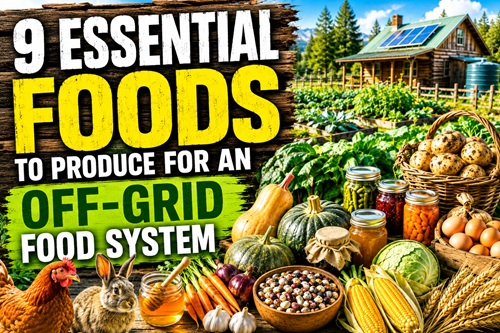
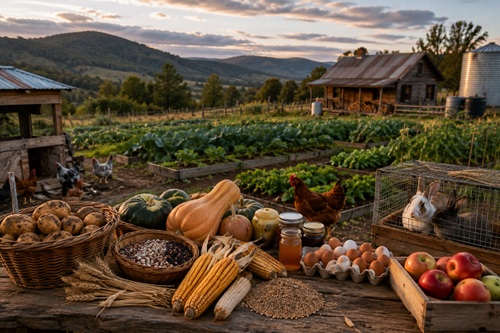
Going off-grid with food is much harder than simply planting a large garden.
A garden can provide plenty of fresh vegetables during summer, but true food independence requires something more. You need enough calories to keep people working, reliable sources of protein, foods that can survive months in storage, renewable seed, animal feed, water, soil fertility, and a way to preserve what you produce.
That changes what should be grown.
Tomatoes, lettuce, cucumbers, peppers, and herbs are excellent additions to a homestead, but they aren’t enough to carry a household through winter. If outside food supplies disappeared for an extended period, the crops that suddenly matter most would be the ones capable of producing substantial calories and nutrition while also being practical to store and reproduce.
The objective isn’t necessarily to produce absolutely everything you eat. For most properties, that isn’t realistic. The more useful goal is to identify the foods that provide the greatest return for your available land, water, labor, climate, and storage capacity.
These nine foods are a strong place to begin.
1. Potatoes: Build Calories Into the Garden
One of the biggest weaknesses in many home gardens is that they produce lots of vegetables but relatively few calories.
Potatoes help solve that problem.
A productive potato patch can turn a modest amount of growing space into a substantial amount of food. Potatoes are filling, versatile, relatively easy to grow, and adaptable to traditional rows, raised beds, containers, and other growing systems.
Their real off-grid advantage appears after harvest.
Storage varieties can remain usable for months when properly cured and kept in cool, dark, well-ventilated conditions. That allows food harvested in late summer or fall to continue feeding the household well into winter.
Growing potatoes is therefore only part of the skill.
An off-grid household should learn the complete cycle: planting, hilling, watering, identifying disease, harvesting without damaging the tubers, curing, storing, and maintaining suitable planting stock for another season.
When you can repeat that cycle without depending entirely on outside supplies, potatoes become much more than another garden vegetable. They become part of your food infrastructure.
2. Dry Beans: Produce Protein That Doesn’t Need a Freezer
Dry beans are one of the most practical foods a household can produce because they combine protein, carbohydrates, long storage life, and seed production in the same crop.
They also require no refrigeration after they have been properly dried.
That matters enormously in an off-grid system.
Freezers are convenient, but every freezer creates an energy requirement. The food remains secure only as long as the freezer continues operating. Dried beans can sit safely in appropriate storage without consuming electricity every day.
There is an important difference between growing beans for fresh eating and producing beans as a staple food.
Green beans are harvested while the pods are young. Dry beans remain on the plant until the seeds mature. Those seeds are then harvested, thoroughly dried, and stored.
Some of the best beans can also be reserved as seed for the following year.
Beans have another useful role in crop rotation. As legumes, they work with soil bacteria that fix atmospheric nitrogen. They aren’t a magical replacement for compost or soil management, but incorporating legumes into a thoughtful rotation can contribute to maintaining productive soil.
For a small property, climbing beans also provide the advantage of vertical production. Instead of spreading across valuable garden ground, they can climb trellises and fencing.
3. Corn: Grow a Grain, Not Just a Summer Vegetable
Sweet corn tastes great straight from the garden, but corn can play a much larger role in food independence.
Dry or flour corn can be allowed to mature on the stalk and then harvested as grain. Depending on the variety, that grain can be ground into cornmeal and used in numerous staple foods.
Corn can potentially contribute to animal feed as well.
That creates an important connection between the garden and livestock. If chickens or other animals depend entirely on bags of purchased feed, the homestead hasn’t eliminated that outside dependency—it has simply moved it from the grocery store to the feed store.
Producing some feed locally can reduce that vulnerability.
Corn does require planning. It is a relatively heavy feeder, needs adequate moisture during important stages of growth, and requires sufficient pollination. Because corn is primarily wind-pollinated, growing it in blocks generally provides better pollination than planting a single long row.
Growing corn for grain also means learning what happens after harvest.
The kernels must mature sufficiently, dry properly, and be protected from moisture, insects, and rodents during storage. If cornmeal is the objective, a grain mill becomes another part of the food system.
That processing step is easy to overlook when planning an off-grid garden.
4. Winter Squash: Grow Food That Naturally Keeps
Preserving everything with jars and freezers requires equipment, energy, containers, and considerable labor.
Winter squash offers another approach.
Many storage squash varieties can remain edible for months after harvest without canning, freezing, or dehydrating. Butternut, Hubbard, acorn, and other varieties each have different storage characteristics, making it worth experimenting to determine which performs best in your climate and storage conditions.
Proper curing is important.
After harvest, suitable squash varieties are generally allowed to cure under appropriate warm, dry conditions so their skins harden before being moved into storage. Damaged fruit should be eaten first because cuts and bruises can dramatically shorten storage life.
Squash plants require considerable garden space, but that isn’t always a disadvantage.
Their vines can spread across areas that might otherwise remain unused, while the large leaves shade the soil and can help suppress weeds and reduce evaporation.
A productive squash patch can therefore provide something extremely valuable at harvest: food that is already packaged by nature for storage.
5. Chickens: Produce Eggs While Building a Larger Food System
Chickens are one of the most useful animals on a small homestead because they can perform several jobs at once.
The obvious benefit is eggs.
A healthy laying flock can provide a regular source of protein and fat through much of the year. Chickens can also provide meat, manure for composting, insect control, and assistance cleaning up garden residue.
But anyone seriously planning for off-grid food production should ask an important question:
What happens when the chicken feed runs out?
A flock consuming commercially produced feed every day still depends heavily on the outside food system.
That doesn’t mean purchased feed should never be used. It means feed deserves the same planning attention as human food.
Pasture, insects, garden surplus, appropriate kitchen scraps, locally produced grains, seeds, and other feed sources may help reduce dependence on commercial feed. The nutritional requirements of the birds still need to be met, so simply throwing scraps into a chicken run isn’t a complete feeding strategy.
Predator protection is equally important.
Losing half a flock in one night can erase months or years of work. A secure coop, protected run, reliable water supply, and sensible flock size are fundamental parts of the system.
The best flock isn’t necessarily the largest one. It is the flock your property can reliably support.
6. Rabbits: Produce Meat in a Small Area
Not every homestead has enough land for cattle, pigs, goats, or other larger livestock.
Rabbits provide another option.
They require relatively little space, reproduce rapidly under proper management, and can provide a recurring source of meat. Their manure can also contribute directly to the fertility cycle of the homestead.
This makes rabbits particularly interesting when they are integrated with the garden rather than treated as a separate operation.
The garden can produce suitable forage and supplemental feed. Rabbits produce manure. That manure helps support soil fertility. Improved soil grows more plants.
The waste from one part of the homestead becomes an input for another.
That is exactly the type of relationship an off-grid property should try to develop.
Rabbits still require careful management. They need dependable water, appropriate nutrition, clean housing, ventilation, protection from predators, and particular attention during hot weather.
As with chickens, feed independence matters.
If rabbits can survive only while commercial pellets are available, the system still contains a significant outside dependency. Learning to produce suitable forage and other appropriate feed sources locally makes rabbit production considerably more resilient.
7. Apples: Plant Food That Can Produce for Decades
Most garden crops have to be replanted every year.
Fruit trees operate on a completely different timeline.
An apple tree may take years before producing significant harvests, but once established, a healthy tree can continue producing food for decades.
That makes fruit trees a long-term investment in food security.
Apples are particularly useful because they can be eaten fresh, stored, dried, canned, turned into applesauce, pressed for cider, or used to make vinegar. Different varieties can also ripen at different points in the season, spreading the harvest rather than producing everything at once.
Choosing varieties carefully matters.
A good off-grid orchard isn’t necessarily ten trees of the same variety. It might include early apples for immediate eating, later varieties for storage, cooking varieties, cider apples, and trees selected for resistance to common local diseases.
Pollination should also be planned before planting because many apple varieties benefit from or require compatible pollination partners.
Fruit trees demonstrate one of the most important principles of self-sufficiency: some resources have to be established long before you need them.
You can plant radishes and eat them weeks later.
You cannot plant an apple tree after a food shortage begins and expect an orchard that fall.
8. Wheat or Another Grain: Learn Where Flour Actually Comes From
Flour is so easy to buy that it is easy to forget how much work exists between a field of grain and a loaf of bread.
Growing some grain yourself quickly changes that perspective.
Wheat may work well in many temperate climates, but it isn’t automatically the best choice everywhere. Rye, oats, barley, buckwheat, and other grains may perform better depending on local growing conditions and how the grain will ultimately be used.
The important lesson isn’t simply learning how to plant grain.
It is learning the entire process.
Grain has to be grown, harvested, dried, threshed, separated from chaff, stored, and eventually processed. If flour is the objective, it must then be milled.
That makes a manual grain mill an especially valuable piece of off-grid equipment. An electric mill may be convenient for normal use, but having a non-electric method provides another layer of redundancy.
Start small.
Growing even a modest experimental patch can teach harvesting and processing skills without risking a major portion of the garden.
The first crop may teach you that producing grain isn’t difficult.
Processing it efficiently may teach you something entirely different.
9. Bees: Produce Sweetener While Supporting the Rest of the Homestead
A garden can produce vegetables. An orchard can produce fruit. Livestock can provide meat and eggs.
Producing your own sweetener is more difficult.
Honey can help fill that gap.
Honey stores exceptionally well when handled properly, making it particularly attractive for a food system designed to function without refrigeration.
But honey isn’t necessarily the biggest contribution bees make to a homestead.
Pollination may be even more valuable.
Fruit trees, berries, squash, cucumbers, and many other food plants benefit from insect pollination. Maintaining good pollinator habitat can therefore increase productivity across several parts of the property.
Beekeeping requires knowledge and ongoing management. Colonies face parasites, disease, predators, weather, food shortages, swarming, and winter losses. Enough honey must also remain with the colony to support its own needs.
Beeswax provides another useful product that can be used for candles, salves, waterproofing applications, and other homestead projects.
Bees are therefore best understood not simply as honey producers but as another working component of the larger food system.
How the Nine Foods Work Together
The real strength of these foods becomes clearer when their roles are compared.
| Food | Main Contribution | Storage Potential | Land Requirement | Outside Dependency to Reduce |
|---|---|---|---|---|
| Potatoes | Calories and carbohydrates | Excellent | Low–Moderate | Seed potatoes, fertilizer |
| Dry Beans | Protein and carbohydrates | Excellent | Low–Moderate | Seed, soil amendments |
| Corn | Calories, grain, possible livestock feed | Excellent when dry | Moderate–High | Seed, fertilizer, processing |
| Winter Squash | Calories and nutrients | Very Good | Moderate | Seed, fertility |
| Chickens | Eggs, meat and manure | Continuous production | Low–Moderate | Commercial feed |
| Rabbits | Meat and manure | Continuous production | Low | Commercial feed |
| Apples | Fruit and carbohydrates | Good–Very Good | Moderate | Orchard supplies |
| Wheat/Grain | Calories and flour | Excellent | Moderate–High | Seed, harvesting equipment |
| Honey/Bees | Sweetener and pollination | Excellent | Low physical footprint | Beekeeping supplies |
No individual food solves the food-independence problem.
That is the most important lesson.
Potatoes provide calories but aren’t a complete diet. Chickens provide valuable protein but require food themselves. Apples can produce for decades but take years to establish. Grain can remain stored for long periods but requires harvesting and processing. Bees can produce honey while improving pollination, but they depend on a healthy surrounding ecosystem.
A resilient food system comes from combining them.
Think in Systems Instead of Individual Crops
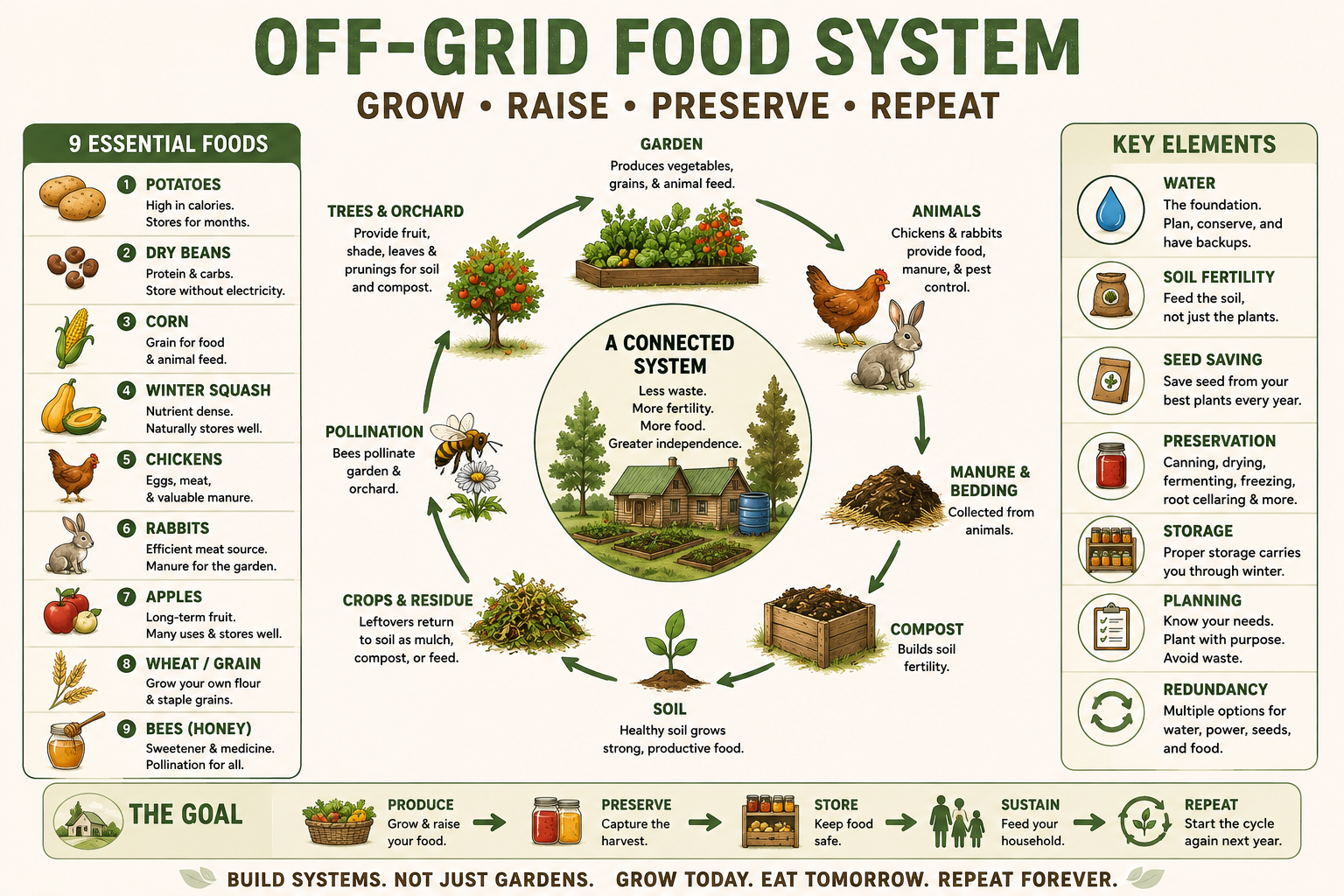
A truly useful off-grid property should gradually become a collection of interconnected systems.
Instead of asking only, “What can I grow?” start looking at what each part of the property can provide to another part.
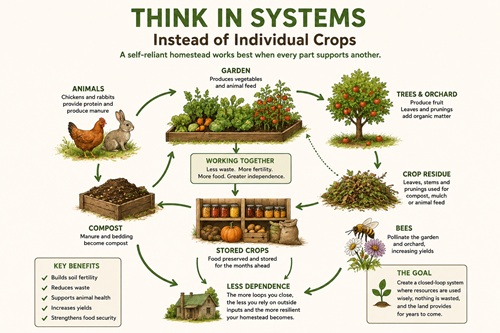
Chickens and rabbits produce manure. Manure and bedding become compost. Compost supports the garden. The garden produces vegetables and animal feed. Crop residue can become compost, mulch, or suitable animal feed. Bees pollinate the garden and orchard. Trees produce fruit while leaves and pruning’s contribute organic material. Stored crops carry the household through the months when little food can be produced.
The closer you can bring those loops together, the less material has to enter the property from somewhere else.
That is a much better measure of food independence than simply counting how many vegetables are growing.
Your Animals Need a Food Plan Too
Livestock can create a false sense of food independence.
Twenty chickens may look like a tremendous source of food until you calculate how much feed those birds consume during an entire year.
The same principle applies to rabbits and larger livestock.
For every animal brought onto an off-grid property, consider how much land, water, feed, shelter, fencing, medicine, bedding, and labor it requires.
Then consider which of those resources currently come from outside the property.
This exercise often reveals weaknesses that aren’t immediately obvious.
Producing even part of your livestock feed can significantly strengthen the system. Growing grain, sunflowers, forage crops, fodder, or other suitable feeds may be worth considering depending on the animals and climate.
The objective isn’t necessarily to eliminate every purchased input immediately. It is to know where the dependencies are and develop alternatives before they become necessary.
Produce Food for Winter, Not Just Summer
A successful July garden can create the illusion of abundance.
The real test comes in January.
If you live somewhere with a cold winter, the productive season may represent only part of the year. That means the growing season has to produce enough surplus to help cover the non-growing season.
This is where crop selection becomes critical.
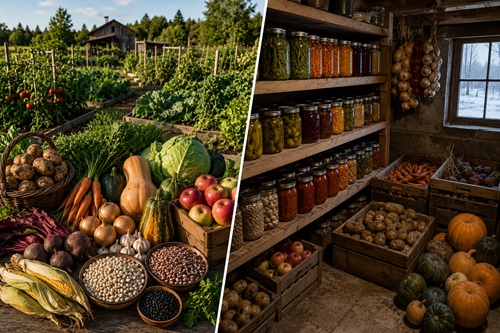
Potatoes, dry beans, grain, winter squash, storage apples, onions, garlic, carrots, beets, cabbage, and other storage-friendly foods have much greater off-grid value than foods that must be eaten immediately after harvest.
Preservation extends that capability further.
Canning, dehydration, fermentation, cold storage, root cellaring, freezing where dependable power exists, and other preservation methods can turn a short harvest window into months of stored food.
A useful exercise is to look at every crop you grow and ask:
If we couldn’t buy groceries this winter, how much of this harvest would still be available in February?
That question can completely change how a garden is planned.
Seed Is Part of Your Food Supply
A pantry full of food may get you through one winter.
Seed helps you produce the next harvest.
For long-term food production, learning to save seed can be just as important as learning to store food.
Open-pollinated varieties are particularly useful because seed can generally be saved and replanted while retaining the basic characteristics of the variety, provided proper isolation and seed-saving practices are followed.
Seed saving is more complicated than simply collecting seeds from every plant.
Different plants have different pollination behaviours. Some readily cross with related varieties. Others are biennial and don’t produce seed until their second year. Seeds must also be properly matured, cleaned, dried, labelled, and stored.
Start with easier crops such as beans and gradually build your skills.
Over time, selecting seed from plants that perform particularly well on your property may also help develop locally adapted seed stock.
That is a powerful form of resilience.
Water Determines How Much Food You Can Really Produce
Land gets much of the attention when people plan homesteads.
Water may ultimately be more important.
A large garden isn’t useful if there isn’t enough water to keep it productive through a hot, dry summer. Livestock also require dependable drinking water every day.
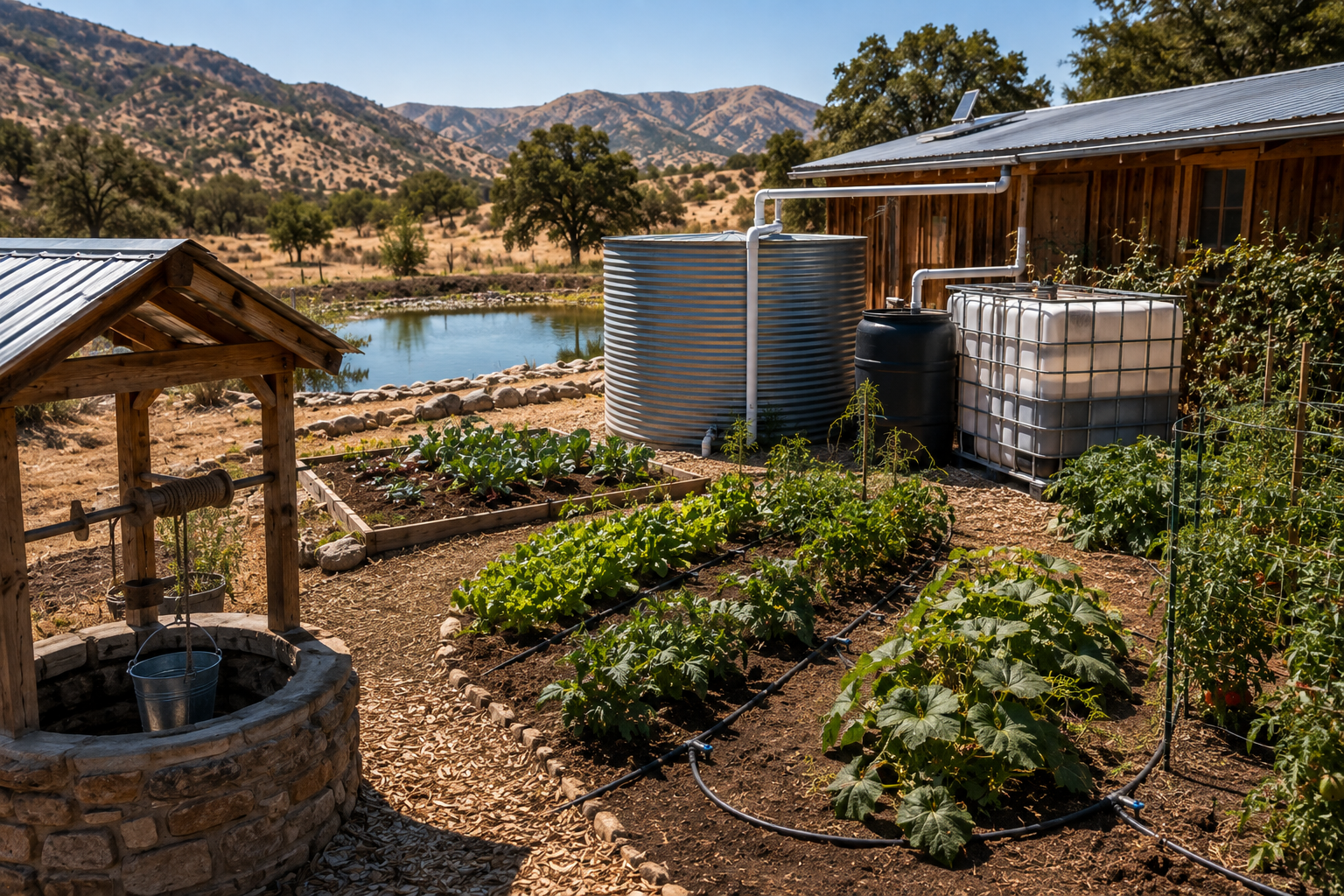
Off-grid food planning should therefore include water before expanding production.
Wells, rainwater collection, ponds, storage tanks, gravity-fed systems, pumps, irrigation, mulching, soil organic matter, and drought-tolerant crops can all become pieces of the solution depending on the property.
Redundancy matters here as well.
If the garden depends entirely on an electric well pump, losing electricity can quickly become a food-production problem.
Knowing exactly how the property will supply water when the normal system isn’t operating is part of building a truly off-grid food system.
Soil Is a Resource That Has to Be Rebuilt
Every harvest removes nutrients from the land.
If those nutrients continually leave the property without being replaced, productivity eventually declines.
Compost, animal manure, cover crops, crop rotation, mulches, plant residues, and other organic materials can help return nutrients and organic matter to the soil.
This is another reason livestock can be valuable.
Animals don’t simply produce food. Properly managed manure becomes part of the fertility system supporting future food production.
The objective is to gradually reduce the need to continually purchase fertility from outside the property.
Healthy soil also does more than supply nutrients. Good soil structure improves water infiltration and moisture retention, supports soil organisms, and gives plant roots better conditions in which to grow.
Protecting the soil is protecting future harvests.
Don’t Try to Become 100 Percent Self-Sufficient Overnight
Producing nearly everything a household eats is a major undertaking.
Trying to build the entire system in one season can create more problems than it solves.
A better approach is to remove dependencies gradually.
One year might focus on potatoes, beans, and learning food storage. The next could add chickens and an expanded compost system. Fruit trees can be planted early because they need time to mature. Grain can begin as a small experimental plot. Beekeeping can come after enough forage and flowering plants are established.
Every season adds another skill.
Eventually the property begins to change.
Instead of simply being a place where food is consumed, it becomes a place where food is continuously produced, preserved, recycled, and regenerated.
The Real Goal Is Repeatable Food Production
Having six months of stored food is valuable.
Being able to produce another six months of food is even more valuable.
That distinction is at the heart of off-grid food security.
A pantry is a reserve. A functioning garden, orchard, seed supply, livestock system, water system, preservation capability, and healthy soil represent production capacity.
Both matter.
The strongest food strategy combines stored reserves with the knowledge and infrastructure required to replace what is consumed.
The ultimate question isn’t simply how much food you have today.
It is whether you can produce it again next year.
Preparedness Action Plan
Begin by identifying which of the nine foods can realistically be produced on your property. Don’t select them simply because they appear on this list. Climate, acreage, water, wildlife pressure, soil, storage space, available labour, and local growing season should determine what makes sense.
Next, identify your biggest food dependencies. Determine where your calories, protein, cooking fats, animal feed, seed, fertilizer, and winter food currently come from.
Choose one or two dependencies to reduce.
Grow a serious storage-potato crop instead of a few plants. Allow beans to mature for dry storage. Experiment with a small grain plot. Plant fruit trees before you need them. Learn to save one variety of seed correctly. Build proper storage for winter squash and potatoes. Determine how livestock could be fed if purchased feed became difficult to obtain.
Most importantly, practice the complete cycle.
Don’t stop at growing the food.
Harvest it. Process it. Store it. Cook with it. Save seed where appropriate. Feed some of the waste back into the property. Then grow it again.
That is how a garden gradually becomes an off-grid food system.
© Prepping Communities. This content is for informational purposes only and not professional advice. Use at your own risk.
Terms | Privacy | Guidelines