
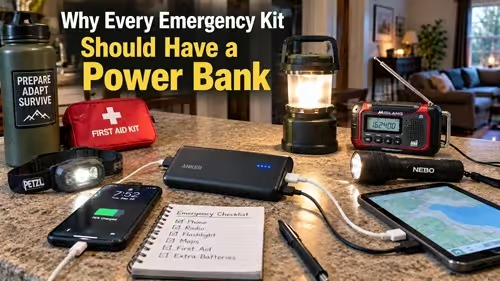
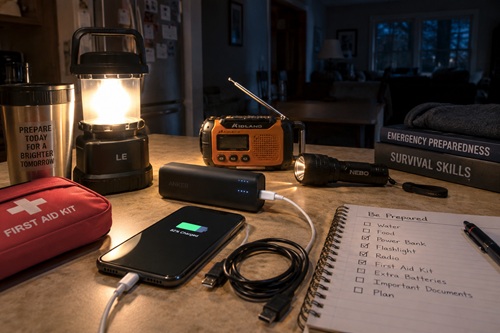
Power banks probably aren’t the first thing most people think about when putting together emergency supplies. Food, water, flashlights and first aid usually come first, and they should. But think about how many things you use during an emergency that now depend on a rechargeable battery. Your phone is the obvious one, but you may also have rechargeable flashlights, headlamps, lanterns, radios, GPS units, tablets and other equipment. Once the electricity goes out, every one of those devices has a limited amount of operating time left.
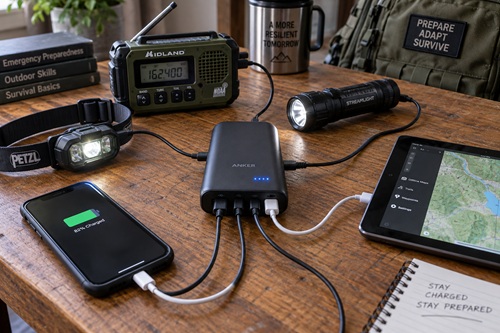
Your phone in particular can become pretty important during an emergency. It may be how you receive weather warnings and emergency alerts, communicate with family, check road conditions, use maps or access information you’ve saved for offline use. Even during a local power outage, cellular service may continue operating for some time because parts of the telecommunications system have backup power. That doesn’t mean cell service will always be available, especially during a widespread or prolonged outage, but keeping your phone charged gives you the ability to use the network while it is still working.
This is really where a power bank earns its place in an emergency kit. It isn’t going to power your house, and it isn’t a replacement for a generator or larger portable power station. What it can do is keep some of your smaller and potentially important electronics working after the outlets stop working. Depending on its capacity, a power bank may recharge a phone several times. Larger USB-C models can also charge certain tablets, laptops and other compatible equipment.
Don’t get too caught up in the numbers printed on the package. Power banks are commonly advertised as 10,000 mAh, 20,000 mAh, 25,000 mAh and larger, but you won’t actually get every bit of that advertised capacity delivered to your phone. Some energy is lost during the charging process. For preparedness purposes, the easiest way to find out what you really have is to test it. Fully charge the power bank, use your phone normally and see how many times you can recharge it before the bank is empty. Do the same with any other important equipment you expect it to charge.
The cables are just as important. It sounds obvious, but it’s easy to put a power bank in an emergency kit and forget that different devices may require different cables. Keep the cables and adapters you need with the power bank. If several people in the household use different phones or devices, make sure your emergency charging setup works with all of them. A spare charging cable isn’t a bad idea either because cables get lost and damaged fairly easily.
Power banks also shouldn’t be something you buy, throw into a drawer and forget about for five years. Batteries gradually lose charge and capacity, and excessive heat can shorten their life. Check your power banks periodically, recharge them as recommended by the manufacturer and store them somewhere reasonably cool and dry. Be especially careful about leaving lithium-ion power banks permanently inside vehicles where summer temperatures can become extremely high. If a power bank becomes swollen, damaged, unusually hot or otherwise looks wrong, stop using it.
There is also an important limitation to remember. A power bank stores electricity; it doesn’t make electricity. Once you’ve drained it, you need some way to recharge it. That isn’t much of a problem during a short outage, but it becomes a much bigger issue if the electricity is unavailable for several days.
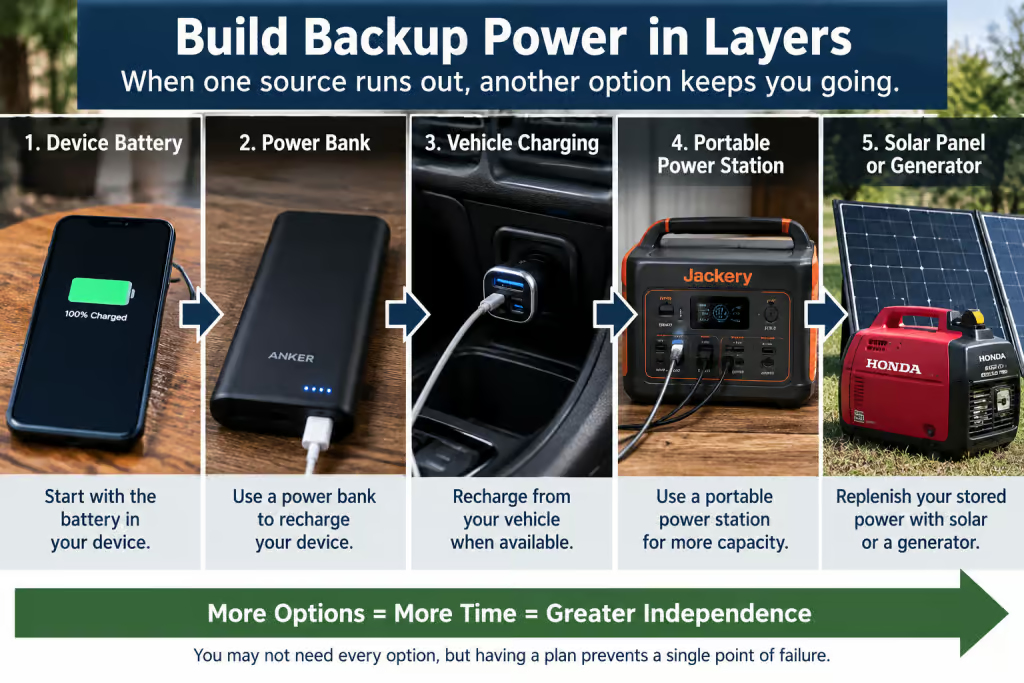
This is why it makes sense to think about emergency power in layers. You might start with the battery in your phone, then have one or two power banks available. Your vehicle may give you another way to charge them. A small solar panel, portable power station or generator might provide another option depending on your situation. You don’t necessarily need every one of these things. The point is to avoid having your entire plan depend on one battery.
You can also stretch your available power considerably by changing how you use your devices. During a normal day it doesn’t matter much if your phone screen is bright or you’re watching videos. During an extended outage, that is stored electricity being used up. Lowering the screen brightness, using battery-saving mode, shutting down unnecessary apps and limiting nonessential use can make a noticeable difference. The same applies to rechargeable lanterns and other equipment. You don’t always need to run them at full brightness.
It’s also worth thinking about how much important information you now keep electronically. Phone numbers, addresses, maps, emergency plans, identification documents and preparedness information may all be stored on a phone, tablet or computer. Downloading important information for offline use is a good start, but remember that offline information still isn’t very useful if the device containing it has a dead battery. Important phone numbers, addresses and basic emergency instructions are still worth keeping on paper as another backup.
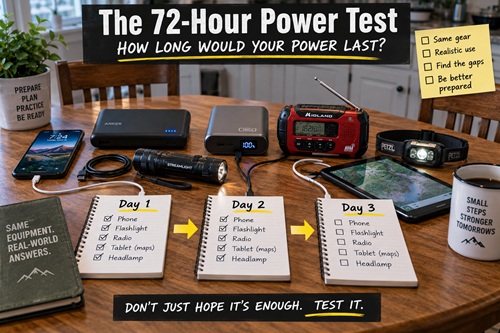
A simple way to test all of this is to imagine the power went out tonight and wouldn’t be restored for three days. Look at the equipment you already have and work out what you could realistically keep running. How many times could you recharge your phones? Could you keep your flashlights and emergency radio operating? Would everyone in the household have access to communication? Most importantly, once your power banks were empty, would you have any way to recharge them?
You don’t have to actually shut your electricity off for three days to learn from the exercise. Even going through one evening without using a wall outlet can reveal quite a bit. You may discover that you have more backup power than you thought. You may also discover that the power bank you haven’t touched in two years is nearly dead, you’re missing the cable for your flashlight, or you have plenty of stored electricity but no practical way to replenish it.
Preparedness Action Plan
Pull out the power banks you already own and charge them. Put the correct charging cables with them and test them with the phones, flashlights, radios and other devices you would actually use during an outage. Find out approximately how many charges they can provide instead of relying entirely on what the packaging says.
Then look one step further ahead. Figure out what you would do after the power banks were empty. That might mean charging from a vehicle, solar panel, portable power station, generator or another source available to you. If you don’t currently have another option, you’ve identified a useful gap in your preparedness.
Key Takeaways
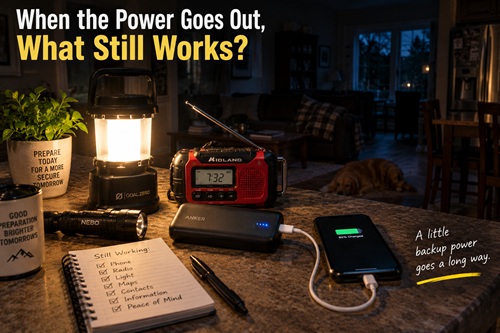
A power bank isn’t going to solve a long-term electricity problem, but that’s not really what it’s for. Its value is that it buys you time. It can keep a phone working, recharge a flashlight, keep a radio operating or give you access to important information while you work out what comes next.
Like most preparedness equipment, the best time to figure out what it can and can’t do is before the emergency. Charge it, test it, keep the right cables with it and know how you’re eventually going to recharge it.
That’s a much better plan than discovering you have a drawer full of rechargeable emergency equipment and no electricity left to run any of it.
© Prepping Communities. This content is for informational purposes only and not professional advice. Use at your own risk.
Terms | Privacy | Guidelines