
Introduction
Water is one of the few survival necessities that cannot be postponed for long. Most people can survive weeks without food, but only a few days without safe drinking water. Unfortunately, finding water during an emergency does not guarantee that it is safe to consume. Rivers, lakes, streams, rainwater collection systems, private wells, and even municipal water supplies may become contaminated following natural disasters, infrastructure failures, power outages, floods, or sanitation problems. Drinking untreated water under these conditions can quickly lead to dehydration, severe gastrointestinal illness, or life-threatening infections that are far more dangerous than thirst itself.
Water purification is the process of destroying or inactivating harmful microorganisms that cause disease. These organisms include bacteria, viruses, protozoa, and parasites that cannot normally be seen with the naked eye. Although the water may appear perfectly clear, millions of microorganisms can still be present. For this reason, appearance alone should never be used to judge whether untreated water is safe to drink.
Many people mistakenly believe that water filtration and water purification are the same process. They are closely related, but they perform different functions. A filter physically removes particles and, depending upon its design, may also remove many microorganisms. Purification uses heat, chemicals, ultraviolet light, or other treatment methods to kill or inactivate organisms that remain in the water. In many emergency situations, the safest drinking water is produced by combining both filtration and purification rather than relying on either method by itself.
One of the most important preparedness principles is redundancy. Just as responsible households maintain multiple food sources, backup power options, and alternative communication methods, they should also maintain multiple ways to produce safe drinking water. A camping stove may run out of fuel. Batteries powering an ultraviolet purifier may eventually fail. Chemical disinfectants lose strength over time, and filters eventually become clogged or damaged. Knowing several purification techniques ensures that the loss of one method does not leave your household without drinking water.
This lesson explains how the most common purification methods work, when each should be used, and the situations where they may not provide adequate protection. More importantly, it teaches you how to evaluate a water source, select the appropriate treatment, avoid common mistakes, and build a layered purification system that remains effective under a wide variety of emergency conditions.
Learning Objectives
By completing this lesson, you should be able to evaluate an unknown water source, identify the most likely contaminants, choose the most appropriate purification method, apply that method correctly, understand its limitations, and safely store the finished water to prevent recontamination. You will also learn why combining several treatment methods often provides a much higher level of protection than relying on a single technique.
Why Water Purification Matters
History repeatedly demonstrates that contaminated water often becomes one of the greatest dangers following disasters. Earthquakes damage underground water mains, floods overwhelm sewage systems, hurricanes interrupt municipal treatment facilities, and wildfires leave ash and debris that contaminate reservoirs. Even temporary power outages may reduce chlorination within municipal systems, allowing harmful microorganisms to enter drinking water supplies before repairs are completed.
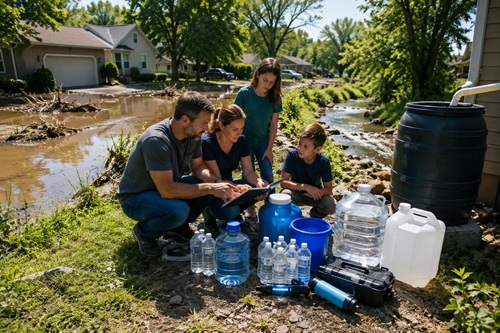
Natural water sources present their own challenges. Wildlife, livestock, birds, and human activity continually introduce bacteria, viruses, and parasites into rivers, lakes, and streams. Rainwater may appear exceptionally clean while falling from the sky, yet it can collect bird droppings, dust, pollen, leaves, and roofing materials before entering storage tanks. Private wells may remain safe for years before suddenly becoming contaminated by flooding or damaged well casings.
One of the greatest hazards is that microbiological contamination usually cannot be detected without laboratory testing. Water carrying harmful organisms often has no unusual taste, odor, or appearance. Clear water is not necessarily clean water. Likewise, cloudy water is not automatically unsafe, although suspended particles usually indicate that additional treatment will be required.
Proper purification dramatically reduces these risks by destroying the microorganisms responsible for many waterborne diseases. While no purification method can solve every possible contamination problem, correctly treating biological hazards significantly reduces the likelihood of illness and allows households to remain healthy when medical care may be unavailable.
Understanding Water Purification
Before discussing individual purification methods, it is important to understand exactly what purification is designed to accomplish.
Purification focuses primarily on biological contamination. The goal is to destroy or inactivate bacteria, viruses, protozoa, and other disease-causing microorganisms before the water is consumed. Various purification methods accomplish this in different ways. Heat destroys organisms by denaturing essential proteins. Chlorine-based disinfectants damage cell walls and interrupt vital biological processes. Ultraviolet light damages DNA and RNA so microorganisms can no longer reproduce. Distillation physically separates water from many contaminants through evaporation and condensation.
It is equally important to understand what purification generally does not accomplish. Most purification methods do not remove sediment, petroleum products, pesticides, industrial chemicals, heavy metals, radioactive materials, or dissolved salts. These contaminants require specialized treatment methods or, in many situations, complete avoidance of the contaminated source.
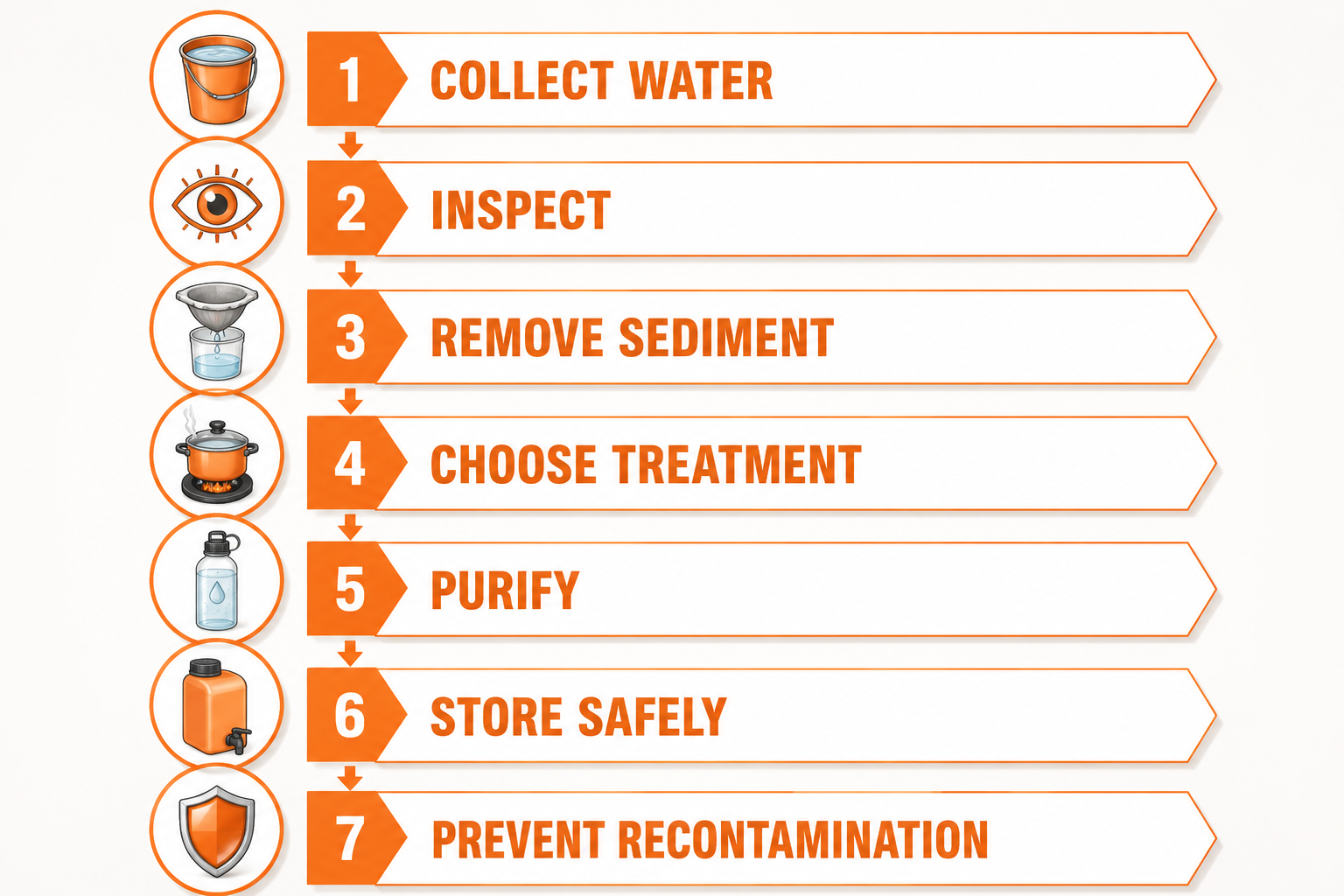
The safest emergency water treatment strategy therefore begins with selecting the cleanest available source, removing suspended particles whenever possible, purifying the water using an appropriate method, and then storing the finished water carefully to prevent contamination from occurring again.
What Does Water Purification Actually Remove?
| Contaminant | Boiling | Bleach | Chlorine Dioxide | UV | Distillation |
|---|---|---|---|---|---|
| Bacteria | ✓ | ✓ | ✓ | ✓ | ✓ |
| Viruses | ✓ | ✓ | ✓ | ✓ | ✓ |
| Protozoa | ✓ | Limited | ✓ | ✓ | ✓ |
| Sediment | ✗ | ✗ | ✗ | ✗ | ✗ |
| Heavy Metals | ✗ | ✗ | ✗ | ✗ | Many |
| Pesticides | ✗ | ✗ | ✗ | ✗ | Some |
| Petroleum Products | ✗ | ✗ | ✗ | ✗ | Limited |
| Salt | ✗ | ✗ | ✗ | ✗ | ✓ |
This table highlights one of the most important concepts in emergency water treatment: no single purification method solves every contamination problem. Understanding these limitations allows you to select the proper treatment rather than assuming one technique works in every situation.
Biological Contaminants You May Encounter
The vast majority of emergency water purification efforts focus on biological contamination because microorganisms are responsible for most cases of waterborne illness following disasters. Fortunately, they are also among the easiest hazards to eliminate when the correct purification method is used.
Bacteria are single-celled organisms that multiply rapidly under favorable conditions. Many species are harmless, but others can cause severe illness, including diarrhea, vomiting, abdominal cramps, and dehydration. Organisms such as Escherichia coli, Salmonella, and Campylobacter commonly enter water supplies through sewage contamination or animal waste.
Viruses are considerably smaller than bacteria and often spread through contaminated human waste. Because of their size, some portable water filters cannot reliably remove them, making chemical disinfection, ultraviolet treatment, or boiling particularly important whenever viral contamination is suspected. Although viruses cannot reproduce outside a living host, they remain capable of causing infection when consumed in untreated water.
Protozoa are microscopic parasites that frequently contaminate streams, rivers, and lakes used by wildlife. Organisms such as Giardia and Cryptosporidium form protective outer shells that allow them to survive harsh environmental conditions. Some chemical disinfectants are less effective against these parasites, making boiling, chlorine dioxide, or high-quality filtration particularly valuable when collecting untreated surface water.
Understanding which biological hazards are most likely to be present helps determine which purification method provides the greatest level of protection. The following sections examine each purification technique individually, explaining exactly how it works, when it should be used, and the situations where another method may provide a safer alternative.
Step 1 – Evaluate Your Water Source
Every successful water purification process begins long before any disinfectant is added or water is placed over a fire. The quality of the source water directly affects how well every purification method performs. Spending a few minutes evaluating the water before treatment often produces safer drinking water while reducing the amount of work required later.
Whenever possible, choose the cleanest available water source rather than attempting to purify the dirtiest one. A clear spring emerging directly from the ground is generally preferable to stagnant pond water. Fast-moving streams usually contain less suspended material than standing water, although flowing water should never be assumed to be free of contamination. Lakes, rivers, rainwater collection systems, and private wells can all provide excellent emergency water sources, but each should be evaluated individually before treatment.
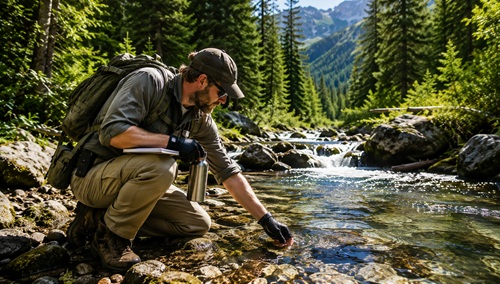
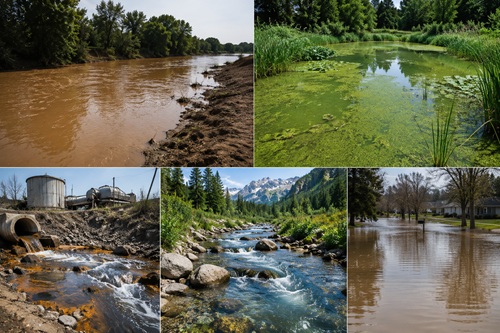
Avoid collecting water near obvious contamination sources whenever alternatives exist. Water located downstream from farms, livestock operations, industrial facilities, sewage treatment plants, campgrounds, or densely populated areas has a much higher likelihood of containing biological or chemical contaminants. Floodwater deserves particular caution because it often contains sewage, fuel, pesticides, household chemicals, and debris collected over large areas.
Do not rely solely on appearance. Water that looks crystal clear may still contain millions of harmful microorganisms, while slightly cloudy water may contain relatively little biological contamination. Visual inspection helps identify obvious problems, but it cannot determine whether water is safe to drink.
Instead, use your senses to identify warning signs that suggest additional treatment – or complete avoidance – is necessary. Oily films floating on the surface, chemical odors, unusual colors, excessive algae growth, dead fish, or evidence of industrial discharge all indicate that another water source should be considered whenever possible. While purification methods are highly effective against microorganisms, most do not remove chemical contamination.
Evaluating an Unknown Water Source
| Observation | Likely Concern | Recommended Action |
|---|---|---|
| Clear flowing stream | Wildlife contamination | Filter and purify |
| Cloudy water | Sediment, microorganisms | Settle, pre-filter, then purify |
| Green algae | Biological growth | Avoid if possible; otherwise multiple treatment steps |
| Oily sheen | Petroleum contamination | Find another source |
| Chemical odor | Industrial or agricultural contamination | Avoid if possible |
| Floodwater | Mixed biological and chemical hazards | Use only as a last resort and apply multiple treatment methods |
| Rainwater from clean collection system | Minor debris and microorganisms | Pre-filter if necessary, then purify |
| Private well after flooding | Sewage contamination | Purify before drinking until tested |
No purification method should be viewed as a substitute for good source selection. Beginning with cleaner water reduces treatment time, extends the life of filtration equipment, and produces better tasting water while increasing overall safety.
Step 2 – Remove Sediment Before Purification
One of the simplest ways to improve every purification method is to remove suspended material before treatment begins. Mud, sand, leaves, algae, insects, and other debris not only make water less appealing to drink but can also reduce the effectiveness of chemical disinfectants and ultraviolet purification. Tiny particles provide microscopic hiding places where bacteria and parasites may escape direct contact with the disinfectant.
If the water contains large amounts of suspended material, allow it to sit undisturbed in a clean container. Over time, gravity causes heavier particles to settle naturally to the bottom. Depending on the amount of sediment present, this process may require anywhere from several minutes to several hours. Once settling is complete, carefully pour the clearer water from the top into another clean container without disturbing the sediment layer.
After settling, additional pre-filtration removes many of the remaining particles. A clean cotton cloth, folded bandana, coffee filter, fine mesh fabric, or commercial sediment filter all work well for this purpose. Although pre-filtration does not make the water safe by itself, it creates ideal conditions for the purification methods that follow.
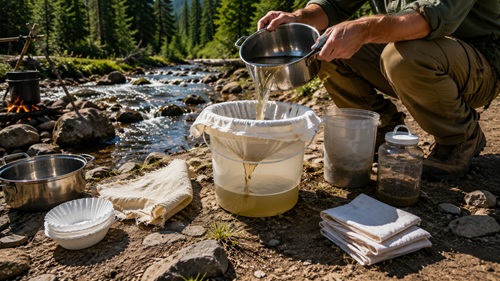
Households relying on portable water filters should remember that pre-filtering also extends the life of expensive filter cartridges. Removing large particles before they reach the primary filter reduces clogging, maintains higher flow rates, and decreases the frequency of cleaning or cartridge replacement.
Common Pre-Filtration Materials
| Material | Removes Large Debris | Removes Fine Sediment | Reusable | Best Used For |
| Cotton cloth | ✓ | Limited | ✓ | Initial filtering |
| Coffee filter | ✓ | ✓ | ✗ | Fine sediment removal |
| Cheesecloth | ✓ | Limited | ✓ | Leaves and insects |
| Fine mesh screen | ✓ | Limited | ✓ | Larger debris |
| Sediment filter | ✓ | ✓ | Depends on type | Home systems |
| Portable water filter | ✓ | ✓ | Yes (maintenance required) | Final filtration before purification |
Remember that these materials improve purification – they do not replace it. Water that has been pre-filtered should still be purified before drinking unless the filtration system itself is specifically certified to remove the contaminants of concern.
Step 3 – Choosing the Right Purification Method
Once the water has been clarified, the next decision is selecting the purification method that best matches the available equipment, environmental conditions, and suspected contaminants. There is no universally “best” method. Each has strengths that make it more appropriate under certain circumstances.
If fuel is readily available and time is not critical, boiling remains one of the most dependable purification techniques because it reliably destroys bacteria, viruses, and protozoa without requiring chemicals or specialized equipment. During extended power outages or wilderness emergencies where cooking equipment is already in use, boiling often becomes the preferred choice.
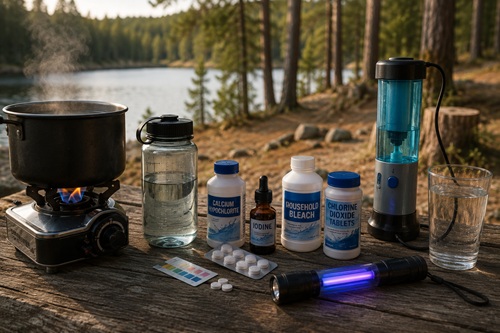
When conserving fuel is important, chemical disinfectants provide an excellent alternative. Household bleach, calcium hypochlorite, chlorine dioxide tablets, and iodine can all disinfect large quantities of water while occupying very little storage space. These methods are especially useful for emergency kits, evacuation supplies, and situations where heating water is impractical.
Ultraviolet purification provides one of the fastest treatment methods for clear water but depends upon functioning batteries or another reliable power source. It is well suited for travel, hiking, and emergency kits where compact equipment and rapid treatment are priorities.
Distillation becomes valuable when biological contamination is combined with dissolved salts or certain minerals. Although slower and more fuel-intensive than other methods, it remains one of the few techniques capable of producing drinking water from seawater or heavily mineralized sources.
Solar Water Disinfection offers a practical backup when sunlight is abundant and other treatment options are unavailable. Although slow, it requires no fuel, chemicals, or electricity, making it a useful emergency technique for long-term preparedness.
Which Purification Method Should You Choose?
| Situation | Recommended Method |
| Home during power outage | Boiling |
| Backpacking | Filter + Chlorine Dioxide |
| Bug-out bag | Chlorine Dioxide or UV |
| Winter emergency | Boiling |
| Coastal survival | Distillation |
| Sunny long-term emergency | Solar Water Disinfection |
| Flood disaster | Pre-filter + Boil or Chemical Disinfection |
| Unknown stream | Filter + Boil or Filter + Chlorine Dioxide |
Choosing the correct purification method is less about finding a single perfect solution and more about matching the treatment to the conditions you face. The following sections examine each purification technique in detail, providing step-by-step instructions, safety considerations, advantages, limitations, and best practices for dependable emergency use.
Boiling Water
Boiling has protected people from waterborne diseases for thousands of years and remains one of the most dependable emergency water purification methods available today. Unlike chemical disinfectants that depend on accurate measurements or specialized equipment that may fail, boiling simply uses heat to destroy harmful microorganisms. As long as you have a suitable container and a reliable heat source, boiling can produce microbiologically safe drinking water almost anywhere in the world.
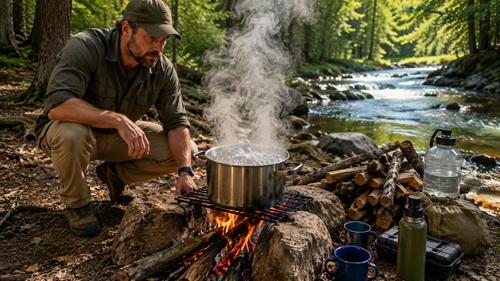
The science behind boiling is straightforward. Harmful bacteria, viruses, and protozoa rely on proteins and enzymes to survive. As water reaches its boiling point, the heat rapidly denatures these essential proteins, destroying the organisms or rendering them incapable of causing infection. Unlike many chemical disinfectants, boiling is highly effective against nearly every biological contaminant likely to be encountered in emergency situations.
Before placing water over the heat, inspect it carefully. If leaves, insects, mud, algae, or other visible debris are present, remove as much of this material as possible. Allow heavily contaminated water to settle so larger particles sink to the bottom before carefully pouring the clearer water into another container. Passing the water through a clean cloth, coffee filter, or sediment filter further improves its quality. While boiling will destroy microorganisms regardless of whether the water is clear or cloudy, removing suspended particles produces cleaner, better-tasting water and helps prevent debris from settling into storage containers later.
Fill a clean metal pot or other heat-resistant container with the prepared water. Avoid filling it completely to the top because vigorous boiling may cause water to splash over the sides. Place the container over a stove, campfire, propane burner, wood stove, rocket stove, or other heat source capable of producing a continuous boil.
The goal is not merely to make the water hot. It must reach a vigorous rolling boil where large bubbles continuously break the surface. Small bubbles forming along the bottom of the pot indicate the water is heating but have not yet reached the temperature required for dependable purification. Once a rolling boil has been established, begin timing the treatment.
At elevations below approximately 2,000 meters (6,500 feet), maintain the rolling boil for at least one full minute. Above this elevation, atmospheric pressure decreases, causing water to boil at lower temperatures. To compensate for the reduced boiling temperature, continue boiling for at least three minutes. Extending the boiling time slightly beyond these minimum recommendations causes no harm and may provide additional peace of mind when water quality is uncertain.
After boiling, remove the container from the heat and allow the water to cool naturally. Resist the temptation to speed cooling by adding untreated water, snow, or ice, as doing so immediately reintroduces contamination. Likewise, avoid leaving the container uncovered where insects, dust, or airborne debris can enter the water during cooling.
Once the water has cooled to a comfortable temperature, transfer it into clean, sanitized storage containers with tightly fitting lids. Labeling the containers with the purification date helps maintain proper water rotation if they will be stored for extended periods. Handle purified water carefully by avoiding contact with the inside of the container or lid to reduce the risk of recontamination.
Boiling Water Quick Reference
| Situation | Recommendation |
|---|---|
| Normal elevation | Rolling boil for at least 1 minute |
| Above 2,000 m (6,500 ft) | Rolling boil for at least 3 minutes |
| Cloudy water | Settle and pre-filter before boiling |
| Recently flooded area | Pre-filter, then boil |
| Winter conditions | Continue boiling normally; allow additional cooling time |
| Unsure of contamination | Boiling remains one of the safest biological treatments |
Advantages of Boiling
One of boiling’s greatest strengths is its reliability. It destroys virtually all disease-causing bacteria, viruses, and protozoa without requiring precise measurements or specialized chemicals. Unlike liquid disinfectants, boiling cannot expire while sitting on a shelf, and unlike battery-powered equipment, it cannot fail because of depleted batteries or damaged electronics.
Boiling also leaves no chemical residue in the water. Individuals sensitive to the taste or odor of chlorine often prefer boiled water because its flavor remains natural. Although dissolved oxygen decreases during boiling and may leave the water tasting somewhat flat, this can usually be corrected by pouring the cooled water back and forth between two clean containers several times, allowing oxygen to mix back into the water.
Another important advantage is flexibility. Nearly every household already possesses cookware capable of boiling water. Camping equipment, wood stoves, fireplaces, outdoor grills, propane burners, and improvised cooking systems all provide potential heat sources during emergencies. This widespread availability makes boiling one of the easiest purification methods to perform without specialized preparedness equipment.
Limitations of Boiling
Despite its effectiveness, boiling is not a complete water treatment solution. Heat destroys microorganisms but leaves many other contaminants behind. Heavy metals, pesticides, industrial chemicals, petroleum products, and dissolved salts remain in the water after boiling. In fact, because some water evaporates during boiling, the concentration of dissolved chemicals may actually increase slightly if contaminated water is used.
Boiling also requires fuel. During prolonged emergencies, fuel conservation becomes an important consideration. Heating several gallons of water every day consumes considerably more fuel than treating the same volume with chemical disinfectants. Households depending on boiling as their primary purification method should estimate their fuel requirements as part of their emergency preparedness planning.
Production capacity represents another limitation. Large families may require several gallons of drinking water every day, in addition to water for cooking and hygiene. Boiling these quantities can become time-consuming, especially when only a single cooking pot is available.
Finally, boiling does not improve the appearance of dirty water. Mud, algae, suspended sediment, and organic debris remain unless removed beforehand. For this reason, settling and pre-filtration should always be considered part of the boiling process rather than optional steps.
Common Mistakes When Boiling Water
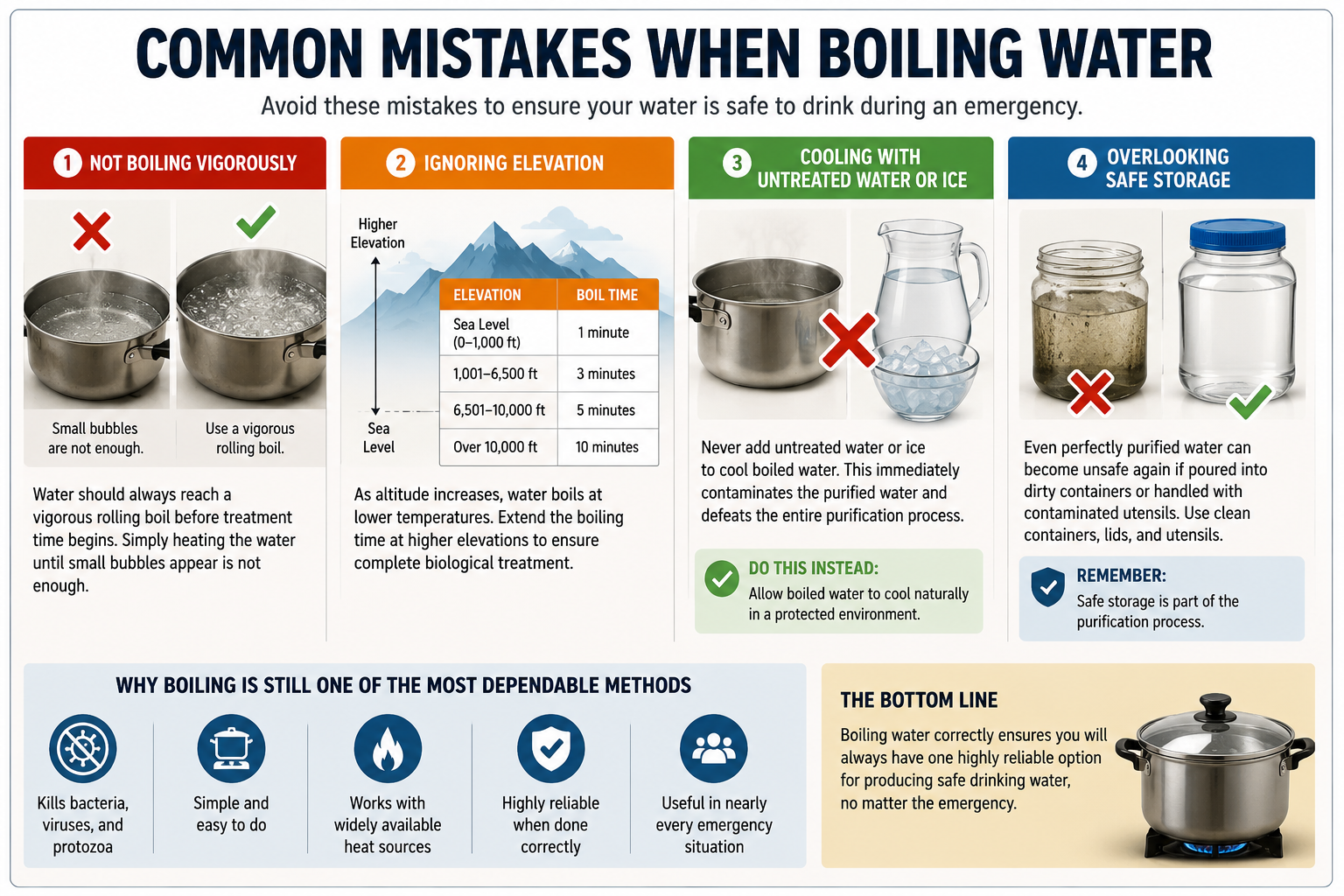
Many people incorrectly assume that bringing water close to boiling is sufficient for purification. Water should always reach a vigorous rolling boil before treatment time begins. Simply heating the water until small bubbles appear is not enough.
Another common mistake is failing to account for elevation. As altitude increases, water boils at lower temperatures. Extending the boiling time at higher elevations compensates for this effect and helps ensure complete biological treatment.
Some people also attempt to cool boiled water by adding untreated water or ice. This immediately contaminates the purified water and defeats the entire purification process. Always allow boiled water to cool naturally in a protected environment before transferring it into clean storage containers.
Finally, many households focus entirely on boiling while overlooking safe storage. Even perfectly purified water can become unsafe again if poured into dirty containers or handled with contaminated utensils. Producing safe water requires both effective purification and careful handling afterward.
Boiling remains one of the most dependable emergency water purification methods because of its simplicity, effectiveness, and universal availability. Although it has limitations, it continues to serve as the standard against which many other purification methods are measured. Understanding how to perform it correctly ensures you will always have one highly reliable option for producing safe drinking water, regardless of the emergency you face.
Household Bleach Disinfection
Household bleach is one of the most practical and widely available emergency water purification methods because it is inexpensive, lightweight, and capable of treating large quantities of water with very little product. Nearly every grocery or hardware store carries unscented household bleach, making it easy to purchase before an emergency and often easier to locate during recovery efforts. When used correctly, bleach provides an effective method for destroying many of the harmful microorganisms responsible for waterborne illness.
The active ingredient in household bleach is sodium hypochlorite. Once added to water, it releases chlorine, which attacks bacteria, viruses, and many other microorganisms by disrupting their cell walls and essential biological functions. Given sufficient contact time, chlorine significantly reduces the number of disease-causing organisms, making the water much safer to drink.
Not all bleach products are suitable for water purification. Only plain, unscented liquid household bleach should ever be used. Products labeled as splashless, scented, color-safe, thickened, or containing additional cleaning agents are designed for laundry or household cleaning and should never be added to drinking water. Before purchasing bleach for emergency storage, carefully read the label to verify that sodium hypochlorite is the only active disinfecting ingredient.
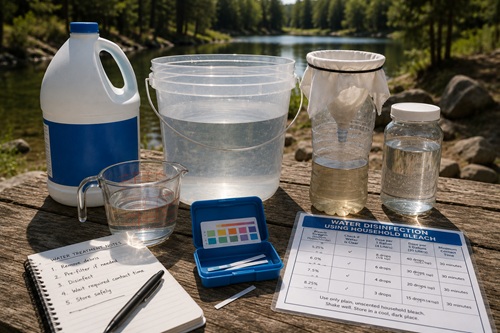
Modern household bleach is sold in several different concentrations, commonly ranging from approximately 5% to over 8% sodium hypochlorite. Because concentrations vary by manufacturer, the dosage required to disinfect drinking water also varies. For this reason, every preparedness household should keep the dosage instructions supplied by the manufacturer or maintain a printed emergency dosage chart with their water treatment supplies. Guessing at the amount to use can leave dangerous microorganisms alive or result in unnecessarily high chlorine concentrations.
Before adding bleach, inspect the water carefully. If the water contains mud, algae, leaves, insects, or other suspended material, remove as much of this debris as possible. Allow heavily contaminated water to settle naturally before carefully pouring off the clearer water. Passing the water through a clean cloth, coffee filter, or sediment filter further improves treatment effectiveness by exposing microorganisms directly to the disinfectant rather than allowing them to remain hidden inside suspended particles.
Once the water has been clarified, carefully measure the proper amount of bleach and mix it thoroughly throughout the container. Stirring ensures the disinfectant reaches every portion of the water. After mixing, cover the container and allow it to stand undisturbed for at least thirty minutes. During this contact period, chlorine destroys microorganisms throughout the water.
After the waiting period has passed, open the container and smell the water carefully. A faint chlorine odor should still be noticeable. This slight odor indicates that enough disinfectant remained after treating the contaminants present in the water. If no chlorine smell can be detected, repeat the treatment using the same dosage, mix thoroughly, and wait another thirty minutes before checking again. Water that still has no detectable chlorine odor after a second treatment may contain unusually heavy contamination and should be avoided if another source is available.
Household Bleach Emergency Guidelines
| Step | Action |
|---|---|
| 1 | Use only plain, unscented household bleach. |
| 2 | Allow muddy water to settle before treatment. |
| 3 | Pre-filter water if visible debris remains. |
| 4 | Add the correct bleach dosage based on concentration. |
| 5 | Stir thoroughly. |
| 6 | Wait at least 30 minutes. |
| 7 | Verify a slight chlorine odor remains. |
| 8 | Store in clean, sanitized containers. |
Advantages of Household Bleach
One of bleach’s greatest advantages is availability. Most households already keep bleach for cleaning and sanitation, allowing it to serve multiple emergency purposes. A single bottle can disinfect hundreds of gallons of drinking water while also sanitizing food preparation surfaces, medical equipment, and storage containers.
Bleach is also compact and inexpensive. Compared to transporting fuel for boiling or carrying multiple water filters, a small bottle occupies very little storage space while providing the ability to treat a substantial volume of water. This makes it particularly valuable for emergency home supplies where long-term water treatment capability is important.
Another advantage is ease of use. Once the correct dosage is known, treatment requires only a few minutes of preparation followed by the necessary contact time. No electricity, batteries, pumps, or specialized equipment are required, allowing bleach to remain effective even during prolonged infrastructure failures.
Limitations of Household Bleach
Despite its usefulness, bleach has important limitations that every preparedness-minded individual should understand. Chlorine is highly effective against most bacteria and viruses but is less effective against certain chlorine-resistant protozoa, particularly Cryptosporidium. When these organisms are suspected, boiling, chlorine dioxide, or appropriate filtration provides better protection.
Bleach also does not remove sediment, heavy metals, pesticides, petroleum products, industrial chemicals, radioactive contaminants, or dissolved salts. If chemical contamination is suspected, selecting another water source or using specialized treatment methods may be necessary.
Storage life is another consideration. Liquid bleach gradually loses strength over time, even when stored properly. Heat, sunlight, and repeated temperature fluctuations accelerate this degradation. For this reason, bleach should be rotated regularly as part of your preparedness plan rather than stored indefinitely and assumed to remain fully effective.
Finally, bleach may leave a noticeable chlorine taste and odor. While some people dislike this flavor, it is generally a small tradeoff for producing microbiologically safe drinking water during an emergency. If desired, the taste can often be reduced by allowing the treated water to stand uncovered for a short period or by pouring it back and forth between two clean containers after the required contact time has elapsed.
Safe Storage of Bleach
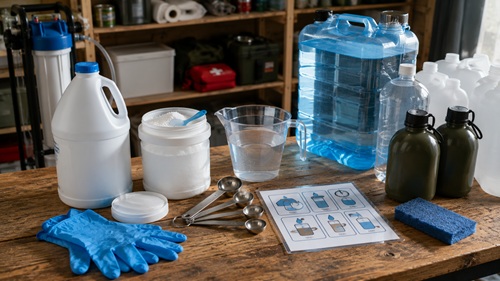
Proper storage greatly extends the useful life of household bleach while improving safety within the home. Store bleach in its original manufacturer’s container with the cap tightly secured. Keep it in a cool, dry, well-ventilated location away from direct sunlight and sources of excessive heat. Garages, sheds, or vehicles that experience extreme summer temperatures may significantly reduce its storage life.
Never transfer bleach into unlabeled containers, beverage bottles, or food containers. Doing so creates a serious poisoning hazard and increases the likelihood of accidental misuse. Always store bleach away from children, pets, medications, and food supplies.
Bleach should also be kept away from ammonia, acids, vinegar, and other household cleaning chemicals. Mixing bleach with incompatible products can release highly toxic gases capable of causing severe injury or death. Handle bleach carefully, avoid splashing it into the eyes, and wash any exposed skin thoroughly with clean water after accidental contact.
Household bleach remains one of the most valuable emergency water purification methods because it combines affordability, simplicity, and effectiveness. When used correctly and as part of a layered water treatment strategy, it provides dependable protection against many of the biological hazards commonly encountered during disasters and long-term emergencies.
Calcium Hypochlorite (Pool Shock)
For long-term emergency preparedness, few water purification chemicals offer the storage life and treatment capacity of calcium hypochlorite. Commonly sold for swimming pool sanitation, calcium hypochlorite is a dry chlorine compound that, when stored correctly, remains effective for many years. Unlike liquid household bleach, which slowly loses strength over time, calcium hypochlorite provides a dependable long-term source of chlorine for disinfecting drinking water.
This extended shelf life is one of the primary reasons many experienced preparedness-minded individuals choose to store calcium hypochlorite instead of relying solely on bottled bleach. A relatively small container can produce enough disinfecting solution to treat thousands of gallons of water, making it one of the most space-efficient emergency water purification supplies available.
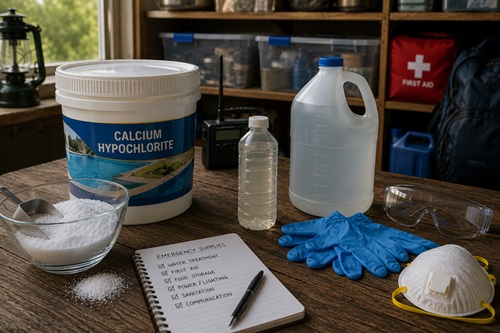
It is important to understand that calcium hypochlorite is significantly more concentrated than household bleach and must never be added directly to drinking water in its dry form. Instead, it is first dissolved in clean water to create a chlorine stock solution. That stock solution is then diluted into untreated water at the proper concentration to safely disinfect it. Following this two-step process allows accurate dosing while preventing dangerously high chlorine concentrations.
Not every pool chemical is appropriate for emergency drinking water treatment. Many products marketed for swimming pools contain stabilizers, algaecides, clarifiers, anti-scale compounds, or other additives that should never be consumed. Only products whose active ingredient is calcium hypochlorite, without unnecessary additives, should be considered for emergency water purification. Always read the product label carefully before purchasing or storing it.
As with every purification method, begin by evaluating the water source. Remove visible sediment, leaves, algae, insects, and other debris by allowing the water to settle and then pre-filtering it if necessary. Cleaner water allows chlorine to contact microorganisms more effectively while reducing the amount of disinfectant consumed by suspended organic material.
Once the chlorine stock solution has been prepared according to the manufacturer’s instructions, carefully measure the appropriate amount and stir it thoroughly into the untreated water. Allow the treated water to stand for the recommended contact period before drinking. After treatment, a faint chlorine odor should still be detectable. If no chlorine smell remains, repeat the treatment using the same dosage and allow another full contact period before checking again.
Household Bleach vs. Calcium Hypochlorite
| Feature | Household Bleach | Calcium Hypochlorite |
|---|---|---|
| Form | Liquid | Dry granules or powder |
| Typical Shelf Life | 1–2 years (loses strength over time) | Many years when stored properly |
| Storage Space | Moderate | Very compact |
| Water Treatment Capacity | Hundreds of gallons | Thousands of gallons |
| Must Prepare Stock Solution | No | Yes |
| Easy to Use | ✓ | Requires more preparation |
| Best For | Short- to medium-term emergencies | Long-term preparedness |
Although calcium hypochlorite requires slightly more preparation, its exceptional storage life and treatment capacity make it one of the most valuable long-term emergency water purification chemicals available.
Advantages of Calcium Hypochlorite
The greatest advantage of calcium hypochlorite is longevity. Properly stored in a cool, dry location, it retains its disinfecting capability far longer than liquid bleach. For households preparing for extended emergencies, this significantly reduces the need to continually rotate chemical supplies.
Storage efficiency is another major benefit. A single sealed container occupies very little space while providing enough chlorine to produce enormous quantities of disinfecting solution. For off-grid homes, cabins, preparedness retreats, and emergency supply caches where storage space is limited, this efficiency becomes particularly valuable.
Calcium hypochlorite also offers flexibility. Once prepared as a stock solution, it functions much like freshly mixed bleach and can be used to disinfect drinking water, sanitize food preparation surfaces, clean water storage containers, and support general emergency sanitation efforts.
Because the active ingredient remains stable for extended periods, preparedness households gain confidence that their water purification chemical will still perform years after it was purchased, provided it has been stored correctly.
Limitations of Calcium Hypochlorite
Despite its many advantages, calcium hypochlorite requires considerably more care than ordinary household bleach. Its concentrated nature means accurate preparation is essential. Improper mixing can produce solutions that are either too weak to disinfect effectively or unnecessarily strong for drinking water treatment.
Like other chlorine-based disinfectants, calcium hypochlorite primarily addresses biological contamination. It does not remove heavy metals, pesticides, petroleum products, industrial chemicals, radioactive contaminants, suspended sediment, or dissolved salts. Selecting a cleaner water source remains preferable whenever chemical contamination is suspected.
Certain protozoa, particularly Cryptosporidium, also demonstrate greater resistance to chlorine than bacteria and viruses. When these organisms are a concern, combining filtration with chlorine dioxide or boiling provides a higher level of protection.
Another limitation is handling safety. Because calcium hypochlorite is a powerful oxidizer, accidental contamination with fuels, oils, sawdust, paper products, or other combustible materials can create serious fire hazards. Careful storage and handling are therefore essential.
Safe Handling and Storage
Always store calcium hypochlorite in its original sealed container with the manufacturer’s label intact. Place it in a cool, dry, well-ventilated area protected from moisture and direct sunlight. Moisture not only reduces product quality but may also initiate unwanted chemical reactions inside partially opened containers.
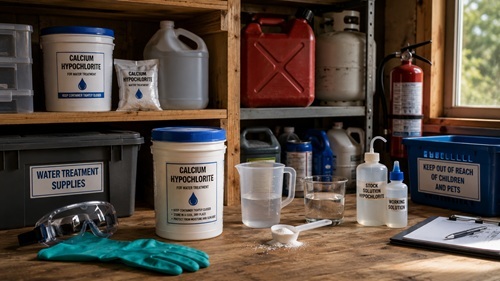
Never store calcium hypochlorite alongside gasoline, propane cylinders, paint thinners, oils, solvents, fertilizers, or other reactive chemicals. Keep it isolated from combustible materials such as cardboard boxes, paper products, wood shavings, or cloth rags. Even though the chemical itself is not flammable, it strongly supports combustion and can dramatically increase the intensity of a fire if improperly stored.
When preparing stock solutions, wear safety glasses and chemical-resistant gloves whenever practical. Avoid breathing dust generated while measuring the dry product, and always add the chemical to water rather than pouring water onto concentrated granules. Use clean plastic or glass containers reserved specifically for water treatment chemicals, and clearly label every prepared solution to prevent accidental misuse.
Keep all calcium hypochlorite products out of reach of children and pets. Never transfer the chemical into food containers, beverage bottles, or unlabeled storage jars. Emergency supplies should always be organized so that every household member can quickly identify water treatment chemicals without confusion.
Calcium hypochlorite remains one of the most valuable long-term water purification supplies available to preparedness-minded households. When stored safely and used correctly, it provides years of dependable service while occupying very little storage space. Combined with other purification methods such as filtration, boiling, and ultraviolet treatment, it forms an important part of a layered emergency water treatment strategy.
Chlorine Dioxide
Chlorine dioxide has become one of the most trusted emergency water purification methods because it combines portability, ease of use, and excellent effectiveness against a broad range of disease-causing microorganisms. Unlike ordinary household chlorine bleach, chlorine dioxide works through a different chemical process and is highly effective against many bacteria, viruses, and chlorine-resistant protozoa. This has made it a preferred choice for backpackers, wilderness travelers, emergency responders, military personnel, and preparedness-minded households.
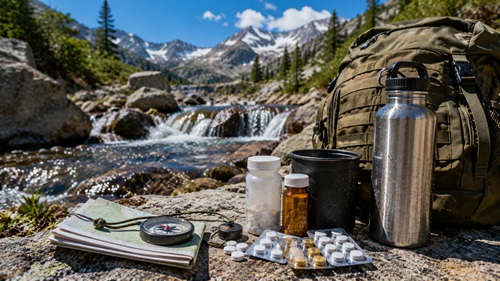
Most emergency chlorine dioxide products are sold as individually packaged tablets or small liquid treatment kits. Their compact size allows dozens of treatments to be carried in a pocket, first aid kit, bug-out bag, or vehicle emergency kit without adding significant weight or requiring bulky equipment. Because they remain sealed until needed, they also tend to have a longer storage life than prepared liquid disinfectants.
Chlorine dioxide works by penetrating microorganisms and disrupting essential cellular processes. Unlike ordinary chlorine, which primarily attacks cell walls, chlorine dioxide damages multiple biological functions inside bacteria, viruses, and protozoa. This broader mode of action makes it particularly effective against organisms such as Giardia and Cryptosporidium, both of which have caused numerous outbreaks of waterborne illness in wilderness areas and municipal water systems.
Despite its effectiveness, chlorine dioxide performs best when treating relatively clear water. Suspended sediment, algae, leaves, and other organic material consume part of the disinfectant before it can reach harmful microorganisms. Whenever possible, allow muddy water to settle naturally before passing it through a clean cloth, coffee filter, or sediment filter. The cleaner the water entering the treatment process, the more reliable the final disinfection will be.
Using chlorine dioxide is straightforward. Fill a clean container with the water to be treated, add the recommended number of tablets or the specified amount of liquid solution according to the manufacturer’s instructions, and mix thoroughly if directed. After treatment, allow the water to remain undisturbed for the full recommended contact time before drinking. Unlike boiling, which works almost immediately once the proper temperature is reached, chlorine dioxide requires time to penetrate and inactivate microorganisms.
One important characteristic of chlorine dioxide is that treatment times vary depending upon water temperature, clarity, and the specific organisms being targeted. Warmer, clearer water generally disinfects more quickly than cold, cloudy water. Some protozoa require considerably longer exposure times than bacteria or viruses, making it essential to follow the manufacturer’s instructions rather than relying on a standard waiting period for every situation.
Chlorine Dioxide Treatment Overview
| Characteristic | Description |
|---|---|
| Primary Use | Emergency drinking water purification |
| Available Forms | Tablets and liquid solutions |
| Effective Against Bacteria | ✓ Excellent |
| Effective Against Viruses | ✓ Excellent |
| Effective Against Giardia | ✓ Excellent |
| Effective Against Cryptosporidium | ✓ Excellent (longer contact time may be required) |
| Removes Chemicals | ✗ No |
| Removes Heavy Metals | ✗ No |
| Removes Salt | ✗ No |
| Requires Fuel | ✗ No |
| Requires Electricity | ✗ No |
Advantages of Chlorine Dioxide
One of the greatest strengths of chlorine dioxide is its broad spectrum of biological protection. Few portable chemical disinfectants provide such effective treatment against bacteria, viruses, and protozoan parasites using equipment that fits easily into a pocket. This versatility makes chlorine dioxide particularly valuable for people who may encounter a variety of water sources during travel or emergencies.
Another major advantage is convenience. Tablets require no measuring equipment, no mixing of concentrated chemicals, and no fuel. Simply following the manufacturer’s directions allows large quantities of drinking water to be treated with very little effort. This simplicity reduces the chance of dosing errors while making the treatment process accessible to nearly anyone.
Unlike traditional chlorine bleach, chlorine dioxide generally produces much less noticeable taste and odor. Many people find the treated water more pleasant to drink, increasing the likelihood that they will remain properly hydrated during an emergency.
Storage characteristics also make chlorine dioxide well suited for preparedness. Individually sealed tablets remain protected from moisture until opened, making them excellent additions to emergency kits that may remain untouched for years before being needed.
Because chlorine dioxide is lightweight, compact, and highly effective, many preparedness experts recommend including it as both a primary purification method for bug-out bags and as a backup method for home emergency supplies.
Limitations of Chlorine Dioxide
Although chlorine dioxide is extremely effective against biological contamination, it does not solve every water treatment problem. Like other chemical disinfectants, it does not remove suspended sediment, petroleum products, industrial chemicals, pesticides, radioactive contaminants, dissolved minerals, or saltwater contamination. Selecting the cleanest available water source remains the first priority whenever possible.
Treatment time represents another consideration. Unlike ultraviolet purification or boiling, chlorine dioxide requires patience. Depending upon water temperature and the type of microorganisms present, complete treatment may require substantially longer waiting periods than some users expect. Rushing the process reduces effectiveness and increases the possibility that harmful organisms remain alive.
Packaging integrity is also important. Tablets exposed to moisture, damaged packaging, or excessive heat may gradually lose effectiveness. Emergency supplies should be inspected periodically, and expired products should be replaced according to the manufacturer’s recommendations.
Finally, chlorine dioxide should never be viewed as a substitute for careful source selection. Water contaminated with petroleum products, agricultural runoff, industrial waste, or heavy metals remains unsafe even after biological purification. When chemical contamination is suspected, another water source should always be sought whenever practical.
Best Uses for Chlorine Dioxide
Chlorine dioxide excels in situations where portability, reliability, and long storage life are important. Backpackers frequently carry tablets because they weigh almost nothing while providing dependable protection against common wilderness pathogens. Travelers appreciate the convenience of treating water without carrying bulky filters or cooking equipment. Emergency responders often include chlorine dioxide in field kits because it requires neither electricity nor fuel to operate.
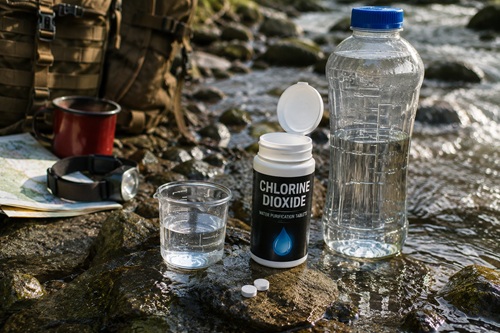
For preparedness households, chlorine dioxide serves as an excellent backup purification method even when other treatment systems are available. A power outage may prevent ultraviolet purification, fuel shortages may limit boiling, and filters may eventually become damaged or clogged. Having chlorine dioxide stored alongside these other methods provides valuable redundancy that increases long-term resilience.
Rather than replacing filtration or boiling, chlorine dioxide works best as one layer within a complete emergency water treatment strategy. Combined with careful source selection, sediment removal, and proper storage, it provides one of the most dependable portable purification methods available for producing microbiologically safe drinking water under a wide variety of emergency conditions.
Iodine Water Purification
Before lightweight water filters and chlorine dioxide tablets became widely available, iodine was one of the most common methods used to disinfect drinking water in the field. Military personnel, backpackers, emergency responders, and wilderness travelers carried iodine tablets because they were compact, inexpensive, and capable of treating water without fuel or specialized equipment. Although newer purification methods have become more popular, iodine still serves as an effective backup option when other treatment methods are unavailable.
Iodine works by penetrating microorganisms and disrupting the proteins and enzymes required for survival. Once these essential biological functions are damaged, bacteria, viruses, and many protozoa can no longer reproduce or cause infection. When used correctly, iodine provides effective protection against many of the microorganisms commonly encountered in emergency water supplies.
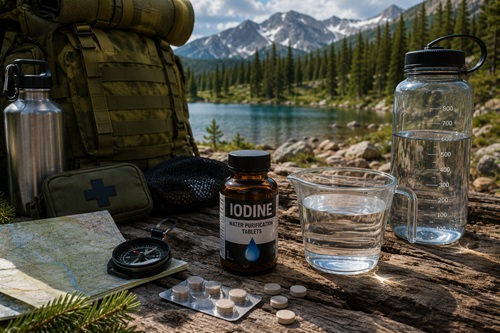
Like every purification method discussed so far, iodine works best when the water is already as clean as possible. If the water contains mud, algae, leaves, insects, or suspended sediment, allow it to settle before carefully pouring the clearer water into another container. Additional pre-filtration through a clean cloth or coffee filter improves treatment effectiveness by exposing microorganisms directly to the disinfectant rather than allowing them to remain hidden within organic material.
Commercial iodine products are available as tablets, liquid tinctures, or specially formulated water treatment solutions. Because each product contains different concentrations, the manufacturer’s instructions should always be followed carefully. Adding too little iodine may fail to eliminate harmful microorganisms, while excessive amounts provide no additional benefit and unnecessarily increase the unpleasant taste.
Once the iodine has been added, mix the water thoroughly and allow it to remain undisturbed for the recommended contact period. During this time, the iodine penetrates microorganisms throughout the container. Cold water generally requires longer treatment because chemical reactions occur more slowly at lower temperatures. Whenever possible, warm the water slightly before treatment or extend the recommended contact time if treating very cold water.
Iodine Water Treatment Overview
| Characteristic | Description |
|---|---|
| Primary Use | Emergency drinking water purification |
| Available Forms | Tablets, liquid, crystals |
| Effective Against Bacteria | ✓ Excellent |
| Effective Against Viruses | ✓ Excellent |
| Effective Against Giardia | ✓ Moderate |
| Effective Against Cryptosporidium | ✗ Limited |
| Requires Fuel | ✗ No |
| Requires Electricity | ✗ No |
| Removes Chemicals | ✗ No |
| Removes Heavy Metals | ✗ No |
| Removes Salt | ✗ No |
Advantages of Iodine
One of iodine’s greatest strengths is portability. A small container of tablets or liquid solution can purify many liters of drinking water while occupying almost no space in an emergency kit. This makes iodine particularly useful for bug-out bags, survival kits, vehicle emergency supplies, and wilderness travel.
Iodine also requires no fuel, batteries, pumps, or complicated equipment. It can be used almost anywhere with only a container of water and sufficient time for treatment. During emergencies where resources are limited, this simplicity provides an important backup capability.
Another advantage is affordability. Iodine products are generally inexpensive and readily available from outdoor retailers, pharmacies, and preparedness suppliers. For households building layered emergency water treatment systems, iodine offers another independent purification method that does not rely on electricity or heat.
Because iodine is lightweight and easy to transport, many emergency kits include it as a secondary purification method in case primary systems become unavailable.
Limitations of Iodine
Despite its usefulness, iodine has more limitations than several of the newer purification technologies. One of the most noticeable drawbacks is taste. Many people find iodine-treated water unpleasant to drink because of its distinctive medicinal flavor and odor. While flavor-neutralizing tablets are available, they should only be added after the required disinfection period has been completed so they do not interfere with the purification process.
Iodine is also less effective against certain protozoan parasites, particularly Cryptosporidium. When these organisms are suspected, boiling, chlorine dioxide, or appropriate filtration generally provides better protection.
Another important limitation involves long-term use. Iodine-treated water is intended primarily for short-term emergency situations rather than continuous daily consumption over extended periods. Individuals with thyroid disorders, iodine allergies, pregnant women, and young infants should avoid prolonged consumption whenever safer alternatives are available. If an emergency extends for weeks or months, transitioning to another purification method is strongly recommended.
Like every other chemical disinfectant discussed so far, iodine does not remove sediment, pesticides, industrial chemicals, petroleum products, radioactive contaminants, heavy metals, or dissolved salts. Water suspected of containing chemical contamination should be avoided whenever possible.
Storage life should also be monitored. Although iodine generally stores well when kept sealed, cool, and dry, emergency supplies should be inspected periodically and replaced according to the manufacturer’s recommendations.
Best Uses for Iodine
Today, iodine is best viewed as an emergency backup rather than a primary household purification method. It performs well when lightweight equipment is essential, such as backpacking, wilderness travel, evacuation kits, and emergency vehicle supplies. Its compact size makes it easy to store alongside other purification methods without requiring significant space.
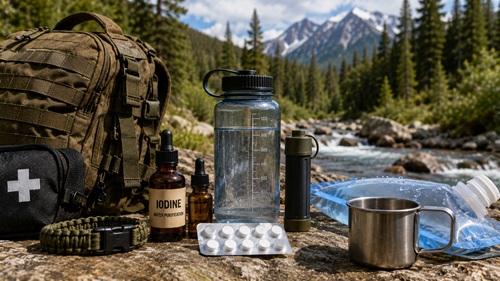
For preparedness households, iodine provides valuable redundancy. A complete emergency water treatment system should never depend upon a single method. Batteries eventually discharge, filters wear out, fuel supplies become exhausted, and chemical disinfectants expire. Maintaining several independent treatment options greatly increases your ability to continue producing safe drinking water regardless of changing conditions.
Although iodine has largely been replaced by chlorine dioxide for many portable applications, it remains a proven purification method that has protected countless people during emergencies over many decades. Understanding both its strengths and limitations allows it to remain a useful component of a comprehensive, layered water purification strategy.
Ultraviolet (UV) Water Purification
Ultraviolet (UV) water purification is one of the fastest and most convenient methods available for producing microbiologically safe drinking water. Rather than using heat or chemical disinfectants, ultraviolet purification relies on high-energy UV-C light to damage the DNA and RNA of harmful microorganisms. Once their genetic material has been disrupted, bacteria, viruses, and protozoa can no longer reproduce or cause infection.
Portable ultraviolet purifiers have become increasingly popular among backpackers, emergency responders, military personnel, humanitarian organizations, and preparedness-minded households because they provide rapid treatment without affecting the taste or odor of the water. Most portable units are about the size of a flashlight and operate using rechargeable batteries or replaceable lithium batteries. They are designed to be inserted into a container of water while the user gently stirs for the duration of the treatment cycle.
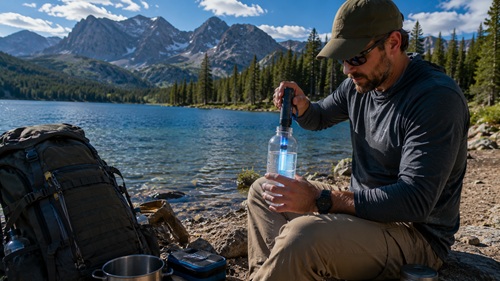
Unlike chemical disinfectants, ultraviolet purification introduces nothing into the water. There is no chlorine taste, no waiting period after treatment, and no need to measure chemicals. Once the treatment cycle is complete, the water is immediately ready for consumption, provided it has been properly treated.
The effectiveness of ultraviolet purification depends heavily on water clarity. UV light must travel directly through the water to reach harmful microorganisms. Suspended sediment, algae, mud, or cloudy water scatter and block ultraviolet rays, creating shadows where microorganisms may survive. For this reason, water should always be as clear as possible before ultraviolet treatment begins.
If the collected water contains visible sediment, allow it to settle first. Carefully pour the clearer water into another clean container and pass it through a clean cloth, coffee filter, or sediment filter if necessary. These simple preparation steps dramatically improve ultraviolet effectiveness by allowing the light to reach every portion of the water.
Once the water has been clarified, fill a clean container with the volume recommended by the UV purifier manufacturer. Insert the purifier into the water and activate the device according to its instructions. Most portable units require the water to be stirred gently throughout the treatment cycle to ensure every portion receives sufficient ultraviolet exposure. Many devices include automatic timers or indicator lights that signal when treatment has been completed.
UV Water Purification Overview
| Characteristic | Description |
|---|---|
| Primary Use | Rapid emergency water purification |
| Effective Against Bacteria | ✓ Excellent |
| Effective Against Viruses | ✓ Excellent |
| Effective Against Protozoa | ✓ Excellent |
| Removes Sediment | ✗ No |
| Removes Chemicals | ✗ No |
| Removes Heavy Metals | ✗ No |
| Removes Salt | ✗ No |
| Requires Batteries | ✓ Yes |
| Requires Clear Water | ✓ Yes |
Advantages of Ultraviolet Purification
One of the greatest advantages of ultraviolet treatment is speed. Most portable devices disinfect a liter of water in approximately one minute or less, making UV one of the fastest emergency purification methods available. There is no extended waiting period like those required for chemical disinfectants.
Another significant benefit is taste. Because ultraviolet light adds nothing to the water, it preserves the water’s natural flavor. Many people prefer UV-treated water because it lacks the chlorine or iodine taste associated with chemical purification methods.
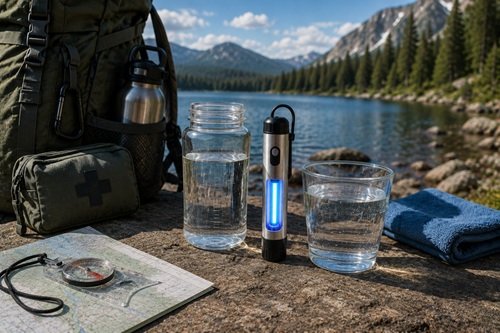
Ultraviolet devices are also extremely compact. Many weigh only a few ounces and easily fit into backpacks, emergency kits, or vehicle preparedness supplies. Combined with a portable water filter, they provide a highly capable purification system without requiring fuel or bulky equipment.
Unlike boiling, ultraviolet purification consumes no cooking fuel and generates no heat. This makes it especially valuable during summer emergencies or situations where conserving fuel is a priority.
Modern UV purifiers are also simple to operate. Built-in timers, sensors, and automatic shutoff systems reduce the likelihood of user error while ensuring the water receives the required ultraviolet exposure.
Limitations of Ultraviolet Purification
Although ultraviolet purification is extremely effective under proper conditions, it has several important limitations that must be understood before relying on it during an emergency.
The greatest limitation is water clarity. UV light cannot penetrate muddy or heavily sedimented water effectively. Attempting to purify cloudy water without first removing suspended particles significantly reduces treatment reliability. Pre-filtration should always be considered part of the purification process rather than an optional step.
Power dependence is another important consideration. Every ultraviolet purifier requires electricity supplied by disposable batteries, rechargeable batteries, or another charging method. During long-term emergencies, replacement batteries or renewable charging systems such as solar chargers become essential if the purifier will remain operational.
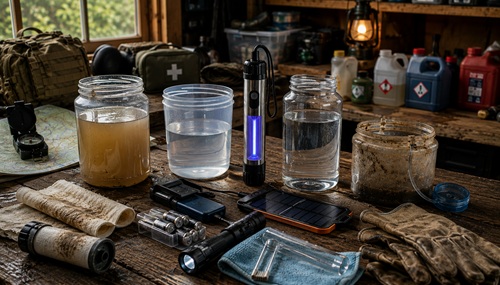
Ultraviolet devices also require routine maintenance. The quartz or protective glass surrounding the UV lamp must remain clean. Mineral deposits, fingerprints, algae, or dirt reduce the amount of ultraviolet light entering the water and can decrease treatment effectiveness. Periodic inspection and cleaning according to the manufacturer’s recommendations should become part of normal equipment maintenance.
Like every purification method discussed so far, ultraviolet treatment only addresses biological contamination. It does not remove pesticides, industrial chemicals, petroleum products, heavy metals, radioactive contaminants, dissolved minerals, or saltwater contamination. Selecting the cleanest available water source remains essential regardless of the purification technology used.
Finally, ultraviolet purification provides no residual protection after treatment. Unlike chlorine-based disinfectants that leave a small amount of disinfectant in the water, UV-treated water can become contaminated again immediately if stored improperly. Clean containers and careful handling are therefore especially important.
Best Uses for Ultraviolet Purification
Ultraviolet purification excels when speed, convenience, and water quality are priorities. It is particularly well suited for hikers collecting water from mountain streams, emergency responders working in the field, travelers visiting areas with uncertain drinking water, and preparedness households maintaining multiple independent purification methods.
Many preparedness experts recommend pairing ultraviolet purification with a high-quality portable water filter. The filter removes sediment and larger contaminants while the ultraviolet purifier inactivates any remaining microorganisms. This layered approach combines the strengths of both systems while minimizing their individual weaknesses.
For home preparedness, ultraviolet purification serves as an excellent secondary treatment method when electrical power or battery charging remains available. It also provides an outstanding backup to boiling by conserving fuel during prolonged emergencies.
Like every emergency preparedness tool, ultraviolet purification performs best when practiced before it is needed. Becoming familiar with battery replacement, treatment cycles, cleaning procedures, and equipment limitations allows you to use the device confidently during an actual emergency rather than learning under stressful conditions.
When combined with careful water source selection, pre-filtration, and proper storage, ultraviolet purification offers one of the fastest and most effective methods for producing microbiologically safe drinking water without altering its taste or requiring chemical disinfectants.
Solar Water Disinfection (SODIS)
Solar Water Disinfection, commonly known as SODIS, is one of the simplest emergency water purification methods available because it relies on one resource that is often abundant during disasters—sunlight. Developed through decades of scientific research and humanitarian field use, SODIS has helped millions of people around the world produce safer drinking water using little more than clear plastic bottles and direct sunlight.
The principle behind SODIS is straightforward. The sun produces ultraviolet radiation and heat that work together to damage the DNA of bacteria, viruses, and many other microorganisms. When water is placed in transparent bottles and exposed to strong sunlight for the required period, these microorganisms lose their ability to reproduce and cause disease.
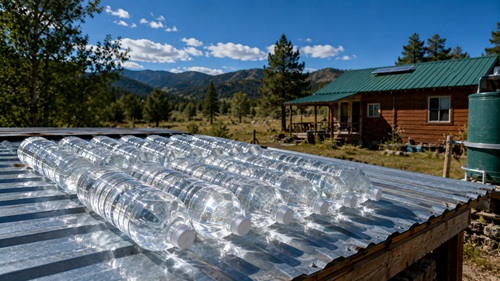
Unlike portable UV purifiers that require batteries and specialized equipment, SODIS requires no electricity, fuel, chemicals, or replacement parts. This makes it particularly valuable during long-term emergencies when supplies become difficult to replace. However, it is also one of the slowest purification methods and should generally be viewed as a backup rather than a primary household water treatment system.
The success of SODIS depends almost entirely on water clarity. Sunlight must be able to penetrate the water completely in order to reach microorganisms throughout the bottle. Cloudy water blocks ultraviolet radiation and greatly reduces treatment effectiveness. Before using SODIS, inspect the water carefully. If it appears muddy, contains suspended sediment, algae, or floating debris, allow it to settle before carefully pouring off the clearer water. If necessary, pass the water through a clean cloth, coffee filter, or sediment filter to improve clarity.
Only clear, transparent PET plastic bottles should be used for SODIS. These are the lightweight bottles commonly used for bottled water and many soft drinks. Glass containers may work under some conditions but are heavier and more fragile. Colored bottles, heavily scratched containers, or opaque plastic should not be used because they reduce the amount of ultraviolet radiation reaching the water.
Fill each bottle almost completely, leaving a small air space at the top. Tighten the cap securely and shake the bottle vigorously for about twenty seconds before placing it in the sun. This simple step dissolves additional oxygen into the water, which enhances the disinfecting process by promoting the formation of reactive oxygen molecules during sunlight exposure.
Lay the bottles horizontally on a reflective surface whenever possible. Corrugated metal roofing, aluminum foil, light-colored concrete, or other reflective materials increase solar exposure by reflecting additional sunlight toward the bottle. Position the bottles where they will receive uninterrupted direct sunlight throughout the treatment period.
During bright sunny conditions, bottles generally require at least six hours of continuous exposure. If skies are partially cloudy, extending exposure through the entire day provides additional safety. During periods of persistent heavy cloud cover, rain, or snow, SODIS may not provide reliable purification and another treatment method should be used whenever possible.
Solar Water Disinfection Quick Reference
| Requirement | Recommendation |
|---|---|
| Bottle Type | Clear PET plastic bottle |
| Water Clarity | Clear; pre-filter if cloudy |
| Bottle Size | Typically 2 liters (0.5 gallon) or smaller |
| Sunlight | Direct sunlight |
| Exposure Time | Minimum 6 hours in full sun |
| Partly Cloudy Conditions | Full day of exposure |
| Heavy Cloud Cover | Use another purification method |
| Electricity Required | No |
| Fuel Required | No |
Advantages of Solar Water Disinfection
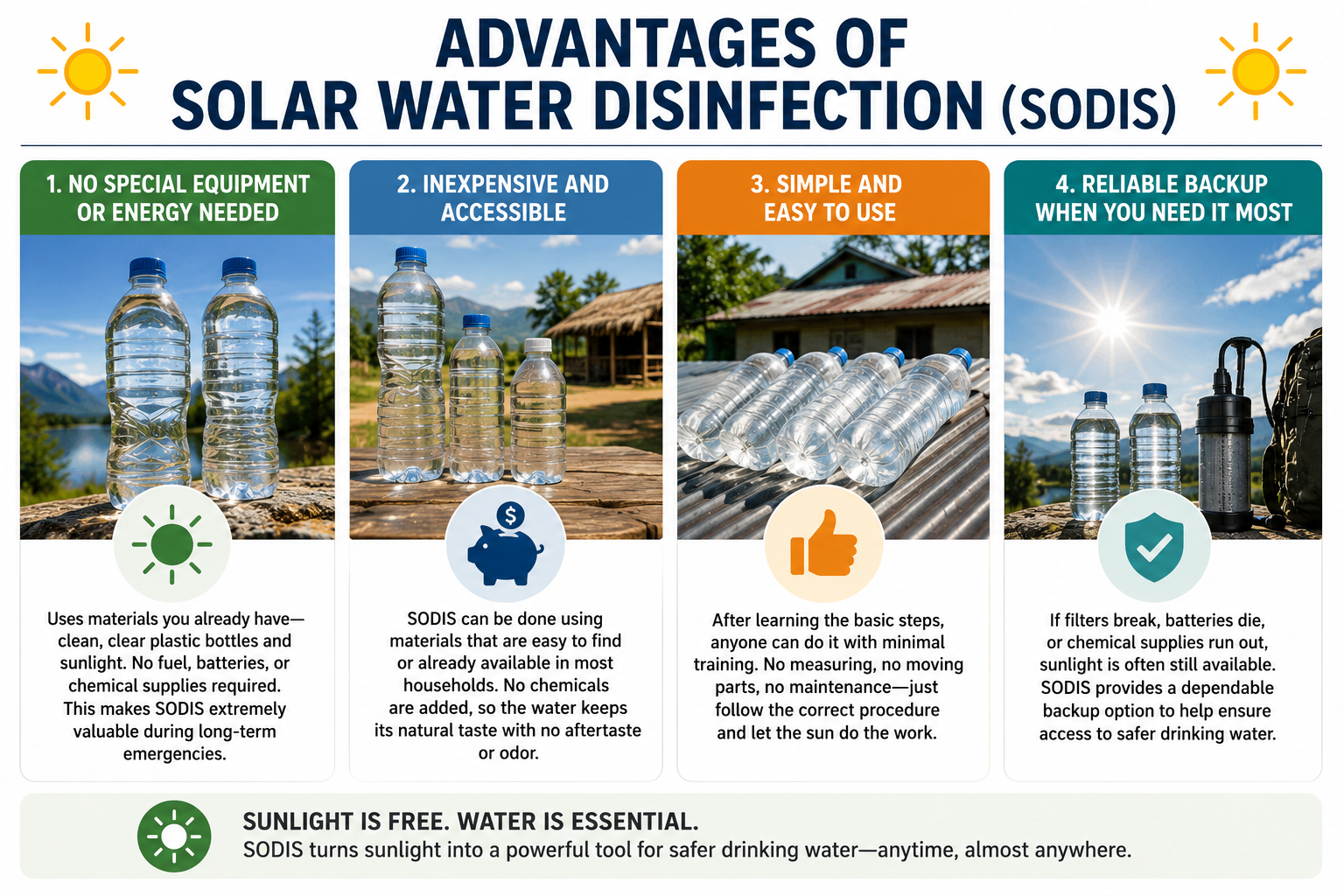
Perhaps the greatest advantage of SODIS is that it requires virtually no specialized equipment. Once suitable bottles have been collected, sunlight provides the energy required for purification without consuming fuel, batteries, or chemical supplies. During prolonged emergencies where resupply is uncertain, this independence becomes extremely valuable.
SODIS is also inexpensive. Families living in remote regions or recovering from disasters can often produce safer drinking water using materials already available to them. Because no chemicals are added, the treated water retains its natural taste and contains no chlorine or iodine aftertaste.
Another benefit is simplicity. After learning the proper procedure, nearly anyone can perform SODIS with minimal training. There are no complex measurements, moving parts, or mechanical systems to maintain. This makes it useful in situations where equipment failures or limited technical knowledge might otherwise complicate water treatment.
For preparedness households, SODIS serves as an excellent contingency plan. If filters become damaged, batteries become depleted, and chemical supplies run out, sunlight remains available on many days to provide at least one additional purification option.
Limitations of Solar Water Disinfection
Although SODIS offers several valuable advantages, it also has important limitations that prevent it from replacing other purification methods in many situations.
The greatest limitation is time. Six hours of exposure under ideal conditions is significantly slower than boiling, chemical disinfectants, or portable ultraviolet purifiers. Emergencies requiring immediate access to drinking water often demand faster treatment methods.
Weather dependence also limits its usefulness. Rain, dense cloud cover, smoke from wildfires, heavy air pollution, or short winter daylight hours reduce ultraviolet intensity and may prevent adequate purification. Unlike boiling or chemical disinfection, SODIS cannot simply be accelerated by increasing the amount of sunlight available.
Bottle size presents another limitation. Most PET bottles hold one to two liters, meaning larger families may need dozens of bottles operating simultaneously to meet their daily drinking water needs. While practical for individuals or small groups, SODIS becomes less efficient for households requiring many gallons each day.
As with every purification method discussed so far, SODIS only addresses biological contamination. It does not remove heavy metals, pesticides, petroleum products, industrial chemicals, radioactive contaminants, or dissolved salts. Water suspected of chemical contamination should never be considered safe simply because it has been exposed to sunlight.
Finally, bottle condition matters. Bottles that become cloudy, deeply scratched, cracked, or discolored reduce ultraviolet transmission and should be replaced. Periodically inspecting stored bottles ensures they continue to perform as expected.
Best Uses for Solar Water Disinfection
Solar Water Disinfection performs best as a supplemental or emergency backup purification method rather than a household’s primary treatment system. It is particularly valuable during extended off-grid living, disaster recovery operations, humanitarian emergencies, and situations where fuel and chemical supplies have become exhausted.
Preparedness-minded households should consider SODIS another layer within a comprehensive water treatment strategy rather than a complete solution by itself. Boiling remains faster, chlorine dioxide provides broader biological protection, ultraviolet purifiers work more quickly under clear-water conditions, and quality filters remove sediment before purification. Each method has strengths that complement the others.
The strongest preparedness plans rarely depend upon one technique alone. Instead, they combine multiple independent purification methods so that if one becomes unavailable because of weather, equipment failure, fuel shortages, or exhausted supplies, safe drinking water can still be produced using another proven technique.
Solar Water Disinfection demonstrates an important preparedness principle: sometimes the most effective emergency solutions are also the simplest. Understanding how to safely harness freely available natural resources such as sunlight can significantly improve a household’s resilience during prolonged emergencies.
Distillation
Distillation is one of the few emergency water purification methods capable of removing both biological contaminants and many dissolved impurities that other purification techniques cannot address. While boiling destroys microorganisms and chemical disinfectants neutralize bacteria and viruses, distillation goes a step further by physically separating pure water from many contaminants through evaporation and condensation.
The process is based on a simple scientific principle. When water is heated, it changes from a liquid into water vapor. Most contaminants – including bacteria, viruses, protozoa, heavy metals, minerals, and salts – do not evaporate with the water. Instead, they remain behind in the original container while the clean water vapor rises. If that vapor is cooled, it condenses back into liquid water that is significantly purer than the original source.
This process has been used for centuries aboard ships, in laboratories, medical facilities, and industrial applications. Today, it remains one of the most dependable methods for producing safe drinking water from sources that would otherwise be impossible to use, including seawater and highly mineralized groundwater.
Before beginning the distillation process, inspect the water source just as you would with any other purification method. Remove leaves, insects, floating debris, and suspended sediment whenever practical. Although distillation separates pure water from most contaminants, removing visible debris beforehand helps keep the equipment cleaner and improves overall efficiency.
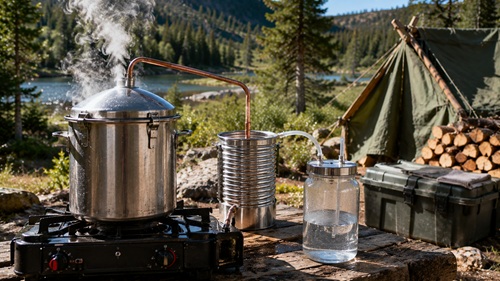
A basic distillation system consists of four essential components: a container for heating the contaminated water, a heat source, a method for directing the steam, and a cooling surface where the steam condenses back into liquid water. Commercial countertop distillers perform this process automatically, but improvised systems can also be built using common cookware during emergencies.
As the water boils, steam rises while contaminants remain in the heating vessel. The steam then travels into a cooler section of the apparatus where it condenses into liquid water and is collected in a separate clean container. Because the distilled water never comes into contact with the original contaminated source after evaporation, it emerges largely free of biological organisms and many dissolved contaminants.
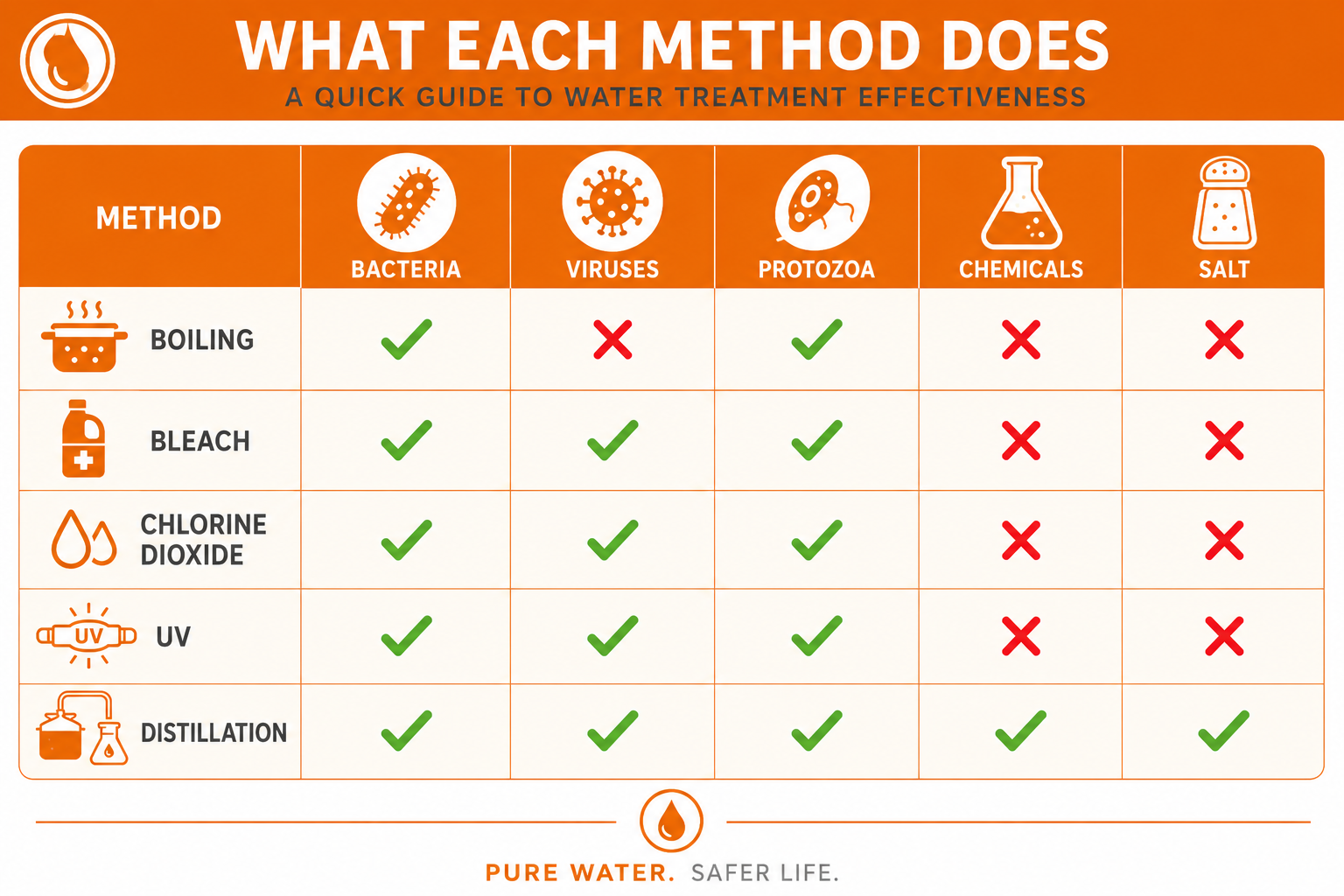
What Distillation Removes
| Contaminant | Removed? |
|---|---|
| Bacteria | ✓ Yes |
| Viruses | ✓ Yes |
| Protozoa | ✓ Yes |
| Heavy Metals | ✓ Most |
| Salt | ✓ Yes |
| Minerals | ✓ Yes |
| Sediment | ✓ Yes |
| Microplastics | ✓ Yes (most) |
| Pesticides | ✓ Many |
| Petroleum Products | ⚠ Some volatile compounds may remain |
| Industrial Chemicals | ⚠ Depends on the chemical |
Important: Some volatile organic compounds (VOCs) have boiling points similar to or lower than water. Without additional filtration, these contaminants may travel with the steam. If chemical contamination is suspected, activated carbon filtration before or after distillation provides an additional layer of protection.
Advantages of Distillation
Distillation offers one of the broadest ranges of contaminant removal available in emergency water treatment. Unlike chemical disinfectants, which only destroy microorganisms, distillation removes many dissolved substances that remain after boiling or chlorination.
One of its greatest strengths is the ability to convert seawater into fresh drinking water. This capability has made distillation indispensable aboard ships, submarines, and desalination facilities around the world. For coastal communities facing prolonged emergencies, distillation may provide one of the few practical methods for producing drinking water from the ocean.
Distillation is also highly effective when treating water with excessive mineral content. Wells containing large amounts of calcium, magnesium, iron, or other dissolved minerals produce hard water that may be unpleasant to drink or damaging to equipment. Distillation removes nearly all of these dissolved minerals, producing exceptionally pure water.
Another important advantage is reliability. The distillation process relies on simple physical principles rather than chemical reactions or specialized filters. As long as sufficient heat can be generated and the equipment remains intact, the process continues to produce purified water.
Limitations of Distillation
Despite its impressive purification capability, distillation has several significant disadvantages that limit its usefulness during many emergencies.
The most obvious limitation is speed. Distillation is considerably slower than boiling, chemical treatment, filtration, or ultraviolet purification. Producing even a few liters of drinking water may require several hours depending on the equipment being used.
Fuel consumption is another major consideration. Maintaining continuous boiling requires substantial amounts of wood, propane, natural gas, electricity, or other energy sources. During long-term emergencies where fuel conservation becomes critical, relying exclusively on distillation may not be practical.
Equipment complexity also increases compared to many other purification methods. While improvised stills can be constructed, commercial distillers generally produce higher-quality water more efficiently. Improvised systems require careful construction to prevent steam leaks and contamination of the condensed water.
Distillation also removes beneficial minerals naturally present in drinking water. Although this does not make the water unsafe, some people find distilled water tastes flat compared to spring water or municipal supplies. Most dietary minerals are obtained from food rather than drinking water, so this is generally not considered a health concern for emergency use.
Finally, certain volatile chemicals – including some fuels, solvents, and industrial compounds – may vaporize along with the water if present. For this reason, distillation should not automatically be assumed to eliminate every possible chemical contaminant. Understanding the nature of the suspected contamination remains important when selecting a treatment method.
Best Uses for Distillation
Distillation is particularly valuable when treating water sources that contain dissolved salts or minerals that cannot be removed through ordinary filtration or chemical disinfection. Coastal emergencies, survival at sea, and off-grid locations with brackish groundwater are situations where distillation becomes especially useful.
It is also well suited for preparedness households that maintain renewable energy systems. Solar-powered electric distillers or systems heated by wood stoves can provide dependable drinking water during extended outages, provided sufficient fuel or sunlight remains available.
Many preparedness experts view distillation as a specialty purification method rather than a primary one. It excels where other techniques fail, especially with saltwater or mineral contamination, but its slower production rate and higher energy requirements make it less practical for everyday emergency water needs.
For this reason, the strongest preparedness plans typically combine distillation with other treatment methods. Filters remove sediment before boiling, chlorine dioxide provides portable biological protection, ultraviolet purifiers offer rapid treatment for clear water, and distillation serves as the ultimate solution when dissolved contaminants become the primary concern.
Understanding when distillation is appropriate – and when another method would be more efficient – allows preparedness-minded households to build flexible water treatment systems capable of adapting to almost any emergency.
Combining Purification Methods
One of the most common misconceptions in emergency preparedness is that a single purification method can solve every water problem. In reality, no individual treatment method removes every possible contaminant. Boiling destroys microorganisms but leaves chemicals behind. Chemical disinfectants kill bacteria and viruses but do not remove sediment or heavy metals. Filters remove particles but may not eliminate viruses. Distillation removes many contaminants but requires considerable time and fuel.
The safest preparedness strategy is therefore layered water treatment. Rather than relying on a single piece of equipment or one chemical disinfectant, multiple methods are combined so that the strengths of one compensate for the limitations of another. This approach provides greater safety, greater flexibility, and greater resilience when conditions change.
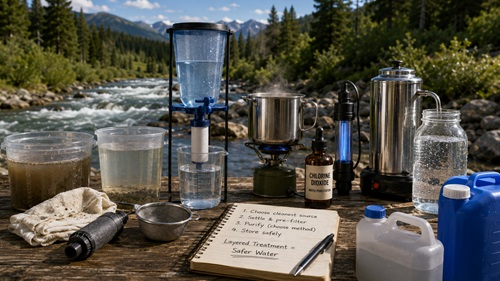
Layered treatment begins before purification even starts. Selecting the cleanest available water source dramatically improves every purification method that follows. Crystal-clear spring water requires far less treatment than muddy floodwater or stagnant pond water. Whenever multiple sources are available, choose moving water upstream from human activity rather than stagnant pools, drainage ditches, or water located near industrial facilities or agricultural runoff.
Once a source has been selected, remove as much suspended material as possible. Allow muddy water to settle naturally before carefully pouring off the clearer water. Passing the water through cloth, coffee filters, sediment filters, or ceramic filters removes many of the particles that interfere with chemical disinfectants and ultraviolet light. Even though these simple filters do not usually make water safe by themselves, they significantly improve the effectiveness of every purification method that follows.
After sediment removal, select the purification method best suited for the contaminants you are most likely facing. If biological contamination is the primary concern, boiling, chlorine dioxide, ultraviolet treatment, or carefully dosed chlorine disinfectants provide excellent protection. If chemical contamination is suspected, selecting another water source or using distillation may become necessary.
Finally, store the purified water correctly. Every purification method can be defeated if clean water is poured into contaminated containers or handled carelessly. Clean storage is an essential part of the purification process rather than a separate activity.
Recommended Layered Water Treatment
| Situation | Recommended Treatment |
|---|---|
| Clear mountain stream | Filter → UV or Chlorine Dioxide |
| Muddy river | Settle → Pre-filter → Boil |
| Flood water | Settle → Filter → Boil or Chlorine Dioxide |
| Unknown wilderness source | Filter → Boil |
| Municipal system after disaster | Bleach or Boil if contamination is suspected |
| Coastal survival | Distillation |
| Agricultural runoff suspected | Seek another source; distillation if necessary |
| Long-term off-grid living | Multiple methods with redundancy |
Notice that almost every scenario begins with removing sediment before purification. Cleaner water improves every subsequent treatment step.
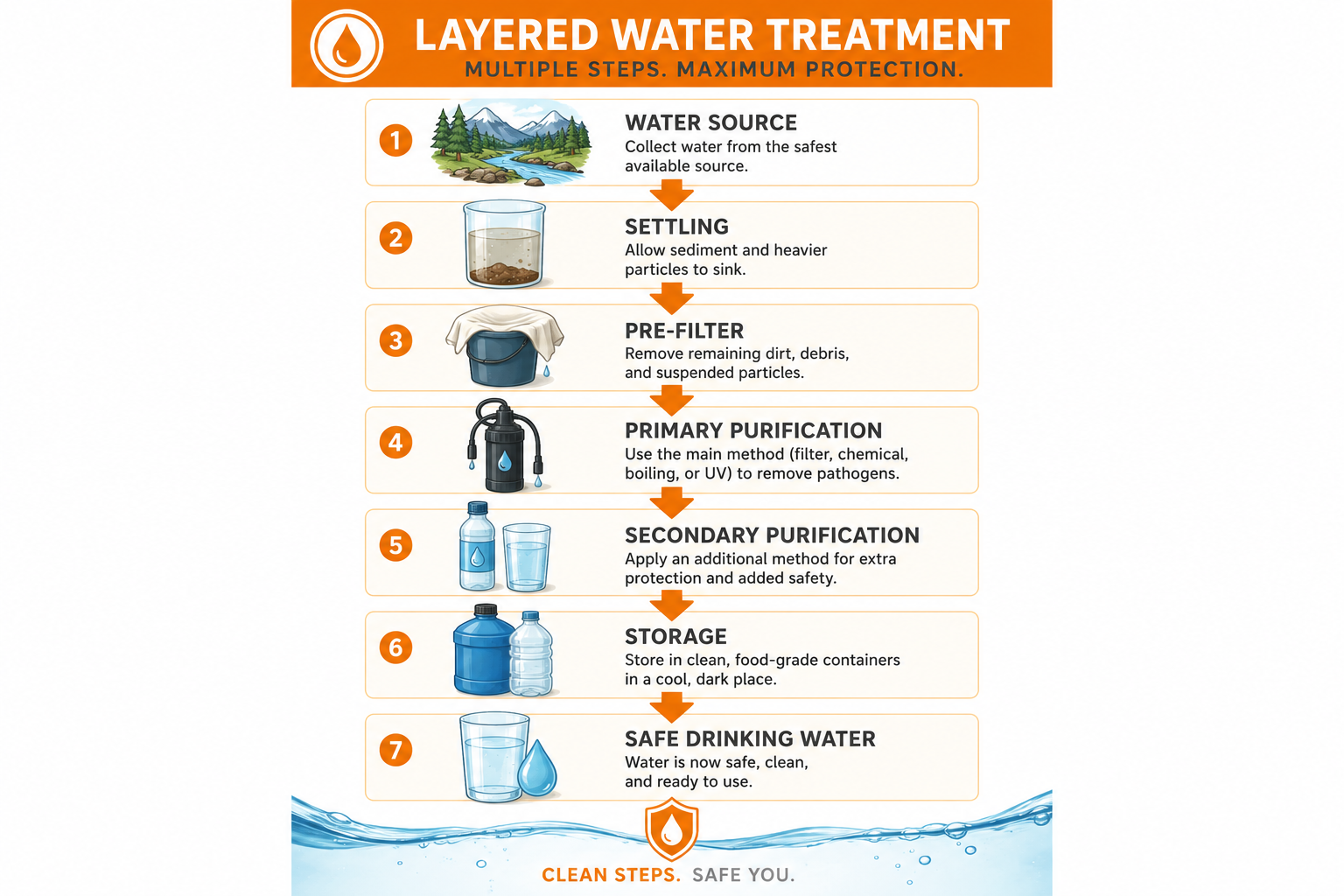
Choosing the Right Method for the Emergency
Preparedness is about making good decisions under changing conditions. The “best” purification method today may become impossible tomorrow because of weather, equipment failure, exhausted fuel supplies, or changing contamination risks. Understanding how each method fits into different emergency situations allows you to adapt instead of becoming dependent on a single solution.
During a short-term power outage at home, boiling may be the fastest and most reliable option if natural gas or propane remains available. If fuel supplies are limited but chemical disinfectants are plentiful, chlorine dioxide or household bleach may conserve valuable energy while still producing safe drinking water.
In a backpacking or evacuation scenario, portability becomes far more important than production capacity. Lightweight filters, chlorine dioxide tablets, or ultraviolet purifiers allow safe water production without carrying heavy equipment or fuel.
Long-term emergencies require a different mindset. Consumable supplies eventually run out. Batteries discharge. Filter elements clog. Fuel becomes scarce. Households preparing for prolonged disruptions should maintain several independent treatment systems that rely on different resources. For example, a household may own gravity filters, chlorine dioxide tablets, calcium hypochlorite for long-term storage, equipment for boiling water, and the knowledge to perform Solar Water Disinfection if every other option becomes unavailable.
Preparedness is strengthened by diversity. The more independent ways you can safely produce drinking water, the less vulnerable you become when one method fails.
Selecting the Best Purification Method
| Emergency | Best Choice | Good Backup |
| Power outage | Boiling | Bleach |
| Wildfire evacuation | Chlorine Dioxide | UV Purifier |
| Backpacking | Filter + Chlorine Dioxide | UV |
| Winter storm | Boiling | Bleach |
| Flooding | Filter + Boiling | Chlorine Dioxide |
| Hurricane | Boiling | Distillation (if saltwater intrusion occurs) |
| Long-term grid failure | Multiple redundant systems | SODIS |
No table can predict every emergency. Instead, use these examples as starting points while considering the specific hazards, available equipment, fuel supplies, weather conditions, and water sources present in your own area.
Building Redundancy Into Your Water Plan
Every preparedness system should assume that something will eventually fail. Filters may crack after freezing temperatures. Replacement cartridges may become unavailable. Batteries eventually discharge. Chemical disinfectants expire. Fuel supplies diminish. Equipment breaks when replacement parts cannot be purchased.
Professional emergency planners address these realities by building redundancy into critical systems. Water purification deserves the same approach because access to safe drinking water cannot be postponed until replacement equipment arrives.
An effective household water purification plan should include at least one method that requires electricity or batteries, one method that requires fuel, one chemical disinfection method, and one completely passive backup such as Solar Water Disinfection. Combining these independent systems ensures that losing any single capability does not eliminate your ability to produce safe drinking water.
Preparedness is not about owning the most expensive equipment. It is about ensuring that when circumstances change unexpectedly, another proven solution is immediately available. The household that understands multiple purification techniques will almost always be better prepared than the household relying on only one.
Proper Storage After Purification
Purifying water is only half of the process. Once water has been made safe to drink, it must be protected from becoming contaminated again. Every year, outbreaks of waterborne illness occur not because the purification method failed, but because clean water was stored improperly or handled with contaminated equipment. Recontamination can happen within seconds, undoing the time and effort invested in purification.
Safe water storage begins with clean containers. Every container used to store drinking water should be thoroughly washed and sanitized before being filled. Containers previously used for chemicals, fuel, pesticides, automotive fluids, or other hazardous substances should never be repurposed for drinking water, regardless of how well they appear to have been cleaned. Many chemicals permanently penetrate plastic and can continue to contaminate water long after the original contents have been removed.
Food-grade plastic containers, stainless steel containers, and glass containers are generally the best choices for long-term water storage. Food-grade plastics are specifically manufactured to minimize chemical migration into stored water while resisting cracking and degradation over time. Containers designed specifically for drinking water also tend to have stronger seals that reduce the likelihood of contamination during storage.
Whenever possible, fill storage containers completely. Leaving excessive air space inside allows additional oxygen and airborne contaminants to enter each time the container is opened. After filling, secure the lid tightly and inspect the seal to ensure no leaks are present.
Store purified water in a cool, dark location away from direct sunlight. Heat accelerates bacterial growth if contamination occurs, encourages algae growth in translucent containers, and gradually weakens many plastic containers. Ultraviolet light also degrades certain plastics over time, increasing the likelihood of cracking or chemical migration.
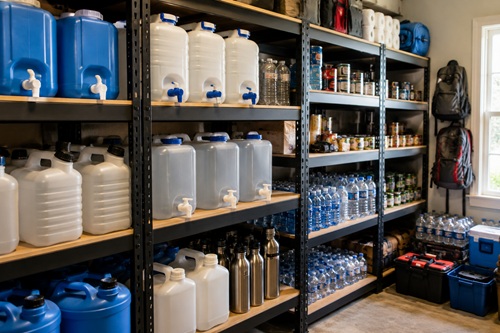
Water should also be protected from freezing whenever practical. Ice expansion can split containers, damage seals, and create openings through which contamination can enter after thawing. If freezing temperatures are expected, leave a small expansion space in rigid containers or use containers specifically designed to withstand freezing conditions.
Recommended Water Storage Containers
| Container Type | Suitable for Drinking Water? | Notes |
|---|---|---|
| Food-grade HDPE container | ✓ Excellent | Best for long-term storage |
| Stainless steel container | ✓ Excellent | Durable and easy to sanitize |
| Glass bottle | ✓ Excellent | Heavy but chemically stable |
| Commercial bottled water | ✓ Excellent | Rotate periodically |
| PET bottles | ✓ Good | Suitable for shorter-term storage |
| Milk jugs | ✗ Not Recommended | Difficult to sanitize; degrade quickly |
| Chemical containers | ✗ Never Use | Permanent contamination risk |
| Fuel containers | ✗ Never Use | Toxic residue remains |
Preventing Recontamination
Once water has been purified, every object that touches it should also be clean. Dirty cups, contaminated ladles, hands, or funnels can all introduce bacteria back into otherwise safe drinking water.
Whenever possible, pour water directly from the storage container rather than dipping cups into it. Dipping repeatedly introduces contaminants from hands, utensils, and the surrounding environment. Containers equipped with spigots or narrow openings significantly reduce this risk.
If a large storage container must be accessed frequently, dedicate one clean ladle or scoop exclusively to drinking water. Store it in a clean location where it cannot come into contact with soil, insects, or dirty surfaces. Never return unused water from drinking cups back into the storage container.
Households should also establish separate containers for untreated and purified water. Clearly labeling each container prevents accidental cross-contamination during stressful emergencies. Color-coded containers or highly visible waterproof labels make this distinction obvious even under poor lighting conditions.
Common Storage Mistakes
| Mistake | Potential Consequence |
| Using non-food-grade containers | Chemical contamination |
| Dipping cups into storage containers | Recontamination |
| Leaving lids loose | Dust, insects, bacteria enter |
| Storing in direct sunlight | Algae growth and plastic degradation |
| Mixing treated and untreated water | Loss of purification |
| Forgetting rotation dates | Reduced water quality |
| Using previously contaminated containers | Toxic exposure |
Water Rotation and Inspection
Stored drinking water should never be forgotten simply because it has been placed on a shelf. Regular inspections ensure that containers remain sealed, undamaged, and ready for immediate use when an emergency occurs.
Inspect stored water periodically for cracked containers, leaking lids, discoloration, unusual odors, algae growth, or visible sediment. Any container showing signs of contamination should be emptied, cleaned, sanitized, and refilled using freshly purified water.
Many preparedness households choose to label every container with the filling date and expected inspection date. This simple practice eliminates uncertainty while making it easy to rotate older supplies into normal household use before replacing them with freshly stored water.
Commercially bottled water generally remains usable for extended periods when stored properly, although manufacturers often print “best by” dates for quality purposes rather than safety. Home-purified water benefits from more regular inspection and rotation because storage conditions vary considerably between households.
Emergency Water Distribution
Producing safe drinking water is only part of emergency water management. During prolonged emergencies, households must also distribute water carefully to avoid unnecessary waste.
Whenever possible, establish a designated drinking water station rather than allowing family members to repeatedly access large storage containers. Smaller daily-use containers can be refilled from larger reserves while minimizing the number of times long-term storage containers are opened.
If several households are sharing water resources, assign one individual responsibility for distributing drinking water. Consistent handling reduces contamination while making it easier to monitor consumption and detect developing shortages before supplies become critical.
Planning distribution procedures before an emergency also reduces confusion. Every household member should know which containers hold untreated water, which contain purified drinking water, and which are reserved exclusively for cooking, hygiene, or sanitation.
Proper storage completes the water purification process. Even the most effective purification method can be undone by careless handling afterward. By combining safe purification with clean storage, careful handling, regular inspection, and thoughtful distribution, preparedness households maximize the value of every gallon of safe drinking water they produce.
Common Water Purification Mistakes
Having the right equipment is only part of producing safe drinking water. Many cases of waterborne illness occur not because people lacked purification supplies, but because seemingly small mistakes reduced or completely eliminated the effectiveness of their treatment methods. Understanding these common errors allows you to avoid problems before they place your health at risk.
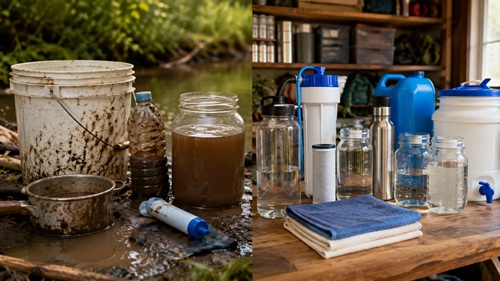
One of the most common mistakes is assuming that clear water is automatically safe to drink. Water flowing from a pristine-looking mountain stream or crystal-clear lake may appear perfectly clean, yet still contain harmful bacteria, viruses, or protozoa. Microorganisms are invisible to the naked eye. Visual inspection can identify sediment and debris, but it cannot determine whether disease-causing organisms are present. Every unknown water source should therefore be considered contaminated until proven otherwise.
Another frequent mistake is selecting the first available water source rather than the safest available source. Water collected downstream from farms, industrial facilities, campgrounds, roads, or populated areas generally presents greater contamination risks than water collected upstream or from protected springs. Spending a few additional minutes locating a better source often reduces the amount of treatment required while improving the overall safety of the water.
Many people also skip pre-filtration because they assume boiling or chemical disinfectants will solve every problem. Although boiling destroys microorganisms and chlorine disinfectants kill many pathogens, suspended sediment reduces treatment effectiveness by shielding microorganisms from heat or chemicals. Removing visible debris before purification significantly improves every treatment method discussed in this handbook.
Another common error is failing to follow the manufacturer’s instructions for filters, ultraviolet purifiers, or chemical disinfectants. Every product has been designed to operate within specific limits regarding water volume, contact time, and maintenance. Guessing at treatment times or chemical dosages introduces unnecessary risk while providing little benefit.
Common Purification Mistakes
| Mistake | Why It Is Dangerous | Better Practice |
|---|---|---|
| Assuming clear water is safe | Invisible pathogens remain | Always purify unknown water |
| Skipping pre-filtration | Sediment protects microorganisms | Remove debris first |
| Using too little disinfectant | Organisms survive | Follow recommended dosage |
| Shortening contact time | Incomplete disinfection | Wait the full treatment time |
| Ignoring expiration dates | Reduced effectiveness | Rotate supplies regularly |
| Storing purified water improperly | Recontamination | Use clean, sanitized containers |
| Depending on one purification method | Equipment failure leaves no backup | Maintain multiple treatment methods |
Mistakes When Using Filters
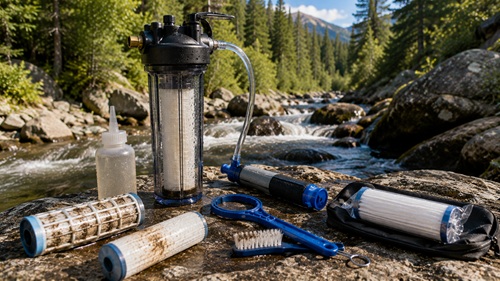
Water filters are among the most valuable preparedness tools, but they require proper care to remain effective.
One of the biggest mistakes is allowing certain filters to freeze after they have been used. Water trapped inside many hollow-fiber filter elements expands when frozen and can create microscopic cracks that are invisible from the outside. Although the filter may appear undamaged, these tiny fractures allow untreated water to bypass the filter media. If a used filter has frozen, consult the manufacturer’s recommendations before relying on it again.
Another mistake is failing to clean filters according to the manufacturer’s maintenance schedule. Sediment gradually accumulates inside filter elements, reducing flow rate and eventually decreasing overall performance. Routine backflushing or cleaning not only improves water production but also extends the useful life of the filter.
Replacement cartridges are another frequently overlooked issue. Many households purchase an excellent filtration system but never store replacement elements. During an extended emergency, clogged cartridges may become impossible to replace. Maintaining spare filters is just as important as owning the filter itself.
Mistakes When Using Chemical Disinfectants
Chemical disinfectants are dependable only when used correctly.
One common mistake is estimating chemical quantities instead of measuring them accurately. Adding extra bleach or iodine does not necessarily produce safer water. Excessive concentrations may create unpleasant taste, unnecessary health concerns, and wasted supplies, while insufficient amounts may leave harmful microorganisms alive.
Another frequent error involves expired chemicals. Household bleach gradually loses strength as it ages, especially when exposed to heat or sunlight. Tablets stored in damaged packaging may also deteriorate over time. Rotating chemical supplies should become part of every preparedness maintenance schedule.
Temperature is another factor that is often ignored. Cold water slows chemical reactions considerably. Water near freezing may require longer contact times than water treated during warm summer conditions. Rushing the process because the water “looks clean” defeats the purpose of purification.
Mistakes During Boiling
Although boiling is one of the simplest purification methods, mistakes still occur.
Many people begin timing the treatment before the water reaches a full rolling boil. The timer should start only after vigorous boiling has been established. Small bubbles forming on the bottom of the container do not indicate that the necessary purification temperature has been reached.
Another mistake is overlooking elevation. At higher altitudes, water boils at lower temperatures because atmospheric pressure decreases. Extending boiling time at elevations above approximately 2,000 meters (6,500 feet) compensates for this lower boiling temperature.
Some people also contaminate freshly boiled water by adding untreated water or snow to cool it more quickly. Once the purification process has been completed, nothing untreated should be added to the container.
Mistakes During Long-Term Emergencies
Extended emergencies introduce additional challenges beyond simply purifying today’s drinking water.
Many households consume purification supplies without considering replenishment. Every bleach bottle eventually empties, every filter eventually clogs, and every battery eventually reaches the end of its useful life. Preparedness planning should include replacement schedules, backup systems, and alternative purification methods before shortages occur.
Another mistake is failing to practice with equipment before an emergency. The first time you assemble a gravity filter, operate a UV purifier, or mix calcium hypochlorite should not be during a crisis. Regular practice builds confidence, identifies missing supplies, and reveals equipment problems while they can still be corrected easily.
Finally, many people underestimate daily water requirements. Producing one or two gallons of drinking water may seem manageable, but a family often requires significantly more water for cooking, hygiene, sanitation, pets, and limited cleaning. Planning only for drinking water frequently leaves households short of their actual needs.
The most successful preparedness plans recognize that safe drinking water depends on more than a single purification method. They combine careful source selection, proper equipment maintenance, multiple treatment options, safe storage practices, and regular training into one complete system. By avoiding these common mistakes, you greatly increase the reliability of every gallon of water you produce during an emergency.
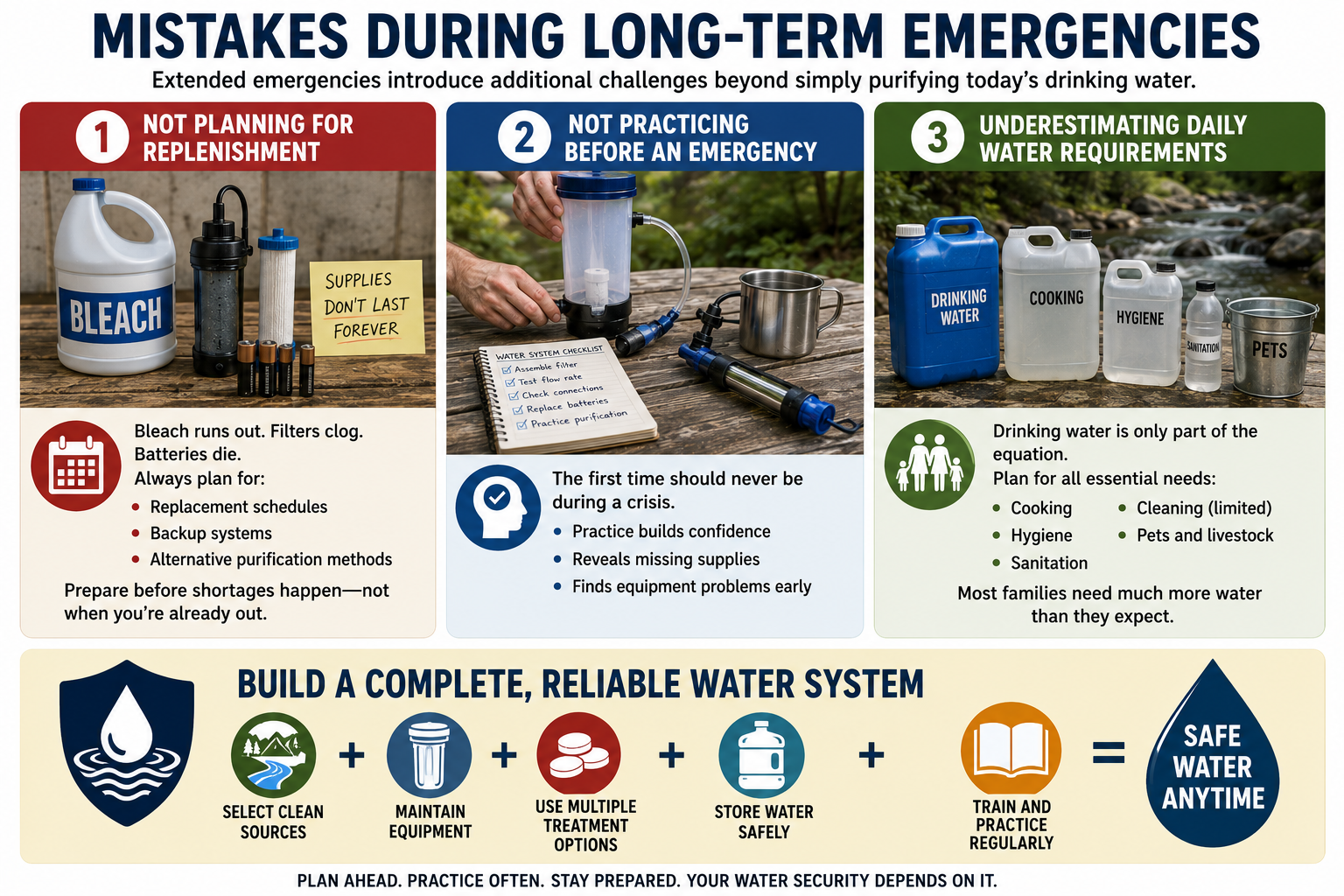
Final Thoughts
Water is one of the few resources that cannot be postponed during an emergency. A person may survive for weeks without food, but only a few days without safe drinking water. Every emergency eventually becomes a water emergency if clean water cannot be found, purified, and stored safely. For this reason, water purification is not simply another preparedness skill—it is one of the foundational abilities upon which every other survival activity depends.
One of the most important lessons throughout this handbook is that there is no perfect purification method. Every technique has strengths, limitations, and situations where it performs better than others. Boiling is dependable but consumes fuel. Chemical disinfectants are lightweight and portable but cannot remove chemicals or heavy metals. Filters improve water clarity but may not eliminate viruses. Ultraviolet purifiers work quickly but depend upon batteries and clear water. Distillation removes many contaminants that other methods cannot, but it is slow and energy intensive.
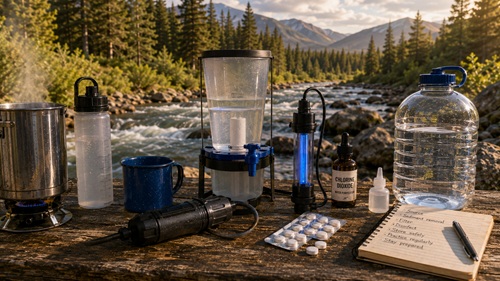
Preparedness is therefore not about choosing the single “best” purification method. Instead, it is about understanding which method is appropriate for the situation you face. A household that understands multiple purification techniques can adapt to changing conditions rather than becoming dependent upon one piece of equipment or one type of chemical.
Another important lesson is that successful water purification begins long before treatment. Choosing a clean water source, removing sediment, maintaining equipment, rotating chemical supplies, and storing purified water correctly all contribute to producing safe drinking water. Each step supports the next. Ignoring any one of them increases risk regardless of how effective the purification method itself may be.
Preparedness also requires practice. Reading about boiling water, assembling a gravity filter, operating an ultraviolet purifier, or mixing chlorine disinfectants is valuable, but hands-on experience builds confidence that cannot be gained from reading alone. Practicing these skills under normal conditions allows mistakes to be corrected before they occur during an actual emergency when stress, fatigue, and limited resources make learning much more difficult.
Finally, remember that water purification is only one part of a larger water preparedness plan. Households should also identify multiple water sources, maintain emergency storage reserves, understand daily water requirements, develop conservation strategies, and prepare for long-term resupply. Purification allows unsafe water to become usable, but preparedness begins by ensuring that adequate water is available in the first place.
The families that weather emergencies most successfully are rarely those with the most expensive equipment. More often, they are the ones who have learned the fundamentals, practiced them regularly, and built multiple layers of redundancy into every critical system. Water purification follows exactly the same principle. Knowledge, preparation, and practice provide resilience long before an emergency ever begins.
Preparedness Action Plan
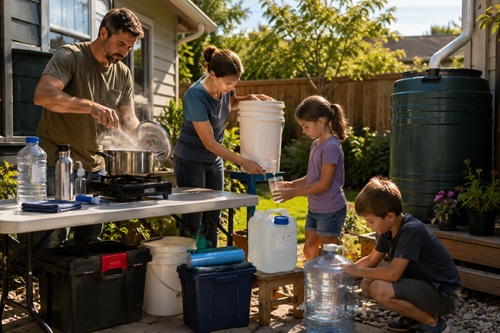
Reading about water purification is valuable, but preparedness improves only when knowledge is turned into action. Use the following action plan to evaluate your own readiness and identify areas that may need improvement.
1. Evaluate Your Water Sources
Identify every potential water source available to your household. Include municipal water, private wells, rainwater collection systems, nearby rivers, lakes, streams, ponds, springs, and emergency storage. Consider how each source might become contaminated during different types of disasters and determine which would likely remain the safest.
2. Build Multiple Purification Capabilities
Do not rely on a single treatment method. Aim to maintain at least three independent purification options. For example:
- Primary method: Gravity or pump filtration
- Secondary method: Boiling
- Backup method: Chlorine dioxide or household bleach
- Long-term method: Calcium hypochlorite
- Specialty method: Distillation
- Passive backup: Solar Water Disinfection (SODIS)
If one method becomes unavailable because of damaged equipment, exhausted fuel, expired chemicals, or changing conditions, another method should immediately be available.
3. Assemble a Water Purification Kit
Your kit should contain more than just a filter.
Recommended contents include:
- Water filter
- Spare filter cartridges
- Unscented household bleach
- Calcium hypochlorite (properly stored)
- Chlorine dioxide tablets
- Measuring devices
- Coffee filters or cloth pre-filters
- Food-grade storage containers
- Stainless steel boiling pot
- Waterproof instruction cards
- Permanent marker for labeling treated water
- Disposable gloves
- Spare batteries for UV purifier (if used)
4. Practice Every Method
At least once each year, practice:
- Pre-filtering muddy water
- Boiling water correctly
- Treating water with bleach
- Using chlorine dioxide tablets
- Operating your water filter
- Operating your UV purifier
- Sanitizing storage containers
Practice reveals missing supplies and builds confidence long before an emergency occurs.
5. Maintain Your Equipment
Create a maintenance schedule that includes:
- Inspecting filters
- Rotating bleach
- Checking chlorine dioxide expiration dates
- Replacing damaged containers
- Charging rechargeable batteries
- Inspecting seals and gaskets
- Cleaning purification equipment
Preparedness equipment only provides value if it functions when needed.
Household Water Preparedness Checklist
| Task | Complete |
|---|---|
| Identified multiple water sources | ☐ |
| Stored emergency drinking water | ☐ |
| Own at least three purification methods | ☐ |
| Stored replacement filter cartridges | ☐ |
| Rotated bleach within recommended period | ☐ |
| Stored calcium hypochlorite safely | ☐ |
| Have chlorine dioxide tablets available | ☐ |
| Practiced boiling procedures | ☐ |
| Practiced using filters | ☐ |
| Practiced UV purifier operation | ☐ |
| Sanitized water storage containers | ☐ |
| Printed purification instructions | ☐ |
| Established water rotation schedule | ☐ |
| Family understands purification procedures | ☐ |
A checklist like this can be reviewed annually to ensure your household remains prepared as equipment ages, supplies are used, or family circumstances change.
Skills Learned
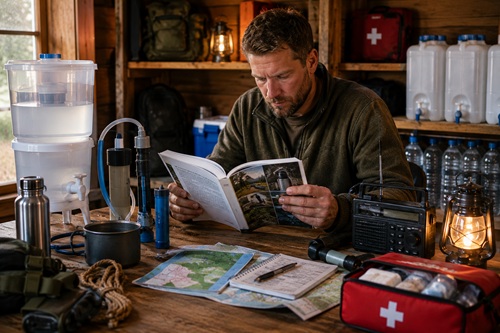
After completing this lesson, you should now be able to:
- Explain the difference between water purification and water filtration.
- Identify the major biological, chemical, and physical contaminants found in emergency water supplies.
- Evaluate unknown water sources before collecting them.
- Select the most appropriate purification method for different emergency situations.
- Safely boil water for emergency drinking purposes.
- Correctly disinfect water using household bleach.
- Understand the proper role of calcium hypochlorite in long-term preparedness.
- Safely use chlorine dioxide and iodine products for emergency water treatment.
- Operate ultraviolet water purification systems effectively.
- Use Solar Water Disinfection (SODIS) when conventional treatment methods are unavailable.
- Understand when distillation provides advantages over other purification methods.
- Combine multiple purification techniques into a layered treatment strategy.
- Properly store purified water while preventing recontamination.
- Recognize and avoid the most common mistakes made during emergency water treatment.
- Develop a comprehensive household water purification plan that remains effective during both short-term disasters and prolonged emergencies.
Water purification is one of the few preparedness skills that every person will eventually depend upon. The more methods you understand, the more options you will have when conditions change unexpectedly. Safe water is never the result of luck – it is the result of planning, knowledge, and consistent practice.
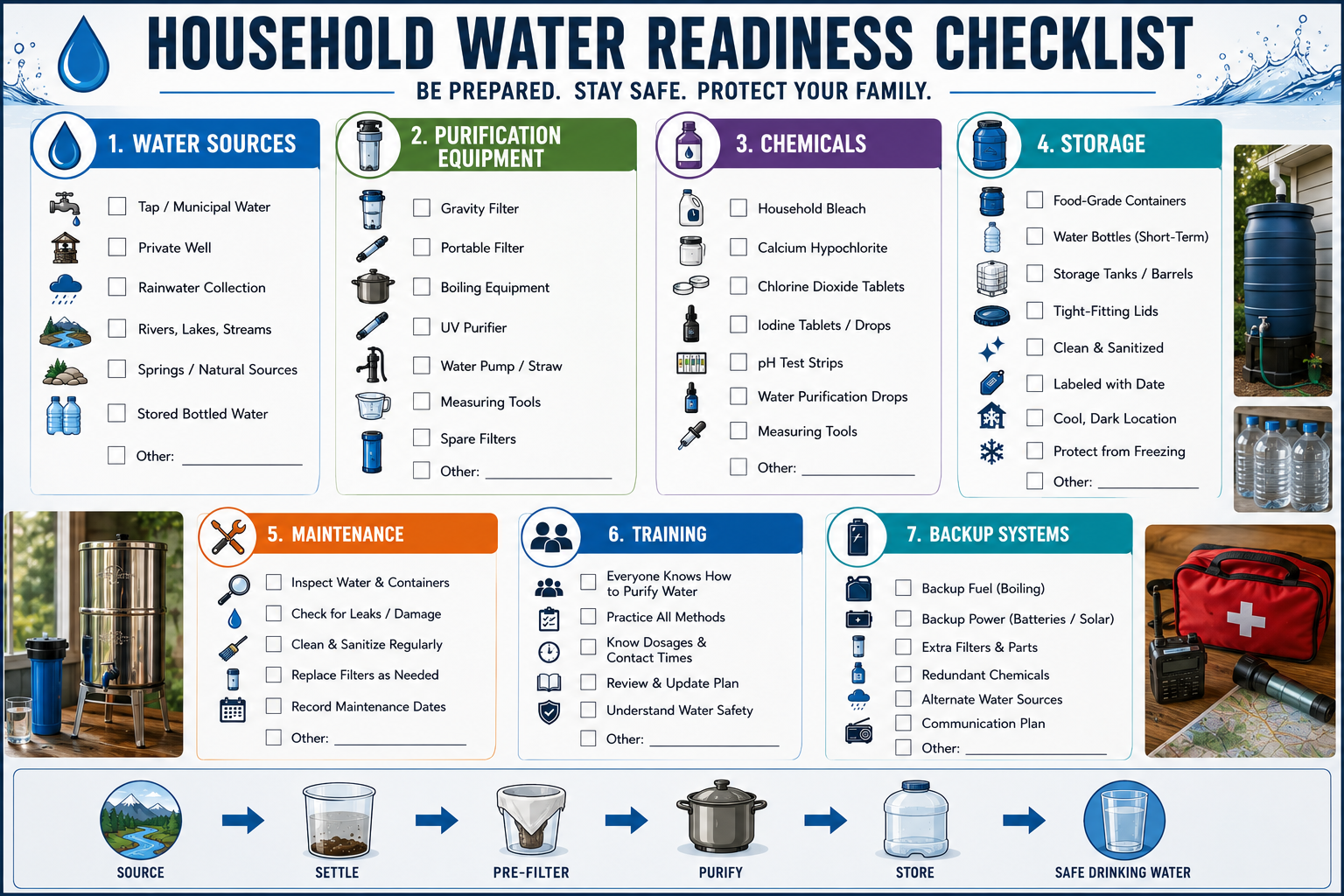
Appendix A – Emergency Water Purification Quick Reference
During an emergency, there may not be time to reread an entire handbook. This appendix provides quick-reference tables that summarize the most important information needed to safely purify drinking water. Consider printing these pages and storing them with your emergency water treatment supplies.
Water Purification Method Comparison
| Method | Bacteria | Viruses | Protozoa | Chemicals | Heavy Metals | Salt | Fuel Required | Power Required |
|---|---|---|---|---|---|---|---|---|
| Boiling | ✓ | ✓ | ✓ | ✗ | ✗ | ✗ | ✓ | ✗ |
| Household Bleach | ✓ | ✓ | Limited | ✗ | ✗ | ✗ | ✗ | ✗ |
| Calcium Hypochlorite | ✓ | ✓ | Limited | ✗ | ✗ | ✗ | ✗ | ✗ |
| Chlorine Dioxide | ✓ | ✓ | ✓ | ✗ | ✗ | ✗ | ✗ | ✗ |
| Iodine | ✓ | ✓ | Limited | ✗ | ✗ | ✗ | ✗ | ✗ |
| UV Purifier | ✓ | ✓ | ✓ | ✗ | ✗ | ✗ | ✗ | ✓ |
| Distillation | ✓ | ✓ | ✓ | Most | Most | ✓ | ✓ | Optional |
| SODIS | ✓ | ✓ | Moderate | ✗ | ✗ | ✗ | ✗ | ✗ |
Typical Treatment Times
| Method | Typical Treatment Time |
| Boiling | 1 minute rolling boil (3 minutes above 2,000 m / 6,500 ft) |
| Household Bleach | Minimum 30 minutes |
| Calcium Hypochlorite | Follow stock solution directions; minimum 30 minutes after dosing |
| Chlorine Dioxide | 30 minutes to 4 hours depending on contaminants |
| Iodine | Approximately 30 minutes (longer in cold water) |
| UV Purifier | Usually 60–90 seconds per liter |
| SODIS | Minimum 6 hours in full sunlight |
| Distillation | Depends on equipment and water volume |
Before You Purify
Always complete these steps whenever possible.
✓ Choose the cleanest available source.
✓ Avoid industrial runoff and floodwater if another source exists.
✓ Allow muddy water to settle.
✓ Remove visible debris.
✓ Pre-filter cloudy water.
✓ Select the proper purification method.
✓ Store purified water safely.
Skipping these simple preparation steps reduces the effectiveness of nearly every purification method discussed in this handbook.
Emergency Priorities
| Priority | Goal |
| 1 | Find the safest available water source. |
| 2 | Remove sediment. |
| 3 | Purify using an appropriate method. |
| 4 | Store safely. |
| 5 | Prevent recontamination. |
These five steps form the foundation of every successful emergency water purification plan.
Water Purification Decision Guide
During an emergency, choosing the correct purification method can sometimes be more difficult than performing the treatment itself. Every water source presents different hazards, and every purification method has strengths and limitations. This decision guide provides a logical process for selecting the safest treatment based on the conditions you encounter.
Step 1 – Can You Find a Better Water Source?
Always begin by asking whether a cleaner source is available.
Choose water sources in this order whenever possible:
- Stored emergency drinking water
- Municipal water (if still considered safe)
- Deep well water
- Natural spring
- Rainwater
- Fast-moving streams
- Rivers
- Lakes
- Ponds
- Floodwater (last resort)
The cleaner the source, the easier it becomes to produce safe drinking water.
Step 2 – Is the Water Cloudy?
If the answer is Yes:
- Allow sediment to settle.
- Carefully pour off the clearer water.
- Filter through cloth, coffee filters, or a sediment filter.
- Then disinfect.
If the answer is No:
Proceed directly to purification.
Step 3 – Could Chemicals Be Present?
Ask yourself:
- Is this near a factory?
- Is it beside a roadway?
- Is it downstream from farms?
- Is there an oily sheen?
- Does it smell like fuel or chemicals?
- Was this floodwater from an industrial area?
If the answer is Yes:
Find another water source if possible.
If another source cannot be found:
Distillation offers the greatest level of protection, although some volatile chemicals may still require activated carbon treatment.
Step 4 – Select Your Purification Method
You Have Fuel
Best choice:
✓ Boiling
Backup:
✓ Chlorine Dioxide
You Have No Fuel
Best choices:
✓ Chlorine Dioxide
✓ UV Purifier
✓ Household Bleach
You Have Salt Water
Best choice:
✓ Distillation
No chemical disinfectant or portable filter removes dissolved salt.
You Have Very Muddy Water
Best approach:
Settle
↓
Pre-filter
↓
Boil or Chlorine Dioxide
You Have Only Sunlight
Best choice:
Solar Water Disinfection (SODIS)
Only if:
- Water is clear
- PET bottles are available
- Several hours of sunlight remain
Quick Decision Matrix
| Situation | Best Choice | Backup |
|---|---|---|
| Backpacking | Filter + Chlorine Dioxide | UV |
| Power Outage | Boiling | Bleach |
| Flood | Filter + Boiling | Chlorine Dioxide |
| Winter | Boiling | Bleach |
| Hurricane | Boiling | Distillation if salt intrusion |
| Coastal Survival | Distillation | Rainwater Collection |
| Long-Term Grid Failure | Multiple Methods | SODIS |
| Vehicle Breakdown | Chlorine Dioxide | UV |
| Earthquake | Boiling | Filter + Bleach |
| Wildfire Evacuation | Chlorine Dioxide | UV |
Emergency Water Purification Flowchart
START

        │
        ▼

Can you find a cleaner source?

        │
   ┌────┴────┐
   │         │
 YES         NO
   │         │
Use better   Continue
source       │
             ▼

Is water cloudy?

        │
   ┌────┴────┐
   │         │
 YES         NO
   │         │
Settle &     Continue
Pre-filter   │
             ▼

Chemical contamination suspected?

        │
   ┌────┴────┐
   │         │
 YES         NO
   │         │
Find another Choose
source or    purification
Distill      method

             ▼

Fuel Available?

        │
   ┌────┴────┐
   │         │
 YES         NO
   │         │
 Boil      Chemical,
            UV, SODIS

        ▼

Store Safely

        ▼

Drink
Golden Rules
If you remember nothing else during an emergency, remember these rules:
- The clearest water is not always the safest.
- Remove sediment before disinfecting.
- Never rush contact times.
- Never assume one purification method solves every problem.
- Protect purified water from recontamination.
- Always have more than one way to make water safe.
When in doubt, use multiple treatment methods. Layered purification almost always provides greater protection than relying on a single technique.
Appendix C – Emergency Water Treatment Dosage & Contact Time Reference
During an emergency, stress, fatigue, poor lighting, and time pressure can make even familiar procedures difficult to remember. This appendix is designed as a quick-reference guide that can be printed and stored with your water purification supplies. While the tables below summarize common emergency recommendations, always follow the manufacturer’s instructions for your specific equipment or chemical whenever they differ.
Boiling Quick Reference
| Situation | Recommendation |
|---|---|
| Normal Elevation (Below 2,000 m / 6,500 ft) | Bring water to a vigorous rolling boil for at least 1 minute. |
| High Elevation (Above 2,000 m / 6,500 ft) | Continue boiling for at least 3 minutes. |
| Very Cloudy Water | Allow to settle and pre-filter before boiling. |
| Flood Water | Pre-filter before boiling whenever possible. |
| Unknown Water Quality | Boiling remains one of the safest biological treatment methods. |
Household Bleach Dosage Guide
Use only plain, unscented household bleach.
| Water Amount | 5–6% Bleach | 7–8.25% Bleach |
| 1 Liter (1 Quart) | 2 drops | 2 drops |
| 4 Liters (1 Gallon) | 8 drops (1/8 tsp) | 6 drops |
| 20 Liters (5 Gallons) | 1/2 teaspoon | About 1/3 teaspoon |
After adding bleach:
- Stir thoroughly.
- Wait 30 minutes.
- A slight chlorine odor should remain.
- If no odor exists, repeat the treatment and wait another 30 minutes.
Chlorine Dioxide
| Water Temperature | Minimum Contact Time |
| Warm, Clear Water | Approximately 30 minutes |
| Cold Water | 1–2 hours |
| Suspected Cryptosporidium | Up to 4 hours (follow manufacturer instructions) |
Iodine Treatment
| Situation | Recommendation |
| Clear Water | Follow product instructions |
| Cold Water | Extend contact time |
| Long-Term Use | Not recommended |
| Pregnancy or Thyroid Disorders | Use another purification method whenever possible |
UV Purifier
| Step | Action |
| 1 | Remove sediment first. |
| 2 | Fill clean container. |
| 3 | Activate purifier. |
| 4 | Stir as instructed. |
| 5 | Complete entire treatment cycle. |
| 6 | Store treated water safely. |
Solar Water Disinfection (SODIS)
| Requirement | Recommendation |
| Bottle | Clear PET bottle |
| Bottle Size | 2 liters (0.5 gallon) or less |
| Sunlight | Full direct sun |
| Exposure | Minimum 6 hours |
| Cloudy Conditions | Entire daylight period |
| Heavy Overcast | Use another method |
Distillation
| Removes | Does Not Always Remove |
| Bacteria | Some volatile chemicals |
| Viruses | Certain solvents |
| Protozoa | Some volatile fuels |
| Heavy Metals | Requires activated carbon if VOCs suspected |
| Salt | |
| Most Minerals |
Typical Daily Water Requirements
These are minimum planning estimates.
| Purpose | Amount Per Person Per Day |
| Drinking | 2–4 liters (0.5–1 gallon) |
| Food Preparation | 2–4 liters |
| Minimal Hygiene | 8–12 liters |
| Total Emergency Planning | Approximately 15–20 liters (4–5 gallons) |
Actual needs increase during:
- Hot weather
- Heavy physical activity
- Illness
- Pregnancy
- High altitude
Water Source Risk Guide
| Water Source | Relative Risk |
| Commercial Bottled Water | Very Low |
| Deep Well | Low |
| Protected Spring | Low |
| Rainwater | Low–Moderate |
| Mountain Stream | Moderate |
| River | Moderate |
| Lake | Moderate |
| Pond | High |
| Flood Water | Very High |
| Industrial Runoff | Extreme |
| Seawater | Requires Distillation |
Emergency Priorities
If time is limited, remember these priorities:
| Priority | Action |
| 1 | Find the cleanest available source. |
| 2 | Remove sediment. |
| 3 | Purify completely. |
| 4 | Wait the required contact time. |
| 5 | Store safely. |
| 6 | Prevent recontamination. |
Quick Reminders
✓ Clear water is not necessarily safe.
✓ Pre-filter whenever possible.
✓ Never shorten chemical contact times.
✓ Rotate bleach and other treatment chemicals regularly.
✓ Maintain multiple purification methods.
✓ Keep printed instructions with your emergency supplies.
✓ Store treated water separately from untreated water.
✓ Practice before an emergency—not during one.
This appendix is intended to serve as your “grab-and-go” field reference when time is limited and immediate decisions are required.
Emergency Water Purification Supply Checklist
No water purification system is complete without the equipment and supplies needed to operate, maintain, repair, and expand it during an emergency. Many people purchase an excellent filter or purifier but overlook the replacement parts, accessories, measuring tools, and backup equipment that keep the system functioning after weeks or months of continuous use.
This appendix is designed as both a shopping guide and an annual inventory checklist. Every preparedness household will have different needs depending on family size, location, available water sources, and expected emergencies, but the categories below provide a comprehensive starting point.
Primary Water Purification Equipment
These are the primary tools used to produce safe drinking water.
| Item | Have | Notes |
|---|---|---|
| Gravity water filter | ☐ | Excellent for home use |
| Pump filter | ☐ | Good for backpacking |
| Squeeze filter | ☐ | Lightweight emergency use |
| Personal straw filter | ☐ | Individual emergency backup |
| UV purifier | ☐ | Requires batteries |
| Stainless steel boiling pot | ☐ | Large capacity preferred |
| Distillation equipment | ☐ | Useful for saltwater or chemical concerns |
Replacement Parts
Many purification systems eventually stop working because inexpensive replacement parts were never stored.
| Item | Have | Recommended Quantity |
| Replacement filter cartridges | ☐ | At least two sets |
| Spare O-rings | ☐ | Several |
| Filter lubricant | ☐ | One tube |
| Cleaning brush | ☐ | One |
| Backflush syringe | ☐ | One |
| Replacement hoses | ☐ | As required |
| Spare seals | ☐ | Several |
Chemical Purification Supplies
Store chemicals separately in cool, dry locations.
| Item | Have |
| Unscented household bleach | ☐ |
| Calcium hypochlorite | ☐ |
| Chlorine dioxide tablets | ☐ |
| Iodine tablets | ☐ |
| Waterproof dosage charts | ☐ |
Measuring Equipment
Accurate measurements improve treatment reliability.
| Item | Have |
| Measuring spoons | ☐ |
| Eye dropper | ☐ |
| Graduated measuring cup | ☐ |
| Waterproof marker | ☐ |
| Waterproof labels | ☐ |
Pre-Filtration Supplies
Removing sediment improves every purification method.
| Item | Have |
| Coffee filters | ☐ |
| Cheesecloth | ☐ |
| Clean cotton cloths | ☐ |
| Fine mesh strainer | ☐ |
| Bucket for settling water | ☐ |
Water Collection Equipment
Collecting water safely is just as important as purifying it.
| Item | Have |
| Collapsible water containers | ☐ |
| Food-grade buckets | ☐ |
| Rainwater collection tarp | ☐ |
| Rain barrel | ☐ |
| Water collection bags | ☐ |
| Funnels | ☐ |
Drinking Water Storage
Proper storage prevents recontamination.
| Item | Have |
| Food-grade water containers | ☐ |
| Stainless steel bottles | ☐ |
| Commercial bottled water | ☐ |
| Water bricks or stackable containers | ☐ |
| Replacement container caps | ☐ |
Maintenance Supplies
Routine maintenance greatly extends equipment life.
| Item | Have |
| Unscented sanitizer | ☐ |
| Mild dish soap | ☐ |
| Soft cleaning cloths | ☐ |
| Spare batteries | ☐ |
| Rechargeable batteries | ☐ |
| Battery charger | ☐ |
| Solar battery charger | ☐ |
Water Testing Equipment
Testing helps identify problems before treatment.
| Item | Have |
| Water quality test strips | ☐ |
| pH test kit | ☐ |
| Total Dissolved Solids (TDS) meter | ☐ |
| Thermometer | ☐ |
Emergency Repair Kit
Small repairs often prevent complete equipment failure.
| Item | Have |
| Waterproof tape | ☐ |
| Silicone sealant | ☐ |
| Zip ties | ☐ |
| Small tool kit | ☐ |
| Adjustable wrench | ☐ |
| Screwdrivers | ☐ |
Documentation
Knowledge is part of your equipment.
Store printed copies of:
☐ Manufacturer instructions
☐ Replacement part numbers
☐ Bleach dosage chart
☐ Calcium hypochlorite mixing instructions
☐ Contact time chart
☐ Family water purification procedures
☐ Water source maps
☐ Equipment maintenance log
Never assume internet access will be available during an emergency.
Recommended Redundancy
Preparedness improves dramatically when every critical capability has at least one backup.
| Capability | Primary | Backup |
| Filtration | Gravity Filter | Pump Filter |
| Biological Purification | Boiling | Chlorine Dioxide |
| Long-Term Chemicals | Calcium Hypochlorite | Bleach |
| Power | Rechargeable Batteries | Solar Charger |
| Water Storage | Food-grade Containers | Bottled Water |
| Collection | Rain Barrel | Buckets & Tarps |
Annual Inspection Checklist
At least once each year:
☐ Replace expired chemicals.
☐ Rotate stored water.
☐ Inspect filters.
☐ Replace worn O-rings.
☐ Test UV purifier.
☐ Charge batteries.
☐ Inspect storage containers.
☐ Practice every purification method.
☐ Update printed instructions.
☐ Replace missing supplies.
Preparedness is not achieved by purchasing equipment once and placing it on a shelf. It is maintained through regular inspection, practice, and replacement of aging supplies. A well-organized purification kit ensures that when clean drinking water becomes critical, every tool needed to produce it is immediately available and ready for use.
Water Purification Equipment Maintenance & Troubleshooting Guide
Water purification equipment is only valuable if it functions when you need it most. During an emergency, there may be no replacement parts available, no repair shops open, and no opportunity to order new equipment. Routine maintenance performed before an emergency greatly increases reliability while extending the useful life of filters, purifiers, containers, and supporting equipment.
This appendix provides recommended inspection schedules, preventive maintenance procedures, and troubleshooting advice for the most common water purification equipment used by preparedness households.
General Inspection Schedule
The following schedule provides a practical starting point for most households. Adjust it based on the manufacturer’s recommendations and how frequently the equipment is used.
| Equipment | Quick Inspection | Full Inspection | Replace or Service |
|---|---|---|---|
| Gravity Filter | Monthly | Every 6 months | Filter elements as required |
| Pump Filter | Before each use | Every 6 months | According to manufacturer |
| Straw Filter | Before each use | Annually | According to manufacturer |
| UV Purifier | Monthly | Every 6 months | Batteries and lamp as needed |
| Stainless Pot | Before use | Annually | Replace if damaged |
| Water Containers | Monthly | Every refill | Replace cracked containers |
| Bleach | Monthly | Annually | Rotate every 12 months |
| Calcium Hypochlorite | Every 6 months | Annually | If contaminated or damaged |
| Chlorine Dioxide Tablets | Every 6 months | Annually | Before expiration |
| Rain Collection System | Monthly | Spring and Fall | Replace damaged components |
Maintaining Water Filters
Filters should never be placed into storage immediately after use without cleaning.
After filtering water:
- Remove visible dirt.
- Backflush if required.
- Allow exterior components to dry.
- Store according to the manufacturer’s instructions.
- Protect from freezing.
- Protect from direct sunlight.
One of the most common causes of filter failure is freezing after use. Water trapped inside many hollow-fiber filters expands as it freezes, creating microscopic cracks that cannot usually be seen. If a filter has frozen after being used, treat it as potentially damaged unless the manufacturer specifically approves continued use.
Never use compressed air to clean filter elements unless recommended by the manufacturer, as excessive pressure may damage internal components.
Maintaining UV Purifiers
Ultraviolet purifiers require very little maintenance but should never be ignored.
Regularly inspect:
- Battery condition
- Battery compartment
- Electrical contacts
- Protective quartz sleeve
- Lens cleanliness
- Waterproof seals
Clean the quartz sleeve with a soft cloth whenever fingerprints, mineral deposits, or dirt become visible.
Store spare batteries separately and rotate rechargeable batteries periodically to maintain capacity.
Maintaining Water Storage Containers
Containers should remain clean even while empty.
Inspect for:
- Cracks
- Bulging
- Damaged lids
- Loose caps
- Mold
- Algae
- Discoloration
- Chemical odors
Wash and sanitize containers before each refill.
Replace containers that have become brittle, permanently stained, or difficult to clean.
Maintaining Chemical Supplies
Chemical disinfectants slowly deteriorate over time.
Household bleach loses strength continuously during storage.
Inspect:
✓ Manufacture date
✓ Expiration date
✓ Container condition
✓ Leaks
✓ Sun damage
✓ Chemical odor
Rotate bleach annually or according to the manufacturer’s recommendations.
Calcium hypochlorite generally stores much longer but should remain completely dry.
Inspect for:
- Moisture
- Clumping
- Damaged packaging
- Corrosion
- Contamination
Never return unused chemicals to the original container.
Troubleshooting Guide
| Problem | Possible Cause | Recommended Action |
| Water still cloudy | Insufficient pre-filtration | Allow settling and filter again |
| Filter flow is slow | Clogged filter | Clean or backflush |
| No water flow | Blocked filter | Service or replace cartridge |
| UV purifier will not turn on | Dead batteries | Replace or recharge batteries |
| UV lamp appears dim | Dirty quartz sleeve | Clean according to instructions |
| Bleach has little odor | Product has degraded | Replace bleach |
| Water still smells bad after treatment | Organic contamination | Filter and retreat |
| Chlorine taste is too strong | Excess disinfectant | Allow water to stand or aerate |
| Distiller producing little water | Low heat or blockage | Inspect system and clean |
| Water container leaks | Damaged seal | Replace lid or container |
When Equipment Should Be Replaced
| Equipment | Replace When… |
| Filter Cartridge | Flow remains poor after cleaning or manufacturer limit reached |
| UV Batteries | Charge no longer holds |
| Water Containers | Cracked, leaking, or difficult to sanitize |
| Bleach | Beyond recommended storage period |
| Chlorine Dioxide | Past expiration date |
| Rubber Seals | Cracked or hardened |
| Hoses | Brittle or leaking |
Annual Preparedness Maintenance Day
Many preparedness households designate one day each year to inspect all emergency equipment.
Suggested annual tasks include:
☐ Rotate drinking water.
☐ Replace expired chemicals.
☐ Test every purifier.
☐ Practice boiling procedures.
☐ Backflush filters.
☐ Replace batteries.
☐ Inspect rainwater collection systems.
☐ Verify spare parts inventory.
☐ Review family purification procedures.
☐ Update printed instructions.
Completing these tasks on the same day each year makes it far less likely that important maintenance will be forgotten.
Preventive Maintenance Is Better Than Emergency Repair
Every emergency places additional stress on equipment. Filters process more water, storage containers are opened more frequently, batteries are discharged more often, and chemicals may be used continuously for weeks. Equipment that has been neglected before an emergency is much more likely to fail when it is needed most.
Preventive maintenance is one of the least expensive preparedness investments you can make. Spending a few minutes each month inspecting your water purification equipment can prevent failures that might otherwise leave your household without safe drinking water.
Remember that redundancy applies to maintenance as well. Even well-maintained equipment can fail unexpectedly. Maintaining backup purification methods ensures that the failure of one system never leaves you without the ability to produce safe drinking water.
Real-World Water Purification Scenarios
Reading about water purification methods builds knowledge, but applying those methods under real-world conditions requires judgment. Emergencies rarely present perfect situations. Water sources may be contaminated in multiple ways, equipment may be damaged, fuel may be limited, and time may be short. This appendix presents realistic scenarios to help you think through the decision-making process before an emergency occurs.
The scenarios below are not intended to provide the only correct solution. Instead, they demonstrate how the principles taught throughout this handbook can be applied to a variety of situations.
Scenario 1 – Municipal Boil Water Advisory
Situation
A severe storm has damaged the local water treatment plant. Public officials issue a boil water advisory because pressure has been lost in portions of the distribution system. Electricity remains available, and tap water is still flowing.
Water Available
- Municipal tap water
Hazards
- Possible bacterial contamination
- Possible viruses entering through broken water mains
Best Treatment
Boil the water for at least one minute (three minutes at high elevations).
Backup Methods
- Household bleach
- Chlorine dioxide
- UV purifier
Common Mistakes
- Assuming clear tap water is automatically safe.
- Ignoring the advisory because neighbors are still drinking untreated water.
- Filling storage containers before purification.
Lessons Learned
Even treated municipal water can become unsafe after natural disasters. Always follow official boil water advisories until they are lifted.
Scenario 2 – Flooded Neighborhood
Situation
Days of heavy rain have flooded roads, fields, and neighborhoods. Streams, rivers, and ponds are filled with muddy water.
Water Available
- Floodwater
- Rainwater
- Municipal supply may be unavailable
Hazards
- Sewage
- Agricultural runoff
- Petroleum products
- Industrial chemicals
- Biological contamination
Best Treatment
Seek another source whenever possible.
If no alternative exists:
- Allow settling.
- Pre-filter.
- Boil.
Backup
Distillation if chemical contamination is suspected.
Common Mistakes
- Drinking floodwater without treatment.
- Assuming boiling removes chemicals.
- Collecting water near fuel spills.
Lessons Learned
Floodwater presents some of the highest contamination risks encountered during disasters.
Scenario 3 – Lost While Hiking
Situation
You become disoriented during a day hike and unexpectedly spend the night outdoors.
Water Available
- Small mountain stream
Hazards
- Giardia
- Cryptosporidium
- Wildlife contamination
Best Treatment
Filter followed by chlorine dioxide.
Backup
Boiling.
Common Mistakes
- Drinking directly from flowing streams.
- Forgetting backup purification tablets.
Lessons Learned
Even crystal-clear mountain water should be purified.
Scenario 4 – Winter Power Outage
Situation
An ice storm leaves your community without electricity for several days.
Water Available
- Snow
- Melted ice
- Stored water
Hazards
- Fuel shortages
- Limited electricity
Best Treatment
Melt snow first.
Then boil.
Backup
Bleach if fuel becomes limited.
Common Mistakes
- Eating snow directly.
- Forgetting that melting snow produces very little water.
- Using contaminated snow collected near roads.
Lessons Learned
Winter conditions often create water shortages despite the abundance of snow.
Scenario 5 – Hurricane Along the Coast
Situation
Storm surge has contaminated wells with seawater.
Water Available
- Brackish well water
- Rainwater
Hazards
- Salt
- Sewage
- Biological contamination
Best Treatment
Rainwater collection.
If unavailable:
Distillation.
Backup
Transport water from unaffected areas.
Common Mistakes
- Assuming boiling removes salt.
- Continuing to drink contaminated well water.
Lessons Learned
Salt contamination requires different treatment than biological contamination.
Scenario 6 – Long-Term Grid Failure
Situation
Power has been unavailable for several weeks. Fuel supplies are becoming limited.
Water Available
- Rainwater
- Nearby creek
Hazards
- Fuel shortages
- Equipment wear
- Replacement parts unavailable
Best Treatment
Gravity filtration followed by chlorine dioxide.
Reserve boiling for questionable water.
Backup
Solar Water Disinfection.
Common Mistakes
- Using all available fuel for boiling.
- Wearing out one filter while backup equipment sits unused.
Lessons Learned
Long-term emergencies require conservation and redundancy.
Scenario 7 – Vehicle Breakdown
Situation
Your vehicle breaks down on a remote highway. Temperatures are high and your stored drinking water is nearly exhausted.
Water Available
- Small farm pond
Hazards
- Livestock contamination
- Algae
- Sediment
Best Treatment
Settle.
Pre-filter.
Use chlorine dioxide.
Backup
Boiling if equipment allows.
Common Mistakes
- Drinking immediately because of thirst.
- Ignoring algae blooms.
Lessons Learned
Heat-related dehydration can pressure people into making poor decisions. Stay disciplined.
Scenario 8 – Cabin Without Running Water
Situation
You spend several weeks at an off-grid cabin supplied by a nearby creek.
Water Available
- Creek
- Rainwater
Hazards
- Seasonal runoff
- Wildlife
Best Treatment
Gravity filtration.
Boil drinking water during periods of heavy runoff.
Backup
UV purifier when batteries are available.
Lessons Learned
Permanent off-grid living benefits from multiple purification systems operating together.
Scenario 9 – Earthquake
Situation
A major earthquake damages municipal infrastructure.
Water Available
- Water heater
- Toilet tank (not bowl)
- Swimming pool (non-potable)
- Rainwater
Hazards
- Broken water mains
- Sewage intrusion
Best Treatment
Stored water first.
Then water heater.
Purify all additional sources.
Lessons Learned
Many households overlook water already stored inside the home.
Scenario 10 – Preparing Before the Emergency
Situation
No emergency exists today.
Best Action
The safest water purification decision is made before disaster strikes.
Build your supplies now.
Practice now.
Rotate chemicals now.
Inspect equipment now.
Print instructions now.
Teach your family now.
The easiest emergency to manage is the one you prepared for before it happened.
Scenario Summary
| Scenario | Best Treatment |
|---|---|
| Boil Water Advisory | Boiling |
| Flood | Settle → Filter → Boil |
| Mountain Stream | Filter + Chlorine Dioxide |
| Winter Storm | Melt → Boil |
| Hurricane | Rainwater → Distillation |
| Grid Failure | Filter + Chlorine Dioxide |
| Vehicle Breakdown | Filter + Chemical Treatment |
| Off-Grid Cabin | Gravity Filter |
| Earthquake | Stored Water First |
| Everyday Preparedness | Build Redundant Systems |
Final Preparedness Principle
No emergency unfolds exactly as planned. Equipment may fail, weather may change, water sources may disappear, and the hazards you encounter may be very different from those you expected. The most resilient households are not those with the most equipment—they are the ones that understand the principles behind water purification and can adapt those principles to changing circumstances.
Knowledge, preparation, practice, and redundancy remain the four pillars of emergency water purification. By mastering each of the methods described throughout this handbook and understanding when to apply them, you greatly improve your ability to provide safe drinking water for yourself and your family regardless of the challenges ahead.
© Prepping Communities. This content is for informational purposes only and not professional advice. Use at your own risk.
Terms | Privacy | Guidelines