
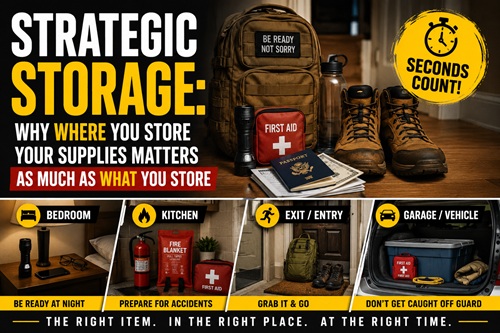
It’s 2:17 in the morning.
The smoke alarm suddenly goes off.
You wake up confused and disoriented.
The house is dark.
You smell smoke.
Your heart starts racing.
You need a flashlight.
You need shoes.
You need to check on your family.
You need to know whether you should stay or leave.
Now imagine the items you need are buried in a closet somewhere across the house.
Every second spent searching feels longer when stress takes over.
This is a simple example, but it highlights a preparedness lesson that often gets overlooked:
Preparedness is not just about what you own.
It’s about how quickly you can access it.
Many people spend years building emergency supplies while giving very little thought to where those supplies are actually stored. Yet during an emergency, organization and accessibility often matter just as much as the supplies themselves.
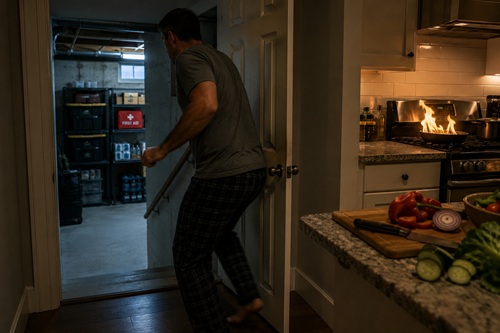 The Problem With the “One Big Storage Room” Approach
Many preppers start by creating a dedicated preparedness area.
A basement room.
A storage closet.
A garage shelf.
A spare bedroom.
There is nothing wrong with having a central storage area. In fact, every prepared household should have one.
The problem occurs when everything is stored there.
Imagine a grease fire starts in the kitchen.
Your fire extinguisher is in the basement.
A severe storm knocks out power during the night.
Your flashlights are stored in the garage.
A family member suffers a serious cut while working outside.
Your medical supplies are locked away in another part of the house.
In each situation, the supplies exist.
The problem is access.
Preparedness is not simply about having resources.
It’s about having the right resources available when you need them.
Think in Layers Instead of Piles
One of the most effective preparedness strategies is layered storage.
Rather than keeping everything together, supplies are distributed throughout the home based on likely needs and likely threats.
Think of it this way:
A firefighter doesn’t store all emergency equipment in one room.
A hospital doesn’t keep every medical supply in a single cabinet.
Critical resources are placed where they are most likely to be needed.
Your home can follow the same principle.
The goal is not to replace your main preparedness storage area.
The goal is to create smaller preparedness layers throughout your daily living space.
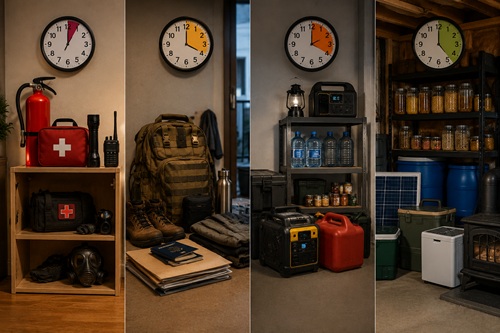 The Preparedness Time Scale
One way to think about layered storage is through time.
Different emergencies require different response times.
Seconds Matter
Some emergencies require immediate action.
Examples include:
- House fires
- Serious injuries
- Home intrusions
- Carbon monoxide alarms
- Medical emergencies
Items needed within seconds should be immediately accessible.
Examples:
- Fire extinguishers
- Trauma kits
- Flashlights
- Emergency communications
- Personal protective equipment
If you need it in less than a minute, it should not be buried in storage.
Minutes Matter
Other emergencies develop slightly slower.
Examples include:
- Evacuations
- Wildfire alerts
- Flood warnings
- Severe weather
Items needed within minutes may include:
- Bug-out bags
- Important documents
- Weather gear
- Pet supplies
- Vehicle kits
These supplies should be organized and ready to grab quickly.
Hours Matter
Some situations allow more preparation time.
Examples include:
- Extended power outages
- Water service interruptions
- Winter storms
These situations often require access to:
- Backup power
- Water storage
- Emergency food
- Communication equipment
- Fuel supplies
These items can be stored centrally because immediate access is usually less critical.
Days Matter
Long-term preparedness resources often include:
- Bulk food storage
- Homesteading supplies
- Long-term medical reserves
- Alternative energy systems
- Seasonal preparedness equipment
These resources support resilience over extended periods rather than immediate response.
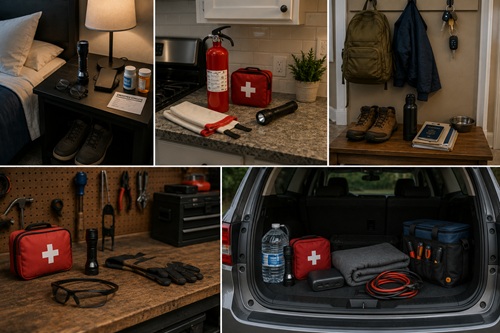 Building Room-by-Room Preparedness
One of the easiest ways to improve preparedness is to evaluate each room independently.
Ask yourself a simple question:
“If something happened here right now, what would I need within the next 60 seconds?”
The answers can be surprisingly revealing.
Most of us have opened a drawer looking for something and realized we can’t remember where we put it. During a normal day that’s frustrating. During an emergency it can become a serious problem.
Bedroom
Nighttime emergencies are common.
Power outages.
Medical emergencies.
Severe weather alerts.
Unexpected evacuations.
Consider keeping:
- Flashlight or headlamp
- Charged battery bank
- Eyeglasses if needed
- Sturdy footwear
- Emergency contact information
- Critical medications
A power outage at noon is inconvenient.
A power outage at 2 a.m. feels very different.
Kitchen
The kitchen presents unique risks.
Heat.
Fire.
Sharp tools.
Electrical appliances.
Potential preparedness items include:
- Fire extinguisher
- Fire blanket
- First aid kit
- Burn treatment supplies
- Flashlight
- Emergency contact list
Many household emergencies begin in the kitchen.
It makes sense to prepare accordingly.
Entryway
This area often becomes your evacuation zone.
Consider storing:
- Bug-out bags
- Important documents
- Vehicle keys
- Weather gear
- Pet supplies
The easier it is to leave quickly, the smoother an evacuation becomes.
Garage or Workshop
Many injuries occur while working on projects.
Consider storing:
- First aid supplies
- Work gloves
- Flashlight
- Safety glasses
- Basic tools
A few simple items can make a significant difference when accidents happen.
Vehicle
Many emergencies happen away from home.
A vehicle preparedness layer might include:
- Water
- First aid supplies
- Flashlight
- Blanket
- Battery bank
- Seasonal clothing
- Basic tools
You don’t need to carry everything.
You simply need enough to handle common problems.
Redundancy Creates Resilience
One flashlight is good.
Several flashlights in strategic locations are better.
One first aid kit is useful.
Multiple kits where injuries are most likely to occur are even better.
Preparedness often comes down to redundancy.
Not because equipment fails.
But because access fails.
A resource you cannot reach quickly may as well not exist.
Layered storage helps solve that problem.
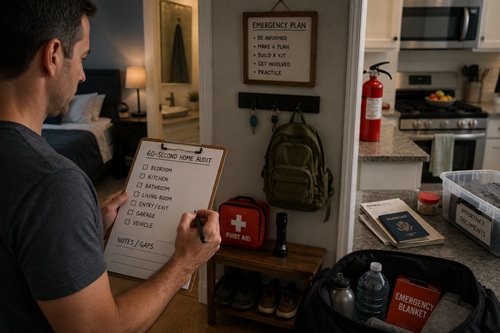 The 60-Second Home Audit
Here’s a simple preparedness exercise.
Walk through your home one room at a time.
Stop in each room and ask:
“If an emergency happened right now, what would I need in the next 60 seconds?”
Write down the answers.
Most people quickly discover gaps they never noticed before.
Maybe there is no flashlight near the bed.
Maybe there is no fire extinguisher near the kitchen.
Maybe important documents are scattered throughout the house.
Maybe evacuation supplies are difficult to access.
Maybe critical medications are not stored where they can be reached quickly.
These discoveries often improve preparedness more than buying another piece of gear.
The Real Goal
The purpose of preparedness is not to fill closets with gear.
The purpose is to solve problems.
When the power goes out, can you quickly find light?
When someone gets hurt, can you quickly reach medical supplies?
When it’s time to leave, can you quickly grab what you need?
The answers to those questions often depend less on what you own and more on where you keep it.
A well-organized home can turn confusion into action and save valuable time when every minute counts.
That’s why strategic storage is one of the simplest and most effective preparedness improvements you can make.
You may not need to buy a single new piece of equipment.
You may simply need to rethink where the equipment you already own is stored.
© Prepping Communities. This content is for informational purposes only and not professional advice. Use at your own risk.
Terms | Privacy | Guidelines