
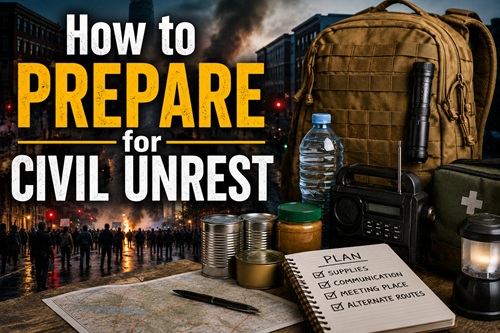
Most people think civil unrest is something that happens somewhere else.
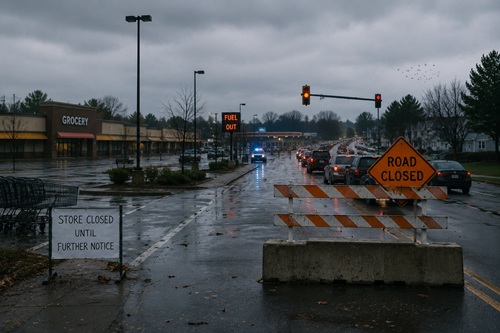
Then one day a road is blocked, stores are unusually busy, fuel stations have lineups, or a protest that started downtown suddenly spreads into neighboring areas. What seemed like someone else’s problem can quickly begin affecting your daily routine.
The good news is that preparing for civil unrest doesn’t require extreme measures. In many ways, the same steps that help you through storms, power outages, and supply shortages can also help you navigate periods of social disruption.
The key is preparing before problems begin.
 Understanding the Real Risks
When people hear the term “civil unrest,” they often picture dramatic scenes from television.
In reality, the biggest impacts are often much less dramatic.
Road closures, supply shortages, transportation disruptions, business closures, overwhelmed emergency services, and uncertainty can affect a community long before anyone experiences a direct threat to their safety.
For most people, the challenge isn’t surviving a riot.
It’s dealing with the disruptions that surround it.
Why Staying Home Often Makes Sense
Many preppers spend a lot of time thinking about bug-out plans.
Those plans have their place, but civil unrest is one situation where staying put is often the better option.
Your home already contains most of the things you need.
Your food is there.
Your water is there.
Your medical supplies are there.
You know the neighborhood, the roads, and the people around you.
Leaving that environment and driving into an uncertain situation may create more problems than it solves.
Unless conditions become genuinely unsafe, staying home and avoiding unnecessary exposure is often the simplest and safest choice.
 Don’t Draw Attention to Yourself
One lesson that comes up repeatedly in preparedness discussions is that attention can be a liability.
If tensions are high and people are stressed, the last thing you want is to stand out.
That doesn’t mean turning your house into a bunker.
It simply means being mindful.
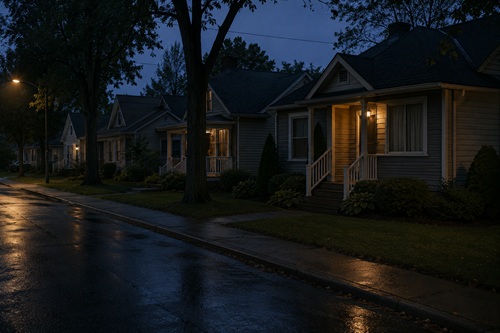
Keep curtains closed at night if bright lights are visible from outside.
Avoid advertising the fact that you have large amounts of supplies.
Keep noise levels reasonable.
Most importantly, don’t make yourself the center of attention.
The houses that attract the least attention are often the ones people overlook entirely.
Buy Supplies Before Everyone Else Does
If there is one lesson we’ve learned from recent years, it’s how quickly shelves can empty.
The worst time to buy emergency supplies is when everyone else suddenly decides they need them too.
A prepared household doesn’t need months of warning.
It doesn’t need to panic-buy.
It doesn’t need to stand in line hoping supplies are still available.
Having extra food, water, medications, batteries, hygiene products, and other essentials creates breathing room when normal systems become stressed.
Preparedness is often about giving yourself options.
Stay Informed Without Becoming Obsessed
Information is important.
So is avoiding information overload.
During uncertain times, it can be tempting to spend hours scrolling through social media trying to figure out what is happening.
Unfortunately, rumors often travel faster than facts.
Monitor reliable sources.
Pay attention to local conditions.
Keep a battery-powered radio available.
Stay informed enough to make good decisions, but don’t allow yourself to become consumed by every rumor or headline.
Sometimes the most useful information comes from simply paying attention to what is happening in your own community.
 Have a Family Communication Plan
Most emergencies become more stressful when family members are separated.
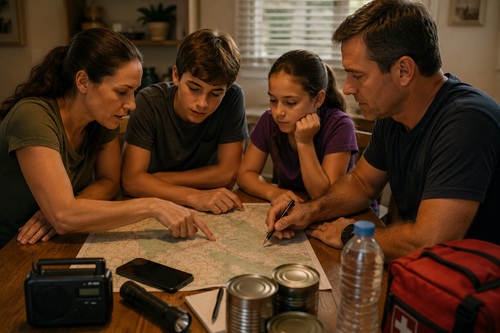
Take a few minutes to discuss simple questions before an emergency occurs.
How will you communicate if cellular networks become overloaded?
Where will family members meet if they cannot get home immediately?
Who should be contacted if local communication becomes difficult?
Simple plans are often the most effective plans.
You don’t need a complicated system.
You just need everyone to know what to do.
Don’t Overlook Your Neighbors
One of the biggest mistakes in preparedness is assuming everything must be done alone.
Good neighbors can be incredibly valuable during difficult times.
They notice unusual activity.
They share information.
They check on one another.
They often become an extra set of eyes and ears when conditions are uncertain.
Building those relationships before an emergency is far easier than trying to build them during one.
Community remains one of the most underrated preparedness assets available.
Conduct a Simple Readiness Check
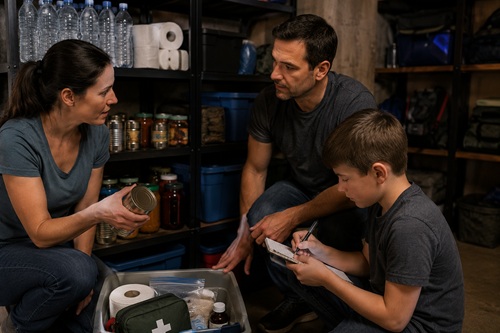
One useful exercise is to spend an hour looking at your preparedness plans through the lens of a temporary disruption.
Ask yourself:
- Could we stay home for two weeks without shopping?
- Do we have enough drinking water?
- What happens if the power goes out?
- How would we communicate if networks become unreliable?
- What roads would we avoid if unrest occurred nearby?
The answers often reveal preparedness gaps that are easy to fix today but much harder to solve during an emergency.
 Preparedness Starts Long Before the Headlines
One of the interesting things about civil unrest is that the people who are most affected are often not the people directly involved.
A blocked highway can affect thousands of commuters.
A temporary store closure can affect an entire neighborhood.
A fuel shortage can create long lineups that spread far beyond the original problem.
A few days of disruption can quickly turn routine tasks into frustrating challenges.
That is why preparedness is less about reacting to civil unrest and more about preparing for the secondary effects that often follow it.
Most people do not need to become security experts.
Most people do not need elaborate survival plans.
What they need is enough food, water, supplies, and information to avoid becoming part of the rush when everyone else suddenly realizes there is a problem.
Take some time to evaluate your own situation.
Could your household remain comfortable for a week if stores were closed?
Would you have enough food, water, medications, and essential supplies if transportation disruptions delayed deliveries?
Does every family member know how to contact one another if normal communication becomes difficult?
Would you know which routes to avoid if conditions changed unexpectedly?
These are not dramatic questions.
They are practical questions.
And preparedness is often built on practical answers.
The households that weather disruptions most successfully are rarely the ones with the most equipment.
They are usually the ones that took the time to think ahead, make a plan, fill a few gaps, and prepare before the situation demanded it.
Civil unrest may never affect your community directly.
But the habits that help you prepare for it—planning ahead, maintaining supplies, staying informed, and building strong community connections—can improve your readiness for many other emergencies as well.
In the end, preparedness is not about expecting the worst.
It is about giving yourself more options when life becomes less predictable.
© Prepping Communities. This content is for informational purposes only and not professional advice. Use at your own risk.
Terms | Privacy | Guidelines