
Severe weather becomes a very different kind of emergency when children are at school and parents are somewhere else. A tornado warning may arrive while a parent is at work, shopping, traveling, or at home several miles away. The natural reaction is often to think about getting to the school as quickly as possible, but that may be exactly the wrong response during an active warning. Roads can become dangerous within minutes, traffic can interfere with emergency vehicles, and arriving parents can unintentionally disrupt procedures that school staff are already carrying out. The better approach is to understand the school’s emergency system before severe weather develops so that both parents and children know what will happen when they cannot immediately reach one another.
School emergency preparedness should be viewed as an extension of family preparedness. Parents may have carefully planned what their household will do during a tornado, wildfire, earthquake, power outage, or other emergency, but children spend a significant amount of time outside the home. During those hours, the family’s preparedness plan temporarily depends upon another organization. Understanding how the school protects students, communicates with families, accounts for children, and reunites them with parents closes an important gap in household preparedness.
The objective is not for parents to second-guess every decision made by school administrators. It is to understand the system well enough that everyone knows their role when an emergency occurs.
Understand the School’s Emergency Plan Before You Need It
The worst time to begin learning about a school’s emergency procedures is after an alert appears on your phone. During an actual emergency, information may arrive slowly, cellular networks may become congested, school personnel may be occupied with students, and conditions may change rapidly. Questions that could have been answered months earlier suddenly become much more difficult to resolve.
Parents should therefore become familiar with the school’s emergency plan during normal conditions. Learn how the school receives severe-weather warnings, who has authority to initiate protective actions, what signals students and staff receive, where different classes are expected to go, how attendance is maintained, how parents will receive information, and what happens after the immediate danger has passed. The source material emphasizes that tornado procedures are intended to be established and practiced before an actual event rather than improvised once a warning is underway.
It is also worth understanding that a school emergency plan may involve much more than simply moving everyone into a hallway. A child could be in a classroom when the warning arrives, but they could just as easily be in the gymnasium, cafeteria, library, playground, portable classroom, school bus, or another part of the property. A useful emergency plan accounts for these different circumstances and establishes how students reach appropriate shelter from wherever they happen to be.
Knowing these procedures gives parents something particularly valuable during an emergency: an understanding of what is happening even when they cannot physically see their child.
Know Where Your Child Will Shelter
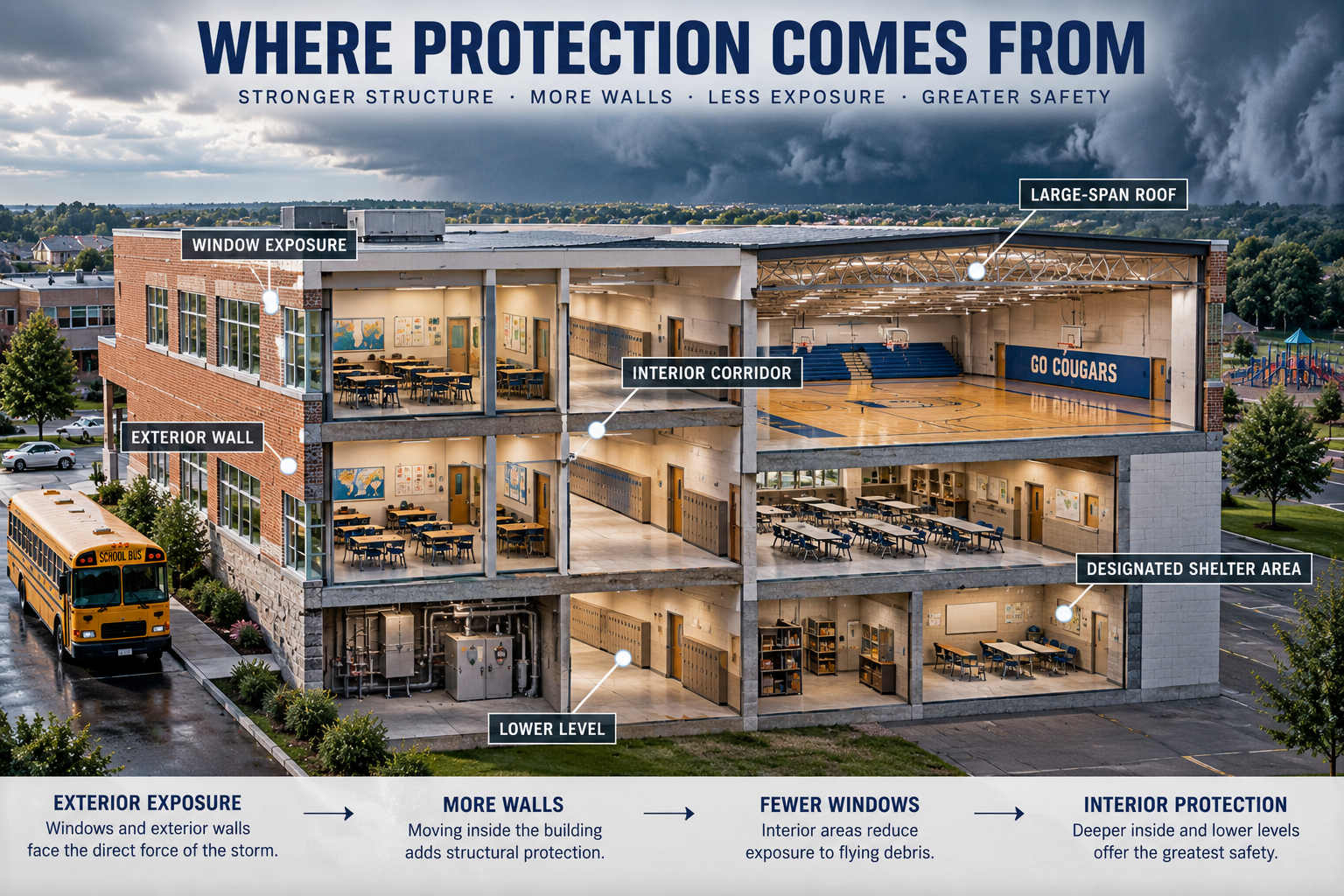
Not every location inside a building provides the same level of protection during a tornado. The safest available areas are generally deeper within a substantial building, away from windows and exterior walls and on the lowest practical level. The reasoning is straightforward. Tornadoes can produce destructive winds, flying debris, broken glass, and structural damage, so putting additional walls and structural elements between people and the exterior can provide greater protection.
Large open spaces require special consideration. Gymnasiums, auditoriums, and some cafeterias may appear attractive because they can accommodate many students, but their wide roof spans can make them less desirable shelter locations than smaller interior areas. Portable classrooms present another challenge because they do not provide the same structural protection as a substantial permanent building. The source specifically discusses the importance of interior lower-level shelter areas, concerns surrounding large-span rooms, and moving students from portable classrooms when appropriate.
Parents should know where their particular child is expected to shelter rather than simply accepting that the school “has a tornado plan.” Ask whether students remain in their classroom or move elsewhere. If they move, find out where they go. Some schools may use interior corridors or smaller rooms, while others may have specially constructed storm shelters or safe rooms.
This information is especially important for children who regularly spend time in detached or portable classrooms. If movement to another building is required, that movement needs to occur early enough that students are not crossing exposed outdoor areas as dangerous conditions arrive.
The purpose of identifying shelter locations beforehand is to eliminate decision-making when seconds may matter.
Understand What Your Child Has Practiced
Emergency drills are valuable because they convert instructions into familiar actions. Reading that students should move to a designated shelter area is very different from physically walking the route, learning where to sit or kneel, understanding how attendance will be taken, and practicing how to protect the head and neck.
During a tornado drill, teachers and students practice a sequence that can later be repeated under much greater stress. Students learn what the alert sounds like, where they are supposed to go, how they should move, and what they should do when they reach the shelter area. Teachers practice accounting for students and managing the group while maintaining the ability to hear additional emergency instructions. The source describes this movement to designated shelter areas and the protective position used to reduce exposure to falling or flying debris.
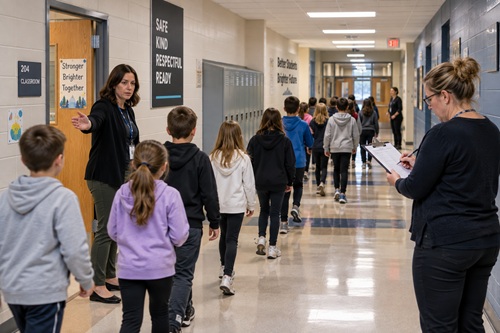
Parents can reinforce this training without turning tornado preparedness into something frightening. Ask children what they do during their school drills and allow them to explain the procedure in their own words. A child who can describe the alarm, shelter location, route, and protective actions is demonstrating that the procedure has become familiar.
If the child is unsure, that does not necessarily mean the school is unprepared. It does provide an opportunity to clarify the procedure and reinforce the important parts at home.
Practice works because people generally perform familiar actions more reliably under stress than unfamiliar ones. The purpose of a drill is therefore not simply compliance with school policy. It is to reduce hesitation when the real warning arrives.
Why Driving to the School May Make Things Worse
For many parents, this may be the most difficult part of school emergency preparedness to accept. When a warning is issued, the instinct to retrieve a child can be overwhelming. Parents naturally want their children physically beside them when danger approaches.
During an active tornado warning, however, driving toward the school may expose both the parent and child to additional danger. A vehicle provides poor protection from a tornado, and the journey may place the parent directly in the path of severe weather. If large numbers of parents respond the same way, roads around the school can become congested at exactly the time emergency responders need access.
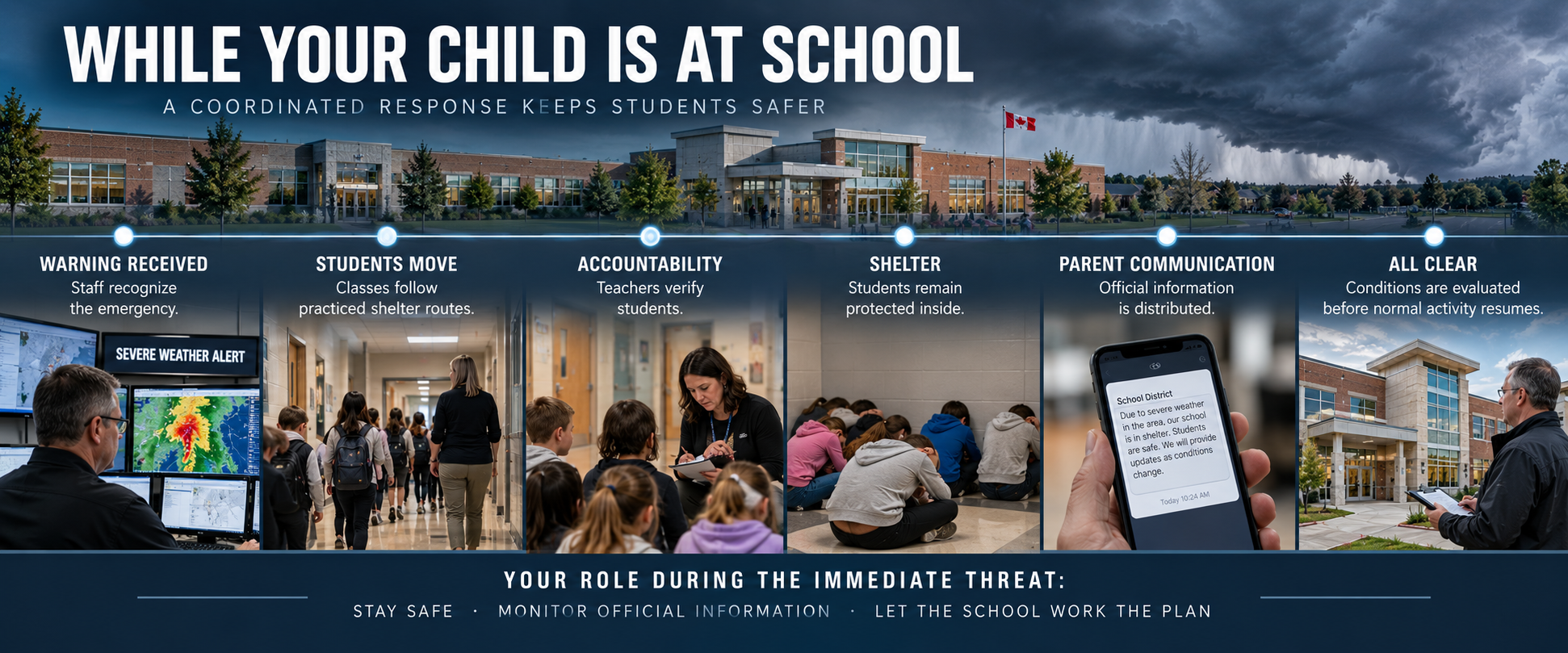
There is also a less obvious problem inside the school. Staff members are trying to account for every student. Classes have moved to predetermined locations, attendance is being checked, and personnel are attempting to maintain order while monitoring the emergency. Parents arriving and requesting individual children can interfere with that accountability system and divert staff attention away from protecting the larger student population.
The safer response during the immediate threat will often be to remain in a safe location, monitor official school and emergency communications, and allow the school’s trained personnel to continue the procedures already underway unless authorities provide different instructions. The source similarly cautions against attempting to travel to the school during an active tornado warning because of road danger, congestion, and disruption to school procedures.
This is one reason understanding the school’s plan beforehand matters so much. Trust is easier when you already know what the school is doing.
Make Sure the School Can Reach You
Emergency communication systems only work when the information behind them is accurate. An outdated telephone number, old email address, or missing emergency contact can become a serious problem when a school needs to reach hundreds of families quickly.
Parents should periodically verify the information the school maintains for their household. Confirm primary and secondary telephone numbers, email addresses, emergency contacts, and the people authorized to pick up the child. Changes in employment, telephone numbers, family arrangements, or addresses should be reflected in the school’s records rather than left until the next routine paperwork update.
It is also important to think about redundancy. A parent may be unable to reach the school because of road closures, work obligations, vehicle problems, damaged infrastructure, or the emergency affecting the parent’s own location. Having another trusted adult authorized to collect the child can preserve options when the normal plan becomes impossible.
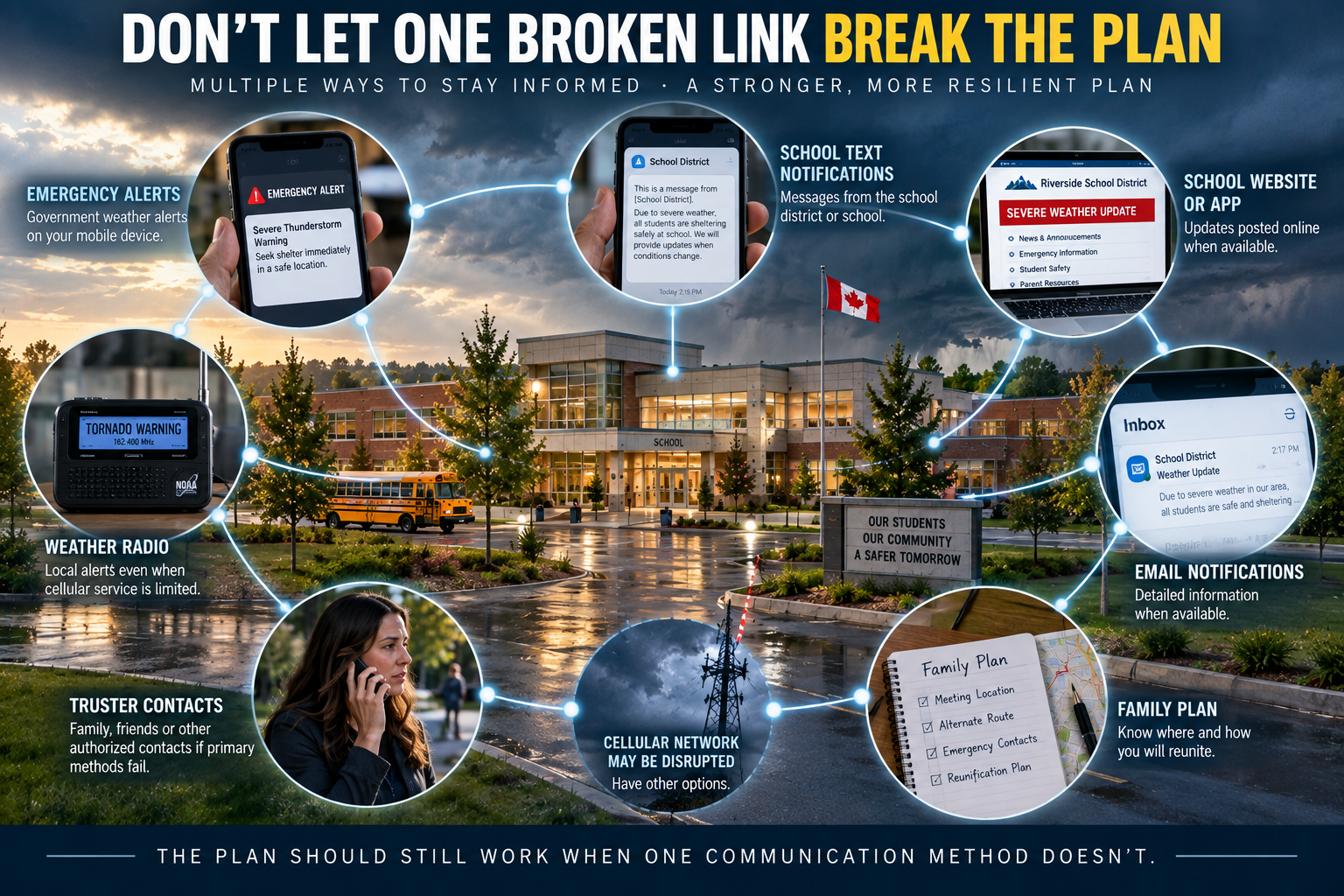
Parents should also understand how emergency messages are normally delivered. Schools may use automated telephone calls, text messages, email, websites, apps, or several methods together. Knowing where official information will appear reduces the temptation to rely on rumors, fragmented social-media posts, or secondhand information from other parents.
Prepare for Communication Systems to Fail
Modern emergency planning relies heavily on technology, but severe weather is capable of damaging the same infrastructure that technology depends upon. Electricity may fail, cellular networks can become overloaded, internet connections may disappear, and thousands of people attempting to communicate simultaneously can slow otherwise functioning networks.
Families should therefore avoid building an emergency plan around the assumption that a particular text message will always arrive immediately.
Learn what backup communication procedures the school uses if its primary system becomes unavailable. Older children should know important family contact information rather than having every telephone number stored only in a phone. Families can also consider identifying a trusted relative or friend outside the immediate area who can act as a communication point if local family members have difficulty reaching one another.
This does not require complicated communications equipment. The principle is simply redundancy. If one method fails, another remains available.
The same principle applies throughout preparedness. A plan that works only when electricity, internet access, cellular service, transportation, and every other normal system remain available is not especially resilient.
Understand What Happens After the Storm
The end of a tornado warning does not necessarily mean the school immediately returns to normal operations. The building may need to be inspected for structural damage. Electrical lines may be down. Roads may be blocked. Windows may be broken, utilities may have failed, or portions of the property may be unsafe.
Normal dismissal may therefore be replaced by an emergency reunification procedure.
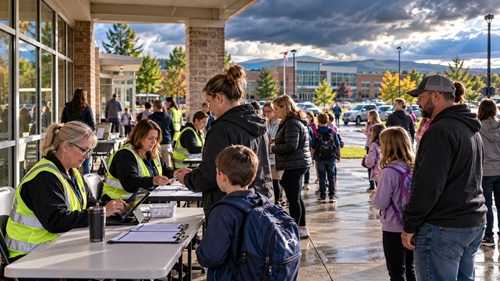
Parents should understand that process before they ever need it. Find out where they are expected to go, what identification they may need, how authorized pickup persons are verified, and whether the school has an alternate reunification location if the campus itself becomes unsafe.
This matters because the natural response after a disaster is to go directly to the place where the child was last known to be. That location may no longer be where students are being held.
A predetermined reunification system allows school staff to continue accounting for students while releasing them in a controlled manner to authorized adults. The source specifically identifies reunification as something parents should understand in advance rather than trying to determine after an emergency.
For parents, knowing the process eliminates one major uncertainty at a time when many other things may already be uncertain.
Account for Medical, Mobility, and Other Individual Needs
Emergency plans work best when they account for the actual people who will use them. Some children have requirements that make a standard evacuation or shelter procedure more complicated. Mobility limitations, medication requirements, sensory sensitivities, respiratory conditions, communication difficulties, or other individual needs can change how quickly or safely a student reaches shelter.
Parents of children with additional needs should discuss these circumstances with school personnel during normal conditions. The useful question is not simply whether the school knows about the child’s needs, but how those needs are incorporated into the emergency procedure.
If the student cannot use stairs easily, how will they reach the designated shelter location? If medication may be needed during a prolonged shelter period, how will it remain accessible? If alarms, crowds, or confined spaces create significant difficulty for the child, what support is available? If a student normally relies on equipment requiring electricity, what happens during a power failure?
The source also identifies the importance of planning for students with mobility, medical, or other special requirements.
These problems are usually much easier to solve around a table than in the middle of a severe-weather warning.
Talk About Emergencies Without Creating Fear
Children need enough information to respond appropriately, but preparedness should not make them believe disaster is constantly approaching. The objective is confidence, not anxiety.
For younger children, explanations can remain simple. Severe weather sometimes happens, the school has safer places to go, teachers know what to do, and students practice so everyone remembers the procedure. Children do not need graphic descriptions of tornado destruction to understand why following instructions matters.
Older children can understand more of the reasoning behind the procedures. They can learn why interior locations are preferable to windows, why protecting the head and neck matters, why a gymnasium may not be the preferred shelter location, and why parents may not immediately arrive at the school.
That last lesson can prevent considerable anxiety. Children should understand beforehand that a parent’s absence during an emergency does not mean something has gone wrong. The parent may deliberately be remaining somewhere safe while the child remains protected at school.
Preparedness conversations should therefore reinforce capability. The message is not that something terrible is about to happen. The message is that if severe weather occurs, the child already knows what to do. The source likewise emphasizes age-appropriate conversations that reinforce preparedness without unnecessarily increasing fear.
Connect School Preparedness With the Home Plan
School preparedness becomes even more effective when children encounter similar principles at home. If the school teaches students to move quickly to a protected interior location during a tornado warning, the family should also know where its safer location is at home.
Depending on the house, this might be a basement, storm shelter, or smaller interior room on the lowest practical level and away from windows. The exact location will depend on the structure, but every family member should know where it is before severe weather arrives.
Keep basic emergency supplies accessible to that location. Lighting, communications, first aid, appropriate footwear, weather information, and other essentials can be useful if the household needs to remain sheltered for an extended period or emerge afterward into a damaged environment.
Practice the home procedure occasionally without turning it into an elaborate exercise. Have everyone move to the designated shelter area and use the exercise to discover practical problems that might otherwise remain hidden until an actual warning occurs. Someone may not know where the flashlight is, batteries may be dead, a weather radio may not receive a reliable signal from the shelter area, or a pet may hide when everyone suddenly begins moving. These small problems are exactly what practice is intended to uncover because they can be corrected easily while conditions are normal.
When children encounter the same general preparedness principles at home and school, emergency response becomes less mysterious. They understand that identifying safer places, listening for warnings, following established procedures, and practicing beforehand are simply normal parts of being prepared.
Build a Family Plan for When You Are Separated
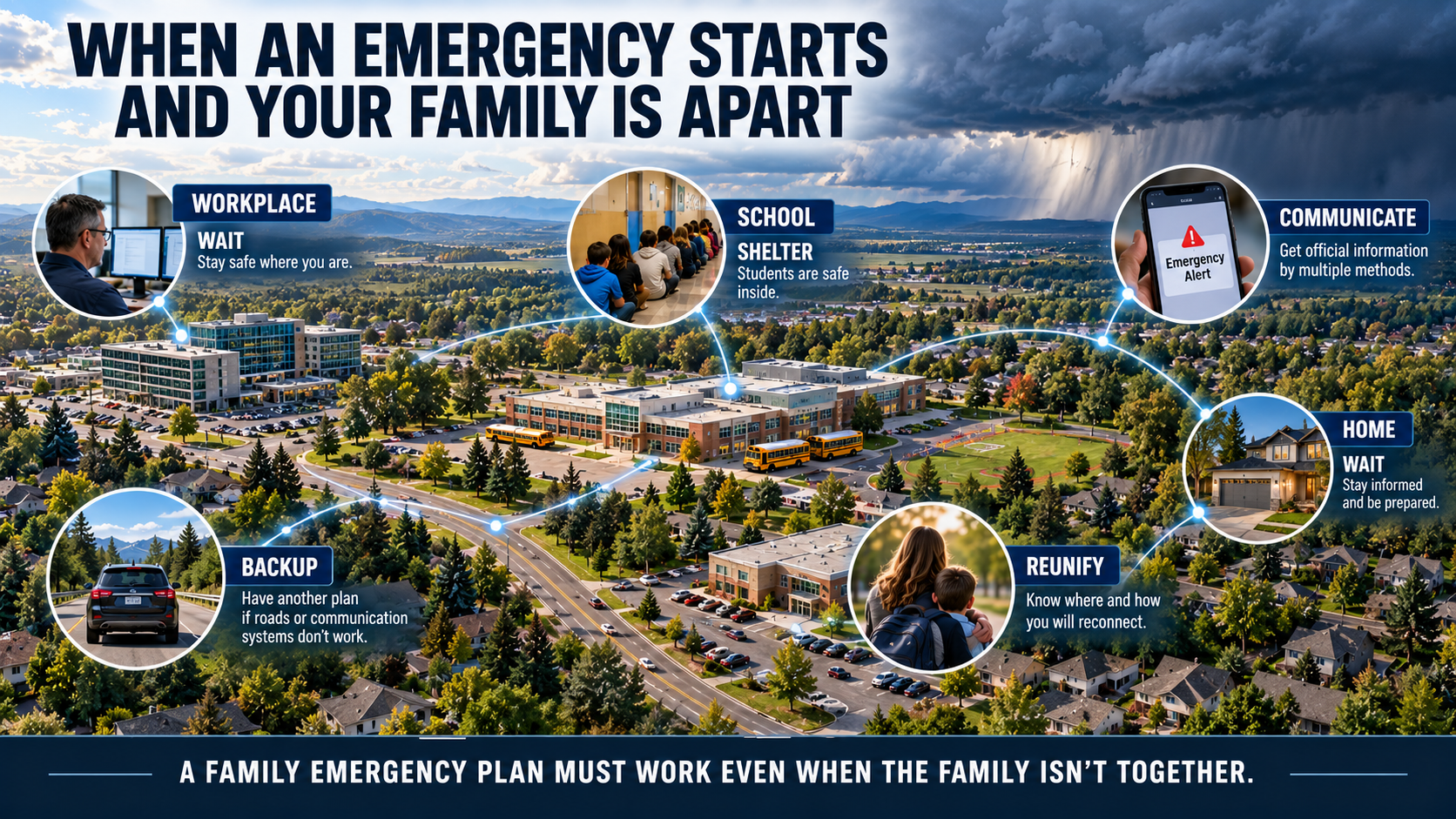
A school emergency highlights a broader preparedness reality: families are frequently separated when emergencies begin.
Parents work. Children attend school. Teenagers may be at sports practices or jobs. One family member may be shopping while another is traveling. A household emergency plan that assumes everyone will be together when something happens leaves a significant gap.
Families should discuss what everyone will do when immediate reunification is impossible. Children should understand that they may need to remain where responsible adults have directed them until conditions improve. Parents should know where official information will come from and resist acting on rumors. Older children should understand whom they can contact if they cannot reach their parents.
Families should also identify primary and alternate meeting arrangements for emergencies where people must reconnect later. The objective is not to create a complicated plan with dozens of possibilities. It is to establish enough shared understanding that nobody has to invent a response while frightened and separated.
This type of planning extends well beyond tornadoes. The same principles can help during earthquakes, wildfires, hazardous-material incidents, prolonged power outages, transportation disruptions, or other emergencies that occur during school hours.
Ask Questions While Everything Is Normal
Parents do not need to become experts in school emergency management. They simply need enough information to understand the system protecting their children.
Learn where your child shelters, how warnings are received, what the child has practiced, how the school communicates with families, how individual medical or mobility needs are handled, what happens if communications fail, and how reunification works afterward.
Approach these conversations as a partnership rather than an inspection. School administrators and teachers have responsibilities during emergencies, but parents also have responsibilities. Accurate contact information, appropriate expectations, family preparedness, and understanding when not to rush toward the school all contribute to a safer response.
One of the greatest advantages of asking these questions beforehand is that the answers can reveal weaknesses while there is still plenty of time to address them.
Preparedness is much easier when nothing is happening.
Preparedness Action Plan
Begin by learning what your child’s school actually does during severe weather rather than assuming you already know. Review the school’s emergency information and determine where your child is expected to shelter during a tornado warning, how emergency notifications are delivered, what happens if normal communications are unavailable, and where reunification would occur if the school could not use its normal dismissal process.
Verify that the school has current telephone numbers, email addresses, emergency contacts, medical information where appropriate, and accurate authorization for anyone who may need to collect your child. If your child has mobility, medical, sensory, or other individual requirements, make sure there is a practical emergency procedure addressing those needs rather than simply assuming they will be handled when the time comes.
At home, ask your child to explain what happens during a school tornado drill. Listen to what they understand before correcting or adding information. Then identify your household’s own severe-weather shelter area and practice using it. Check communications, lighting, first-aid supplies, footwear, weather information, and anything else the family may need while sheltered or immediately afterward.
Finally, discuss what everyone should expect if an emergency occurs while the family is separated. Children should know that parents may not be able to reach them immediately and that remaining with trained school staff may be the safest course until conditions improve. Parents should know where official information will come from and understand the school’s reunification procedure before they ever need to use it.
Key Takeaways
School emergency preparedness is not something that belongs entirely to the school. It is part of the family’s larger preparedness system because children may be away from home when severe weather or another emergency develops.
Parents who understand the school’s procedures are better positioned to make good decisions when they cannot immediately reach their children. Knowing where students shelter, what they have practiced, how the school accounts for them, how information will be communicated, and how families will eventually reunite removes uncertainty before an emergency begins.
Children benefit from the same preparation. A child who has practiced what to do does not need to invent a response when an alarm sounds. They recognize the procedure, know where to go, and understand that the adults around them have a plan.
The most important work therefore happens while the weather is calm. Learn the plan, keep information current, practice at home, prepare for communication problems, and make sure everyone understands what happens when the family cannot immediately be together.
The goal is not to make children or parents worry about the next tornado.
It is to make sure that when a warning eventually comes, everyone already knows what to do.
© Prepping Communities. This content is for informational purposes only and not professional advice. Use at your own risk.
Terms | Privacy | Guidelines