
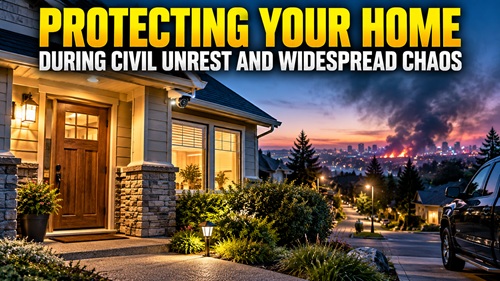
Home security changes when the problem outside is larger than ordinary crime. A burglary is usually an isolated event. Civil unrest, prolonged power outages, major disasters, widespread shortages, or a breakdown in normal services can affect an entire community at the same time. Police response may be delayed, communications may become unreliable, streets may become difficult to travel, and normally quiet neighborhoods may suddenly experience problems they were never designed to handle.
Preparing for that possibility does not mean turning a home into a fortress. In fact, one of the most useful principles of emergency home security is that the strongest protection usually begins well before someone reaches the front door.
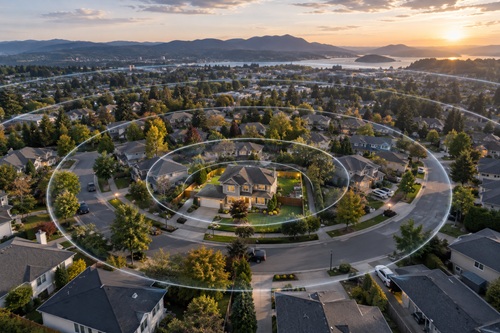
A prepared household builds layers of security.
Each layer should provide information, discourage unwanted attention, create additional time, or give the household another option. The farther away a developing problem can be identified, the more time there is to make a calm decision. By the time a threat reaches the property itself, several earlier layers should already have provided warning.
The goal is simple:
Detect problems early. Avoid them when possible. Deter them from coming closer. Delay unauthorized entry. Protect the people inside.
Security Begins Beyond Your Property
Most people think about home security in terms of locks, alarms, cameras, and doors. Those things matter, but they are actually among the final layers.
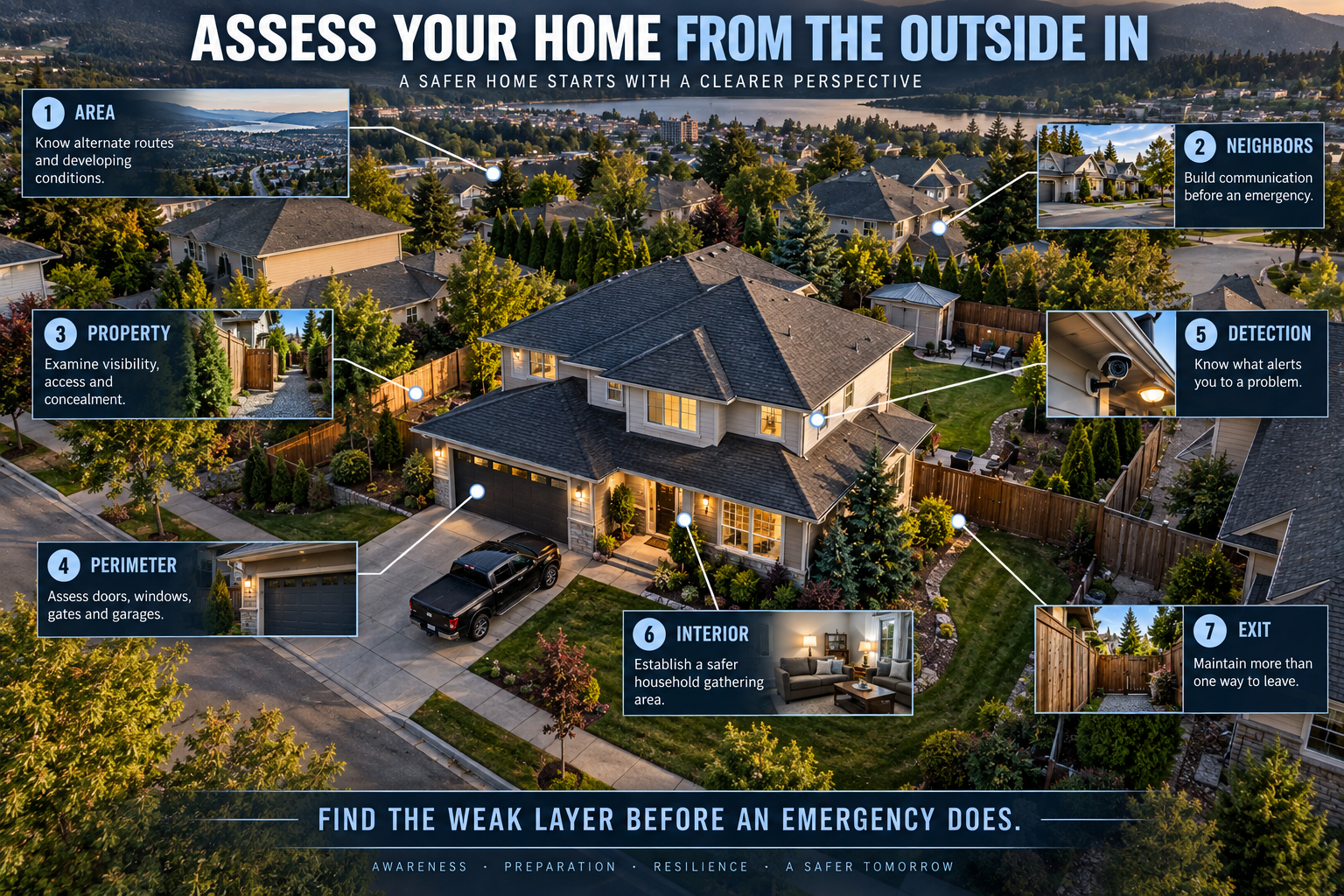
The first layer is understanding the area surrounding the home.
Think about how people and traffic normally move through the community. Major highways, secondary roads, bridges, commercial districts, transportation hubs, hospitals, government buildings, shopping areas, fuel stations, and other heavily used locations can influence what happens during an emergency.
A disruption can completely change normal movement patterns.
A highway closure may push traffic onto residential streets. A prolonged blackout can cause people to congregate around the few stores or fuel stations that remain operational. An evacuation can overwhelm roads that are normally quiet. Civil unrest concentrated in one part of a city can cause traffic and people to move into surrounding areas.
The preparedness advantage comes from recognizing these patterns before an emergency.
Learn several ways to reach your home rather than depending on one familiar route. Know which roads are likely to become bottlenecks and which routes provide alternatives. Consider how you would return home if you could not drive. If family members regularly work, attend school, shop, or spend time away from home, everyone should understand how they would reconnect if normal transportation or communications failed.
This type of regional awareness creates something extremely valuable during an emergency: time.
A person who realizes that trouble is moving toward the neighborhood an hour before it arrives has far more options than someone who discovers it by looking through the front window.
Your Neighborhood Is the Next Security Layer
A neighborhood filled with people who recognize one another has an enormous advantage over a street filled with strangers.
You do not need to be close friends with everyone around you. Simply knowing who normally belongs in the area can dramatically improve situational awareness.
Neighbors notice things.
Someone may see unfamiliar vehicles repeatedly driving through the area. Another person may notice a power outage beginning several blocks away. Someone closer to a main road may see traffic suddenly increasing. Another household may hear that emergency services are responding to an incident nearby.
Individually, these observations may not mean much. Shared between neighbors, they can provide early warning.
Relationships are much easier to establish before an emergency than during one. A simple conversation over a fence today may become an important communication connection later.
Community cooperation also reduces the burden placed on any single household. One family cannot watch an entire street around the clock. Several households communicating with one another can provide a much broader picture of what is happening.
The objective should not be confrontation. The objective is awareness, communication, and mutual assistance.
During serious unrest, unnecessary confrontation can turn a manageable situation into a dangerous one very quickly.
Look at Your Street Like You Have Never Seen It Before
People become so familiar with their homes that they stop noticing vulnerabilities.
One useful preparedness exercise is to leave the property, walk across the street, and simply look back at the house.
What can you see?
Can someone easily see expensive electronics through a window? Is a side entrance hidden from neighboring houses? Are there dark areas around the property? Can someone walk directly from the sidewalk to a basement window without being noticed? Does landscaping provide privacy for the homeowner—or concealment for someone approaching the house?
Now look at the surrounding street.
Consider alleys, walking paths, vacant properties, wooded areas, parking lots, parks, and other routes that allow someone to approach without using the main road.
This is not about becoming suspicious of everyone around you. It is about understanding the physical environment.
Good security design makes abnormal activity easier to notice.
Make the Property Unattractive to Opportunists
Many security improvements work because they make one property less appealing than another.
Exterior lighting is one of the simplest examples. Strategic lighting around entrances, walkways, garages, sheds, and darker sections of the property removes concealment and makes movement easier to notice.
Motion-activated lights can be particularly useful because a sudden change in lighting draws attention.
Landscaping matters as well. Overgrown shrubs directly beside windows can create hiding places. Trees or objects near upper windows may provide unintended access. Gates that never close and sheds that never lock can quietly weaken the property’s security.
At the same time, avoid making the home unnecessarily conspicuous.
Preparedness supplies, generators, fuel storage, expensive equipment, and large deliveries do not need to be advertised to the neighborhood. During prolonged shortages, knowledge that a particular household possesses significant resources can become a security concern of its own.
Good preparedness includes operational discretion.
The best protected home may simply look like an ordinary, occupied, well-maintained house.
Doors and Windows Are Delay Systems
Once someone reaches the house, the security problem changes.
Doors and windows are no longer simply entrances. They become physical barriers designed to prevent or delay unauthorized access.
Delay matters.
A weak door that fails immediately provides almost no time to react. A stronger entry point may provide additional seconds or minutes to recognize what is happening, gather family members, move to a safer location, contact emergency services, or leave through another route if that remains the safest option.
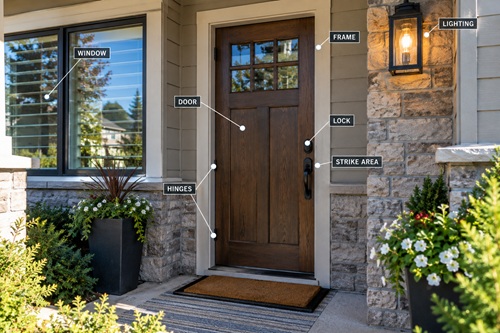
Inspect every exterior door.
The door itself matters, but so do the frame, hinges, strike plate, locks, and surrounding structure. A strong lock installed in a weak frame may provide far less protection than expected.
Windows deserve the same attention, particularly windows that are hidden from the street or easily reached from the ground.
Sliding doors, basement windows, attached garages, and doors connecting a garage to the house are frequently overlooked during casual security assessments.
Do not forget secondary buildings. Garages and sheds may contain tools that are valuable themselves or could potentially be used to defeat other security measures.
Think of the perimeter as a complete system rather than a collection of individual locks.
Technology Should Provide Warning, Not Create Dependence
Cameras, alarms, door sensors, motion detectors, smart lighting, and other security technology can provide tremendous situational awareness.
But emergency preparedness requires asking another question:
What happens when the power or internet connection disappears?
A security system that becomes useless during a blackout should not be the household’s only warning system.
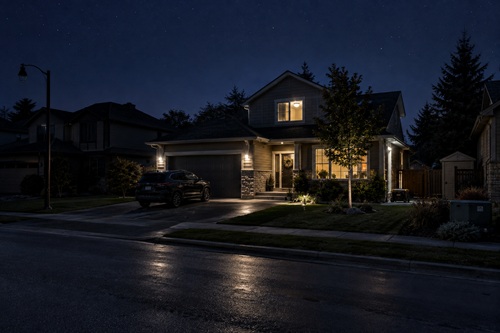
Where practical, security technology should have backup power. Important devices should continue functioning during short outages, and households should understand which features depend on internet connectivity, cellular service, external monitoring, or cloud-based applications.
Offline capability becomes particularly important during widespread emergencies.
A local alarm that still produces an audible warning may remain useful even if outside monitoring is unavailable. Battery-powered motion lights can continue operating when household electricity fails. Locally recording cameras may preserve useful information when internet service disappears.
Technology should strengthen physical security rather than replace it.
Create an Interior Safety Layer
If the exterior perimeter is breached, the security plan should not suddenly end.
The inside of the home should provide another layer.
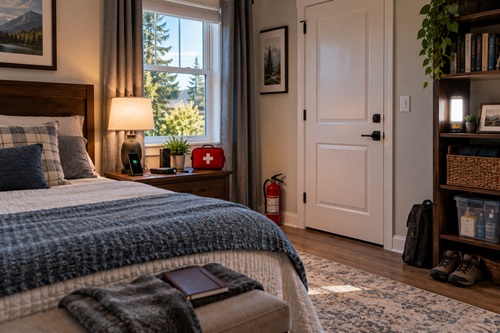
Choose an area where household members can gather during a serious security incident. Depending on the home, this might be a bedroom, interior room, basement area, or another location with a solid door and reliable communications.
The purpose is not to create a dramatic bunker.
It is to create another barrier and another decision point.
The area should provide access to communication, lighting, basic first aid, and other emergency essentials appropriate to the household. A charged phone, backup battery, flashlight, emergency contact information, and fire extinguisher can be far more valuable than complicated equipment that nobody remembers how to use.
Everyone in the household should know where to go.
During an emergency, confusion consumes time.
Do Not Forget Fire
Security planning during civil unrest often focuses so heavily on intrusion that fire is forgotten.
That is a mistake.
Fires may result from accidents, damaged infrastructure, electrical problems, nearby disturbances, or delayed emergency response. A household may need to manage the first moments of a fire without immediate help.
Maintain working smoke and carbon-monoxide alarms. Keep appropriate fire extinguishers accessible and make sure household members know how to use them. Keep exits usable rather than blocking them with security improvements.
This last point is extremely important.
A security measure that prevents someone from entering should not accidentally prevent the family from escaping a fire.
Home security and fire safety must work together.
Communications Are Part of Home Security
Information can prevent unnecessary exposure.
During a developing emergency, establish a reliable way for family members and trusted neighbors to communicate.
Cell phones may be the primary method, but consider what happens if cellular networks become overloaded. Battery-powered radios, local emergency broadcasts, two-way radios where appropriate, and predetermined family procedures can provide alternatives.
Keep important numbers available somewhere other than the contact list inside a phone.
People rarely memorize telephone numbers anymore. If a phone is lost, damaged, or dead, even contacting family members can suddenly become difficult.
An offline written contact list is simple resilience.
Have More Than One Way Out
A secure home should never become a trap.
Every household needs evacuation options.
Know the normal exits and identify alternatives. Decide where family members would meet if they had to leave separately. Determine where you could go if remaining at home became unsafe.
Vehicles should not routinely be allowed to reach nearly empty fuel levels, particularly during periods of elevated uncertainty. Essential evacuation supplies should be reasonably accessible rather than scattered throughout the house.
The decision to leave should also be made according to conditions rather than pride.
There are emergencies where sheltering at home is the safest option. There are others where remaining behind becomes increasingly dangerous.
Preparedness means preserving both choices.
Avoid Unnecessary Confrontation
Perhaps the most important home-security principle during widespread chaos is also one of the simplest:
Do not go looking for trouble.
If suspicious activity occurs outside, running into the street to investigate may surrender the protection provided by the house.
Observe from a safe position when possible. Communicate with neighbors. Contact emergency services when they are available. Gather family members and prepare to leave or move to a safer part of the home if conditions deteriorate.
Property can be replaced.
A confrontation that begins over a vehicle, shed, fence, or other possession can escalate into something far more serious within seconds.
The objective of preparedness is not to win confrontations.
The objective is to keep people safe.
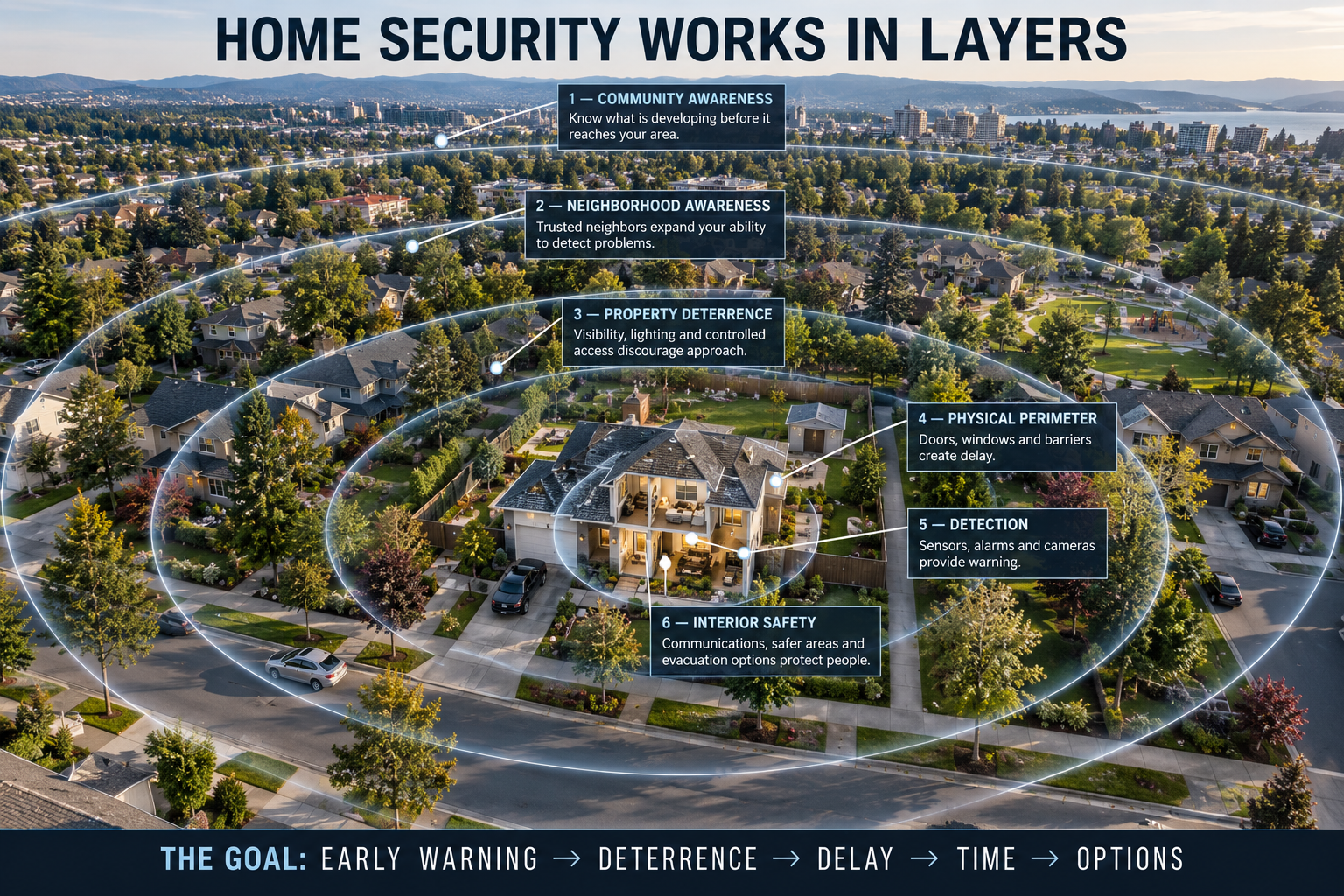
Security Should Work in Layers
The strongest home-security strategy does not depend on one lock, one camera, one alarm, or one person staying awake all night.
It works through overlapping layers.
Awareness of the wider area provides early warning. Neighborhood relationships provide additional information. The street and property provide visibility and deterrence. Doors and windows create delay. Alarms and sensors provide warning. Interior barriers create additional time. Communications connect the household with help. Evacuation planning preserves another option if conditions become unsafe.
No single layer has to be perfect.
That is the strength of layered security.
If one layer fails, another remains.
Preparedness Action Plan
Walk through your security system from the outside inward. Begin with the routes leading into your community and continue through your neighborhood, street, property, doors, windows, and interior rooms. Look for places where you currently depend upon a single system or assumption.
Test exterior lighting after dark. Inspect locks, doors, windows, gates, garages, and sheds. Determine what happens to cameras and alarms during a power or internet outage. Establish a household meeting area and an evacuation destination. Make sure everyone understands how to communicate if family members become separated.
Then speak with at least one trusted neighbor.
That conversation may ultimately become one of the most useful security improvements you make.
Key Takeaways
Home security during widespread disruption is primarily about awareness, deterrence, delay, communication, and options.
The earlier a household recognizes a developing problem, the more choices it retains. Physical barriers buy time. Technology can provide warning, but it should not create dependence on electricity or internet access. Trusted neighbors can greatly expand situational awareness. Interior planning protects the household if the exterior perimeter fails, while evacuation planning ensures the home never becomes the family’s only option.
Most importantly, effective preparedness does not require living in fear or expecting violence.
It means looking at the home as a complete system and strengthening weak points while conditions are normal.
When something unusual eventually happens—whether it is crime, civil unrest, a blackout, wildfire evacuation, severe weather, or another emergency—the household does not have to invent a security plan in the middle of the crisis.
The plan is already there.
© Prepping Communities. This content is for informational purposes only and not professional advice. Use at your own risk.
Terms | Privacy | Guidelines