
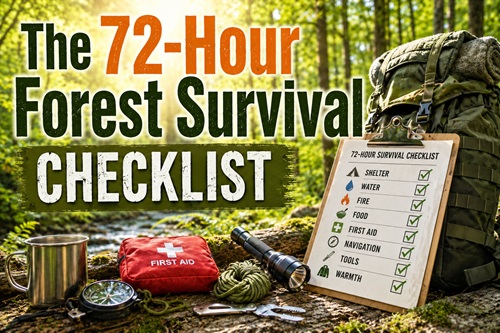
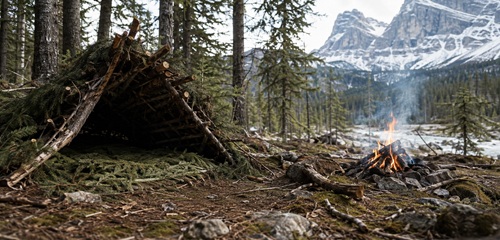
When SHTF, there is no guarantee your bug-out bag will still be with you. It could be lost crossing a river, left in a vehicle, damaged, stolen, or abandoned during an evacuation. This checklist assumes a difficult situation: you are in the forest, your main supplies are gone, and outside help may not be coming.
The objective for the first 72 hours is straightforward: stay alive, stay hydrated, stay mobile, and get yourself into a position where you can decide what happens next.
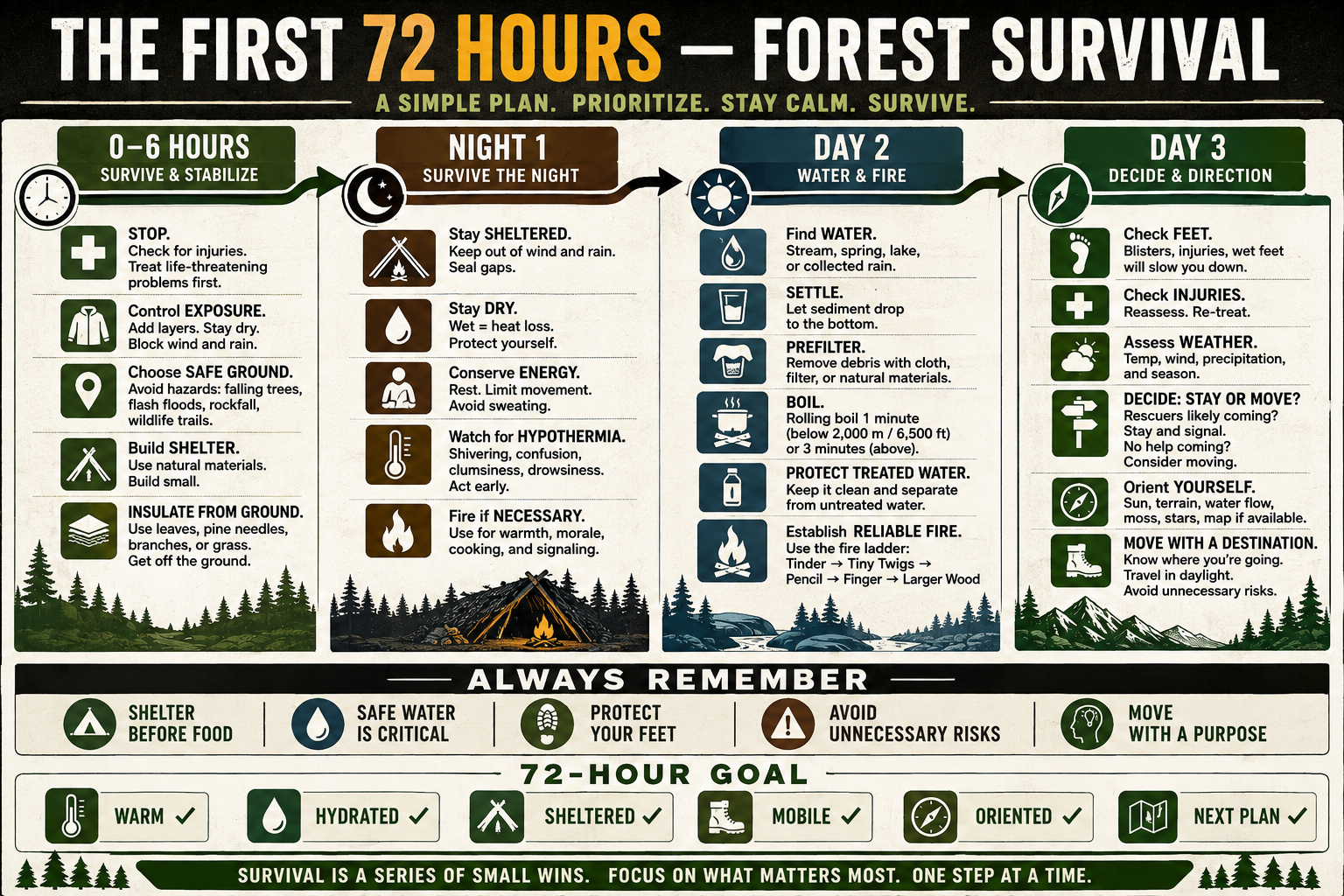
FIRST 10 MINUTES – STOP
☐ Stop moving. Do not immediately wander around looking for lost equipment unless you know where it is and recovering it is safe.
☐ Control serious bleeding first. Life-threatening bleeding takes priority over shelter, water, fire, and everything else.
☐ Check yourself for injuries. Look for cuts, sprains, head injuries, dizziness, pain, burns, and anything that could affect your ability to walk.
☐ Check your clothing. If you are soaked, cold, or exposed to strong wind, exposure moves to the top of the priority list.
☐ Check your footwear. Your feet may soon become your only transportation.
☐ Empty your pockets. Put everything where you can see it. A knife, lighter, bandanna, wallet, keys, watch, phone, belt, shoelaces, medication, or cordage may become extremely useful.
☐ Check remaining daylight. If darkness is approaching, shelter becomes urgent.
☐ Look for immediate threats. Check for wildfire smoke, rising water, severe weather, unstable trees, cliffs, or other reasons you should not remain where you are.
FIRST 1-3 HOURS – GET SHELTERED
☐ Get out of the wind. Use terrain, thick vegetation, rocks, or another natural barrier when available.
☐ Look up. Avoid dead branches, leaning trees, broken treetops, and standing dead timber.
☐ Look down. Avoid depressions, dry streambeds, flood channels, and obviously wet ground.
☐ Look around. Make sure you have a safe route out if conditions change.
☐ Deal with wet clothing. If practical, wring water from saturated clothing one piece at a time and put it back on.
☐ Avoid sweating. Work steadily rather than so hard that you soak your clothing with perspiration.
BUILD THE FLOOR BEFORE THE ROOF
☐ Gather dry leaves, grasses, pine needles, evergreen boughs, or other suitable dry vegetation.
☐ Use a stick to disturb piles before reaching into them.
☐ Build a thick mattress underneath your entire body.
☐ Make it considerably thicker than seems necessary because your weight will compress it.
☐ Lie down briefly and test it. If you can easily feel the cold ground underneath you, add more insulation.
REMEMBER
The ground can pull heat from your body all night.
A survival shelter is not just something over your head.
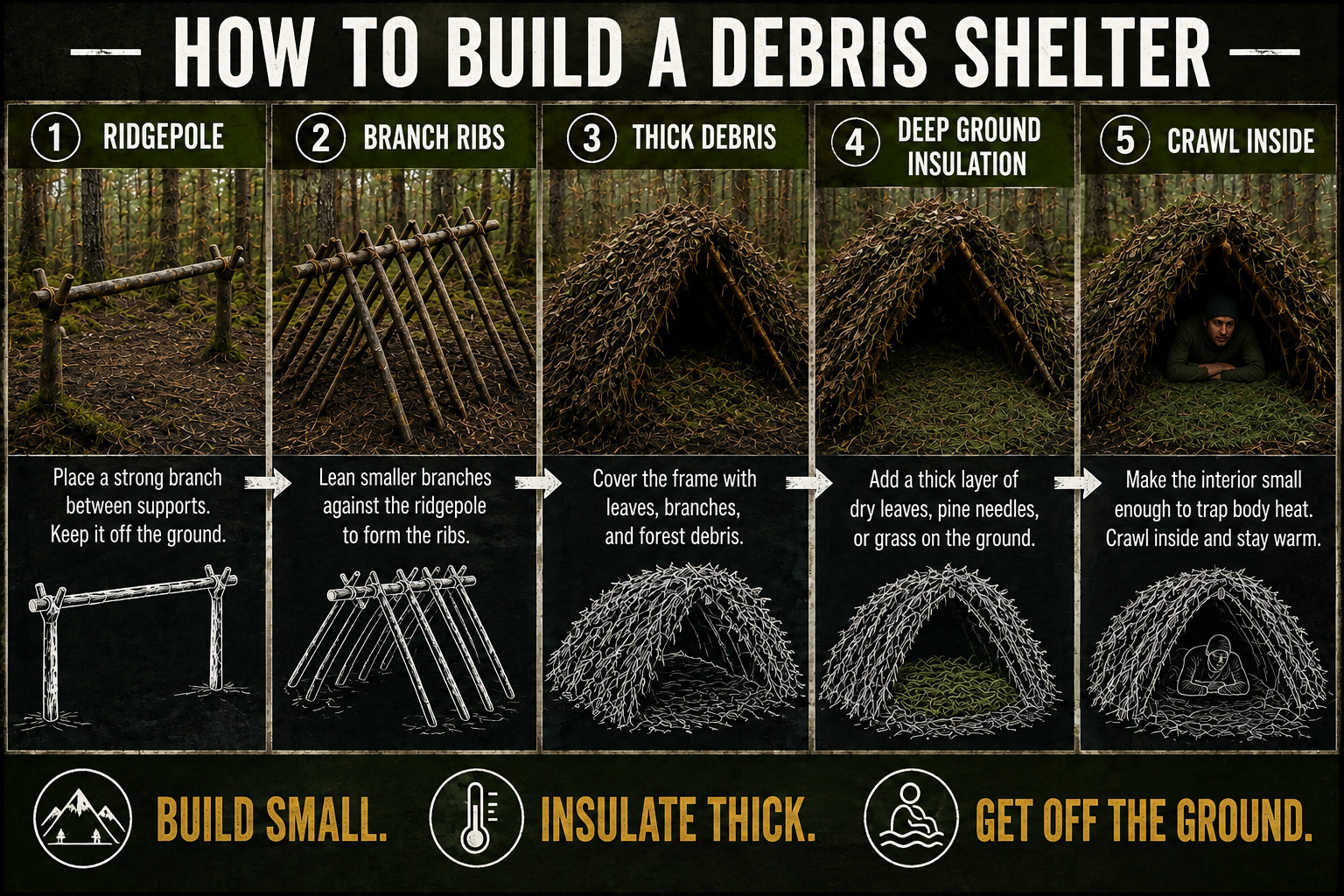
BUILD A SIMPLE DEBRIS SHELTER
☐ Find a sturdy branch somewhat longer than your body to use as a ridgepole.
☐ Secure one end above the ground and allow the opposite end to rest lower.
☐ Lean smaller branches along both sides to create ribs.
☐ Add smaller sticks across large openings.
☐ Cover the frame with a thick layer of leaves, grass, pine needles, bark, or other dry forest debris.
☐ Make the covering thicker than you think necessary.
☐ Keep the interior just large enough for your body.
☐ Fill gaps around the sleeping area with additional dry insulation.
☐ Keep enough ventilation to breathe safely.
BEFORE DARK – PREPARE FOR NIGHT ONE
☐ Gather additional dry insulation.
☐ Collect firewood before darkness if you expect to need a fire.
☐ Protect dry tinder from rain and ground moisture.
☐ Determine where the nearest water source is, if possible.
☐ Check your feet.
☐ Clean and protect cuts.
☐ Shake out boots and clothing.
☐ Check yourself for ticks.
☐ Put equipment where you can find it in darkness.
☐ Stop unnecessary travel before dark.
If your shelter is keeping you reasonably warm, conserve energy. If you are becoming dangerously cold, getting warm takes priority.
KNOW THE COLD WARNING SIGNS
Watch for persistent or violent shivering, increasing clumsiness, difficulty using your hands, slurred speech, confusion, poor judgment, unusual behavior, or increasing exhaustion.
A severely cold person who stops shivering or suddenly feels strangely warm may not be recovering. Severe hypothermia can interfere with the body’s normal temperature regulation.
Do not wait for severe hypothermia before improving shelter, insulation, clothing, or warmth.
FIRE ON THE FIRST NIGHT?
Do not automatically start a fire simply because you are in the wilderness. Ask what problem the fire needs to solve.
If you need fire to prevent dangerous cooling, build one.
If this is a normal lost-person emergency, smoke and light may also help rescuers find you.
If this is a genuine SHTF situation where attracting unknown people could create additional risk, consider light and smoke discipline.
Immediate survival comes first.
Do not become dangerously cold simply because you are worried about being seen.
DAY 2 – MORNING CHECK
Before leaving your shelter:
☐ Check your physical condition.
☐ Check your feet.
☐ Deal with blisters or hot spots early.
☐ Check cuts and wounds.
☐ Check for ticks.
☐ Shake out footwear and clothing.
☐ Repair your shelter if necessary.
☐ Check the weather.
☐ Check your water supply.
☐ Decide what your most important problem is today.
For most people who have survived the first night with shelter, water now becomes one of the highest priorities.
FIND WATER
☐ Begin searching before severe thirst develops.
☐ Follow terrain downhill when appropriate.
☐ Look for streams, springs, seeps, drainage channels, and unusually green vegetation.
☐ Listen for running water.
☐ Look for converging valleys where drainage collects.
☐ Collect morning dew when conditions allow.
A clean cloth can be passed across dew-covered vegetation and then wrung into a container. Do not depend on dew as your only water source, but use it when available.
Never assume water is safe because it looks clear.
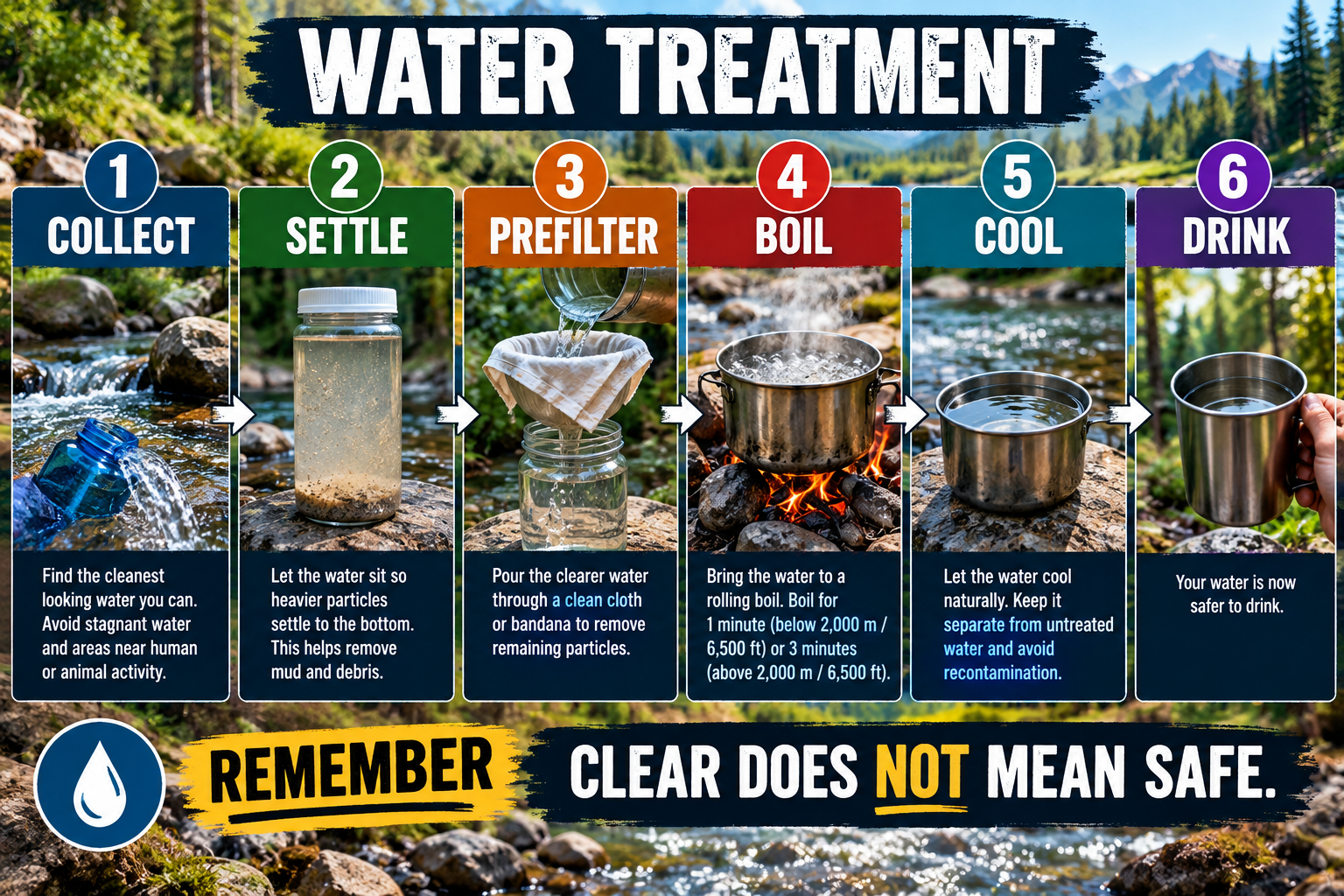
MAKE THE WATER SAFER
If the water contains sediment:
☐ Let it stand so heavier material settles.
☐ Carefully pour the clearer water from the top.
☐ Pass it through clean cloth if available.
This improves the water’s appearance. It does not reliably disinfect it.
If boiling is available:
☐ Bring the water to a rolling boil.
☐ Below approximately 2,000 meters / 6,500 feet, boil for at least 1 minute.
☐ Above approximately 2,000 meters / 6,500 feet, boil for at least 3 minutes.
☐ Allow the water to cool.
☐ Protect treated water from becoming contaminated again.
IF YOU DON’T HAVE A POT
☐ Search for a safe discarded metal container.
☐ Check around abandoned camps, structures, vehicles, roads, or other areas of previous human activity when doing so is safe.
☐ Do not use containers that previously held unknown chemicals or hazardous substances.
☐ Do not assume plastic containers can be placed directly over a fire.
Primitive water-heating techniques exist, including heating water with hot stones, but they require knowledge and introduce additional hazards. Wet, porous, cracked, or unsuitable rocks can fracture when heated.
This is one reason a small stainless-steel cup is an excellent addition to a survival kit. It can collect water, boil water, prepare food, and carry hot liquids.
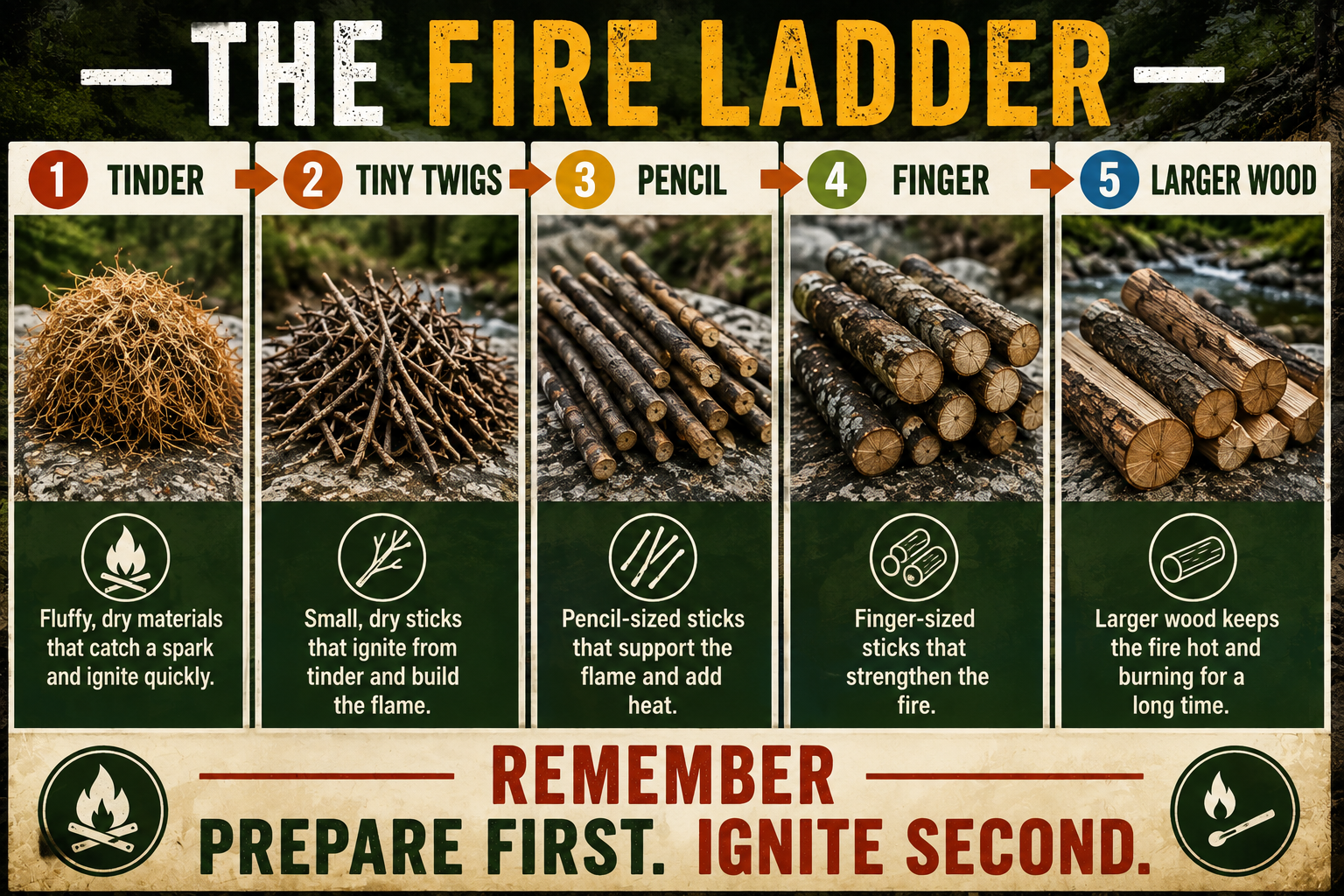
DAY 2 – BUILD A PROPER FIRE
Do not waste your ignition source trying to light an unprepared pile of wet sticks.
Build the entire fire first.
☐ Choose a safe location.
☐ Clear leaves and combustible material away from the fire area.
☐ Gather fine, dry tinder.
☐ Gather very small dry twigs.
☐ Gather pencil-sized sticks.
☐ Gather finger-sized sticks.
☐ Gather larger fuel.
☐ Gather enough fuel to maintain the fire after ignition.
☐ In wet conditions, look for dead standing wood rather than relying entirely on wood lying on the ground.
☐ Split damp wood when possible. The interior may still be dry.
☐ Make feather sticks from dry interior wood if necessary.
☐ Keep your best tinder protected until the last moment.
Only when everything is ready should you use your lighter, match, ferro rod, or other ignition source.
ONCE YOU HAVE FIRE – KEEP IT
Do not waste limited matches or lighter fuel unnecessarily.
☐ Keep additional tinder dry.
☐ Protect your ignition source from rain.
☐ Dry damp tinder near the fire without placing it where it can accidentally ignite.
☐ Maintain usable coals when practical.
☐ Prepare tomorrow’s tinder before going to sleep.
Once you have established a difficult capability, preserve it whenever practical.
DAY 2 – DON’T WASTE THE DAY CHASING FOOD
Hunger can feel urgent, but during the first 72 hours it usually should not outrank shelter, water, temperature control, or injury prevention.
☐ Do not spend hours hunting.
☐ Do not burn large amounts of energy chasing small animals.
☐ Do not experiment with unfamiliar plants.
☐ Do not eat mushrooms you cannot positively identify.
☐ Do not assume a berry is safe because animals eat it.
☐ Use known safe foods opportunistically when they require little energy to obtain.
YOUR PRIORITIES ARE STILL
SHELTER BEFORE FOOD.
WATER BEFORE FOOD.
MOBILITY BEFORE FOOD.
KEEP FOOD AWAY FROM YOUR SHELTER
If food becomes available:
☐ Do not leave scraps around your sleeping area.
☐ Do not clean fish or animals beside your shelter.
☐ Cook away from your sleeping location when wildlife is a concern.
☐ Keep food and strong-smelling materials separated from the sleeping area.
☐ Store food securely according to the wildlife risks in your region.
Do not turn your shelter into an animal feeding location.
PROTECT YOUR FEET
Your feet are now transportation.
Check them every morning and evening.
☐ Remove stones and debris from footwear.
☐ Deal with hot spots before they become blisters.
☐ Dry footwear when possible.
☐ Dry socks whenever possible.
☐ Rotate socks if you have another pair.
☐ Clean cuts promptly.
☐ Stop periodically during long movement and inspect your feet.
A minor foot problem at home is inconvenient.
A minor foot problem when you must walk 20 kilometers can become a survival problem.
DAY 3 – DECIDE WHETHER TO MOVE
Do not leave a functioning shelter simply because another day has started.
Ask yourself:
Where am I going?
Why am I going there?
If search and rescue is likely looking for you, remaining near your last known location and making yourself visible may be the correct decision.
If this is a widespread SHTF event and rescue is genuinely unavailable, movement may become necessary to reach a known road, property, settlement, fallback point, water source, or other destination.
Before leaving:
☐ Identify your destination.
☐ Determine your approximate direction.
☐ Take treated water.
☐ Protect your ignition source.
☐ Check your feet.
☐ Check the weather.
☐ Check for wildfire smoke.
☐ Check nearby waterways for unusual conditions.
☐ Leave with adequate daylight.
☐ Know what will make you turn around.
REMEMBER
MOVE WITH A REASON, NOT BECAUSE WAITING FEELS WRONG.
NAVIGATE WITHOUT YOUR PHONE
Do not depend on your sense of direction alone. People without reliable visual references can gradually drift away from their intended direction.
Use obvious terrain features whenever possible.
☐ Follow a creek or river when doing so safely supports your route.
☐ Use ridgelines and valleys as reference features.
☐ Use shorelines when appropriate.
☐ Use established roads or trails when appropriate.
☐ Use power corridors or other recognizable linear features where useful.
These features can act like navigational handrails.
An analog watch, shadow movement, and Polaris can also provide backup directional references when electronic navigation is unavailable.
Learn and practice these methods before depending on them.
WHILE MOVING – SLOW DOWN
An injury can destroy everything you accomplished during the previous two days.
☐ Use three points of contact on steep terrain.
☐ Avoid stepping on wet logs.
☐ Avoid slick rocks.
☐ Slow down when descending.
☐ Probe questionable mud before stepping into it.
☐ Do not jump unnecessarily.
☐ Stop when visibility becomes poor.
☐ Rest before exhaustion affects judgment.
☐ Watch where you place your hands.
☐ Use a stick before reaching into holes, leaf piles, wood piles, or places you cannot see.
REMEMBER
A bear may frighten you. A broken ankle may strand you.
Protect your mobility.
BEFORE CROSSING WATER – STOP
Ask yourself:
☐ Do I actually need to cross?
☐ Is there another route?
☐ Can I find a shallower or slower section?
☐ Can I wait for conditions to improve?
☐ Is the water cold enough to create an exposure problem?
☐ Is the current stronger than it appears?
☐ What happens if I fall?
☐ Can I release my equipment immediately?
If there is a safer alternative, use it.
REMEMBER
YOUR EQUIPMENT IS REPLACEABLE. YOU ARE NOT.
WATCH FOR FLASH FLOODS
Never assume a dry wash or low creek is safe simply because conditions are currently calm.
Watch for:
☐ Sudden rising water.
☐ Water becoming unexpectedly muddy.
☐ Changes in the sound of the creek.
☐ Sticks and debris suddenly appearing in the current.
☐ Heavy rain upstream or nearby.
If conditions change rapidly:
MOVE TO HIGHER GROUND IMMEDIATELY.
Do not try to outrun floodwater downstream.
WATCH FOR WILDFIRE
If you see or smell smoke:
☐ Determine the wind direction.
☐ Look at the slope.
☐ Identify areas with substantially less vegetation.
☐ Identify large bodies of water or broad areas of bare ground.
☐ Watch for changes in smoke and wind.
☐ Do not automatically flee uphill.
☐ Leave threatened areas early.
Fire can accelerate rapidly on slopes.
Do not wait until you can see flames before deciding you have a wildfire problem.
WATCH THE HEAT
If conditions are hot:
☐ Perform difficult work during cooler parts of the day.
☐ Use shade during extreme midday heat.
☐ Reduce unnecessary movement.
☐ Drink regularly when safe water is available.
☐ Protect your head and neck from direct sun.
☐ Watch yourself and others for confusion or unusual behavior.
Severe heat illness can affect judgment before a person realizes how serious the situation has become.
CHECK FOR TICKS AND OTHER SMALL THREATS
Every day:
☐ Check behind your knees.
☐ Check your waist.
☐ Check your groin.
☐ Check your armpits.
☐ Check behind your ears.
☐ Check your hairline.
☐ Shake out boots.
☐ Shake out clothing.
☐ Avoid blindly reaching underneath logs or rocks.
☐ Watch for ground nests of stinging insects.
Small threats are easier to prevent than deal with after the fact.
IF YOU ENCOUNTER A SNAKE
☐ Stop.
☐ Give it space.
☐ Do not attempt to catch or kill it.
☐ Do not handle a snake because you believe it is dead.
☐ Look before stepping over logs.
☐ Use a stick before reaching into hidden spaces.
If bitten by a potentially venomous snake, reduce unnecessary movement and seek professional medical treatment as quickly and safely as circumstances allow.
Do not cut the bite, attempt to suck out venom, apply ice, or improvise a tourniquet.
BEFORE EVERY NIGHT
Run the same check.
☐ Shelter secure.
☐ Ground insulation thick and dry.
☐ Safe water available.
☐ Firewood prepared if needed.
☐ Tinder protected.
☐ Ignition source protected.
☐ Feet checked.
☐ Cuts cleaned.
☐ Tick check completed.
☐ Food separated from the sleeping area.
☐ Weather assessed.
☐ Tomorrow’s plan identified.
Routine prevents small problems from becoming emergencies.
HOUR 72 – CHECK YOUR STATUS
At approximately three days, stop and reassess everything.
☐ Am I warm enough?
☐ Do I have usable shelter?
☐ Do I have safe drinking water?
☐ Can I make or maintain fire?
☐ Are my feet functional?
☐ Do I have untreated injuries?
☐ Do I know approximately where I am?
☐ Do I know where I am going next?
☐ Is my ignition source protected?
☐ Do I have a plan beyond today?
The 72-hour point is not the end of survival.
It is where the objective begins changing from simply reacting to the emergency to operating deliberately.
AFTERWARD – DON’T DEPEND ON ONE BAG
If losing one backpack removes nearly every survival capability you have, your preparedness system has a single point of failure.
Fix it.
☐ Keep critical everyday survival items on your body where practical.
☐ Keep additional equipment in your main pack.
☐ Keep another layer of supplies in your vehicle when practical.
☐ Identify a realistic fallback location.
☐ Consider legally stored supplies on property you own or where you have explicit permission.
☐ Keep backup ignition equipment separate from the primary fire kit.
☐ Carry a small metal water container.
☐ Keep critical supplies in more than one location.
A lost backpack should create a problem. It should not eliminate the entire plan.
PRACTICE BEFORE YOU NEED IT
Do not assume watching someone perform a survival skill means you can perform it.
☐ Build a debris shelter.
☐ Spend a safe night in it.
☐ Start a fire after rain.
☐ Boil water outdoors.
☐ Practice navigation without your phone.
☐ Walk several kilometres carrying your actual bug-out equipment.
☐ Practice setting up shelter before darkness.
☐ Learn which equipment fails when wet.
☐ Find out where your footwear causes blisters.
☐ Practice when failure means going back inside the house.
Skill is the part of your survival system that cannot be dropped in a river, stolen with your backpack, or left behind in a vehicle.
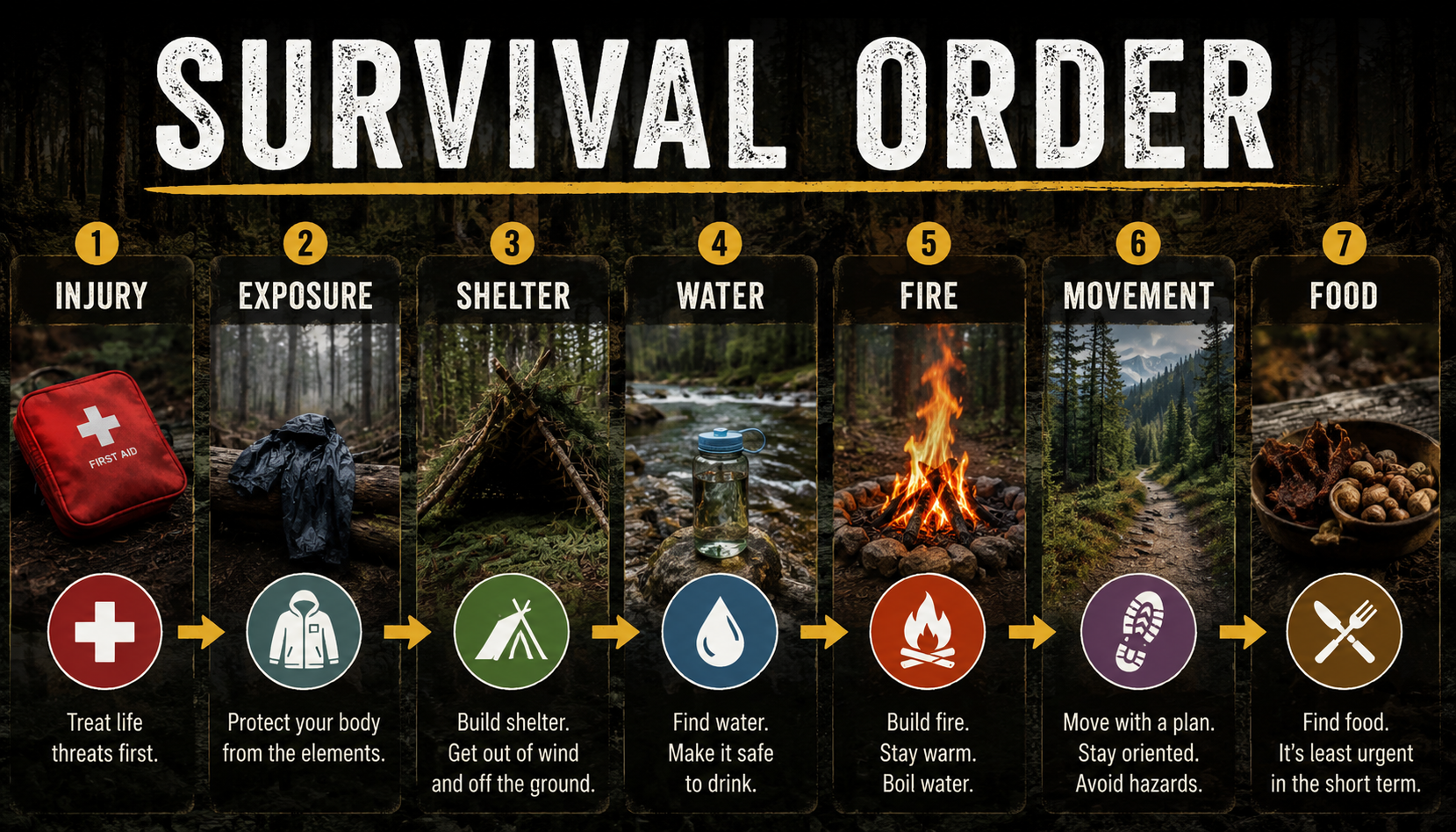
THE 72-HOUR EMERGENCY MEMORY CHECK
If everything else is forgotten, remember:
1. STOP
Do not make the emergency worse.
2. CONTROL EXPOSURE
Get out of the wind, deal with wet clothing, and protect your body temperature.
3. GET OFF THE GROUND
Build insulation underneath yourself before worrying about comfort.
4. FIND AND TREAT WATER
Never assume clear water is safe.
5. PROTECT YOUR MOBILITY
Your feet and legs may be your only transportation.
6. BUILD FIRE PROPERLY
Prepare the entire fuel system before using your ignition source.
7. MOVE WITH A PURPOSE
Know where you are going and why before abandoning a safe location.
Preparedness Action Plan
Take your bug-out bag and put it on the floor.
Now imagine it is gone.
Look at what remains on your body, in your vehicle, at your fallback location, and inside your head.
If losing that one bag eliminates your shelter, water treatment, fire, navigation, first aid, and communication capabilities at the same time, build more redundancy into your preparedness system.
Then practice the skills in this checklist one at a time.
The objective is not to prove that gear doesn’t matter. Good equipment can make an enormous difference.
The objective is to make sure that losing the gear does not mean losing the plan.
Key Takeaways
During the first 72 hours, control the problems that can disable you fastest. Stop unnecessary movement, deal with injuries, protect yourself from exposure, build shelter, find and treat water, establish fire when necessary, and protect your ability to walk.
Do not allow hunger, fear, or the urge to keep moving to push more important priorities aside.
Most importantly, do not build your entire preparedness system around one backpack.
Gear makes survival easier. Knowledge keeps the plan alive when the gear is gone.
© Prepping Communities. This content is for informational purposes only and not professional advice. Use at your own risk.
Terms | Privacy | Guidelines