
Introduction
Water is one of the few emergency supplies that every person requires every single day. While food shortages can often be managed by reducing portions or changing meal plans, a reliable supply of safe drinking water cannot be postponed. Even short interruptions to municipal water systems caused by severe weather, earthquakes, wildfires, flooding, power outages, equipment failures, or contamination can quickly affect an entire community. Grocery store shelves often empty within hours, leaving many households with little or no reserve. Long-term water storage provides a dependable buffer that allows families to remain safe, healthy, and self-sufficient while normal services are restored.
Many people assume that purchasing several cases of bottled water is enough to prepare for an emergency. Although commercially bottled water provides an excellent starting point, it represents only one part of a complete preparedness strategy. Bottled water eventually runs out, containers can become damaged, and larger households may consume surprisingly large quantities in only a few days. A comprehensive water storage plan considers not only how much water is available today, but how additional supplies will be maintained, protected, rotated, and replenished throughout a prolonged emergency.
Long-term water storage is about far more than simply filling containers with tap water and placing them in a basement. The type of container used, the cleanliness of the water before storage, the environmental conditions surrounding the storage area, and the methods used to inspect and rotate supplies all influence how well the water will remain usable over time. Poor storage practices can lead to contamination, unpleasant tastes or odors, algae growth, damaged containers, or unnecessary waste. Proper preparation, on the other hand, allows stored water to remain a dependable emergency resource for years.
Preparedness also means recognizing that different emergencies create different water demands. A family sheltering in place after a winter storm may require less water than one recovering from a summer wildfire or extended power outage. Hot weather, increased physical activity, sanitation needs, medical conditions, food preparation, and caring for pets all increase water consumption beyond the minimum amounts often recommended in emergency planning guides. Understanding these variables allows households to develop storage plans that match their own unique circumstances rather than relying solely on general recommendations.
Another important principle of preparedness is redundancy. Successful preparedness plans rarely depend upon a single storage container or one method of obtaining water. Instead, they combine commercially bottled water, reusable food-grade containers, large storage tanks, rainwater collection systems, filtration equipment, purification supplies, and knowledge of nearby natural water sources into one integrated system. If one component fails, several others remain available. This layered approach greatly increases resilience during both short-term disruptions and long-duration emergencies.
Long-term water storage should also be viewed as an ongoing preparedness habit rather than a one-time project. Containers should be inspected regularly, storage locations evaluated, emergency supplies updated, and household water requirements reviewed whenever family circumstances change. Small improvements made consistently over time often provide far greater protection than hurried preparations made immediately before an approaching disaster.
This lesson explains how to safely store water for months and years, choose appropriate storage containers, prevent contamination, rotate supplies efficiently, develop practical household storage systems, and build a dependable long-term water reserve capable of supporting your family through a wide variety of emergencies. By understanding these principles before they are needed, you greatly improve your ability to remain healthy, independent, and prepared when normal water infrastructure is no longer available.
Why Long-Term Water Storage Matters
Most emergency preparedness discussions begin with the recommendation to store water, but relatively few explain why long-term storage is one of the most valuable investments a household can make. Water supports nearly every aspect of daily life. It is needed not only for drinking, but also for preparing meals, taking medications, brushing teeth, washing hands, cleaning wounds, maintaining sanitation, caring for infants and elderly family members, supporting pets and livestock, and countless other activities that continue regardless of whether public utilities remain operational.
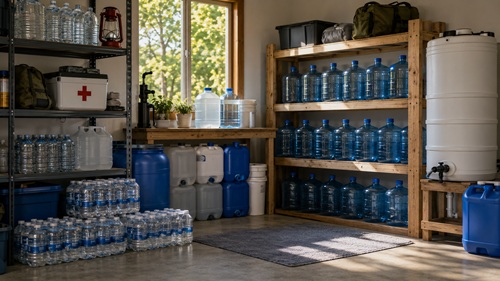
Unlike food shortages, which often develop gradually, water emergencies frequently occur without warning. A water main may rupture overnight, an earthquake may damage treatment facilities, a wildfire may destroy distribution infrastructure, or severe flooding may contaminate municipal supplies within hours. Even planned maintenance or localized contamination events can result in boil-water advisories lasting several days. Families who have already established substantial water reserves experience these events very differently than those who immediately join long lines at grocery stores hoping to find the last remaining cases of bottled water.
Long-term storage also provides valuable decision-making time. Instead of rushing to locate water while thousands of other people are doing the same, a prepared household can remain safely at home while assessing the situation. This reduces unnecessary travel, limits exposure to hazardous conditions, conserves fuel, and allows emergency responders to focus their efforts on individuals who genuinely require immediate assistance. Stored water therefore provides both physical security and psychological confidence during the uncertain early stages of a disaster.
Another benefit of long-term storage is flexibility. Emergencies rarely unfold exactly as expected. A power outage anticipated to last one day may continue for a week. Roads expected to reopen quickly may remain blocked because of flooding or wildfire. Municipal water systems may require extensive repairs before pressure and water quality are fully restored. Families with substantial water reserves are better positioned to adapt to these changing conditions because they are not immediately dependent upon outside assistance.
Water storage also complements every other preparedness investment. Emergency food often requires clean water for preparation. Medical supplies depend upon sanitary conditions. Personal hygiene, cooking, cleaning, gardening, and even many off-grid energy systems become easier to manage when reliable water remains available. Water is therefore not an isolated preparedness item—it is a resource that supports nearly every other component of household resilience.
Preparedness-minded individuals often describe stored water as buying time. Every gallon stored today represents additional time to evaluate conditions, establish alternative collection methods, repair damaged infrastructure, or relocate if necessary. The larger and more diversified your water reserve becomes, the greater your ability to respond calmly rather than react under pressure.
Ultimately, long-term water storage is not based on fear of disaster but on recognizing that reliable access to clean water is essential under every circumstance. Whether facing a brief service interruption or a prolonged emergency, households that invest in safe, organized, and well-maintained water storage gain one of the most valuable forms of preparedness available.
Understanding Household Water Storage Requirements
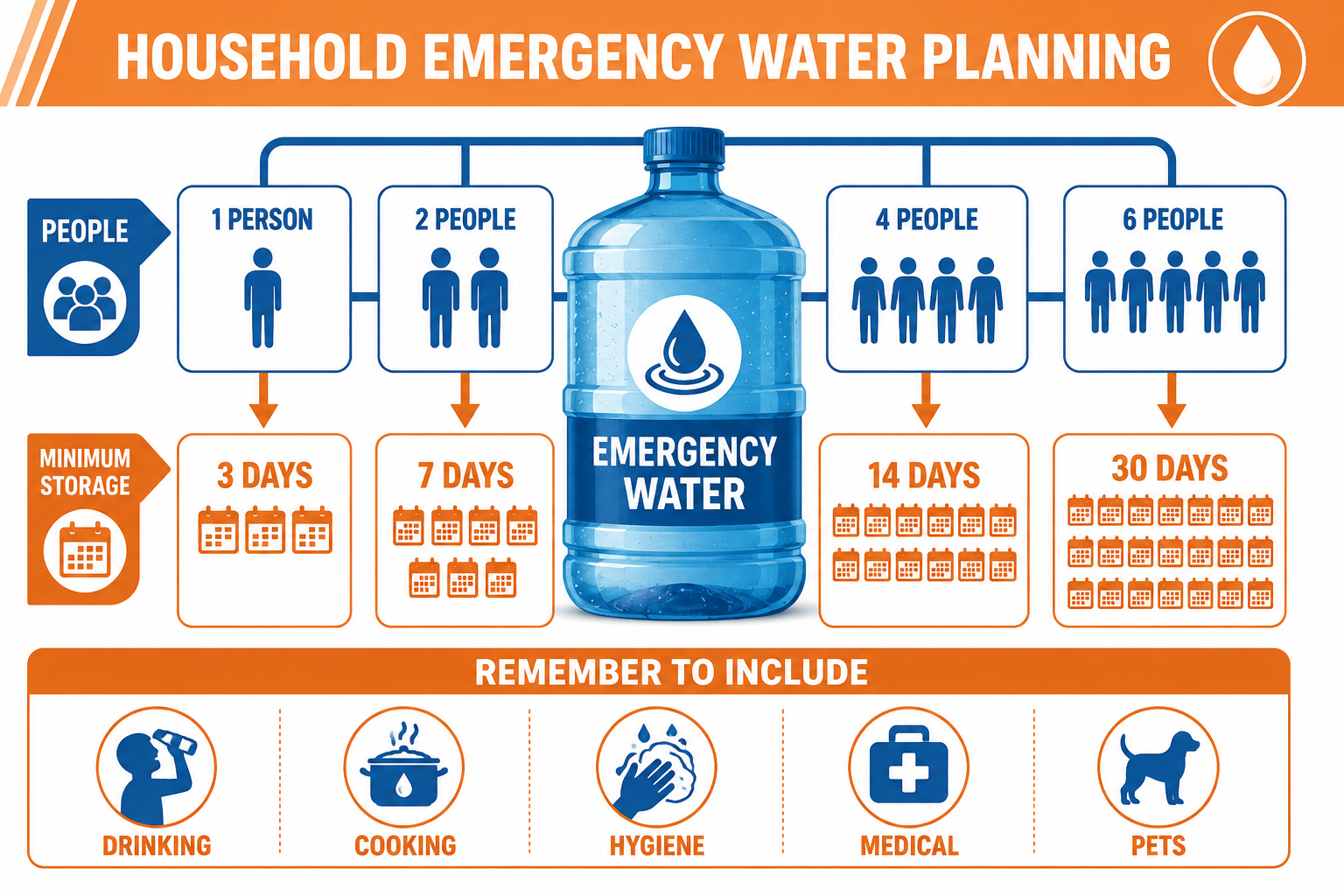
One of the most common mistakes households make when preparing for emergencies is underestimating how much water they actually use each day. Emergency planning guides frequently recommend storing a minimum of one gallon (3.8 liters) of water per person per day. While this recommendation provides a useful baseline, it represents only the minimum amount generally required for drinking and limited food preparation under moderate conditions. Real emergencies often demand considerably more water, especially when they extend beyond only a few days.
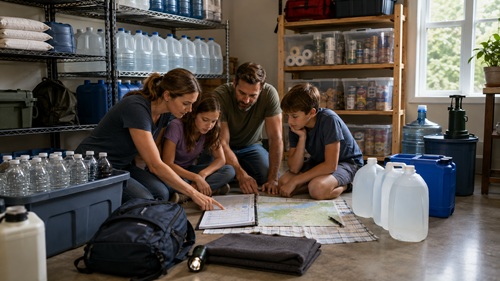
Water supports nearly every daily activity. Preparing dehydrated meals, washing fruits and vegetables, making coffee or tea, brushing teeth, washing hands, cleaning cooking utensils, treating injuries, taking medications, and maintaining basic sanitation all consume water. During stressful emergencies, maintaining proper hygiene becomes even more important because medical care may be limited and infections become more difficult to treat. Families that calculate storage based only on drinking water often discover their reserves disappear much faster than expected.
Environmental conditions also play a major role in determining water requirements. High temperatures, low humidity, strenuous physical labor, and prolonged exposure to sunlight all increase water consumption. Clearing fallen trees after a storm, repairing damaged roofs, carrying emergency supplies, or simply remaining outdoors during a summer heatwave can dramatically increase the amount of drinking water each person requires. Winter emergencies create different challenges. Although people may feel less thirsty, cold weather still causes dehydration while additional water is often needed for melting snow, preparing hot meals, and maintaining sanitation.
Every household is different. Infants require clean water for preparing formula, while young children dehydrate more quickly than healthy adults. Elderly family members, pregnant women, nursing mothers, and individuals with chronic medical conditions frequently require additional water or more careful hydration monitoring. Pets and livestock should never be overlooked. Dogs, cats, poultry, goats, horses, rabbits, and other animals all depend upon clean water every day. Families who prepare only for themselves may quickly discover that caring for animals significantly increases total household water demand.
Preparedness also requires considering the duration of an emergency rather than simply the number of gallons stored. Three days of water may be sufficient for a short-term power outage, but major disasters often disrupt services for weeks. Wildfires, hurricanes, earthquakes, flooding, and widespread infrastructure failures can all produce extended periods where replacement water is difficult to obtain. Long-term preparedness focuses on creating a storage system that bridges these disruptions while allowing time to establish additional collection and purification methods.
Storage capacity should also reflect available space and budget. Apartment residents may need to rely primarily on commercially bottled water and stackable containers, while rural homeowners often have room for large storage barrels, cisterns, or rainwater harvesting systems. The objective is not to reach an arbitrary number but to build the largest practical reserve that your living situation allows while maintaining proper storage conditions.
Many experienced preparedness-minded households divide their water supplies into several categories. Small bottles provide immediate access during evacuations or vehicle travel. Medium-sized containers support daily household use and are easier to rotate regularly. Large drums, tanks, or cisterns serve as strategic reserves intended for prolonged emergencies. This layered approach improves flexibility because water can be accessed efficiently without exposing the entire reserve to contamination every time a container is opened.
Understanding your household’s true water requirements changes the way you approach preparedness. Instead of viewing water storage as purchasing a few extra cases from the grocery store, you begin developing a comprehensive storage strategy capable of supporting every essential household activity. The result is greater confidence, improved resilience, and a much stronger foundation for every other aspect of emergency preparedness.
Estimated Minimum Household Water Requirements
| Household Size | 3 Days | 7 Days | 14 Days | 30 Days |
|---|---|---|---|---|
| 1 Person | 3 gal (11 L) | 7 gal (26 L) | 14 gal (53 L) | 30 gal (114 L) |
| 2 People | 6 gal (23 L) | 14 gal (53 L) | 28 gal (106 L) | 60 gal (227 L) |
| 4 People | 12 gal (45 L) | 28 gal (106 L) | 56 gal (212 L) | 120 gal (454 L) |
| 6 People | 18 gal (68 L) | 42 gal (159 L) | 84 gal (318 L) | 180 gal (681 L) |
These figures represent minimum emergency drinking and basic food preparation needs. Additional water should be planned for hygiene, cooking, medical care, pets, and sanitation.
Choosing Water Storage Containers
Selecting the proper storage container is one of the most important decisions in a long-term water storage plan. Even perfectly clean water can become contaminated if it is stored in unsuitable containers or exposed to excessive heat, sunlight, or chemical residues. The goal is not simply to hold water but to protect its quality for months or even years while ensuring the container remains durable enough to withstand repeated use.
Food-grade plastic containers remain one of the most popular choices because they are lightweight, relatively inexpensive, and available in many sizes. Containers manufactured specifically for drinking water are made from materials designed to minimize chemical leaching while resisting cracking and degradation over time. Many are molded from high-density polyethylene (HDPE), a plastic that performs well under long-term storage conditions when protected from excessive heat and direct sunlight.
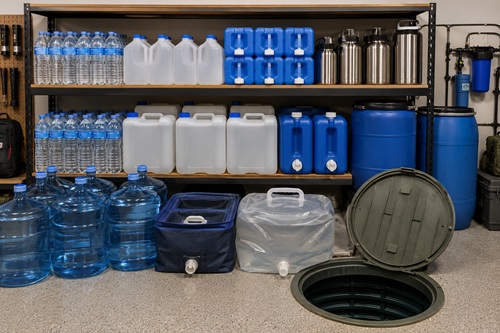
Commercially bottled water offers another excellent storage option, particularly for households just beginning their preparedness journey. Because it has already been packaged under controlled conditions, commercially bottled water requires little preparation before storage. Individual bottles are portable, easy to rotate, and convenient during evacuations or power outages. However, they are less space-efficient than larger containers and generate considerably more plastic waste over time.
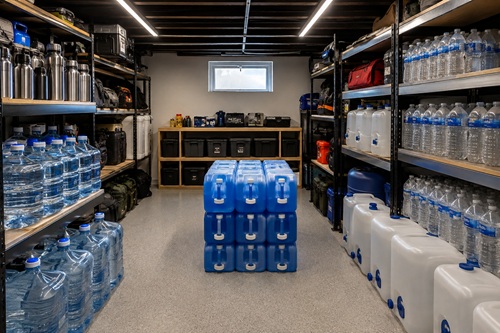
Larger storage systems become increasingly practical as preparedness goals expand. Purpose-built water drums holding fifty-five gallons (208 liters), stackable water bricks, intermediate storage tanks, and underground cisterns allow households to store hundreds or even thousands of gallons in relatively compact spaces. These systems provide exceptional long-term capacity but require greater planning for installation, maintenance, and periodic inspection.
Stainless steel containers are another excellent option, particularly for portable water storage. They resist corrosion, tolerate temperature changes well, and do not degrade from ultraviolet exposure like many plastics. Although they typically cost more than plastic containers, their durability makes them attractive for bug-out bags, vehicle emergency kits, and long-term preparedness equipment.
Glass containers can safely store water for extended periods because glass is chemically stable and does not absorb odors or flavors. However, their weight and fragility make them less suitable for large emergency reserves. A dropped glass container may instantly destroy valuable drinking water while creating dangerous broken glass during an already stressful emergency.
One of the most important rules of long-term water storage is to avoid reusing containers that previously held non-food substances. Buckets, jugs, or bottles that once contained pesticides, fuel, paint, automotive fluids, cleaning chemicals, or industrial products should never be used for drinking water regardless of how thoroughly they appear to have been cleaned. Residual chemicals may remain trapped within microscopic scratches or absorbed into plastic surfaces, creating contamination that cannot easily be removed.
Container size should also match the intended purpose. Small one- to two-liter bottles are ideal for grab-and-go situations, personal emergency kits, and daily rotation. Five- to seven-gallon containers balance portability with reasonable storage capacity, making them popular for household use. Large drums and tanks maximize storage efficiency but become extremely heavy once filled and are generally intended to remain in one permanent location.
Regardless of which container type is selected, every storage container should include a tightly sealing lid that prevents dust, insects, rodents, and airborne contaminants from entering the water supply. Containers should also be inspected regularly for cracks, damaged seals, bulging sides, discoloration, or other signs of deterioration that could compromise water quality over time.
The best water storage system rarely depends upon a single type of container. Instead, experienced preparedness-minded households combine multiple container sizes and styles to create a flexible system capable of supporting shelter-in-place emergencies, evacuations, vehicle travel, and long-term storage simultaneously. This layered approach ensures that water remains available regardless of changing circumstances while reducing dependence on any single storage method.
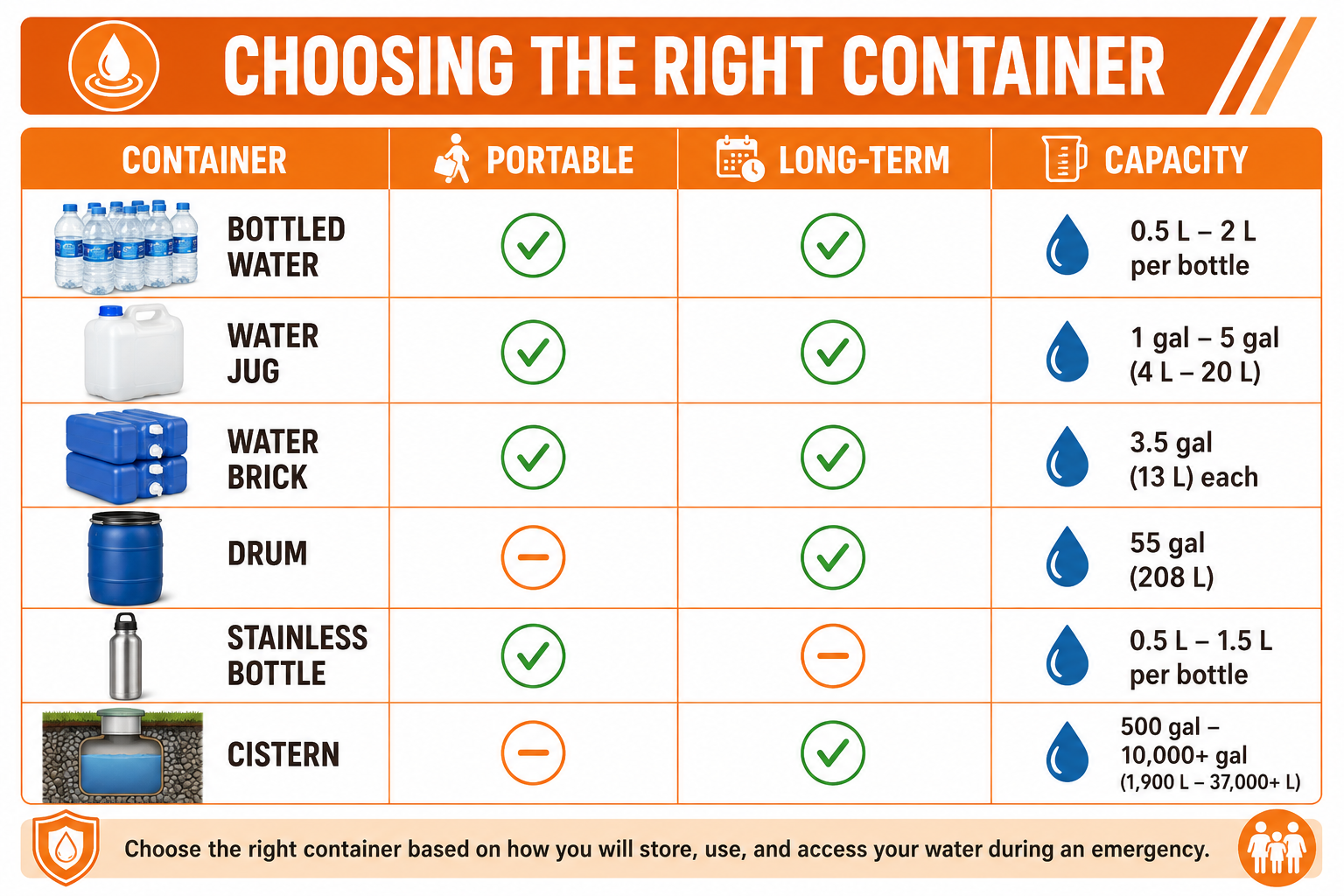
Water Storage Container Comparison
| Container Type | Capacity | Durability | Portability | Best Use |
|---|---|---|---|---|
| Commercial Bottled Water | Small | Excellent | Excellent | Immediate emergency use |
| Food-Grade Water Jug | Medium | Excellent | Good | Household storage |
| Water Brick | Medium | Excellent | Good | Stackable storage |
| 55-Gallon Water Drum | Large | Excellent | Poor | Long-term reserves |
| Stainless Steel Bottle | Small | Excellent | Excellent | Travel and bug-out bags |
| Collapsible Water Container | Medium | Good | Excellent | Evacuations and backup storage |
| Underground Cistern | Very Large | Excellent | Fixed | Whole-property water storage |
Preparing Water Storage Containers
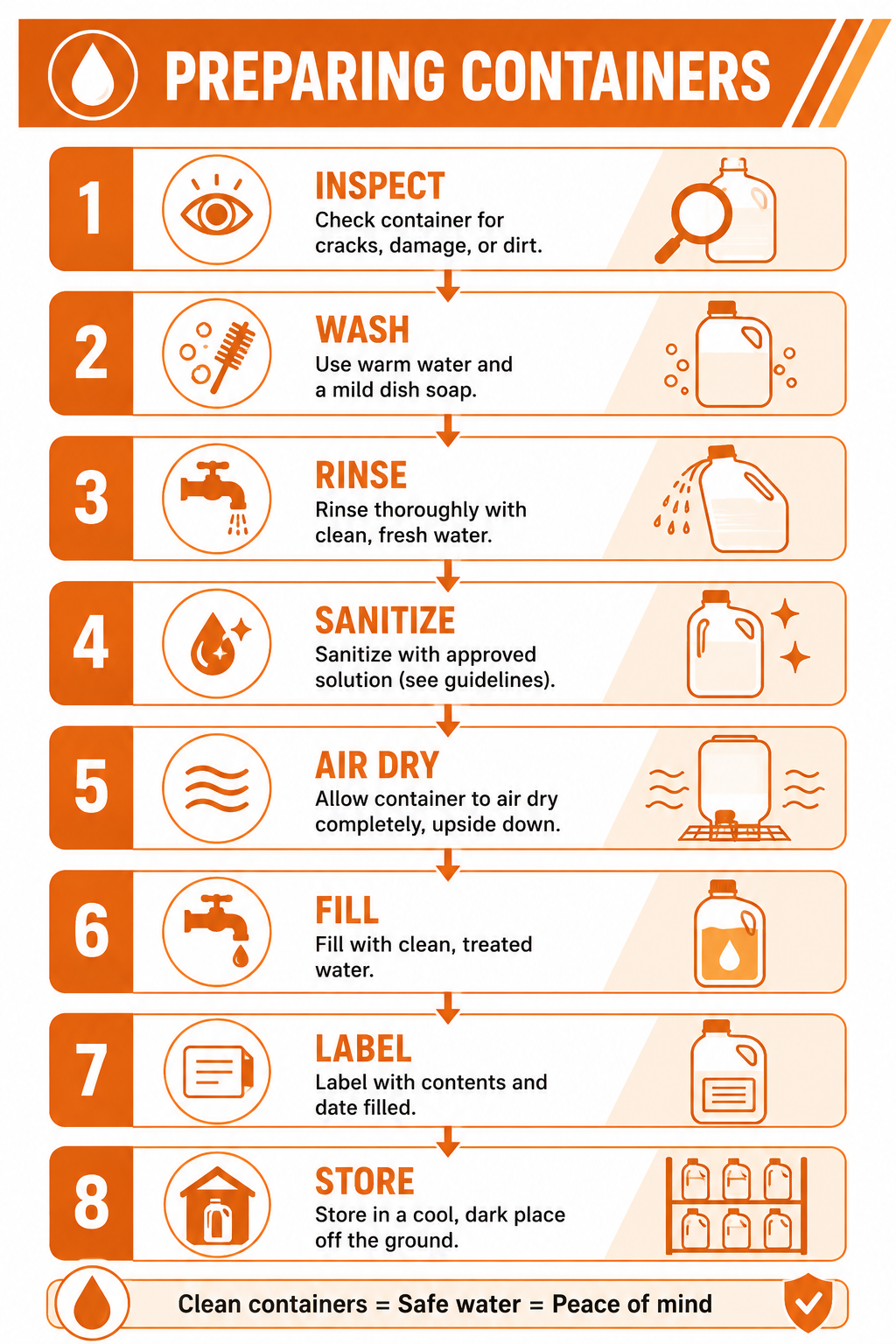
Selecting high-quality water storage containers is only the beginning. Before any water is stored for long-term use, every reusable container should be properly cleaned and sanitized. Even containers that appear perfectly clean may contain dust, manufacturing residues, bacteria, mold spores, or other contaminants that could affect water quality over time. Spending a few extra minutes preparing containers correctly greatly reduces the risk of contamination months or years later.
Begin by carefully inspecting each container before use. Look for cracks, worn threads around the lid, damaged seals, discoloration, bulging sides, or any evidence that the container has previously been exposed to chemicals or excessive heat. Containers showing signs of physical damage should be replaced rather than repaired. Even a small crack can allow bacteria, insects, or airborne contaminants to enter while also increasing the likelihood of leaks during an emergency.
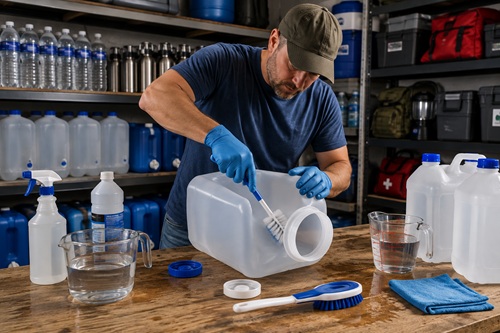
Wash every reusable container thoroughly using warm water and a small amount of dish soap. Scrub the inside walls, bottom, neck, and lid with a clean brush reserved specifically for food or water containers. Pay particular attention to threaded openings where dirt and bacteria commonly accumulate. After washing, rinse the container several times with clean water until no soap residue remains.
Cleaning alone removes visible dirt but does not eliminate microorganisms. Sanitizing provides an additional layer of protection before long-term storage begins. One of the simplest methods is to prepare a dilute bleach solution using unscented household bleach and clean water. Swirl the solution throughout the container so every interior surface comes into contact with the disinfectant, including the cap and threads. Allow the solution to remain in contact with the surfaces for several minutes before emptying the container and rinsing with potable water if recommended by the bleach manufacturer.
Containers should then be allowed to air dry whenever practical. Placing the opening downward on a clean rack allows excess moisture to drain while preventing airborne dust from settling inside. Avoid drying containers with towels that may introduce lint, bacteria, or other contaminants. Once dry, containers should remain sealed until they are filled with drinking water.
Lids deserve just as much attention as the containers themselves. Rubber seals, gaskets, threaded caps, and dispensing spouts all come into direct contact with stored water. Inspect seals for cracks, brittleness, or mold growth, and replace worn components whenever possible. A damaged lid can compromise an otherwise perfectly prepared water container by allowing contamination to enter over time.
Previously used food-grade containers require additional consideration. Containers that once held fruit juice, syrup, cooking oil, or other food products often retain sugars, oils, or flavors that are difficult to remove completely. Although some can be cleaned successfully, many preparedness-minded households choose containers manufactured specifically for water storage because they reduce cleaning time and eliminate uncertainty about lingering residues.
Temperature also influences preparation. Containers stored in extremely cold garages or hot sheds should be allowed to return to room temperature before cleaning and filling. Sudden temperature changes can occasionally stress plastic materials, particularly older containers that have already experienced years of use. Gentle handling during preparation helps extend container life while reducing the possibility of leaks later.
Many preparedness households choose to sanitize all reusable water containers before every refill, even if the container previously held only drinking water. This simple routine minimizes the possibility that bacteria introduced during the previous use remain inside the container during long-term storage. The small amount of time required for sanitization provides valuable peace of mind while helping maintain consistently high water quality.
Proper preparation is often overlooked because it occurs before the water is ever stored. However, it is one of the most important steps in the entire storage process. Clean, sanitized containers establish the foundation upon which every other aspect of long-term water storage depends. Water stored in a contaminated container begins deteriorating immediately, while water placed into a properly prepared container remains protected far longer.
Container Preparation Checklist
| Step | Action | Completed |
|---|---|---|
| Inspect | Check for cracks, leaks, or damage | □ |
| Wash | Clean thoroughly with warm soapy water | □ |
| Rinse | Remove all soap residue | □ |
| Sanitize | Apply approved bleach solution | □ |
| Dry | Air dry completely | □ |
| Inspect Lid | Check seals and threads | □ |
| Fill | Use potable drinking water | □ |
| Label | Record fill and rotation date | □ |
Storing Municipal Tap Water
For many households, municipal tap water provides the easiest and safest starting point for long-term emergency water storage. Public water systems are continuously monitored, filtered, and disinfected before distribution, making them an excellent source for filling emergency storage containers under normal operating conditions. When properly stored, municipal water can remain a dependable emergency reserve for extended periods with relatively little preparation.
Before filling containers, confirm that the municipal system is operating normally. If boil-water advisories, contamination notices, or water quality alerts have been issued, resolve those concerns before using tap water for long-term storage. Filling emergency containers with contaminated water only transfers the problem into your emergency reserve.
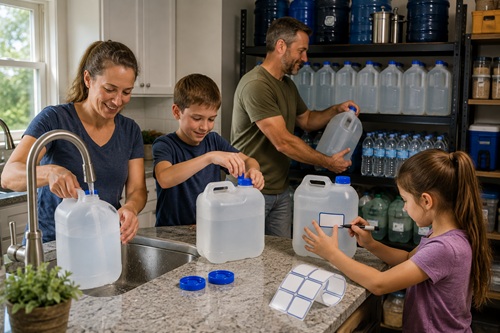
Whenever possible, fill containers directly from a clean indoor faucet that is regularly used for drinking water. Avoid hoses that have remained outdoors for extended periods unless they are specifically designed for potable water. Garden hoses often contain materials not intended for drinking water and may introduce unpleasant tastes or contaminants during filling.
Fill each container almost completely while leaving a small amount of air space near the top. This expansion space allows water to accommodate minor temperature changes without placing unnecessary stress on the container walls or lid. Overfilling containers may increase pressure during warm weather, while excessive air space provides additional oxygen that can affect water quality over very long storage periods.
Many municipal water systems already maintain a chlorine residual that continues protecting stored water after filling. Because of this existing disinfection, additional bleach treatment is often unnecessary when using clean municipal water and properly sanitized containers. However, households using private wells or uncertain water sources should disinfect the water before long-term storage according to recognized emergency water treatment guidelines.
Immediately after filling, tighten the lid securely to create an effective seal. Avoid repeatedly opening containers to inspect the water because every opening creates another opportunity for contamination. Instead, inspect the outside of containers periodically for leaks, damage, or signs of deterioration while keeping the water itself sealed until needed.
Clearly label every container with the date it was filled, the water source, and the planned inspection or rotation date. Permanent waterproof labels greatly simplify inventory management while ensuring that older water supplies are used before newer ones. A simple labeling system also prevents uncertainty years later when multiple storage containers have accumulated.
Storage location remains just as important as the water itself. Filled containers should be moved promptly into cool, dark locations away from direct sunlight, heating equipment, gasoline, pesticides, solvents, or strong-smelling chemicals. Plastic containers can slowly absorb odors from nearby substances, affecting the taste of stored water even when the water itself remains microbiologically safe.
Large quantities of stored water should also be distributed thoughtfully throughout the home. Concentrating several thousand pounds of water on one small section of flooring may exceed structural load limits in some buildings. Basements, concrete floors, and purpose-built storage areas generally provide better support than elevated wooden floors. Households planning very large storage systems should consider both accessibility and structural loading during installation.
Municipal tap water offers one of the simplest ways to establish a reliable emergency reserve because it requires relatively little treatment under normal conditions. Combined with proper container preparation, careful storage, and regular inspection, it provides a strong foundation upon which larger and more diversified preparedness systems can be built.
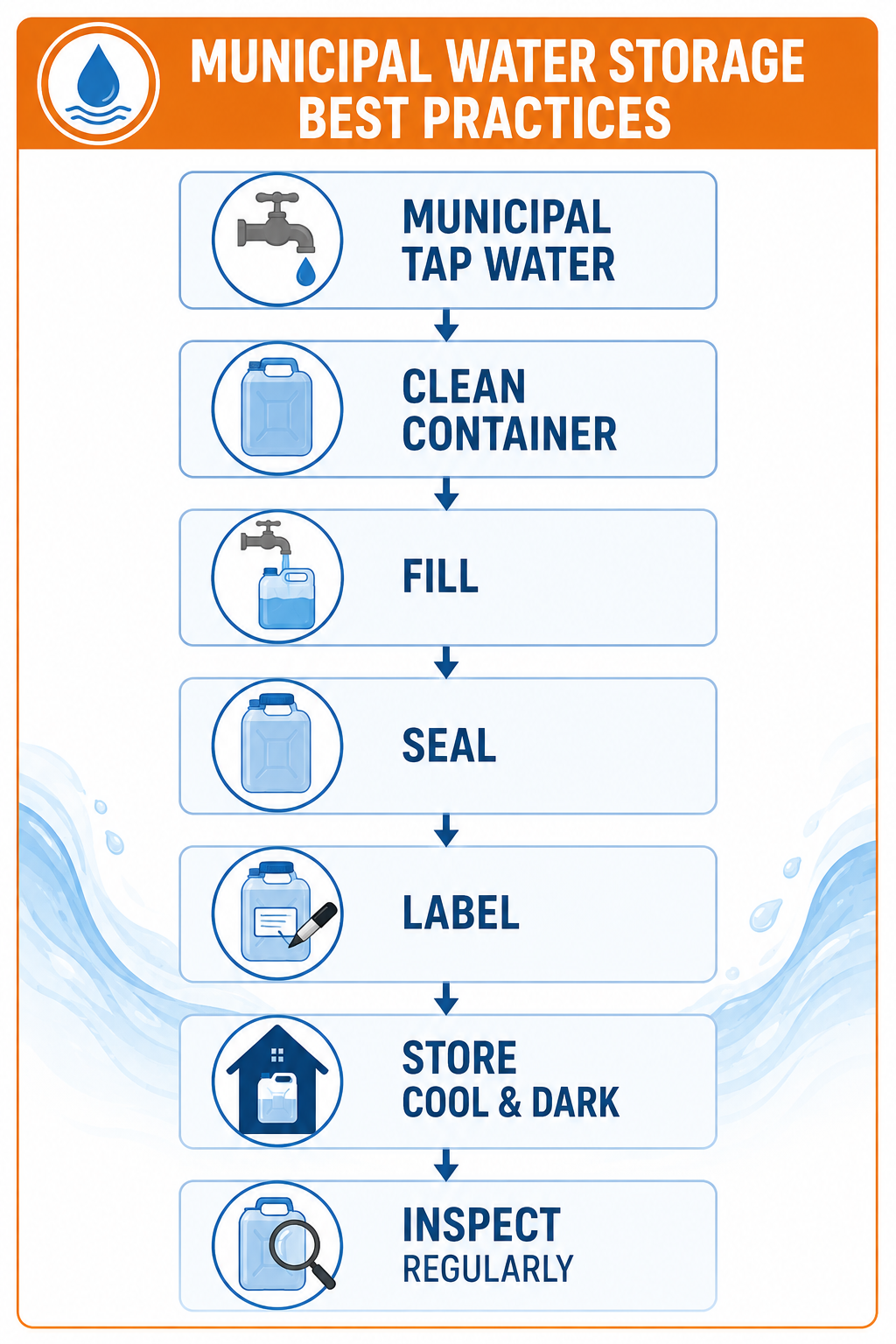
Municipal Water Storage Best Practices
| Practice | Recommendation |
|---|---|
| Water Source | Use potable municipal drinking water |
| Filling Equipment | Clean indoor faucet or potable water hose |
| Container Fill Level | Leave small expansion space |
| Additional Treatment | Usually unnecessary if water is already chlorinated |
| Labeling | Fill date and rotation date |
| Storage Area | Cool, dark, dry location |
| Inspection | Check containers periodically without opening |
| Rotation | Follow household rotation schedule |
Treating Water Before Long-Term Storage
The quality of water placed into storage determines how dependable it will remain throughout its storage life. Even the best storage containers cannot improve contaminated water once it has been sealed inside. Long-term preparedness therefore begins with ensuring the water itself is as clean and safe as possible before storage ever begins. Proper treatment reduces biological contamination, slows the growth of microorganisms, and provides greater confidence that emergency reserves will remain usable when they are finally needed.
Municipal drinking water generally requires the least preparation because it has already undergone filtration and disinfection at a water treatment facility. Most municipal systems maintain a small chlorine residual that continues protecting the water after it leaves the treatment plant. When this water is transferred into properly sanitized food-grade containers and stored under appropriate conditions, additional treatment is often unnecessary. Nevertheless, containers should always be filled using clean equipment and sealed immediately after filling to preserve water quality.
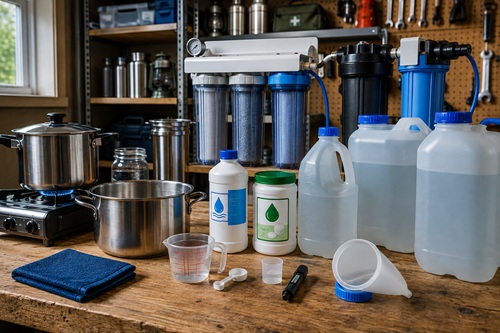
Private wells require additional consideration. Many well owners enjoy excellent water quality under normal conditions, but groundwater quality varies significantly depending on geology, nearby land use, well construction, and maintenance practices. Wells located near agricultural operations, septic systems, industrial sites, or areas recently affected by flooding may require treatment before long-term storage. Regular water testing provides valuable information, but emergency preparedness assumes that conditions can change unexpectedly. When uncertainty exists, disinfecting the water before storage provides an additional margin of safety.
Water collected from natural sources such as rivers, lakes, springs, or rainwater harvesting systems should always be treated before entering long-term storage. Even crystal-clear water may contain bacteria, viruses, protozoa, algae, or other microorganisms invisible to the naked eye. Storing untreated natural water allows these organisms to remain inside the container where they may multiply over time. Successful long-term storage begins by producing the cleanest possible water before the storage process even begins.
One of the most widely accepted methods of emergency disinfection uses unscented household bleach containing sodium hypochlorite. When used in the proper concentration, chlorine effectively destroys many harmful microorganisms while leaving a protective residual inside the stored water. Only plain, unscented household bleach should be used. Products containing fragrances, cleaners, splashless formulas, or other additives are not suitable for emergency drinking water treatment. Always follow current emergency water treatment guidelines because bleach concentrations vary between manufacturers and may change over time.
Calcium hypochlorite offers another excellent long-term preparedness option. Unlike liquid bleach, which gradually loses strength during storage, properly stored calcium hypochlorite remains effective for many years. Preparedness-minded households often keep it as a backup disinfectant because a relatively small quantity can treat thousands of gallons of water when mixed correctly. However, calcium hypochlorite must be handled carefully, stored separately from combustible materials, and mixed according to established safety procedures before use.
Boiling provides another reliable treatment method before storage when contamination is suspected. Heating water to a rolling boil effectively destroys bacteria, viruses, and protozoa that commonly threaten drinking water. After boiling, allow the water to cool naturally inside a covered container before transferring it into sanitized storage containers. Care should be taken to avoid introducing contamination during cooling by leaving the container uncovered or exposing it to dirty surfaces.
Filtration may also play an important role before storage, particularly when water contains visible sediment or suspended particles. Removing dirt, organic matter, and fine debris before disinfection improves the effectiveness of chemical treatment because disinfectants work best in clear water. Depending on the source, pre-filtration through cloth, coffee filters, sediment filters, or purpose-built water filters may significantly improve long-term storage quality.
It is important to remember that no treatment method can correct every possible contamination problem. Chemical pollutants, petroleum products, agricultural runoff, heavy metals, and certain industrial contaminants require specialized treatment methods beyond ordinary household disinfection. When chemical contamination is suspected, selecting another water source is generally preferable to attempting treatment. Preparedness emphasizes beginning with the cleanest available water rather than relying entirely on purification technology.
Treating water before storage should become a routine part of every preparedness plan rather than an emergency response performed only after disaster strikes. Clean containers, properly treated water, and careful handling create a strong foundation that protects stored water for months or years. Every gallon treated correctly today represents one less concern during tomorrow’s emergency.
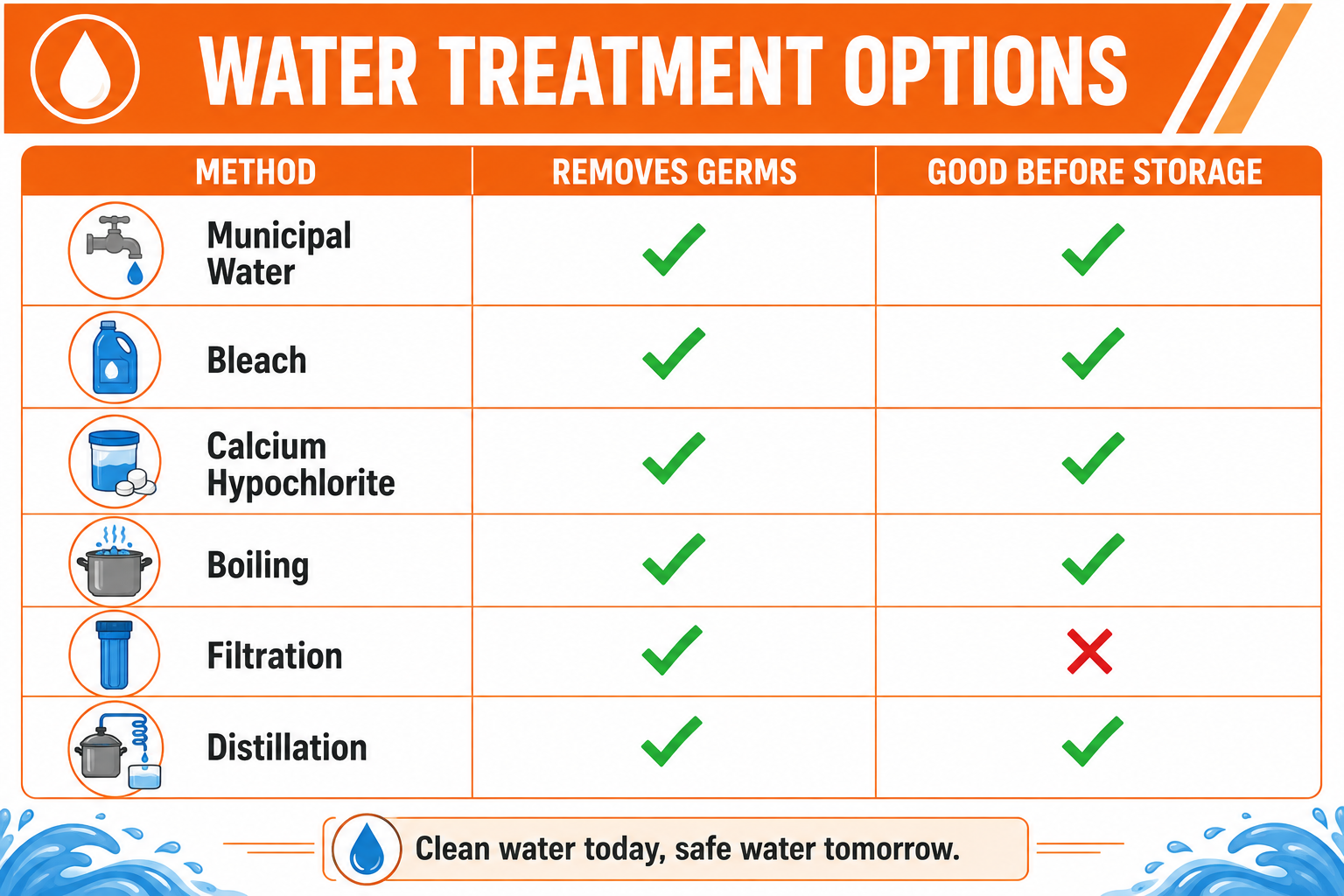
Water Treatment Methods Before Storage
| Treatment Method | Removes Bacteria | Removes Viruses | Removes Protozoa | Best Used Before Storage |
|---|---|---|---|---|
| Municipal Chlorination | ✅ | ✅ | Limited | Municipal tap water |
| Household Bleach | ✅ | ✅ | Limited | Emergency disinfection |
| Calcium Hypochlorite | ✅ | ✅ | Limited | Long-term preparedness |
| Boiling | ✅ | ✅ | ✅ | Suspected biological contamination |
| Filtration + Disinfection | ✅ | ✅ | ✅ | Natural water sources |
| Distillation | ✅ | ✅ | ✅ | High-purity storage |
Selecting the Best Storage Location
Even perfectly treated water can deteriorate if it is stored in poor environmental conditions. Heat, sunlight, freezing temperatures, chemical vapors, and physical damage all influence how well emergency water reserves perform over time. Selecting the proper storage location is therefore just as important as choosing quality containers or properly treating the water before storage.
One of the most important considerations is temperature. Water should be stored in a cool environment whenever possible. Excessive heat accelerates the breakdown of chlorine residuals, encourages algae growth if sunlight is present, and gradually weakens many plastic containers. Garages, sheds, attics, and vehicle trunks often experience dramatic temperature swings throughout the year, making them less desirable than climate-controlled basements, utility rooms, or interior storage areas.
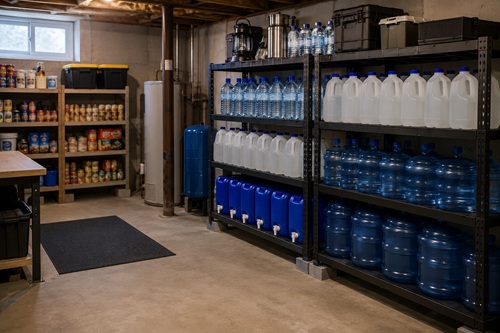
Sunlight presents another challenge. Ultraviolet radiation gradually degrades many plastics while encouraging algae growth whenever light reaches the stored water. Even translucent containers benefit from being protected from direct sunlight. Dark storage areas or opaque containers help preserve water quality while extending container life. If transparent containers must be used, storing them inside enclosed cabinets or covering them with protective materials significantly reduces light exposure.
Water should also be protected from freezing whenever practical. Although freezing itself does not necessarily make water unsafe, expanding ice can crack containers, damage lids, or create leaks that remain unnoticed until the water thaws. Large storage drums are particularly vulnerable because expanding ice creates substantial pressure against container walls. In cold climates, leave adequate expansion space inside containers and avoid storing them where prolonged freezing is expected.
Chemical contamination is another frequently overlooked concern. Plastic containers may gradually absorb strong odors or vapors from nearby gasoline, paint thinners, pesticides, solvents, fertilizers, or cleaning chemicals. Although the water may remain microbiologically safe, unpleasant tastes and odors can develop over time. Water storage areas should therefore remain separate from workshops, fuel storage, and areas containing volatile chemicals.
Accessibility should also influence storage decisions. Water stored in difficult-to-reach crawl spaces or buried beneath heavy equipment may remain safe but become impractical during an actual emergency. Containers should be organized so they can be inspected, rotated, and transported without unnecessary difficulty. During a disaster, the ability to access water quickly becomes just as important as having stored it.
Structural support deserves careful attention whenever large quantities of water are stored. Water weighs approximately 8.3 pounds (3.8 kilograms) per gallon. A single fifty-five-gallon drum therefore weighs well over 450 pounds (204 kilograms) when full. Several drums positioned together can place thousands of pounds of weight on a relatively small area. Concrete basement floors generally provide excellent support, while elevated wooden floors may require careful planning or professional evaluation before storing very large reserves.
Organization greatly improves long-term maintenance. Similar container sizes should be grouped together, labels should remain visible, and aisles should allow containers to be inspected without moving heavy equipment. Many preparedness-minded households also separate daily-use water from long-term emergency reserves, reducing the need to disturb strategic storage supplies during routine household activities.
Security is another important consideration. Emergency water represents an essential survival resource. Storage locations should be protected from accidental damage, curious children, rodents, insects, and unauthorized access whenever possible. Simple precautions such as locking utility rooms, elevating containers off damp floors, and protecting storage areas from flooding greatly improve long-term reliability.
Choosing an appropriate storage location is ultimately about protecting the investment you have already made. Proper environmental conditions preserve water quality, extend container life, simplify maintenance, and ensure your emergency reserve remains ready whenever normal infrastructure fails.
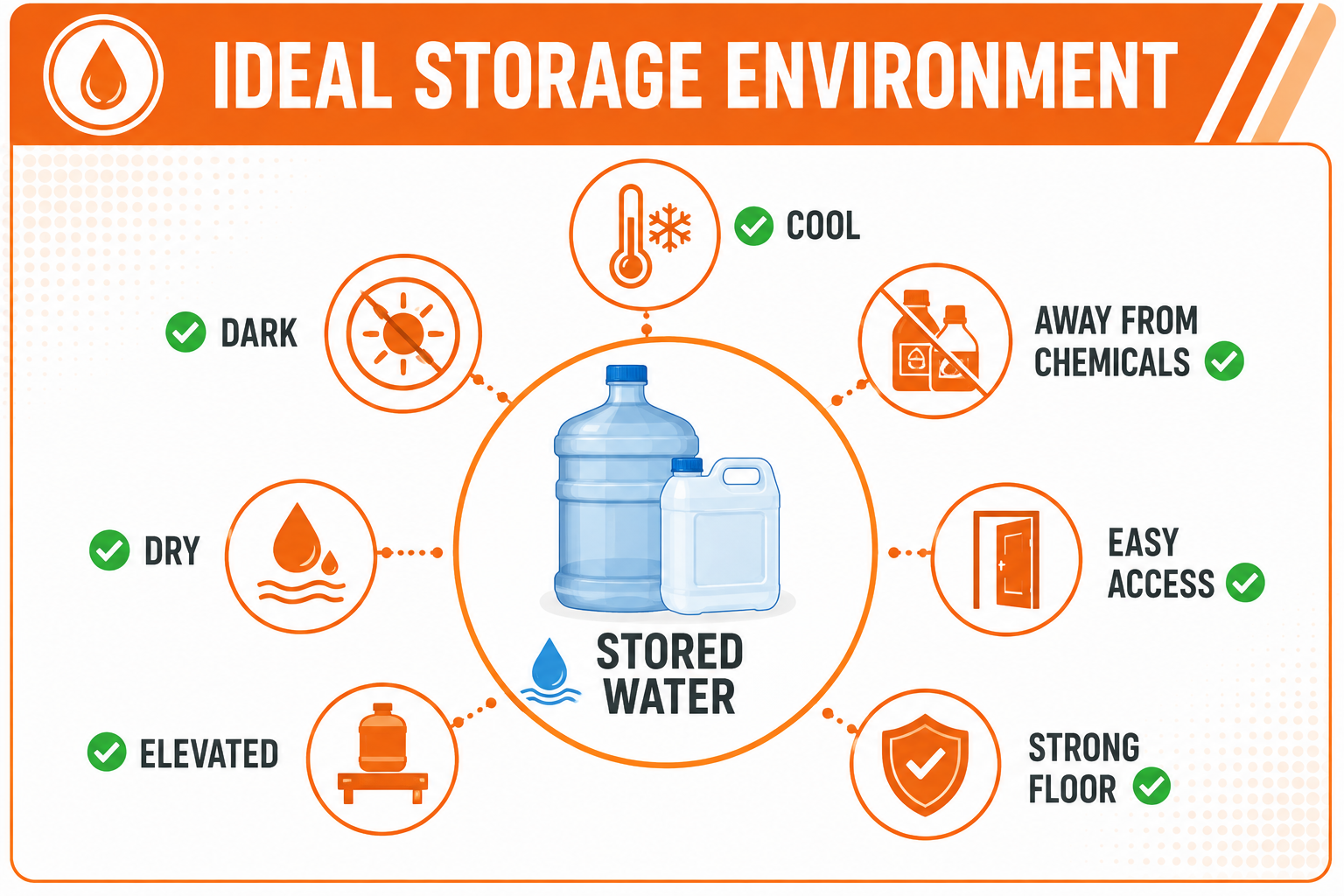
Ideal Water Storage Environment
| Environmental Factor | Recommended Condition |
|---|---|
| Temperature | Cool and stable |
| Sunlight | No direct UV exposure |
| Humidity | Dry, well-ventilated |
| Chemicals | Store far from fuels and solvents |
| Floor Surface | Strong, level surface |
| Accessibility | Easy inspection and removal |
| Security | Protected from damage and contamination |
| Flood Risk | Elevated above potential flooding |
Water Rotation and Inspection
Storing emergency water is only the first step in building a dependable preparedness system. To ensure that water remains safe, clean, and ready for use, it should be inspected periodically and rotated according to a planned schedule. Rotation is often misunderstood as replacing every container on a fixed calendar regardless of condition. In reality, successful long-term preparedness focuses on maintaining container integrity, preserving water quality, and replacing supplies only when necessary. A well-organized inspection program allows households to identify potential problems long before they become emergencies.
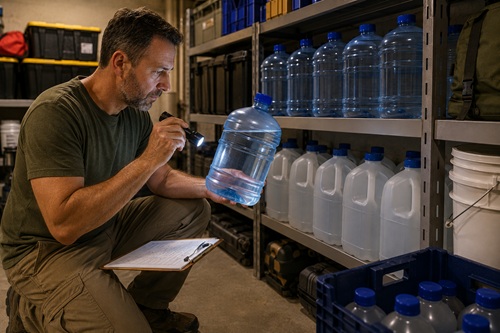
Every inspection should begin with the container itself. Carefully examine all sides for cracks, dents, bulging walls, discoloration, or evidence of ultraviolet damage. Plastic containers that have become brittle or warped may eventually fail without warning, particularly if they experience temperature fluctuations throughout the year. Metal containers should be checked for corrosion, damaged seams, or rust that could compromise their structural integrity. Any container showing signs of deterioration should be emptied, cleaned, replaced if necessary, and refilled with fresh water.
The lid and sealing surfaces deserve equal attention. A damaged gasket or loose cap may allow dust, insects, bacteria, or moisture to enter the container over time. Threaded lids should tighten securely without cross-threading, while rubber seals should remain flexible and free from cracking or mold. Even a small leak can slowly reduce stored water supplies while creating conditions that encourage contamination around the storage area.
Visual inspection of the water itself provides another valuable assessment. Clear water should remain clear. Unexpected cloudiness, floating particles, algae growth, discoloration, or sediment that was not originally present may indicate contamination or deterioration. While some harmless mineral deposits can settle naturally during long-term storage, significant changes in appearance warrant closer investigation. If there is any doubt about water quality, the safest approach is to discard the water, sanitize the container, and refill it with fresh treated water.
Odor should also be evaluated whenever containers are opened during planned rotation. Properly stored water generally has little or no odor. Musty smells, chemical odors, sour aromas, or unusual tastes may indicate contamination, deterioration of the storage container, or exposure to nearby chemicals. Never ignore changes in smell simply because the water appears clear. Water quality should always be evaluated using multiple observations rather than appearance alone.
Many preparedness households choose to follow a first-in, first-out (FIFO) rotation system. Under this approach, the oldest stored water is used first for everyday household purposes such as watering plants, cleaning, flushing toilets, or other non-emergency uses before containers are cleaned, sanitized, and refilled. This natural rotation keeps supplies fresh without wasting usable water. Commercially bottled water can be incorporated into the same system by using the oldest cases before newly purchased supplies.
The frequency of rotation depends largely on the water source, storage conditions, and container type. Commercially bottled water stored under ideal conditions may remain usable for many years, while reusable containers filled from household taps may benefit from more frequent inspection and periodic replacement. Rather than relying solely on a fixed calendar, preparedness-minded households combine scheduled inspections with common-sense evaluation of container condition and storage environment.
Keeping written records simplifies long-term management. A simple inspection log attached to the storage area allows each container to be tracked throughout its service life. Recording fill dates, inspection dates, observations, and rotation history helps identify recurring problems while ensuring that no container is forgotten. Larger preparedness systems containing dozens of storage containers become much easier to manage when accurate records are maintained.
Rotation should also include the equipment associated with water storage. Filters, replacement cartridges, disinfectants, measuring tools, siphons, pumps, and transfer hoses should all be inspected alongside stored water. An emergency reserve is only as useful as the equipment available to access and treat it. Replacing expired supplies and repairing damaged equipment during routine inspections prevents unpleasant surprises during an actual emergency.
Ultimately, water rotation is not about replacing water because a calendar says it is time. It is about maintaining confidence that every gallon stored today will still be available tomorrow. Regular inspections, organized rotation, and proper recordkeeping ensure that your emergency water reserve remains one of the most dependable resources within your preparedness plan.
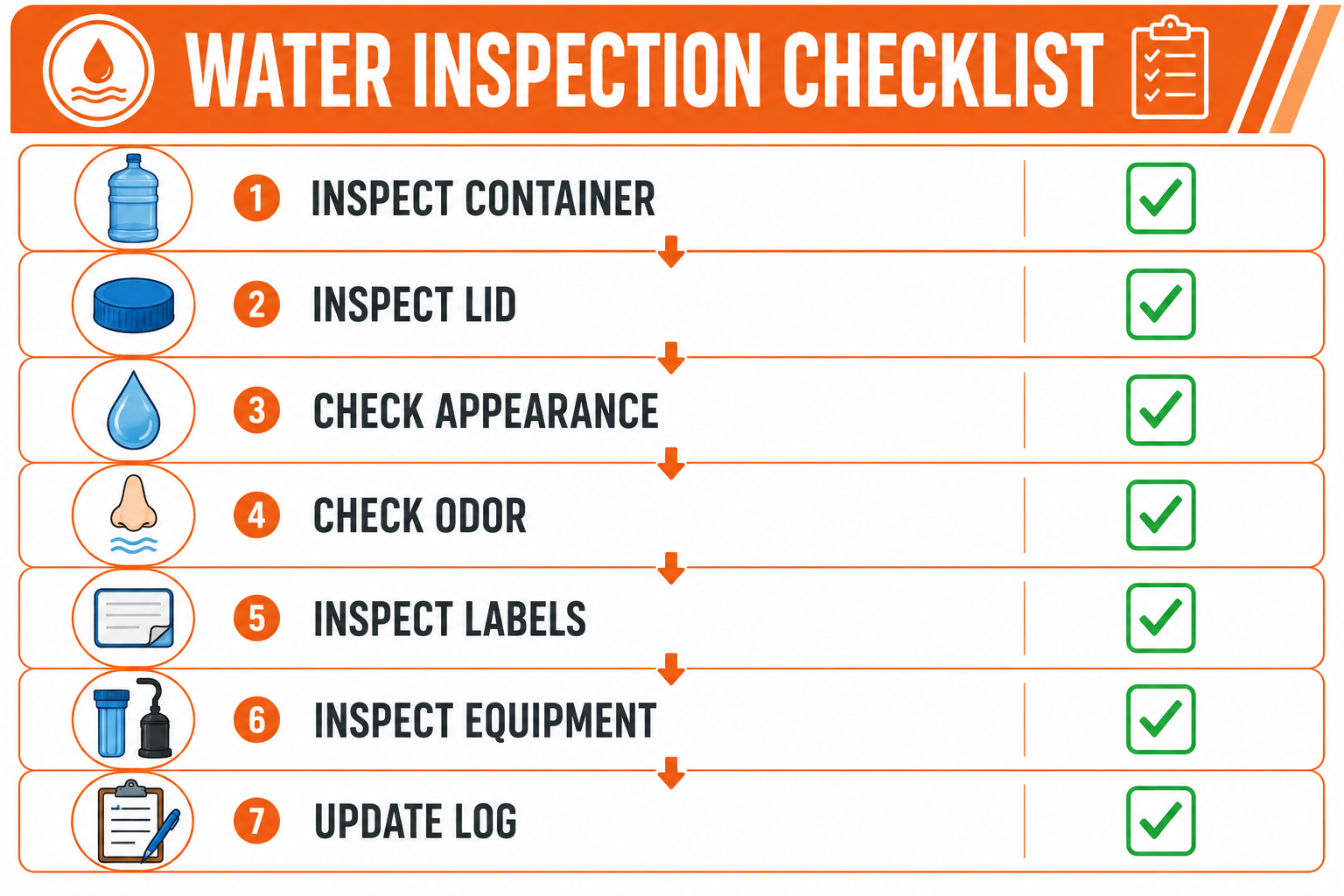
Water Inspection Checklist
| Inspection Item | Check For | Action if Problem Found |
|---|---|---|
| Container | Cracks, dents, UV damage | Replace container |
| Lid & Seal | Loose cap, damaged gasket | Replace seal or lid |
| Water Appearance | Cloudiness, algae, sediment | Empty, sanitize, refill |
| Odor | Chemical, musty, sour smell | Discard and replace |
| Labels | Missing or unreadable | Replace labels |
| Storage Area | Heat, sunlight, chemicals | Relocate containers |
| Equipment | Filters, pumps, hoses | Repair or replace |
| Inspection Log | Dates up to date | Update records |
Preventing Water Contamination During Storage
Preventing contamination is considerably easier than correcting it after it occurs. Once harmful microorganisms, dirt, chemicals, or debris enter a storage container, restoring water quality often requires emptying the container, thoroughly sanitizing it, and beginning the storage process again. Developing good handling habits before contamination occurs helps preserve emergency water supplies while reducing unnecessary work and wasted resources.
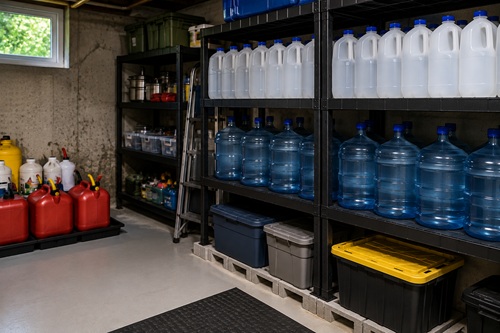
One of the simplest ways to prevent contamination is by minimizing how often storage containers are opened. Every time a lid is removed, airborne dust, bacteria, insects, and moisture gain an opportunity to enter the container. Instead of repeatedly accessing one large storage tank, many preparedness-minded households maintain several smaller containers for daily use while keeping larger emergency reserves sealed until truly needed. This layered approach greatly reduces unnecessary exposure while extending the life of strategic water reserves.
Clean handling practices are equally important. Hands should be washed before handling lids, dispensing equipment, or transfer hoses. Containers should never be placed directly on muddy ground while being filled, and clean dispensing equipment should remain separate from equipment used for untreated water. Cross-contamination often occurs not because the stored water was unsafe, but because dirty equipment introduced contaminants during routine handling.
Transfer equipment requires careful attention. Funnels, siphons, pumps, hoses, and measuring cups should all be cleaned and sanitized before use. Equipment dedicated exclusively to drinking water should never be used for fuel, chemicals, gray water, or untreated natural water. Color-coding or clearly labeling equipment helps prevent accidental misuse during stressful emergencies.
Storage containers should also remain tightly sealed whenever they are not actively being filled or emptied. Loose lids allow insects, rodents, airborne dust, and humidity to enter over time. Even small openings may permit mold spores or bacteria to establish themselves inside the container, particularly in warm environments. Checking lid tightness during routine inspections significantly reduces these risks.
Location continues to influence contamination long after containers have been filled. Water stored near gasoline, pesticides, solvents, paints, fertilizers, or strong-smelling household chemicals may gradually absorb odors through certain plastic materials. Although this does not always indicate dangerous contamination, it often affects taste and reduces confidence in the stored supply. Keeping emergency water separate from chemical storage areas remains one of the simplest preventive measures available.
Flooding presents another significant contamination risk. Containers stored directly on basement floors may become submerged during heavy rainfall or plumbing failures. Floodwater often contains sewage, fuel, chemicals, and biological contaminants capable of entering damaged containers. Elevating emergency water storage several inches above the floor using sturdy pallets or shelving provides valuable protection while also improving airflow around the containers.
Rodents and insects should never be overlooked. Mice may chew plastic containers under certain conditions, while insects can enter poorly sealed lids or damaged dispensing spouts. Maintaining clean storage areas, controlling pests, and inspecting containers regularly helps prevent these problems before they compromise valuable water supplies.
Preparedness also means protecting water from accidental human contamination. Emergency water should not be confused with utility water, gardening water, or untreated rainwater. Clear labeling prevents family members from inadvertently mixing treated and untreated supplies. During prolonged emergencies, establishing separate areas for untreated collection water and finished drinking water further reduces the possibility of cross-contamination.
Perhaps the most effective contamination prevention strategy is maintaining a complete water management system rather than relying on individual containers. Safe collection, proper treatment, careful storage, regular inspections, clean dispensing equipment, and disciplined handling practices all work together to preserve water quality. Weakness in any one area can compromise the entire system, while attention to every step creates a highly dependable emergency water reserve.
Contamination prevention ultimately comes down to consistency. Small habits practiced during routine maintenance become automatic during emergencies, ensuring that every gallon of carefully stored water remains as safe on the day it is used as it was on the day it was stored.
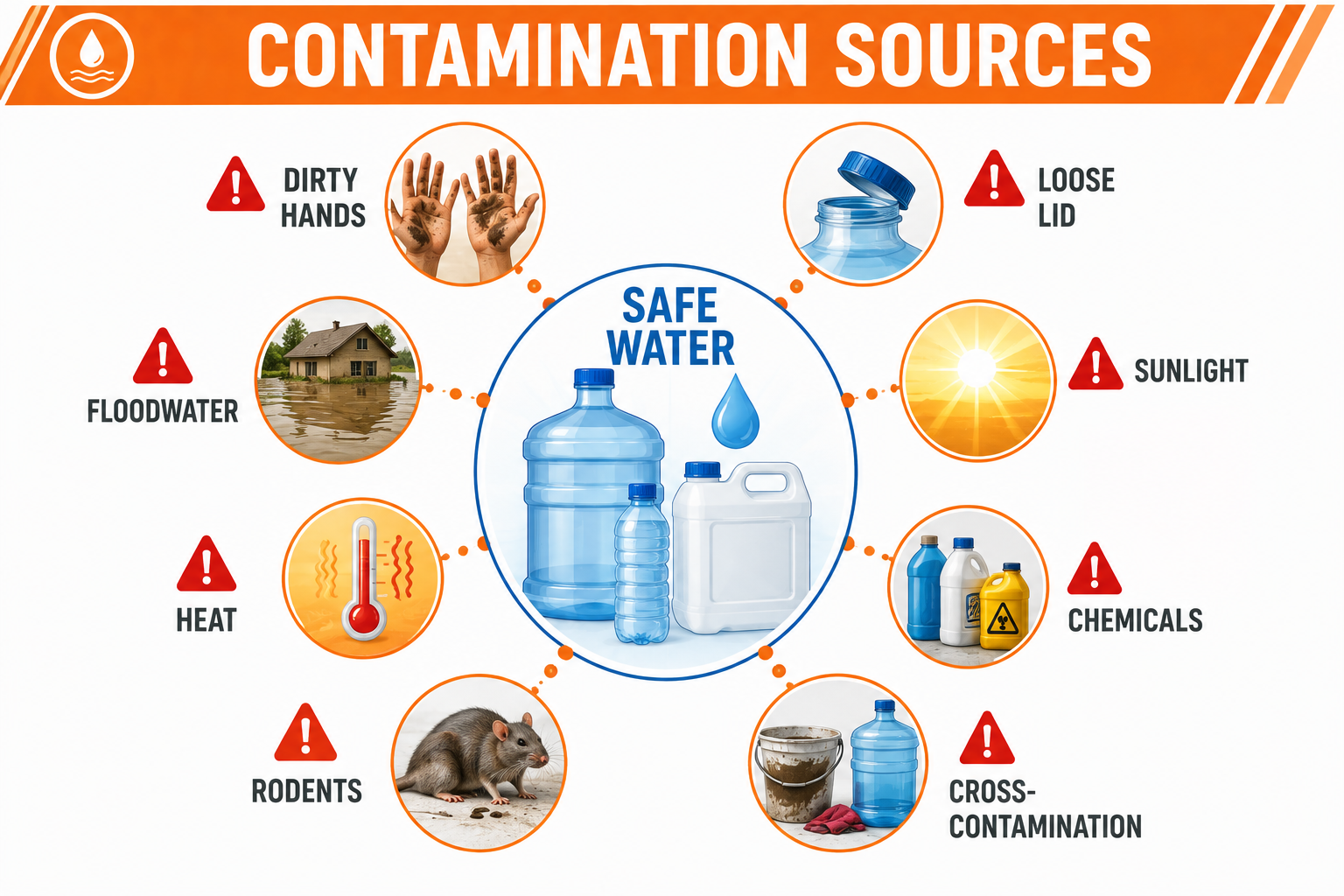
Common Sources of Water Contamination
| Source | Prevention |
|---|---|
| Dirty hands | Wash hands before handling containers |
| Unclean funnels or hoses | Sanitize before each use |
| Loose container lids | Keep tightly sealed |
| Floodwater | Elevate storage containers |
| Sunlight | Store in dark locations |
| Heat | Maintain cool storage temperatures |
| Chemical vapors | Separate water from fuels and chemicals |
| Cross-contamination | Separate treated and untreated water equipment |
| Insects and rodents | Inspect storage area regularly |
| Damaged containers | Replace immediately |
Large Water Storage Systems
As emergency preparedness goals expand, many households discover that individual bottles and small portable containers are no longer sufficient to meet long-term water requirements. Larger storage systems allow families to maintain hundreds or even thousands of gallons of emergency water while reducing the amount of space required per gallon stored. These systems provide a dependable reserve capable of supporting extended power outages, natural disasters, infrastructure failures, and prolonged emergencies that may last weeks or even months.
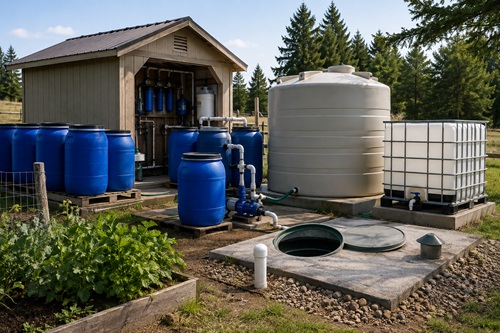
One of the most common options is the fifty-five-gallon (208-liter) food-grade water drum. These drums provide an excellent balance between storage capacity, affordability, and durability. A single drum contains enough emergency drinking water to support one person for nearly two months at minimum emergency consumption levels, while several drums can provide an entire family’s reserve in a relatively small footprint. Because a full drum weighs well over 450 pounds (204 kilograms), it should be positioned in its permanent location before filling. Attempting to move a full drum without specialized equipment is both difficult and potentially dangerous.
Stackable water containers, often called water bricks or modular storage containers, provide another practical solution. Their rectangular shape allows them to utilize storage space much more efficiently than round containers, making them especially attractive for garages, basements, utility rooms, and closets. Unlike large drums, individual bricks remain portable when full, allowing water to be transported more easily throughout the home or loaded into vehicles during evacuations.
Above-ground polyethylene storage tanks are frequently used by rural homeowners, homesteads, and off-grid properties. These tanks range from a few hundred gallons to several thousand gallons and can be connected directly to rainwater harvesting systems, well pumps, or backup water supplies. When properly installed and maintained, they provide excellent long-term storage while supporting irrigation, livestock, sanitation, and emergency household use. Because of their size, careful planning is required to ensure adequate structural support and accessibility for maintenance.
Underground cisterns offer one of the most secure forms of long-term water storage. By placing the water below ground level, these systems naturally protect it from sunlight, freezing temperatures, and many forms of physical damage. Underground storage also conserves valuable yard space while maintaining relatively stable temperatures throughout the year. Installation costs are considerably higher than above-ground systems, but many preparedness-minded property owners consider underground cisterns one of the most resilient long-term investments available.
Large storage systems also require appropriate methods for accessing the water. Rather than opening the top of a large tank each time water is needed, many systems utilize spigots, hand pumps, siphons, or transfer pumps that allow water to be removed while keeping the remaining supply sealed. Minimizing exposure to air greatly reduces the possibility of contamination while preserving overall water quality.
Maintenance becomes increasingly important as storage capacity grows. Large tanks should be inspected periodically for leaks, UV damage, algae growth, damaged fittings, and sediment accumulation. Valves, hoses, and transfer pumps should also be tested regularly to ensure they operate properly during an emergency. A storage system containing thousands of gallons of water provides little value if the equipment needed to access it fails when it is finally needed.
Structural planning should never be overlooked. Water is extremely heavy, and large storage systems place tremendous loads on foundations, floors, and supporting structures. Outdoor tanks require stable, level bases capable of supporting their full operating weight, while indoor systems should be located on reinforced concrete whenever possible. Improper support can cause tanks to shift, crack, or fail over time.
Preparedness-minded households often combine several storage systems rather than depending upon only one. Large stationary tanks provide strategic reserves, modular containers support household distribution, and portable bottles remain available for evacuations or short-term travel. This layered approach increases flexibility while reducing the impact if any one storage system becomes damaged or contaminated.
The purpose of large water storage is not simply to accumulate impressive volumes of water. It is to provide dependable access to one of life’s most essential resources while creating enough reserve to adapt confidently to prolonged emergencies. Proper planning, quality equipment, and regular maintenance transform these systems into one of the strongest foundations of household preparedness.
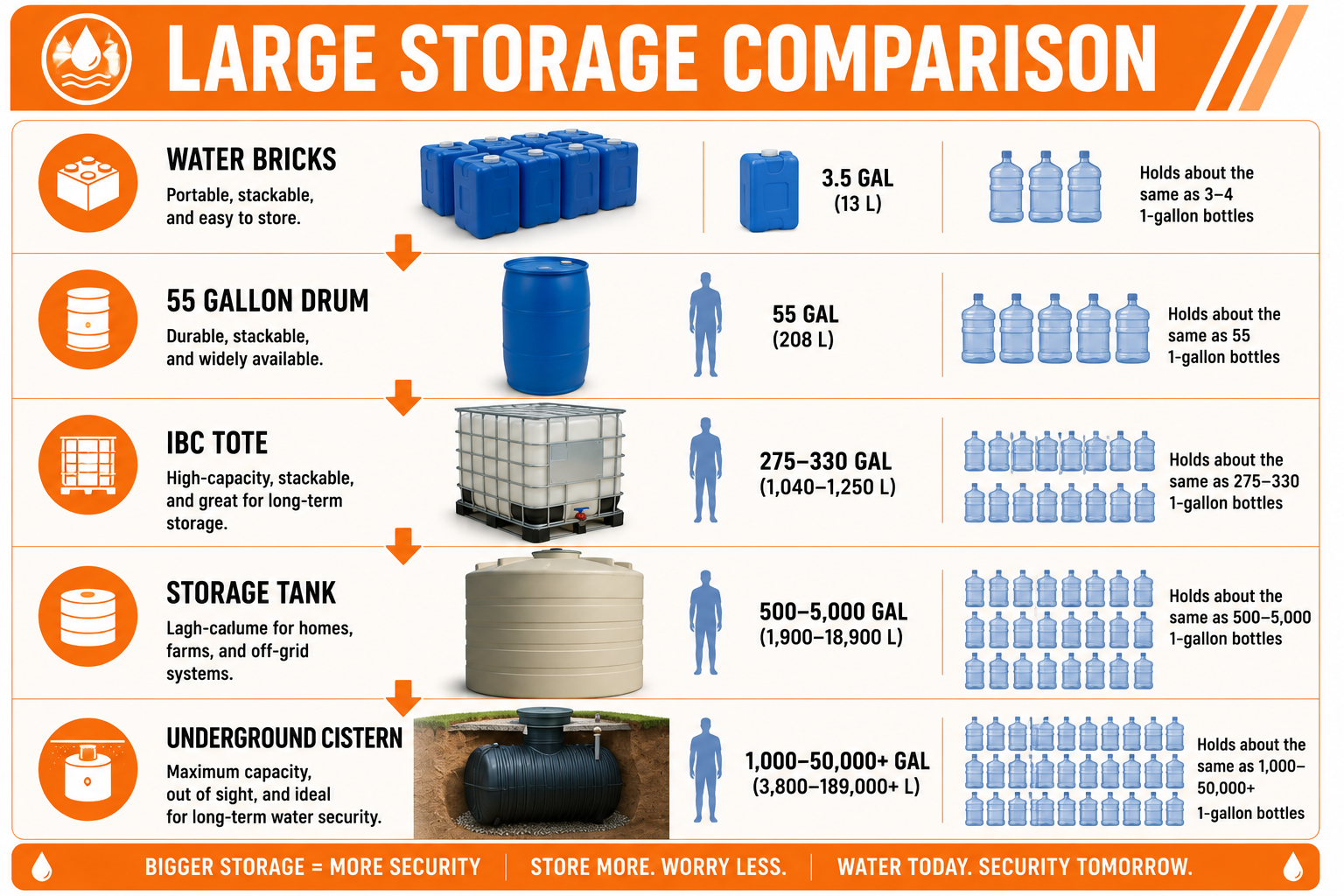
Large Water Storage Comparison
| Storage System | Capacity | Portability | Best Use | Advantages |
|---|---|---|---|---|
| 55-Gallon Drum | 55 gal | Poor | Home emergency reserve | Affordable, durable |
| Water Bricks | 3–4 gal each | Excellent | Modular storage | Stackable, portable |
| Above-Ground Tank | 100–5,000+ gal | None | Homesteads, rural properties | High capacity |
| Underground Cistern | 500–20,000+ gal | None | Long-term resilience | Protected from weather |
| Intermediate Bulk Container (IBC Tote) | 275–330 gal | Limited | Bulk storage | Excellent value per gallon |
Rainwater Storage Systems
Rainwater harvesting has become one of the most valuable additions to modern preparedness planning because it provides a renewable source of water that can replenish stored reserves without depending upon municipal infrastructure. Every rainfall delivers fresh water directly to your property, allowing properly designed collection systems to capture hundreds or even thousands of gallons each year. While rainwater should still be purified before drinking, storing collected rainfall greatly expands long-term water security during prolonged emergencies.
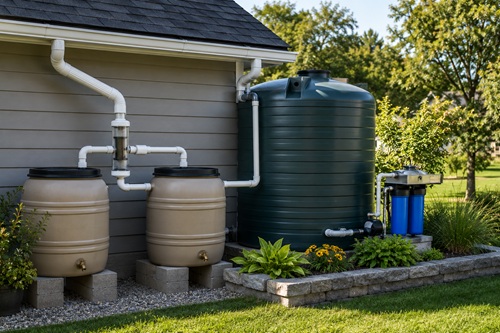
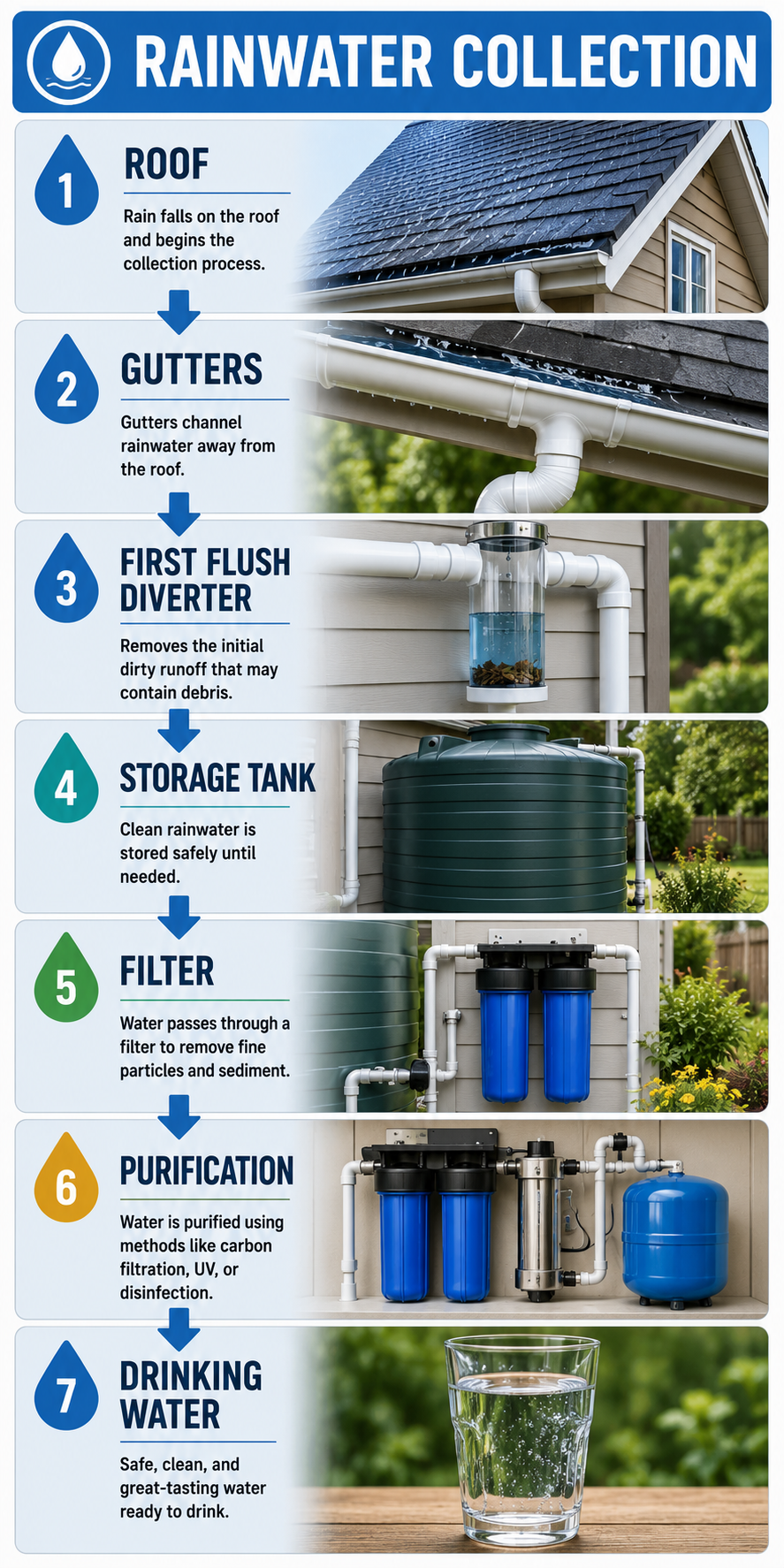
The effectiveness of a rainwater collection system begins with the collection surface itself. Most residential systems use rooftops because they provide large collection areas capable of producing significant volumes of water from even moderate rainfall. Metal roofing generally offers the best performance because it sheds water efficiently while introducing relatively few contaminants. Asphalt shingles, treated wood, and older roofing materials may contribute additional particles or chemicals that require more careful filtration before storage.
Gutters and downspouts serve as the transportation system for collected rainwater. Keeping these components clean is one of the simplest ways to improve water quality. Leaves, twigs, bird droppings, insects, and accumulated debris should be removed regularly, particularly before rainy seasons. Neglecting gutter maintenance allows contaminants to enter storage tanks while increasing the possibility of clogged downspouts and overflow.
A first-flush diverter is one of the most valuable upgrades that can be added to any rainwater harvesting system. During dry weather, roofs accumulate dust, pollen, leaves, bird droppings, and airborne pollutants. The first portion of rainfall washes this material from the roof. A first-flush diverter automatically redirects this initial runoff away from the storage tank, allowing cleaner water to enter once the roof has been rinsed naturally. Even simple manual diversion methods provide noticeable improvements in water quality.
Storage tanks for rainwater should always be designed to exclude sunlight. Light entering the tank encourages algae growth while warming the stored water. Opaque polyethylene tanks, underground cisterns, or enclosed storage systems help preserve water quality while reducing maintenance requirements. Tight-fitting lids also prevent insects, rodents, and debris from entering the system while limiting mosquito breeding.
Overflow management is another important consideration. Heavy rainfall can quickly fill storage tanks, making properly designed overflow outlets essential. Overflow water should be directed safely away from building foundations to prevent erosion, flooding, or structural damage. Screens placed over overflow openings also prevent insects and small animals from entering the storage system.
Although rainwater is generally cleaner than many surface water sources, it should still be treated before drinking. Dust, pollen, bacteria, bird droppings, and environmental pollutants may all enter the collection system during rainfall. Depending on the intended use, filtration, chemical disinfection, ultraviolet treatment, or boiling may all form part of the final purification process before consumption.
Rainwater systems provide another important preparedness advantage: they operate passively. Once installed, they continue collecting water whenever it rains without requiring electricity, fuel, or daily attention. During prolonged emergencies, this passive replenishment allows stored reserves to grow rather than steadily decline, reducing dependence on rivers, lakes, or transported water.
The size of a rainwater storage system should reflect local rainfall patterns, available roof area, household water consumption, and available storage space. Some households benefit from a few fifty-gallon rain barrels, while others install several thousand gallons of permanent storage. Regardless of size, regular inspection and maintenance remain essential for ensuring reliable long-term performance.
Rainwater harvesting is most effective when integrated into a broader household water strategy rather than serving as the sole source of emergency water. Combined with municipal storage, wells, natural water sources, and purification equipment, rainwater collection provides another layer of resilience that strengthens the entire preparedness system.
Rainwater Storage Components
| Component | Purpose |
|---|---|
| Roof | Primary collection surface |
| Gutters | Direct rainwater to storage |
| First-Flush Diverter | Removes initial contaminants |
| Leaf Screen | Prevents debris entry |
| Storage Tank | Long-term water storage |
| Overflow Outlet | Prevents overfilling |
| Tank Lid | Blocks sunlight and pests |
| Water Filter | Removes sediment before treatment |
| Purification System | Produces safe drinking water |
Water Storage for Apartments and Small Homes
Emergency preparedness is often associated with rural properties, large basements, or dedicated storage rooms, but millions of people live in apartments, condominiums, townhouses, and smaller homes where storage space is limited. While these living arrangements present unique challenges, they do not prevent effective long-term water preparedness. Successful apartment preparedness focuses on maximizing available space, using efficient storage methods, and developing multiple layers of redundancy rather than relying solely on large storage tanks.
One of the greatest advantages apartment residents have is flexibility. Instead of concentrating hundreds of gallons in one location, water can be distributed throughout the home in smaller containers that fit naturally into existing storage spaces. Cases of commercially bottled water slide beneath beds, stack neatly in closets, fit behind furniture, or occupy unused shelf space without significantly affecting daily living. This distributed approach also reduces the consequences if one container becomes damaged.
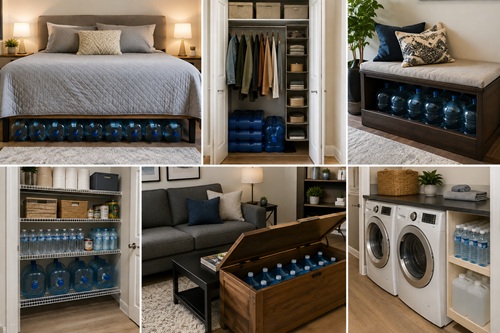
Stackable water containers provide another excellent solution for compact living spaces. Their rectangular design allows them to fit inside closets, utility rooms, laundry areas, and shelving units far more efficiently than traditional round containers. Many are designed specifically to interlock securely, allowing vertical storage while maintaining stability and easy access. Unlike large barrels, these containers remain portable when full, making them practical for both daily use and emergency evacuations.
Furniture can also become part of a preparedness plan. Water stored beneath beds, inside storage benches, beneath stairways, or inside purpose-built cabinets often utilizes space that would otherwise remain unused. Some preparedness-minded individuals incorporate emergency supplies into decorative furniture or shelving systems, allowing substantial quantities of water to remain available without altering the appearance of the home.
Weight distribution deserves careful consideration in multi-story buildings. Water weighs approximately 8.3 pounds (3.8 kilograms) per gallon, meaning even relatively modest storage systems become surprisingly heavy. Concentrating hundreds of gallons in one corner of an upper-floor apartment may exceed the intended load for that portion of the structure. Distributing containers evenly throughout the living space reduces concentrated loading while improving accessibility.
Apartment residents should also prepare for the possibility that municipal water service may continue briefly after power failures. Bathtubs can provide temporary emergency storage when filled immediately after learning of an approaching storm or infrastructure disruption. Commercial bathtub liners designed specifically for emergency water storage help keep this water clean while greatly increasing short-term household reserves. These systems should complement – not replace – permanent long-term storage.
Accessibility remains especially important in smaller homes. Emergency water should remain available even if power is lost or evacuation becomes necessary during the night. Containers buried beneath heavy household items or placed in inaccessible attic spaces may technically increase storage capacity while remaining difficult to retrieve under emergency conditions. Organizing supplies with practical access in mind greatly improves their usefulness.
Apartment preparedness also benefits from redundancy beyond stored water. Portable filtration equipment, chemical disinfectants, collapsible water containers, and knowledge of nearby emergency water sources strengthen preparedness while requiring very little storage space. If stored reserves begin running low, these additional capabilities greatly extend household resilience without occupying significant room.
Many apartment residents overlook nearby community resources that may become valuable during emergencies. Public parks, emergency shelters, community centers, and designated disaster response locations often form part of municipal emergency planning. While these resources should never replace personal preparedness, understanding their locations before an emergency adds another layer of resilience should circumstances exceed household storage capacity.
Preparedness within small living spaces is ultimately about efficiency rather than volume. Carefully selected containers, thoughtful organization, distributed storage, and complementary purification methods allow even modest apartments to maintain meaningful emergency water reserves. The goal is not to match the storage capacity of a rural homestead but to create the largest practical reserve that fits comfortably within the available living space.
Apartment Water Storage Ideas
| Storage Location | Typical Capacity | Advantages |
|---|---|---|
| Under Beds | 20–60 gallons | Hidden, accessible |
| Closet Floor | 20–100 gallons | Uses existing storage |
| Storage Bench | 10–30 gallons | Dual-purpose furniture |
| Pantry | 10–40 gallons | Easy rotation |
| Laundry Room | 20–60 gallons | Cool, protected area |
| Bathtub (Emergency Fill) | 60–100 gallons | Short-term emergency reserve |
Water Storage for Bug-Out Locations and Cabins
Many preparedness-minded individuals maintain cabins, seasonal properties, hunting camps, or dedicated bug-out locations intended to provide refuge during extended emergencies. These locations often present unique water storage challenges because they may remain unoccupied for weeks or months at a time. Successful long-term water storage at these sites requires careful planning, reliable storage systems, and protection against environmental conditions that differ significantly from those experienced in regularly occupied homes.
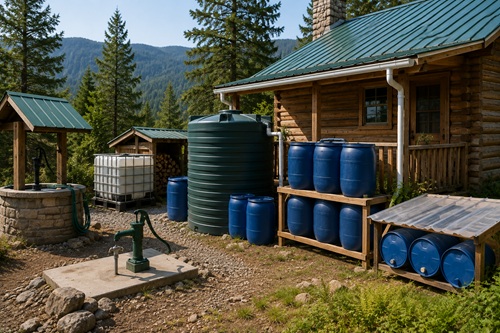
The first objective is ensuring that a dependable water reserve already exists when you arrive. Emergencies rarely provide time to begin filling storage tanks after reaching a retreat. Stored water should therefore be maintained continuously so that every visit begins with an established reserve rather than an empty storage system awaiting replenishment.
Climate plays a major role in storage planning. Cabins located in regions with freezing winters require containers that tolerate expansion as water freezes or storage systems protected from freezing altogether. Underground cisterns, insulated utility rooms, frost-free basements, or partially buried tanks often provide greater protection than exposed outdoor containers. In warmer climates, shielding storage systems from direct sunlight becomes the higher priority to reduce algae growth and container degradation.
Private wells are among the most valuable assets available at many rural retreats, but they should never be viewed as infallible. Most modern wells depend upon electrically powered pumps, meaning water may remain inaccessible during prolonged power outages unless backup systems have been installed. Manual hand pumps, solar-powered pumping systems, generators, battery backups, or gravity-fed storage tanks greatly improve reliability while reducing dependence on the electrical grid.
Rainwater harvesting frequently complements rural preparedness exceptionally well. Cabin roofs often provide excellent collection surfaces capable of filling large storage tanks during seasonal rainfall. Combined with filtration and purification equipment, rainwater collection can substantially reduce dependence on groundwater while providing an additional renewable source of emergency water.
Wildlife protection deserves greater attention at remote locations than in urban settings. Bears, rodents, insects, birds, and other animals may damage exposed storage systems or contaminate poorly sealed containers. Storage tanks should remain securely covered, screened, and inspected regularly for signs of animal activity. Rodent-resistant utility buildings and elevated storage platforms further reduce these risks.
Water stored at bug-out locations should also be protected against long periods without inspection. High-quality food-grade containers, reliable lids, periodic maintenance visits, and written inspection records help ensure that supplies remain dependable between visits. Whenever practical, water systems should be tested during every trip to confirm that pumps, valves, filters, and treatment equipment continue functioning properly.
Preparedness at remote properties benefits greatly from redundancy. Large storage tanks provide strategic reserves, while smaller portable containers support daily activities around the property. Springs, wells, rainwater harvesting systems, nearby streams, and emergency purification equipment all strengthen one another by ensuring that the failure of any single source does not eliminate access to safe drinking water.
Transportation should also be considered. If roads become impassable because of flooding, snow, wildfire, or other disasters, replenishing stored water may become impossible for extended periods. Maintaining larger reserves than would normally be required provides an important safety margin while reducing dependence on outside assistance.
A well-designed water storage system transforms a cabin or bug-out location from a simple shelter into a truly resilient emergency retreat. By combining long-term storage, renewable collection methods, backup pumping capability, and multiple purification options, these locations remain prepared regardless of how long normal infrastructure remains unavailable.
Rural Retreat Water Storage Options
| Water Source | Reliability | Best Role |
|---|---|---|
| Private Well | Excellent | Primary year-round source |
| Rainwater Harvesting | Seasonal | Renewable backup supply |
| Underground Cistern | Excellent | Long-term reserve |
| 55-Gallon Drums | Excellent | Emergency storage |
| Nearby Spring | Good–Excellent | Supplemental source |
| River or Stream | Variable | Emergency collection source |
Common Water Storage Mistakes
Many water storage failures occur long before an emergency begins. In most cases, the problem is not a lack of water but rather poor planning, improper storage methods, neglected maintenance, or unrealistic expectations. Understanding these common mistakes allows preparedness-minded households to avoid preventable problems while building a storage system that remains dependable for years rather than only months.
One of the most common mistakes is storing too little water. Many households purchase a single case of bottled water believing they are prepared, only to discover during an actual emergency that the supply disappears within a day or two. Water is used for much more than drinking alone. Cooking, hygiene, sanitation, medications, pets, and food preparation all require clean water. Planning only for drinking leaves households vulnerable long before the emergency has ended.
Another frequent mistake is storing all emergency water in one location. A single basement room may seem convenient until flooding, structural damage, fire, or contamination affects that entire storage area. Preparedness emphasizes redundancy. Dividing water between several locations throughout the home reduces the likelihood that one event will destroy the entire emergency reserve. Small portable containers stored separately also provide valuable flexibility if evacuation becomes necessary.
Many people also overlook the importance of proper containers. Buckets or bottles that previously held chemicals, cleaning products, fuel, pesticides, or other non-food substances should never be reused for drinking water regardless of how thoroughly they appear to have been cleaned. Chemical residues can remain trapped within plastic surfaces and contaminate stored water months later. Using containers manufactured specifically for potable water eliminates this unnecessary risk.
Poor storage locations create another common problem. Containers placed in direct sunlight, hot garages, sheds, or attics often experience excessive temperature fluctuations that shorten container life and reduce water quality. Likewise, storing water beside gasoline, paint, fertilizers, pesticides, or household chemicals increases the possibility of odor absorption or contamination. Cool, dark, climate-controlled storage areas consistently provide the best long-term protection.
Failing to inspect stored water is another widespread mistake. Many people fill containers, place them on a shelf, and forget about them entirely for years. Small leaks, damaged lids, cracked containers, or environmental changes may go unnoticed until the water is finally needed. Routine inspections require very little time yet dramatically improve long-term reliability by identifying problems before they become emergencies.
Another mistake involves neglecting supporting equipment. Water storage alone is only one part of a complete preparedness system. Filters, replacement cartridges, pumps, siphons, transfer hoses, treatment chemicals, measuring equipment, and repair supplies should all be inspected alongside stored water. An emergency reserve becomes far less useful if the equipment required to access or purify it has deteriorated or disappeared.
Many preparedness beginners also fail to consider transportation. Large storage drums provide outstanding capacity but become virtually immovable once filled. If every gallon of emergency water is stored inside containers weighing hundreds of pounds, moving water throughout the home or loading supplies during an evacuation becomes extremely difficult. Combining large stationary reserves with smaller portable containers provides much greater flexibility during changing circumstances.
Some households rely entirely on stored water while ignoring methods for replenishment. Even substantial reserves eventually become depleted during prolonged emergencies. Long-term preparedness combines stored water with filtration systems, rainwater harvesting, nearby natural water sources, and purification equipment to ensure supplies can continue growing rather than steadily declining.
Perhaps the greatest mistake of all is assuming that preparedness is complete once water has been stored. Successful preparedness is an ongoing process involving regular inspections, periodic maintenance, equipment testing, household planning, and practical experience. Families who actively maintain their systems enjoy far greater confidence than those who simply place containers on shelves and hope they remain usable indefinitely.
Avoiding these common mistakes requires no expensive equipment or advanced technical knowledge. It requires consistency, attention to detail, and the willingness to review preparedness plans periodically. Small improvements made today often prevent major problems during tomorrow’s emergency.
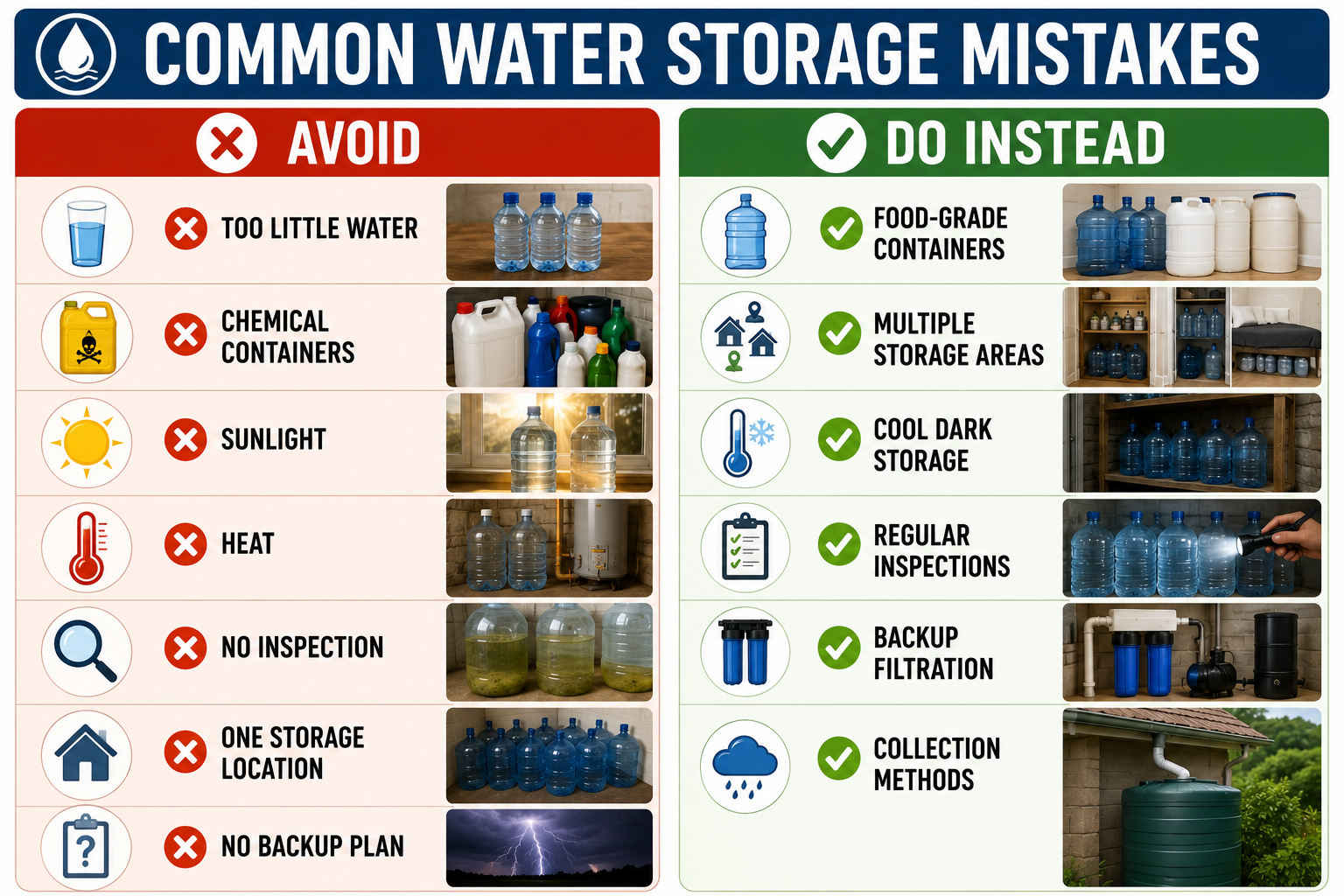
Common Water Storage Mistakes
| Mistake | Potential Consequence | Better Practice |
|---|---|---|
| Storing too little water | Supplies exhausted quickly | Plan for total household needs |
| Using non-food containers | Chemical contamination | Use food-grade containers only |
| Storing near chemicals | Odors or contamination | Separate storage areas |
| Direct sunlight exposure | Algae growth and container damage | Store in dark locations |
| No inspections | Undetected leaks or deterioration | Inspect regularly |
| One storage location | Single-point failure | Distribute storage |
| Ignoring equipment | Unable to access stored water | Inspect complete system |
| No replenishment plan | Water eventually exhausted | Combine storage with collection methods |
| Never practicing | Unfamiliar equipment | Test systems regularly |
Building a Household Long-Term Water Storage Plan
Long-term preparedness becomes significantly more effective when it is guided by a written plan rather than relying on memory alone. A household water storage plan organizes every aspect of emergency water preparedness into a single reference that every family member can understand and follow. Instead of making decisions during a stressful emergency, the important work has already been completed while conditions remain calm.
Begin by calculating your household’s realistic water requirements. Consider every individual living in the home along with pets, livestock, frequent visitors, and anyone who may seek temporary shelter during an emergency. Account for drinking, cooking, sanitation, hygiene, medical needs, and seasonal changes that may increase consumption. These estimates become the foundation upon which every storage decision is based.
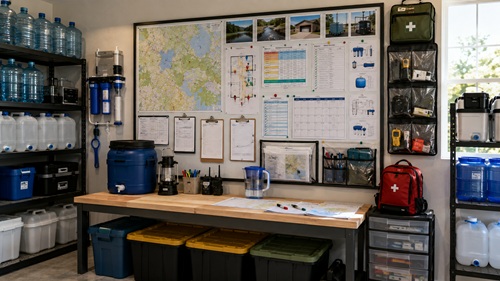
Next, document every water storage location within the home. Record container sizes, storage capacities, fill dates, inspection schedules, and the intended purpose of each reserve. Some containers may be dedicated to daily rotation, while others remain untouched except during major emergencies. Knowing exactly where water is stored prevents confusion when quick access becomes necessary.
The plan should also identify every potential source of replacement water available after stored reserves begin to decline. Include municipal water, private wells, rainwater harvesting systems, nearby rivers, lakes, streams, springs, and any hidden household water sources such as water heaters. For each source, record the treatment methods required before the water becomes safe for drinking.
Assign responsibilities to family members whenever appropriate. Everyone should understand where emergency water is stored, how to inspect containers, operate pumps, use filtration equipment, disinfect water, and access written treatment instructions. Emergencies frequently require different people to perform unfamiliar tasks. Shared knowledge greatly improves household resilience.
Inspection schedules should become part of the written plan. Rather than relying on memory, establish regular dates for checking containers, rotating supplies, testing pumps, replacing filters, and reviewing emergency procedures. Many households combine these inspections with seasonal time changes or other recurring annual events to create consistent maintenance routines.
Backup plans should also be documented. What happens if the primary storage area floods? What if the private well loses power? What if the nearest stream becomes contaminated? Thinking through these possibilities before an emergency allows secondary options to be developed while conditions remain favorable. Redundancy is one of the strongest principles in preparedness.
Keep printed copies of the household water plan in several locations. Electronic files provide convenience but may become inaccessible during extended power outages or equipment failures. Waterproof printed copies stored alongside emergency supplies ensure that critical information remains available regardless of the circumstances.
Preparedness plans should evolve over time. Family size changes, new equipment is purchased, additional storage systems are installed, and local conditions may change. Reviewing the household water plan annually keeps it current while providing opportunities to improve areas that experience has shown to be less effective.
A written household water storage plan transforms emergency preparedness from a collection of equipment into an organized system. It provides structure, reduces uncertainty, improves coordination, and ensures that every member of the household understands how safe drinking water will remain available throughout both short-term disruptions and prolonged emergencies.
Household Water Storage Plan
| Planning Element | Information to Record |
|---|---|
| Household Water Needs | Daily and long-term requirements |
| Storage Locations | Every container and capacity |
| Inspection Schedule | Monthly and annual maintenance |
| Rotation Schedule | Fill and replacement dates |
| Treatment Supplies | Bleach, filters, UV, boiling equipment |
| Replacement Sources | Wells, rainwater, rivers, lakes, springs |
| Family Responsibilities | Assigned preparedness tasks |
| Emergency Contacts | Utility company and local emergency services |
| Backup Plans | Alternative storage and collection methods |
Preparedness Action Plan
Preparedness is most effective when knowledge is translated into action. Long-term water storage should not remain an unfinished project or a future goal. Every improvement made today increases your household’s ability to remain healthy, independent, and resilient during emergencies. Whether you are beginning with a few gallons of bottled water or expanding an existing storage system, consistent progress over time provides far greater value than attempting to complete everything at once.
Begin by evaluating your current water reserve. Determine exactly how much drinking water is already available, where it is stored, and how long it would realistically support every member of your household. Include pets, livestock, cooking, hygiene, sanitation, and medical needs in your calculations. This assessment establishes a realistic starting point while identifying the largest gaps in your preparedness plan.
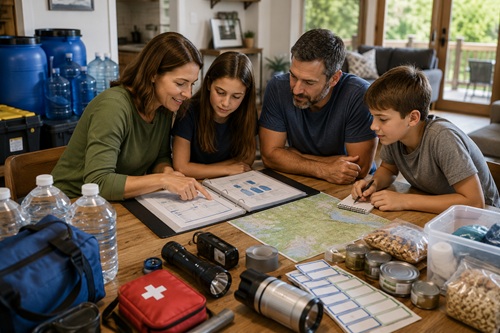
Next, establish a practical storage goal based on your family’s circumstances. Many households begin by building a three-day emergency reserve before expanding to two weeks, one month, or even several months of stored water. Breaking larger preparedness goals into smaller milestones makes progress easier to achieve while allowing your storage system to grow steadily over time.
Inspect every existing storage container. Replace damaged containers, tighten loose lids, update labels, and verify that all stored water remains protected from sunlight, excessive heat, freezing temperatures, and nearby chemicals. If any container shows signs of deterioration or contamination, clean or replace it before refilling with treated water.
Evaluate your storage locations. Ensure containers remain accessible during emergencies while distributing supplies throughout the home to reduce single points of failure. Consider whether your current storage system would remain usable if one room became flooded, damaged by fire, or otherwise inaccessible.
Review your water treatment capabilities. Verify that you have functioning filtration equipment, backup purification methods, and sufficient treatment supplies to replenish your stored reserves if the emergency extends beyond your initial storage capacity. Replace expired disinfectants, inspect filters, and ensure every family member understands how each treatment method operates.
Develop a written household water storage plan if one does not already exist. Record storage locations, inspection schedules, treatment procedures, replacement water sources, equipment inventories, and family responsibilities. Keep printed copies alongside emergency supplies so critical information remains available even if electricity or internet access is unavailable.
Finally, practice your plan. Retrieve water from storage, operate pumps, assemble filtration equipment, sanitize containers, and refill supplies exactly as you would during an actual emergency. Practical experience reveals small problems that written plans often overlook while building confidence throughout the household.
Preparedness is not measured by the number of gallons stored but by your ability to consistently provide safe drinking water regardless of changing circumstances. Every container filled, every inspection completed, and every skill practiced strengthens your household’s resilience while reducing uncertainty during future emergencies.
Household Preparedness Checklist
☐ Calculate total household water requirements.
☐ Build at least a three-day emergency reserve.
☐ Expand storage toward long-term preparedness goals.
☐ Use only food-grade storage containers.
☐ Sanitize containers before filling.
☐ Label every container with fill and inspection dates.
☐ Store water in cool, dark, protected locations.
☐ Maintain multiple container sizes.
☐ Inspect containers regularly.
☐ Rotate water as needed.
☐ Maintain backup filtration equipment.
☐ Store emergency disinfection supplies.
☐ Identify alternative water sources.
☐ Practice your household water plan.
☐ Review your preparedness plan annually.
Skills Learned
After completing this lesson, you should now possess a comprehensive understanding of how to safely store water for long-term emergency use while maintaining its quality, safety, and reliability. More importantly, you should understand that successful water preparedness extends far beyond simply filling containers. Effective long-term storage requires thoughtful planning, appropriate equipment, routine maintenance, and multiple layers of redundancy that work together to provide dependable access to safe drinking water.
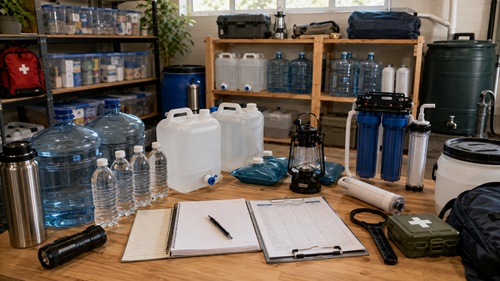
You should now be able to calculate realistic household water requirements based on family size, climate, pets, sanitation needs, and expected emergency duration. Rather than relying solely on minimum recommendations, you understand how to develop storage goals that reflect your household’s unique circumstances while providing additional safety margins for prolonged emergencies.
You should now understand the advantages and limitations of different water storage containers, including commercially bottled water, food-grade jugs, stackable containers, large drums, storage tanks, and underground cisterns. You should also recognize why only food-grade containers should be used for drinking water and why previously used chemical containers should never become part of a preparedness system.
You should now know how to properly clean, sanitize, fill, label, inspect, and maintain reusable water storage containers. These practices reduce contamination, preserve water quality, and significantly increase the reliability of long-term emergency reserves.
You should also understand how environmental conditions influence stored water. Temperature, sunlight, freezing conditions, chemical exposure, flooding, structural support, and accessibility all affect long-term storage success. Selecting appropriate storage locations helps preserve both the containers and the water they protect.
You should now recognize the importance of water rotation and inspection as ongoing preparedness activities rather than one-time tasks. Regular inspections identify problems early while maintaining confidence that stored water remains available whenever it is needed.
You should understand how rainwater harvesting, wells, natural water sources, filtration equipment, purification methods, and renewable collection systems complement long-term storage. Together, these resources create a layered preparedness strategy capable of supporting households through extended disruptions.
Finally, you should appreciate that long-term water storage is not simply about accumulating gallons of water. It is about creating a complete water management system that allows your household to remain healthy, self-sufficient, and adaptable regardless of how long normal infrastructure remains unavailable.
Final Thoughts
Long-term water storage is one of the most practical investments any household can make. While many emergencies differ dramatically in their causes and consequences, nearly all of them share one common requirement: people continue needing safe water every single day. Whether responding to a brief utility outage or a prolonged regional disaster, access to dependable drinking water provides stability when many other systems have become uncertain.
Preparedness should never be viewed as an attempt to predict every possible disaster. Instead, it is the process of reducing uncertainty by developing practical capabilities before they become necessary. A thoughtfully designed water storage system allows families to focus on solving new challenges rather than immediately searching for one of life’s most essential resources.
Successful preparedness also recognizes that no single solution is perfect. Commercially bottled water, reusable containers, large storage tanks, rainwater harvesting systems, private wells, filtration equipment, and purification methods each contribute different strengths. When combined into a layered system, they provide resilience far beyond what any individual component could achieve alone.
Perhaps most importantly, long-term water storage encourages self-reliance without isolation. Households capable of meeting their own basic water needs place less strain on emergency responders and community resources during disasters. This additional resilience allows families to remain safe while also becoming better positioned to assist neighbors and loved ones when circumstances permit.
Preparedness is built through consistent effort rather than dramatic purchases. Every properly filled container, every scheduled inspection, every practiced skill, and every improvement to your water storage system strengthens your household’s ability to respond confidently during future emergencies. Safe water remains one of the foundations of survival, and investing in its long-term storage is an investment in your family’s security, independence, and peace of mind.
Appendix A – Long-Term Water Storage Comparison Guide
| Storage Method | Typical Capacity | Expected Storage Life* | Portability | Initial Cost | Best For | Advantages | Limitations |
|---|---|---|---|---|---|---|---|
| Commercial Bottled Water | 500 mL–1 Gal | Long-term (manufacturer guidance) | Excellent | Low | Beginners | Ready to use, portable | More plastic waste |
| Food-Grade Water Jugs | 5–7 Gal | Long-term with rotation | Good | Low | Home storage | Easy to carry | Limited capacity |
| Water Bricks | 3.5 Gal Each | Long-term with rotation | Excellent | Medium | Apartments | Stackable, modular | Higher cost per gallon |
| 55-Gallon Water Drum | 55 Gal | Long-term | Poor | Medium | Home reserve | Large capacity | Difficult to move |
| IBC Tote | 275–330 Gal | Long-term | Limited | Medium | Rural properties | Excellent value | Requires space |
| Poly Storage Tank | 100–5,000+ Gal | Long-term | None | High | Homesteads | Massive capacity | Permanent installation |
| Underground Cistern | 500–20,000+ Gal | Long-term | None | High | Off-grid homes | Protected from weather | Expensive installation |
| Stainless Steel Containers | Various | Long-term | Excellent | High | Portable storage | Durable | Higher cost |
| Rain Barrels | 40–80 Gal | Seasonal | Limited | Low | Rainwater harvesting | Renewable supply | Requires treatment |
| Water Heater (Emergency Source) | 30–80 Gal | Emergency only | Fixed | Existing | Hidden reserve | Already installed | Not primary storage |
*Storage life depends on water quality, container condition, storage environment, and inspection schedule.
Appendix B – Long-Term Water Storage Decision Tree
                    START
                      │
                      ▼
       Do you already have stored water?
               ┌──────────────┐
          YES  │              │  NO
               ▼              ▼
     Inspect containers     Begin storage plan
               │              │
               ▼              ▼
      Are containers food-grade?
          ┌──────────────┐
     YES  │              │  NO
          ▼              ▼
 Continue inspection   Replace containers
          │
          ▼
 Is water source municipal?
      ┌──────────────┐
 YES  │              │ NO
      ▼              ▼
 Store directly   Treat before storage
      │              │
      └──────┬───────┘
             ▼
   Label all containers
             │
             ▼
 Store in cool, dark location
             │
             ▼
 Schedule inspections
             │
             ▼
 Add backup purification methods
             │
             ▼
 Build additional storage capacity
             │
             ▼
             END
Appendix C – Household Long-Term Water Storage Checklist
Print this checklist and review it at least twice each year.
Planning
☐ Household water needs calculated
☐ Emergency storage goal established
☐ Alternative water sources identified
☐ Written household water plan completed
Containers
☐ Food-grade containers only
☐ Containers inspected for damage
☐ Lids and seals inspected
☐ Containers sanitized before filling
☐ Waterproof labels applied
Water Storage
☐ Municipal water stored
☐ Backup treated water stored
☐ Large reserve established
☐ Portable containers available
☐ Vehicle emergency water stored
☐ Bug-out supplies include water
Treatment Equipment
☐ Water filter
☐ Backup filter
☐ Spare filter cartridges
☐ Unscented household bleach
☐ Calcium hypochlorite (optional)
☐ Chlorine dioxide tablets
☐ UV purifier
☐ Boiling equipment
Storage Location
☐ Cool location
☐ Protected from sunlight
☐ Away from chemicals
☐ Protected from freezing
☐ Containers elevated above flood level
☐ Easy to access
Maintenance
☐ Inspection schedule established
☐ Rotation schedule established
☐ Equipment tested
☐ Labels updated
☐ Maintenance log completed
Rainwater Collection
☐ Gutters cleaned
☐ First-flush diverter installed
☐ Storage tank inspected
☐ Overflow checked
☐ Collection screen cleaned
Emergency Readiness
☐ Family knows storage locations
☐ Family knows purification procedures
☐ Family practiced emergency water plan
☐ Backup collection methods available
☐ Emergency supplies organized
Final Readiness Check
☐ I have sufficient emergency water for my household.
☐ My water is stored in safe containers.
☐ My containers are inspected regularly.
☐ I have multiple methods of obtaining water.
☐ I can safely purify additional water.
☐ My family knows our emergency water plan.
☐ My equipment has been tested.
☐ I am confident my household can maintain safe drinking water during a prolonged emergency.
© Prepping Communities. This content is for informational purposes only and not professional advice. Use at your own risk.
Terms | Privacy | Guidelines