
Introduction
Water is one of the most important resources required for survival, yet it is often one of the first necessities disrupted during an emergency. Severe storms, earthquakes, wildfires, floods, extended power outages, infrastructure failures, and other disasters can interrupt municipal water systems with little warning. Wells may lose power, pipelines can rupture, treatment facilities may become damaged, and public officials may issue boil-water advisories that remain in effect for days or even weeks. Even if water continues flowing from the tap, there is no guarantee that it remains safe to drink.
Because of this, preparedness is about far more than storing bottled water or filling a few containers before a storm arrives. Every stored supply has limits. Families may consume more water than expected during hot weather, while an emergency may last much longer than initially anticipated. For long-term resilience, every preparedness plan should include the knowledge and skills needed to locate additional water once stored reserves begin to run low.
Fortunately, water exists in far more places than many people realize. Rivers, streams, lakes, ponds, springs, rainwater, snow, and groundwater all represent potential natural sources. At the same time, homes and businesses often contain significant quantities of overlooked water stored inside water heaters, plumbing systems, toilet tanks, swimming pools, rain barrels, and other locations that many people never consider until an emergency forces them to look more carefully. Understanding where these sources exist before they are needed allows you to make better decisions under pressure.
Finding water, however, is only part of the challenge. The safest source is not always the closest, and the largest source is not always the cleanest. Water that appears crystal clear may still contain harmful bacteria, viruses, parasites, or chemical contaminants that cannot be seen with the naked eye. Learning how to evaluate potential water sources before collecting them is every bit as important as learning how to purify them afterward. Good source selection reduces treatment time, extends the life of filtration equipment, conserves purification supplies, and significantly improves the overall safety of the water you produce.
Another important consideration is sustainability. A small spring that provides a few gallons each day may easily support one individual but prove inadequate for an entire family. Likewise, a large lake may appear to offer an unlimited supply, yet seasonal algae blooms or nearby agricultural runoff could require much more extensive treatment than a smaller but cleaner stream located nearby. Preparedness is about evaluating every available option rather than depending upon a single source that may change as conditions evolve.
The most resilient preparedness plans always include multiple water sources. If one becomes contaminated, inaccessible, or depleted, another source remains available. This layered approach reduces dependence on any single location while increasing your ability to adapt to changing conditions throughout an emergency.
This lesson explains how to identify the most common emergency water sources, evaluate their advantages and disadvantages, recognize contamination hazards, and select the best available source based on the circumstances you face. By understanding where water can be found before an emergency occurs, you greatly improve your ability to remain healthy, self-sufficient, and prepared when normal infrastructure is no longer available.
Why Finding Emergency Water Sources Matters
Many preparedness plans begin with storing water, and that is exactly where they should begin. Every household should maintain an emergency water reserve capable of supporting the family during the first several days of an emergency. Stored water provides immediate security while allowing time to evaluate the situation, organize supplies, and avoid unnecessary travel during the most chaotic period following a disaster.
However, preparedness does not end when your storage containers are full. Every emergency water supply is finite. Whether you store twenty gallons or two hundred gallons, there will always be a point where those reserves begin to decline. Longer emergencies, unexpected guests, damaged containers, higher temperatures, increased physical activity, or additional sanitation needs can all accelerate water consumption far beyond what was originally planned. When that happens, the ability to locate additional water becomes one of the most valuable survival skills you possess.
Water supports nearly every aspect of daily life. Beyond drinking, it is required for preparing food, taking medications, maintaining hygiene, washing wounds, caring for children, supporting elderly family members, cleaning cooking utensils, watering livestock, and performing countless other tasks that continue regardless of whether municipal infrastructure is functioning. As dehydration begins to develop, physical strength, endurance, concentration, and decision-making all decline. A person who is dehydrated is far more likely to make poor decisions, overlook hazards, or suffer preventable injuries while attempting to solve other problems created by the emergency.
Knowing where additional water can be found changes the way you approach preparedness. Instead of viewing your stored supply as a countdown to failure, you begin viewing it as a buffer that gives you time to establish new collection routines before supplies become critical. This shift in mindset reduces stress while encouraging long-term planning rather than short-term survival.
Understanding local water sources also allows you to prioritize your efforts. During an emergency, energy becomes a valuable resource. Walking several miles to collect poor-quality water that requires extensive treatment may consume far more time and effort than collecting cleaner rainwater from your own property or drawing water from a nearby spring. Careful planning before an emergency helps eliminate unnecessary work when conditions become difficult.
Finding emergency water is therefore not simply about locating the nearest river or filling containers from the first available source. It is about understanding the strengths, limitations, and long-term reliability of every potential water source available to you. The more options you identify before an emergency occurs, the greater your ability to adapt when circumstances change.
Understanding Daily Water Requirements
One of the biggest mistakes people make when preparing for emergencies is underestimating how much water their household actually requires. Many preparedness recommendations suggest storing a minimum of one gallon of water per person per day. While this provides a useful starting point, it represents only the minimum amount generally needed for drinking and limited food preparation under moderate conditions. Real-world emergencies often require considerably more.
Water is used continuously throughout the day in ways that are easy to overlook. Meals require water for cooking, dehydrated foods must be reconstituted, medications often need clean drinking water, and even basic hygiene consumes more water than most people realize. Washing hands before preparing food, cleaning minor wounds, brushing teeth, and maintaining sanitary conditions all become increasingly important during emergencies when medical care may be limited.
Environmental conditions also have a significant impact on consumption. High temperatures, low humidity, strenuous physical activity, and prolonged exposure to sunlight all increase water requirements. Individuals clearing fallen trees after a storm, repairing damaged property, or carrying emergency supplies may require substantially more drinking water than someone remaining indoors under normal conditions. Likewise, infants, elderly family members, pregnant women, nursing mothers, and individuals with certain medical conditions often require special consideration when calculating household water needs.
Pets and livestock should never be overlooked. Dogs, cats, poultry, goats, horses, and other animals depend upon clean water just as much as people do. Families that prepare only for their own needs may quickly discover that caring for animals dramatically increases daily water consumption during an extended emergency.
Understanding these requirements changes how you evaluate emergency water sources. A small spring producing only a few gallons each day may easily sustain one or two people but prove insufficient for a larger household. Conversely, a large river may provide virtually unlimited water but require considerably more treatment before it becomes safe to drink. Matching household demand with available water sources allows you to develop realistic collection plans that remain practical throughout both short-term and long-term emergencies.
Successful preparedness begins with understanding not only where water can be found, but also how much water your household will actually need when normal infrastructure is no longer available.
Natural Water Sources
The natural world provides an abundance of freshwater, but not every source offers the same level of safety, reliability, or ease of collection. A successful preparedness plan is built upon understanding the advantages and limitations of each source before an emergency occurs. Waiting until clean water is urgently needed often forces people to make decisions under pressure, increasing the likelihood of collecting poor-quality water or overlooking a better alternative nearby.
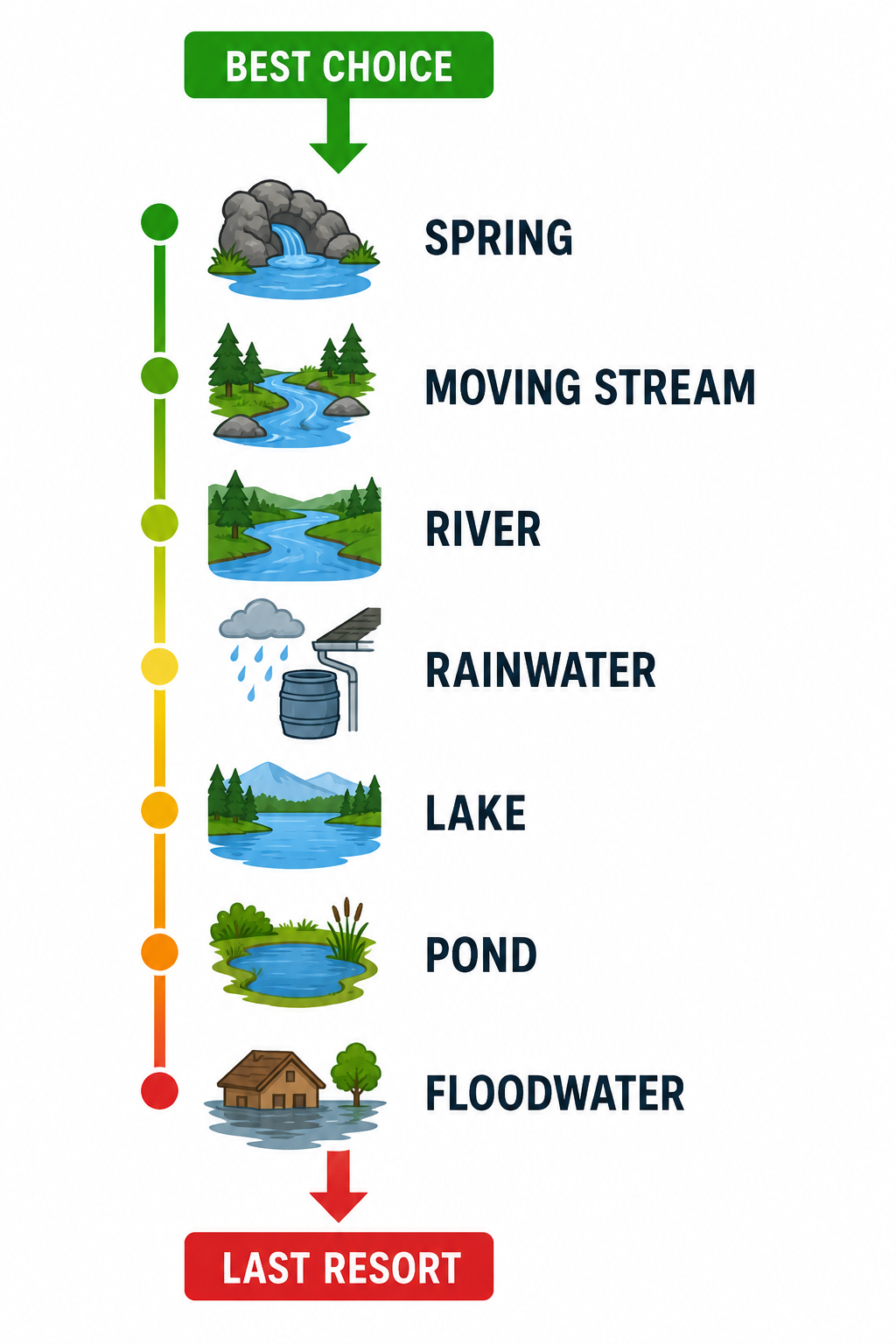
One of the first principles of emergency water collection is to seek the cleanest available source rather than the closest one. Water that begins cleaner generally requires less treatment, places less strain on filtration equipment, and reduces the amount of fuel, chemicals, or time needed to produce safe drinking water. Every purification method performs better when it starts with higher-quality water. Selecting a cleaner source may only require walking a few hundred additional yards, yet it can dramatically improve both safety and efficiency.
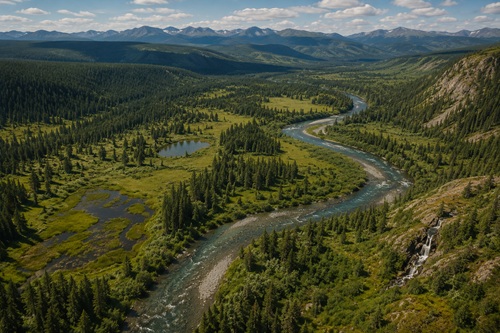
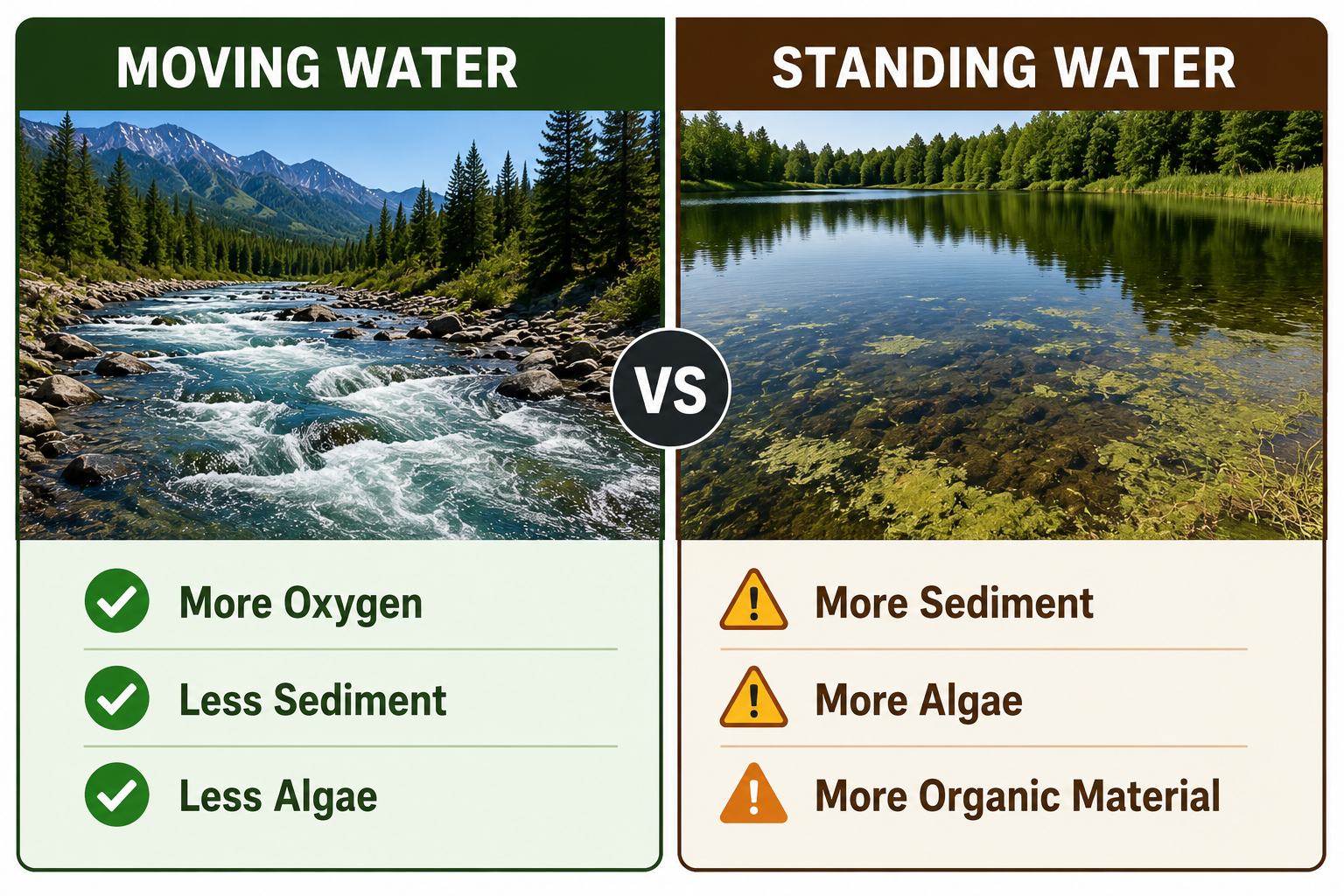
Natural water sources can generally be divided into two broad categories: moving water and standing water. Moving water, such as rivers, streams, and flowing springs, tends to remain better oxygenated and is less likely to accumulate algae or decaying organic material than stagnant water. Standing water, including ponds, marshes, and many lakes, allows sediment, bacteria, algae, and other contaminants to settle and concentrate over time. While both categories can provide usable water, they often require different collection strategies and different levels of treatment.
Environmental conditions also influence water quality. A clear mountain stream flowing through an undeveloped forest generally presents different challenges than a river passing through agricultural land or an urban area. Likewise, a pond surrounded by livestock pasture carries different risks than a spring emerging from a protected hillside. The surrounding environment frequently tells you as much about the potential quality of the water as the water itself.
Seasonal changes should also be considered when evaluating natural sources. Heavy spring runoff may increase sediment levels, while summer drought can reduce rivers to isolated pools where contaminants become concentrated. Autumn leaves introduce additional organic material into standing water, and winter ice may limit access while creating entirely different collection opportunities. A source that performs exceptionally well during one season may become far less dependable during another.
Another important consideration is accessibility. During an emergency, reaching a water source may become more difficult because of damaged roads, fallen trees, flooding, wildfires, or severe weather. Water that is easily accessible under normal conditions may require a completely different route during a disaster. Whenever possible, identify multiple routes to your preferred collection locations and consider how changing conditions could affect your ability to reach them safely.
It is also wise to think beyond a single water source. Experienced preparedness-minded individuals rarely depend upon one river, one spring, or one rain barrel. Instead, they develop several independent options that can support one another if conditions change. A nearby creek may serve as the primary source during summer, while rainwater collection supplements household reserves during storm seasons. Snow and ice may become valuable winter resources, and a properly maintained well may provide dependable water whenever electrical power remains available or alternative pumping methods have been prepared.
The goal is not simply to memorize a list of possible water sources. The goal is to understand which sources are most likely to remain dependable, which require the least treatment, and which should be avoided entirely under certain conditions. This knowledge allows you to make informed decisions instead of reacting out of desperation when your stored water begins to run low.
The following sections examine the most common emergency water sources individually, explaining where they are typically found, how they should be evaluated, and the advantages and limitations that every preparedness-minded household should understand before relying upon them.
Natural Water Sources
|
Source |
Reliability | Quality |
Treatment Needed |
| Spring | Excellent | Excellent | Yes |
| Stream | Excellent | Very Good | Yes |
| River | Excellent | Good | Yes |
| Lake | Good | Good | Yes |
| Pond | Fair | Fair | Yes |
| Rainwater | Seasonal | Excellent | Usually |
| Snow | Seasonal | Good | Yes |
Springs
Natural springs have long been considered one of the most desirable emergency water sources because they originate from groundwater that has traveled through layers of soil, sand, gravel, and rock before reaching the surface. This natural movement often removes a significant amount of suspended sediment and organic material, producing water that is noticeably clearer than many surface water sources. For centuries, communities were built around dependable springs because they provided a relatively constant supply of fresh water throughout the year.
Not every spring, however, offers the same level of quality. A true spring is characterized by water flowing naturally from the ground rather than simply collecting in a depression. Flowing spring water is generally preferable because it remains continuously refreshed. Water that pools after emerging from the ground can accumulate leaves, insects, animal waste, algae, and other contaminants before it is collected.
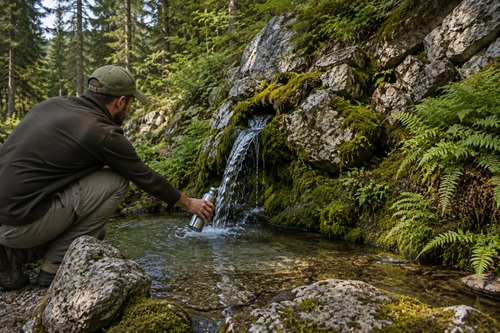
When approaching a spring, begin by evaluating the surrounding landscape rather than the water itself. A spring located deep within an undeveloped forest may present relatively few contamination concerns, while one located below agricultural fields, livestock grazing areas, roads, septic systems, or industrial facilities may carry additional risks. Groundwater can travel considerable distances beneath the surface, meaning contamination introduced far away may eventually reach the spring.
The condition of the spring opening also provides valuable clues. Water emerging directly from rock or gravel often remains cleaner than water flowing through muddy depressions where surface runoff easily enters the system. Heavy animal traffic surrounding the spring, visible algae growth, unusual odors, or excessive sediment should all encourage closer evaluation before collection.
Although springs are frequently regarded as some of the highest-quality natural water sources available, they should never be assumed to be completely safe for drinking without treatment. Wildlife can introduce bacteria and parasites into groundwater, heavy rainfall may temporarily carry surface contaminants into the spring, and microorganisms remain invisible regardless of how clear the water appears. Modern preparedness emphasizes treating every natural water source before consumption rather than relying solely on appearance or reputation.
One of the greatest advantages of springs is reliability. Many continue flowing during dry periods when nearby streams become seasonal or disappear entirely. This consistency makes springs particularly valuable for long-term preparedness planning. Once dependable springs have been identified near your home, cabin, bug-out location, or retreat, they should become part of your regular preparedness planning rather than remaining an unknown resource discovered only during an emergency.
Whenever practical, collect water as close as possible to the point where it emerges from the ground. This reduces the opportunity for contamination after the water reaches the surface. Use clean collection containers, avoid stirring sediment unnecessarily, and transport the water carefully to prevent introducing additional contaminants before purification begins.
While springs often represent one of the best natural water sources available, they should still be viewed as one layer within a complete preparedness strategy. Combining careful source selection with proper purification and safe storage provides a far greater margin of safety than depending upon any single factor alone.
Rivers and Streams
Rivers and streams are among the most dependable emergency water sources because they are continually replenished by rainfall, groundwater, snowmelt, and natural springs. Unlike standing water, flowing water is constantly moving, helping to reduce stagnation and limiting the buildup of algae and decaying organic matter. For this reason, many preparedness-minded individuals naturally seek moving water first when searching for a long-term supply during an emergency. However, flowing water should never be confused with safe drinking water. Every river reflects everything that has entered it upstream, sometimes for dozens or even hundreds of miles before it reaches your location.
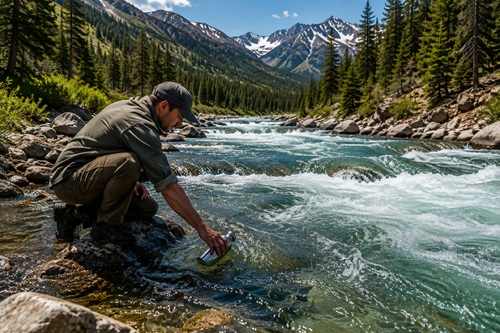
Evaluating a river begins long before collecting any water. Spend a few minutes observing the surrounding landscape and considering what may exist upstream. Farms, ranches, roads, campgrounds, industrial facilities, mines, sewage treatment plants, and residential neighborhoods all have the potential to introduce contaminants into the water. Agricultural runoff may carry fertilizers, pesticides, or animal waste, while urban areas can contribute fuel, oils, heavy metals, and other pollutants. Even remote wilderness streams are not immune to contamination, as wildlife frequently introduce bacteria and parasites into otherwise pristine-looking water.
The speed of the current provides another useful indicator when selecting a collection point. Fast-moving water flowing over rocks and gravel is generally preferable to slow-moving water trapped in quiet pools or backwaters. Continuous movement increases oxygen levels while reducing the opportunity for algae growth and sediment accumulation. Rapids and shallow riffles often provide cleaner collection locations than calm pools where organic matter naturally settles over time.
Choosing the correct location within the river is equally important. Collecting water directly from the shoreline often introduces unnecessary sediment because leaves, mud, insects, and decaying vegetation naturally accumulate along the banks. Instead, collect water from the main current whenever it can be done safely. A clean container attached to a rope or extended with a pole often allows water to be gathered from deeper, faster-moving sections without disturbing the riverbed.
Weather conditions can dramatically affect river quality. Heavy rainfall frequently washes soil, debris, fertilizers, oils, and other contaminants into waterways while increasing sediment levels. Water that was exceptionally clear the previous day may become heavily clouded after a storm. Floodwaters deserve even greater caution because they often contain sewage, chemicals, fuel, dead animals, and countless contaminants collected as water moves across developed areas. During flooding, finding an alternative source is often preferable to attempting to purify heavily contaminated floodwater.
Seasonal changes also influence rivers and streams. Spring snowmelt may produce abundant water while carrying increased sediment. During prolonged summer droughts, smaller creeks may shrink dramatically or disappear entirely, leaving isolated pools where contaminants become concentrated. Winter may reduce access because of ice, while autumn introduces additional leaves and organic debris into the water. Becoming familiar with nearby waterways throughout the year helps you understand which sources remain dependable regardless of the season.
Although rivers and streams often provide some of the best natural emergency water sources available, purification remains essential. Flowing water may appear exceptionally clean while still containing bacteria, viruses, protozoa, and other microscopic hazards that cannot be detected by sight, smell, or taste. Successful preparedness combines careful source selection with proper treatment rather than relying on appearance alone.
| River Evaluation Factor | Preferred Conditions | Use Extra Caution |
|---|---|---|
| Water Movement | Fast current | Slow or stagnant water |
| Collection Location | Main flow | Shoreline or muddy banks |
| Upstream Environment | Forest or wilderness | Farms, towns, industry |
| Water Appearance | Clearer water | Heavy sediment or unusual color |
| Recent Weather | Stable conditions | Heavy rain or flooding |
Lakes and Ponds
Lakes and ponds provide abundant freshwater in many regions and often remain available when smaller streams have dried up. Their large storage capacity makes them valuable long-term resources, particularly during prolonged emergencies when dependable water becomes increasingly important. Unlike rivers, however, lakes and ponds contain standing water. This allows sediment, organic material, algae, and microorganisms to accumulate over time, creating different challenges that must be considered before collection.
Large lakes generally provide better opportunities than small ponds because their greater volume naturally dilutes many contaminants. Wind and wave action also help circulate water, reducing stagnation in open areas away from shore. Smaller ponds, especially those surrounded by livestock, agriculture, or residential development, often contain higher concentrations of bacteria, algae, decaying vegetation, and suspended organic matter. The smaller the body of water, the more quickly contamination can affect its overall quality.
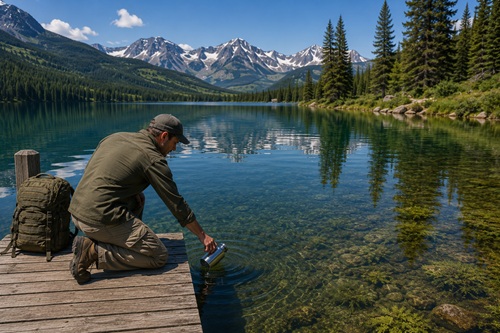
The shoreline is rarely the best place to collect water. Leaves, insects, mud, animal waste, and decaying vegetation naturally accumulate around the edges, creating ideal conditions for bacterial growth. Whenever practical, collect water a short distance from shore where it is generally clearer and contains fewer suspended contaminants. Even moving only a few metres away from the bank can noticeably improve water quality before purification begins.
Algae deserve special attention when evaluating lakes and ponds. Green surface scum, thick floating mats, unusual colors, or strong earthy odors may indicate significant algae growth. Some blue-green algae, more accurately known as cyanobacteria, are capable of producing toxins that are not reliably removed through ordinary boiling or standard filtration methods. Whenever these conditions are observed, another water source should be selected if possible.
Wildlife activity also influences water quality. Ducks, geese, beavers, livestock, and other animals frequently gather around ponds and shallow lake edges, increasing the amount of biological contamination entering the water. Selecting collection points away from areas of heavy animal activity helps reduce these risks before purification even begins.
Seasonal changes significantly affect standing water. During warm summer months, algae populations often increase while evaporation concentrates dissolved minerals and contaminants. Autumn introduces large amounts of decaying leaves that increase organic material within the water. Winter conditions may improve water clarity beneath the ice but create new challenges for safe access and collection.
Standing water should always be treated as requiring complete purification before drinking. Allowing sediment to settle, removing visible debris through pre-filtration, and then applying an appropriate purification method greatly improves safety. Although lakes and ponds require more careful evaluation than many moving water sources, they remain valuable components of a diversified emergency water plan because of the large quantities of water they can provide throughout the year.
| Standing Water Source | Typical Advantages | Common Concerns |
|---|---|---|
| Large Lake | Reliable supply, high volume | Algae, shoreline contamination |
| Small Lake | Easy access | Organic material, wildlife |
| Pond | Widely available | Stagnation, algae, parasites |
| Reservoir | Large storage capacity | Possible chemical contamination |
Rainwater Collection
Rainwater is one of the most overlooked emergency water sources despite being one of the easiest to collect. Every rainfall delivers fresh water directly to your property without requiring pumps, electricity, or transportation. For households that prepare in advance, a properly designed rainwater collection system can supplement stored reserves and reduce dependence on natural water sources that may require lengthy travel or extensive purification. During prolonged emergencies, every gallon collected from the sky is one less gallon that must be carried home from a river or lake.
Many people assume that rainwater is completely pure because it falls from the sky. While rain itself is generally very clean, it begins collecting contaminants the moment it comes into contact with roofs, gutters, trees, or storage containers. Dust, pollen, bird droppings, leaves, insects, and airborne pollutants can all become part of the collected water. This does not make rainwater unusable, but it does mean that proper collection and treatment remain important before the water is consumed.
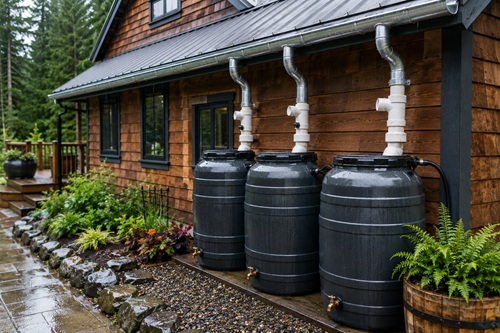
The roof itself plays a significant role in determining water quality. Metal roofing generally provides one of the best collection surfaces because it sheds water quickly and contributes relatively few contaminants. Asphalt shingles, treated wood shakes, and older roofing materials may introduce additional particles or chemicals into the runoff. Regardless of the roofing material, keeping gutters clean and removing accumulated debris before rainy seasons greatly improves the quality of the collected water.
One of the most effective improvements to any rainwater collection system is a first-flush diverter. During dry weather, dust, leaves, bird droppings, pollen, and other debris accumulate on rooftops. The first few gallons of rainfall wash much of this material into the gutters. A first-flush system diverts this initial runoff away from the storage tank before cleaner water is collected. Even households without dedicated equipment can manually discard the first portion of runoff before directing water into storage containers.
Storage is equally important. Water should be collected in clean, food-grade containers that protect it from sunlight, insects, rodents, and airborne debris. Containers that remain sealed greatly reduce algae growth while preventing mosquitoes from breeding inside stored water. Every storage container should also be inspected periodically for cracks, leaks, damaged lids, or accumulated sediment that could compromise water quality over time.
Rainwater collection offers another important advantage that is often overlooked. Unlike many natural water sources, it requires very little physical effort once the collection system has been installed. Instead of repeatedly traveling to distant streams or lakes, rainfall automatically replenishes household reserves whenever weather conditions allow. During long-term emergencies, this passive collection capability conserves both time and energy while reducing exposure to hazards outside the home.
Rainfall patterns vary considerably depending on geography and season. Some regions receive frequent rainfall throughout the year, while others experience extended dry periods interrupted by occasional heavy storms. Understanding your local climate allows you to size storage systems appropriately and identify periods when rainwater collection is likely to provide the greatest benefit. Even in relatively dry climates, a single heavy rainfall can produce hundreds of gallons of water from an average residential roof if sufficient storage capacity is available.
Although rainwater is often cleaner than rivers, ponds, or lakes, it should still be purified before drinking. Proper filtration and disinfection provide an additional margin of safety while ensuring that microorganisms introduced during collection or storage do not create unnecessary health risks. Combined with stored water and other natural sources, rainwater harvesting provides an excellent layer of redundancy within a comprehensive emergency water plan.
| Rainwater Collection Consideration | Best Practice |
|---|---|
| Roof Maintenance | Remove leaves and debris regularly |
| First Rainfall | Divert initial runoff before collection |
| Storage Containers | Food-grade, sealed, and protected from sunlight |
| Maintenance | Inspect gutters and tanks routinely |
| Drinking Water | Purify before consumption |
Snow and Ice
In cold climates, snow and ice become valuable emergency water sources when liquid water is difficult to obtain. Although many people overlook frozen water because of the effort required to collect and melt it, snowfields, frozen lakes, and accumulated snowfall can provide dependable water supplies throughout the winter months. For preparedness-minded households, understanding how to safely use frozen water greatly expands the number of available options during severe winter emergencies.
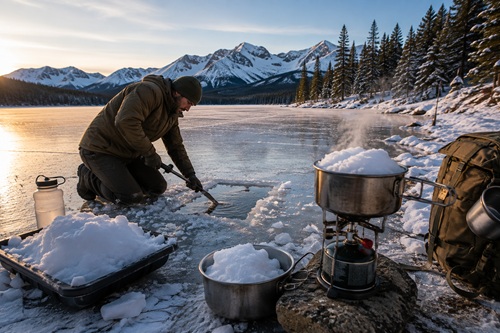
Freshly fallen snow is generally preferable to older snow that has remained on the ground for extended periods. New snow has had less opportunity to collect dirt, vehicle exhaust, animal waste, windblown debris, or other contaminants that gradually accumulate over time. Snow collected from open fields or elevated surfaces is usually cleaner than snow gathered alongside highways, parking lots, or heavily traveled walkways where chemicals, salt, oil, and road debris are common.
Not all snow is equally suitable for drinking water. Discolored snow, snow with an unusual odor, or snow containing visible debris should be avoided whenever cleaner alternatives exist. Wind can carry dust and pollutants considerable distances, particularly near industrial areas or busy roadways. Choosing the cleanest available collection location reduces the amount of purification required after melting.
Ice can also provide an excellent water source. Clear ice formed on lakes or rivers is generally preferable to cloudy or slushy ice because it often contains fewer trapped air bubbles and suspended particles. Ice collected from the upper layers of frozen lakes frequently produces clearer water than the water beneath it. Nevertheless, ice should still be treated as untreated natural water and purified before drinking.
One mistake commonly made during winter emergencies is eating snow directly instead of melting it first. Consuming large quantities of snow lowers body temperature while forcing the body to expend valuable energy warming the ice before it can be absorbed. This accelerates heat loss and may contribute to hypothermia under severe conditions. Melting snow before drinking is far more efficient and conserves body heat when warmth is already limited.
Melting snow also requires more volume than many people expect. Fresh powder contains a great deal of air, meaning a large container of snow often produces only a small amount of liquid water. Compressing snow before melting or gradually adding small amounts into a pot already containing a little water helps improve efficiency while reducing the risk of scorching cookware over a heat source.
Winter weather can present additional challenges beyond simply obtaining water. Fuel consumption increases because snow and ice must first be melted before purification can begin. Households relying on wood stoves, propane, or other heating systems should account for this additional fuel requirement when planning long-term winter preparedness.
Snow and ice should be viewed as valuable seasonal resources rather than emergency solutions of last resort. When combined with appropriate purification methods, they provide dependable drinking water throughout periods when many other natural water sources may be frozen or difficult to access. Understanding how to collect, melt, and safely treat frozen water allows winter preparedness plans to remain effective even under the harshest environmental conditions.
| Frozen Water Source | Recommended Practice |
|---|---|
| Fresh Snow | Collect from clean, open areas |
| Older Snow | Inspect carefully for contamination |
| Lake Ice | Prefer clear ice over cloudy ice |
| Roadside Snow | Avoid whenever possible |
| Consumption | Melt and purify before drinking |
Groundwater and Wells
Groundwater is one of the most dependable sources of fresh water available during an emergency because it is naturally stored beneath the Earth’s surface. Rain and melting snow slowly soak into the ground, passing through layers of soil, sand, gravel, and rock before reaching underground aquifers. During this journey, many suspended particles are naturally filtered out, producing water that is often much clearer than rivers, lakes, or ponds. For households that rely on private wells, groundwater may continue to provide an abundant supply long after surface water sources have become difficult to access.
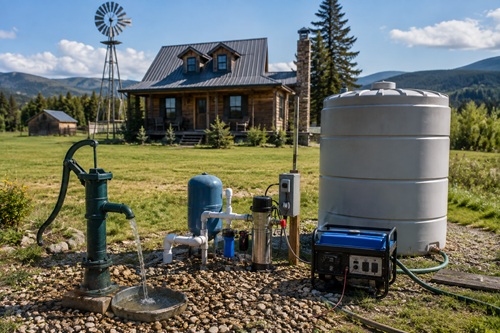
Having a well, however, does not guarantee that water will always be available. Most modern residential wells depend upon electrically powered pumps to bring groundwater to the surface. During extended power outages, the water remains underground even though the well itself is full. This is one of the reasons many preparedness-minded homeowners invest in backup generators, solar-powered pumping systems, battery backup systems, or manual hand pumps that can continue operating when the electrical grid is unavailable.
The condition of the well itself also deserves careful attention. Wells that have been properly constructed and maintained generally provide excellent water quality, but flooding, damaged well caps, cracked casings, or nearby contamination sources can allow surface water to enter the system. Floodwater is particularly concerning because it often carries sewage, fuel, agricultural runoff, and countless microorganisms that can infiltrate damaged wells. After any flooding event, private wells should be treated as potentially contaminated until they have been properly tested or the water has been purified before use.
Location plays an important role in groundwater quality. Wells located near septic systems, livestock operations, agricultural fields, industrial sites, or landfills may face greater contamination risks than wells located in undeveloped areas. Although groundwater moves slowly compared to rivers, contaminants can still travel considerable distances beneath the surface over time. Understanding the surrounding environment helps identify potential risks long before an emergency occurs.
Older wells deserve additional consideration. Components such as pumps, pressure tanks, electrical wiring, and well seals gradually wear with age. Routine inspections and maintenance help ensure the system remains reliable when it is needed most. Preparedness should include more than simply owning a well—it should include knowing how the system operates, where replacement parts are located, and what backup options are available if the primary pump fails.
Households that rely on wells should also understand their daily production capacity. Some shallow wells recover quickly after pumping, while others require time for groundwater levels to recharge. Excessive pumping during an emergency can temporarily exceed the well’s recovery rate, reducing water availability until groundwater levels stabilize. Learning the capabilities of your well before an emergency helps prevent unnecessary strain on the system during periods of high demand.
Even when groundwater appears exceptionally clean, purification remains a wise precaution during emergencies. Natural filtration removes many suspended particles but does not guarantee the absence of bacteria, viruses, dissolved minerals, or chemical contaminants. If the integrity of the well has been compromised or contamination is suspected, appropriate purification methods should always be used before the water is consumed.
For preparedness households, a properly maintained private well represents one of the most valuable long-term water resources available. Combined with backup pumping capability and multiple purification methods, it provides an independent water supply that can continue serving the household long after municipal infrastructure has failed.
| Well Consideration | Preparedness Recommendation |
|---|---|
| Electrical Pump | Maintain backup power or manual pump |
| Flooding | Purify water until safety is confirmed |
| Annual Maintenance | Inspect pump, casing, and well cap |
| Backup Parts | Store essential replacement components |
| Water Quality | Test periodically and purify if necessary |
Urban Emergency Water Sources
Many people assume that cities become water deserts once municipal service fails, but urban environments often contain numerous emergency water sources that are easily overlooked. Buildings, parks, commercial facilities, and public infrastructure frequently store thousands of gallons of water that remain available long after water pressure has been lost. The key is knowing where to look before an emergency forces everyone else to begin searching.
Municipal water systems themselves often retain usable water immediately after service is interrupted. Household plumbing still contains water trapped inside pipes, while elevated water towers and storage reservoirs may continue supplying neighborhoods until pressure is exhausted. Opening taps too early during a widespread outage may unnecessarily drain these remaining reserves. Understanding local emergency procedures helps determine when conserving municipal water becomes more important than immediately using it.
Public parks frequently provide valuable opportunities. Decorative ponds should generally be avoided because they often contain chemicals or stagnant water, but irrigation systems, maintenance facilities, and occasionally untreated groundwater wells may provide alternative water sources if proper authorization exists and purification methods are available. Likewise, golf courses, sports complexes, and commercial landscaping systems sometimes maintain independent water supplies separate from municipal drinking water.
Commercial buildings often contain significant amounts of stored water. Office towers, schools, hotels, hospitals, shopping centres, and industrial facilities frequently maintain large water storage systems for fire suppression, heating, cooling, or emergency backup purposes. While not all of these systems provide potable water, understanding their existence helps identify possible emergency resources that may become valuable under exceptional circumstances.
Construction sites can also contain water storage tanks used for dust control or equipment operation. These supplies should never be assumed safe for drinking without careful evaluation and purification, but they demonstrate how water exists in many locations beyond traditional drinking water systems.
Urban waterways deserve careful evaluation. Rivers passing through cities often receive stormwater runoff, industrial discharge, road contaminants, sewage overflows, and countless pollutants generated by dense populations. Although these rivers may provide large quantities of water, they frequently require more extensive treatment than similar waterways flowing through undeveloped regions.
Preparedness within urban environments relies heavily on advance planning. Identifying potential collection points before an emergency allows households to compare options based on accessibility, contamination risks, and expected reliability. During a widespread disaster, many obvious water sources may quickly become crowded as thousands of people search for supplies simultaneously. Having several alternatives greatly improves flexibility while reducing dependence on a single location.
One important advantage of urban preparedness is diversity. While natural water sources may be limited, cities often contain numerous man-made storage systems capable of providing temporary supplies. Households that understand their local environment generally discover far more opportunities than those who wait until an emergency begins before considering where additional water might be found.
Although urban water sources can be extremely valuable, every source should be evaluated carefully and purified appropriately before consumption. Buildings, infrastructure, and commercial systems may contain chemicals or contaminants that are not immediately apparent. Careful assessment remains the foundation of safe emergency water collection regardless of where the water is found.
Hidden Household Water Sources
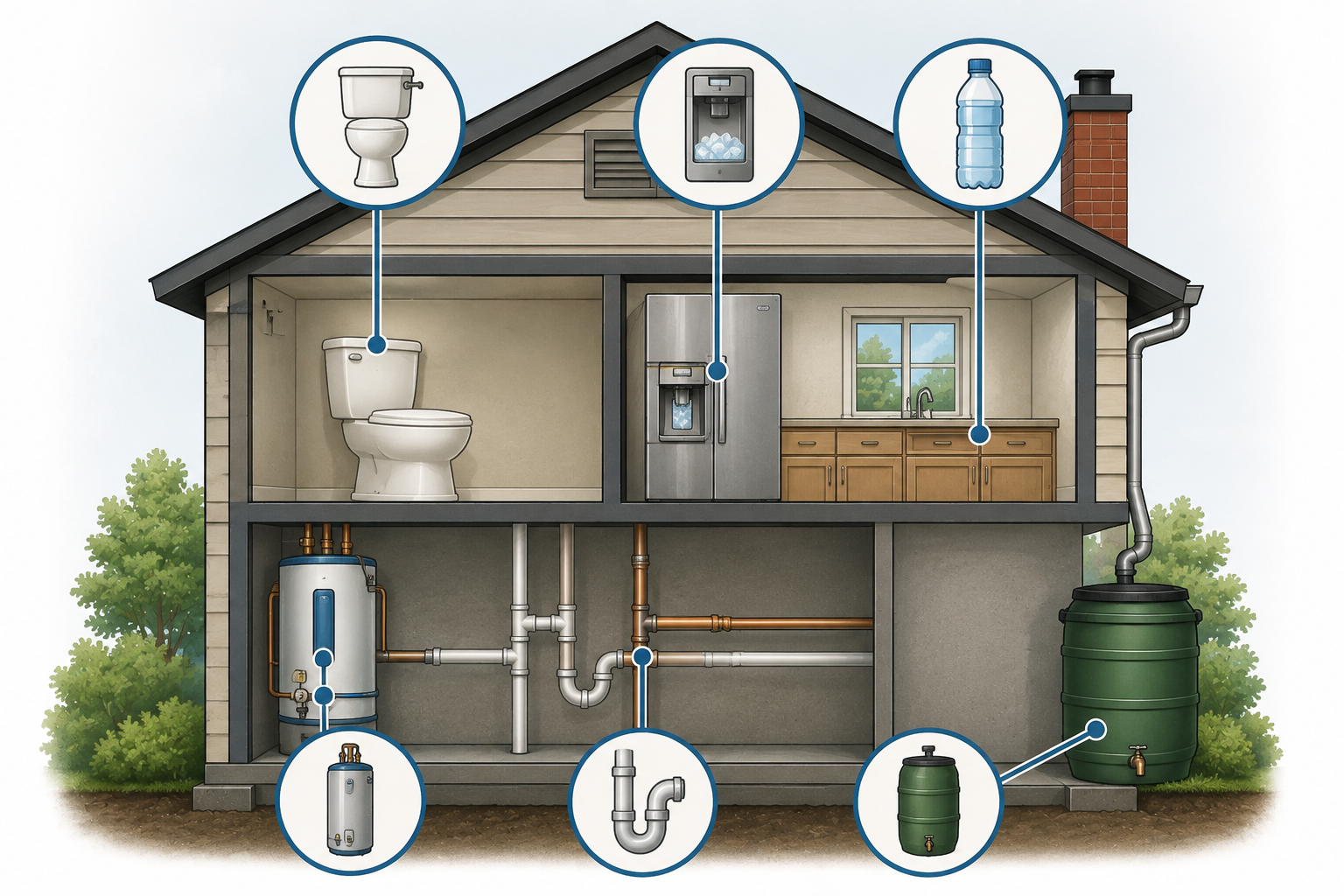
When most people think about emergency water, they immediately picture rivers, lakes, rain barrels, or bottled water stored in a pantry. What many fail to realize is that their own home may already contain dozens or even hundreds of gallons of usable water hidden in places they rarely consider. During the first several days of an emergency, these overlooked sources are often easier, safer, and more convenient to access than traveling outside in search of natural water. Knowing where these supplies exist before they are needed can save valuable time while reducing unnecessary exposure to hazards.
One of the largest hidden water reservoirs in many homes is the water heater. Depending on its size, a residential water heater may contain between forty and eighty gallons of potable water that has already been treated by the municipal water system. If the incoming water supply has become contaminated or interrupted, turning off the water supply valve and shutting off the heater before draining it helps protect the remaining contents from contamination. Because this water has been stored inside a closed system, it is often one of the safest emergency water sources immediately available within the home.
Household plumbing also contains a surprising amount of water. Pipes running throughout the house continue holding water after municipal pressure has been lost. Opening the highest faucet in the home allows air to enter the system while opening the lowest faucet permits much of the remaining water to drain into clean containers. Although the quantity is relatively small compared to a water heater, every gallon contributes to extending household reserves during the early stages of an emergency.
Toilet tanks represent another frequently overlooked source. It is important to distinguish between the toilet tank and the toilet bowl. Water stored inside the tank is generally clean if no chemical cleaning tablets, disinfectants, or automatic bowl cleaners have been added. The bowl itself should never be considered a source of drinking water. If the tank contains only clean municipal water, it can provide several additional gallons that may be purified if necessary before consumption.
Refrigerators equipped with built-in water dispensers or ice makers also contain usable water. The internal reservoir supplying chilled drinking water remains available even after power has failed, while ice cubes can be melted to supplement drinking water supplies. Although the quantity is modest, these sources require very little effort to access and should not be overlooked.
Many homes contain bottled beverages that can contribute to hydration during an emergency. Bottled water is the obvious choice, but canned fruits packed in water, fruit juices, sports drinks, and other commercially sealed beverages may temporarily supplement drinking water reserves. While sugary beverages should not replace water for extended periods, they may provide valuable fluids until larger water supplies have been established.
Homes with rainwater harvesting systems often have substantial reserves already stored in barrels or cisterns. Depending on how the system has been maintained, this water may require filtration and purification before drinking, but it represents an excellent supplemental resource that many households intentionally install as part of their preparedness planning.
Swimming pools and hot tubs contain thousands of gallons of water, leading many people to assume they provide unlimited emergency drinking water. While these large volumes can be extremely valuable for sanitation, flushing toilets, firefighting, or irrigation, they should generally not be considered primary drinking water sources because of the chemicals used to maintain water quality. In extreme survival situations, specialized purification methods such as distillation may make some of this water usable, but cleaner alternatives should always be selected first whenever possible.
Decorative water features, garden ponds, birdbaths, and fountains should be viewed cautiously. These systems often contain stagnant water, algae, fertilizers, animal waste, or chemical treatments that require extensive purification before they become suitable for drinking. Although they may serve as emergency backup sources, they are rarely among the best options available.
Businesses and commercial buildings may also contain overlooked water reserves. Restaurants often store bottled beverages, commercial ice machines hold large amounts of ice, office buildings maintain drinking water coolers, and warehouses may contain pallets of bottled water awaiting distribution. During widespread emergencies, access to these supplies will depend upon ownership, authorization, and local emergency conditions, but understanding their existence helps broaden your awareness of potential water resources.
The most effective preparedness plans begin by identifying every possible water source already available inside the home. Conducting a simple household inspection before an emergency allows family members to understand where these supplies are located, how much water each source contains, and how they should be accessed safely. This knowledge transforms overlooked household systems into valuable components of a comprehensive emergency water strategy.
Recognizing Unsafe Water Sources
One of the most dangerous assumptions a person can make during an emergency is believing that clear water is automatically safe to drink. Water may appear perfectly clean while containing harmful bacteria, viruses, parasites, agricultural chemicals, industrial pollutants, or naturally occurring toxins. Unlike spoiled food, contaminated water often provides no obvious warning through its appearance, smell, or taste. Learning to recognize warning signs before collecting water is therefore one of the most important skills in emergency preparedness.
The surrounding environment should always be evaluated before considering the water itself. A stream flowing through an undeveloped forest generally presents different risks than one flowing beneath highways, through industrial districts, or alongside agricultural land. Fertilizers, pesticides, petroleum products, sewage, mining waste, and countless other contaminants can enter waterways long before the water reaches your collection point. Looking upstream often reveals potential hazards that cannot be detected by simply examining the water in front of you.
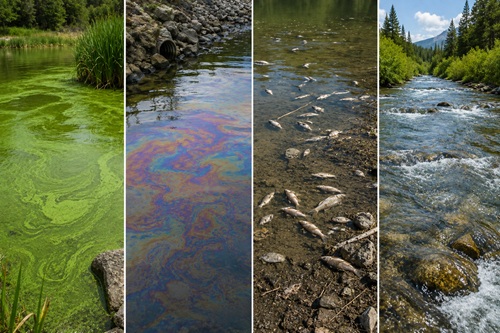
Visible signs of contamination should never be ignored. Water containing floating oil, chemical sheens, excessive algae, unusual colors, foam, or strong chemical odors should immediately raise concern. Likewise, large numbers of dead fish, amphibians, birds, or other wildlife may indicate serious contamination that extends beyond ordinary biological hazards. When these warning signs are present, locating another water source is usually the safest decision.
Heavy algae growth deserves particular attention. Thick green mats, blue-green surface films, or water that resembles spilled paint may indicate harmful cyanobacteria. These organisms can produce toxins that are not reliably removed through ordinary boiling or standard filtration methods. Although algae blooms are most common during warm weather, they can occur whenever nutrient levels and environmental conditions become favorable.
Areas affected by flooding require additional caution. Floodwater frequently carries sewage, fuel, industrial chemicals, pesticides, animal waste, and countless other contaminants collected as water spreads across developed areas. While purification methods effectively address many biological hazards, they do not necessarily remove dissolved chemicals or toxic substances. Whenever possible, avoid collecting floodwater when cleaner alternatives exist.
Saltwater presents another important limitation. Ocean water and seawater cannot be made safe simply by boiling, filtering, or adding chemical disinfectants. Although these methods destroy microorganisms, they leave dissolved salts behind. Drinking untreated saltwater actually accelerates dehydration because the body must expend additional water to remove excess salt. Only specialized methods such as distillation or reverse osmosis can reliably produce safe drinking water from seawater.
Even groundwater deserves careful evaluation. Wells located in flood zones, near septic systems, or adjacent to industrial activity may become contaminated despite appearing perfectly clear. Springs emerging from the ground can also carry microorganisms introduced far upstream beneath the surface. No natural water source should ever be considered completely free of risk based solely on its appearance.
Perhaps the most valuable habit a preparedness-minded individual can develop is maintaining a healthy level of skepticism. Rather than asking whether water looks clean enough to drink, ask what may have happened to that water before it reached your location. This simple change in perspective encourages better source selection, more thorough purification, and safer long-term decision-making.
Recognizing unsafe water is not about becoming fearful of every natural source. It is about learning to identify conditions that increase risk while understanding that every water source should be evaluated carefully before collection. Combined with proper purification methods, thoughtful source selection forms the foundation of a safe and dependable emergency water strategy.
Seasonal Considerations
The availability and quality of emergency water sources change throughout the year. A stream that flows year-round in one season may shrink to a trickle during another, while heavy rainfall, snowmelt, or freezing temperatures can dramatically alter both the quantity and quality of available water. Preparedness is not simply about identifying water sources—it is about understanding how those sources behave under different seasonal conditions so you are never caught by surprise.
Spring often provides the greatest abundance of freshwater. Melting snow and seasonal rainfall replenish rivers, streams, ponds, and groundwater, creating numerous collection opportunities. However, this abundance comes with its own challenges. Rapid snowmelt and heavy spring rains frequently increase sediment levels, making rivers and streams noticeably cloudier than during other times of the year. Fast-moving runoff also washes soil, agricultural fertilizers, animal waste, and other contaminants into nearby waterways. Although there may be more water available, additional settling and pre-filtration are often necessary before purification begins.
Summer presents a very different set of conditions. High temperatures increase evaporation, reducing water levels in ponds, lakes, and smaller streams. As water levels fall, contaminants become more concentrated while algae growth becomes increasingly common. Warm temperatures also encourage the growth of bacteria and other microorganisms. During extended droughts, some seasonal streams disappear entirely, forcing households to depend on larger rivers, springs, groundwater, or stored reserves. Summer is also the season when household water consumption typically reaches its highest level because of increased physical activity and heat.
Autumn is frequently overlooked when discussing emergency water preparedness, yet it introduces its own unique challenges. Falling leaves and decaying vegetation gradually accumulate in ponds, lakes, and slower-moving streams, increasing the amount of organic material present in the water. Heavy autumn storms may produce short-term flooding that introduces additional sediment and contaminants into waterways. At the same time, cooler temperatures generally reduce algae growth compared to the peak summer months, often improving overall water clarity.
Winter transforms the landscape entirely. Rivers may freeze along their edges, lakes become covered with ice, and many smaller streams disappear beneath snow. While this limits access to liquid water, winter also creates new opportunities. Fresh snow and clear lake ice become valuable emergency water sources when collected properly. Frozen conditions may also reduce algae growth and biological activity in many bodies of water. However, obtaining usable water now requires additional effort because snow and ice must first be collected and melted before purification can begin. This increases fuel consumption and should be considered when planning winter preparedness supplies.
Seasonal weather patterns can also influence groundwater. Heavy rainfall may temporarily affect well water quality by allowing surface contamination to enter damaged wells, while prolonged drought can lower groundwater levels and reduce well production. Springs that flow strongly during wet seasons may weaken considerably during extended dry periods. Understanding these seasonal changes helps identify which water sources remain dependable regardless of environmental conditions.
Preparedness-minded households should make a habit of observing local water sources throughout the year rather than only during emergencies. Visit nearby streams during spring runoff, examine ponds during late summer, observe river levels after heavy rainfall, and become familiar with winter collection opportunities before severe weather arrives. These observations create valuable experience that cannot be replaced by reading books or studying maps alone.
One of the most effective preparedness strategies is maintaining several independent water sources that complement one another throughout the seasons. Rainwater harvesting may perform exceptionally well during wet months, while a dependable spring provides year-round reliability. Stored water bridges short-term disruptions, and snow becomes a valuable winter resource when surface water becomes difficult to access. Each source strengthens the others, creating a resilient system capable of adapting to changing environmental conditions.
Seasonal planning is ultimately about eliminating surprises. By understanding how your local environment changes throughout the year, you gain the confidence to adapt your water collection strategy long before conditions become critical.
Water Source Selection Strategy
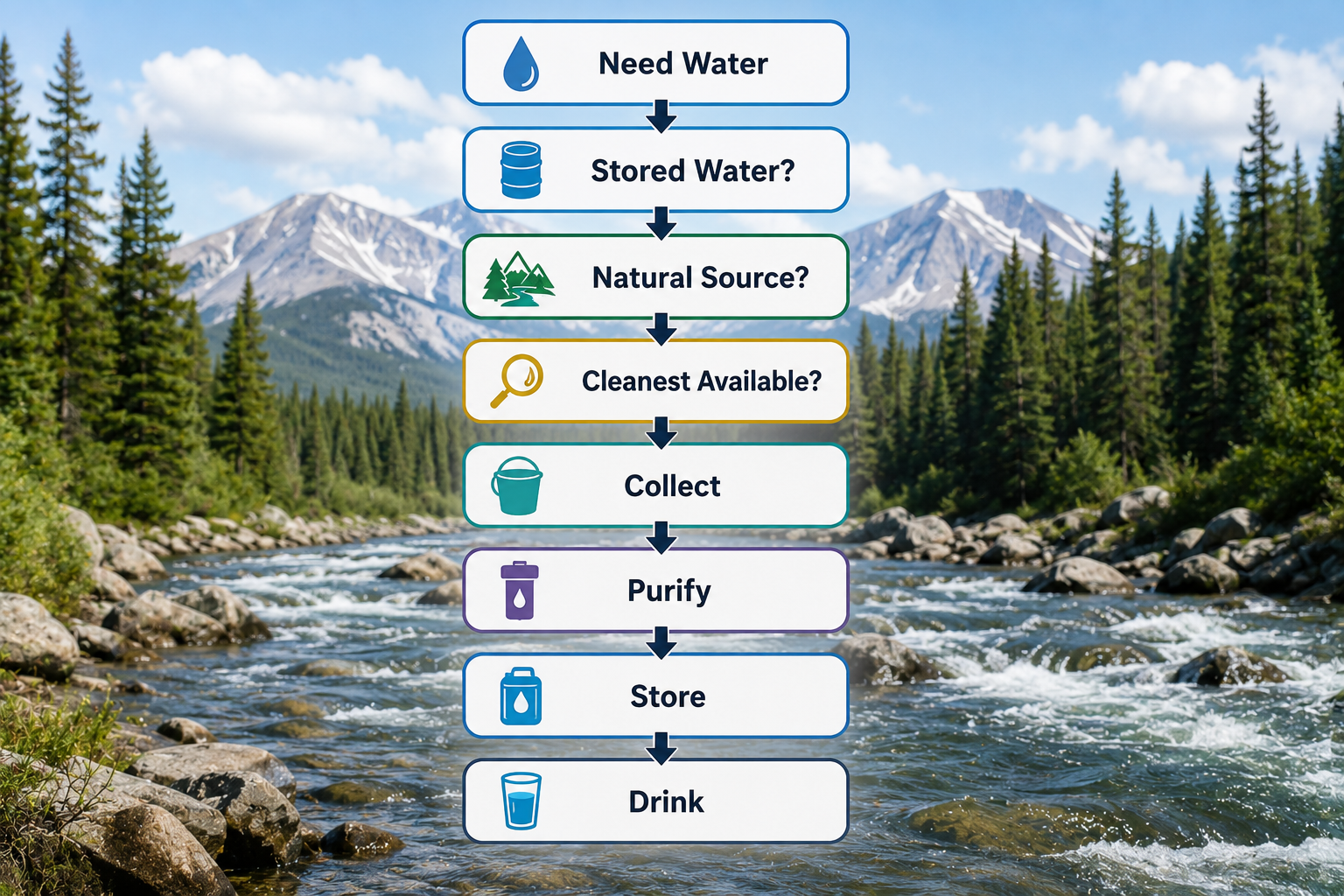
Finding water is only the first step. Choosing which water source to use is often the more important decision. During an emergency, several sources may be available at the same time, each offering different advantages and disadvantages. Some provide cleaner water but require a longer walk. Others are closer but demand more extensive purification. Developing a simple decision-making process before an emergency helps eliminate uncertainty when every decision matters.
The first priority should always be selecting the cleanest available source. Every purification method performs more effectively when the starting water contains fewer contaminants. Clear water generally requires less filtration, less fuel for boiling, fewer chemical disinfectants, and places less strain on filters. Choosing a cleaner source from the beginning often saves significant time and resources over the course of a prolonged emergency.
Reliability should be considered immediately after water quality. A small spring producing exceptionally clean water may not generate enough volume to support a large family, while a nearby river may provide virtually unlimited water despite requiring additional treatment. A dependable source that continues producing water throughout the emergency is often more valuable than one that offers excellent quality but limited capacity.
Accessibility is another important factor that is frequently overlooked. Collecting water should not expose you to unnecessary danger. Steep riverbanks, unstable shorelines, flooded roadways, heavy traffic, wildfire zones, or areas with significant security concerns may all increase the risk associated with a particular source. The safest water source is one that can be reached consistently without placing yourself or your family in unnecessary danger.
Energy expenditure should also influence your decision. Walking several kilometres while carrying heavy water containers consumes time and physical energy that may be needed for other essential tasks. During long-term emergencies, small differences in travel distance accumulate quickly. A source that is slightly less desirable but significantly closer may become the more practical long-term choice when transportation resources are limited.
The expected contaminants should guide your purification method. If biological contamination is the primary concern, boiling, filtration, ultraviolet treatment, or chemical disinfectants may all provide excellent protection. If chemical contamination is suspected, selecting another water source is often preferable because many household purification methods do not remove industrial chemicals, pesticides, or heavy metals. Source selection and purification should always be viewed as complementary decisions rather than separate processes.
Redundancy remains one of the most important principles in preparedness. Never depend entirely on a single water source regardless of how reliable it appears. Drought, contamination, severe weather, infrastructure damage, or increased competition from other people can quickly make a previously dependable source unavailable. Identifying several primary and secondary collection locations provides flexibility while reducing the likelihood that one unexpected problem will create a water emergency.
Good decision-making becomes much easier when planning occurs before the emergency begins. Walk your local area, identify every potential water source, evaluate seasonal changes, estimate travel times, and determine which purification methods would be required for each location. Completing this work in advance allows you to respond calmly and confidently when normal water supplies are interrupted.
The strongest preparedness plans are built upon thoughtful choices rather than fortunate circumstances. Every water source has strengths, limitations, and risks. Understanding those differences allows you to select the option that best balances safety, reliability, effort, and long-term sustainability for the situation you face.
Finding Water During Evacuations
Finding water while sheltering at home is very different from finding water during an evacuation. At home, you benefit from familiar surroundings, stored supplies, and the ability to establish long-term collection routines. During an evacuation, however, mobility becomes the priority. You may be traveling through unfamiliar areas, carrying limited equipment, and making decisions with incomplete information. The ability to quickly identify reliable water sources can determine whether an evacuation remains manageable or becomes increasingly dangerous.
Preparation begins long before leaving home. Every planned evacuation route should include known water sources marked on both digital and printed maps. Rivers, lakes, streams, public campgrounds, provincial parks, rest areas, and communities with public water access should all be identified in advance. Even if these locations are never used, knowing where they are located provides valuable flexibility if conditions force changes to your original plan.
Do not assume that every river or lake encountered during an evacuation will be accessible. Wildfires may close roads, floods may wash out bridges, and emergency personnel may restrict access to certain areas. Construction, private property, or rapidly changing weather conditions can also make previously identified collection points unusable. For this reason, every evacuation route should include multiple backup water sources rather than relying on a single location.
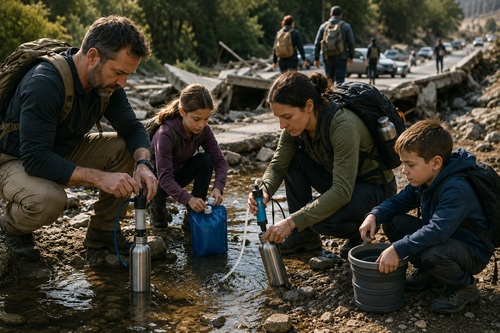
Water carried from home should always be considered your first line of defense. Beginning an evacuation with full water bottles, hydration bladders, or portable containers allows you to remain selective when choosing new water sources. People who wait until they are completely out of water before searching are more likely to collect poor-quality water simply because they have no other option.
Portable purification equipment becomes especially valuable during evacuations. Lightweight filters, chlorine dioxide tablets, compact ultraviolet purifiers, and small metal containers suitable for boiling allow you to adapt to changing conditions without carrying excessive weight. Redundancy remains important even in mobile situations. Batteries may fail, filters can become damaged, and fuel eventually runs out. Carrying more than one purification method greatly increases long-term reliability.
Urban evacuations present different opportunities than wilderness travel. Commercial buildings, public parks, recreational facilities, marinas, campgrounds, and community emergency centers may provide access to water that is unavailable elsewhere. At the same time, large populations competing for limited resources can quickly exhaust obvious collection points. Understanding alternative locations before an emergency improves your ability to avoid unnecessary delays and overcrowding.
Security should also influence every water collection decision. Rivers, lakes, and public water access points may attract many people during widespread emergencies. Crowded locations increase the possibility of conflict, contamination, and theft. Whenever practical, collect water during daylight hours, remain aware of your surroundings, and avoid creating predictable collection routines if security concerns exist.
Transportation also affects how much water can realistically be carried. Individuals traveling on foot may only transport a few liters comfortably, making frequent resupply necessary. Vehicles allow significantly larger reserves to be carried but introduce different vulnerabilities, including fuel limitations, road closures, and mechanical failures. Regardless of the transportation method, knowing where additional water can be obtained reduces dependence on the amount initially carried.
Perhaps the most important principle during an evacuation is flexibility. Conditions change rapidly during disasters, and the “best” water source identified during planning may become inaccessible or contaminated. Preparedness is strengthened by understanding several alternatives rather than becoming committed to one destination. The more collection options you identify before leaving home, the more confidently you can adapt when circumstances change unexpectedly.
Common Mistakes
Many emergency water problems are not caused by a lack of available water but by poor decisions made during collection. Simple mistakes can increase contamination, waste valuable time, or create unnecessary risks that could have been avoided through planning and experience. Understanding these common errors allows preparedness-minded households to avoid repeating them when an actual emergency occurs.
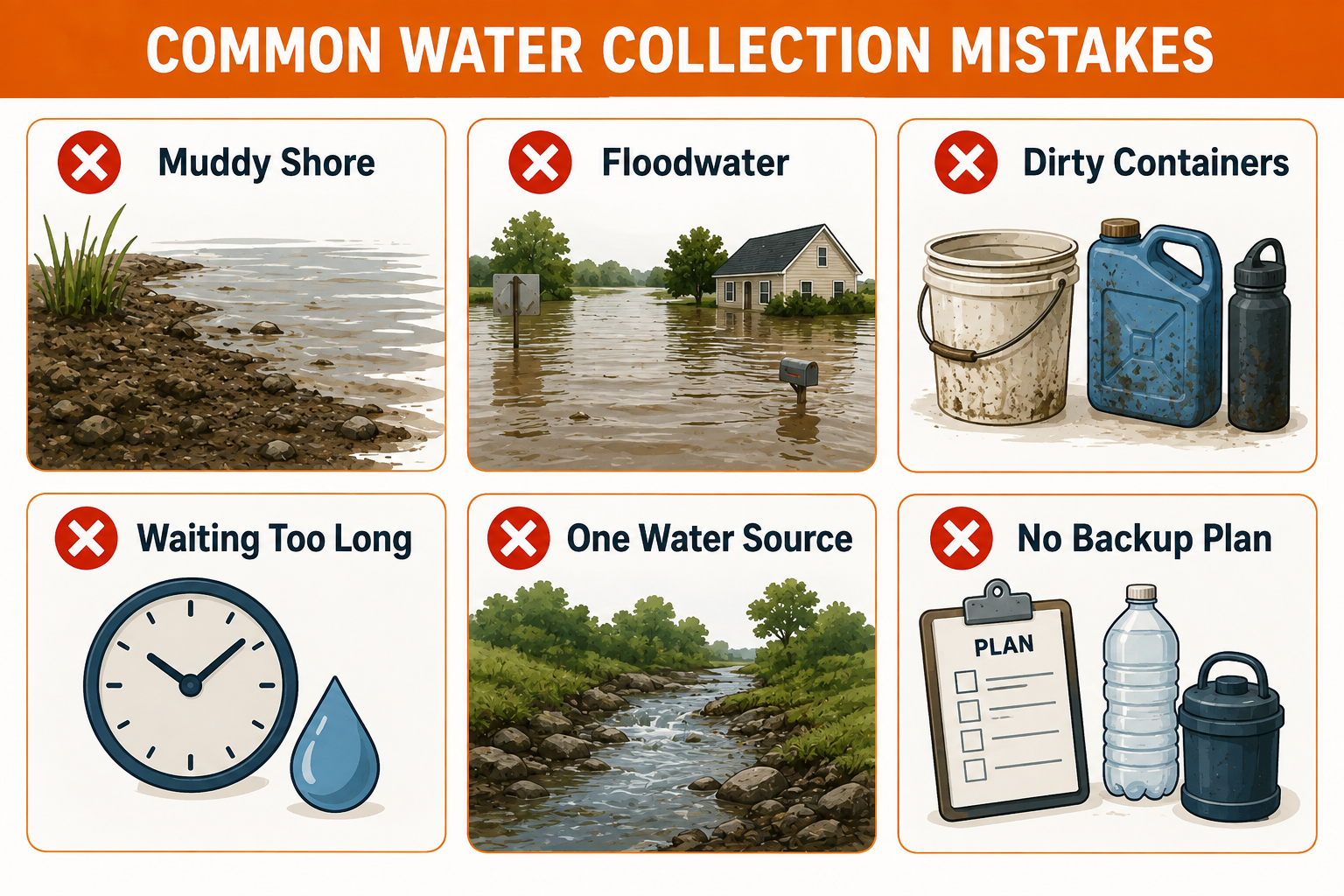
One of the most frequent mistakes is waiting too long before searching for additional water. Some households consume nearly all of their stored reserves before looking for replacement sources. This creates unnecessary pressure and often forces people to collect water under stressful conditions when poor decisions become more likely. A much better approach is to begin replenishing stored supplies while reserves are still available, allowing time to evaluate different sources without urgency.
Another common mistake is assuming that clear water is safe water. Crystal-clear streams, springs, and lakes may still contain harmful bacteria, viruses, protozoa, or chemical contaminants that cannot be seen with the naked eye. Appearance alone should never determine whether water is suitable for drinking. Every natural water source should be evaluated carefully and purified appropriately before consumption.
Many people also overlook the importance of the surrounding environment. They focus entirely on the water itself while ignoring what lies upstream or nearby. Agricultural fields, livestock, septic systems, industrial facilities, highways, and residential neighborhoods all influence water quality. Taking a few moments to study the landscape often reveals contamination risks that would otherwise go unnoticed.
Improper collection techniques create additional problems. Stirring mud while filling containers, collecting water directly from stagnant shorelines, or allowing dirty containers to contact clean water all increase contamination before purification even begins. Small improvements in collection practices frequently produce cleaner water that is easier and faster to treat.
Another mistake is depending upon a single water source. A nearby stream may appear dependable throughout most of the year but become inaccessible because of flooding, drought, wildfire, or security concerns. Likewise, a private well may become unusable during an extended power outage if no backup pumping system exists. Preparedness is built upon redundancy. Every household should identify multiple independent water sources capable of supporting one another when conditions change.
People also tend to underestimate the amount of water required during prolonged emergencies. They prepare only for drinking while overlooking cooking, hygiene, medical care, sanitation, pets, and other daily needs. As a result, water supplies disappear much faster than expected. Planning for total household consumption rather than drinking alone provides a much more realistic understanding of long-term requirements.
Finally, one of the greatest mistakes is failing to practice before an emergency occurs. Reading about water collection provides valuable knowledge, but practical experience reveals challenges that books cannot fully describe. Walking to local water sources, testing collection equipment, practicing purification methods, and evaluating seasonal changes all build confidence that becomes invaluable when normal infrastructure is no longer available.
Preparedness is not achieved by avoiding every possible mistake. It is achieved by recognizing common problems before they occur and developing practical solutions while conditions are still favorable. Experience, planning, and regular practice remain the best safeguards against the unexpected.
Final Thoughts
Finding emergency water sources is far more than simply locating the nearest river or filling a bucket from the closest pond. It is a skill that combines observation, planning, environmental awareness, and sound decision-making. Every emergency presents unique challenges, and the most successful preparedness plans are those that adapt to changing conditions rather than depending upon a single source or one fixed solution.
Throughout this lesson, one principle has remained consistent: begin with the cleanest water source available. Careful source selection reduces the amount of treatment required, extends the life of purification equipment, conserves fuel and chemicals, and improves the overall safety of the drinking water you produce. Every good decision made before purification strengthens the effectiveness of every step that follows.
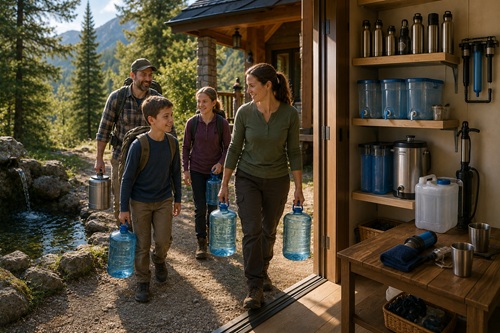
Preparedness is also built upon redundancy. Rivers, springs, lakes, rainwater, wells, household water reserves, and seasonal sources each provide unique advantages under different circumstances. No single source is ideal for every emergency, but together they create a flexible system capable of adapting to power outages, droughts, floods, severe weather, evacuations, and long-term infrastructure failures.
Knowledge alone, however, is not enough. The confidence to locate and collect water safely comes through experience. Visit nearby water sources throughout the year, become familiar with seasonal changes, maintain your collection and purification equipment, and practice using it under realistic conditions. The lessons learned during routine practice are far easier—and far safer—than those learned during a real emergency.
Ultimately, successful preparedness is not measured by how much water you store, but by how confidently you can continue obtaining safe water after those stored supplies begin to decline. Families who understand their local environment, maintain multiple collection options, and regularly practice their skills are far better prepared to remain healthy, independent, and resilient regardless of how long an emergency lasts.
Reading the Landscape for Water
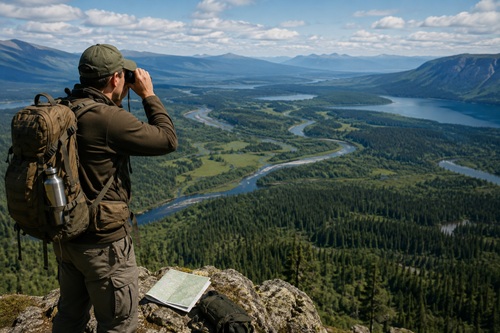
One of the most valuable skills a preparedness-minded individual can develop is the ability to recognize where water is likely to be found simply by observing the landscape. Long before modern maps, satellite imagery, and GPS navigation existed, hunters, explorers, Indigenous peoples, and early settlers learned to interpret the natural environment for clues that revealed nearby water. These same observation skills remain valuable today, particularly when traveling through unfamiliar terrain or when modern navigation tools are unavailable.
Water naturally follows the path of least resistance. Gravity pulls rainfall and snowmelt downhill, causing it to collect in valleys, low-lying depressions, ravines, and drainage channels. Even when no visible stream exists, these landforms often indicate where groundwater may be close to the surface or where seasonal water flows after rainfall. Learning to identify these natural drainage patterns greatly improves your ability to predict where water is most likely to be found.
Topographic maps illustrate this principle clearly through contour lines. Valleys are represented by contour lines that form a “V” shape pointing uphill, indicating the direction from which water flows. By following these valleys downhill, you can often locate streams, creeks, rivers, ponds, or wetlands. Even without a map, broad valleys surrounded by higher terrain frequently indicate natural water collection areas.
Vegetation also provides valuable information. Areas supporting lush green growth during otherwise dry conditions often suggest that groundwater is available beneath the surface. Large deciduous trees, dense shrubs, reeds, cattails, willows, cottonwoods, and other moisture-loving plants frequently grow where water remains available throughout much of the year. Although these plants do not guarantee safe drinking water, they often indicate that groundwater or surface water is nearby.
Changes in vegetation are often easier to recognize from a distance than the water itself. A narrow band of darker green trees crossing an otherwise dry hillside frequently marks the location of a seasonal creek or underground seep. During aerial photography and satellite imagery, these green corridors commonly reveal watercourses hidden beneath dense forest canopies.
Rock formations can provide additional clues. Water frequently emerges where impermeable rock layers force groundwater toward the surface. Cliffs, exposed bedrock, and steep hillsides sometimes contain natural seeps or springs that remain active even during dry periods. Moss-covered rocks, unusually damp soil, or persistent patches of green vegetation beneath rocky slopes often suggest groundwater movement nearby.
Animal trails deserve careful observation as well. Wildlife requires regular access to water, and many species establish well-defined paths leading toward dependable sources. Multiple game trails converging into one direction frequently indicate a nearby stream, pond, or spring. While following these trails may help locate water, remember that wildlife activity also increases the possibility of biological contamination. Animal trails should lead you to water—not determine exactly where you collect it.
Morning dew and persistent fog sometimes reveal hidden moisture. Valleys that remain foggy after sunrise often indicate nearby rivers, wetlands, or saturated ground. Likewise, isolated patches of dense vegetation covered in heavy morning dew may suggest groundwater close to the surface.
Even soil provides useful information. Dry, sandy ridges generally shed water quickly, while darker, richer soils in low-lying areas retain moisture much longer. Soft ground, damp leaves, or unusually cool soil during warm weather often indicate increased moisture below the surface.
Reading the landscape is not about relying upon a single clue. Rather, it involves combining many observations into a complete picture. A valley containing lush vegetation, converging animal trails, damp soil, and morning fog provides much stronger evidence of nearby water than any one of those indicators alone. As these observation skills develop, locating dependable water sources becomes faster, easier, and more reliable.
Plants and Wildlife That Indicate Nearby Water
Nature constantly provides clues about the presence of water for those who know how to recognize them. Plants and animals have evolved to locate dependable water sources because their survival depends upon them. By observing their behavior and distribution, preparedness-minded individuals can often identify water long before it becomes visible.
Plants are among the most reliable indicators because they remain rooted in one location throughout their lives. Certain species require consistently moist soil and therefore grow only where groundwater remains accessible or surface water is present for much of the year. Willows are one of the best-known examples. Their extensive root systems thrive in moist environments, making them common along rivers, streams, ponds, and wetlands. Cottonwoods, alders, and many species of poplar also favor areas where groundwater is readily available.
Cattails deserve special attention because they almost always indicate standing or slow-moving freshwater. These tall plants grow in marshes, shallow ponds, lake edges, and wetlands where water remains present throughout much of the growing season. While the water surrounding cattails still requires purification before drinking, their presence provides a reliable indication that water exists nearby.
Dense patches of reeds, rushes, sedges, and other marsh vegetation similarly suggest saturated ground. Even when surface water is not immediately visible, these plants often grow where groundwater remains close to the surface. During dry seasons, following these vegetation patterns may lead to small seeps or springs that continue producing water after other sources have disappeared.
Trees also provide important clues. In otherwise dry landscapes, narrow ribbons of taller trees often trace the course of hidden streams or seasonal drainage channels. These natural corridors can frequently be identified from considerable distances because their vegetation remains greener and denser than surrounding terrain.
Animals provide additional information, although their behavior must be interpreted carefully. Birds frequently travel to water shortly after sunrise and again before sunset. Watching the direction of repeated bird flights may help identify nearby rivers, ponds, or wetlands. Waterfowl such as ducks and geese naturally remain close to lakes and marshes, while swallows and other insect-eating birds often gather where flying insects concentrate around water.
Large mammals also establish regular travel routes between feeding areas and dependable water sources. Deer, elk, moose, and other wildlife often create well-worn trails leading toward streams or ponds. Multiple trails converging into one direction usually indicate frequent movement toward a common resource. However, collecting water directly where animals drink should be avoided whenever possible because these areas often contain increased biological contamination from animal waste and heavy foot traffic.
Insects may also reveal nearby water. Mosquitoes breed in standing water, while dragonflies commonly hunt near ponds, marshes, and slow-moving streams. Large concentrations of insects can suggest the presence of water, although they should never be relied upon as the sole indicator.
It is important to remember that no plant or animal guarantees safe drinking water. Their value lies in helping you locate water—not determining whether that water is safe to consume. Every source located through natural indicators should still be evaluated carefully and purified appropriately before use.
The more familiar you become with the plants and wildlife in your local region, the easier it becomes to recognize these subtle environmental clues. Developing these observation skills before an emergency greatly improves your ability to locate dependable water when modern infrastructure and technology are no longer available.
Emergency Water Collection Equipment
Knowing where to find water is only part of the equation. The ability to collect, transport, and store that water safely depends upon having the right equipment. During an emergency, the difference between a successful collection trip and a frustrating one is often determined by preparation rather than the availability of water itself. Even the cleanest spring or fastest flowing stream provides little benefit if you cannot transport the water home without contaminating it or spilling a significant portion along the way.
Collection containers should always be selected with durability and safety in mind. Food-grade plastic containers, stainless steel bottles, collapsible water bladders, and purpose-built water jugs all perform well because they are designed to safely hold drinking water without introducing harmful chemicals or affecting taste. Containers that previously held fuels, pesticides, cleaning products, or other chemicals should never be repurposed for drinking water, regardless of how thoroughly they appear to have been cleaned. Residual contamination may remain long after visible residue has disappeared.
The size of the container should also match the task. Small bottles are convenient for collecting water from difficult locations such as narrow springs or shallow streams, while larger containers are more efficient for transporting significant volumes back to camp or home. Many experienced preparedness-minded individuals carry both. Smaller containers simplify collection, while larger storage containers reduce the number of trips required to meet household water needs.
Collapsible water containers have become increasingly popular because they occupy very little storage space when empty. They fit easily inside bug-out bags, emergency kits, or vehicle preparedness supplies, expanding only when additional water must be transported. Although they are generally less durable than rigid containers, their portability makes them excellent backup equipment during evacuations.
A simple metal bucket also deserves consideration. Beyond collecting water, it can be used for boiling large quantities of water over an open fire, transporting water for sanitation, extinguishing small fires, washing clothing, or supporting numerous other emergency tasks. Equipment capable of serving multiple purposes often provides greater value than specialized items with only one function.
Collecting water from shallow streams or steep riverbanks sometimes requires additional tools. A lightweight rope attached to a sturdy container allows water to be gathered from locations that would otherwise be unsafe or difficult to reach. Long-handled dippers, collapsible buckets, and even small hand pumps may simplify collection while reducing the likelihood of stirring sediment along the shoreline.
Transportation should never be overlooked. Water is heavy. A single gallon weighs approximately eight pounds (3.8 kilograms), meaning even modest quantities quickly become physically demanding to carry over long distances. Wagons, garden carts, backpacks with hydration compartments, pack frames, bicycles equipped with cargo racks, or off-road utility carts can significantly reduce physical strain while increasing the amount of water transported during each trip.
Keeping collection equipment clean is equally important. Containers should be rinsed regularly, inspected for cracks, and protected from dirt, insects, and animal contamination when not in use. Lids should fit securely to prevent spills and reduce the possibility of contamination during transport. Equipment that is cared for properly before an emergency is far more likely to perform reliably when conditions become difficult.
Preparedness is not about owning the most expensive collection equipment available. It is about selecting practical tools that meet your household’s needs while ensuring they remain organized, maintained, and readily accessible. A well-planned collection kit allows you to focus on finding the best available water source rather than improvising solutions under stressful conditions.
| Water Collection Equipment | Primary Purpose | Best Use |
|---|---|---|
| Stainless Steel Bottle | Collection, transport, boiling | Hiking, bug-out bags |
| Food-Grade Water Jug | Bulk storage and transport | Home preparedness |
| Collapsible Water Container | Lightweight backup storage | Evacuations and travel |
| Metal Bucket | Collection and boiling | Camp or home use |
| Rope and Bucket | Deep or steep collection points | Wells, riverbanks |
| Water Wagon or Cart | Heavy transport | Long-distance collection |
Building a Household Water Source Plan
Locating water becomes much easier when decisions have already been made before an emergency begins. Instead of searching for water under stressful conditions, preparedness-minded households should develop a written water source plan that identifies where water can be found, how it will be collected, and which purification methods will be used for each source. This simple planning exercise transforms scattered knowledge into an organized system that every member of the household can understand and follow.
Begin by identifying every potential water source within a practical distance of your home. Include rivers, streams, lakes, ponds, springs, private wells, rainwater collection systems, public water access points, and overlooked household sources such as water heaters and plumbing systems. Recording these locations on both printed maps and digital devices provides valuable redundancy should electronic navigation become unavailable.
Each source should then be evaluated individually. Consider its distance from home, expected reliability throughout the year, accessibility during severe weather, likely contaminants, and the purification methods that would be required before the water becomes safe to drink. A nearby creek may be convenient but vulnerable to agricultural runoff after heavy rain, while a spring located farther away may provide consistently cleaner water year-round. Understanding these differences allows you to prioritize collection locations based on changing conditions.
It is also important to estimate production capacity. Some springs flow continuously but produce only a few gallons per hour, while rivers and lakes provide virtually unlimited quantities. Matching expected household water requirements with the output of each source helps determine whether a single location can support your family or whether several sources will need to be used together during prolonged emergencies.
Transportation planning should become part of the written plan as well. Identify the safest routes to each collection point, estimate travel times, and determine which equipment will be required. During disasters, familiar roads may become blocked by fallen trees, flooding, debris, or emergency response activities. Alternate routes should therefore be identified whenever possible.
Purification methods should be assigned to each source before an emergency occurs. For example, rainwater may require only disinfection under normal conditions, while river water may require settling, filtration, and chemical treatment. Recording these procedures eliminates uncertainty during stressful situations and ensures that every family member follows the same process regardless of who performs the collection.
The plan should also address seasonal changes. Some sources perform exceptionally well during spring but become unreliable during drought, while others remain dependable throughout the entire year. Reviewing the plan periodically and updating it as local conditions change keeps it accurate and useful over time.
Finally, every household member should become familiar with the plan through regular practice. Walk collection routes together, inspect water sources during different seasons, test collection equipment, and rehearse purification procedures under normal conditions. Practical experience builds confidence while identifying problems that can be corrected long before an actual emergency occurs.
Preparedness is strongest when knowledge is shared rather than held by one individual. A well-developed household water source plan ensures that everyone understands where water can be found, how it will be collected, and what steps are required to produce safe drinking water regardless of the emergency they face.
| Household Water Plan | Information to Record |
|---|---|
| Primary Water Source | Location and year-round reliability |
| Secondary Water Sources | Seasonal alternatives |
| Household Sources | Water heater, plumbing, rain barrels |
| Collection Equipment | Containers, carts, ropes, pumps |
| Purification Method | Best treatment for each source |
| Seasonal Changes | Reliability throughout the year |
| Backup Routes | Alternate access during disasters |
Preparedness Action Plan
Knowledge becomes truly valuable only when it is applied. Reading about emergency water sources provides a strong foundation, but preparedness is built through observation, planning, and regular practice. The goal is not simply to know that water exists nearby—it is to understand exactly where it can be found, how it will be collected, and what steps will be required to make it safe for your household under a variety of emergency conditions.
Begin by identifying every potential water source within a practical distance of your home. Include obvious natural sources such as rivers, streams, lakes, ponds, and springs, but do not overlook rainwater collection opportunities, private wells, or the emergency water already stored inside your home. Mark these locations on printed maps that can be used even if electronic devices become unavailable.
Visit each location under normal conditions and evaluate its accessibility. Determine how long it takes to reach the source on foot and by vehicle, identify any seasonal hazards, and consider whether flooding, wildfire, heavy snowfall, or damaged roads could affect access during an emergency. Understanding these challenges before they occur allows you to develop alternate routes and backup collection locations.
Inspect your emergency water collection equipment at least twice each year. Verify that containers remain clean, food-safe, and free of cracks or leaks. Replace damaged lids, inspect ropes, carts, buckets, and pumps, and ensure that all purification supplies remain stocked and within their recommended service life. Equipment that has never been tested should not be expected to perform flawlessly during an actual emergency.
Practice collecting and purifying water before you depend upon these skills. Visit a nearby stream or lake, collect water using your emergency equipment, and complete the entire purification process exactly as you would during an actual disaster. Practical experience quickly reveals equipment limitations, missing supplies, or procedures that require improvement. The confidence gained through practice cannot be replaced by reading alone.
Review your household’s water plan with every family member. Everyone should understand where emergency water can be found, which sources should be used first, how purification equipment operates, and where emergency supplies are stored. Emergencies often separate family members or require different individuals to assume responsibilities unexpectedly. Shared knowledge greatly increases the resilience of the entire household.
Preparedness should also remain an ongoing process. New developments, changing land use, road construction, drought conditions, or environmental changes may affect local water sources over time. Revisit your collection sites periodically and update your household water plan whenever conditions change. The strongest preparedness plans evolve alongside the communities and environments they serve.
Ultimately, successful preparedness is not measured by the amount of equipment you own but by your ability to consistently locate, collect, purify, and safely store water regardless of the circumstances you face. Developing these skills today provides confidence that will remain valuable throughout every future emergency.
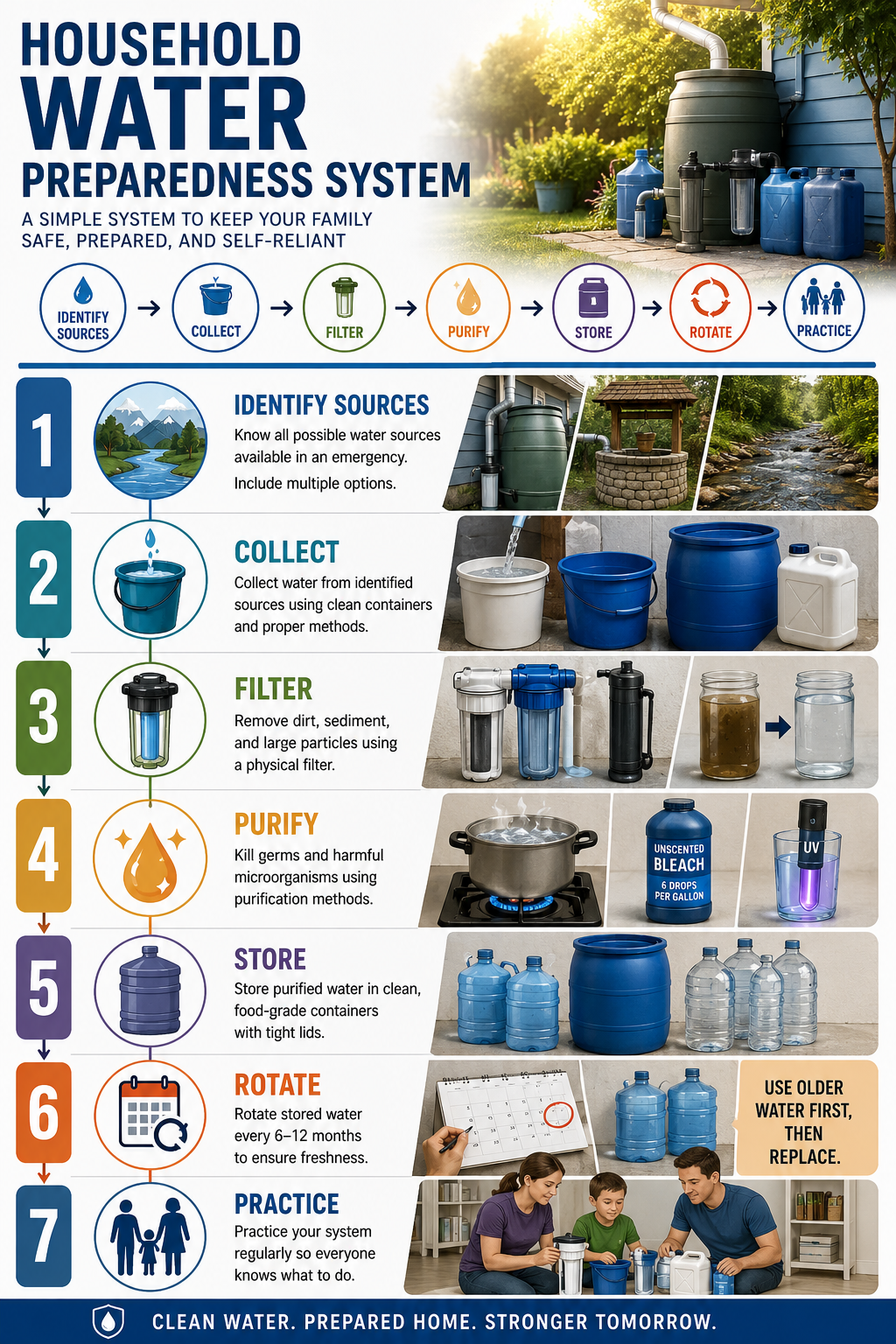
Skills Learned
After completing this lesson, you should now have a comprehensive understanding of how to locate, evaluate, and prioritize emergency water sources under a wide variety of conditions. More importantly, you should understand that finding water is not simply a matter of locating the nearest river or pond, but rather selecting the safest and most reliable source while considering long-term sustainability, accessibility, and purification requirements.
You should now be able to identify the major categories of emergency water sources, including rivers, streams, lakes, ponds, natural springs, rainwater, snow, ice, groundwater, private wells, urban water sources, and the many hidden water reserves found inside homes and commercial buildings. Understanding the advantages and limitations of each source allows you to make informed decisions instead of relying upon assumptions or convenience.
You should also recognize how environmental conditions influence water quality throughout the year. Seasonal changes, weather events, flooding, drought, wildfire, and human activity all affect the availability and safety of emergency water. This knowledge enables you to adapt your collection strategy as conditions change rather than depending upon a single source that may become unavailable.
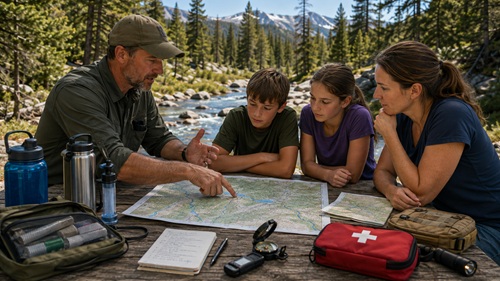
Another important skill developed throughout this lesson is the ability to read the landscape. By observing terrain, vegetation, drainage patterns, wildlife activity, and other natural indicators, you can greatly improve your ability to locate dependable water even in unfamiliar areas. These observation skills have guided travelers, hunters, and explorers for generations and remain valuable today whenever modern infrastructure or technology becomes unavailable.
You should now understand how proper collection equipment contributes to safe water management. Selecting appropriate containers, maintaining clean equipment, planning transportation, and protecting collected water from contamination are all essential parts of successful emergency water collection. Every stage of the process contributes to the quality of the final drinking water.
Perhaps most importantly, this lesson emphasizes that preparedness depends upon redundancy rather than perfection. No single water source remains ideal under every circumstance. The strongest preparedness plans identify multiple collection locations, maintain several purification methods, and regularly practice these skills before they become necessary. This layered approach provides flexibility while reducing dependence upon any one piece of equipment or one specific location.
By combining careful planning, practical experience, environmental awareness, and multiple backup options, you have taken another important step toward building a resilient preparedness system capable of supporting your household through both short-term disruptions and prolonged emergencies.
Appendix A – Emergency Water Source Comparison
| Water Treatment Method | Removes Bacteria | Removes Viruses | Removes Protozoa | Removes Sediment | Removes Chemicals | Removes Salt | Improves Taste | Requires Power | Typical Treatment Time | Best Use |
|---|---|---|---|---|---|---|---|---|---|---|
| Boiling | ✅ | ✅ | ✅ | ❌ | ❌ | ❌ | ❌ | Heat Source | 1–3 min boil + cooling | Biological emergencies |
| Household Bleach | ✅ | ✅ | ⚠️ | ❌ | ❌ | ❌ | ❌ | No | 30–60 min | Clear stored water |
| Calcium Hypochlorite | ✅ | ✅ | ⚠️ | ❌ | ❌ | ❌ | ❌ | No | 30–60 min | Long-term disinfectant storage |
| Chlorine Dioxide Tablets | ✅ | ✅ | ✅ | ❌ | ❌ | ❌ | ❌ | No | 30 min–4 hrs | Travel and emergency kits |
| UV Purifier | ✅ | ✅ | ⚠️ | ❌ | ❌ | ❌ | ❌ | Batteries | 60–90 sec/L | Clear water only |
| Ceramic Filter | ✅ | ❌ | ✅ | ✅ | ❌ | ❌ | ⚠️ | No | Immediate | Rivers and lakes |
| Hollow Fiber Filter | ✅ | ❌ | ✅ | ✅ | ❌ | ❌ | ⚠️ | No | Immediate | Backpacking |
| Activated Carbon Filter | ❌ | ❌ | ❌ | ⚠️ | ✅ | ❌ | ✅ | No | Immediate | Improving taste and reducing chemicals |
| Gravity Filter | ✅ | ❌ | ✅ | ✅ | ⚠️ | ❌ | ✅ | No | 5–20 min/L | Household preparedness |
| Pump Filter | ✅ | ❌ | ✅ | ✅ | ⚠️ | ❌ | ✅ | Manual | Immediate | Mobile use |
| Distillation | ✅ | ✅ | ✅ | ✅ | ✅ | ✅ | ✅ | Heat Source | Several hours | Highest purity |
| Reverse Osmosis | ✅ | ✅ | ✅ | ✅ | ✅ | ✅ | ✅ | Pressure | Continuous | Home purification systems |
| Settling | ❌ | ❌ | ❌ | ✅ | ❌ | ❌ | ❌ | No | 1–24 hrs | Pre-treatment only |
| Cloth/Coffee Filter | ❌ | ❌ | ❌ | ⚠️ | ❌ | ❌ | ❌ | No | Immediate | Initial debris removal |
Legend
- ✅ = Effective
- ⚠️ = Limited effectiveness or depends on conditions
- ❌ = Not effective
*If contamination of the household plumbing system is suspected, purify before drinking.
Appendix B – Water Source Decision Guide
START
│
▼
Do you have stored drinking water?
┌───────────────┐
YES │ │ NO
▼ ▼
Is it still sealed? Find a water source
┌─────────────┐ │
YES │ │ NO ▼
▼ ▼ Is the water visibly dirty?
Drink if within Inspect, smell, ┌──────────────┐
storage guidelines and disinfect YES │ │ NO
▼ ▼
Allow sediment to settle Continue
│
▼
Pre-filter through cloth
│
▼
Do you have a water filter?
┌──────────────┐
YES │ │ NO
▼ ▼
Filter the water Skip to
│ disinfection
▼
Can you boil the water?
┌──────────────┐
YES │ │ NO
▼ ▼
Boil 1 minute Chemical treatment
(3 min at or UV purifier
high altitude) │
│ ▼
└──────► Wait required
contact time
│
▼
Is the water safe to store?
┌──────────────┐
YES │ │ NO
▼ ▼
Store in sanitized Use immediately
food-grade containers if necessary
│
▼
Label with treatment date
│
▼
Rotate and inspect regularly
│
▼
END
Appendix C – Household Water Preparedness Checklist
Print this checklist and review it every 6–12 months.
Water Sources
☐ Municipal water supply identified
☐ Private well inspected (if applicable)
☐ Rainwater collection system available
☐ Nearby river, creek, lake, or spring identified
☐ Emergency backup water sources mapped
Water Storage
☐ Minimum three-day emergency supply stored
☐ Long-term water reserve established
☐ Food-grade containers used
☐ Containers cleaned and sanitized before filling
☐ Water stored in a cool, dark location
☐ Storage containers labeled with fill date
☐ Water rotation schedule established
☐ Stored water inspected regularly
Filtration Equipment
☐ Primary water filter
☐ Backup water filter
☐ Spare filter cartridges
☐ Replacement O-rings and seals
☐ Cleaning brush
☐ Filter lubricant (if required)
☐ Manufacturer instructions printed
Water Purification Supplies
☐ Unscented household bleach
☐ Calcium hypochlorite (optional)
☐ Chlorine dioxide tablets
☐ UV purifier with spare batteries
☐ Metal pot for boiling
☐ Fuel for boiling water
☐ Measuring spoon or dropper
☐ Water treatment dosage chart printed
Pre-Filtration Supplies
☐ Clean cloths
☐ Coffee filters
☐ Fine mesh strainer
☐ Buckets for settling water
☐ Dirty water container
☐ Clean water container
Storage & Transport
☐ Water bottles
☐ Large storage jugs
☐ Water bricks or stackable containers
☐ Collapsible water containers
☐ Water carrying bucket
☐ Waterproof labels
☐ Permanent marker
Testing & Maintenance
☐ Filter tested recently
☐ Backup filter tested
☐ Boiling equipment inspected
☐ Treatment supplies checked for expiration
☐ Stored water inspected for leaks
☐ Storage containers cleaned
☐ Emergency water plan reviewed
Family Preparedness
☐ Every family member knows water sources
☐ Everyone knows filtration procedures
☐ Everyone knows purification methods
☐ Everyone knows storage procedures
☐ Children understand basic water safety
☐ Family completed a water emergency practice
Documentation
☐ Printed treatment instructions
☐ Dosage charts
☐ Local water source map
☐ Emergency contact list
☐ Household preparedness plan
☐ Maintenance log
Final Readiness Check
☐ I can locate emergency water within minutes.
☐ I can safely filter contaminated water.
☐ I can disinfect water using more than one method.
☐ I have enough storage containers for my household.
☐ My supplies are organized and easy to access.
☐ My family understands our emergency water plan.
☐ My equipment has been tested within the past year.
☐ I am confident I can provide safe drinking water during an emergency.
© Prepping Communities. This content is for informational purposes only and not professional advice. Use at your own risk.
Terms | Privacy | Guidelines