
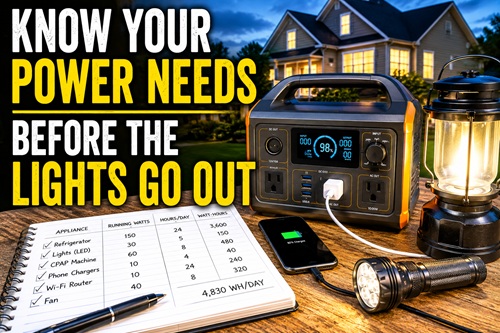
One of the biggest mistakes people make when buying a generator or portable power station is guessing how much electricity they actually need. A system that’s too small may not keep essential equipment running, while an oversized system can cost far more than necessary.
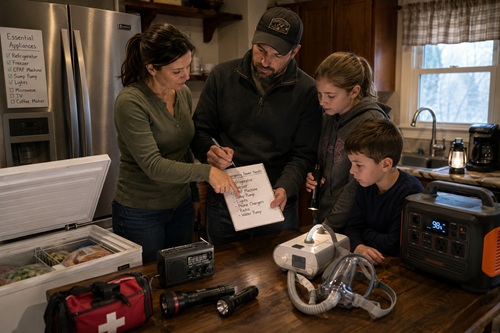
Start by making a list of the appliances that are truly important during a power outage. Your refrigerator, freezer, medical equipment, lights, phone chargers, and any equipment needed for heating or water should usually be at the top of the list.
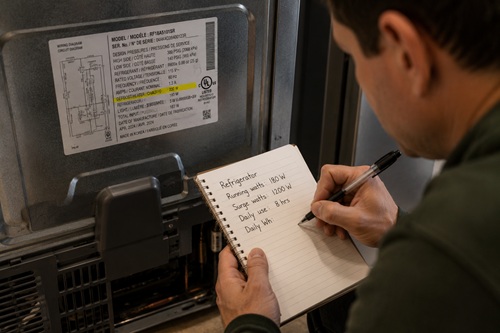
Check each appliance for its running wattage and, if it has an electric motor, its starting or surge wattage. Items like refrigerators, freezers, and sump pumps often require much more power for a few seconds when they first start.
Next, estimate how many hours each appliance will be used during a typical day. Multiplying the running watts by the number of hours gives you a good estimate of your daily energy needs. Adding those numbers together provides a realistic picture of how much power your household requires.
When choosing backup power, don’t size your system to the exact number you calculated. Leave extra capacity so your generator or battery isn’t constantly operating at its maximum output. A little extra capacity also gives you flexibility if your needs change during an extended emergency.
Taking the time to calculate your household’s power requirements now can save money, reduce frustration during an outage, and help ensure your family has reliable electricity when it matters most. A well-planned backup power system is based on real numbers, not guesswork.
Create a Priority List
Not every appliance needs to run during an emergency. Divide your household’s electrical needs into three categories: essential, important, and optional. Essential items are those that protect life, health, and food, such as refrigerators, freezers, medical equipment, water pumps, and a few lights. Important items improve comfort but can usually wait if necessary, while optional items are conveniences that consume valuable power without being critical.
Don’t Forget Hidden Power Needs
Many people focus only on the obvious appliances and overlook smaller devices that still require electricity. Internet equipment, security systems, battery chargers, laptops, radios, fans, and even garage door openers may all be important depending on your situation. Individually they use little power, but together they can noticeably increase your daily energy requirements.
Plan for Extended Outages
A power outage lasting a few hours is very different from one lasting several days. During a prolonged emergency, conserving fuel or battery capacity becomes just as important as producing electricity. Consider which appliances can be used only when needed instead of running continuously. For example, a microwave may only operate for a few minutes each day, while a refrigerator cycles on and off automatically. Managing when appliances are used can significantly reduce overall energy consumption.
Consider Seasonal Differences
Your power needs will change throughout the year. Winter may require additional electricity for heating equipment, furnace blowers, or electric blankets, while summer may increase demand for fans, portable air conditioners, or extra refrigeration. Planning for the season with the highest expected demand helps ensure your backup power system remains adequate year-round.
Test Your Backup Power Plan
Owning a generator or battery system is only part of the solution. Test it before an emergency occurs. Connect the appliances you expect to run and verify that everything operates properly without overloading the system. This practice also helps you become familiar with startup procedures, fuel consumption, extension cords, transfer switches, and battery charging requirements before you’re dealing with a real emergency.
Review Your Needs Regularly
Household power requirements change over time. A new freezer, additional medical equipment, changes in family size, or new electronic devices can all affect your calculations. Review your emergency power plan at least once a year to ensure your backup system still meets your family’s needs.
Final Thoughts
Knowing your household’s electrical requirements gives you confidence when selecting a generator, inverter, or portable power station. Instead of relying on estimates or marketing claims, you’ll understand exactly what your family needs to stay safe and comfortable during a power outage. A little planning today can prevent costly mistakes and ensure your backup power system performs when you need it most.
How to Calculate Your Household’s Emergency Power Needs
Calculating emergency power requires looking at two different numbers: how much power your appliances need at one time and how much energy they use over an entire day.
Power is measured in watts. Energy use over time is measured in watt-hours.
The basic calculation is:
Running watts × hours used = watt-hours
For example, a 100-watt appliance running for five hours would use:
100 watts × 5 hours = 500 watt-hours
If an appliance label lists amps instead of watts, multiply the amps by the voltage.
Amps × volts = watts
For a 120-volt appliance drawing 3 amps:
3 amps × 120 volts = 360 watts
Always check the actual label on your equipment because appliance power use can vary considerably.
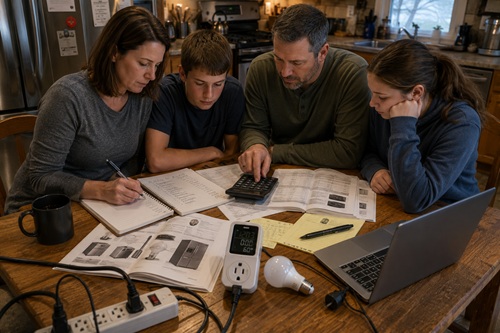
Example Emergency Household Calculation
Assume a family wants to operate the following equipment during a power outage:
| Appliance | Running Watts | Daily Use | Daily Energy |
|---|---|---|---|
| Refrigerator | 180 watts | 8 hours | 1,440 Wh |
| Chest freezer | 120 watts | 6 hours | 720 Wh |
| Five LED lights | 50 watts | 5 hours | 250 Wh |
| CPAP machine | 60 watts | 8 hours | 480 Wh |
| Two phone chargers | 20 watts | 3 hours | 60 Wh |
| Laptop | 65 watts | 4 hours | 260 Wh |
| Microwave | 1,500 watts | 15 minutes | 375 Wh |
The microwave is used for only 15 minutes, which equals 0.25 hours.
1,500 watts × 0.25 hours = 375 watt-hours
Now add the daily energy requirements:
1,440 + 720 + 250 + 480 + 60 + 260 + 375 = 3,585 watt-hours
This household would use approximately:
3,585 Wh per day
To avoid running the system at its absolute limit, add a 25 percent reserve.
3,585 × 1.25 = 4,481 Wh
The family should therefore plan for approximately:
4,500 watt-hours of usable energy per day
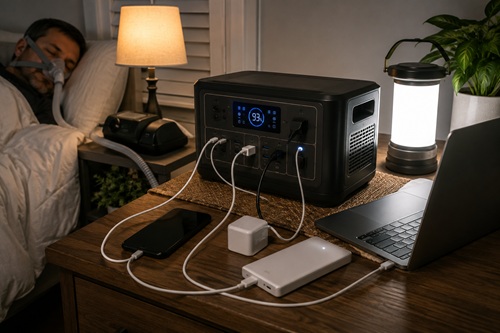
Calculating Battery Capacity
A portable power station advertised as having a 4,500 Wh battery may not provide the full amount as usable AC electricity. Some energy is lost through the inverter, wiring, temperature, and the battery management system.
Assuming approximately 85 percent usable efficiency:
4,500 Wh ÷ 0.85 = 5,294 Wh
This means the household would need a power station with roughly:
5,300 Wh of rated battery capacity
A slightly larger unit would provide additional flexibility and help prevent the battery from being completely discharged every day.
Calculating Peak Running Load
Battery capacity tells you how long the system can operate. Inverter wattage tells you how many appliances can operate at the same time.
Assume the following appliances are running together:
- Refrigerator: 180 watts
- Freezer: 120 watts
- Lights: 50 watts
- CPAP: 60 watts
- Phones: 20 watts
- Laptop: 65 watts
- Microwave: 1,500 watts
The total running load would be:
180 + 120 + 50 + 60 + 20 + 65 + 1,500 = 1,995 watts
Adding a 25 percent reserve gives:
1,995 × 1.25 = 2,494 watts
The system should therefore have an inverter capable of providing at least:
2,500 watts of continuous power
A 3,000-watt inverter would provide a more comfortable operating margin.
Calculating Starting Surge
Refrigerators, freezers, pumps, air conditioners, and other motor-driven appliances may briefly require several times their normal running wattage when they start.
Assume the refrigerator requires 1,200 starting watts and the freezer requires 900 starting watts.
If the refrigerator starts while the other appliances are already running, calculate the load using the refrigerator’s starting wattage instead of its normal running wattage.
1,995 watts − 180 watts + 1,200 watts = 3,015 watts
The system would need to briefly handle at least:
3,015 surge watts
Adding a safety margin:
3,015 × 1.25 = 3,769 watts
A power station or generator with approximately 4,000 watts of surge capacity would be suitable for this example.
The refrigerator and freezer may not normally start at exactly the same time, but emergency planning should allow for the possibility. Staggering appliance use can reduce the size of the system required.
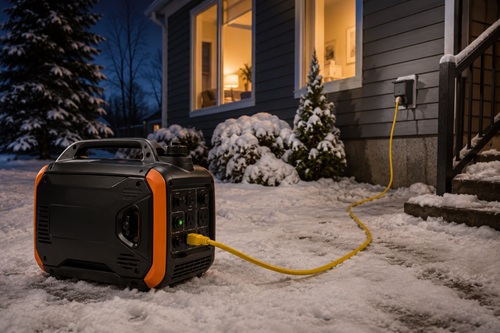
Generator Example
A generator is normally selected according to continuous wattage and surge wattage rather than total watt-hours.
Using the example above, the household needs approximately:
2,500 watts of continuous output
and approximately:
4,000 watts of surge capacity
A generator rated for around 3,000 running watts and 4,000 starting watts would likely handle these essential loads, provided high-demand appliances are managed carefully.
However, the generator would not necessarily need to run continuously. It could be operated periodically to cool the refrigerator and freezer, recharge batteries, operate the microwave, and power other essential equipment.
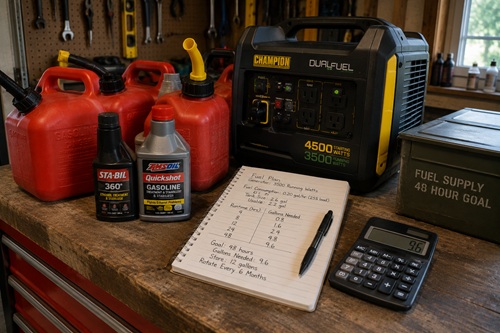
Fuel Consumption Example
Suppose a generator burns 0.4 gallons of fuel per hour at the expected load and is operated for six hours each day.
0.4 gallons × 6 hours = 2.4 gallons per day
For a seven-day outage:
2.4 gallons × 7 days = 16.8 gallons
Adding a 20 percent reserve:
16.8 × 1.20 = 20.16 gallons
The household would need approximately:
20 gallons of fuel for seven days
Actual fuel consumption depends on generator size, electrical load, engine efficiency, fuel type, weather, and maintenance condition.
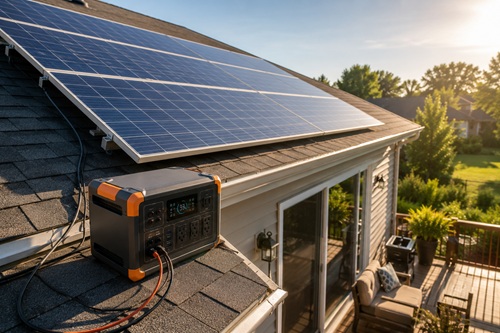
Solar Recharging Example
Assume the household needs to replace 4,500 Wh of energy each day and receives an average of five effective hours of strong sunlight.
The basic solar calculation is:
Daily watt-hours ÷ peak sun hours = required solar watts
4,500 Wh ÷ 5 hours = 900 watts
Solar systems also experience losses from clouds, panel angle, heat, wiring, and charging equipment. Adding a 30 percent allowance:
900 × 1.30 = 1,170 watts
This household would need approximately:
1,200 watts of solar panels
That estimate assumes reasonably good weather and properly positioned panels. Several cloudy days could greatly reduce charging, making additional battery capacity, generator backup, or reduced power use necessary.
A Smaller Essential-Only Plan
A household may decide to eliminate the microwave, laptop, and some lighting during an emergency.
The remaining daily load might be:
- Refrigerator: 1,440 Wh
- Freezer: 720 Wh
- CPAP: 480 Wh
- Lights: 150 Wh
- Phones: 60 Wh
Total:
1,440 + 720 + 480 + 150 + 60 = 2,850 Wh
Adding a 25 percent reserve:
2,850 × 1.25 = 3,563 Wh
This reduced plan would require approximately:
3,600 Wh of usable daily energy
Reducing unnecessary loads can substantially lower battery, solar, generator, and fuel requirements.
Final Calculation Summary
For each appliance, record:
Running watts × hours used = daily watt-hours
Then calculate:
Total daily watt-hours × 1.25 = recommended usable daily capacity
For battery systems, account for efficiency losses:
Required usable energy ÷ expected efficiency = rated battery capacity
For inverter or generator size:
Combined running watts × 1.25 = recommended continuous output
For surge capacity:
Running load minus normal appliance watts plus appliance starting watts
These calculations do not need to be perfect. Their purpose is to replace guesswork with a realistic estimate. A household that knows its essential loads can choose backup equipment more wisely, conserve fuel, manage battery capacity, and avoid overloading its emergency power system.
© Prepping Communities. This content is for informational purposes only and not professional advice. Use at your own risk.
Terms | Privacy | Guidelines