

Collecting eggs from your own chickens is one of those homesteading jobs that seems almost too simple to need instructions. You gather the eggs, bring them inside, clean off anything that looks dirty, and put them away.
But cleaning fresh eggs is one of those small jobs where how you do it matters.
A freshly laid egg is not simply a hard shell containing an egg. The shell has thousands of microscopic pores and is covered by a natural protective coating commonly called the bloom or cuticle. That coating helps limit the movement of microorganisms through the shell.
Washing can damage or remove that protective coating. That is why the safest approach for backyard eggs is not necessarily to wash every egg as soon as it comes inside. Canadian public-health guidance for backyard flocks actually recommends dry cleaning first and advises avoiding water when possible. When water washing is necessary, it should be done carefully.
Learning the right method gives you another useful homesteading skill while helping you get more from the food your flock produces.
Start With Cleaner Eggs
The easiest egg to clean is the one that never became badly soiled.
Good egg handling therefore begins in the chicken coop rather than at the kitchen sink. Keep nesting boxes clean, replace dirty bedding, and collect eggs frequently. Public Health Agency of Canada guidance recommends collecting backyard-flock eggs twice daily and separating clean eggs from dirty ones. Eggs that are cracked or covered in feces should be discarded rather than cleaned for eating.
Frequent collection also reduces the amount of time eggs spend around dirt, droppings, broken eggs, and nesting material.
This is a useful preparedness principle in general: preventing contamination is easier than trying to correct it afterward.

Inspect Every Egg Before Cleaning
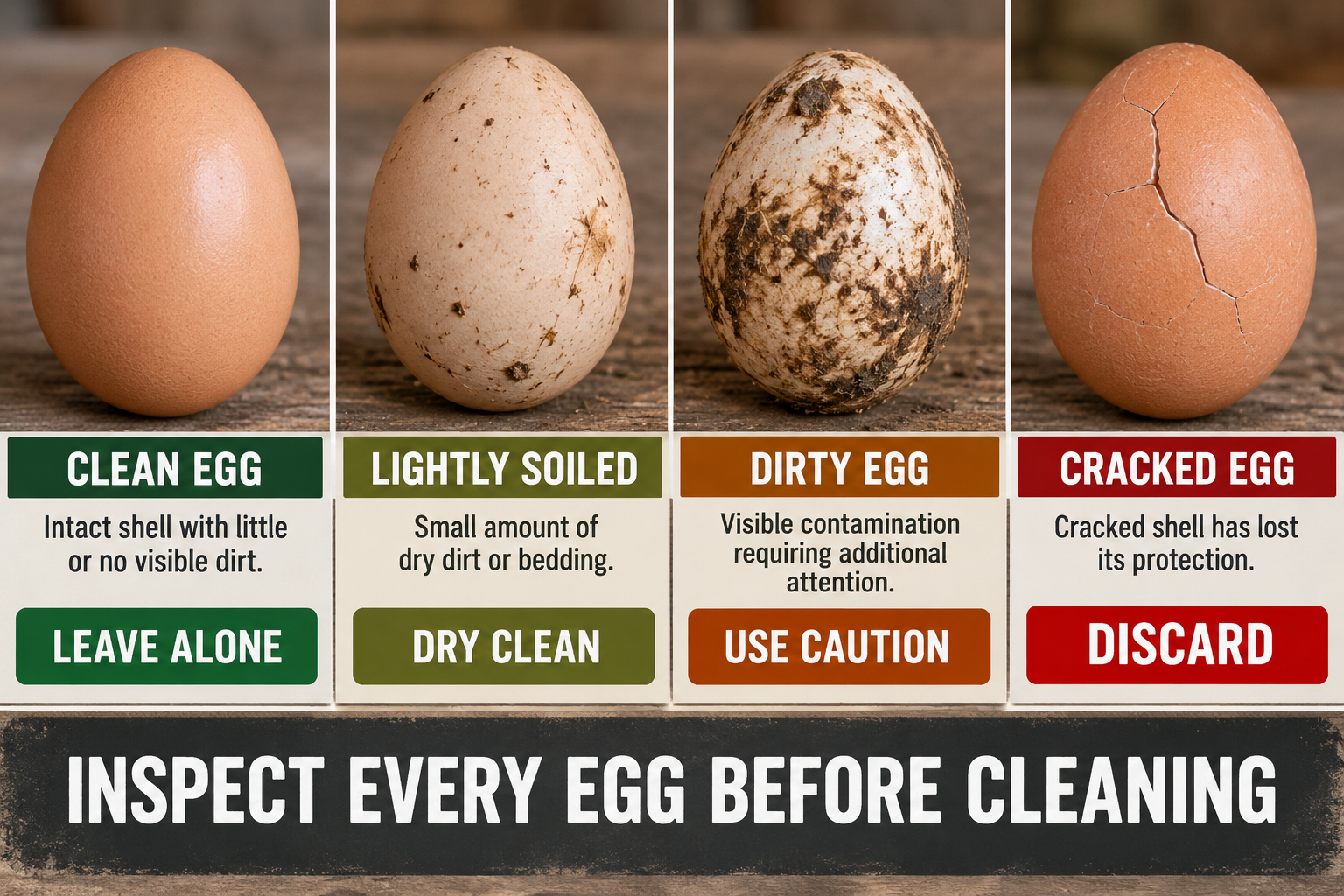
Before doing anything with a freshly collected egg, look at it carefully.
A clean, intact egg may need little or no cleaning. An egg with a small amount of dry bedding or dirt may only need dry cleaning. An egg covered with material that cannot be removed safely is a different matter.
Pay particular attention to cracks.
Do not try to rescue a cracked egg by washing the outside. Once the shell is cracked, the physical barrier protecting the contents has been compromised. Canadian backyard-flock guidance recommends throwing away cracked eggs.
Also separate eggs heavily contaminated with fecal material rather than placing them together with the clean eggs.
The objective is not to make every egg look perfect. It is to identify which eggs can be safely kept and which should be discarded.
Dry Clean Fresh Eggs Whenever Possible
For backyard eggs, this should be the first cleaning method.
If an egg has a little dry dirt, dust, or nesting material stuck to it, try removing the material without water.
Use a clean, dry cloth, paper towel, brush, or purpose-made egg-cleaning material and gently remove the debris. Public Health Agency of Canada guidance specifically recommends clean, dry, slightly abrasive material and says eggs with debris that cannot be brushed away should be discarded.
Do not aggressively scrub the entire shell simply because one small area is dirty. Clean only what needs cleaning and handle the shell gently.
Dry cleaning helps preserve more of the shell’s natural protective layer while still removing loose contamination.

When an Egg Really Does Need Washing
Sometimes dry cleaning is not enough.
If you choose to wash a backyard egg with water, the objective is to remove the contamination without encouraging contaminants on the outside of the shell to move inward.
This is where water temperature becomes important.
Never wash fresh eggs in cold water.
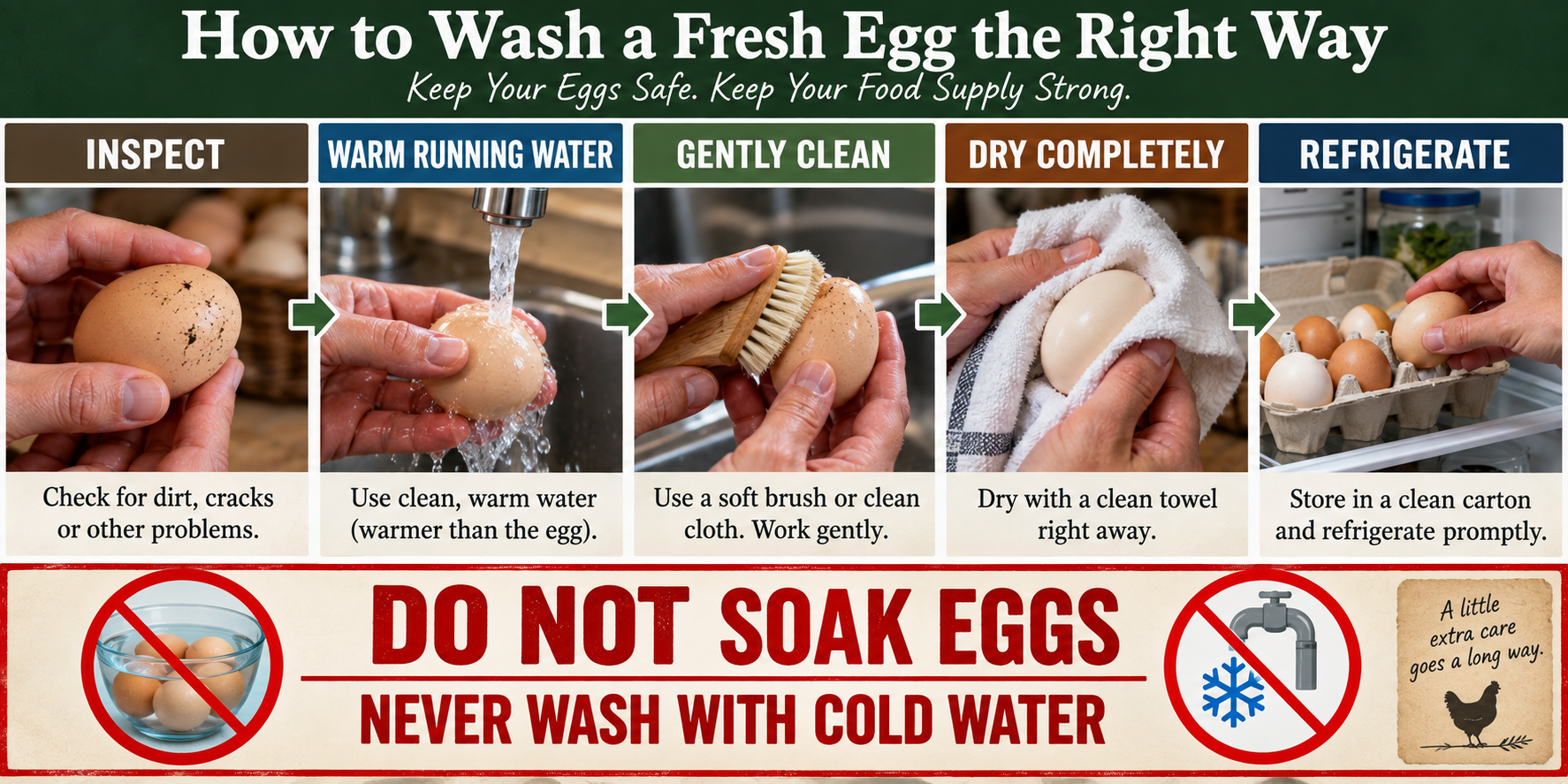
Use clean, potable water that is warmer than the egg but not excessively hot. Canadian public-health guidance recommends bringing eggs to room temperature and using warm water. Cold water can cause the contents of the egg to contract and potentially draw contamination through the shell’s pores.
Commercial egg-washing standards are more tightly controlled and should not simply be copied as a home recipe, but the same principle is visible there: Canadian inspection guidance specifies wash water warmer than the egg and cautions against excessive temperature differences that can contribute to thermal cracking.
For a backyard flock, the simple rule is easier to remember:
Warm water. Warmer than the egg. Never cold.
Wash One Egg at a Time
Do not fill the kitchen sink with water and leave a dozen eggs soaking in it.
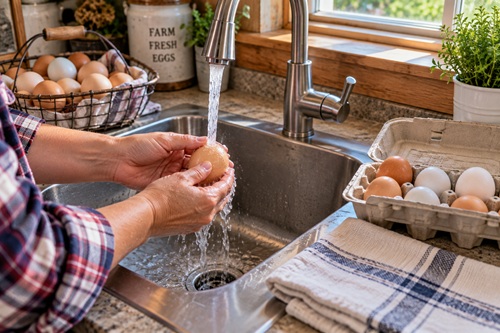
Instead, wash eggs individually under clean running water.
Hold the egg carefully and allow the warm water to run over the dirty area. Gently loosen remaining material with a clean cloth or suitable egg-cleaning brush.
Work quickly.
You are trying to remove contamination from the shell, not give the egg a bath.
Public Health Agency of Canada specifically recommends running water rather than soaking eggs.
A shared bowl or sink of dirty water can also become increasingly contaminated as additional eggs are washed.
Clean water should be moving away from the egg, carrying contamination with it.
Don’t Reach for Ordinary Dish Soap
A dirty egg may tempt you to treat it like a dirty plate.
It isn’t one.
Do not automatically reach for scented dish detergent, household cleaners, disinfectant sprays, or other products that were never intended for washing shell eggs.
If a cleaning product is needed, Canadian backyard-flock guidance recommends using an egg-washing detergent according to the manufacturer’s instructions.
This is another reason prevention matters. Clean nesting boxes and frequent egg collection reduce the number of eggs that ever require wet cleaning.
Dry the Egg Immediately
Washing is only half the job.
Once the egg is clean, dry it promptly and completely using a clean cloth or paper towel.
Do not leave a collection of wet eggs sitting on the counter to air dry slowly.
Canadian public-health guidance recommends drying washed backyard eggs quickly and thoroughly.
Then place the cleaned eggs into a clean carton or appropriate container.
At this point, treat the egg as refrigerated food.
Refrigerate Cleaned Eggs
Once backyard eggs have been cleaned, they should go into the refrigerator.
Public Health Agency of Canada recommends refrigerating eggs after cleaning and says backyard eggs can be stored in the refrigerator for approximately three to four weeks. Storing them with the pointed end downward may help preserve quality longer.
Health Canada recommends keeping refrigerators at 4°C (40°F) or colder, and keeping eggs in their carton helps protect them from damage.
Write the collection date on the carton if you regularly collect eggs. If several cartons are in the refrigerator, use the oldest eggs first.
That simple rotation system prevents perfectly good food from becoming forgotten at the back of the refrigerator.

Don’t Move Refrigerated Eggs Back and Forth
Once eggs are refrigerated, keep them refrigerated.
Repeatedly allowing cold eggs to warm and then chilling them again is unnecessary and makes temperature control more difficult.
Health Canada advises that eggs should not remain at room temperature for more than two hours and recommends discarding eggs that have exceeded that period.
This is particularly important during summer, power outages, transportation, camping trips, or farmers-market activities where eggs may spend more time outside controlled refrigeration.
If refrigeration is part of your egg-storage system, maintaining the cold chain becomes part of the system too.
Keep Your Egg-Cleaning Area Clean
Cleaning eggs can spread contamination around the kitchen if the workspace itself is ignored.
Wash your hands with soap and water for at least 20 seconds before and after handling eggs. Clean equipment used for egg handling and sanitize reusable equipment appropriately. Public Health Agency of Canada provides specific sanitation guidance for backyard-flock egg equipment.
Pay attention to sink handles, faucets, countertops, brushes, towels, egg baskets, and anything else touched while handling dirty eggs.
Avoid using the same dirty cloth repeatedly.
A clean egg placed back into a contaminated basket or carton defeats much of the work you just did.
Clean Eggs Begin With a Clean Coop
If you find yourself washing large numbers of eggs every day, the better solution may be outside the kitchen.
Look at the nesting boxes.
Are they staying dry?
Is bedding being replaced often enough?
Are hens sleeping in the nest boxes and leaving droppings behind?
Are eggs being collected frequently enough?
Are broken eggs attracting additional dirt?
A few improvements to flock management can dramatically reduce the amount of egg cleaning required.
The best egg-washing system is one that does not have to wash very many eggs.
Be Careful With Advice About Unrefrigerated Eggs
Backyard chicken keepers frequently hear that an unwashed egg can simply be left on the counter because its bloom remains intact.
There are traditional egg-handling systems built around unwashed eggs, and practices differ between countries. But Canadian public-health guidance does not recommend treating backyard eggs as automatically safe at room temperature simply because they have not been washed.
Health Canada advises refrigerating eggs as soon as possible, while Public Health Agency of Canada guidance specifically for backyard flocks recommends dry cleaning when possible and refrigerating eggs after cleaning.
That distinction matters for Prepper Offline because food-preservation advice should not turn a traditional practice into a safety guarantee.
The bloom is useful protection.
It is not sterilization.
Even an apparently clean egg can contain Salmonella or other harmful bacteria.
Selling or Giving Away Eggs Is Different
Keeping eggs for your own household and selling eggs commercially are not necessarily governed by the same rules.
Canadian commercial egg grading includes controlled washing, candling, inspection, weighing, packing, and refrigerated storage. Eggs graded Canada A must meet requirements for cleanliness, shell condition, and other quality factors.
Provincial and local requirements may also apply to farm-gate sales, farmers markets, or other direct sales.
If you plan to sell eggs, don’t assume that a home egg-washing method automatically satisfies the applicable rules. Check the requirements where the eggs will actually be sold.
The Simple Routine to Remember
Fresh egg handling does not need to become complicated.
Start in the coop by keeping nesting boxes clean and collecting eggs regularly. Inspect every egg when it comes inside. Discard cracked or heavily contaminated eggs. Dry clean lightly soiled eggs whenever possible.
When wet cleaning is necessary, use clean running water that is warmer than the egg. Do not use cold water and do not soak the eggs. Clean them individually, dry them immediately, and refrigerate them promptly.
Then clean your hands, equipment, and work area.
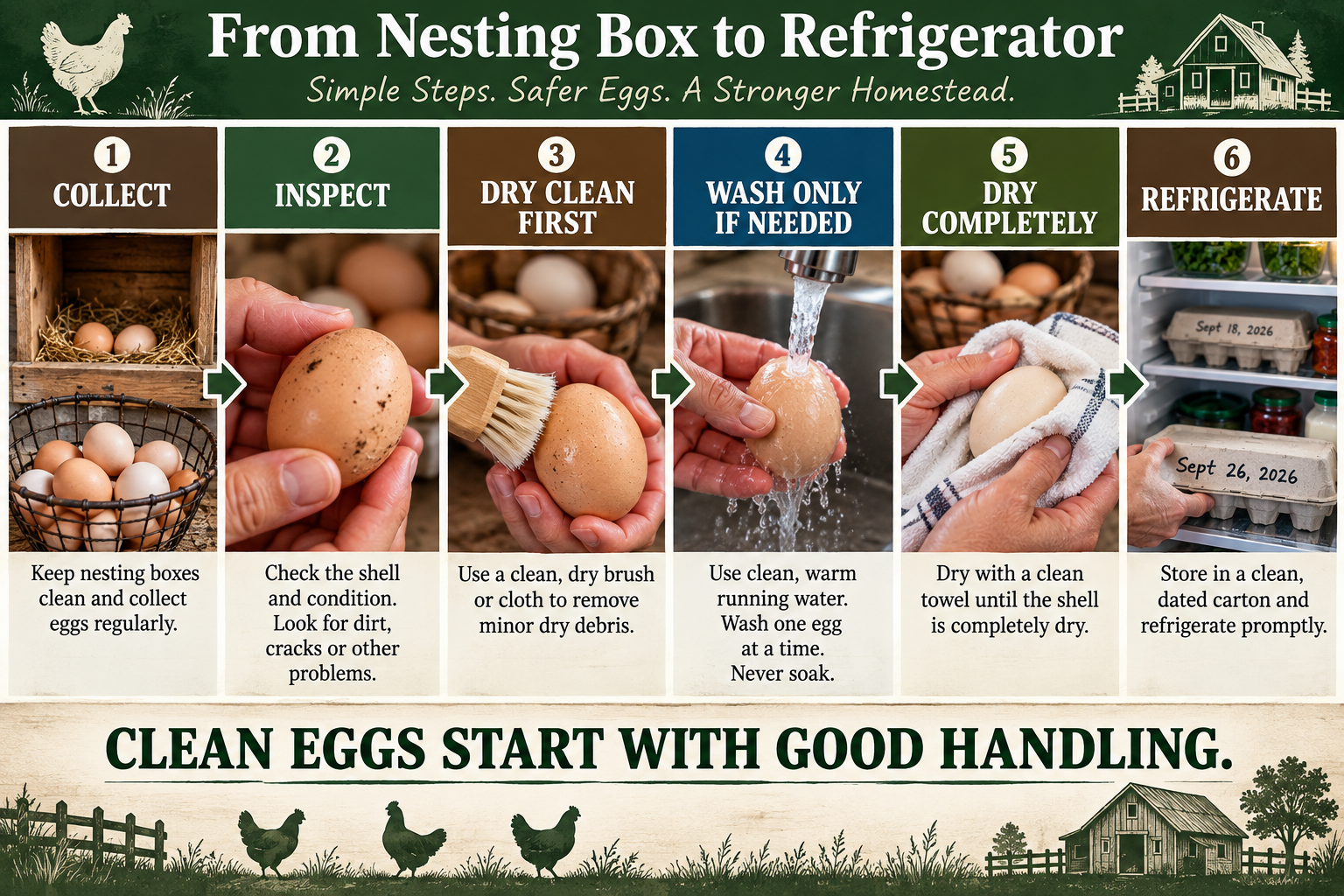
The whole routine can be remembered as:
COLLECT → INSPECT → DRY CLEAN FIRST → WASH ONLY IF NEEDED → DRY → REFRIGERATE
Preparedness Action Plan
Set up a dedicated egg-handling area before the next collection rather than improvising each time dirty eggs come into the house. Keep a clean dry brush or cloth available for routine cleaning, along with clean cartons, a marker for dating cartons, clean towels, and any egg-washing product you intentionally use.
Check the nesting boxes at the same time. Replace dirty bedding and correct whatever is causing unnecessary contamination. Collect eggs at least twice daily when practical, especially when nests are heavily used.
Make refrigerator space part of the plan as flock production increases. A dozen hens producing well can quickly turn egg storage into a management problem, particularly during peak laying season.
Most importantly, establish one routine and make sure everyone in the household follows it. Consistency reduces the chance that one person dry-cleans eggs while another soaks them in cold water or leaves washed eggs sitting on the counter.
Key Takeaways
Fresh eggs already have a natural protective layer, so washing every egg simply because it came from the coop is unnecessary. Canadian backyard-flock guidance recommends dry cleaning as the preferred method.
Prevent dirty eggs by maintaining clean nesting boxes and collecting frequently. Discard cracked eggs and eggs heavily contaminated with feces rather than attempting to save them.
When an egg genuinely needs washing, use clean running water warmer than the egg, never cold water and never prolonged soaking. Dry the shell quickly and thoroughly afterward and refrigerate the egg.
Above all, remember that an egg looking clean does not guarantee that it is free of harmful microorganisms.
Good egg handling starts in the nesting box, continues at the cleaning station, and ends with proper refrigerated storage.
© Prepping Communities. This content is for informational purposes only and not professional advice. Use at your own risk.
Terms | Privacy | Guidelines