
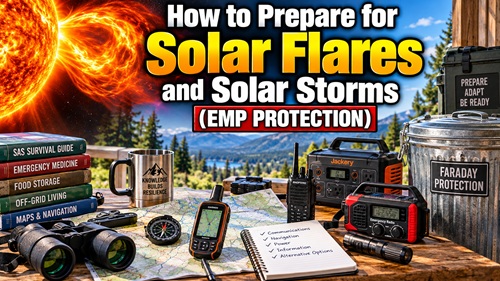
Most people hear the term EMP and immediately think about a nuclear weapon. But nature is capable of creating electromagnetic disturbances of its own. Powerful activity from the Sun can interfere with radio communications, GPS, satellites, and, under the right conditions, parts of the electrical grid. That does not mean every solar flare is going to destroy electronics or cause a nationwide blackout. It does mean that solar storms are another good reason to prepare for a situation where electricity and communications may suddenly become unreliable.
Preparing for a solar storm is really about preparing for two different problems. The first is protecting certain electronic equipment that could be useful after a major electromagnetic disturbance. The second, and probably more important problem, is learning how to function if the infrastructure those electronics normally depend upon is unavailable. A perfectly protected cellphone is not particularly useful if the cellular network is down. A protected laptop does not give you internet access if telecommunications systems are offline. A working radio becomes less useful if you have no way to replace or recharge its batteries.
The objective, therefore, should not be to protect every electronic device in the house. The objective is to preserve important capabilities while developing alternatives that do not depend entirely on electricity.
Understand What a Solar Storm Can Do
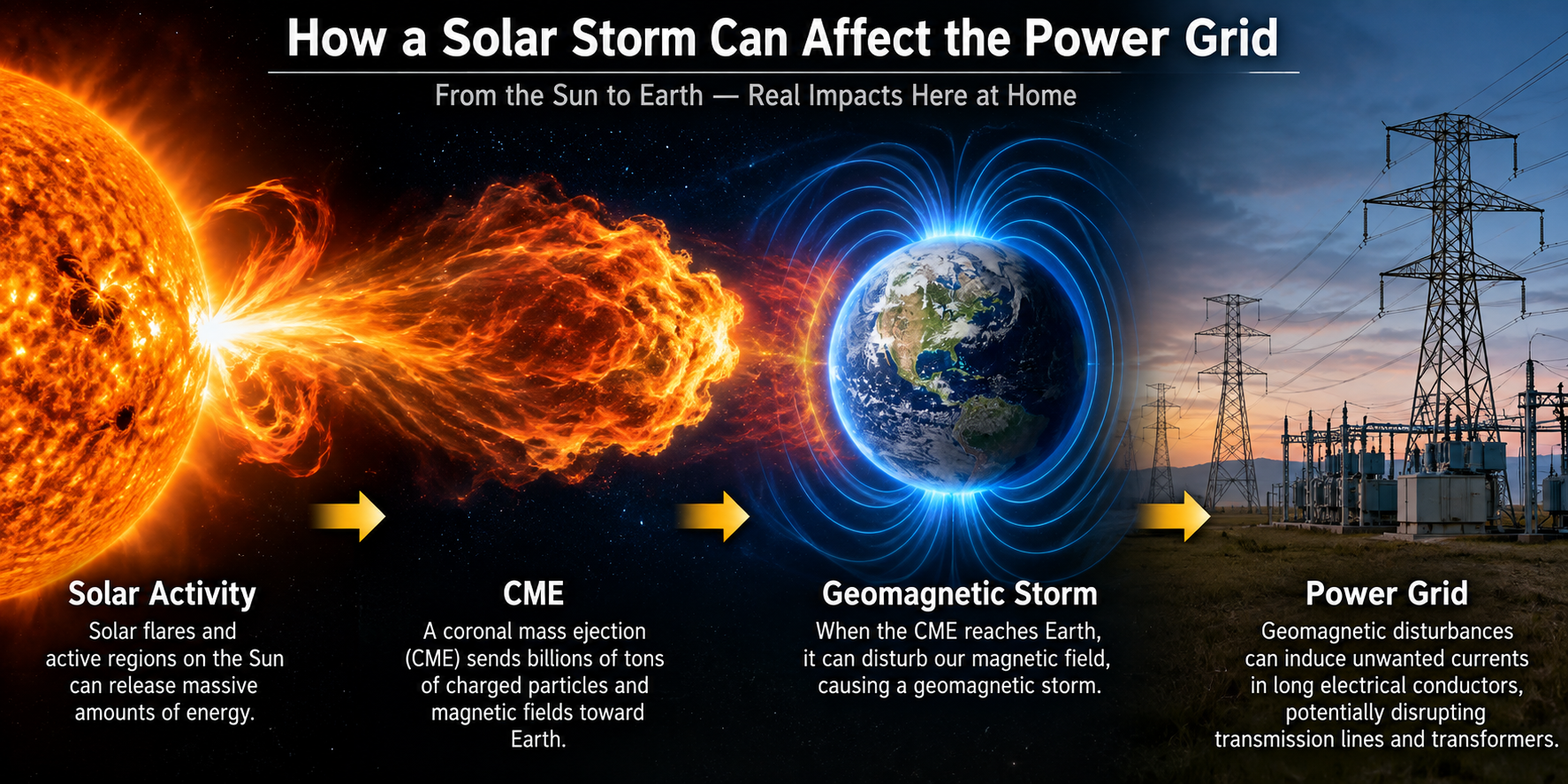
Solar flares and coronal mass ejections, commonly called CMEs, are related but different events. A solar flare is an intense release of electromagnetic radiation from the Sun. A CME involves a massive release of plasma and magnetic field into space. When a sufficiently powerful CME reaches Earth under the right conditions, it can disturb Earth’s magnetic field and produce what is known as a geomagnetic storm.
For people on the ground, one of the biggest concerns is the electrical infrastructure around us. Geomagnetic disturbances can induce currents in long electrical conductors. Large transmission lines and transformers are therefore much more significant concerns than assuming every disconnected flashlight, radio, or cellphone will automatically be destroyed.
This is an important distinction because preparation should match the actual problem. A solar storm and a high-altitude nuclear EMP are not identical events. They can affect electrical systems differently. Preparing for either, however, leads to many of the same useful preparedness measures: backup power, protected communications, offline information, alternative navigation, stored supplies, and the ability to live temporarily without the electrical grid.
Decide What Electronics Are Actually Worth Protecting
Before building anything, decide what equipment would actually help your household during an extended outage. There is little reason to fill a Faraday container with entertainment electronics while leaving your emergency communications and charging equipment unprotected.
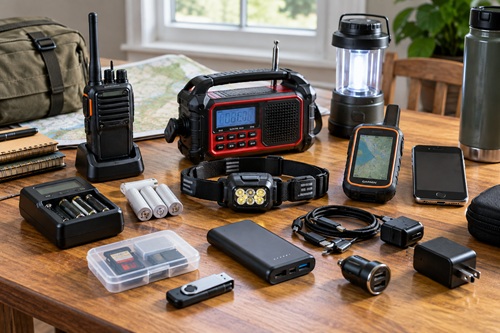
A battery-powered emergency radio is an obvious candidate because receiving information becomes extremely important during a widespread outage. Handheld two-way radios may allow communication between family members or neighbors. Flashlights and headlamps provide lighting. Rechargeable batteries and chargers keep those devices operating. Small power banks provide another layer of backup power. Spare solar charge controllers, charging cables, USB adapters, GPS equipment, offline phones, tablets, and storage devices containing emergency information may also be worth protecting.
Think about these devices according to what they allow you to do. You are not really protecting a radio; you are protecting your ability to receive information. You are not protecting a flashlight; you are protecting your ability to see after dark. You are not protecting a USB drive; you are protecting access to information.
That change in thinking makes it much easier to decide what belongs in your protected equipment cache.
Build a Simple DIY Faraday Container
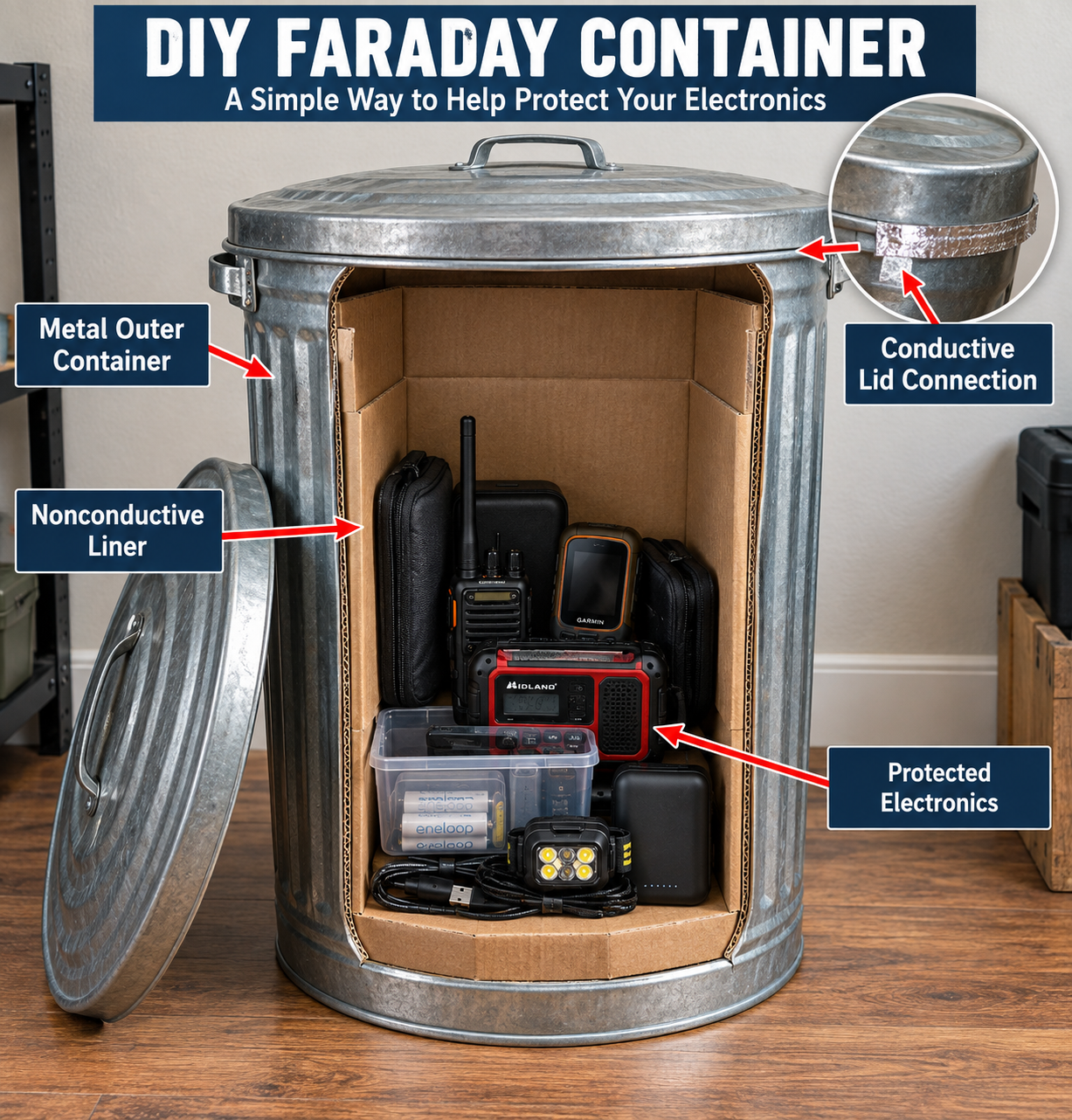
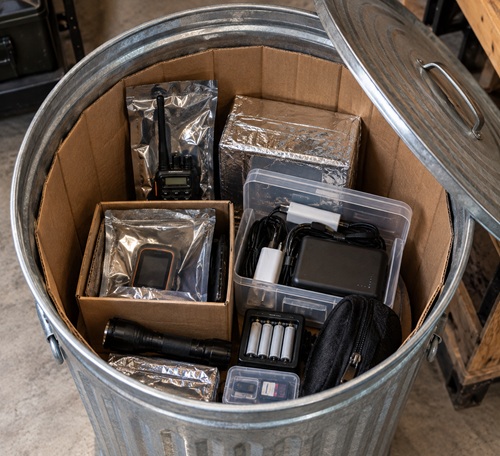
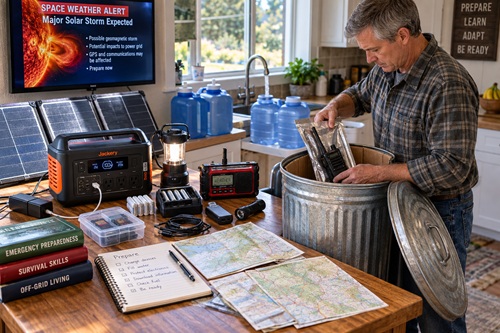
One practical DIY approach is to use a galvanized steel trash can with a tightly fitting metal lid. The metal container becomes the conductive enclosure surrounding the protected equipment.
The electronics inside should not sit directly against the metal. Cut heavy cardboard or another suitable nonconductive material to fit the bottom of the container and then line the sides. Smaller cardboard boxes can be used to organize individual pieces of equipment while providing additional physical separation from the conductive exterior.
There are two different principles working together here. The electronic equipment should be electrically isolated from the metal enclosure, while the conductive enclosure itself needs good electrical continuity. In other words, you want metal surrounding the equipment without the equipment itself touching that metal.
The lid deserves particular attention because openings and poorly connected seams can reduce the effectiveness of the enclosure. A metal trash can may look completely enclosed when the lid is installed, but painted surfaces, loose-fitting sections, or gaps can interfere with electrical continuity.
Conductive gasket material or conductive foil tape can be used where appropriate to improve electrical contact around the lid. Ordinary duct tape or masking tape can physically hold something together, but it should not be confused with conductive material. The goal is to create as continuous a conductive enclosure as reasonably possible.
Once the electronics are insulated from the metal and the lid has been properly fitted, the basic Faraday container is complete.
Add Another Layer Around Critical Equipment
Some equipment may be important enough to justify a second protective layer. Instead of placing a radio directly into the larger protected container, for example, it can first be placed inside an appropriate Faraday bag or another properly constructed conductive enclosure.
This creates nested protection. If the outer enclosure develops a problem, the inner enclosure provides another barrier. The principle is similar to having multiple backups for water purification or power generation rather than depending entirely on one system.
Care still needs to be taken to prevent electronics from directly contacting conductive wrapping. If heavy-duty aluminum foil is being used for a smaller DIY enclosure, place the electronic device inside a cardboard box or another nonconductive container first. The exterior can then be completely enclosed with overlapping layers of conductive material.
Pay particular attention to seams, corners, openings, and places where conductive material joins together. Complete enclosure and electrical continuity matter more than simply piling on material.
Protect Communications, Not Just Radios
Emergency communication deserves special attention because information can become extremely valuable during a widespread power outage. A battery-powered AM/FM radio provides a relatively simple way of receiving broadcasts if stations remain operational. Weather-capable radios may provide additional emergency information. Amateur radio and other two-way radio systems can provide additional communication options for people with the appropriate equipment, knowledge, and licensing.
A good approach is to keep everyday communications equipment available while protecting backup equipment. The radio you use regularly does not necessarily need to spend its entire life sealed inside a Faraday container. A second radio can remain protected specifically for an emergency.
The same idea applies to batteries and charging equipment. Protecting the radio while forgetting about its power supply creates another single point of failure. Spare rechargeable batteries, charging cables, adapters, and other small supporting equipment should be considered part of the communications system.
Create an Offline Navigation Backup
Modern navigation has become almost completely dependent upon GPS. That dependence is easy to overlook because satellite navigation works so reliably during normal conditions. Solar activity, however, can interfere with satellite signals and navigation accuracy.
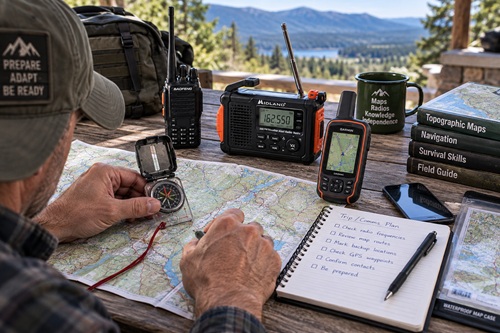
Paper maps are one of the easiest ways to eliminate this dependency. Keep detailed maps of your local area, surrounding communities, major highways, secondary roads, evacuation routes, and destinations you might need during an emergency. Important locations can be marked before anything happens.
A protected GPS receiver or an offline cellphone containing maps can still be extremely useful, but neither should be your only navigation capability. A paper map does not require satellites, batteries, cellular towers, software updates, or an internet connection.
The equipment is only part of the solution. Learn how to read the map before you need it. Navigation is a capability that should remain available even when the technology supporting modern navigation does not.
Build Independent Backup Power
Protecting electronics makes little sense if there is no way to power them afterward. This makes backup electricity one of the most important parts of solar-storm preparedness.
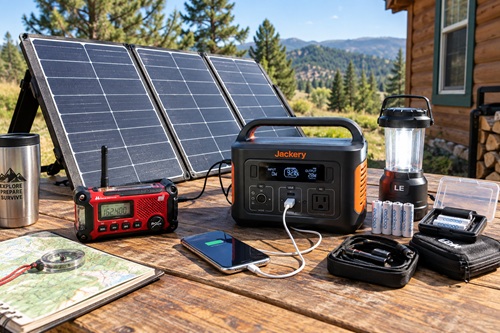
A modest emergency power system does not need to operate an entire house. Its first job can simply be keeping communications, lighting, and small electronics working. Portable solar panels, rechargeable batteries, power banks, and small portable power stations can provide this capability.
Think about the complete power chain. A solar panel may produce electricity, but the system may also require a charge controller, cables, adapters, batteries, or an inverter before that energy becomes useful. Protecting spare components can therefore be more useful than protecting one expensive piece of equipment.
For example, a spare solar charge controller takes relatively little storage space but could become extremely valuable if the controller operating your emergency solar system failed. The same principle applies to charging cables, USB adapters, battery chargers, and other inexpensive components.
Redundancy does not always mean buying another expensive system. Sometimes it means having inexpensive replacement components for the parts most likely to stop the system from functioning.
Prepare for the Power Outage
This is where solar-storm preparedness becomes much larger than EMP protection.
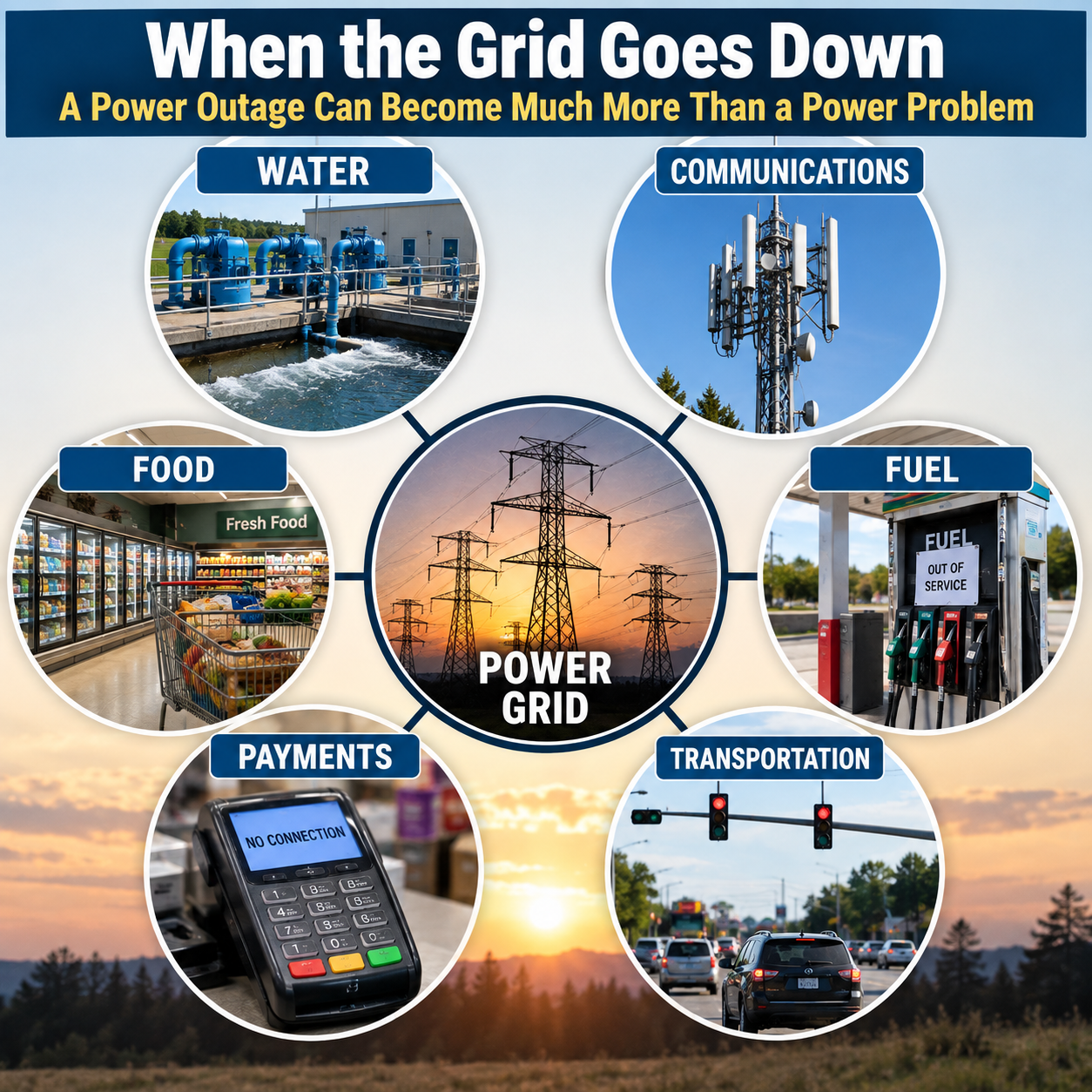
Imagine that every electronic device you protected survives perfectly, but the electrical grid does not. Your refrigerator stops working. A private well may stop pumping water. Gas stations may be unable to operate their pumps. Debit and credit card terminals may stop working. Cellular towers eventually exhaust their backup power. Internet service becomes unreliable. Stores may have difficulty processing transactions or restocking shelves.
Municipal water and wastewater systems also depend upon electricity, communications, pumps, treatment equipment, chemicals, transportation, and trained personnel. A sufficiently prolonged outage can therefore become a water and sanitation problem as well as an electrical problem.
This is why a Faraday cage should never be mistaken for a complete solar-storm preparedness plan.
Stored drinking water, shelf-stable food, necessary medications, sanitation supplies, alternative lighting, safe backup cooking methods, appropriate emergency heat, cash, and other ordinary preparedness supplies may ultimately prove much more important than electromagnetic protection.
Prepare for the consequences of the event rather than becoming fixated on the event itself.
Use Advance Warning Wisely
One advantage of solar-weather events is that they are monitored. A significant eruption from the Sun does not necessarily translate into an immediate impact on the ground. Depending upon the event, authorities and space-weather organizations may have time to analyze what has happened and issue alerts or warnings.
That warning time is valuable.
If credible authorities warn of a potentially significant geomagnetic storm, use the opportunity to put your existing preparedness plan into action. Recharge batteries, radios, power banks, and portable power stations. Make sure vehicles have fuel. Fill appropriate water containers. Confirm that emergency lighting works. Download information that may be needed later and make sure paper maps are accessible.
Backup electronics that are not needed immediately can be placed inside their protected containers. Equipment that does not need to remain connected can be disconnected from external wiring where doing so is safe and appropriate.
Avoid improvised work on electrical panels, utility equipment, or other high-voltage systems. Solar-storm preparedness should reduce risk rather than introduce an electrical hazard while attempting to protect equipment.
Protect Your Information Too
There is another dependency that often receives much less attention than electricity.
Information.
Consider how often a modern household solves a problem by searching the internet. Cooking instructions, medical information, equipment manuals, maps, repair instructions, gardening information, radio frequencies, water-treatment instructions, emergency contacts, and countless other pieces of knowledge are normally only seconds away.
That changes when communications infrastructure disappears.
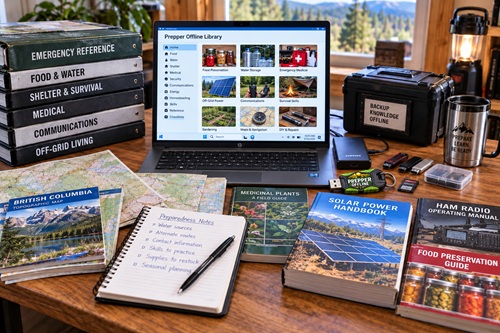
Important information should therefore exist offline before an emergency occurs. Critical material can be printed, while larger collections of information can be stored on USB drives, memory cards, laptops, tablets, or other offline devices.
Digital information should have more than one copy, and at least some of the equipment required to access it can be stored with protected electronics.
A working laptop without the information you need is only a functioning machine. A functioning device containing maps, manuals, emergency instructions, reference material, and other useful knowledge becomes a preparedness resource.
Keep Non-Electronic Alternatives
One of the strongest ways to prepare for an electromagnetic event is surprisingly simple: make sure some important capabilities do not require electronics at all.
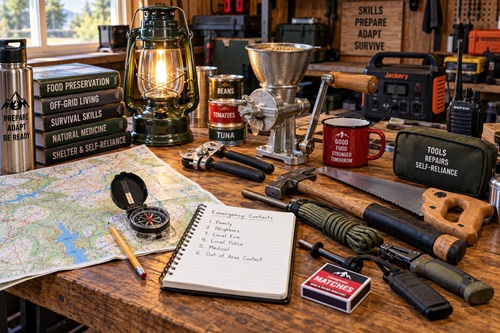
Keep manual can openers rather than depending only on electric ones. Have paper maps in addition to GPS. Keep printed emergency contacts rather than relying exclusively on a cellphone. Maintain hand tools alongside powered tools. Have ways to cook that do not depend upon the electrical grid. Keep physical records of information that would be difficult to reconstruct.
The goal is not to abandon technology. Technology provides enormous advantages during emergencies.
The goal is to prevent technology from becoming the only way you know how to perform an essential task.
Whenever an important capability depends completely upon one electronic system, ask what you would do if that system disappeared.
That question often reveals the preparedness gap more clearly than trying to predict exactly what a solar storm will damage.
Maintain Your Faraday Protection
A DIY Faraday container should not be built once and forgotten.
Periodically inspect the container for corrosion or physical damage. Check the lid, conductive seams, gasket material, and other areas responsible for maintaining the conductive enclosure. Inspect stored electronics and batteries. Recharge equipment according to the manufacturer’s recommendations and remove batteries from equipment when appropriate for long-term storage.
Commercial Faraday bags can also wear through repeated folding, opening, and handling. Treat them as equipment rather than permanent protection that can never deteriorate.
Offline information should also be reviewed periodically. Maps change. Emergency contacts change. Equipment gets replaced. Manuals become outdated. Storage devices can fail.
Preparedness equipment works best when it is maintained as a system.
What Faraday Protection Cannot Do
It is important not to develop false confidence simply because electronics have been protected.
A protected cellphone does not guarantee that cellular towers will operate. A protected radio does not guarantee that a station will be transmitting. A protected computer does not restore the internet. A protected GPS receiver still depends upon functioning satellites. A protected power station eventually becomes useless if there is no way to recharge it.
Faraday protection also does nothing about food, water, sanitation, medicine, heating, transportation, or fuel.
This is why electromagnetic protection should be viewed as one layer of a larger preparedness system rather than the solution itself.
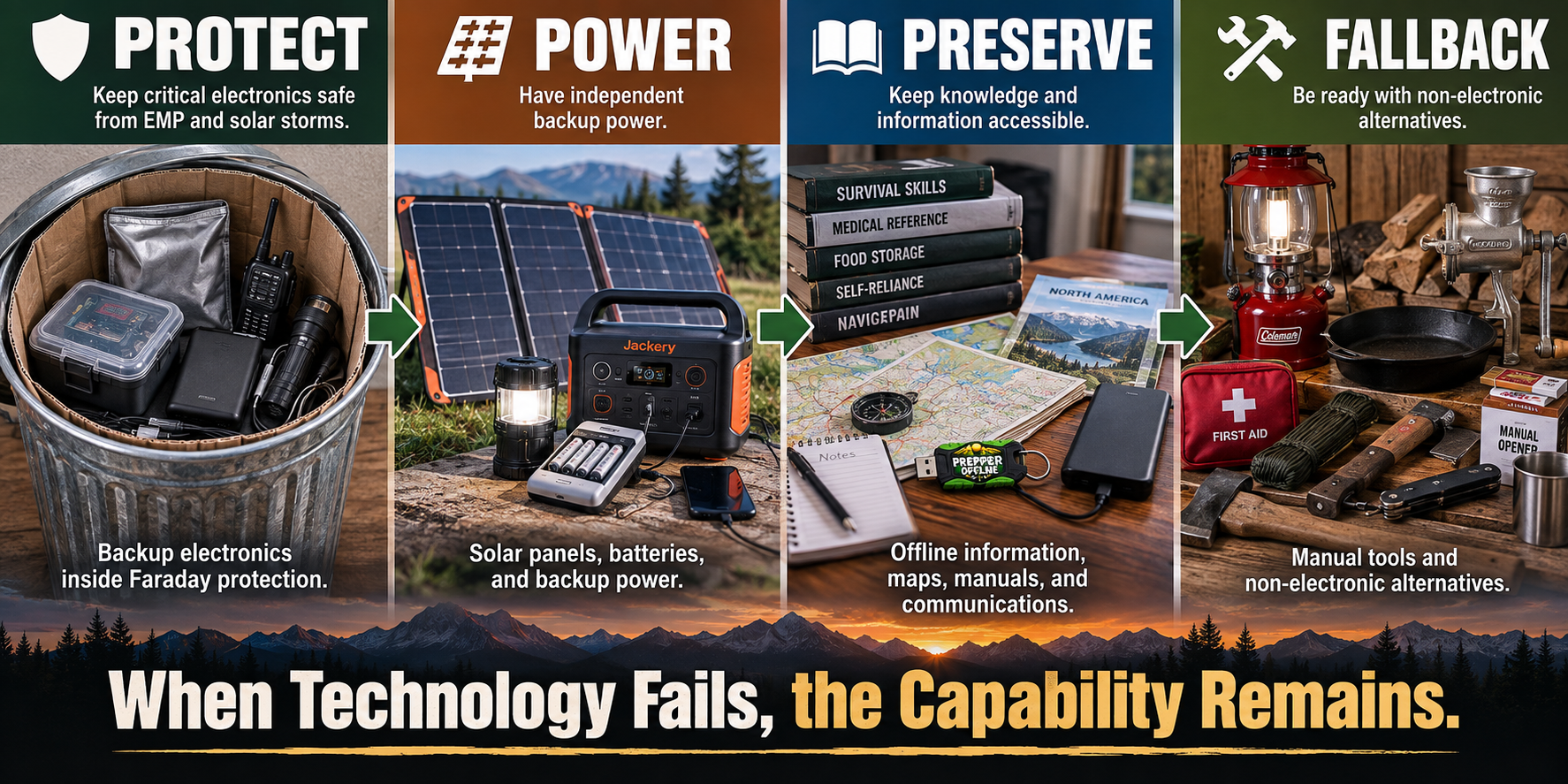
Protect the device. Protect or provide the power necessary to operate it. Preserve the information needed to use it. Then maintain a simpler fallback whenever practical.
Build Capability Instead of Collecting Equipment
A good solar-storm preparedness system should preserve basic household capabilities even as technology becomes less available.
Water keeps the household hydrated. Stored food provides time for disrupted supply chains to recover. Backup power keeps selected equipment operating. Radios preserve access to information. Paper maps maintain navigation. Offline information preserves access to knowledge. Manual tools allow work to continue without electricity.
Faraday protection adds another layer by increasing the likelihood that selected electronic equipment remains available.
The important part is how all these pieces work together.
A radio, batteries, charging system, solar panel, backup information, and the knowledge required to operate them form a capability. Any single piece of equipment by itself is much less useful.
That is the mindset to use when preparing for solar storms.
Preparedness Action Plan
Begin by identifying the handful of electronic capabilities your household would most want after an extended power outage. Communications, lighting, navigation, small-device charging, and offline information are good places to start.
Build or obtain appropriate protection for backup equipment rather than attempting to protect everything you own. If constructing a DIY metal Faraday container, electrically isolate the contents from the metal enclosure while maintaining good conductive continuity around the exterior enclosure and lid.
Then look beyond electromagnetic protection. Determine how you would obtain drinking water, prepare food, maintain sanitation, receive information, navigate, provide lighting, charge essential equipment, and manage basic household needs if grid electricity disappeared.
Create non-electronic alternatives wherever practical.
Finally, write down what your household will do if a credible severe geomagnetic-storm warning is issued. Charging equipment, topping up water, checking fuel, downloading information, confirming communications, and protecting backup electronics should become predetermined actions rather than decisions made under pressure.
The purpose of preparation is not to predict exactly what the Sun will do.
It is to make sure that if technology becomes temporarily unreliable, your household does not become helpless with it.
Key Takeaways
Solar-storm preparedness is much more than putting electronics inside a Faraday cage. A sufficiently disruptive event could affect electricity, communications, navigation, internet access, electronic payments, water systems, transportation, and supply chains.
Faraday protection can help preserve selected electronics, particularly backup communications, lighting, charging equipment, navigation devices, and offline information systems. But those devices remain dependent upon power, infrastructure, information, and the skills required to use them.
The stronger approach is to build layers of capability and redundancy.
Protect useful technology, maintain independent power, keep important knowledge offline, preserve manual alternatives, and prepare the household to function when the systems normally taken for granted are no longer available.
The objective is not to protect every electronic device you own. It is to make sure the capabilities you depend upon do not disappear when the grid does.
© Prepping Communities. This content is for informational purposes only and not professional advice. Use at your own risk.
Terms | Privacy | Guidelines