
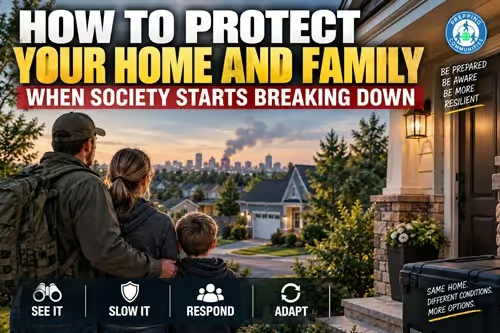
Most id=”top”home-security advice assumes the world around your house is still working normally. If somebody tries to break in, you call 911. Your alarm company receives the signal. Cameras send notifications to your phone. Streetlights are on, police are patrolling, and if somebody breaks a window you can probably get it repaired fairly quickly.
Preparedness changes some of those assumptions.
It doesn’t take a complete collapse of society for home security to become more difficult. A major blackout, wildfire, earthquake, communications outage or prolonged civil emergency can start removing some of the systems we normally depend on. The first night without electricity may be little more than an inconvenience. After several days, streetlights are still dark, alarm batteries are getting low, some gas stations and stores may not be operating normally, cell service could be spotty and emergency crews may be dealing with a lot more calls.
If it continues, other problems start creeping in. Supplies become harder to replace. Some people leave the area. Everyone gets tired. Most people will still be doing exactly what you’re doing – looking after themselves and their families – but shortages, frustration and slower emergency response can change what is happening around a neighborhood.
The house itself hasn’t changed. The environment around it has, and your security may need to change with it.
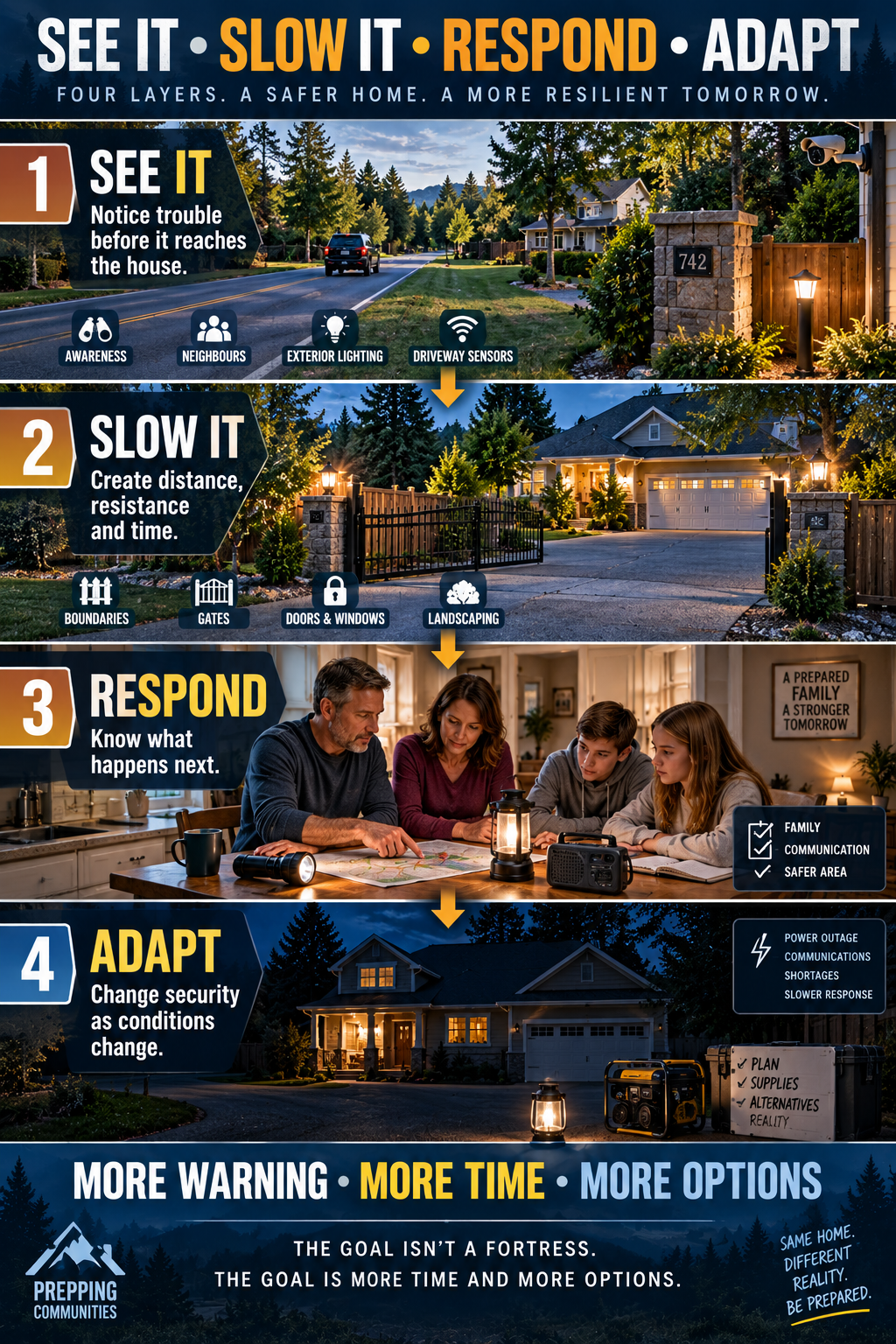
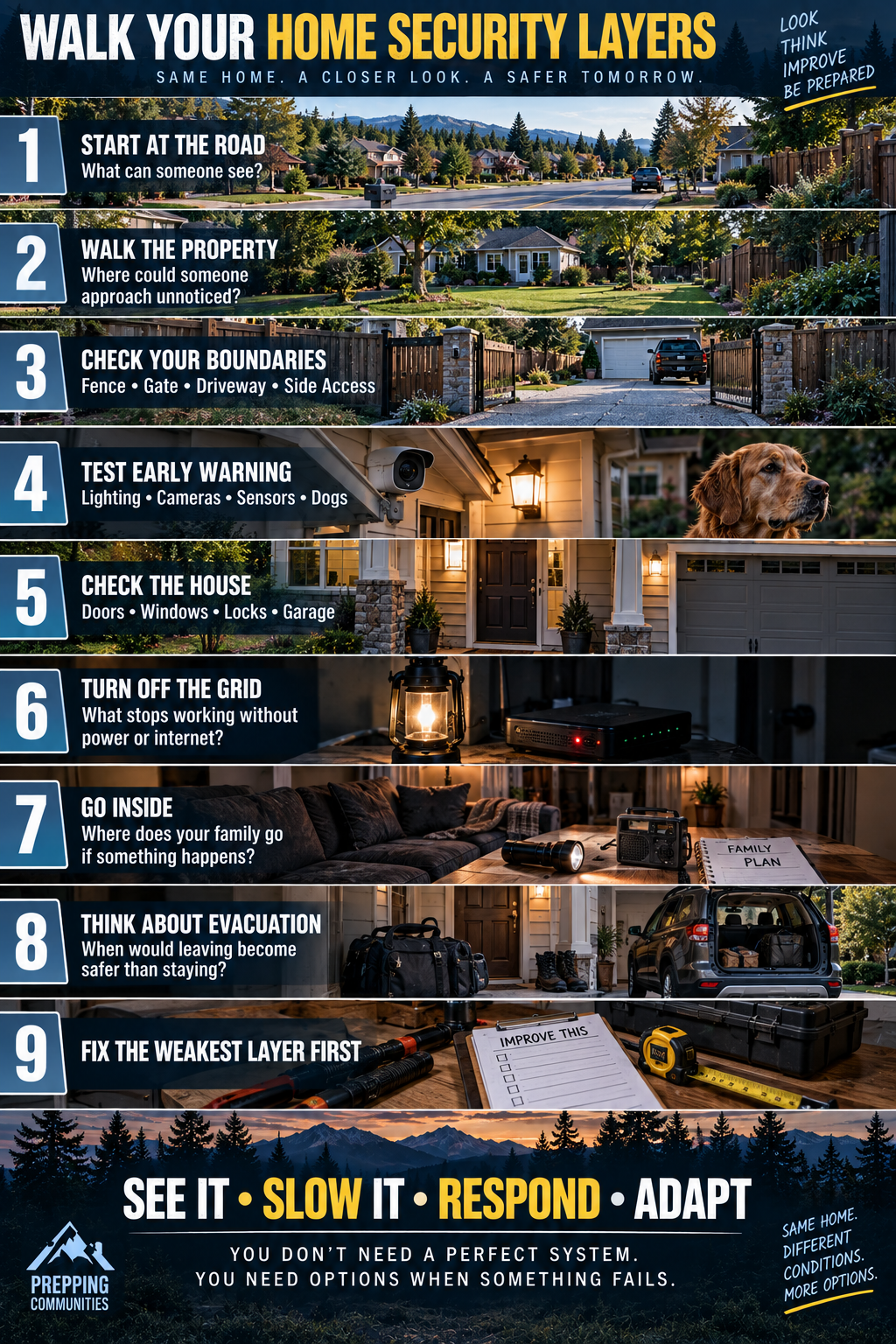
One way to keep the whole subject manageable is to think about four things as you look around your property: see it, slow it, respond and adapt. Ideally you want to notice trouble before it reaches the house, put enough obstacles in the way to give yourself some time, know what your family will do if there really is a problem, and then adjust as conditions change.
When Normal Security Starts to Fail
A serious disruption probably won’t come with some obvious moment when normal life ends and everything suddenly becomes lawless. It is more likely to be uneven. One service works while another doesn’t. Electricity comes back for a few hours and goes out again. One gas station opens while another remains closed. Police are still answering calls, but response times aren’t what they were last week.
That matters because there is no reason to treat every power outage like the end of civilization. Your security can change gradually along with the situation.
If the power has been out for three days, maybe equipment normally left outside gets brought into the garage. You check batteries and backup lighting. Doors that sometimes remain unlocked while everyone is home start getting locked earlier. You talk to the neighbor’s a little more often because they’re hearing things you aren’t.
If conditions return to normal, great. If they don’t, you reassess.
That is probably a more useful preparedness habit than trying to predict exactly what some future collapse will look like.
Start Farther Away From the Front Door
Walk to the edge of your property sometime and look back at your house.
It’s surprising what you notice when you deliberately look at the place as though you don’t live there. Can somebody drive right up to the house? Could a person walk across the property without being noticed? Is there a side trail, alley, wooded area or neighboring property that provides another approach? Maybe a shed, parked vehicle or overgrown hedge blocks the view of one side of the house.
Then walk toward the house yourself and pay attention to when somebody inside would realistically know you were there.
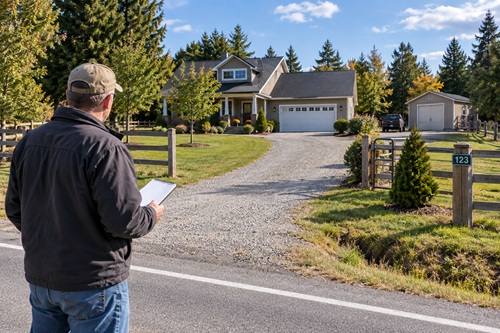
For a rural property, that might be hundreds of feet away. In a subdivision it could be the sidewalk. In an apartment the whole exercise is different again, but the principle still works.
Knowing that an unfamiliar vehicle just entered the driveway gives you more time to figure out what is happening than discovering somebody already standing at the back door. A lot of home security really comes down to creating that extra time.
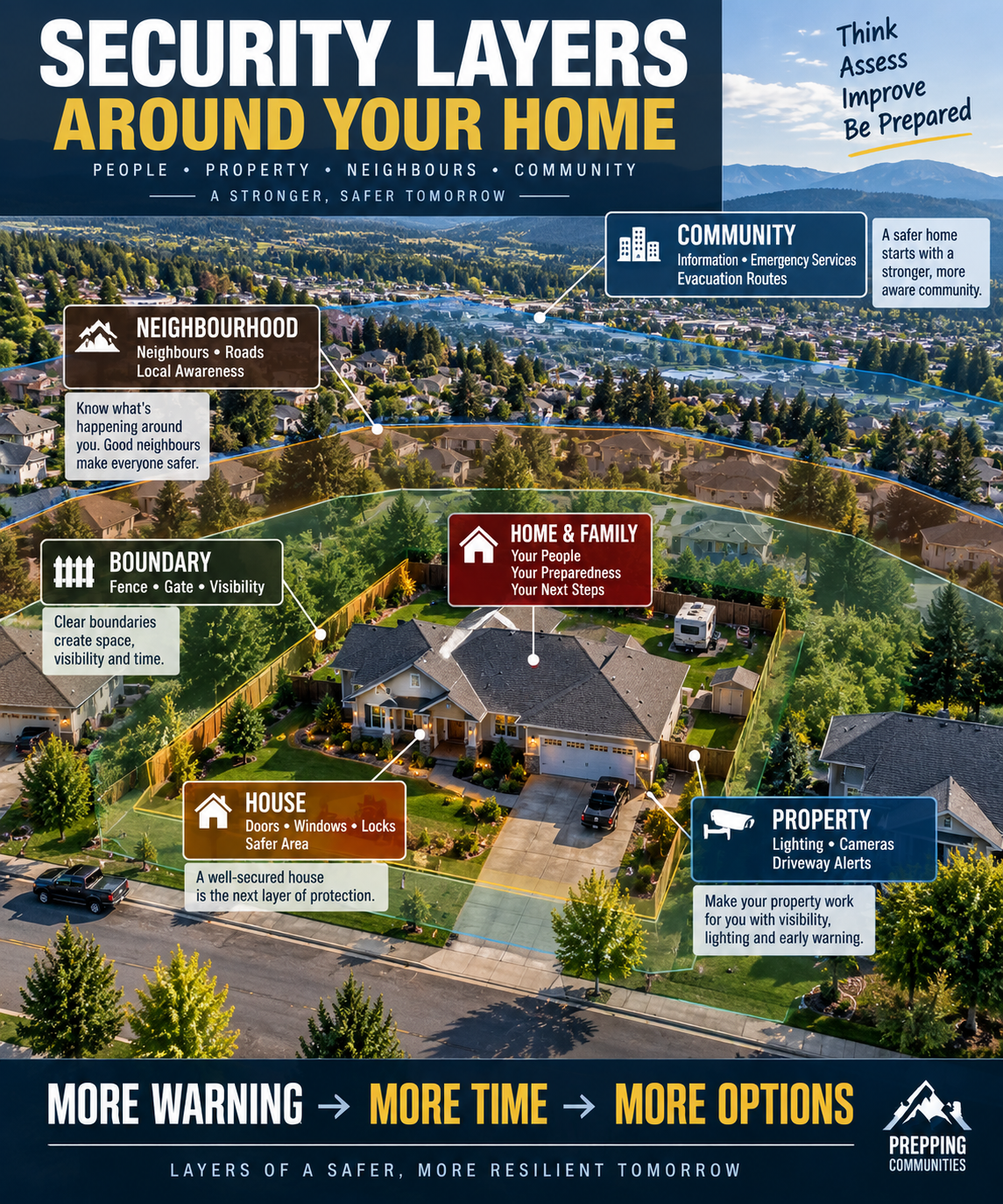
This is where fences, gates, driveway alarms, lighting and cameras start working together. None of them guarantees anything. A person can climb a fence. A gate can be defeated. Cameras mostly observe rather than stop anyone. But a closed gate changes how a vehicle can approach, a driveway sensor lets you know something has arrived, and a camera may tell you whether it’s a neighbor, delivery driver or somebody you don’t recognize.
They don’t all have to solve the same problem.
Don’t Advertise Everything You Have
Take another look at the house from the road, but this time look for things somebody might want.
A generator sitting beside the garage probably isn’t particularly interesting when the local hardware store has twenty of them. During an extended blackout when generators are sold out everywhere, it may look different. The same can eventually apply to fuel, tools, batteries and other supplies.
Some of this is just ordinary common sense. Expensive equipment doesn’t need to be visible from the road if there is somewhere better to keep it. Garage windows don’t need to provide a showroom view of everything inside.
The same applies online. It’s easy to post a picture of a new generator, preparedness supplies or another expensive purchase without thinking about how much the photograph shows. Vacation posts can tell people that nobody is home. Even packaging left beside the garbage can occasionally tells more of a story than intended.
There is no need to become secretive about everything you own. Good neighbors knowing you are prepared can actually be an advantage. The point is simply to have some control over who knows what instead of broadcasting it without thinking.
Your Neighbors Matter More Than You Might Think
Individual preparedness has limits, especially when an emergency lasts more than a few days.
A camera may show an unfamiliar vehicle on your road. A neighbor who has lived there for twenty years may know immediately that it doesn’t belong there. Somebody walking their dog might notice that your garage door is open when they know you’re away. You may notice something at their property and give them a call.
None of this requires organizing a formal neighborhood patrol. Knowing a few people around you is enough to start.
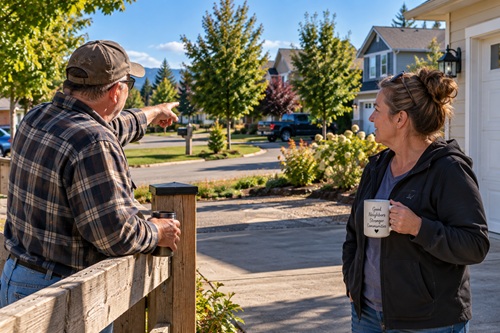
Exchange phone numbers with neighbors you trust. Know roughly who lives nearby and which vehicles normally belong there. If you’re going away for several days, having someone who will notice something unusual at your house is useful during normal times, never mind an emergency.
During a prolonged outage those relationships can become even more useful. Someone may know why the road is blocked, whether the gas station has reopened or when the power crew came through. Maybe somebody heard that another road into town is still open. It isn’t sophisticated intelligence gathering. It’s people who live in the same place comparing what they know.
It also helps to understand the area itself. Know the roads, back roads and trails around you. Have a reasonable idea where police, fire and medical help are coming from. Think about where people will naturally travel if grocery stores, pharmacies or fuel stations start having trouble.
Knowing what normal looks like makes it easier to notice when something genuinely changes without treating every stranger or unfamiliar vehicle as a threat.
Find Out Whether Your Early Warning Actually Works
Driveway sensors, cameras, motion lighting, door sensors and dogs can all give you warning before somebody reaches the house. What matters is whether they work the way you think they do.
Try them.
Have somebody walk down the driveway while you watch the camera. Do it again after dark. Approach from the side instead of straight on. Check what happens when headlights point toward the camera.
You may discover the expensive camera gives you an excellent view of the top of everyone’s head because it was mounted too high. Maybe the lilac bush you planted five years ago now blocks half the driveway. Perhaps the motion light doesn’t switch on until somebody is almost standing underneath it.
Those are exactly the kinds of things worth discovering on a quiet Saturday afternoon.
Property boundaries help as well. A fence or closed gate doesn’t need to stop every possible person to be useful. It establishes where the property begins and makes crossing that boundary a more deliberate act.
Keep those barriers safe. Traps and improvised hazards intended to hurt an intruder can just as easily injure a child, neighbor, pet, firefighter or somebody in your own family, and they can create serious legal problems. A useful boundary discourages entry, exposes it or slows it down without becoming a hazard itself.
What Still Works Without Electricity?
This is where the exercise gets more interesting.
Imagine the electricity has already been off for three days. Go through the security equipment you currently own and figure out what remains useful.
Your alarm may have a backup battery, but how long does it actually last? Do cameras continue recording locally if your internet connection disappears? Does the router have backup power? Can the garage door be opened manually? Do electronic locks have a mechanical way in? How much exterior lighting remains?
People sometimes have cameras, smart locks, alarms and sensors and reasonably think they have several independent security systems. Then the router shuts down and half of them disappear together.
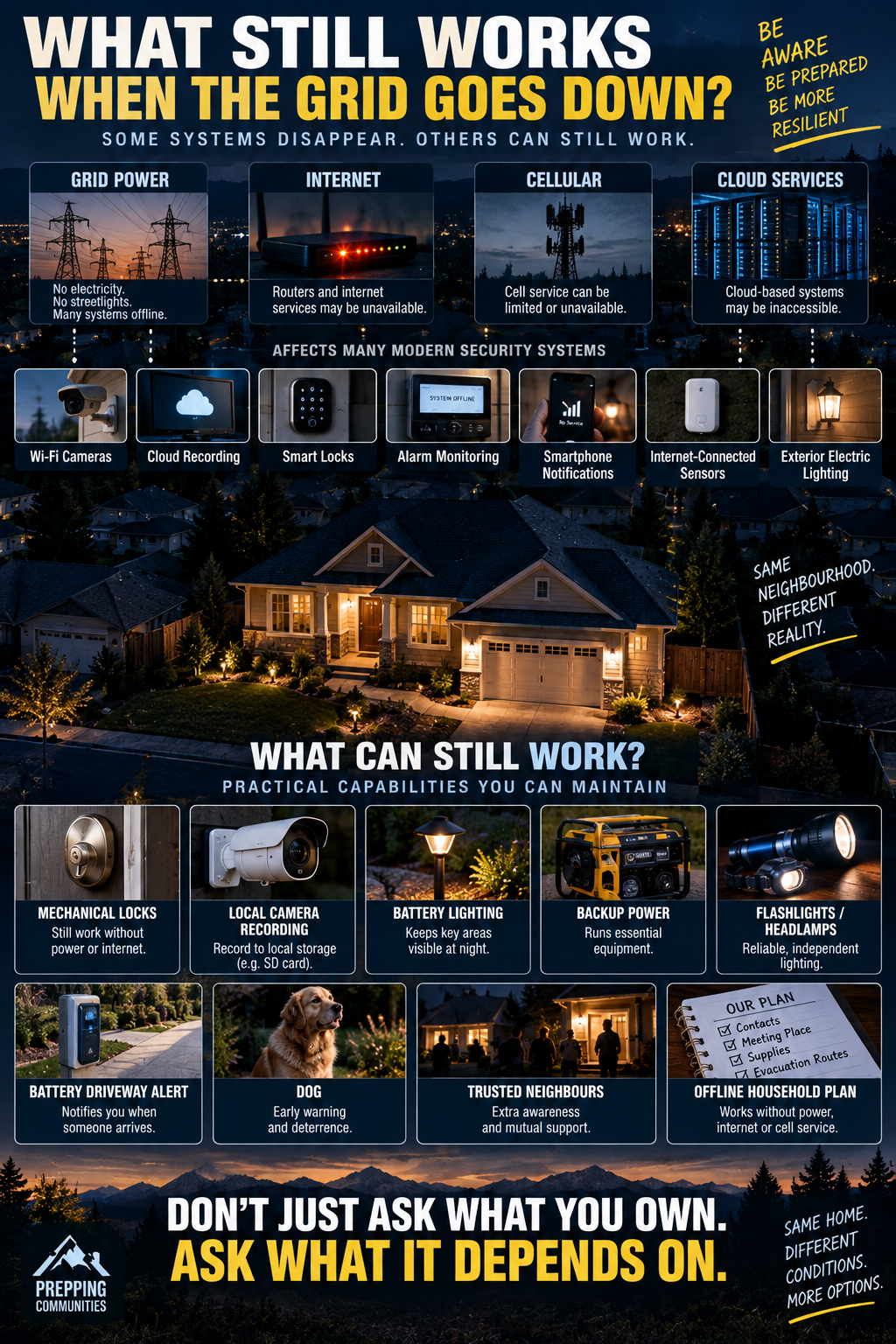
That doesn’t mean technology is a bad idea. Cameras and electronic sensors can give you capabilities that would have been difficult or expensive not that long ago. Just know what sits underneath them.
If you have backup power, test that too. Find out what it actually runs and roughly how long it will do so. A battery backup that lasts twenty minutes solves a different problem from one that can keep essential equipment operating overnight.
Some simple things remain useful precisely because they don’t have many dependencies. Mechanical locks still work. Battery flashlights still work. A dog still hears something outside. A neighbor looking through the window doesn’t need an internet connection.
After you’ve thought through three days without power, stretch the exercise to a week. Maybe fuel is becoming difficult to find and several businesses are still closed. Would you leave the generator where everybody can see it? Would you start checking in with neighbors at a regular time? Would you change where equipment is stored?
There isn’t one correct answer. The useful part is recognizing that the answer can change.
Make the House Harder to Enter Quickly
Eventually all of those outside layers lead to the house.
When looking at exterior doors, don’t concentrate only on the lock. A strong deadbolt attached to a weak frame doesn’t accomplish much. Look at the door, frame, hinges, strike plate and surrounding structure together. Windows deserve the same attention, especially ones that can easily be reached from the ground or aren’t visible to neighbors.
For most houses, trying to make every possible entrance impossible to defeat isn’t realistic. What you can often do is make entry more difficult and slower.
Even a short delay can matter at night. A door that holds for a little longer may give people inside time to wake up, understand what is happening, get children moving, put another locked door between themselves and the problem and call for help.
Access control includes the less interesting things too. Think about how many people may have handled keys to the house over the years. Previous owners, contractors, cleaners, relatives or neighbors may have had one at some point. Garage-door remotes and keypad codes are another form of key. When somebody no longer needs access, changing the code is simple enough.
Lost keys are worth dealing with instead of assuming they’ll never turn up.
Have Somewhere Safer to Go Inside
The exterior door doesn’t have to be the final security layer.
Depending on the layout of your house, there may be a bedroom or another room that can serve as a safer place for everyone to gather during an immediate threat. It doesn’t need to be a purpose-built panic room. A decent door and lock, a way to communicate, a flashlight and basic medical supplies may be enough to make the room useful.
The bigger issue is whether everybody knows the plan.
Imagine the dog starts barking hard at two in the morning and doesn’t stop. Someone hears glass break downstairs. Maybe somebody is repeatedly trying an exterior door.
What happens in your house?
It is worth talking about before it happens. If children are old enough to understand, they should know where they’re expected to go rather than wandering through the house trying to find a parent. Adults should know who is contacting emergency services and what the other person is doing.
Keep it simple enough that people can remember it while half awake.
Try the Plan Once
You can learn quite a bit by actually trying this during the day.
Lie down in bed and pretend you just heard something break downstairs. Go through whatever you think you would normally do.
You may discover that your phone is charging in the kitchen. The flashlight you were sure was beside the bed disappeared three months ago. Maybe an interior door doesn’t lock properly. Perhaps everyone in the family has a completely different idea of where they’re supposed to go.
That’s useful information.
You aren’t rehearsing a battle. You’re finding ordinary little problems before they become problems at the worst possible time.
The same thinking applies to fire and evacuation plans. People don’t need a complicated script for every possible emergency. They need a few simple actions everyone understands.
Scarcity Can Change the Neighborhood
One of the less believable ideas in some collapse scenarios is that normal people suddenly turn into criminals the moment the lights go out. Real life isn’t that simple.
Most people will still be looking after their families and probably helping other people when they can.
What can change is the pressure they’re under.
Fuel becomes difficult to find. Someone can’t refill an important medication. A store runs out of infant formula. Electronic payments aren’t working reliably. People start travelling farther to find ordinary necessities.
Things that didn’t have much value a week earlier can suddenly become worth stealing. A fuel can left outside is an obvious example. Generators, batteries and certain tools may attract more attention as replacements become difficult to find.
This is where privacy and community have to coexist. You probably don’t want everyone knowing exactly what you have stored, but completely isolating yourself from everyone around you isn’t much of a strategy either.
A neighborhood where people know each other and occasionally help solve small problems has something going for it that a collection of isolated households doesn’t.
There is another issue that appears as emergencies drag on: fatigue. Nobody stays alert around the clock. People eventually have to sleep, and after several bad nights everybody’s judgement starts slipping. Having other trusted people nearby who are awake at different times becomes useful without anybody needing to stand guard all night.
There May Be a Point Where You Leave
A home-security plan should include the possibility that the safest thing to do is leave.
Wildfire and flooding make that obvious, but they aren’t the only reasons. Structural damage, hazardous materials or serious disorder nearby could eventually make staying more dangerous than going somewhere else.
Think about where you could realistically go and how you would get there. If the main road is blocked, is there another route? If you needed to leave quickly, where are the vehicle keys? Is there enough fuel in the vehicle to get somewhere useful?
Keeping a vehicle from routinely reaching nearly empty is a small preparedness habit that costs almost nothing beyond buying the same fuel a little earlier.
It is also worth knowing what you would take if you had ten minutes instead of several hours. You don’t need to spend your life expecting an evacuation. Just work it out once while you have time to think.
The goal of home security is protecting the people who live there. If remaining at the house eventually works against that goal, the plan needs another option.
Be Able to Secure Basic Damage
Some security problems have nothing to do with crime.
A storm breaks a window. A tree takes out part of the fence. Wind damages the gate. Something hits a door and it won’t close properly afterward.
During normal times you call someone and get it repaired. During a widespread emergency, the repair company may have a very long list ahead of you.
Look around your own property and think about what you could temporarily secure yourself. A few appropriate tools, fasteners and repair materials may be enough to close an opening or restore a basic boundary until a permanent repair is possible.
It’s not particularly exciting preparedness, but emergencies tend to produce plenty of boring problems.
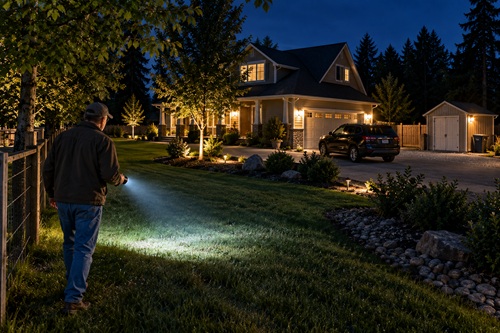
Walk Your Property After Dark
If you do only one thing after reading this, try this one.
Wait until dark and go outside.
Start at the road or the edge of the property and walk toward your house. Don’t use only the normal path. Approach from another direction and look at what changes. Notice dark areas, overgrown landscaping and places where vehicles or buildings block visibility. Look at what can be seen through the windows.
Check the cameras while you’re doing it.
Then go inside, turn off the lights and find the flashlight you expect to use during an outage. Test the driveway alarm. Make sure you know how to operate the garage door manually. Check whatever backup power you have.
Now imagine the electricity has already been off for three days and think about what disappeared from your security.
Then make it a week.
Fuel is getting harder to find. Some stores are still closed. Emergency response is slower than normal. What would you start doing differently?
You aren’t trying to predict exactly how a future crisis will unfold. You’re learning enough about your own home and its weak points that you can make sensible changes if circumstances get worse.
That’s the practical meaning behind see it, slow it, respond and adapt.
Continue Building Your Home Security
If you want to go deeper into the everyday side of home security, also see How to Build a Layered Home Security System on Prepping Communities. It goes further into evaluating your property, doors and windows, cameras, lighting, access control, backup systems and testing the security you already have.
Preparedness Action Plan
Take a notebook when you walk around the property and write down what you actually find. Start outside and work inward. Look at approaches to the house, blind spots, lighting, cameras, property boundaries, doors and windows. Pay attention to equipment and supplies that are more visible than they need to be.
Go through the systems that depend on electricity, internet or cellular service and find out what happens when those services disappear. Test backup batteries instead of assuming they’re good. Learn how to operate doors, locks and other equipment manually where possible.
Talk with everyone who lives in the house about a few basic situations. Decide where people go if there is an immediate threat inside, how you’ll contact help and what the plan is if you need to leave. Keep it simple.
Look outside your own property as well. If you don’t have the phone number of even one neighbor you trust, that’s an easy thing to change.
Don’t try to turn the house into a fortress in one weekend. Start with the weakness that bothers you most after doing the walkthrough and fix that one. Then move on.
Skills Learned
After working through this lesson, you should be able to look at your home differently. You should have a better idea of how someone could approach the property, when you would notice them, what could slow unwanted access and what your household would do if those outside layers failed.
You should also know which parts of your security disappear when electricity or communications do, and which ones keep working. More importantly, you should recognize that the security you need on an ordinary day may not be the same security you need after a week of serious disruption.
If society ever does begin breaking down around you, there probably won’t be one piece of equipment that suddenly protects your family. More likely it will be a collection of fairly ordinary things that were dealt with beforehand: a neighbor who knows what belongs on the road, a camera that actually covers the driveway, a stronger door frame, a flashlight that is where everybody expects it to be, a backup that still works without the internet, and a family that already knows where to go.
Layered security isn’t about making every layer perfect. The real advantage is having enough of them that the failure of one doesn’t leave you with nothing.
© Prepping Communities. This content is for informational purposes only and not professional advice. Use at your own risk.
Terms | Privacy | Guidelines